Preparation is the key to success in any interview. In this post, we’ll explore crucial Trapeze Artistry interview questions and equip you with strategies to craft impactful answers. Whether you’re a beginner or a pro, these tips will elevate your preparation.
Questions Asked in Trapeze Artistry Interview
Q 1. Describe your experience performing catches and throws on a trapeze.
Catches and throws on a trapeze are the heart of dynamic trapeze artistry. It requires a precise blend of timing, strength, and trust. The ‘catcher’ must anticipate the ‘flyer’s’ trajectory, creating a stable and secure catch. This involves judging the flyer’s momentum, adjusting body position for optimal grip, and absorbing the impact of the catch. The ‘throw’ is equally critical, requiring a controlled exertion of strength to launch the flyer safely and accurately to the next apparatus or to the catcher.
For example, in a simple ‘back-to-back’ catch, the flyer swings from the trapeze bar, releasing at the apex of their swing to be caught by the catcher. The catcher will lean back, extend their arms, and create a cradle to receive the flyer’s weight. The timing is crucial; a split-second too early or late can result in a missed catch. Similarly, a ‘throw’ for a high-flying trick would necessitate a powerful upward and outward movement, perfectly timed to send the flyer to their intended destination.
My experience encompasses years of honing these skills, progressing from simple catches to complex maneuvers involving multiple flyers and intricate aerial sequences. This includes countless hours of practice, focusing on building the necessary muscle memory and refining the precision needed for a successful and safe performance.
Q 2. Explain your understanding of various trapeze techniques (e.g., single, double, triple).
Trapeze techniques vary significantly in complexity, ranging from basic single trapeze work to intricate multi-person routines.
- Single Trapeze: This involves a single trapeze bar and is foundational, focusing on swings, drops, and basic tricks. It develops essential skills like body control, timing, and aerial awareness.
- Double Trapeze: This introduces a second trapeze bar, typically used for catches and throws between two performers. It demands enhanced trust, coordination, and precise timing. Many tricks, such as the ‘back-to-back catch’ and variations of the ‘flyaway’ are performed using double trapeze.
- Triple Trapeze: This involves three trapeze bars, often used in larger-scale productions. It dramatically increases the complexity of the routine, demanding more advanced teamwork and highly refined precision.
Beyond these basic categories, there are numerous specialized techniques. For instance, the ‘planche’ is a static handstand position on the bar, while the ‘iron cross’ involves holding a position where the body is stretched horizontally, supporting itself only with the hands gripping the bar.
Q 3. What safety protocols do you adhere to during trapeze practice and performance?
Safety is paramount in trapeze artistry. Our protocols begin with a thorough warm-up and rigorous safety checks before each practice or performance. This includes inspecting the rigging, checking the strength of the apparatus, and ensuring all safety nets and harnesses are properly secured and functioning correctly.
During practice, we use safety nets to mitigate the risk of falls, gradually increasing the height and complexity of tricks as confidence and skill levels improve. Spotters are always present during practice and especially while learning new techniques, providing assistance and guidance, and ensuring a safe landing. During a performance, rigorous spotter placement is also crucial, along with meticulous pre-show checks and backup systems. Clear communication between performers is vital to maintain the safety of the entire team.
Furthermore, we meticulously adhere to all regulations set forth by governing bodies and follow established safety guidelines, prioritizing the well-being of all performers.
Q 4. How do you maintain your physical fitness and strength for trapeze artistry?
Maintaining peak physical fitness is crucial for trapeze artistry. My training regimen is intense and multifaceted, combining strength training, cardiovascular exercises, and flexibility work. Strength training focuses on building upper body strength, core stability, and grip strength. Exercises like pull-ups, dips, and weightlifting are essential for developing the necessary power for throws and catches.
Cardiovascular exercises help improve stamina and endurance, essential for the energy-demanding nature of performances. Flexibility training, including yoga and Pilates, ensures suppleness and prevents injuries. This rigorous regime is supplemented by a healthy diet, prioritizing protein intake for muscle recovery and overall well-being. Regular medical check-ups also play an important role in maintaining overall health and ensuring fitness levels are suitable for the rigors of trapeze artistry.
Q 5. Describe your experience with different types of trapeze apparatus.
My experience encompasses working with various trapeze apparatuses, each with its unique characteristics and challenges.
- Static Trapeze: This is the most common type, fixed at a single point, offering a predictable swing arc.
- Flying Trapeze: This type is designed for dynamic movements, often featuring a longer swing arc. The dynamic nature requires more advanced control and timing.
- Russian Trapeze: This is a static bar suspended from two points, offering different swinging characteristics than a single-point suspension. It is often used for tricks emphasizing strength and control.
- Straps: This is a crucial element across many trapeze techniques. Different strap materials, lengths and attachment points affect the swing characteristics and impact on the performer’s technique.
Understanding the nuances of each apparatus is critical for safe and effective performance. Each one demands a different approach to technique, requiring adaptation and precision in executing tricks.
Q 6. How do you handle unexpected events or mishaps during a trapeze performance?
Handling unexpected events during a performance is a critical skill honed through extensive training and experience. Our preparation includes contingency plans for various scenarios. For example, a missed catch requires immediate improvisation. The flyer must be able to react instantly, and the spotters must be ready to intervene to ensure a safe landing. The catcher should also be prepared to handle unexpected movements and adjust accordingly to minimize the chance of injury.
Communication is vital in these situations. Pre-established signals between performers facilitate immediate responses and coordinated actions during any mishap. The ability to maintain composure under pressure is essential, ensuring a smooth recovery from an unexpected event. Many years of performing under pressure have instilled a natural ability to remain calm and take quick and appropriate actions to ensure the safety of all performers.
Q 7. Explain your understanding of spotting techniques in trapeze.
Spotting techniques are crucial for safety and successful training in trapeze artistry. Spotters are responsible for providing support and guidance to the performer, helping them maintain balance, prevent falls, and ensure a safe landing.
Effective spotting necessitates anticipation of the performer’s movements, knowing where and when to provide assistance without hindering their execution. The spotter’s position and body mechanics are essential; they must be able to provide support without interfering with the performer’s actions. Spotters must be strong, attentive, and have a deep understanding of the specific techniques being practiced. Their positioning will vary depending on the type of trick being performed. For example, in a catch, the spotter would be positioned to catch the flyer if the primary catcher fails. In a swing, the spotter may be needed to steady the swing and prevent the flyer from losing control.
Proper spotting techniques are learned through extensive training and observation, emphasizing both physical strength and keen awareness of the performer’s movements.
Q 8. How do you adapt your performance to different audiences and venues?
Adapting a trapeze performance hinges on understanding the audience and venue’s unique characteristics. For example, a family-friendly show at a circus requires a different approach than a sophisticated performance in a theatre.
- Audience: For younger audiences, I incorporate more playful elements and simpler, visually striking tricks. With older audiences, I might showcase more complex routines with a focus on artistry and athleticism. I gauge audience reaction and adjust the energy and pace accordingly; a quiet, reserved crowd might need a slower, more deliberate build-up to the climax.
- Venue: The size and layout of the venue dictates the scale and type of act. A large circus tent allows for more dynamic movements and grander effects. A smaller stage necessitates a more compact, focused routine. Ceiling height, rigging points, and stage floor conditions directly impact trick selection and safety precautions.
- Example: In a recent outdoor performance at a festival, strong winds forced us to simplify the routine, replacing high-flying sequences with closer-to-the-ground tricks that maintained the aesthetic appeal without compromising safety.
Q 9. Describe your experience collaborating with other performers in a trapeze act.
Collaboration is the cornerstone of successful trapeze acts. Trust and impeccable communication are paramount. My experience working with various partners has taught me the value of synchronized movements, clear signals, and unwavering support.
- Trust: Catching a partner mid-air requires absolute faith in their skills and timing. Building this trust involves extensive rehearsal and open communication about any anxieties or concerns.
- Communication: We establish a system of nonverbal cues – hand signals, eye contact – to ensure flawless synchronization. This is critical in fast-paced, intricate routines.
- Support: Physically supporting a partner involves understanding their weight distribution and maintaining a firm yet gentle grip. The ability to anticipate and adjust to any unforeseen shifts in balance is crucial.
- Example: In one act, I collaborated with a strongman who tossed me high into the air for a catch by my partner. The precise timing of his throw, my body position, and my partner’s catch created a thrilling, visually stunning moment that wouldn’t have been possible without meticulous collaboration and trust.
Q 10. How do you manage performance anxiety?
Performance anxiety is a common experience for trapeze artists. My approach involves a combination of preparation, mindfulness, and positive self-talk.
- Preparation: Thorough rehearsals eliminate many sources of anxiety by building confidence and muscle memory. Knowing the routine inside and out reduces the likelihood of mistakes and increases my sense of control.
- Mindfulness: Before performances, I practice deep breathing exercises and focus on the present moment, rather than dwelling on potential mistakes or negative outcomes. This centers me and helps manage my physical reaction to stress.
- Positive Self-Talk: I actively counter negative thoughts with positive affirmations, reminding myself of my skills and past successes. This helps build self-belief and reduces self-doubt.
- Example: Before a particularly challenging performance, I visualize a successful execution of the routine, focusing on the specific movements and the feeling of accomplishment. This mental rehearsal helps to reduce anxiety and increase my confidence.
Q 11. What is your experience with trapeze choreography and creation?
Trapeze choreography is a blend of artistry, athleticism, and technical skill. Creating a new routine involves considering several factors.
- Concept and Story: I begin by developing a central theme or story that will guide the movement and emotional arc of the piece.
- Music Selection: Music is crucial to conveying mood and creating a cohesive flow. The music dictates the rhythm and pace of the routine.
- Trick Selection: I carefully select tricks based on their aesthetic appeal, difficulty, and suitability for the overall narrative. Safety is always the top priority.
- Sequence and Transition: A well-choreographed routine seamlessly transitions between tricks, creating a visually engaging and exciting flow.
- Rehearsal and Refinement: Numerous rehearsals are essential to perfect the timing, synchronization, and overall effect. Constant refinement ensures a polished and professional performance.
- Example: A recent piece I choreographed explored the theme of metamorphosis, using a series of increasingly difficult tricks to reflect a transformative journey. The music was evocative and gradually intensified as the routine progressed, culminating in a breathtaking final sequence.
Q 12. Explain your knowledge of different trapeze styles (e.g., static, dynamic).
Trapeze styles are broadly categorized as static and dynamic. Understanding these differences is crucial for both performance and safety.
- Static Trapeze: This involves tricks performed on a stationary trapeze bar. It emphasizes strength, balance, and precision. Skills include handstands, muscle-ups, and various poses. The focus is on artistry and control.
- Dynamic Trapeze: This style involves swinging and aerial maneuvers. It demands superior strength, agility, and timing. Skills include catches, drops, swings, and various aerial transitions. The emphasis is on dynamism and momentum.
- Other Styles: There are many variations and specialized styles such as flying trapeze (catching), straps, and silks, each demanding unique skill sets and techniques. Each is defined by its apparatus and the specific techniques involved in their execution.
Q 13. How do you ensure the safety and maintenance of trapeze equipment?
Safety and maintenance of trapeze equipment are paramount. Neglect in this area can lead to serious injury.
- Regular Inspection: Before every performance, I meticulously inspect all equipment, including the bar, ropes, rigging, and safety nets, looking for any signs of wear, tear, or damage. I always ensure the equipment meets safety standards and has appropriate certifications.
- Proper Rigging: Correct rigging is essential for safe performance. I follow established procedures and use the right equipment to ensure the trapeze is securely fastened to a stable structure. I carefully measure and double-check all attachments.
- Maintenance and Repair: Regular maintenance is crucial. This includes replacing worn ropes or bars and checking for fraying, corrosion, or other damage. If any issues are identified, I ensure they are repaired by qualified professionals before further use. I keep detailed records of all inspections and maintenance activities.
- Example: Before every show, I perform a detailed walk-through of all equipment, visually inspecting for any signs of wear or damage. I also check the tension of the ropes and double-check all safety mechanisms.
Q 14. Describe your approach to teaching trapeze to beginners.
Teaching beginners involves a progressive approach that prioritizes safety and builds confidence.
- Foundation Skills: I start by teaching basic climbing, grip techniques, and safe dismounts. This builds a solid foundation of body awareness and control.
- Gradual Progression: New skills are introduced gradually, ensuring students master each step before moving on. This avoids frustration and prevents bad habits.
- Emphasis on Safety: Safety is paramount. I teach proper spotting techniques and stress the importance of following safety protocols. Students learn to use safety equipment correctly and never perform beyond their capabilities.
- Positive Reinforcement: I focus on positive reinforcement and celebrate small successes. This helps build confidence and motivates students to keep learning and improving.
- Example: I begin by having students practice basic climbs and dismounts with the support of a spotter. Once they are comfortable, we move on to simple swings and controlled movements, gradually introducing more advanced techniques.
Q 15. How do you assess a student’s skill level and progress in trapeze?
Assessing a student’s skill in trapeze involves a multifaceted approach, going beyond just the tricks they can perform. I consider several key aspects:
- Basic Strength and Conditioning: I evaluate their core strength, grip strength, upper body strength, and overall flexibility. These are foundational elements for safe and efficient trapeze work. For example, a student struggling with basic body holds might need more time on conditioning exercises before progressing to more complex maneuvers.
- Body Awareness and Control: I observe their posture, balance, and ability to control their body during various exercises. A lack of body awareness can lead to falls and injuries. I might have them perform simple swings and static holds to assess this.
- Technique: Correct technique is paramount for safety and efficiency. I carefully analyze their grip, posture, and timing during each movement, providing feedback and corrections as needed. For instance, a poor release technique in a catch can easily lead to an accident.
- Progress Tracking: I maintain a detailed log of each student’s progress, noting their achievements, challenges, and any necessary modifications to their training plan. This allows me to tailor the training to their individual needs and pace. I might use a simple chart showing the progression from basic swings to more advanced tricks.
Ultimately, my assessment is holistic, combining objective measures of strength and technique with subjective observations of progress and overall understanding.
Career Expert Tips:
- Ace those interviews! Prepare effectively by reviewing the Top 50 Most Common Interview Questions on ResumeGemini.
- Navigate your job search with confidence! Explore a wide range of Career Tips on ResumeGemini. Learn about common challenges and recommendations to overcome them.
- Craft the perfect resume! Master the Art of Resume Writing with ResumeGemini’s guide. Showcase your unique qualifications and achievements effectively.
- Don’t miss out on holiday savings! Build your dream resume with ResumeGemini’s ATS optimized templates.
Q 16. What is your experience with designing and implementing trapeze training programs?
My experience in designing and implementing trapeze training programs spans over 15 years, working with students ranging from complete beginners to advanced performers. I approach program design using a structured, progressive methodology:
- Needs Assessment: I begin by assessing each student’s individual strengths, weaknesses, goals, and physical limitations. This informs the program’s structure and pace.
- Progressive Skill Development: I build programs around a progressive skill development model, starting with fundamental movements and gradually introducing more complex skills. This builds confidence and ensures a safe progression.
- Specificity and Variation: I incorporate exercises that target specific muscles groups and improve overall fitness while also incorporating a variety of drills to prevent boredom and promote holistic development. This might include strength training, flexibility exercises, and even plyometrics.
- Safety Protocols: Safety is paramount. Every program includes detailed safety procedures and emergency protocols. Proper spotting techniques are rigorously practiced.
- Regular Evaluation and Adjustment: I regularly evaluate the program’s effectiveness and adjust it based on the student’s progress and feedback.
For example, a beginner’s program might focus on building core strength and mastering basic swings and holds, while an advanced program could incorporate complex catches, transitions, and dynamic movements.
Q 17. How do you deal with injuries or setbacks in trapeze training?
Injuries and setbacks are an unfortunate reality in trapeze, but managing them effectively is crucial. My approach is multi-pronged:
- Immediate Response: I prioritize immediate first aid and assessment in case of an injury. This includes contacting emergency services if necessary.
- Medical Evaluation: I always recommend seeking medical attention for any significant injury. A doctor’s diagnosis and treatment plan are essential.
- Gradual Return to Training: Once cleared by a doctor, I work with the student on a gradual return to training. This might involve modified exercises or reduced intensity to prevent re-injury.
- Mental Support: Injuries can be discouraging. I provide mental support and encourage the student to focus on rehabilitation and recovery.
- Addressing Underlying Causes: If the injury was due to a technique flaw, I work with the student to refine their technique to prevent recurrence.
For example, a student with a wrist sprain might start with light exercises to improve range of motion and then slowly reintroduce swinging movements with modified grips.
Q 18. Describe your experience with creating and performing trapeze sequences.
My experience in creating and performing trapeze sequences is extensive. I approach sequence creation as a form of choreography, blending athleticism with artistic expression.
- Conceptualization: I begin with a concept or theme, which might be inspired by music, a story, or a particular mood. I sketch out potential movements and transitions.
- Skill Integration: I carefully select the appropriate skills and movements based on the performers’ capabilities and the overall sequence’s difficulty.
- Flow and Transitions: I emphasize smooth transitions between movements to create a visually appealing and dynamic performance. This involves careful consideration of momentum and body positioning.
- Rehearsal and Refinement: Extensive rehearsal is essential to refine the sequence, ensure safety, and achieve synchronization if working with a partner.
- Musicality: If the performance is set to music, I carefully synchronize the movements to the rhythm and tempo.
One memorable sequence involved a triple-catch followed by a series of rapid transitions between the trapeze bars culminating in a graceful dismount. This sequence required extensive practice and a high level of coordination.
Q 19. What is your understanding of the physics involved in trapeze movements?
Understanding the physics of trapeze is crucial for safe and effective performance. Key principles include:
- Newton’s Laws of Motion: These laws govern the movement of the body and the trapeze. Understanding inertia, momentum, and force is critical for controlling swings and transitions.
- Conservation of Energy: Efficient use of energy is essential. Proper technique minimizes energy loss during the swing, maximizing height and distance.
- Center of Gravity: The body’s center of gravity plays a key role in balance and stability. Controlling the center of gravity is essential for maintaining balance during various movements.
- Angular Momentum: This concept is important for understanding rotations and spins on the trapeze. Changing body position affects angular momentum and rotation speed.
For instance, understanding angular momentum allows a performer to control the speed and direction of a spin by adjusting their body posture. Ignoring these principles can result in uncontrolled movements and potential injury.
Q 20. Explain your experience working with different types of rigging.
My experience with different types of rigging is broad, ranging from simple single-point rigs to complex multi-point systems used in professional performances. Factors to consider when working with different rigging systems include:
- Rigging Material: I have worked with various materials, including steel cables, ropes, and chains. Each material has different strengths, weaknesses, and safety requirements.
- Rigging Configuration: I am familiar with various rigging configurations, including single-point, double-point, and flying rigs. Each configuration requires different calculations and safety procedures.
- Safety Inspections: Before each use, rigorous inspections are mandatory to check for wear and tear, damage, and proper functionality. I ensure all safety measures are in place and follow all safety protocols.
- Weight Capacity: Careful calculations are essential to ensure the rigging system can safely support the performer’s weight and any added equipment.
For instance, a high-flying act necessitates a more robust and sophisticated rigging system than a basic static trapeze setup. The understanding of load bearing, tension, and knot tying is paramount.
Q 21. How do you ensure the safety of your audience during a trapeze performance?
Ensuring audience safety during a trapeze performance is my top priority. Several measures are implemented:
- Proper Rigging and Inspection: Rigorous inspection and maintenance of all rigging equipment before, during, and after the performance is conducted by qualified personnel.
- Designated Performance Area: A clearly defined and safe performance area is established, keeping the audience a safe distance from the apparatus.
- Emergency Protocols: Emergency plans and procedures are in place in case of an accident, including trained personnel to respond quickly and efficiently.
- Safety Netting: Depending on the type of performance and the level of risk involved, safety netting might be used as an additional safety measure. The netting’s integrity is rigorously inspected.
- Crowd Control: Clear instructions and guidelines are provided to audience members to ensure their safety and prevent any accidental interference with the performance.
A successful performance is one where not only the performers excel but also audience members leave feeling entertained and safe. Safety is not just a precaution; it is the foundation upon which all successful performances are built.
Q 22. What is your experience with developing a trapeze show or act?
Developing a trapeze show is a multifaceted process requiring meticulous planning and execution. It begins with conceptualization, where we brainstorm the theme, narrative, and overall aesthetic. This might involve choosing a specific style, like classic elegance or a modern, edgy approach. Then comes the choreography, a crucial step involving designing sequences of impressive aerial maneuvers, ensuring safety and visual appeal. We consider factors like transitions between acts, the flow of the narrative, and the emotional impact of each segment. Next is the selection of music, which dramatically influences the overall mood and audience response. Finally, it’s all about selecting the right team of trapeze artists, each possessing unique skills to complement the show’s vision. For example, in one show I developed, the theme was ‘Celestial Dance,’ and we incorporated intricate partner work, impressive catches, and stunning drops all set to ethereal music. The resulting act was not just a collection of acrobatic feats but a storytelling experience.
Q 23. How do you manage your time and workload effectively as a trapeze artist?
Time management for a trapeze artist is crucial because we balance intensive physical training, rehearsals, performances, and self-care. My strategy involves creating detailed weekly schedules that allocate specific time slots for each activity. This includes rigorous strength and conditioning workouts, technique refinement sessions, rehearsal time with my team, and sufficient rest to prevent injury. I utilize time-blocking techniques, breaking down larger tasks into smaller, manageable chunks. For instance, instead of just ‘rehearse the triple somersault,’ I’ll break it down into warm-up, practicing individual components, refining the transition, and full run-throughs. Prioritization is key; understanding what needs immediate attention versus tasks that can be scheduled later prevents feeling overwhelmed. Utilizing technology like scheduling apps and to-do lists also helps maintain organization and track my progress effectively. Finally, I make sure to prioritize sleep and nutrition which are crucial for maintaining peak physical condition.
Q 24. What are your career aspirations in the field of trapeze artistry?
My career aspirations extend beyond simply performing. I aim to become a renowned choreographer and creative director for trapeze shows, crafting unique and captivating experiences for audiences worldwide. This includes developing innovative and visually stunning acts that push the boundaries of trapeze artistry. I envision creating my own trapeze company, fostering a collaborative environment where talented artists can thrive and develop their potential. Furthermore, I’m passionate about using my skills to mentor and train the next generation of trapeze artists, passing on my expertise and experience. Ultimately, my goal is to leave a lasting mark on the world of trapeze artistry, not only through my performance but through my contribution to its evolution and growth.
Q 25. Describe your experience with public speaking and interacting with audiences.
I’ve always enjoyed interacting with audiences. Before each performance, I connect with the crowd, creating a palpable sense of anticipation and excitement. I’ve found that sharing stories about my journey and the artistry behind the trapeze helps create a deeper connection. After performances, I often engage with spectators, answering questions and appreciating their feedback. For example, I often share anecdotes about the challenges and rewards of mastering certain skills, making the feats relatable. I believe a performer is more than just an athlete; we’re storytellers, and connecting with the audience on a human level enhances the whole experience. In larger venues, I might work with the emcee to create engaging introductions that set the stage for the performance.
Q 26. What are your strengths and weaknesses as a trapeze artist?
My strengths lie in my exceptional strength, flexibility, and aerial awareness. I possess a strong sense of rhythm and timing, crucial for executing complex routines flawlessly. I’m also a highly dedicated and disciplined performer, constantly striving for improvement. However, I also acknowledge my weaknesses. Sometimes I can be overly critical of myself, which can lead to unnecessary pressure. I’m working on cultivating a more balanced and compassionate approach to self-evaluation. Another area I’m focusing on is improving my public speaking skills for interviews and pre-show interactions. Understanding and addressing my weaknesses allows me to strategize and refine my approach for continual growth.
Q 27. How do you handle constructive criticism and feedback on your performance?
Constructive criticism is invaluable to my growth as an artist. I actively seek feedback from trusted colleagues, coaches, and even audience members. I approach criticism with an open mind, focusing on understanding the specific points being raised. I don’t take it personally but view it as an opportunity to learn and improve my technique, presentation, or even the overall act. For instance, if feedback suggests I could improve the fluidity of a particular transition, I’ll analyze the sequence, practice the specific elements, and incorporate any suggested adjustments. Ultimately, the goal is to transform feedback into actionable steps to enhance my performance and reach my full potential.
Q 28. Describe your experience with marketing and promoting trapeze performances.
Marketing and promoting trapeze performances require a multifaceted approach. I leverage social media platforms like Instagram and Facebook to share captivating videos and behind-the-scenes content, building a following and showcasing my skills. Collaborating with event organizers and promoters is essential, ensuring my act reaches the appropriate audiences. I’ve found that creating high-quality promotional materials, including visually stunning posters and flyers, is also very effective. Building relationships with local media outlets through press releases and interviews increases visibility. In addition, I am exploring the use of targeted advertising on social media to reach a wider audience. The key is to create a compelling narrative that goes beyond just showcasing acrobatic skills and creates a genuine sense of wonder and anticipation in the audience.
Key Topics to Learn for Trapeze Artistry Interview
- Fundamentals of Aerial Arts: Understanding basic aerial techniques, safety protocols, and equipment knowledge is crucial. This includes understanding different trapeze types and their unique challenges.
- Strength and Conditioning: Discuss your understanding of the physical demands of trapeze artistry and how you maintain strength, flexibility, and endurance. Be prepared to explain your training regimen and its relevance to performance.
- Partnering and Teamwork: Trapeze artistry often involves collaboration. Highlight your experience working effectively in a team environment, emphasizing communication and trust-building skills.
- Choreography and Performance: Demonstrate your understanding of creating and executing routines, incorporating elements of artistry and storytelling. This might include discussing your experience with different performance styles.
- Risk Assessment and Safety Procedures: Discuss your approach to risk management in aerial work, encompassing pre-performance checks, spotting techniques, and emergency protocols.
- Improvisation and Adaptability: Be ready to discuss your ability to adapt to unexpected situations during a performance or rehearsal and how you maintain composure under pressure.
- Showmanship and Audience Engagement: Articulate your understanding of connecting with an audience and creating an engaging performance experience.
Next Steps
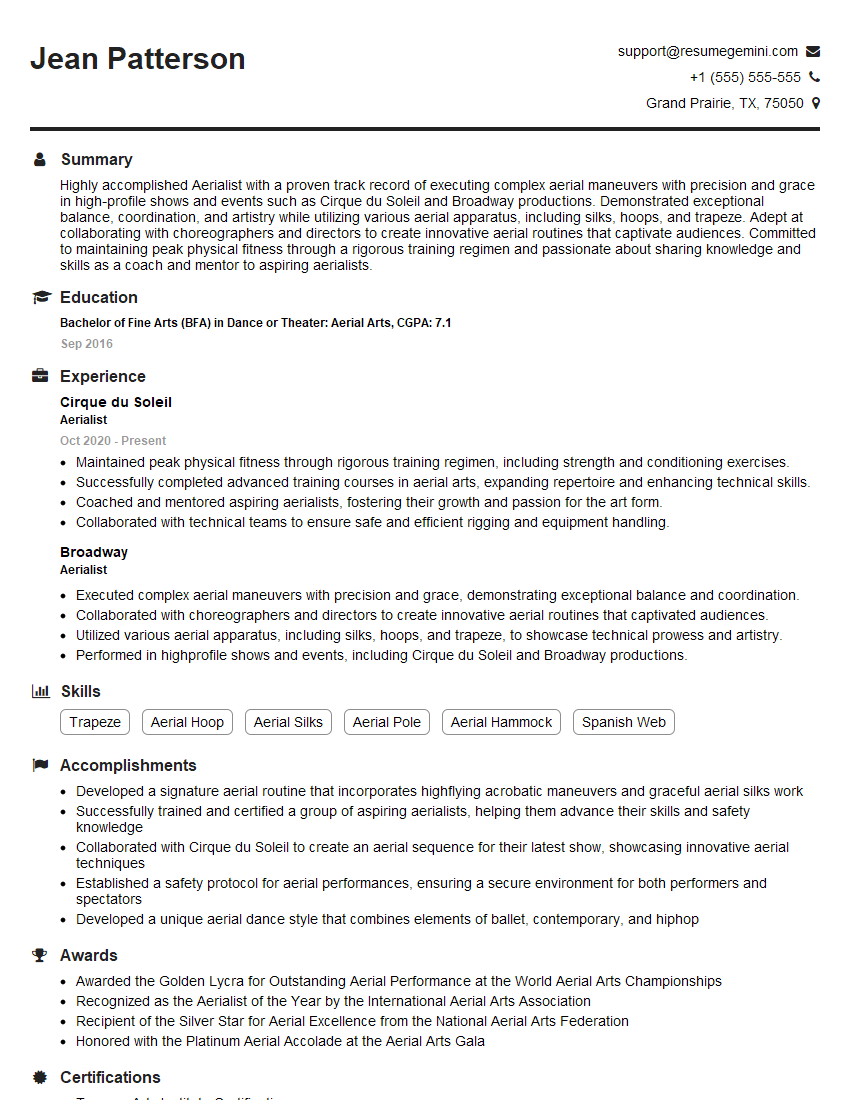
Mastering trapeze artistry opens doors to exciting career opportunities in entertainment, performance, and related fields. To maximize your job prospects, it’s essential to create a compelling and ATS-friendly resume that highlights your unique skills and experience. We strongly encourage you to use ResumeGemini, a trusted resource for building professional resumes, to craft a document that effectively showcases your qualifications. Examples of resumes tailored to the specific demands of Trapeze Artistry are available to help guide you.
Explore more articles
Users Rating of Our Blogs
Share Your Experience
We value your feedback! Please rate our content and share your thoughts (optional).
What Readers Say About Our Blog
Very informative content, great job.
good