Are you ready to stand out in your next interview? Understanding and preparing for Tree Climbing and Safety Techniques interview questions is a game-changer. In this blog, we’ve compiled key questions and expert advice to help you showcase your skills with confidence and precision. Let’s get started on your journey to acing the interview.
Questions Asked in Tree Climbing and Safety Techniques Interview
Q 1. Describe your experience with different climbing techniques (e.g., SRT, DRT).
My experience encompasses both Single Rope Technique (SRT) and Double Rope Technique (DRT), each with its strengths. SRT, using a single rope for ascent and descent, is efficient for accessing specific points in a tree, ideal for pruning or inspections. I’m proficient in various SRT techniques, including using ascenders and descenders like the Petzl Ascender and Micro Traxion for controlled movement. DRT, employing two ropes, offers increased redundancy and safety, particularly crucial in complex situations or when working with larger loads. I frequently utilize DRT for rigging and larger-scale tree work, where the added security is invaluable. I’ve successfully implemented both techniques in numerous projects, ranging from delicate pruning in residential settings to extensive removals in challenging environments.
- SRT Example: Efficiently accessing a specific branch for pruning using a Petzl Ascender and a friction hitch.
- DRT Example: Rigging a large, complex removal using two ropes and a series of pulleys for controlled lowering of sections.
Q 2. Explain the importance of pre-climb inspections.
Pre-climb inspections are paramount; they’re the cornerstone of safe tree climbing. A thorough inspection identifies potential hazards and allows for informed decision-making. This involves assessing the tree’s overall health, identifying decay, assessing the structural integrity of the branches, checking for deadwood, evaluating the surrounding environment (power lines, obstacles), and confirming the stability of the ground. Imagine trying to climb a house without checking the foundation – it’s equally reckless to climb a tree without a thorough inspection. I always start with a visual assessment from a distance, followed by a closer examination, including a detailed inspection of the access points and the area where I intend to work. This systematic approach minimizes risks and ensures a successful and safe climb.
Q 3. What are the different types of ropes used in tree climbing, and their applications?
The choice of rope depends heavily on the specific task. We primarily use dynamic ropes for climbing and static ropes for rigging. Dynamic ropes, with their elasticity, absorb shock loads during falls, crucial for climber safety. Static ropes, with minimal stretch, are ideal for rigging systems because they maintain consistent tension. We also utilize kernmantle ropes, featuring a core (kern) and a protective sheath (mantle), for their durability and strength. The diameter also varies depending on the application; thinner ropes are used for SRT, while thicker ropes are common in DRT for greater strength and safety margin. Different rope materials, such as nylon and polyester, also affect their properties, with nylon being more elastic and polyester more resistant to abrasion.
- Dynamic Rope: Used for climbing and offers shock absorption in the event of a fall.
- Static Rope: Used for rigging systems and requires minimal stretch for consistent tension.
- Kernmantle Rope: A common type offering durability and strength.
Q 4. How do you assess tree risk and potential hazards before climbing?
Assessing tree risk involves a multi-faceted approach. I begin with a visual inspection of the tree, looking for signs of decay, disease, structural weakness, or damage. I carefully examine the canopy, trunk, and root system. Then, I consider the surrounding environment: are there power lines, obstacles, or unstable ground? I evaluate the potential impact of weather conditions, such as strong winds or rain. This comprehensive assessment, combined with my experience and knowledge of arboriculture, allows me to identify potential hazards and implement appropriate safety measures. I might use tools like a Resistograph to assess internal wood decay if needed. For complex situations, I may even consult with other arborists to get a second opinion.
Q 5. What are your preferred methods for securing yourself and your equipment?
Securing myself and my equipment is always my top priority. I use a combination of techniques, including a climbing harness, properly anchored ropes, and redundant safety systems. This typically involves attaching two independent anchor points to the tree, ensuring that if one fails, the other provides backup. I always double-check my knots and equipment before each climb. My preferred method utilizes a chest harness, a seat harness, and independent climbing and safety lines, ensuring maximum safety in case of a fall. I never rely on a single point of attachment, and I regularly check and re-check my gear throughout the climb.
Q 6. Describe your experience with different types of climbing gear (e.g., ascenders, descenders).
My experience with climbing gear is extensive. I’m comfortable using a wide variety of ascenders (e.g., Petzl Ascender, CMC ascender), descenders (e.g., Petzl Micro Traxion, ATC), carabiners, pulleys, and other rigging equipment. The selection depends on the specific task. For example, the Petzl Ascender is excellent for efficient ascent in SRT, while the Micro Traxion provides more versatile controlled descent. I regularly inspect all my equipment for wear and tear and ensure that it is properly maintained and meets safety standards. I’m familiar with the limitations of each piece of gear and understand how to use it effectively and safely within its parameters. I regularly attend refresher courses and training to stay updated with the latest techniques and safety advancements.
Q 7. How do you handle unexpected situations while climbing (e.g., equipment failure)?
Handling unexpected situations demands quick thinking and proficiency in emergency procedures. If equipment fails, my training kicks in immediately. I have backup systems in place—redundant anchor points and extra equipment—designed precisely for these scenarios. My immediate reaction would be to assess the situation, establish a safe position, and implement the appropriate rescue procedures. This might involve using my backup equipment, calling for assistance, or utilizing self-rescue techniques depending on the severity of the situation. Regular practice of emergency drills and scenarios is critical, so muscle memory takes over during stressful situations. Thorough planning and preparation before the climb is the best way to mitigate unforeseen events.
Q 8. Explain the importance of proper knot tying and its impact on safety.
Proper knot tying is the bedrock of tree climbing safety. A poorly tied knot can lead to catastrophic equipment failure, resulting in serious injury or death. It’s not just about knowing *which* knots to use, but also understanding the principles behind them – how they hold under load, how they react to different materials, and how they can be affected by weather conditions.
- Importance of Redundancy: We almost never rely on a single knot. Think of it like a safety net. We often use a combination of knots to create a system of backups. For instance, a clove hitch might secure the rope to a branch, but we’d back it up with a figure-eight knot to prevent slippage.
- Choosing the Right Knot: The knot selection depends on the specific task and conditions. A bowline is excellent for creating a loop that won’t tighten under load, perfect for attaching a climbing line to a harness, while a prusik knot allows for controlled movement up and down a rope.
- Understanding Knot Strength: Each knot reduces the rope’s strength by a certain percentage. We choose knots that minimize this reduction while maintaining security. Practicing proper knot tying technique ensures that the knot is tied correctly to reduce the strength loss.
For example, I once witnessed a climber’s knot fail because it wasn’t properly cinched. The consequences were fortunately minor, but it served as a sharp reminder of the critical nature of attention to detail in knot tying.
Q 9. What are your preferred methods for pruning trees?
My preferred pruning methods focus on minimizing damage to the tree and ensuring safety. This involves a combination of techniques, tailored to the specific tree and its condition. We generally avoid topping (removing the top of the tree) as it can severely weaken the tree and invite disease.
- Crown Cleaning: Removing dead, diseased, or crossing branches to improve the tree’s structure and health.
- Thinning: Reducing branch density to improve light penetration and air circulation within the crown.
- Raising the Crown: Removing lower branches to increase clearance.
- Reduction Cuts: Reducing the length of larger branches in a way that promotes proper healing. This is a multi-step process to avoid tearing the bark.
The tools I use depend on the size and location of the branches. This ranges from hand saws and loppers for smaller branches to climbing saws and ropes for larger ones. Safety is always paramount, employing appropriate Personal Protective Equipment (PPE) and using proper techniques to prevent dropped limbs from causing harm.
Q 10. How do you ensure the safety of yourself and others on the ground during a climb?
Ensuring the safety of myself and ground crew is non-negotiable. This involves a multi-layered approach incorporating thorough planning, clear communication, and the use of specialized equipment.
- Pre-Climb Assessment: I carefully inspect the tree and surrounding area, identifying potential hazards. This includes assessing the stability of the tree, the presence of power lines, and identifying safe anchor points.
- Designated Ground Crew: A competent ground crew is essential. Their responsibilities include managing the ropes, providing tools, and acting as a spotter, monitoring my position and alerting me to any hazards. We establish clear hand signals before the climb.
- Equipment and Techniques: I use a climbing harness, ropes, and other specialized equipment. I use a friction hitch (like a prusik) which allows for controlled descent. A safety line is always secured to a robust anchor point, ensuring a redundant safety measure.
- Clear Communication: Continuous communication with the ground crew is vital. We use established hand signals and verbal cues to avoid miscommunication.
For instance, before any pruning, I ensure that the ground crew has established a safe zone free of obstructions and people. Their understanding of my actions allows for better coordination and avoidance of accidents.
Q 11. What are the signs of a diseased or unhealthy tree?
Identifying a diseased or unhealthy tree requires careful observation of several factors.
- Dead Branches: The presence of numerous dead or dying branches is a strong indicator. These are often brittle and easily break.
- Fungal Growth: Unusual fungal growth on the bark or at the base of the tree can signify decay or disease.
- Bark Changes: Discoloration, peeling, or unusual texture changes in the bark can signal internal problems.
- Leaning or Structural Issues: An unusually leaning tree or evidence of significant cracks or cavities in the trunk could suggest instability.
- Foliage Changes: Unusually sparse foliage, leaf discoloration, or wilting can suggest stress or disease.
It’s crucial to note that some signs might be subtle. A professional arborist can perform a more in-depth assessment, potentially using tools to check for internal decay.
Q 12. Describe your knowledge of relevant safety regulations and standards (e.g., ANSI Z133).
I am well-versed in ANSI Z133, the American National Standard for Safety in Tree Care. This standard provides comprehensive guidelines for safe tree care practices, covering everything from personal protective equipment (PPE) to risk assessment and emergency procedures. I’m also familiar with OSHA standards and any relevant local regulations.
- PPE: I always use a harness, helmet, gloves, and eye protection. The appropriate PPE is adjusted based on the specific job.
- Risk Assessment: A thorough risk assessment is critical before each job. This involves identifying potential hazards and implementing strategies to mitigate them.
- Emergency Procedures: I have a clear understanding of emergency procedures, including rescue techniques and communication protocols.
Compliance with these standards is not just a matter of regulations; it’s about protecting lives and ensuring the long-term health of trees. Negligence can have severe consequences.
Q 13. How do you communicate effectively with your team during a climb?
Effective communication is paramount during a climb. Miscommunication can lead to serious accidents. I utilize a combination of methods to ensure clarity.
- Pre-Climb Briefing: Before starting a climb, I hold a briefing with the ground crew. We review the plan, assign roles, and agree on communication methods (hand signals, verbal cues).
- Hand Signals: We use established hand signals for clear and concise communication during the climb. These signals are practiced and understood by all members of the team.
- Verbal Communication: Verbal communication is used for more complex instructions or situations where hand signals might be unclear.
- Radio Communication: In certain situations, particularly when working with large teams or in noisy environments, two-way radios are employed for reliable communication.
For instance, a simple hand signal indicating “secure” or “take up the slack” can prevent mishaps. This establishes a reliable system that prevents misinterpretations and ensures safety.
Q 14. What are your experience and skills with aerial rescue techniques?
I possess extensive experience and training in aerial rescue techniques. This is a critical skill for tree climbers, as accidents can occur. My training includes both self-rescue and rescuing others.
- Self-Rescue Techniques: I am proficient in various self-rescue techniques using my equipment, such as prusik knots and mechanical ascenders, to regain a safe position if I encounter a problem.
- Partner Rescue Techniques: I am trained in rescuing a fellow climber who is injured or incapacitated. These techniques often involve specialized equipment and ropes.
- Emergency Procedures: I understand the emergency response procedures, including contacting emergency services and coordinating rescue efforts with external agencies if necessary.
Having regularly practiced these techniques instills confidence and preparedness to respond effectively in emergency situations, ensuring the safety of myself and my team.
Q 15. Describe your approach to working at heights.
My approach to working at heights is fundamentally based on a proactive risk management strategy. It’s not just about climbing; it’s about planning, preparation, and execution. Before I even consider ascending, I conduct a thorough site assessment. This includes identifying potential hazards like dead branches, power lines, unstable ground, and weather conditions. I then develop a detailed plan, selecting the appropriate climbing techniques and safety equipment based on the tree’s characteristics and the task at hand. This detailed planning minimizes risks and increases efficiency.
The key elements are:
- Pre-climb assessment: Thorough inspection of the tree and surrounding environment.
- Equipment selection: Choosing appropriate ropes, harnesses, ascenders, and other safety gear.
- Plan development: Mapping out the climbing route, identifying anchor points, and outlining emergency procedures.
- Communication: Maintaining clear communication with ground crew or assistants.
- Continuous monitoring: Constantly assessing the tree’s condition and my own safety during the climb.
For example, if I’m working on a large oak tree near a power line, my assessment would focus heavily on the line’s proximity, the tree’s health, and the wind conditions. My plan would involve using specialized climbing techniques to maintain a safe distance from the power line and ensuring I have backup escape routes in case of unforeseen circumstances.
Career Expert Tips:
- Ace those interviews! Prepare effectively by reviewing the Top 50 Most Common Interview Questions on ResumeGemini.
- Navigate your job search with confidence! Explore a wide range of Career Tips on ResumeGemini. Learn about common challenges and recommendations to overcome them.
- Craft the perfect resume! Master the Art of Resume Writing with ResumeGemini’s guide. Showcase your unique qualifications and achievements effectively.
- Don’t miss out on holiday savings! Build your dream resume with ResumeGemini’s ATS optimized templates.
Q 16. What is your understanding of fall protection systems?
Fall protection systems are paramount in tree climbing. They’re designed to arrest a fall and prevent serious injury or death. A complete system typically includes a harness, an anchor point, and a connecting device like a rope or lanyard. The anchor point is crucial – it needs to be strong enough to withstand a significant impact force. There are various types of anchors, from purpose-built climbing systems to strategically placed tree limbs (only with a very careful assessment and understanding of the tree’s mechanics).
Understanding how these systems interact is key. For instance, a poorly placed anchor or a malfunctioning device can render the entire system ineffective. I’m proficient with various systems, including:
- Doubled ropes: Providing redundancy and increased safety.
- Single rope techniques (SRT): Efficient for ascents and descents.
- Anchoring systems: Utilizing different types of anchors like prusik knots, mechanical ascenders, and climbing hardware.
Regular inspection and maintenance are essential. I meticulously check every piece of equipment before each climb for any signs of wear or damage.
Q 17. How do you select appropriate personal protective equipment (PPE)?
Selecting appropriate PPE is non-negotiable. The right equipment can be the difference between a safe climb and a serious accident. My selection process considers several factors:
- Task-specific needs: Different tasks require different gear. Pruning requires specialized hand tools and possibly a chainsaw harness. Inspection might only require a helmet and harness.
- Tree characteristics: The type of tree, its size, and its condition influence the equipment choice. A tall, slender tree might call for different techniques and equipment than a short, thick one.
- Weather conditions: Rain, wind, and extreme temperatures can significantly impact both safety and equipment selection. Wet conditions, for example, often demand extra caution and potentially waterproof gear.
- Personal fit and comfort: Ill-fitting equipment can compromise safety and lead to fatigue. I always make sure my PPE fits comfortably and correctly.
For example, when working with a chainsaw at height, I’ll use a chainsaw specific harness with a chaps, helmet with visor, and cut-resistant gloves. This contrasts sharply with a visual inspection where a basic harness, helmet, and climbing gloves might suffice.
Q 18. Explain your experience using various rigging techniques.
My rigging experience is extensive and covers various techniques adapted to different scenarios. I’m skilled in both traditional and modern methods, emphasizing safety and efficiency. This includes:
- Traditional climbing techniques: Using ropes and ascenders to ascend and descend trees.
- SRT (Single Rope Technique): Utilizing a single rope for both ascending and descending, offering efficiency in certain situations.
- Double rope technique (DRT): Using two ropes for increased safety and redundancy.
- Friction hitches: Utilizing knots and devices to create secure and adjustable anchor points.
- Mechanical ascenders: Employing devices to aid in ascending and descending ropes efficiently and safely.
One example of a complex rigging situation might involve creating a three-point anchor system on a large, leaning tree for supporting a work platform. This would require careful planning and selection of appropriate anchor points, ropes, and connecting hardware to ensure the safety of both the platform and the climber.
Q 19. How do you manage equipment maintenance and inspection?
Equipment maintenance and inspection are critical for safety. I follow a rigorous schedule to ensure all my gear is in top condition. This involves:
- Regular inspections: Before every climb, I thoroughly inspect all my equipment, including ropes, harnesses, ascenders, carabiners, and other hardware. This involves looking for signs of wear, tear, abrasion, or any other damage.
- Detailed documentation: I maintain a detailed log of all inspections, noting any issues or repairs. This record helps me track the condition of each piece of equipment over time and predict potential future problems.
- Scheduled maintenance: I follow the manufacturer’s recommendations for maintenance and replacement intervals for all gear. This often involves professional servicing of ropes and complex mechanical components.
- Retirement of damaged equipment: Any damaged or worn-out equipment is immediately retired from service and replaced. Safety is paramount, and I would never compromise on that.
A simple example is regularly checking for fraying on ropes, which can be a critical safety issue. I also regularly check the stitching and webbing on my harness for any signs of wear. Damaged equipment is immediately taken out of service, regardless of the cost of replacement. This commitment ensures the highest levels of safety throughout all of my operations.
Q 20. Describe your experience with different tree species and their specific climbing challenges.
Different tree species present unique climbing challenges. Understanding their characteristics is crucial for safe and efficient climbing. For example:
- Softwoods (e.g., pines, firs): Often have relatively brittle branches and can be susceptible to breakage, requiring careful branch selection for anchoring and movement.
- Hardwoods (e.g., oaks, maples): Generally stronger and more durable, but can have complex branching patterns and denser wood, sometimes making anchoring more challenging.
- Decaying trees: Present the most significant challenges due to unpredictable structural integrity. They require meticulous assessment to identify potential weak points before any climbing activities are initiated.
I adapt my climbing techniques based on the species. For example, when working on a decaying tree, I might use smaller diameter ropes or a different climbing style to minimize stress on the potentially weak branches. With pines, I prioritize selecting strong, live branches with good growth as anchor points. The knowledge of the tree’s anatomy and its vulnerabilities enables a risk-assessed and well-executed job.
Q 21. How do you adapt your climbing techniques to different weather conditions?
Weather conditions significantly impact tree climbing safety and efficiency. My approach involves adapting my techniques and equipment to ensure safety and productivity.
- High winds: I might postpone the climb altogether if wind speeds are too high, or use specialized techniques and equipment to minimize the risk of swaying. This includes using additional tie-off points and possibly staying in smaller areas of the tree.
- Rain: Wet conditions make ropes and branches slippery, increasing the risk of falls. I may use additional friction hitches or opt for alternative climbing strategies, prioritizing safety. It’s crucial to assess if the work can continue safely given the slippery conditions.
- Extreme temperatures: Extreme heat or cold can impact both equipment performance and physical endurance. I would adjust my work schedule to avoid the most extreme periods and ensure adequate hydration and appropriate clothing. The condition of the tree itself, such as its susceptibility to ice or heat stress, is also a serious consideration.
For instance, if working in a significant wind, I’d avoid single-point anchor systems entirely and instead use a more secure three-point or even four-point system to minimize the potential for significant sway and the associated risk of a fall.
Q 22. What is your understanding of tree anatomy and its relevance to climbing?
Understanding tree anatomy is fundamental to safe and efficient tree climbing. It allows us to predict how a tree will react to our weight and manipulations, minimizing risks. We need to consider several key aspects:
- Branch Structure and Strength: Different species have different branching patterns and wood density. Knowing this helps identify strong points for attaching climbing gear and avoiding weak, decaying branches. For example, a mature oak’s strong, robust branches offer more secure attachment points than a weeping willow’s slender, flexible branches.
- Trunk Characteristics: The diameter, taper, and condition of the trunk influence anchor placement and climbing techniques. A large, healthy trunk provides more options than a narrow, decaying one. We also look for signs of internal decay or rot, which could weaken the structure.
- Root System: Understanding the root system informs our decisions regarding soil conditions and the overall stability of the tree. Surface roots, for example, can pose tripping hazards. A shallow root system might indicate a tree susceptible to windthrow.
- Growth Habits and Wood Properties: Different species have different growth habits—some are upright, some are spreading. Knowing this is crucial in assessing the trajectory of a fall and choosing appropriate climbing techniques. The type of wood – its hardness, brittleness, etc. – also impacts our approach.
By carefully observing the tree’s anatomy before beginning any climb, we can significantly improve safety and efficiency.
Q 23. Explain the importance of using a fall arrest system and its components.
A fall arrest system is crucial for mitigating the risk of serious injury during tree climbing. It’s a combination of equipment designed to stop a fall and prevent the climber from hitting the ground. The components work together, and each one’s proper function is critical:
- Harness: A properly fitted harness distributes the impact forces over the body. Think of it as a safety net, directly connected to you.
- Anchor: This is the fixed point to which the rope system is attached, usually a strong branch or a purpose-built anchor point. Selecting a sound and dependable anchor is critical and heavily relies on good tree anatomy knowledge.
- Rope System: This generally includes a climbing rope, a friction device (like a figure-eight descender or a Petzl ASAP), and a shock-absorbing lanyard. The friction device controls the descent speed, whilst the lanyard absorbs the energy during a fall.
- Helmet: Always essential, a helmet protects the head from impacts during a fall or from falling debris.
The whole system needs to be regularly inspected and maintained. A malfunction in any component could compromise the entire system. Imagine the rope system being the seatbelt in a car—it’s not foolproof, but it dramatically increases your chances of survival in a crash.
Q 24. How do you plan and execute a complex tree climbing operation?
Planning a complex tree climbing operation is meticulous. It requires assessing risks, developing a strategy, and gathering the right tools and equipment. Here’s a typical approach:
- Pre-climb Assessment: This involves a detailed evaluation of the tree’s anatomy, surrounding environment (obstacles, power lines, weather conditions), and the specific task to be performed (e.g., pruning, removal, inspection).
- Risk Assessment: Identifying potential hazards like weak branches, nearby structures, or inclement weather. We develop mitigation strategies to eliminate or reduce these risks.
- Access Planning: Determining the best access points and climbing techniques. This might involve using ropes, ladders, or a combination of both.
- Equipment Selection: Choosing the appropriate tools and safety equipment based on the assessment and plan. This includes saws, ropes, harnesses, and other specialized gear.
- Communication Plan: Establishing clear communication protocols with ground crew. This is essential for a safe and efficient operation, especially when working with a team.
- Execution and Monitoring: Careful execution of the climb according to the plan, continuously monitoring conditions and adjusting the strategy as needed.
For example, removing a large, leaning tree might involve setting up complex rigging systems to direct the tree’s fall away from buildings or power lines. Thorough planning and risk mitigation are essential in such scenarios.
Q 25. Describe your experience working with different types of saws and cutting tools.
My experience encompasses a wide range of saws and cutting tools. Proper tool selection is crucial for efficiency and safety:
- Chainsaws: I’m proficient with various chainsaw models, understanding the importance of proper maintenance, sharpening, and safe operating procedures. We use different bar lengths and chain types depending on the wood type and task.
- Hand Saws: I’m skilled in using bow saws, pruning saws, and other hand saws for precise cuts, particularly in situations where a chainsaw might be too powerful or dangerous.
- Pole Saws: These are essential for reaching high branches without climbing, improving both safety and efficiency. This allows for work at a distance, reducing the need for risky climbing maneuvers.
- Other Cutting Tools: I’m familiar with using various loppers, secateurs, and other hand tools for pruning and shaping branches.
Maintaining all tools in excellent condition is non-negotiable. A dull chain or damaged saw can lead to dangerous kickbacks or inefficient cuts. Understanding the nuances of each tool enables me to choose the most appropriate instrument for each task.
Q 26. How do you handle emergency situations such as equipment malfunctions or injuries?
Emergency preparedness is paramount. Our response to equipment malfunctions or injuries follows a structured approach:
- Assessment: Quickly assess the situation—the nature of the problem and its potential impact on safety.
- Immediate Actions: Take immediate steps to mitigate the risk, such as securing the climbing system or providing first aid.
- Communication: Communicate clearly with ground crew, relaying the situation and requesting assistance.
- Evacuation/Rescue: If necessary, execute a safe evacuation or rescue plan. This may involve using backup equipment or calling for emergency services.
- Post-Incident Analysis: After the emergency, a thorough analysis is crucial to identify contributing factors, implement corrective actions, and prevent similar incidents in the future.
For instance, if a rope snaps, the primary response is to secure the climber’s position using backup equipment. Simultaneously, we communicate the emergency to the ground crew who can assist with rescue and provide further equipment.
Q 27. What is your approach to continuous professional development in tree climbing and safety?
Continuous professional development is essential in this field. My approach involves a multi-faceted strategy:
- Advanced Training Courses: Regularly attending workshops and courses to learn new techniques and improve existing skills. This keeps me up-to-date with the latest safety standards and best practices.
- Industry Conferences and Networking: Attending conferences and networking with other professionals to share knowledge and learn about industry trends.
- Self-Study and Research: Constantly reading industry publications and engaging in self-study to expand my knowledge base.
- Mentorship: Seeking guidance from experienced arborists and climbers to further refine my skills and approach.
- Staying Updated on Regulations and Standards: Staying abreast of any changes to safety regulations and industry standards is critical for ensuring compliance and safety.
This ongoing commitment ensures I maintain a high level of competency and safety in my work. It is not merely about following rules but actively seeking out ways to improve and stay ahead of the curve.
Q 28. Describe your experience with documenting and reporting work completed.
Accurate documentation is vital for transparency and accountability. My approach includes:
- Pre-work Inspection Reports: Detailed reports on the tree’s condition, risk assessment, and planned procedures.
- Detailed Work Logs: Records of work performed, including time spent, equipment used, and any challenges encountered.
- Post-work Reports: Summaries of work completed, including photos or videos of the final result.
- Incident Reports: Thorough documentation of any incidents, near misses, or accidents, along with their root causes and corrective actions.
- Digital Record Keeping: Utilizing software and digital platforms for storing and organizing all documentation.
This comprehensive documentation serves as a record of work completed, evidence of adherence to safety standards, and a valuable resource for future projects. It also facilitates insurance claims or disputes if necessary.
Key Topics to Learn for Tree Climbing and Safety Techniques Interview
- Rope Access Techniques: Understanding various climbing systems (single rope technique, double rope technique), their applications in different tree situations, and limitations.
- Knots and Hitches: Mastering essential knots for climbing, securing equipment, and creating anchor points. Practical application includes demonstrating proficiency in tying and inspecting knots under pressure.
- Tree Anatomy and Physiology: Knowledge of wood properties, branch structure, and identifying potential hazards within a tree to inform safe climbing strategies.
- Risk Assessment and Mitigation: Developing a thorough understanding of hazard identification, risk assessment processes, and implementing appropriate safety measures before, during, and after a climb.
- Personal Protective Equipment (PPE): Correct selection, inspection, and use of harnesses, helmets, gloves, eye protection, and other crucial safety gear. This includes understanding limitations and potential failures of PPE.
- Rescue Techniques: Familiarity with self-rescue and rescue procedures for various scenarios, including falls and equipment malfunctions. This encompasses both theoretical understanding and practical problem-solving scenarios.
- Environmental Awareness: Understanding the impact of tree climbing on the environment and employing environmentally responsible practices.
- Regulations and Standards: Familiarity with relevant industry safety regulations and standards (mentioning specific standards is optional, focusing instead on the general concept).
- Communication and Teamwork: Effective communication with ground crew and other team members, including clear signaling and verbal instructions.
Next Steps
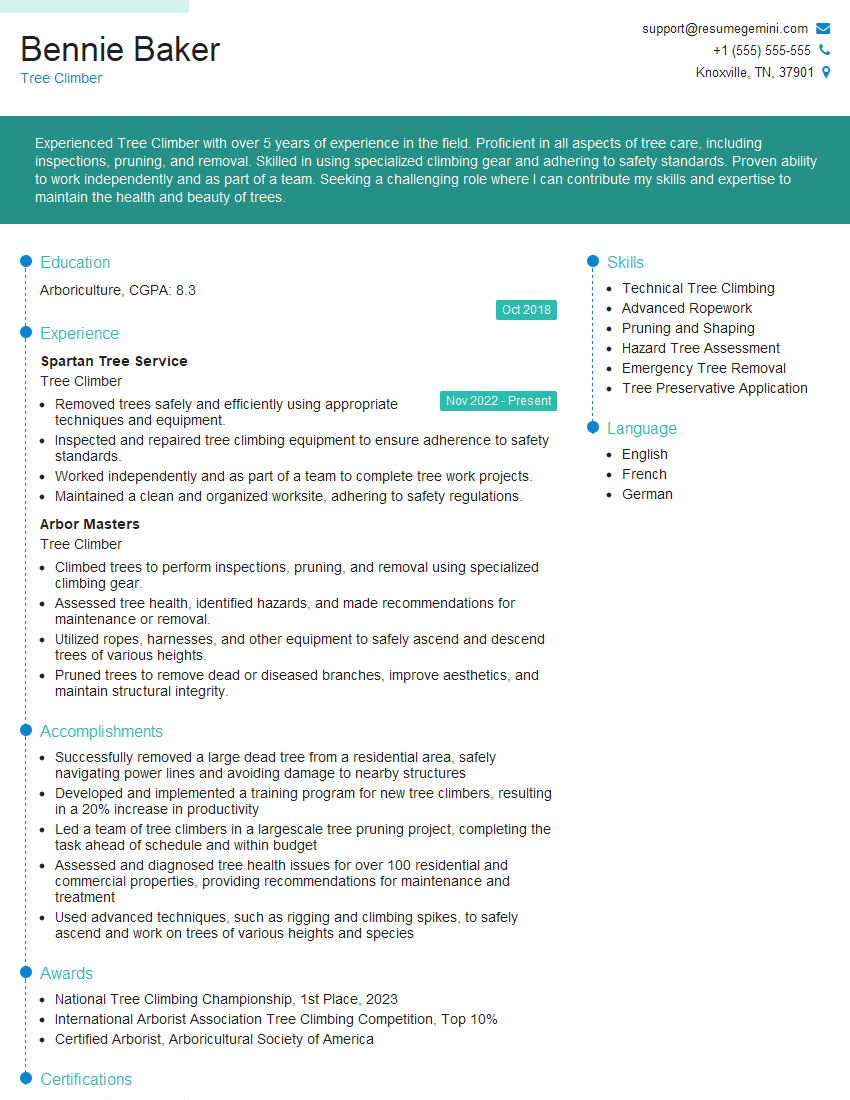
Mastering Tree Climbing and Safety Techniques is crucial for career advancement in this exciting and demanding field. Proficiency in these areas demonstrates commitment to safety and expertise, leading to increased job opportunities and higher earning potential. To maximize your chances of landing your dream job, a well-crafted, ATS-friendly resume is essential. ResumeGemini is a trusted resource to help you create a professional and impactful resume that highlights your skills and experience effectively. Examples of resumes tailored to Tree Climbing and Safety Techniques are available to help guide your process.

Explore more articles
Users Rating of Our Blogs
Share Your Experience
We value your feedback! Please rate our content and share your thoughts (optional).
What Readers Say About Our Blog
Very informative content, great job.
good