Unlock your full potential by mastering the most common Trimming and embellishing hats interview questions. This blog offers a deep dive into the critical topics, ensuring you’re not only prepared to answer but to excel. With these insights, you’ll approach your interview with clarity and confidence.
Questions Asked in Trimming and embellishing hats Interview
Q 1. Describe your experience with various hat trimming techniques.
My experience with hat trimming techniques spans a wide range, from classic to contemporary methods. I’m proficient in various stitching techniques, including hand-sewing, machine sewing, and specialized millinery stitches like blanket stitch and slip stitch, crucial for securing trims securely and invisibly. I’m adept at working with different fabrics and materials, understanding how to properly prepare and manipulate them for optimal results. For example, I know how to create clean, crisp edges using techniques like pinking, bias binding, or even laser cutting for more modern designs. I’ve also mastered techniques like pleating, gathering, and shaping fabrics to create dimensional trims and embellishments. Beyond the basic techniques, I’ve experimented with more advanced methods like millinery wire work for shaping and structuring floral elements, adding a unique three-dimensional quality to the finished hat.
- Hand-sewing: Provides precision and control for intricate details.
- Machine sewing: Ideal for bulkier trims and faster production.
- Millinery wire work: Creates structural support and allows for complex shapes.
Q 2. What types of embellishments are you most proficient with?
My expertise lies in a diverse array of embellishments. I’m highly skilled in working with feathers, both natural and synthetic, creating everything from delicate plumes to dramatic cascades. I’m equally comfortable with floral embellishments, crafting realistic blooms using fabrics, millinery wire, and even sugar paste for truly unique and edible options! Ribbons, bows, and braids are another area of strength; I can create intricate arrangements and unique textures with these materials. Beyond these, I’m proficient in incorporating beads, sequins, jewels, and other decorative elements for a touch of sparkle and glamour. I also enjoy experimenting with less traditional embellishments, such as incorporating vintage brooches or repurposing found objects to create one-of-a-kind pieces.
- Feathers: Adds texture, movement, and drama.
- Flowers: Provides a romantic and elegant touch.
- Beads & Sequins: Adds sparkle and visual interest.
Q 3. How do you select appropriate trims and embellishments for different hat styles?
Selecting appropriate trims and embellishments is a crucial aspect of hat design. The process begins with a thorough understanding of the hat’s style, purpose, and overall aesthetic. A classic fedora, for example, might call for understated trims like a simple ribbon band or a subtle feather accent, whereas a flamboyant cocktail hat might benefit from more dramatic embellishments like cascading feathers, intricate beadwork, or large, statement flowers. I consider factors like the hat’s color palette, the occasion for which it’s intended, and the client’s personal style. I always strive for a cohesive look where the trims enhance, not overpower, the hat’s design. For instance, a brightly colored hat might require subtler embellishments to avoid visual overload, while a more neutral-colored hat provides a blank canvas for bolder choices.
Q 4. Explain your process for creating a custom hat design, including trimming and embellishment.
Creating a custom hat design is a collaborative process that begins with a consultation to understand the client’s vision. We discuss the occasion, desired style, color preferences, and any specific ideas they may have. Then, I create sketches and mood boards to explore different design possibilities. Once the design is finalized, I source materials and begin constructing the hat base. The trimming and embellishment phase involves meticulously attaching chosen elements, paying close attention to placement, balance, and overall visual harmony. I often create prototypes using inexpensive materials to test out design ideas before committing to the final, high-quality materials. The entire process is iterative, with adjustments made as needed to achieve the perfect result. For example, I might initially plan for a certain type of feather arrangement but adjust the placement or density depending on how it looks on the finished hat.
Q 5. What materials are you comfortable working with for hat trimming?
My experience encompasses a wide variety of materials used in hat trimming. I’m comfortable working with various fabrics, including silk, velvet, felt, straw, and sinamay. I’m equally adept at handling diverse embellishment materials, ranging from natural feathers and flowers to synthetic materials, beads, sequins, ribbons, and even unusual recycled elements for a more sustainable approach. I’m knowledgeable about the properties of different materials and choose them based on their suitability for the specific design and desired effect. For example, delicate silk might be perfect for a subtle floral arrangement, while sturdy felt is better suited for supporting heavier embellishments. Understanding the durability and care requirements of each material is crucial for ensuring the longevity of the final product.
Q 6. How do you ensure the durability and longevity of your hat embellishments?
Ensuring the durability and longevity of hat embellishments involves careful selection of high-quality materials and precise application techniques. I use strong, durable threads appropriate for the material being used, and I employ secure stitching methods to prevent unraveling or detachment. For instance, I avoid using glue where possible, especially with delicate materials like feathers, opting instead for hand-stitching for superior longevity. For more delicate embellishments, I might add layers of support to ensure their stability and prevent them from being easily damaged. I advise clients on the proper care of their hats, including cleaning and storage methods to prolong their life. For example, feather embellishments can be lightly cleaned with a soft brush to maintain their vibrancy and prevent damage. This approach ensures that the final hat not only looks beautiful but also withstands the test of time.
Q 7. Describe your experience with different stitching techniques for hat trimming.
My stitching repertoire is extensive, encompassing a wide range of techniques suited to different materials and applications. Beyond basic running stitch and backstitch, I’m skilled in specialized millinery stitches like the blanket stitch, used to create a decorative and secure edge on trims; slip stitch, for invisible attachment; and French knots, for adding small decorative details. I adapt my stitching technique based on the material’s weight and texture. For instance, a fine silk ribbon would require a delicate slip stitch, while a heavier fabric might need a stronger backstitch or a combination of techniques to provide both strength and an aesthetic finish. I also employ different needle sizes and thread weights depending on the materials and desired effect, ensuring both functionality and visual appeal. My stitching is not merely functional; it’s an integral part of the overall aesthetic of the hat.
Q 8. How do you handle intricate details and delicate embellishments?
Handling intricate details and delicate embellishments requires a meticulous approach and the right tools. Think of it like working on a miniature sculpture – precision is paramount. I start by carefully examining the embellishment and the hat itself, assessing the best placement and attachment method. For example, tiny beads might require a fine-tipped needle and thread, while larger, heavier elements might necessitate glue specifically designed for millinery. I always work in a well-lit area with magnification tools, like a jeweler’s loupe, to ensure accuracy and prevent accidental damage. This careful examination and selection of tools minimize risk and ensures the embellishments are securely and aesthetically placed.
I also utilize various stabilizing techniques depending on the material. For delicate feathers, I might use a light-tack adhesive and carefully place them, allowing them to dry undisturbed. For fragile lace, I may use a temporary tacking method to secure the position before permanently attaching it with invisible stitching. This layered approach safeguards the embellishment’s integrity and ensures longevity.
Q 9. What are your preferred methods for attaching embellishments to hats?
My preferred methods for attaching embellishments depend entirely on the material of both the embellishment and the hat. There’s no one-size-fits-all solution. For instance, I use high-quality millinery glue for lightweight items like sequins or small beads, ensuring it’s appropriate for the hat material to avoid discoloration or damage. For heavier embellishments, such as brooches or feathers, I often use a combination of glue and secure stitching, providing both strong adhesion and a reinforcement for longevity. Invisible stitching is a favorite technique for its clean, professional finish – it blends seamlessly and avoids distracting from the embellishment itself.
For fabrics like felt or straw, I might use a specialized needle and thread to whip stitch embellishments directly onto the hat. This provides a durable and secure attachment, particularly suitable for more robust embellishments. The selection process always prioritizes the best approach for both aesthetic appeal and structural integrity, considering the weight and delicate nature of each piece.
Q 10. How do you maintain accuracy and consistency in your trimming and embellishment work?
Maintaining accuracy and consistency is fundamental to my work. I achieve this through careful planning and the use of templates and measuring tools. Before starting any project, I meticulously plan the placement of each embellishment, often creating a sketch or even a miniature mock-up to visualize the final result. This prevents errors and ensures a balanced, symmetrical design.
I also utilize consistent techniques and tools. For example, I always use a consistent stitch length for hand-sewing and always measure twice before cutting any fabric. I’ve even created my own personalized tools and jigs for repetitive tasks like placing evenly spaced sequins to aid consistency. Regular quality checks during the process allow for immediate adjustments, preventing minor inconsistencies from escalating into major problems.
Q 11. Explain your experience with working with different hat shapes and sizes.
My experience spans a wide variety of hat shapes and sizes. I’ve worked on everything from delicate fascinators to large-brimmed sun hats, and from close-fitting berets to top hats. The process adjusts according to the shape. A small, structured hat demands precise placement of embellishments, avoiding visual overcrowding. A larger, floppy hat allows for more creative freedom and space to incorporate larger, more elaborate decorations.
Understanding the unique characteristics of each shape – how it fits the head, the flow of its lines, and the drape of its materials – is key to successful trimming and embellishment. I approach each project by adapting my techniques to fit the specific design and the client’s desires, ensuring each hat is uniquely complemented and enhanced by the embellishments.
Q 12. Describe a time you had to troubleshoot a problem during the trimming or embellishment process.
I once encountered a problem working on a bespoke wedding hat featuring intricate beading on a delicate silk fabric. The glue I initially used, while suitable for the beads, caused slight discoloration on the silk. Rather than panicking, I took a systematic approach to troubleshoot the issue. Firstly, I carefully cleaned the affected area with a gentle fabric cleaner, ensuring not to damage the beads. Then, I researched alternative adhesives, opting for a specialized acid-free, silk-safe glue recommended by a millinery supply expert. Finally, I carefully reapplied the beads, taking extra precautions to protect the underlying fabric. This experience highlighted the importance of thorough material knowledge and the need to have backup solutions at hand when working with delicate materials.
Q 13. How do you stay updated on the latest trends in hat trimming and embellishment?
Staying updated on the latest trends is vital in the ever-evolving world of millinery. I regularly attend industry events and workshops, networking with other milliners and designers. I subscribe to several relevant magazines and follow prominent milliners and designers on social media platforms like Instagram and Pinterest. This allows me to observe the use of new materials, techniques, and design aesthetics, constantly enriching my skills and expanding my creative horizons.
Trade shows and online forums provide valuable insights into new embellishment materials and innovative methods. Experimentation is also important— I regularly test out new materials and techniques in my own projects, staying ahead of the curve and adapting new ideas to my workflow.
Q 14. How do you manage your time and prioritize tasks when working on multiple hat projects?
Managing multiple hat projects effectively requires detailed organization and time management. I utilize project management tools to track deadlines, prioritize tasks, and allocate time efficiently. This could involve creating a simple spreadsheet or using a dedicated project management app. Each project is broken down into manageable steps, and I assign realistic timelines to each stage, accounting for potential setbacks or unforeseen delays.
Prioritization is key. I often focus on high-priority projects with tighter deadlines first, while strategically scheduling less time-sensitive projects around them. I also learn to delegate tasks, if possible, or outsource certain aspects of the process when necessary, allowing me to focus on tasks requiring my specialized expertise. Consistent review and adaptation of my workflow ensures efficient and effective completion of multiple projects without sacrificing quality.
Q 15. What software or tools are you familiar with for hat design and production?
My expertise in hat trimming and embellishment extends to various software and tools. For design, I’m proficient in Adobe Illustrator and Photoshop, using them to create detailed patterns, visualize embellishment placement, and experiment with different designs before physical production. These programs allow for precise scaling, color matching, and the creation of intricate designs that are crucial for high-end hat making. In terms of production tools, I’m experienced with a wide range of machinery including industrial sewing machines (both straight stitch and specialized decorative stitch machines), specialized hat blocking equipment to shape the hat forms, and a variety of hand tools for precise embellishment placement and finishing. This includes specialized needlework tools, beading tools, and glue guns for various materials. For example, I often use Illustrator to create intricate feather placement patterns for a bespoke fascinator, then use Photoshop to virtually ‘try on’ different colored feathers to determine the best color palette before beginning the construction.
Career Expert Tips:
- Ace those interviews! Prepare effectively by reviewing the Top 50 Most Common Interview Questions on ResumeGemini.
- Navigate your job search with confidence! Explore a wide range of Career Tips on ResumeGemini. Learn about common challenges and recommendations to overcome them.
- Craft the perfect resume! Master the Art of Resume Writing with ResumeGemini’s guide. Showcase your unique qualifications and achievements effectively.
- Don’t miss out on holiday savings! Build your dream resume with ResumeGemini’s ATS optimized templates.
Q 16. Describe your experience with quality control procedures for hat trimming and embellishment.
Quality control is paramount in my work. My process begins with a meticulous inspection of the base hat for any defects before I start trimming and embellishment. Then, each stage of the process – from stitching to embellishment placement – undergoes checks for accuracy, consistency, and quality. For example, if I’m hand-sewing beads, I regularly inspect my work to ensure even spacing and secure attachments. Any flaws are immediately addressed. I use standardized checklists and photographic documentation at each stage. This allows me to easily track progress, identify any recurring issues, and maintain a consistently high level of craftsmanship. This also helps with troubleshooting later if issues were to arise.
For instance, if I notice a consistent thread tension issue, I can adjust the machine settings and immediately improve the quality of future products. Finally, a thorough final inspection is conducted before the hat is packaged, ensuring the final product meets the highest standards. I believe in a proactive approach to quality control; catching errors early in the process is far more efficient than fixing them later.
Q 17. How do you handle feedback and criticism on your hat trimming work?
I value feedback as an opportunity for growth. I actively solicit feedback from clients and colleagues, viewing criticism not as a personal attack, but as constructive input to improve my techniques and refine my process. I listen carefully to any concerns and work collaboratively to find solutions. If the feedback highlights a genuine flaw, I’ll carefully analyze where I went wrong, and what steps I can take to prevent similar errors in the future. This can range from adjusting my techniques to reviewing my initial design plans. I document these instances, using them to inform my future projects and elevate my skill.
For example, a client once pointed out that the spacing between some feathers on a hat wasn’t perfectly even. While it was subtle, their feedback was valid, and I adjusted my technique for future projects. I improved my workflow by incorporating a visual guide for precise feather placement.
Q 18. How do you manage deadlines and meet production goals?
I manage deadlines through meticulous planning and efficient workflow organization. I break down large projects into smaller, manageable tasks, assigning realistic timelines to each step. This includes setting aside buffer time to account for unforeseen delays. I frequently review my progress against the schedule, using project management tools like digital calendars and to-do lists. Proactive communication with clients is also vital. If I anticipate a delay, I communicate it promptly, offering alternative solutions whenever possible. This ensures transparency and prevents unexpected disruptions.
For example, when working on a large order of hats for an event, I created a detailed production schedule that accounted for each hat’s unique design and embellishment needs. This allowed me to efficiently allocate resources and meet the tight deadline. This involved close collaboration with my team (if applicable) ensuring that everyone understood their roles and responsibilities.
Q 19. Describe your experience working with clients to create custom hats.
Collaborating with clients on custom hat designs is one of the most rewarding aspects of my job. I begin by having an in-depth consultation to understand their vision, style preferences, and the event or occasion for which the hat is intended. I use mood boards, sketches, and fabric swatches to help visualize their ideas. This often involves presenting design concepts and making adjustments based on their feedback. I’m adept at translating client inspiration into tangible designs, incorporating their preferences while also leveraging my design expertise. The entire process is a collaborative one, aiming to create a unique and personalized hat that exceeds their expectations.
For instance, I once worked with a bride who wanted a wedding hat that reflected the vintage elegance of the 1920s. After several consultations, we finalized a design incorporating feathers, beads, and a unique veil attachment. The finished product was a truly bespoke creation that perfectly captured the bride’s vision and style.
Q 20. How do you maintain a clean and organized workspace?
Maintaining a clean and organized workspace is crucial for efficiency and quality control. I follow a systematic approach to organization, keeping my tools and materials neatly arranged and easily accessible. This involves regular clean-up sessions, ensuring that my work surface is clear and free of clutter. I have designated storage spaces for different materials and tools, preventing cross-contamination and ensuring that I always have what I need at my fingertips. This meticulous organization allows me to concentrate on my work without distraction and contributes to overall quality control. A tidy workspace is a productive workspace. It also promotes safety, especially when dealing with sharp tools and potentially hazardous materials.
Q 21. What are your strengths and weaknesses related to hat trimming and embellishment?
My strengths lie in my meticulous attention to detail, precision handwork, and creative design skills. I’m highly proficient in various embellishment techniques and possess a keen eye for color and texture coordination. I’m also adaptable and comfortable working with diverse materials and styles. One area I’m always striving to improve is my time management skills when working on especially complex projects with multiple custom elements – learning to better anticipate the time required for each step is a continuous goal.
Q 22. Explain your understanding of different hat blocking techniques.
Hat blocking is the foundational process of shaping and setting the form of a hat. It’s like sculpting with fabric and involves manipulating the hat’s base material – typically millinery buckram, straw, or felt – over a hat block, a three-dimensional form that determines the hat’s final shape. There are several techniques:
Steam Blocking: This is common for felt and wool hats. The hat is carefully steamed, softening the fibers, and then gently stretched and molded over the block until it dries and retains the desired shape. It’s a bit like giving the hat a relaxing spa treatment! Precision is key to avoid distortion.
Dry Blocking: Used for stiffer materials like straw or buckram. It involves careful manipulation and sometimes the use of adhesives to ensure the material conforms perfectly to the block. Think of it as carefully tailoring the fabric to the block’s form.
Blocking with Shaping Tools: Special tools, like hat stretchers and pliers, are used to manipulate the material precisely, particularly around curves and edges. This allows for finer detail and intricate shaping.
The choice of technique depends on the hat’s material, desired shape, and the milliner’s skill and experience. Mastering these techniques is vital for creating well-structured, beautifully shaped hats.
Q 23. How do you ensure your hat creations meet both aesthetic and structural requirements?
Balancing aesthetic and structural requirements is paramount in millinery. The beauty of a hat is enhanced by its proper structure. I achieve this balance through a meticulous process:
Careful Material Selection: The choice of fabric directly impacts both aesthetics and structure. A lightweight silk might look elegant but requires careful blocking to retain its shape, while a sturdy wool felt can provide a strong foundation for elaborate embellishments.
Precise Pattern Making: A well-drafted pattern ensures the hat’s structural integrity, providing the correct foundation for shaping and embellishment. This is like building a house – a strong foundation ensures a stable structure.
Strategic Blocking: The blocking process itself directly influences the final shape and drape of the hat. A poorly blocked hat, no matter how beautiful the embellishments, will ultimately look sloppy.
Balanced Embellishment: Trims and embellishments should enhance the hat’s shape and not detract from its structure. Over-embellishment can overwhelm the design, creating an unbalanced and visually heavy look. I always aim for a harmonious blend of form and decoration.
For example, a wide-brimmed hat might require internal wire supports to maintain its shape even with heavy feather embellishments. This strategic use of structural elements ensures both the hat’s visual appeal and its ability to keep its form.
Q 24. How do you maintain the integrity of vintage hats during restoration?
Restoring vintage hats is a delicate balance between preservation and revitalization. My approach prioritizes the hat’s integrity above all else. This includes:
Gentle Cleaning: I use specialized cleaning techniques appropriate for the hat’s material, often opting for dry cleaning or spot cleaning to avoid damage.
Careful Repair: Small tears or holes are painstakingly mended using period-appropriate materials and techniques. This might involve hand-sewing with invisible stitches, matching threads to the original color and texture as closely as possible.
Minimal Intervention: My goal is to preserve the original hat as much as possible. Only necessary repairs are undertaken, avoiding unnecessary alterations that would compromise the hat’s historical value.
Proper Storage: Once restored, the hat is stored in a climate-controlled environment, away from light and dust, to prevent further damage. Think museum-quality care!
For instance, while restoring a 1920s cloche hat, I might use archival-quality glue to reattach a loose feather instead of replacing it entirely. The preservation of the original materials and construction methods are key.
Q 25. What safety precautions do you follow when working with sharp tools and materials?
Safety is paramount in my work. Sharp tools and potentially hazardous materials necessitate strict adherence to safety protocols:
Sharp Tools: I use sharp needles and pins, scissors, and knives with extreme care. I always cut away from myself and use cutting mats to protect my work surface. Proper needle storage is essential, avoiding loose pins.
Protective Gear: I wear safety glasses to protect my eyes from flying debris, especially when working with wire or stiff materials. Gloves are used when handling certain adhesives or fabrics that could irritate my skin.
Workspace Organization: A clean and organized workspace is crucial. I keep my tools within easy reach but ensure they are neatly arranged to prevent accidental cuts or punctures.
Proper Disposal: All sharp objects are disposed of appropriately in designated containers, ensuring they are never left loose.
I treat every project with the utmost caution, viewing safety as an integral part of the creative process. A small cut could easily derail a project, so preventing injury is my top priority.
Q 26. Describe your experience with hand-sewing versus machine sewing for hat construction.
Both hand-sewing and machine sewing have their place in hat construction, and I utilize both depending on the project’s requirements. Hand-sewing offers precision and control for delicate details and invisible seams, crucial for high-end millinery. Machine sewing provides speed and efficiency for repetitive tasks like attaching linings or creating bulkier structures.
Hand-sewing: I frequently use hand-sewing for attaching embellishments, creating intricate decorative stitches, and making subtle adjustments to fit and shape. The control it offers is invaluable for ensuring a neat and precise finish, especially on visible areas.
Machine sewing: A sewing machine is essential for creating robust seams on linings, assembling the body of hats, or constructing components which need to be durable, like structured brims. It allows for speed and consistency in constructing various hat parts.
For instance, the delicate embellishment on a fascinator would be painstakingly hand-sewn, while the basic structure of a fedora would likely use a combination of machine and hand-sewing.
Q 27. How do you create a cohesive and balanced design using multiple trims and embellishments?
Creating a cohesive and balanced design with multiple trims and embellishments involves careful planning and execution. It’s about creating harmony, not just piling on decorations. My approach is guided by several key principles:
Color Palette: Selecting a consistent color palette is fundamental. Trims should complement each other and work in harmony with the base material, creating a visually pleasing combination. Analogous or complementary color schemes often work best.
Texture and Scale: Combining different textures—smooth silks, rough felts, delicate lace—adds depth and visual interest, as long as they complement the design’s overall aesthetic. Scale is also crucial; a large feather might dominate a small hat, so the size of the embellishments must be proportional to the hat itself.
Strategic Placement: The placement of trims is pivotal. Key embellishments should be strategically positioned to emphasize the hat’s shape and highlight its best features. Avoid overcrowding a single area; balance is key.
Focal Point: A strong focal point draws the eye and unifies the design. This could be a single, striking embellishment, or a cluster of smaller elements arranged purposefully. It acts as an anchor for the other elements.
For example, a hat might incorporate a central jeweled brooch as a focal point, surrounded by smaller feathers and ribbons strategically placed to accentuate the shape and create visual flow. The key is balance, creating an overall look that’s both visually exciting and harmonious.
Q 28. Describe your knowledge of different types of hat fabrics and their suitability for various trims and embellishments.
Understanding hat fabrics and their suitability for various trims and embellishments is crucial. Different materials react differently to embellishments, and choosing the right fabric foundation is key to a successful hat.
Felt: A versatile material for many hat styles, felt is strong and can hold its shape well, supporting heavier embellishments like feathers, beads, and brooches. Its texture complements a variety of trims.
Straw: Light and airy, straw is ideal for summer hats. It’s best suited for lighter embellishments, as heavier ones could overwhelm the material’s delicate structure. Flowers, ribbons, and lightweight veiling would be suitable.
Silk: Elegant and luxurious, silk is often used for more formal hats. Its smooth surface is perfect for showcasing delicate embellishments like lace, embroidery, or small, carefully placed jewels. However, its structure requires careful consideration for heavier trims.
Velvet: Rich and dramatic, velvet provides a luxurious base for hats. It’s excellent for creating a bold look with heavier embellishments, but the pile may require careful consideration when attaching trims.
For instance, a delicate silk hat would be better suited to lighter trims such as lace and small beads, while a sturdy wool felt hat could support bolder embellishments like large feathers or jeweled ornaments. The fabric’s weight, texture, and drape directly influence the choice of embellishment.
Key Topics to Learn for Trimming and Embellishing Hats Interview
- Understanding Hat Construction: Knowledge of various hat structures (e.g., brim styles, crown shapes) and their impact on trimming and embellishment placement.
- Material Selection and Properties: Identifying suitable fabrics, feathers, ribbons, and other embellishments based on hat style and desired aesthetic. Understanding the drape and behavior of different materials.
- Trimming Techniques: Mastering hand-sewing, gluing, and other methods for securely attaching embellishments while maintaining a professional finish. This includes understanding different stitch types and their applications.
- Embellishment Design and Placement: Creating balanced and visually appealing designs. Understanding principles of design, color theory, and proportion as they apply to hat decoration.
- Working with Specialized Tools and Equipment: Familiarity with hat blocks, needles, awls, and other tools specific to millinery. Demonstrating safe and efficient use of these tools.
- Quality Control and Finishing: Ensuring the highest standards of craftsmanship, including attention to detail, neat stitching, and secure attachment of embellishments. Identifying and correcting imperfections.
- Problem-Solving and Adaptability: Demonstrating the ability to troubleshoot challenges such as material imperfections, design adjustments, or unexpected technical difficulties.
- Industry Trends and Styles: Staying current with the latest trends in millinery and hat design to showcase your adaptability and creativity.
Next Steps
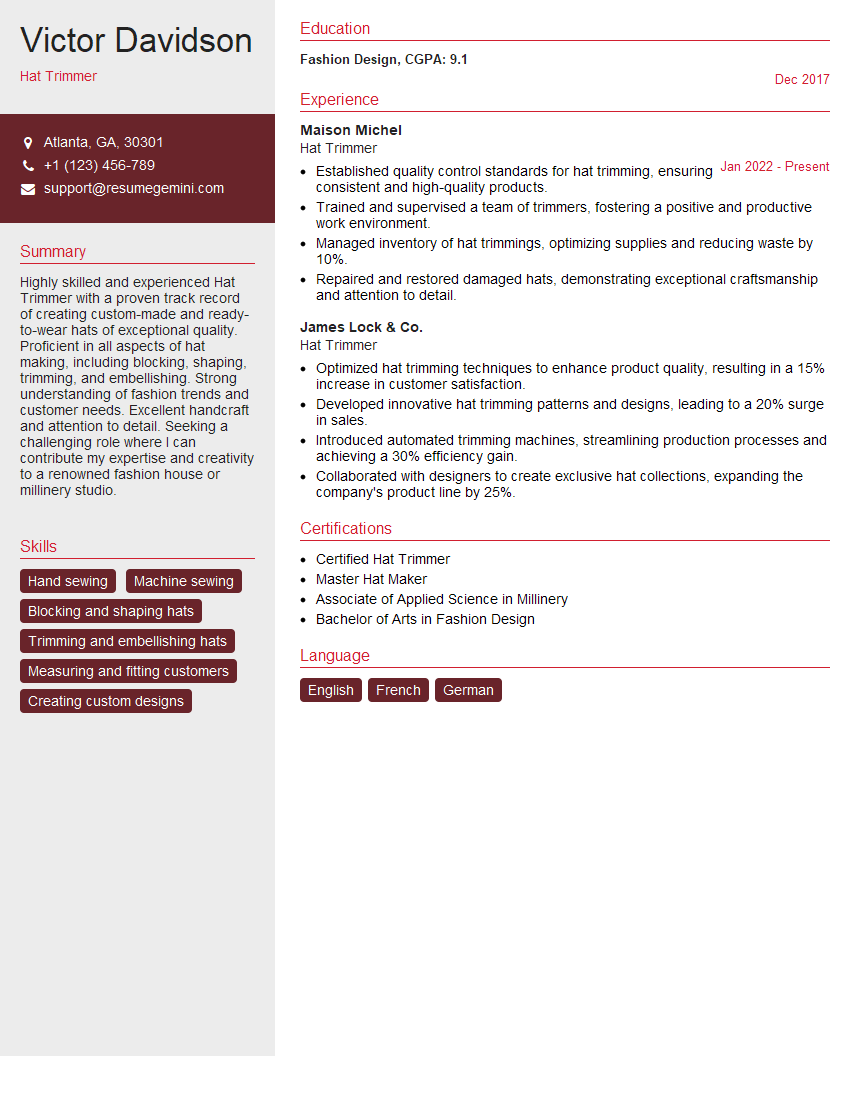
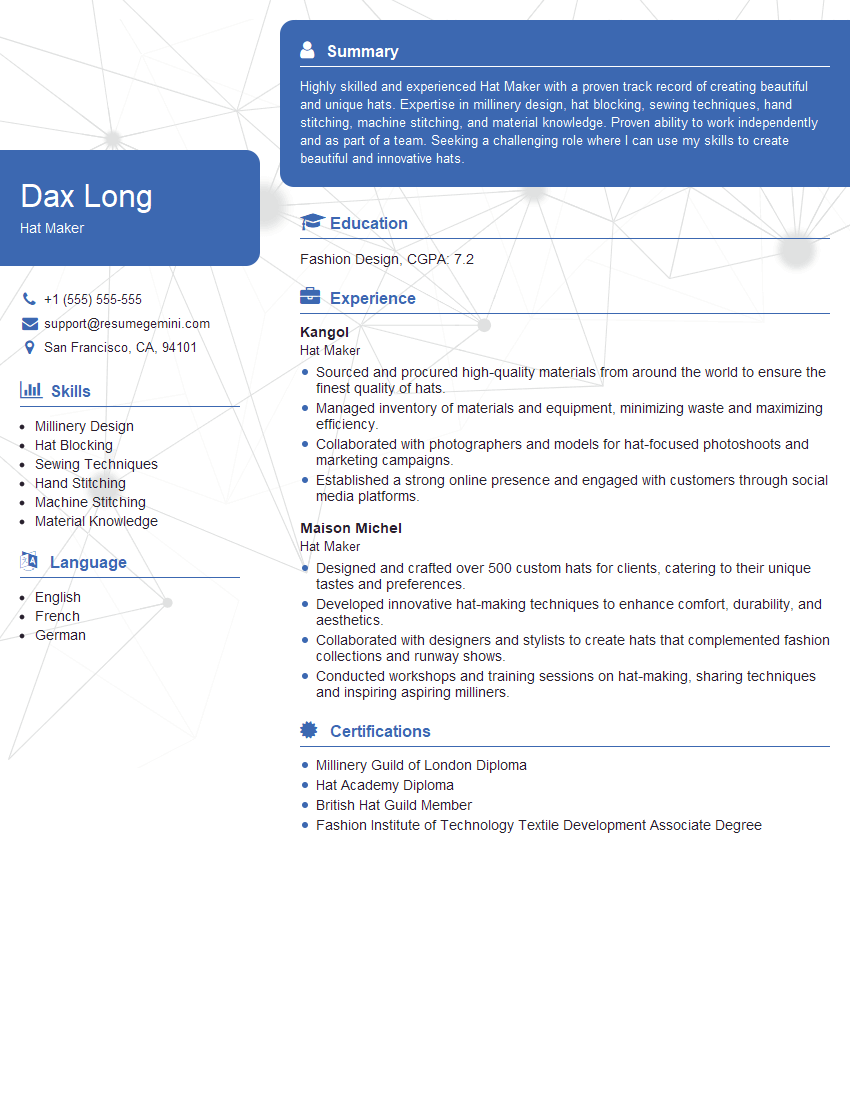
Mastering the art of trimming and embellishing hats opens doors to exciting career opportunities in the fashion and design industries. A strong understanding of these techniques, coupled with a well-crafted resume, significantly increases your chances of landing your dream job. To maximize your job search success, create an ATS-friendly resume that highlights your skills and experience effectively. ResumeGemini is a trusted resource that can help you build a professional and impactful resume. They offer examples of resumes tailored to the Trimming and Embellishing Hats field to guide you in showcasing your unique qualifications. Invest time in crafting a compelling resume; it’s your first impression on potential employers.
Explore more articles
Users Rating of Our Blogs
Share Your Experience
We value your feedback! Please rate our content and share your thoughts (optional).
What Readers Say About Our Blog
Very informative content, great job.
good