The thought of an interview can be nerve-wracking, but the right preparation can make all the difference. Explore this comprehensive guide to Cavalry Operations interview questions and gain the confidence you need to showcase your abilities and secure the role.
Questions Asked in Cavalry Operations Interview
Q 1. Describe the different types of cavalry formations and their tactical applications.
Cavalry formations are designed to leverage the speed and maneuverability of mounted forces. Historically, common formations included the wedge, designed for breaking enemy lines; the line, for frontal assaults and maximizing firepower; and the echelon, for flanking maneuvers and flexibility. Modern cavalry formations are far more fluid and adaptable, often employing smaller, dispersed units.
- Wedge Formation: Think of a battering ram – excellent for piercing enemy defenses, but vulnerable on the flanks. This was a classic formation used during medieval and early modern warfare.
- Line Formation: Imagine a line of soldiers abreast, maximizing the front for firepower. This was useful in set-piece battles, but slow to react to flanking attacks.
- Echelon Formation: Picture a staggered line – offering better protection from flanking attacks than a straight line, allowing for rapid shifts in direction.
- Modern Formations: Today, cavalry often operates in smaller, highly mobile squads or platoons, relying heavily on speed, surprise, and coordinated maneuver to achieve objectives. The specific formation will depend heavily on the mission, terrain, and enemy situation.
Tactical application relies on understanding the strengths and weaknesses of each formation relative to the mission and enemy capabilities. For example, a wedge might be suitable for a fast, decisive attack against a lightly defended position, while an echelon is more appropriate for a reconnaissance patrol operating in uncertain terrain.
Q 2. Explain the advantages and disadvantages of using cavalry in modern warfare.
While the image of cavalry charging across open fields is largely a thing of the past, modern cavalry, often mounted in highly mobile vehicles, retains significant advantages.
- Advantages: Speed and maneuverability remain key; cavalry can rapidly deploy to critical areas, outmaneuver opponents, and conduct rapid reconnaissance. Their mobility enables them to exploit weaknesses and react quickly to changing battlefield situations. Modern cavalry units also often possess significant firepower, leveraging advanced weaponry systems.
- Disadvantages: Cavalry units can be vulnerable to anti-armor weaponry and air attacks if not properly supported. Their effectiveness depends heavily on logistical support and communication, as isolated units can be easily overwhelmed. Certain terrains, such as densely forested areas or mountains, can significantly impede cavalry mobility.
In modern warfare, the advantages of cavalry often outweigh the disadvantages when used effectively. The ability to rapidly deploy and conduct reconnaissance in diverse environments remains essential for military success.
Q 3. What are the key principles of cavalry reconnaissance?
Cavalry reconnaissance is crucial for gathering information about the enemy and the terrain. Key principles include:
- Speed and Mobility: Rapid deployment and movement are essential for quickly gathering information and avoiding enemy detection.
- Stealth and Deception: Minimizing enemy detection is critical, requiring careful planning and execution of routes and actions.
- Observation and Reporting: Accurate and timely reporting of observations is essential for effective decision-making. This includes the use of advanced surveillance technologies.
- Security: Protecting the reconnaissance unit is paramount, requiring careful planning to avoid ambush and potential threats.
- Adaptability: Cavalry reconnaissance must be adaptable to changing conditions, adjusting routes and actions as needed.
Effective reconnaissance provides the commander with critical intelligence, allowing for informed decision-making regarding troop deployments, maneuver plans, and combat operations.
Q 4. How does cavalry integrate with other combat arms?
Cavalry integrates with other combat arms through combined arms operations, leveraging each arm’s strengths to achieve synergistic effects. For instance:
- With Infantry: Cavalry can provide rapid reaction forces for infantry units, conducting flanking maneuvers, providing security, and responding to enemy threats.
- With Armor: Cavalry can scout ahead for armored units, identifying enemy positions and guiding the advance of heavier armor.
- With Artillery: Cavalry reconnaissance can identify targets for artillery fire, significantly enhancing its effectiveness.
- With Air Support: Cavalry can coordinate close air support, providing crucial assistance during combat operations and reducing casualties.
Successful integration relies heavily on clear communication, coordination, and mutual understanding of capabilities and limitations. A combined arms approach, employing the unique strengths of different military arms, is crucial for achieving success on the modern battlefield.
Q 5. Discuss the role of technology in modern cavalry operations.
Technology plays a pivotal role in modern cavalry operations, enhancing effectiveness and survivability. Key technological advances include:
- Advanced Surveillance Systems: Drones, Unmanned Aerial Vehicles (UAVs), and satellite imagery provide real-time intelligence, enhancing situational awareness.
- Improved Communication Systems: Secure and reliable communication networks allow for real-time coordination between units, ensuring effective combined arms operations.
- Advanced Weaponry Systems: Modern tanks and armored vehicles equip cavalry units with enhanced firepower and protective capabilities.
- Night Vision and Thermal Imaging: These technologies provide significant advantages in low-light and nighttime operations, enhancing the operational capabilities of cavalry units.
These technologies significantly enhance the effectiveness of modern cavalry, enabling them to operate effectively across a wide range of environments and combat scenarios. The integration of these technologies requires substantial investment and ongoing training to maximize their utility.
Q 6. Describe your experience with cavalry tactical planning and execution.
My experience in cavalry tactical planning and execution encompasses a wide range of operations, from reconnaissance patrols to large-scale combined arms maneuvers. I’ve been involved in developing detailed plans considering terrain analysis, enemy capabilities, and the integration of other combat arms. One particular operation involved planning a reconnaissance mission in a mountainous region. We meticulously analyzed satellite imagery, identified likely enemy patrol routes, and established multiple observation points, ensuring comprehensive coverage of the area. This involved coordinating with infantry units to provide security during the operation. The detailed planning and successful execution led to the timely acquisition of critical intelligence, directly impacting the overall success of the campaign.
My experience further includes participation in various live-fire exercises and simulations, where I refined my skills in command, control, and communication within a dynamic environment. I am proficient in using mission planning software and effectively communicating with supporting elements, fostering effective collaboration.
Q 7. Explain the challenges of cavalry operations in different terrains.
Cavalry operations face unique challenges depending on the terrain.
- Dense Forests: Mobility is severely restricted, limiting speed and maneuverability. Visibility is greatly reduced, making reconnaissance more challenging and increasing the risk of ambush.
- Mountains: Steep slopes and rough terrain hinder movement and deployment. Altitude can impact vehicle performance, and specialized equipment and training are often required.
- Deserts: Extreme temperatures and vast distances create significant logistical challenges. Water scarcity and sandstorms can limit operational effectiveness.
- Urban Environments: Navigating complex urban infrastructure and dealing with civilian populations requires specific tactics and procedures to minimize collateral damage and maintain operational security.
Overcoming these challenges requires thorough planning, specialized training, and the appropriate equipment. Adaptability is crucial, demanding flexible operational strategies adjusted to the specifics of each terrain type. For example, in mountainous terrain, using lighter, more agile vehicles and relying on dismounted operations might be necessary. In urban environments, specialized training in urban warfare tactics is paramount.
Q 8. How do you assess risk and mitigate threats during a cavalry operation?
Assessing risk and mitigating threats in cavalry operations is a continuous process demanding a proactive and layered approach. It begins with thorough intelligence gathering, analyzing the operational environment for potential threats – from enemy forces and terrain to weather conditions and civilian populations. This intelligence informs our risk assessment, which we categorize by likelihood and severity. We use a matrix to visualize this, plotting each threat’s probability of occurrence against its potential impact on the mission.
Mitigation strategies are then developed based on this assessment. These might include: employing reconnaissance assets to gain further situational awareness, selecting routes and positions that minimize exposure, using deception and camouflage techniques to reduce our detectability, establishing robust security perimeters, and coordinating with supporting arms such as artillery or air support to neutralize threats.
For example, during a reconnaissance patrol in a high-threat environment, we might send out advance scouts to detect enemy ambushes, use covered and concealed positions, and maintain constant communication to share information and coordinate responses. The constant reassessment of risk based on new information is key; what was deemed a low risk earlier may become high-risk due to changing conditions.
Q 9. What are the key leadership principles you apply as a cavalry officer?
As a cavalry officer, my leadership principles are built on a foundation of competence, character, and commitment. Competence demands continuous professional development, staying abreast of advancements in tactics, technology, and leadership theory. Character involves leading by example, upholding ethical standards, and fostering trust and respect among the troops. Commitment embodies relentless dedication to mission accomplishment and unwavering loyalty to my soldiers’ well-being.
I emphasize decentralized command, empowering subordinate leaders to make decisions on the ground, fostering initiative and adaptability. Clear communication, coupled with constant feedback and mentorship, is vital to ensuring understanding and alignment across the unit. I strongly believe in fostering a culture of continuous learning and improvement through after-action reviews where we analyze successes and failures, extracting lessons learned to refine our operational procedures. Finally, I prioritize soldiers’ physical and mental health, recognizing they are our most valuable asset.
Q 10. Describe your experience with cavalry training and development.
My cavalry training and development has been extensive, encompassing both basic and advanced courses. I’ve completed the rigorous Officer Basic Course, followed by advanced training in reconnaissance, combined arms operations, and leadership development. My experience includes participation in numerous field exercises, simulating various operational scenarios, from large-scale maneuvers to small-unit actions. I’ve gained proficiency in diverse skills, including mounted and dismounted operations, weapons systems operation and maintenance, and tactical communication.
Moreover, I actively seek out opportunities for professional development, attending conferences, participating in wargames, and seeking mentorship from experienced officers. This continual learning process ensures my skills and knowledge remain relevant and applicable to the ever-evolving operational landscape. Specific training includes expertise in using advanced reconnaissance technologies and experience working with air assets in joint operations.
Q 11. How do you maintain discipline and morale within a cavalry unit?
Maintaining discipline and morale within a cavalry unit requires a multifaceted approach. Fair and consistent application of standards and regulations forms the cornerstone of discipline. This includes holding soldiers accountable for their actions, yet simultaneously creating a culture where mistakes are seen as opportunities for learning and growth.
Boosting morale focuses on fostering a cohesive and supportive team environment. This involves recognizing and rewarding achievements, ensuring soldiers’ needs are met (both physical and emotional), fostering a sense of camaraderie, and providing opportunities for professional development and advancement. Open communication channels, where soldiers feel comfortable raising concerns and providing feedback, are essential. Leading by example, demonstrating resilience and commitment, builds trust and inspires confidence within the ranks. During tough operations, a genuine display of empathy and recognition of the shared challenges significantly boosts morale.
Q 12. Explain your understanding of cavalry logistics and sustainment.
Cavalry logistics and sustainment are crucial for operational success, especially given our typically high mobility and operational tempo. Understanding the intricacies of supply chain management, from procurement to distribution, is essential. This encompasses ensuring adequate fuel, ammunition, rations, water, medical supplies, and parts for equipment.
Planning is key; we conduct detailed assessments to determine the unit’s logistical requirements based on the mission’s duration, location, and intensity. This includes considering the terrain, the availability of resupply routes, and potential disruptions. We work closely with support elements, coordinating resupply operations and establishing secure logistics hubs. Developing contingency plans for unexpected events, such as route blockages or supply shortages, is vital. We often employ techniques like caching supplies in advance to ensure operational continuity in remote or hostile environments.
Q 13. What are the common challenges in cavalry communication and coordination?
Challenges in cavalry communication and coordination frequently stem from the dynamic and dispersed nature of our operations. Operating in remote areas with limited communication infrastructure can disrupt real-time updates. The use of diverse communication platforms (radios, satellite phones, etc.) can lead to interoperability issues, creating gaps in information sharing. Environmental factors like terrain masking and electronic jamming can further complicate communications.
To mitigate these issues, we rely on redundancy in communication systems, cross-training personnel in different communication techniques, using robust encryption to secure sensitive information, establishing clear communication protocols, and practicing thorough rehearsals for coordinated actions. Maintaining situational awareness through multiple sources of information, and regularly conducting communications checks, ensures we overcome these challenges.
Q 14. How do you manage casualty evacuation in a cavalry operation?
Casualty evacuation in a cavalry operation requires swift, coordinated action. The process begins with immediate first aid and stabilization of the wounded soldier at the point of injury. This is followed by a rapid evacuation to a designated casualty collection point (CCP). The method of evacuation depends on the situation, ranging from carrying the casualty on foot or litter to using tactical vehicles or helicopters.
Close coordination with medical personnel and air support is crucial. Pre-planned evacuation routes and CCP locations must be well-defined and readily accessible. We prioritize the most seriously injured casualties, employing triage procedures to allocate resources efficiently. Communication is paramount throughout the process to ensure a smooth transfer of the casualty to the next level of medical care. We must also consider the security of the evacuation route, protecting medical personnel and the casualties from further harm. Detailed planning and efficient execution are key to maximizing the survival rate and minimizing additional casualties.
Q 15. Describe your experience with cavalry intelligence gathering and analysis.
Cavalry intelligence gathering and analysis is crucial for mission success. It involves actively seeking, collecting, processing, and disseminating information about the enemy, terrain, and weather. My experience encompasses utilizing a variety of methods including reconnaissance patrols (both mounted and dismounted), exploitation of captured enemy documents and equipment, and the integration of signals intelligence (SIGINT) and human intelligence (HUMINT). For example, during a recent exercise, my team utilized a combination of aerial drones for long-range surveillance and small, stealthy dismounted patrols to gather real-time intelligence on enemy troop movements and positions. This data was then analyzed to identify enemy vulnerabilities and inform our tactical decisions, ultimately leading to a successful simulated engagement.
The analytical process itself involves critical thinking to assess the credibility of information sources and synthesize fragmented data into a cohesive intelligence picture. This understanding is then used to create accurate assessments of enemy strengths, weaknesses, and likely courses of action. We use a variety of analytical tools and techniques, including geospatial mapping software, to visualize and interpret the intelligence gathered.
Career Expert Tips:
- Ace those interviews! Prepare effectively by reviewing the Top 50 Most Common Interview Questions on ResumeGemini.
- Navigate your job search with confidence! Explore a wide range of Career Tips on ResumeGemini. Learn about common challenges and recommendations to overcome them.
- Craft the perfect resume! Master the Art of Resume Writing with ResumeGemini’s guide. Showcase your unique qualifications and achievements effectively.
- Don’t miss out on holiday savings! Build your dream resume with ResumeGemini’s ATS optimized templates.
Q 16. How do you adapt cavalry tactics to different enemy capabilities?
Adapting cavalry tactics to different enemy capabilities is paramount. The core principles remain the same – speed, mobility, and shock action – but the application varies greatly. For instance, facing a technologically superior enemy with advanced air power, we might rely more on decentralized operations, utilizing smaller, more dispersed units to avoid detection and concentrate our efforts at the decisive point. Against a technologically inferior force, a more aggressive approach with larger, massed formations could be employed to overwhelm them through a rapid advance.
We meticulously analyze enemy strengths and weaknesses, such as their anti-armor capabilities, command and control structure, and logistical vulnerabilities. Based on this analysis, we tailor our tactics to maximize our advantages and minimize our risks. This might involve utilizing different formations, employing deception maneuvers, or prioritizing specific objectives, such as disrupting enemy lines of communication.
Q 17. Explain the use of mounted and dismounted operations in cavalry tactics.
Mounted and dismounted operations are complementary and essential components of modern cavalry tactics. Mounted operations leverage the speed and mobility of cavalry vehicles to rapidly deploy, maneuver, and conduct reconnaissance over large areas. Think of them as the ‘eyes and ears’ of the force, swiftly covering ground to gather intelligence and provide early warning. Dismounted operations, on the other hand, provide the capability for close-quarters combat, precision strikes, and infiltration in areas inaccessible to vehicles. They allow for detailed reconnaissance and the ability to clear specific objectives, such as buildings or fortified positions.
A typical scenario might involve a mounted patrol conducting long-range reconnaissance. Upon identifying an enemy position, they might then dismount a portion of the team to conduct a closer reconnaissance or a precision strike, while the mounted element provides security and fire support. This synergy is vital for achieving mission success.
Q 18. Discuss the role of cavalry in combined arms maneuver warfare.
Cavalry plays a crucial role in combined arms maneuver warfare by exploiting breakthroughs, screening flanks, and conducting rapid reconnaissance. Their speed and mobility allow them to rapidly penetrate enemy defenses, creating opportunities for other arms, such as infantry and armor, to exploit. Imagine a scenario where armor has created a breach in enemy lines. Cavalry can quickly exploit this opening, pushing deep into enemy territory, disrupting their command and control, and potentially isolating key units. Simultaneously, cavalry can screen the flanks of the main force, preventing enemy counterattacks and providing early warning of any attempts to encircle the advancing troops.
Effective coordination with other arms is crucial. Cavalry units must be integrated into the overall battlefield plan and communicate closely with other units to ensure seamless coordination and avoid friendly fire. This collaborative approach allows each arm to leverage its unique capabilities to maximize effectiveness.
Q 19. How do you utilize technology to enhance cavalry situational awareness?
Technology significantly enhances cavalry situational awareness. We use a range of tools including advanced communication systems, GPS tracking, Unmanned Aerial Vehicles (UAVs), and geospatial intelligence platforms. UAVs provide real-time aerial reconnaissance, giving us eyes in the sky and enhancing our ability to detect enemy movements and positions far beyond the immediate vicinity. GPS tracking provides accurate location data for all friendly units, ensuring seamless coordination and avoiding friendly fire incidents. Advanced communication systems allow for near instantaneous communication across the battlefield, facilitating rapid decision-making and coordinated actions.
Geospatial intelligence platforms integrate various data sources, including imagery, terrain data, and intelligence reports, providing a comprehensive and interactive view of the battlefield. This allows us to visualize enemy movements, identify potential vulnerabilities, and plan our actions more effectively.
Q 20. Explain your understanding of the principles of mounted combat.
The principles of mounted combat center around speed, mobility, firepower, and shock action. Speed allows for rapid deployment and maneuver, allowing us to rapidly seize key terrain and outpace the enemy. Mobility allows us to operate in challenging terrains and quickly adapt to changing battlefield conditions. Firepower, from both mounted and dismounted elements, ensures we can effectively engage and destroy enemy forces. Shock action, the rapid and unexpected application of overwhelming force, can demoralize the enemy and lead to decisive victories.
Effective mounted combat also involves sound tactics and formations, coupled with excellent communication and coordination. Knowing when to exploit weaknesses, when to withdraw, and how to best utilize cover and concealment is essential to minimize casualties and maximize our effectiveness. Training is key – it’s crucial to constantly hone these skills and adapt to evolving threats.
Q 21. Describe your experience with cavalry close-quarters combat.
Cavalry close-quarters combat (CQC) training focuses on techniques and tactics relevant to urban and confined environments, emphasizing the use of individual weapons and close-quarters maneuvers. This isn’t just about firefights; it also includes building clearing, room clearing, and close protection of high-value assets. My experience has involved rigorous training in close-quarters battle techniques, including utilizing breaching tools, employing coordinated fire teams, and practicing effective communication in high-stress scenarios.
We regularly practice room-clearing drills and various CQB maneuvers using realistic training environments and simulated scenarios. This focuses on the precision and speed needed in tight spaces, the importance of communication, and the ability to react effectively to unexpected situations. The focus is always on minimizing friendly casualties while neutralizing the enemy threat quickly and decisively.
Q 22. How do you maintain the operational readiness of cavalry equipment?
Maintaining the operational readiness of cavalry equipment is a multifaceted process demanding meticulous attention to detail and proactive planning. It’s akin to keeping a high-performance sports car in peak condition – regular maintenance is crucial for optimal performance and prevents costly breakdowns during crucial moments.
Preventive Maintenance: This forms the cornerstone of our approach. We adhere to rigorous scheduled maintenance routines, including inspections, lubrication, and component replacements as per manufacturer’s guidelines and unit SOPs (Standard Operating Procedures). This minimizes downtime and extends the lifespan of equipment.
Reactive Maintenance: Despite preventive measures, equipment malfunctions can occur. We have well-defined procedures for rapid diagnosis and repair, leveraging both in-house expertise and external support when needed. A robust supply chain ensures timely access to spare parts.
Training and Proficiency: Equally crucial is the training of personnel in equipment maintenance and operation. Regular training exercises ensure our soldiers are competent in handling repairs, troubleshooting, and preventative maintenance. This reduces reliance on external support and enhances operational independence.
Technological Integration: Modern cavalry units utilize sophisticated diagnostic tools and predictive maintenance technologies to identify potential issues before they become critical. This allows for proactive interventions, preventing costly and time-consuming repairs. We also utilize data analytics to optimize maintenance schedules and resource allocation.
Q 23. What are the key safety considerations in cavalry operations?
Safety in cavalry operations is paramount, demanding constant vigilance and adherence to strict protocols. Think of it like a complex, high-stakes game of chess, where every move requires careful consideration of potential risks.
Risk Assessment: Before any operation, we conduct thorough risk assessments, identifying potential hazards like terrain, weather, enemy activity, and equipment malfunction. This allows us to develop mitigation strategies and implement appropriate safety measures.
Protective Equipment: Our soldiers are equipped with the necessary personal protective equipment (PPE), including helmets, body armor, and eye protection, tailored to the specific operational environment. Regular inspections ensure PPE remains in good working order.
Communication and Coordination: Clear and effective communication is vital, particularly during dynamic operations. We utilize secure communication systems to maintain situational awareness and coordinate actions among team members, minimizing the risk of friendly fire incidents or accidents.
Operational Procedures: Standardized operating procedures (SOPs) are meticulously followed during all operations, from mounted patrols to dismounted actions. These SOPs address various scenarios, emphasizing safety precautions at every stage.
Emergency Procedures: We have well-rehearsed emergency response protocols for various situations, including accidents, injuries, and equipment failures. This ensures swift and effective action in case of unexpected events.
Q 24. Explain your experience with cavalry patrolling and security operations.
My experience in cavalry patrolling and security operations spans various operational environments, from open desert terrain to dense urban settings. It’s been a dynamic and challenging experience, requiring adaptability and a deep understanding of tactical principles.
During patrols, I’ve gained expertise in route planning, reconnaissance, and early warning systems. In security operations, I’ve played a key role in establishing and maintaining security perimeters, conducting checkpoints, and responding to threats. A specific example involves leading a patrol that successfully detected and neutralized an IED (Improvised Explosive Device) during a counter-insurgency operation. This required meticulous observation, quick decision-making, and close coordination with supporting units. This experience reinforced the importance of proactive risk assessment, thorough reconnaissance, and seamless team coordination in ensuring both mission success and troop safety.
Q 25. How do you conduct after-action reviews to improve cavalry performance?
After-action reviews (AARs) are critical for continuous improvement in cavalry performance. They are not about assigning blame but about identifying areas for improvement and learning from both successes and failures. Think of it as a post-game analysis in a sports team—identifying what worked, what didn’t, and how to improve for the next game.
Structured Approach: We follow a structured approach, typically using a guided discussion format involving all participating personnel. This encourages open communication and collective problem-solving.
Data-Driven Analysis: We use data collected during the operation—such as GPS tracking, fire control records, and after-action reports—to supplement the discussion and provide objective insights.
Identifying Strengths and Weaknesses: The primary focus is to identify both strengths and weaknesses in planning, execution, communication, and equipment. We aim to understand what contributed to success and what hindered performance.
Developing Actionable Recommendations: The outcome of the AAR is a set of concrete, actionable recommendations for improvement, which are incorporated into updated SOPs, training programs, and equipment procurement plans.
Q 26. Discuss the ethical considerations in modern cavalry warfare.
Ethical considerations in modern cavalry warfare are complex and demand careful attention. The goal is to balance military necessity with the protection of civilian lives and adherence to the laws of war. It’s a delicate balancing act, constantly evolving with the changing nature of conflict.
Proportionality: Military actions must be proportionate to the military advantage gained, minimizing collateral damage to civilian populations and infrastructure.
Distinction: A clear distinction must be maintained between combatants and non-combatants. Civilians are not legitimate targets of military action.
Humanity: All military actions must be conducted with humanity and respect for human dignity. Cruelty and unnecessary suffering are strictly prohibited.
Accountability: All personnel are held accountable for their actions, and appropriate measures are taken to address violations of the laws of war or ethical standards.
In practice, this involves rigorous training on the laws of war, regular ethical reflections, and a commitment to upholding the highest standards of conduct in all operations. It also involves employing de-escalation techniques whenever possible and adhering to strict rules of engagement.
Q 27. Explain your understanding of the legal framework governing cavalry operations.
The legal framework governing cavalry operations is multifaceted and comprises international humanitarian law (IHL), national laws, and rules of engagement (ROE). It’s essential to understand and adhere to all these to ensure lawful and ethical conduct.
International Humanitarian Law (IHL): This body of law, also known as the laws of war, establishes the legal boundaries of armed conflict. Key provisions govern the protection of civilians, the treatment of prisoners of war, and the prohibition of certain weapons and tactics.
National Laws: National laws also govern the conduct of military operations, encompassing areas such as the use of force, military discipline, and the treatment of prisoners.
Rules of Engagement (ROE): ROEs are specific instructions issued by competent military authorities, outlining the circumstances under which force may be used. These are crucial for ensuring lawful and proportionate use of force in dynamic operational environments.
Understanding this framework is crucial for all military personnel. Non-compliance can lead to legal consequences, and it is my responsibility to ensure that all operations I’m involved in are conducted within the legal bounds.
Q 28. How do you build and maintain effective relationships with allied forces in joint operations?
Building and maintaining effective relationships with allied forces in joint operations is essential for mission success and interoperability. This requires proactive communication, mutual trust, and a shared understanding of objectives and capabilities. It’s like building a successful sports team where different players bring unique skills but collaborate effectively for a common goal.
Pre-Operational Planning: Establishing clear communication channels, sharing operational plans, and conducting joint training exercises are vital during the pre-operational phase. This facilitates a common understanding of roles, responsibilities, and capabilities.
Cultural Awareness: Understanding the cultural background and operational norms of allied forces is crucial to building rapport and trust. This requires careful consideration of differences in communication styles, decision-making processes, and operational procedures.
Regular Communication: Maintaining regular communication throughout the operation is essential to ensure coordination and address any emerging challenges. This includes daily briefings, joint planning sessions, and open channels of communication between leadership and personnel.
Shared Objectives and Goals: Focusing on shared objectives and goals reinforces a sense of common purpose and fosters collaboration. This emphasizes the importance of a unified vision and collaborative problem-solving.
Key Topics to Learn for Cavalry Operations Interview
- Mission Planning and Execution: Understanding the principles of reconnaissance, planning, and conducting mounted and dismounted operations in diverse environments. Practical application includes analyzing mission parameters and developing effective timelines and strategies.
- Combined Arms Operations: Knowledge of coordinating and integrating cavalry assets with other combat arms (infantry, artillery, aviation) to achieve unified objectives. Practical application involves understanding the capabilities and limitations of each branch and developing effective synergy during operations.
- Maneuver Warfare Principles: Deep understanding of speed, tempo, deception, and the exploitation of opportunities in the battlefield. Practical application includes analyzing terrain, identifying enemy vulnerabilities, and developing plans to capitalize on those weaknesses.
- Reconnaissance and Surveillance: Expertise in employing various reconnaissance methods, including both human and technological assets, to gather vital intelligence. Practical application involves interpreting collected intelligence and formulating effective reports for decision-making.
- Technology and Equipment Familiarity: Thorough knowledge of modern cavalry equipment, communication systems, and technological advancements impacting operations. Practical application includes understanding the functionalities and limitations of various systems used in modern cavalry units.
- Leadership and Teamwork: Understanding the principles of effective leadership in a fast-paced, demanding environment, including communication, motivation, and decision-making under pressure. Practical application involves describing personal experiences showcasing these skills.
- Risk Assessment and Mitigation: Ability to identify, assess, and mitigate risks inherent in cavalry operations. Practical application involves explaining how you approach problem-solving and decision-making in high-stakes scenarios.
Next Steps
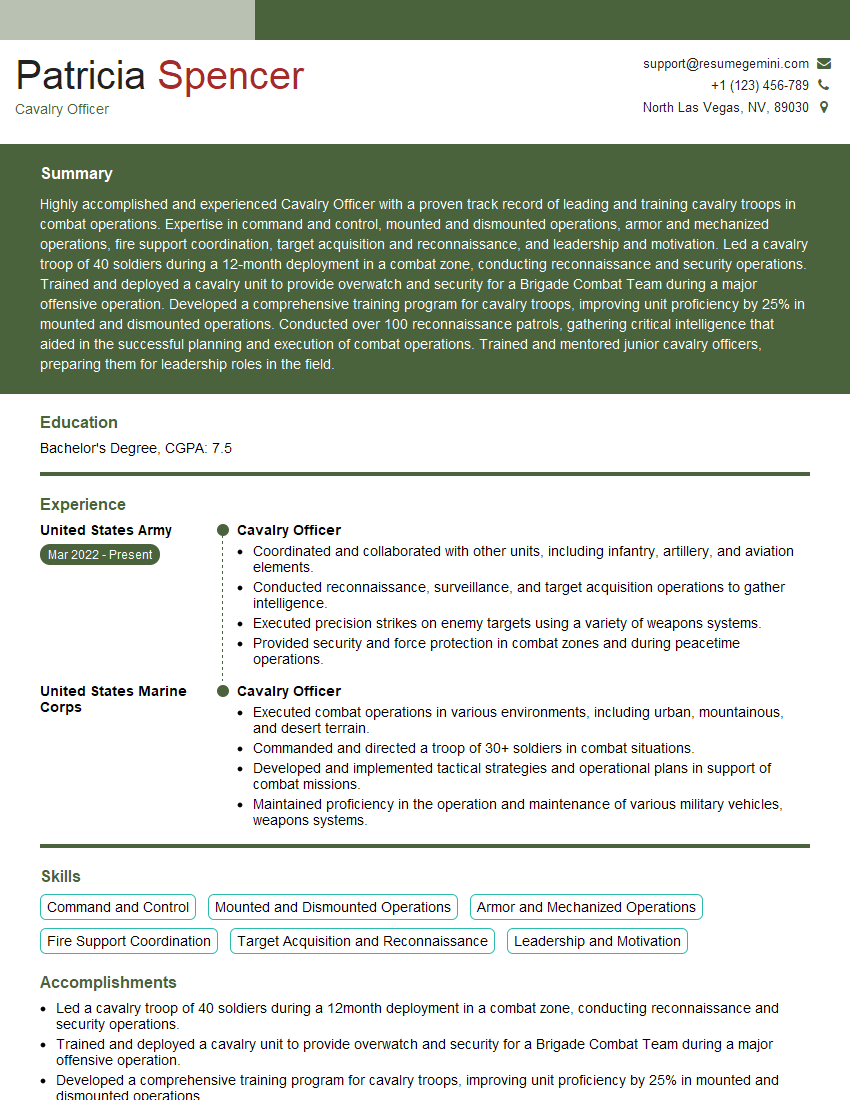
Mastering Cavalry Operations is crucial for career advancement within the military and related fields. A strong understanding of these principles positions you for leadership roles and increased responsibility. To maximize your job prospects, it’s essential to create a resume that effectively communicates your skills and experience to Applicant Tracking Systems (ATS). ResumeGemini is a trusted resource that can help you craft a compelling, ATS-friendly resume that highlights your expertise in Cavalry Operations. Examples of resumes tailored to Cavalry Operations are available to help guide your resume building process.
Explore more articles
Users Rating of Our Blogs
Share Your Experience
We value your feedback! Please rate our content and share your thoughts (optional).
What Readers Say About Our Blog
Very informative content, great job.
good