Cracking a skill-specific interview, like one for Understanding of Printing Principles, requires understanding the nuances of the role. In this blog, we present the questions you’re most likely to encounter, along with insights into how to answer them effectively. Let’s ensure you’re ready to make a strong impression.
Questions Asked in Understanding of Printing Principles Interview
Q 1. Explain the difference between offset and digital printing.
Offset and digital printing are two fundamentally different methods for mass-producing printed materials. Offset printing, the dominant method for large-scale projects, uses an indirect printing process. Ink is transferred from a plate to a rubber blanket, and then from the blanket to the substrate (paper, etc.). Think of it like a two-step kiss. Digital printing, on the other hand, is a direct process. Ink is applied directly to the substrate using an inkjet or laser mechanism, similar to a home printer, but on a much larger scale and with specialized inks and media.
Key Differences Summarized:
- Indirect vs. Direct: Offset is indirect (plate-blanket-substrate); Digital is direct (ink-substrate).
- Setup Time: Offset requires significant setup time for platemaking; Digital is much faster.
- Cost per Unit: Offset is more cost-effective for large print runs; Digital is better for smaller runs or personalized items.
- Run Lengths: Offset excels at high volumes; Digital handles short-run jobs efficiently.
- Image Quality: Both can achieve high quality, though offset often holds a slight edge in fine detail and color consistency for large runs.
Example: Imagine printing 10,000 brochures. Offset would be the economical choice, while for 50 personalized invitations, digital printing would be more practical and efficient.
Q 2. Describe the process of color separation.
Color separation is the process of breaking down a full-color image into its constituent colors – typically cyan (C), magenta (M), yellow (Y), and black (K), known as CMYK. Each color gets its own separate plate in offset printing or a digital equivalent in digital printing. This allows for precise control over ink distribution during the printing process. Think of it like separating layers in Photoshop, but instead of digital layers, we’re creating physical separations for each color.
The Process:
- Scanning/Digital File: The process begins with a high-resolution scan of artwork or a digital file.
- Color Space Conversion: The image is converted from the RGB (red, green, blue) color space commonly used for displays to the CMYK color space used for printing.
- Separation: The software then separates the image into four individual files, one for each color (cyan, magenta, yellow, and black). Each file contains the information needed to create the corresponding plate.
- Platemaking (Offset): In offset printing, these files are used to create four separate printing plates, one for each color.
- Digital Equivalent (Digital Printing): In digital printing, the process is handled internally by the machine, creating the cyan, magenta, yellow, and black images digitally and printing them in the appropriate layers.
Importance: Accurate color separation ensures faithful reproduction of the original image. Improper separation can lead to muddy colors or inaccurate representation of the design.
Q 3. What are the common color spaces used in printing (e.g., CMYK, RGB)?
The most common color spaces in printing are CMYK and RGB, though others like Pantone (PMS) exist.
- CMYK (Cyan, Magenta, Yellow, Key [Black]): This subtractive color model is used in printing. It works by subtracting colors from white light to achieve the desired result. Think of mixing paints – each color subtracts light and results in darker mixes. Mixing all four colors ideally produces black.
- RGB (Red, Green, Blue): This additive color model is used for displaying images on screens. It works by combining red, green, and blue light to produce a range of colors. Adding all three creates white light.
- Pantone Matching System (PMS): This is a proprietary system of spot colors used for accurate color matching, particularly for specific brand colors or where precise color consistency across different print runs is crucial. Pantone colors are pre-mixed inks and not created by combining CMYK.
In short: RGB is for screens; CMYK is for print. Pantone is for precise color matching, often used alongside CMYK.
Q 4. What is a color profile and why is it important?
A color profile is a set of data that describes how a particular device (such as a monitor, scanner, printer) handles colors. It’s essentially a translation guide. It’s crucial because different devices interpret and reproduce colors differently. Without a color profile, the colors on your screen might not accurately reflect the final printed output.
Importance:
- Color Accuracy: Color profiles help to ensure that the colors you see on your screen are accurately represented in the final printed piece.
- Consistency: Using the correct profiles helps maintain color consistency across different devices and print runs.
- Problem Solving: Color profiles help diagnose color issues by providing information about how a specific device is interpreting colors.
Example: If you’re printing a photograph, using the correct printer profile will ensure that the colors in the print are as close as possible to what you saw on your screen. Without it, the print might be overly saturated, too dull, or have incorrect color casts.
Q 5. Explain the concept of dot gain.
Dot gain refers to the increase in the size of a printed dot compared to its size on the printing plate or in the digital file. It happens due to the spreading of ink on the substrate during the printing process. Imagine dropping a drop of water on a paper towel – it spreads out, right? Similarly, ink spreads out, making the printed dots slightly larger than intended.
Causes of Dot Gain:
- Ink Properties: Different inks have varying degrees of spread.
- Paper Type: The absorbency of the paper significantly affects dot gain.
- Printing Pressure: Higher printing pressure leads to greater dot gain.
- Printing Technique: Offset, digital, and other techniques can affect the dot gain.
Impact: Dot gain leads to darker colors and a reduction in detail. Significant dot gain results in muddy colors and loss of image sharpness. Proper calibration of the printing process and using appropriate color management techniques helps to mitigate this effect.
Q 6. What are the different types of printing plates?
Several types of printing plates exist, each with its own properties and applications. Most commonly used in offset lithography:
- Metal Plates (Aluminum): These are the most common type, offering durability and good print quality. Different surface treatments are used to improve ink receptivity and image fidelity.
- Polymer Plates: These are more environmentally friendly than metal plates as they require less processing and can be easily recycled. They may not offer the same longevity or durability as metal plates in very high print runs.
Other types of plates are used in other print processes like flexography or screen printing, but they use different materials and techniques. The choice of plate type depends on several factors like the print run length, the desired print quality, and the environmental considerations. For instance, high volume jobs may favour metal plates for their durability, while short runs might use more cost-effective polymer plates.
Q 7. Describe the process of preparing a file for print.
Preparing a file for print involves a series of critical steps to ensure optimal quality and avoid costly reprints. It’s more than just saving your file as a PDF!
Key Steps:
- Color Mode: Ensure your file is in CMYK color mode, not RGB. RGB is for screens, CMYK is for print.
- Resolution: The resolution should be appropriate for the printing process (e.g., 300 dpi for offset). Images should be at least 300 DPI.
- Bleed: Add bleed (extra space beyond the trim size) to avoid white edges on the final product. Typically 0.125 inches or 3mm.
- Fonts: Outline or embed all fonts to avoid font substitution problems.
- Image Compression: Avoid heavily compressing images as this can significantly reduce print quality.
- Color Management: Use appropriate color profiles to ensure color accuracy throughout the workflow.
- File Format: Save your file as a high-resolution PDF/X-1a or a similar format. This is the industry standard.
- Proofing: Always create a proof to review the file before sending it to the printer. Soft proofs are less costly than a physical proof but will not show all possible issues.
- Communication with Printer: Discuss the project specifics with your printer early in the process. This helps to avoid any last minute issues and ensures that you both are on the same page regarding specifications.
Example: Forgetting to add bleed could lead to unsightly white borders in your final printed piece. Incorrect color profiles could result in the colors being drastically different than your original design. Skipping proofing can lead to serious errors and costly reprints.
Q 8. What is the importance of print resolution?
Print resolution, measured in dots per inch (DPI) or pixels per inch (PPI), dictates the sharpness and detail of a printed image. Higher resolution means more dots or pixels are used to create the image, resulting in a finer, crisper output. Think of it like a digital photograph: a high-resolution image will display far more detail than a low-resolution one. In printing, insufficient resolution leads to blurry text and images, while high resolution ensures sharp, clear results. The required resolution depends on the printing method and the intended use. For instance, a high-quality photo print might require 300 DPI or higher, while a simple document might only need 150 DPI.
For example, if you’re printing a business card with fine text and a logo, a low resolution could render the text illegible and the logo pixelated. Conversely, high resolution ensures all details are sharp and easily readable.
Q 9. What are some common printing defects and how are they corrected?
Common printing defects include banding (uneven ink distribution creating stripes), ghosting (a faint, unintended image appearing behind the main print), mottle (uneven ink coverage resulting in a speckled appearance), and slurring (blurred text or images). These defects stem from various sources including incorrect ink settings, problems with the printing press, paper quality issues, or improper file preparation.
- Banding is often addressed by adjusting the ink density or cleaning the print heads (for inkjet printers) or rollers (for offset presses).
- Ghosting can result from issues with the fuser unit (in laser printing) or from incorrect paper selection. Troubleshooting involves checking the fuser or changing the paper stock.
- Mottle can be caused by inconsistent ink viscosity or incorrect printing pressure. Adjustments to ink and press settings are typically required.
- Slurring often arises from worn components in the print mechanism or incorrect registration. Replacing worn parts or adjusting the registration settings can resolve the issue.
In a professional setting, meticulous troubleshooting involves systematically investigating each potential cause, starting with the simplest solutions and progressing to more complex repairs or adjustments. Often, trial and error are part of the process, carefully noting changes made and observing the effects on the print output.
Q 10. Explain the difference between screen printing and offset printing.
Screen printing and offset printing are distinct methods with different applications and characteristics. Screen printing is a stencil-based method where ink is pushed through a mesh screen onto the substrate (e.g., t-shirt, poster). It’s excellent for vibrant, thick ink layers, and is often used for textiles, posters, and signage. It’s relatively low-cost for small runs but becomes less efficient for large quantities.
Offset printing, on the other hand, uses a plate to transfer ink to a rubber blanket, then to the paper. This indirect transfer allows for high-quality, detailed prints on various substrates, ideal for magazines, brochures, and books. Offset printing excels in producing large quantities cost-effectively. While setup costs are higher, the per-unit cost decreases significantly with increased volume.
In short: screen printing is ideal for vibrant, thick-ink jobs on various surfaces in smaller quantities, while offset printing is better suited for high-volume, high-quality prints on paper, particularly for complex designs and detailed images.
Q 11. What are the various finishing options available after printing?
Post-printing finishing options enhance the visual appeal and durability of printed materials. These include:
- Cutting and Trimming: Precisely cutting printed sheets to the desired size and shape.
- Folding and Binding: Folding leaflets, brochures, or binding books or magazines to create a finished product.
- Laminating: Applying a protective plastic film to enhance durability and water resistance.
- Die-Cutting: Using a custom-shaped die to create unique shapes and designs.
- Embossing/Debossing: Creating raised or indented images for a tactile effect.
- Foil Stamping: Applying metallic foil to add a luxurious touch.
- Perfuming: Adding a scent to the printed material.
The selection of finishing options depends on the type of printed material and its intended purpose. For example, a high-quality brochure might benefit from lamination, embossing, and die-cutting, while a simple flyer might only require cutting and folding.
Q 12. How do you ensure color consistency across different print runs?
Maintaining color consistency across different print runs is crucial for brand identity and visual quality. This involves using a standardized color management system throughout the process, from design to printing. A vital step is using a Pantone Matching System (PMS) or similar color system that provides a unique numerical identifier for each color. This ensures that the same color will be reproduced consistently across different printing presses, inks, and substrates.
Furthermore, proofs are essential—printed samples produced early in the process for review and approval. Color calibration of the printing equipment is paramount, performed regularly to compensate for variations caused by age and usage. Thorough documentation of ink formulations and press settings ensures that the process can be replicated accurately for subsequent print runs. In professional settings, color consistency is an iterative process that relies on rigorous quality control and careful attention to detail.
Q 13. What is a trapping and why is it necessary?
Trapping is a crucial prepress technique used to prevent gaps or misregistration between colors in print. It involves intentionally overlapping adjacent colors by a small amount (typically 0.5-1 point). This overlap compensates for slight misalignments that can occur during the printing process, ensuring clean edges and preventing the appearance of white gaps between colors, especially crucial when printing multiple colors on a press with multiple printing units. Without trapping, small registration errors can be highly visible, ruining the finished product’s appearance.
For example, in a logo with thin lines between colors, if there’s no trapping, slight misregistration can result in visible white gaps. Trapping ensures a clean, professional finish even if there are minor print imperfections.
Q 14. Describe your experience with different types of paper and their suitability for different printing methods.
My experience encompasses various paper types and their suitability for different printing methods. For example, coated paper (glossy or matte) is ideal for high-resolution images and vibrant colors, often used in magazines or brochures, and it’s well-suited for offset and inkjet printing. Uncoated paper (often absorbent) is suitable for letterheads, business cards, or other applications where a less glossy finish is desired. It’s compatible with most printing processes, including offset, digital, and screen printing.
Cardstock, a thicker paper, is often used for business cards or postcards, lending itself well to digital and offset printing and even screen printing (especially for thicker cardstock). Specialty papers, such as textured or recycled papers, offer unique visual effects but may have limitations depending on the printing process. For instance, some textured papers might not be ideal for high-resolution offset printing due to the potential for ink inconsistencies. Choosing the appropriate paper is a critical decision, balancing the aesthetic requirements with the printing process capabilities and the project budget.
Q 15. Explain your understanding of print workflow management.
Print workflow management is the orchestration of all processes involved in taking a design from initial concept to a finished printed product. It’s like a carefully choreographed dance, ensuring every step – from design and pre-press to printing and finishing – flows smoothly and efficiently. Think of it as a project management system specifically tailored to the printing industry.
A typical workflow involves several key stages:
- Design & Pre-flighting: Creating the artwork and ensuring it’s ready for printing (correct color modes, resolutions, fonts embedded, etc.).
- Pre-press: Preparing files for the printing process – this often includes creating printing plates, color separations, and proofing.
- Printing: The actual printing process itself, using various methods like offset, digital, or screen printing.
- Finishing: Post-printing treatments like cutting, folding, binding, lamination, and other value-added processes that enhance the final product.
- Quality Control: Rigorous checks at every stage to ensure quality and consistency.
- Delivery: The final stage, getting the printed product to the client.
Effective workflow management relies on utilizing appropriate software, clear communication, and meticulous attention to detail to avoid costly errors and delays. For example, failing to check for missing fonts before sending files to print can lead to significant setbacks and reprints.
Career Expert Tips:
- Ace those interviews! Prepare effectively by reviewing the Top 50 Most Common Interview Questions on ResumeGemini.
- Navigate your job search with confidence! Explore a wide range of Career Tips on ResumeGemini. Learn about common challenges and recommendations to overcome them.
- Craft the perfect resume! Master the Art of Resume Writing with ResumeGemini’s guide. Showcase your unique qualifications and achievements effectively.
- Don’t miss out on holiday savings! Build your dream resume with ResumeGemini’s ATS optimized templates.
Q 16. What is the role of a Proof in the print process?
A proof is a physical or digital representation of the final printed piece, used to check for accuracy and consistency before mass production. It’s your last chance to catch errors in color, content, layout, and image quality. Imagine it as a dress rehearsal before the big show! Different types of proofs exist, each serving a specific purpose:
- Digital Proof: A soft proof on a screen, convenient for quick review but not fully representative of the final print.
- Soft Proof with Color Calibration: A digital proof with calibrated color settings, offering a more accurate preview of the printed product.
- Hard Proof: A physical print on the intended printing material, offering the most accurate representation of the final product.
Proofs are crucial for client approval and ensuring the final product meets their expectations. Without a proper proof, costly reprints and client dissatisfaction are very likely.
Q 17. How do you handle a client’s request for a specific Pantone color?
Handling Pantone color requests requires precision. Pantone is a standardized color matching system, meaning a Pantone 294 C will always be the same shade of blue, regardless of the printer. To fulfill this request, I’d first confirm the specific Pantone number (e.g., Pantone 186 C). Then:
- Verification: Double-check the Pantone color book for the exact color shade.
- Software Input: Input the correct Pantone code into my design software (e.g., Adobe Illustrator or InDesign). Most professional design applications support Pantone color libraries.
- Color Separation (if necessary): For offset printing, the Pantone color needs to be separated into CMYK values using the appropriate color profile. This process converts the special Pantone ink to a combination of cyan, magenta, yellow, and black inks that the printing press can use.
- Proofing: A color proof is absolutely necessary to verify the accuracy of the Pantone color reproduction before mass printing. I’d generate a hard proof (printed on the same paper stock as the final print run) to ensure color accuracy.
It’s important to manage expectations, since a perfect match is sometimes difficult to achieve across different printers and materials. Clear communication is vital with the client throughout this process.
Q 18. What software programs are you proficient in for pre-press work?
For pre-press work, I’m proficient in a range of software applications, including:
- Adobe Creative Suite (Illustrator, InDesign, Photoshop): These are industry-standard tools for designing, laying out, and preparing print-ready artwork.
- Adobe Acrobat Pro: Essential for creating and managing PDF files, including pre-flighting and adding metadata for proper color profiles.
- Color Management Software (e.g., X-Rite i1Profiler): Software used for accurate color calibration and profiling to ensure consistent color across different devices and printing processes.
- RIP Software (Raster Image Processor): Used to process digital files into a format that a printing press understands.
My experience with these programs allows me to efficiently prepare files for optimal printing, minimize potential issues, and ensure high-quality results.
Q 19. What is your experience with quality control in printing?
Quality control is paramount in printing. My approach involves a multi-stage process that begins with file preparation and extends through the entire workflow:
- Pre-flight Checks: Thoroughly checking for font issues, low-resolution images, color profiles, and bleeds before sending files to print. This prevents errors that can be very costly to correct after printing.
- Proofing and Approval: Obtaining client approval on the proofs and confirming accuracy against the initial design.
- Press Checks: Monitoring the printing process closely – checking color consistency, registration (alignment of different colors), and overall print quality during the printing run.
- Post-Press Inspection: Inspecting the finished products for defects like misaligned folds, damaged pages, or inconsistencies in finishing techniques like binding and lamination. A random sampling of the finished product is done to ensure quality standards.
Proactive quality control measures help reduce waste, avoid costly reprints, and maintain client satisfaction.
Q 20. Explain your understanding of print finishing techniques like binding, lamination, and die-cutting.
Print finishing techniques significantly impact the final product’s appearance, durability, and overall presentation. They add value and enhance the customer experience.
- Binding: The process of holding pages together, including methods like saddle stitch (stapling), perfect binding (glue binding), wire-o binding, and case binding.
- Lamination: Applying a protective film coating to enhance durability, water resistance, and UV protection. This can be gloss, matte, or soft-touch lamination.
- Die-Cutting: Using a custom-shaped die to cut out specific shapes or designs from the paper. This is commonly used for creating unique shapes and designs for business cards, stickers, or packaging.
Selecting the right finishing technique depends heavily on the project’s requirements and the desired effect. For example, a high-end brochure might benefit from case binding and lamination, while a simple flyer might only need a saddle stitch.
Q 21. Describe a situation where you had to troubleshoot a printing problem.
During a large-scale poster printing project, we encountered an unexpected banding issue – uneven color distribution across the printed surface, creating light and dark stripes. After initial investigation, we ruled out software issues and focused on the printing press itself.
Troubleshooting Steps:
- Press Inspection: A thorough examination of the printing press revealed that one of the ink rollers was slightly damaged, causing inconsistent ink application.
- Roller Replacement: The damaged roller was replaced with a new one.
- Test Prints: Test prints were run to ensure the issue was resolved.
- Color Calibration: A color calibration was performed after the roller replacement to make sure the colors were correct.
- Client Communication: We kept the client updated throughout the troubleshooting process, explaining the situation and the steps taken to rectify it.
Through careful observation, systematic troubleshooting, and clear communication, we successfully resolved the issue without significant production delays. This experience highlighted the importance of ongoing maintenance and preventative measures in avoiding potential print problems.
Q 22. What is your experience with different printing presses (e.g., Heidelberg, Komori)?
My experience encompasses a wide range of printing presses, including significant hands-on time with both Heidelberg and Komori machines. I’ve worked extensively with Heidelberg Speedmaster models, specifically the XL series, appreciating their robust build and precision. My expertise extends to color management and fine-tuning these presses for optimal print quality across various substrates. With Komori presses, I’ve gained experience on their Lithrone series, focusing on their advanced automation features and their ability to handle high-volume jobs efficiently. I understand the nuances of each manufacturer’s technology and can troubleshoot issues effectively. For instance, I once resolved a recurring paper jam issue on a Heidelberg press by identifying a subtle misalignment in the feeder, a problem that had previously stumped other technicians. This involved a thorough understanding of the machine’s mechanics and systematic troubleshooting.
Beyond specific models, I possess a strong understanding of the underlying principles of offset lithography, enabling me to adapt quickly to different press configurations and optimize performance regardless of the manufacturer.
Q 23. How do you ensure the sustainability of your print production process?
Sustainability is a core principle in my approach to print production. We achieve this through a multi-pronged strategy focusing on reducing waste, utilizing eco-friendly materials, and optimizing energy consumption. This includes implementing a rigorous system for tracking and minimizing paper waste, carefully selecting FSC-certified papers, and using vegetable-based inks wherever possible. We also invest in energy-efficient equipment and practice responsible disposal of consumables and waste products. For example, we partnered with a local recycling facility specializing in ink and cleaning solvent disposal, ensuring responsible waste management. Moreover, we actively educate clients on sustainable printing practices, guiding them toward environmentally conscious choices like selecting appropriate paper weights and print quantities. This proactive approach minimizes our environmental impact and positions us as responsible leaders in the industry.
Q 24. Explain your understanding of variable data printing.
Variable data printing (VDP) is a powerful technique that allows for personalized print pieces by altering content on each individual copy within a print run. Imagine a mass mailing campaign where each recipient receives a letter addressed to them personally, with their name, address, and perhaps even personalized messaging. That’s the power of VDP. This is achieved by integrating databases with printing equipment, allowing for dynamic content changes within the print stream. My experience with VDP includes working with various software solutions and integrating them with different printing presses. I’ve managed projects involving personalized marketing materials, direct mail campaigns, and even customized product packaging. One notable project involved generating thousands of uniquely personalized birthday cards for a large retail chain, each including a unique discount code and a personalized message based on customer purchase history. This requires a deep understanding of data handling, print workflow, and the integration of different technologies.
Q 25. What is your experience with large-format printing?
My experience in large-format printing spans various applications, from outdoor billboards and posters to indoor signage and trade show displays. I’m proficient in operating large-format inkjet printers and understand the intricacies of different printing technologies, including solvent, eco-solvent, and UV inkjet printing. I have worked with a wide array of substrates, such as vinyl, canvas, and various types of paper, and am familiar with the pre-press and post-press processes required for large-format printing, including cutting, laminating, and mounting. For example, I successfully managed the production of a large-scale mural for a city-wide art initiative, requiring precision in printing, mounting, and ensuring color consistency across large panels. This included careful planning, color profiling, and meticulous quality control to guarantee the project’s high visual impact.
Q 26. How do you manage deadlines and prioritize tasks in a fast-paced print environment?
Managing deadlines and prioritizing tasks in a fast-paced print environment requires a structured approach and excellent organizational skills. I use a combination of project management software and efficient workflow strategies. This includes breaking down complex projects into smaller, manageable tasks, assigning priorities based on deadlines and client urgency, and using Gantt charts to visualize project timelines. Effective communication with clients and internal teams is crucial to ensure everyone is informed and aligned. I also regularly monitor progress, identify potential bottlenecks, and implement corrective actions to keep projects on track. For instance, I once successfully navigated a critical delay in a large print run by re-prioritizing tasks, negotiating with suppliers, and utilizing an alternative printing method to meet a tight deadline. This required adaptability, problem-solving skills, and effective team collaboration.
Q 27. Describe your experience with print estimating and costing.
Print estimating and costing is a critical skill requiring a detailed understanding of production costs, material pricing, and labor. I’m proficient in using industry-standard software and methodologies for creating accurate and competitive estimates. This includes considering all factors contributing to the cost of a print job, such as paper stock, ink, labor, pre-press preparation, and finishing processes. I’m also adept at negotiating with vendors for optimal pricing on materials and services. I create detailed breakdowns of costs, ensuring transparency with clients and avoiding unexpected expenses. I regularly review my estimates against actual production costs to refine my estimating accuracy. This experience enables me to provide accurate and competitive bids, maintaining profitability while maintaining client satisfaction.
Q 28. What are your salary expectations?
My salary expectations are commensurate with my experience and skillset within the industry. I’m open to discussing a competitive compensation package based on the specific responsibilities and benefits offered.
Key Topics to Learn for Understanding of Printing Principles Interview
- Color Theory and Management: Understanding color models (CMYK, RGB, Pantone), color separation techniques, and color profile management for accurate reproduction.
- Pre-press Preparation: Practical application includes file preparation, trapping, imposition, and proofing techniques to ensure print-ready files.
- Printing Processes: A deep understanding of various printing methods (offset, digital, screen, flexography) including their advantages, limitations, and applications.
- Image Resolution and Quality: Theoretical concepts include DPI, PPI, and their impact on print quality. Practical application focuses on selecting appropriate resolutions for different printing methods.
- Paper and Substrate Selection: Understanding different paper types, their properties (weight, finish, texture), and suitability for various printing techniques and applications.
- Print Finishing Techniques: Knowledge of various finishing options like binding, laminating, die-cutting, embossing, and their impact on the final product.
- Troubleshooting and Quality Control: Practical problem-solving approaches to identify and rectify common printing issues, ensuring consistent high-quality output.
- Print Production Workflow: Understanding the entire process from design to delivery, including file transfer, job scheduling, and quality checks.
- Sustainability in Printing: Exploring environmentally friendly printing practices, materials, and processes.
- Industry Standards and Best Practices: Familiarity with relevant industry standards and best practices for efficient and high-quality printing.
Next Steps
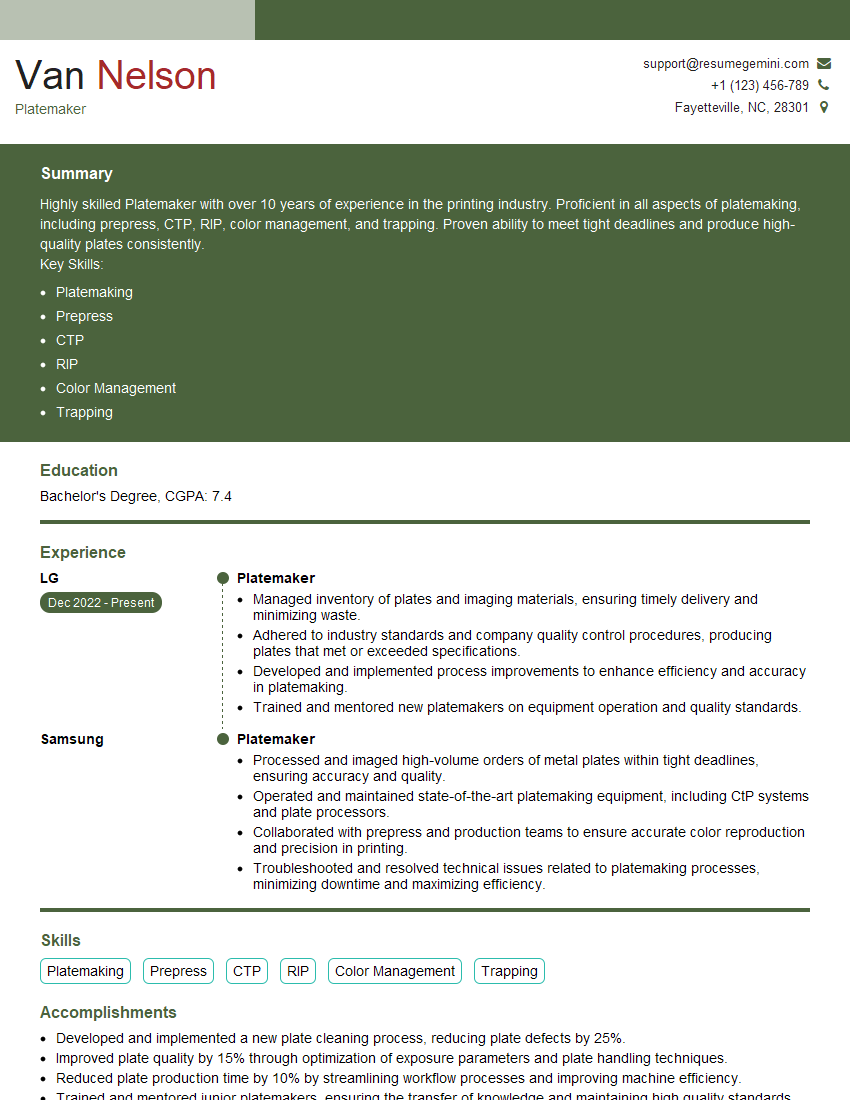
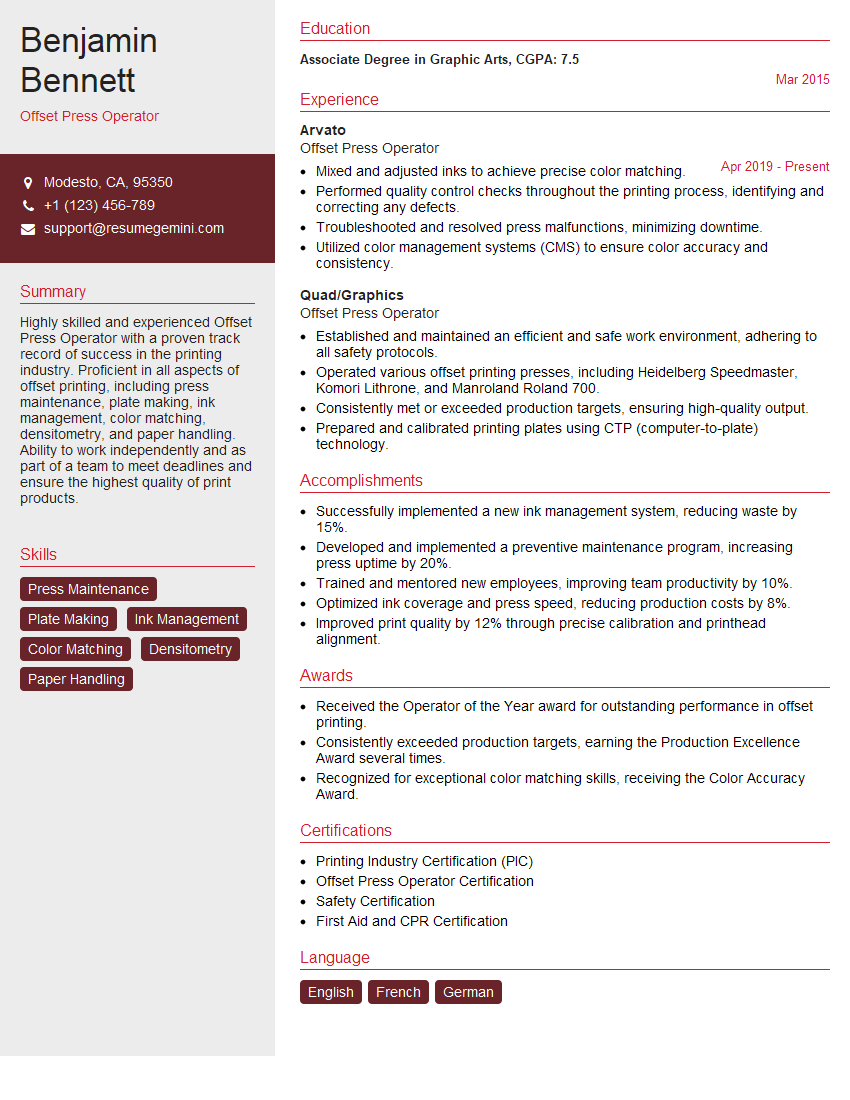
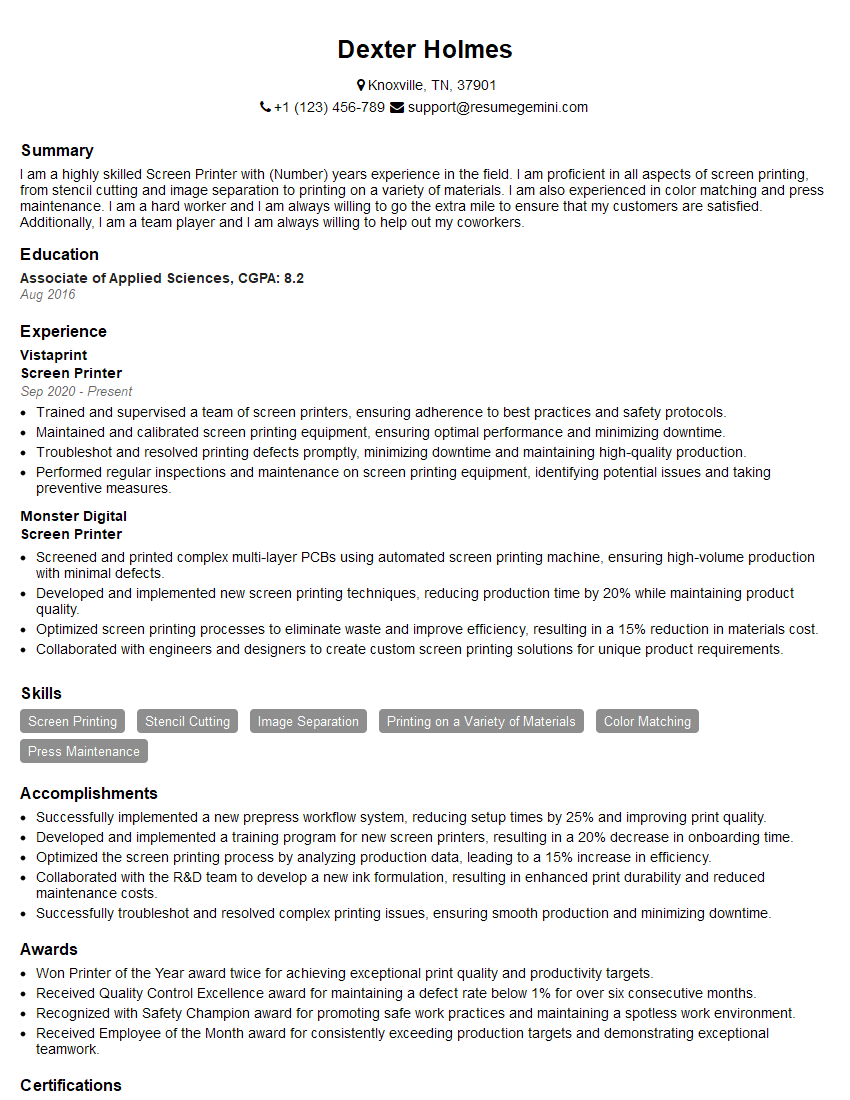
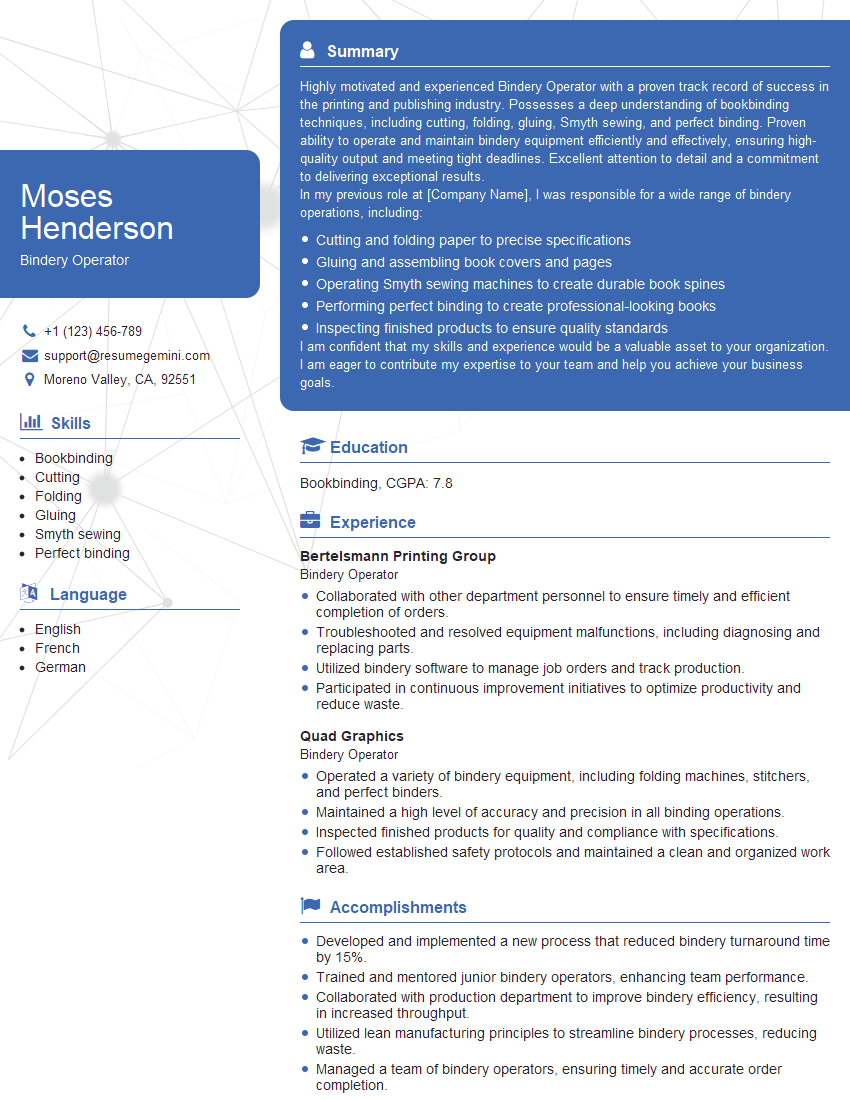
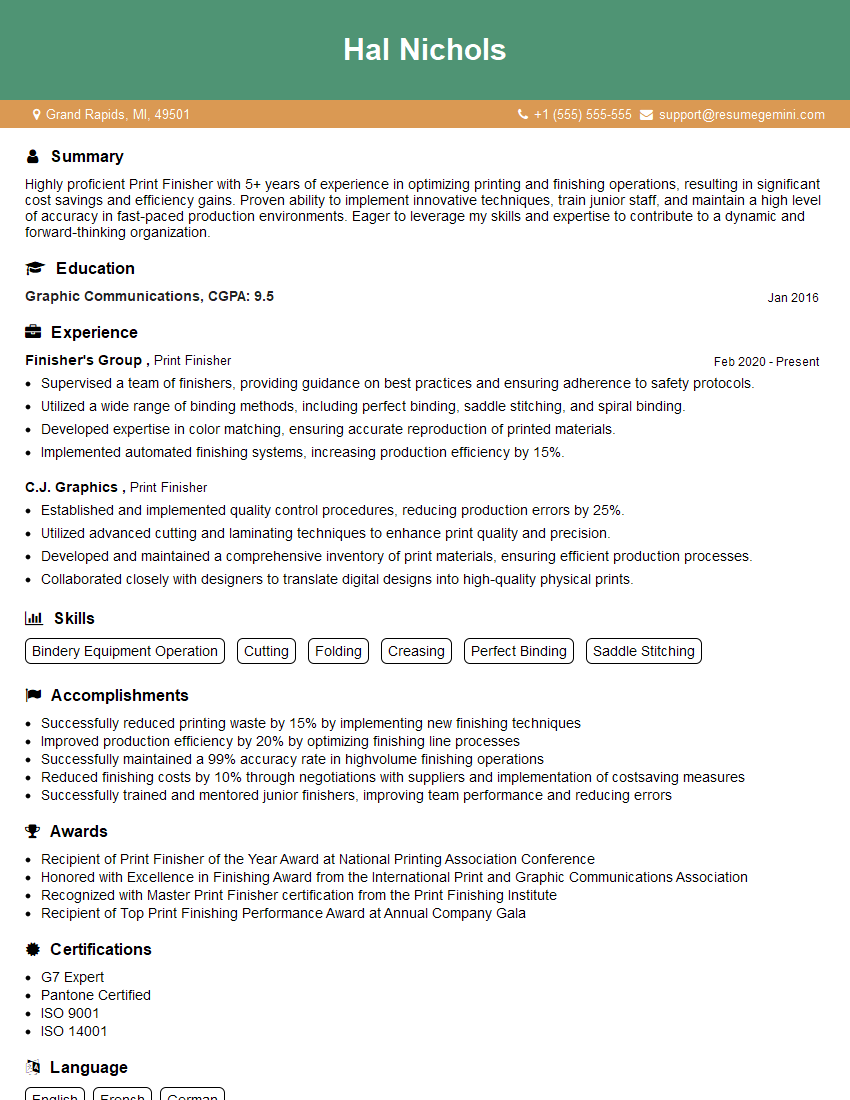
Mastering the principles of printing is crucial for career advancement in the graphic arts and publishing industries. A strong understanding of these concepts demonstrates valuable technical skills and problem-solving abilities, making you a highly competitive candidate. To maximize your job prospects, create an ATS-friendly resume that highlights your relevant skills and experience. ResumeGemini is a trusted resource that can help you build a professional and impactful resume. Examples of resumes tailored to Understanding of Printing Principles are available to guide you through the process.


Explore more articles
Users Rating of Our Blogs
Share Your Experience
We value your feedback! Please rate our content and share your thoughts (optional).
What Readers Say About Our Blog
Very informative content, great job.
good