Preparation is the key to success in any interview. In this post, we’ll explore crucial Understanding of Railroad Signaling and Communication Systems interview questions and equip you with strategies to craft impactful answers. Whether you’re a beginner or a pro, these tips will elevate your preparation.
Questions Asked in Understanding of Railroad Signaling and Communication Systems Interview
Q 1. Explain the principles of track circuits and their role in train detection.
Track circuits are the fundamental building blocks of train detection in railway signaling. They work by using the rails themselves as part of an electrical circuit. A small voltage is applied to the rails within a section of track, and the presence or absence of a train in that section is detected by monitoring the current flow.
Imagine a simple electrical circuit with a battery, a light bulb (representing the signal), and a switch. Normally, the circuit is closed, and the light is on. When a train occupies the track section, the wheels create a low-resistance path to ground, effectively short-circuiting the circuit and turning off the light. This signals to the system that a train is present. The absence of a short circuit indicates that the track section is clear.
Different types of track circuits exist, including:
- DC track circuits: These use direct current and are relatively simple, suitable for shorter distances.
- AC track circuits: These use alternating current and are generally preferred for longer distances due to their ability to overcome impedance issues.
The detection of a train in a track circuit is crucial for preventing collisions. It provides the essential information that prevents multiple trains from occupying the same section of track simultaneously. A failure in track circuitry can lead to serious safety issues.
Q 2. Describe different types of railway signals and their meanings.
Railway signals are visual indicators that convey instructions to train drivers. They use a combination of lights and shapes (aspects) to indicate whether a train can proceed, stop, or take other actions. Different countries might have slightly different standards, but several common aspects exist across various systems.
- Green light: Typically indicates ‘proceed’ allowing the train to continue at permitted speed. Specific speed limits might be enforced by other means like Automatic Train Control (ATC).
- Yellow light (or aspects including yellow): Generally represents a cautionary signal, warning the train driver to reduce speed and be prepared to stop. The exact meaning can vary depending on the combination with other signal aspects and the local signaling rules.
- Red light: Indicates a ‘stop’ signal, and the train must stop before the signal and ensure that the track ahead is clear before proceeding.
- Additional aspects: More complex signaling systems utilize additional aspects incorporating multiple lights (e.g., red and yellow) to convey more specific speed restrictions and information.
The shapes of the signals themselves (e.g., the position of the light on the mast) can also add to the meaning, particularly on older systems, further enhancing the conveying of precise instructions.
Q 3. What are the safety critical aspects of railroad signaling systems?
The safety-critical aspects of railroad signaling systems are paramount because failures can lead to catastrophic consequences like collisions. Key safety considerations include:
- Redundancy and fail-safe design: Systems should be designed to fail safely, such as automatically stopping trains if a signal fails or loses power. Multiple independent systems often support critical functions.
- Signal integrity and reliability: Rigorous testing and maintenance procedures ensure that signals reliably operate as designed, with fail-safe mechanisms to minimize false or misleading signals.
- Train detection accuracy: Accurate detection of train presence and absence is fundamental to preventing conflicts. Track circuits, axle counters, and other detection technologies must be reliable and continuously monitored.
- Human factors and operational procedures: Training programs teach drivers how to interpret and respond correctly to signals. Clear and consistent operational procedures minimize the risk of human error.
- Cybersecurity: Modern signaling systems are increasingly reliant on computer networks, and cybersecurity is crucial to protecting against malicious attacks that could compromise safety.
Regular inspections, testing, and maintenance are vital for maintaining the safety and integrity of railroad signaling systems. A failure in any of these aspects can have potentially devastating effects.
Q 4. How do Automatic Train Control (ATC) systems work?
Automatic Train Control (ATC) systems enhance safety by automatically regulating train speed and location. These systems continuously monitor a train’s position and compare it to authorized speed profiles based on the track configuration and signal aspects. If a train exceeds the permitted speed or enters a forbidden section of track, the ATC system intervenes.
Different types of ATC exist, but commonly they involve:
- Trackside components: These transmit speed and location information to the train.
- On-board equipment: This receives the trackside information, compares it to the train’s actual speed and position, and initiates corrective action.
Corrective actions might include:
- Visual and audible warnings: Alerting the driver of a potential safety violation.
- Automatic braking: Automatically applying the brakes to reduce train speed or bring it to a complete stop.
Think of ATC as a sophisticated cruise control system, ensuring that the train doesn’t exceed the speed limit and stops before signals showing restrictions. It’s an essential layer of safety supplementing human vigilance.
Q 5. Explain the function of wayside controllers in a railroad signaling system.
Wayside controllers are the brains of a local section of a railway signaling system. They manage the signals and track circuits within their defined area, ensuring safe train movements. They receive inputs from various sensors (such as track circuits) and use pre-programmed logic to determine the appropriate signal aspects.
For example, a wayside controller might receive the information from a track circuit that a section of track is occupied. Based on its logic, it would then set the signal protecting that section to red, stopping any following train. Once the track section is cleared, the controller would change the signal aspect to allow trains to proceed.
Wayside controllers are often interconnected with other controllers and a centralized control system, forming a larger network of distributed intelligence. They are critical for safety, coordinating train movements and ensuring that conflicts are avoided.
Q 6. Describe the different communication protocols used in railway signaling.
Railway signaling utilizes several communication protocols, with the choice depending on the specific application and system architecture. Some common protocols include:
- Serial communications (RS-232, RS-485): These simpler protocols are used for point-to-point communication between components within a localized area, like communication between a wayside controller and nearby sensors.
- Ethernet: Increasingly prevalent in modern systems for higher bandwidth data transfer, allowing more data-rich applications and easier integration of various components within a larger network.
- Wireless technologies (e.g., radio, cellular): Used for remote monitoring, control, and data transfer, particularly in situations where cabling is impractical or expensive, often with redundancy to ensure reliable communication.
- Proprietary protocols: Older systems might use proprietary protocols developed by specific manufacturers, adding complexity to integration and maintenance.
Safety and reliability are prioritized in choosing these protocols, and often redundant communication paths are incorporated to ensure that system operation isn’t disrupted by a single communication failure.
Q 7. What is the role of a centralized traffic control (CTC) system?
A Centralized Traffic Control (CTC) system provides a single point for managing and monitoring train movements over a large geographic area. Instead of local controllers managing individual sections of track, a CTC system enables a central operator to control signal aspects, route trains, and manage overall traffic flow across many wayside controllers and stretches of track.
Imagine a large railway network represented on a large screen in a control center. A CTC operator can view the positions of trains, the status of signals, and other operational data. They can then manually manipulate switches and signals to efficiently direct trains through the network, optimizing scheduling and minimizing delays while ensuring that no conflicts arise.
CTC systems dramatically improve efficiency and safety by streamlining traffic management, allowing better coordination of train movements and quick response to unexpected events. Modern CTC systems are often computer-based, using sophisticated software to support the operator.
Q 8. Explain the concept of fail-safe design in railroad signaling systems.
Fail-safe design in railroad signaling is paramount. It’s a philosophy that ensures that in the event of a system failure, the default state is always the safest possible one. Imagine a light switch – if it malfunctions, you want it to default to ‘off,’ preventing a fire risk. Similarly, in railroad signaling, a failure should always result in a stop signal, preventing train collisions. This is achieved through redundancy, where multiple systems and components work in parallel. If one fails, another takes over. For instance, a signal might be controlled by multiple circuits, or a system might have backup power sources. This ensures that even if one component fails, the overall system remains safe and reliable. A common implementation uses relays, where a failure results in the interruption of power, reverting the signal to a stop.
Q 9. How do you troubleshoot a malfunctioning signal system?
Troubleshooting a malfunctioning signal system is a systematic process. It often starts with an observation of the symptom: is a signal failing to change state, is there a communication breakdown, is there a power outage? I’d begin by checking the obvious first: power supply, cable connections, and the integrity of the signal lamps themselves. A circuit tester is used to verify signal pathways, while communication system diagnostics would rely on specialized software to identify network errors or data corruption. This would likely involve checking log files for error messages. If the issue isn’t immediately apparent, I’d consult schematic diagrams and system documentation to trace the signal path and isolate the faulty component. Sometimes, signal failures are caused by environmental factors like lightning strikes or extreme weather, so a thorough inspection of the entire system is necessary. In complex cases, specialized testing equipment might be needed, or even a call to the manufacturer for assistance.
Q 10. What are the different types of signal failures and their potential consequences?
Signal failures can range from minor inconveniences to catastrophic events. A common type is a ‘false clear’ signal, where a signal incorrectly indicates a clear track, potentially leading to a head-on collision. On the other hand, a ‘false stop’ might cause delays but avoids accidents. Communication failures can also be serious; loss of communication between the train and the signaling system can disrupt train control, potentially endangering passengers. Power outages can bring the entire system to a halt, causing significant disruptions and safety concerns. The consequences vary depending on the type and duration of the failure. A short-lived false stop might only cause minor delays, whereas a prolonged false clear signal poses a severe risk of a major accident. I’ve seen instances of signal failures due to equipment malfunction, human error during maintenance, or even vandalism, highlighting the importance of robust design and stringent safety protocols.
Q 11. Describe your experience with signal maintenance and repair procedures.
My experience in signal maintenance and repair involves both preventative and corrective measures. Preventative maintenance includes regular inspections of all components – checking wiring, testing relays, and ensuring proper grounding. I’m proficient in using specialized tools to test circuit continuity and signal strength. Corrective maintenance involves troubleshooting and repairing identified faults. This might range from replacing a faulty bulb to repairing damaged wiring or replacing a malfunctioning relay or circuit board. I’ve worked with various types of signaling equipment, from older electromechanical systems to modern computer-based systems. Proper documentation of all work performed is crucial for tracking maintenance history and ensuring safety. I’m also experienced in working under strict safety regulations, always prioritizing safety over speed during repairs.
Q 12. What safety regulations must be adhered to when working on railroad signaling systems?
Safety regulations when working on railroad signaling systems are extremely strict and paramount. Before any work begins, the track must be secured, and appropriate lockout/tagout procedures must be followed to prevent accidental energization of the system. This ensures that no trains can enter the work zone. Personnel working on the system must be properly trained and qualified, possessing the necessary certifications and safety clearances. Personal protective equipment (PPE), including safety glasses, gloves, and high-visibility clothing, is mandatory. Detailed work permits and risk assessments are essential before commencing any tasks. Furthermore, clear communication protocols must be in place, ensuring everyone involved is aware of the ongoing work and potential hazards. Non-compliance can lead to severe penalties, injuries, or fatalities.
Q 13. How do you ensure the integrity of data transmitted within railway communication systems?
Data integrity in railway communication systems is crucial for safe and efficient operations. We employ several techniques to ensure this. Error detection and correction codes are used to detect and correct errors that might occur during transmission. Redundancy, where data is sent over multiple paths, ensures that if one path fails, the data can still be received. Data encryption protects sensitive information from unauthorized access. Regular system checks and testing are performed to identify and resolve potential issues. Cybersecurity measures are in place to prevent unauthorized access and attacks that might compromise data integrity. Finally, robust protocols for data backup and recovery are implemented to ensure data is preserved even in the event of a major system failure. For example, CRC (Cyclic Redundancy Check) codes are commonly used for error detection, while more sophisticated algorithms can be used for error correction. The use of firewalls and intrusion detection systems are critical in protecting the integrity of the railway communication network.
Q 14. Explain the principles of Positive Train Control (PTC).
Positive Train Control (PTC) is an advanced train control system designed to enhance railway safety. It uses a combination of technologies, including GPS, wireless communication, and onboard computers, to automatically monitor and control train speed and location. If a train exceeds a speed limit or enters a restricted area, PTC will automatically intervene, bringing the train to a safe stop. The system also helps prevent collisions by automatically stopping trains before they enter occupied track. The core principles of PTC include continuous train monitoring, enforcement of speed restrictions, and automatic train stop capabilities. PTC is a layered system; various subsystems work together. A critical part is the communication between the trackside infrastructure and the onboard train system. The system is designed to be fail-safe, reverting to a safe state in case of failure. While implementing PTC is a complex and costly undertaking, the enhanced safety it provides significantly outweighs the investment.
Q 15. What are the challenges in integrating new signaling technologies into existing systems?
Integrating new signaling technologies into existing railway systems presents significant challenges. Imagine trying to replace the plumbing in a 100-year-old building while keeping the water running – it’s complex and risky. The main hurdles include:
- Interoperability: New systems must seamlessly interact with legacy equipment, often involving different communication protocols and data formats. This requires careful planning and extensive testing to ensure compatibility.
- Phased Rollout: A complete system overhaul is usually impractical. Integration often happens in stages, requiring careful management of transition periods and potential disruptions to service.
- Safety Certification: Rigorous testing and certification are essential to ensure the safety and reliability of the integrated system. Meeting stringent regulatory requirements can be time-consuming and expensive.
- Cost: Upgrading signaling systems is a substantial investment, involving hardware, software, installation, testing, and training. Justifying the cost against potential benefits requires a comprehensive cost-benefit analysis.
- Signal Migration Strategies: Developing a robust migration plan is crucial. This involves deciding whether to migrate gradually (parallel operation) or switch over abruptly (cutover). Each approach requires different expertise and resources.
For example, migrating from a traditional track circuit-based system to a modern communication-based train control (CBTC) system requires meticulous planning to handle the coexistence of both systems during the transition phase.
Career Expert Tips:
- Ace those interviews! Prepare effectively by reviewing the Top 50 Most Common Interview Questions on ResumeGemini.
- Navigate your job search with confidence! Explore a wide range of Career Tips on ResumeGemini. Learn about common challenges and recommendations to overcome them.
- Craft the perfect resume! Master the Art of Resume Writing with ResumeGemini’s guide. Showcase your unique qualifications and achievements effectively.
- Don’t miss out on holiday savings! Build your dream resume with ResumeGemini’s ATS optimized templates.
Q 16. Describe different types of communication networks used in railway operations.
Railway operations rely on a variety of communication networks, each suited to specific needs. Think of it like a city’s infrastructure – roads for general traffic, dedicated lanes for buses, and special pathways for emergency vehicles. These networks include:
- Radio Systems: VHF/UHF radio is widely used for communication between train crews, dispatchers, and maintenance personnel. This provides a flexible, real-time communication channel, especially in areas with limited wired infrastructure. Different frequencies are used to prevent interference.
- Ethernet Networks: These are increasingly common for high-bandwidth data transmission between signaling components, control centers, and other systems. They allow for efficient transmission of data from various sensors, providing real-time information for centralized management and monitoring.
- Fiber Optic Networks: Offer high bandwidth, long distances, and superior security and resilience compared to traditional copper cabling. This is ideal for transporting large amounts of data, such as video surveillance or high-definition images from trackside cameras.
- Cellular Networks (GSM-R, LTE-R): These mobile networks offer advantages for efficient communication across wide geographical areas and are increasingly used for train-to-ground communication, providing real-time data for train control, dispatch, and passenger information systems.
- Microwave Systems: Used for long-distance point-to-point communication between remote locations, particularly suitable for situations where laying cables is difficult or impossible.
The choice of network depends on factors like distance, bandwidth requirements, security needs, and cost. Often, a hybrid approach combining several network types is employed to maximize efficiency and reliability.
Q 17. How do you manage conflicts between different signaling systems?
Managing conflicts between different signaling systems requires a layered approach, prioritizing safety and ensuring interoperability. Imagine managing traffic flow at a complex intersection – you need clear rules and coordinated signals. Strategies include:
- Standardization: Adopting common standards and protocols minimizes potential conflicts. This ensures different systems can communicate effectively and exchange data without ambiguity.
- Interface Management: Developing robust interfaces that clearly define the interaction between different systems is critical. This prevents conflicts by ensuring data is exchanged correctly and conflicts are resolved according to pre-defined rules.
- Priority Schemes: Establishing clear priority rules among different systems is necessary, particularly in scenarios involving multiple interlocking systems or train control systems. This ensures a consistent and predictable response in case of conflicts.
- Redundancy and Fail-Safe Mechanisms: Building in redundancy and fail-safe mechanisms to handle system failures or communication outages is essential. This ensures the safety of train operations even in the event of conflicts or malfunctions.
- Conflict Resolution Logic: Implementing sophisticated conflict resolution logic within each system ensures that potential conflicts are addressed proactively and safety is not compromised. This may involve prioritizing certain signals or implementing fallback procedures.
A practical example is the interaction between an Automatic Train Protection (ATP) system and a traditional signaling system. The ATP system has overriding priority in case of conflicting commands, ensuring the safety of the train.
Q 18. Explain the importance of redundancy in railroad signaling and communication systems.
Redundancy is paramount in railroad signaling and communication because safety is non-negotiable. Imagine flying a plane with only one engine – a single point of failure could be catastrophic. Redundancy means having backup systems in place to ensure continued operation even if one component fails. This involves:
- Hardware Redundancy: Having duplicate components (e.g., power supplies, signal processors, communication links) so that if one fails, the other takes over seamlessly.
- Software Redundancy: Employing multiple software layers and failover mechanisms to ensure that the system remains operational even if a software component malfunctions.
- Communication Redundancy: Using multiple communication paths (e.g., fiber optic and microwave links) to ensure that communication is maintained even if one path is disrupted.
- Geographic Redundancy: Distributing critical components across multiple locations to mitigate the impact of localized disasters or failures.
For instance, a critical signaling system might have dual power supplies, separate communication links, and redundant processors. If one processor fails, the other immediately takes over, ensuring uninterrupted operation and maintaining safety.
Q 19. How do you ensure the reliability and availability of railway communication networks?
Ensuring the reliability and availability of railway communication networks is a continuous process involving proactive maintenance, monitoring, and robust design. It’s like maintaining a highway system – regular inspections, timely repairs, and contingency plans are vital. Key strategies include:
- Regular Maintenance: Scheduled maintenance checks and repairs prevent minor issues from escalating into major outages. This includes inspections of hardware, software updates, and testing communication links.
- Network Monitoring: Real-time monitoring of network performance and health allows for early detection of problems before they impact operations. This involves using network management systems that provide alerts and diagnostics.
- Fault Tolerance: Designing networks with inherent fault tolerance ensures that the system continues operating even if components fail. This involves using redundant components, diverse routing paths, and self-healing mechanisms.
- Disaster Recovery Planning: Developing robust disaster recovery plans ensures a quick recovery from unforeseen events, such as natural disasters or cyberattacks. This involves backup systems, alternate communication paths, and well-defined recovery procedures.
- Security Measures: Implementing appropriate security measures protects the network from unauthorized access and cyber threats, ensuring the integrity and reliability of the system. This includes firewalls, intrusion detection systems, and access control measures.
For example, a railway might use a distributed network architecture with multiple points of failure, ensuring that if one part of the network fails, other parts can still operate and maintain communication.
Q 20. What are the common causes of signal system failures?
Signal system failures can stem from various causes, ranging from simple hardware malfunctions to complex software errors. It’s like diagnosing a car problem – you need a systematic approach. Common causes include:
- Hardware Failures: This includes failures of components such as track circuits, relays, signal heads, cables, and power supplies. Age, wear and tear, and environmental factors contribute to these failures.
- Software Glitches: Software bugs, unexpected inputs, or configuration errors can lead to unexpected system behavior or malfunctions. This necessitates rigorous testing and software maintenance.
- Environmental Factors: Extreme weather conditions, such as heavy rain, snow, or ice, can damage equipment and disrupt communication lines. Lightning strikes can also cause significant damage.
- Human Error: Mistakes in installation, maintenance, or configuration can lead to signal failures. Proper training and clear procedures are essential to minimize human error.
- Cybersecurity Threats: Malicious attacks or unauthorized access can compromise the integrity and reliability of signal systems, requiring robust cybersecurity measures.
A classic example is a track circuit failure due to a broken rail, causing a signal to malfunction and potentially resulting in a train collision. Regular inspections and preventative maintenance help to mitigate these risks.
Q 21. What are the different methods of testing and validating railroad signaling systems?
Testing and validating railroad signaling systems are critical to ensuring safety and reliability. It’s like testing a new aircraft design – rigorous testing is mandatory before passenger flights. Methods include:
- Simulation Testing: Using computer simulations to model various scenarios and test the system’s response under different conditions. This allows for efficient and cost-effective testing of different failure modes.
- Hardware-in-the-Loop (HIL) Testing: Connecting real hardware components to a simulated environment to test their interaction with the rest of the system. This provides a more realistic test environment compared to pure software simulation.
- Field Testing: Testing the system in the actual operational environment, involving controlled scenarios and observations. This is essential to verify that the system works as intended in real-world conditions.
- Acceptance Testing: A final verification process conducted by an independent authority to ensure the system meets all safety and performance requirements before it’s deployed. This ensures compliance with regulatory standards.
- Continuous Monitoring and Diagnostics: After deployment, the system is continuously monitored for performance and potential issues. This enables quick detection and resolution of any problems that arise during operation.
For example, HIL testing might involve connecting a real signal head to a simulated track circuit and train to verify the signal’s response to different train speeds and positions.
Q 22. Describe your experience with different types of signal equipment and their maintenance.
My experience encompasses a wide range of signaling equipment, from traditional electromechanical systems to modern computer-based interlocking systems and positive train control (PTC) technologies. I’ve worked extensively with various components, including:
- Signal heads: I’m familiar with maintaining both LED and traditional light signal heads, troubleshooting issues like lamp failures, lens cracks, and circuit malfunctions. This includes understanding the different aspects and lens configurations for conveying various train movement commands.
- Track circuits: I’ve performed regular inspections and maintenance on track circuits, which are essential for detecting train occupancy. This involves understanding the intricacies of AC and DC track circuits, identifying insulation faults, and resolving continuity issues to ensure accurate train detection.
- Interlocking systems: My experience includes working with both electromechanical and solid-state interlockings. I’m proficient in diagnosing and repairing failures in these crucial systems that control the movement of trains within a railway yard or junction, ensuring that conflicting movements are prevented. This includes understanding relay logic and modern software-based control systems.
- Centralized traffic control (CTC) systems: I have experience maintaining and troubleshooting CTC systems, which allow for remote control and monitoring of signals and switches. This involves working with sophisticated software interfaces and understanding network communication protocols.
- Wayside devices: This includes axle counters, point machines, and other equipment essential to train operation and safety. I’m adept at both preventative and corrective maintenance procedures on these devices.
Maintenance involves preventative measures like regular inspections, cleaning, and testing, as well as corrective actions for failures. We use a combination of scheduled maintenance plans and condition-based monitoring techniques to optimize maintenance efforts and minimize downtime.
Q 23. Explain the role of signaling in improving railway safety and efficiency.
Railroad signaling plays a vital role in enhancing both safety and efficiency. Safety is paramount, and signaling systems prevent collisions by ensuring that trains maintain safe distances and follow predetermined routes. This is achieved through various mechanisms:
- Train separation: Signals indicate to train drivers whether a section of track is occupied, preventing rear-end collisions.
- Route setting: Interlocking systems ensure that conflicting train movements are prevented by only allowing safe routes to be established.
- Speed control: Signals can enforce speed restrictions in areas where caution is needed, such as approaching curves or junctions.
- Warning systems: Advance warning systems alert drivers to potential hazards such as track defects or approaching trains.
In terms of efficiency, signaling improves train flow and reduces delays by:
- Optimizing train schedules: Efficient signaling allows for closer train spacing, leading to increased capacity and improved punctuality.
- Reducing congestion: Intelligent signaling systems can manage traffic flow in complex areas, minimizing delays and congestion.
- Automated train operation (ATO): Modern signaling systems can support automated train operations, further enhancing efficiency and reducing human error.
Imagine a busy railway junction without a signaling system – the chaos would be unimaginable. The signaling system is the traffic controller of the railway network, ensuring both safe and efficient movement of trains.
Q 24. How do you stay updated on the latest advancements in railroad signaling technologies?
Staying current in this rapidly evolving field requires a multifaceted approach:
- Professional organizations: I actively participate in professional organizations like the AREMA (American Railway Engineering and Maintenance-of-Way Association) and attend their conferences and workshops. These provide access to the latest research, best practices, and technological advancements.
- Industry publications and journals: I regularly read industry publications and journals focusing on signaling and communication technologies to keep abreast of new developments and research findings.
- Vendor training programs: Manufacturers of signaling equipment frequently offer training programs on their latest products and technologies. I actively seek out these opportunities to enhance my knowledge and skills.
- Online courses and webinars: Numerous online resources provide training and updates on signaling technologies. I leverage these to continuously improve my expertise.
- Networking: Attending industry events and networking with other professionals provides valuable insights and perspectives on emerging trends.
Continuous learning is crucial in this field, as new technologies and challenges constantly emerge. It’s not just about keeping up; it’s about anticipating future developments and integrating them into my work.
Q 25. Describe a situation where you had to solve a complex signaling problem.
During a major system upgrade at a busy freight yard, we experienced intermittent signal failures affecting train movements. The problem was initially diagnosed as a faulty power supply, but replacing the power supply didn’t resolve the issue. The failures were sporadic, making diagnosis challenging.
My approach involved a systematic troubleshooting process:
- Data analysis: We analyzed system logs and operational data to identify patterns in the failures. This revealed that the failures were correlated with high-power consumption events in other parts of the yard.
- Circuit tracing: We meticulously traced the signal circuits, identifying all connected components and measuring voltages and currents. We discovered a hidden ground loop in a section of cabling that was creating interference.
- Isolation testing: By isolating sections of the cabling, we were able to pinpoint the source of the interference. The ground loop was causing voltage spikes that were triggering the failures.
- Remediation: We corrected the ground loop by properly grounding the cabling and implementing noise filters. This eliminated the interference and resolved the intermittent signal failures.
The solution involved understanding not only the signaling system but also its interaction with other electrical systems in the yard. The ability to systematically approach a complex problem, employing methodical troubleshooting techniques, was key to resolving the issue.
Q 26. What is your understanding of cybersecurity threats to railway signaling systems?
Cybersecurity threats pose a significant risk to modern railway signaling systems. These systems are becoming increasingly reliant on networked components and software, making them vulnerable to various attacks:
- Network intrusions: Hackers could gain unauthorized access to the signaling system’s network, potentially disrupting train operations or even causing accidents.
- Data breaches: Sensitive data stored within the signaling system could be targeted, leading to operational disruptions or even financial losses.
- Malware attacks: Malicious software could infect the system, corrupting data or causing malfunctions in the signaling equipment.
- Denial-of-service (DoS) attacks: DoS attacks could overload the system, making it unavailable and disrupting train operations.
Mitigation strategies involve a multi-layered approach incorporating:
- Network security: Implementing firewalls, intrusion detection systems, and secure network configurations.
- Software security: Regular software updates, patching security vulnerabilities, and secure coding practices.
- Physical security: Protecting signaling equipment from unauthorized physical access.
- Redundancy and failover mechanisms: Designing systems with redundant components and failover mechanisms to maintain operations in case of failure.
- Cybersecurity training: Educating personnel about cybersecurity threats and best practices.
It’s a continuous battle, requiring proactive measures and ongoing vigilance to protect these critical systems from cyber threats.
Q 27. How do you prioritize maintenance tasks in a railroad signaling system?
Prioritizing maintenance tasks in a railroad signaling system requires a balanced approach combining risk assessment, criticality, and resource constraints. We utilize a combination of methods:
- Criticality analysis: We assess the criticality of each component based on its impact on safety and train operations. Components crucial for safe train operation receive higher priority.
- Risk assessment: We evaluate the risk of failure for each component, considering factors like age, condition, and operating environment. High-risk components receive higher priority.
- Manufacturer recommendations: We adhere to manufacturer recommendations for maintenance intervals and procedures.
- Condition-based monitoring: We use advanced monitoring techniques to track the health of components and prioritize maintenance based on actual condition rather than solely on scheduled intervals.
- Resource allocation: We consider the available resources, including personnel, equipment, and budget, when prioritizing maintenance tasks.
Imagine a scenario where you have a limited maintenance crew and several tasks to complete. You would prioritize the task that poses the highest risk to safety and operational efficiency, even if it means postponing less critical tasks. It’s about optimizing maintenance activities to minimize risk while maximizing the effectiveness of resource allocation.
Q 28. Explain the impact of weather conditions on railroad signaling systems.
Weather conditions significantly impact railroad signaling systems. Extreme weather can cause various problems:
- High winds: Strong winds can damage signal structures, causing signal failures or misalignments. This includes the physical structures that hold signals, as well as potentially damaging the electrical components.
- Heavy rain and snow: Accumulated snow and ice can obstruct visibility and cause short circuits in signal equipment. Heavy rain can lead to water ingress in housings, causing corrosion and component failures.
- Lightning strikes: Lightning strikes can directly damage signal equipment, causing significant disruptions.
- Extreme temperatures: Extreme heat and cold can affect the performance and reliability of electronic components. Extreme cold can also cause signal failures in track circuits.
- Flooding: Flooding can submerge track circuits and other equipment, causing major disruptions and potential damage.
Mitigation strategies include:
- Protective measures: Using weatherproof housings, lightning arrestors, and other protective measures to safeguard equipment from the elements.
- Regular inspections: Conducting regular inspections to identify and address potential issues caused by weather conditions.
- Emergency response plans: Having well-defined emergency response plans to deal with weather-related signal failures.
- Redundancy: Using redundant systems to minimize the impact of weather-related failures.
The railway system needs to be robust to weather events. Failing to account for adverse weather conditions can lead to significant disruptions and safety hazards.
Key Topics to Learn for Understanding of Railroad Signaling and Communication Systems Interview
- Fundamentals of Railway Signaling: Understand the basic principles of railway signaling, including the purpose, types (e.g., absolute permissive, automatic block), and functions of signals.
- Signal System Components: Familiarize yourself with the various components of a railway signaling system, such as track circuits, signals, interlockings, and their interactions.
- Communication Systems in Railways: Explore different communication systems used in railway operations, including radio systems, train-to-ground communication, and data transmission methods.
- Safety and Regulations: Gain a thorough understanding of safety regulations and procedures related to railway signaling and communication, including failure analysis and emergency response protocols.
- Practical Application: Be prepared to discuss real-world scenarios involving signal failures, communication breakdowns, and how these situations are handled using established procedures.
- Troubleshooting and Problem-Solving: Develop your ability to analyze problems within signaling and communication systems, identifying the root cause and proposing effective solutions.
- Modern Technologies: Explore the integration of modern technologies such as CBTC (Communications-Based Train Control), ETCS (European Train Control System), and their impact on railway operations and safety.
- Maintenance and Inspection: Understand the importance of regular maintenance and inspection of signaling and communication equipment, and the associated procedures.
Next Steps
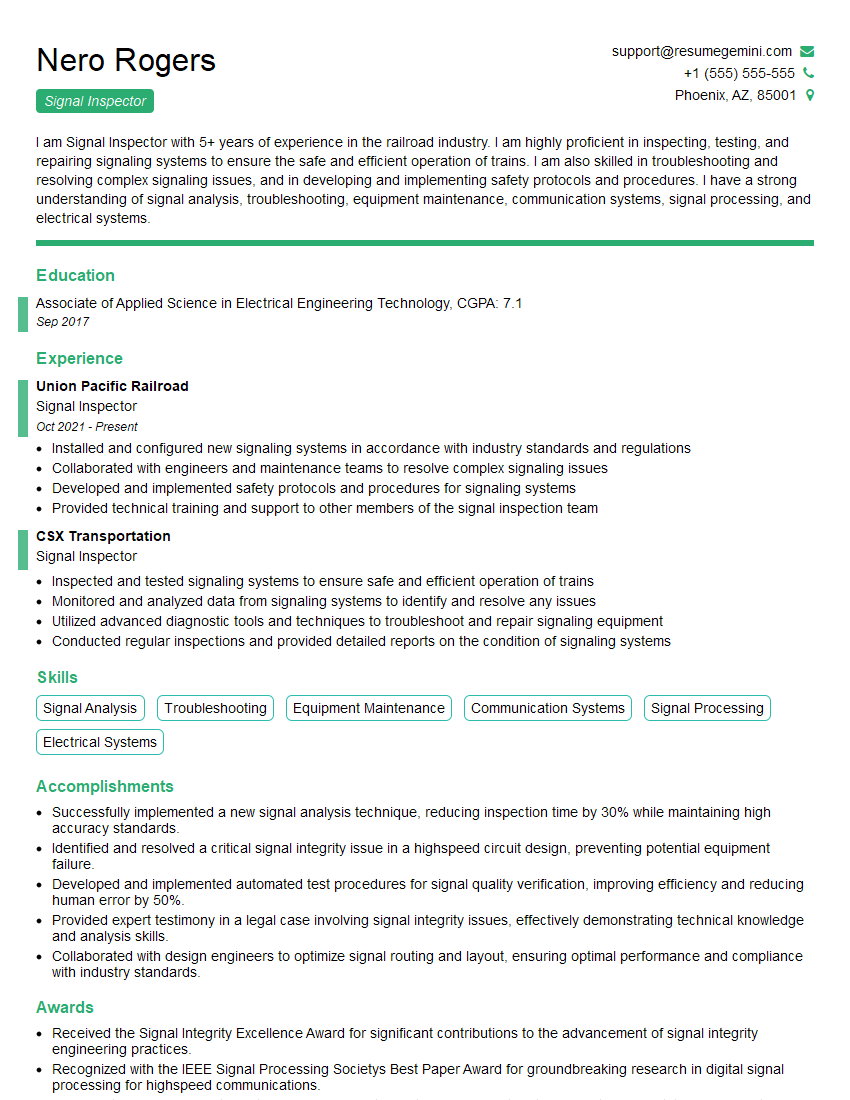
Mastering Understanding of Railroad Signaling and Communication Systems is crucial for career advancement in the railway industry. It demonstrates a deep commitment to safety and operational efficiency, opening doors to more senior roles and specialized positions. To maximize your job prospects, it’s essential to present your skills effectively. Creating an ATS-friendly resume is key to getting your application noticed. ResumeGemini is a trusted resource that can help you build a professional and impactful resume, ensuring your qualifications stand out to potential employers. Examples of resumes tailored to Understanding of Railroad Signaling and Communication Systems are available within ResumeGemini to help guide your creation.


Explore more articles
Users Rating of Our Blogs
Share Your Experience
We value your feedback! Please rate our content and share your thoughts (optional).
What Readers Say About Our Blog
Very informative content, great job.
good