Are you ready to stand out in your next interview? Understanding and preparing for Use of Meteorological Data interview questions is a game-changer. In this blog, we’ve compiled key questions and expert advice to help you showcase your skills with confidence and precision. Let’s get started on your journey to acing the interview.
Questions Asked in Use of Meteorological Data Interview
Q 1. Explain the difference between weather and climate.
Weather and climate are often confused, but they represent different timescales of atmospheric conditions. Think of it like this: weather is what’s happening outside right now – the temperature, humidity, precipitation, wind, and cloud cover at a specific location and time. It can change dramatically within minutes or hours. Climate, on the other hand, is the average weather pattern of a region over a long period, typically 30 years or more. It describes the overall trends and statistical variations in temperature, rainfall, and other atmospheric factors for a given area.
For example, a sunny day with a high of 75°F is a weather condition. However, a region experiencing consistently mild winters and hot, dry summers for decades describes its climate. Understanding the difference is vital because weather forecasting deals with short-term predictions, while climate studies analyze long-term patterns and changes.
Q 2. Describe the various types of meteorological data.
Meteorological data encompasses a wide range of measurements crucial for understanding and predicting weather patterns. These data types can be broadly categorized:
- Surface Observations: These are measurements taken at ground level, including temperature, humidity, wind speed and direction, atmospheric pressure, precipitation (rain, snow, etc.), visibility, and cloud cover. This is the foundation of most weather analyses.
- Upper-Air Observations: These observations are taken at various altitudes using weather balloons (radiosondes), providing data on temperature, humidity, wind speed and direction, and pressure in the atmosphere’s vertical profile. Understanding upper-air conditions is critical for predicting storms and large-scale weather systems.
- Satellite Data: Satellites orbiting Earth provide imagery and measurements covering vast areas. This data includes cloud cover, temperature profiles, water vapor content, sea surface temperature, and even snow and ice cover. Satellite data is invaluable for monitoring large-scale weather phenomena and inaccessible regions.
- Radar Data: Weather radar uses radio waves to detect precipitation and estimate its intensity and movement. This provides vital information about storms, including their location, size, and intensity, enhancing short-term forecasting and warning systems.
- Lightning Data: Detecting lightning strikes provides crucial insights into thunderstorm development and intensity, further improving storm tracking and warnings.
Each data type contributes uniquely to a complete weather picture. Combining these sources allows for comprehensive analysis and more accurate forecasts.
Q 3. What are the primary sources of meteorological data?
Meteorological data originates from several key sources:
- Surface Weather Stations: These are ground-based stations equipped with instruments to measure various atmospheric parameters, forming the backbone of surface-level weather data collection.
- Weather Balloons (Radiosondes): These balloons carry instruments that measure atmospheric conditions as they ascend, providing vertical profiles of temperature, humidity, wind, and pressure.
- Weather Satellites: Geostationary and polar-orbiting satellites provide continuous monitoring of global weather patterns, offering imagery and measurements from space.
- Weather Radar: Radar systems detect precipitation and estimate its characteristics, aiding storm tracking and forecasting.
- Aircraft Observations: Data from aircraft, especially those equipped with weather-sensing equipment, are useful in gathering information from otherwise sparsely-observed regions.
- Automated Weather Stations (AWS): These are remote, self-operated stations that transmit data remotely, crucial for covering vast areas or challenging terrains.
The quality and quantity of data depend on the density and sophistication of the observational network in a given region. Advanced technologies and data integration improve forecasting accuracy.
Q 4. How are weather models used in forecasting?
Weather models are sophisticated computer programs that simulate the atmosphere’s behavior using mathematical equations based on the laws of physics. These models ingest meteorological data from various sources (discussed earlier) and use them as initial conditions. The model then runs these equations forward in time, predicting how atmospheric variables will evolve. The process essentially involves:
- Data Assimilation: Combining observed data with the model’s previous state to produce the best possible initial conditions. (This is covered in more detail in a later answer).
- Model Integration: Numerically solving the equations, stepping through time to produce a forecast.
- Post-processing: Transforming model output (often in gridded format) into user-friendly products like maps, charts, and textual summaries.
Different models exist, each with strengths and limitations. Some models focus on global-scale weather, while others specialize in regional or very localized forecasting. Ensemble forecasting runs the model multiple times with slightly varied initial conditions to provide a range of possible outcomes and improve forecast reliability. For example, the Global Forecast System (GFS) is a widely used global weather model, while the High-Resolution Rapid Refresh (HRRR) specializes in high-resolution forecasts for the U.S.
Q 5. Explain the concept of atmospheric pressure and its importance in weather forecasting.
Atmospheric pressure is the force exerted by the weight of the air above a given point. It’s measured in units like millibars (mb) or hectopascals (hPa). High pressure systems typically indicate sinking air, leading to clear skies and fair weather. Conversely, low-pressure systems often feature rising air, which can lead to cloud formation, precipitation, and sometimes severe weather.
Importance in forecasting: The pressure gradient – the difference in pressure between two locations – drives wind. Strong pressure gradients result in stronger winds. Weather forecasting uses pressure data to identify areas of high and low pressure, predict wind speed and direction, and forecast the movement and development of weather systems. Changes in pressure can indicate approaching storms or shifts in weather patterns. For instance, a rapidly falling barometer (pressure decreasing) often suggests an approaching low-pressure system, signaling potentially stormy conditions.
Q 6. Describe the different types of atmospheric fronts and their associated weather patterns.
Atmospheric fronts are boundaries separating air masses with different temperatures and humidity. Several types exist:
- Cold Front: A cold air mass pushes into a warmer air mass. This often leads to rapid cooling, strong winds, heavy precipitation, and sometimes thunderstorms. The passage of a cold front is usually marked by a sharp temperature drop.
- Warm Front: A warm air mass moves over a cooler air mass. This usually leads to a gradual rise in temperature, light to moderate precipitation (often drizzle or light rain), and cloudiness. The precipitation often precedes the arrival of the warm air.
- Stationary Front: A boundary between two air masses where neither is strong enough to advance significantly. This can lead to prolonged periods of cloudiness and precipitation.
- Occluded Front: A complex front that forms when a cold front catches up to a warm front. The resulting weather can be variable, depending on the temperatures and humidities of the involved air masses.
Understanding these different fronts and their associated weather patterns is crucial for accurate weather forecasting and warning of severe weather events. Weather maps commonly depict these fronts using symbols, allowing meteorologists to track their movement and predict future weather conditions.
Q 7. Explain the process of data assimilation in numerical weather prediction.
Data assimilation is a crucial step in numerical weather prediction (NWP). It’s the process of optimally combining observational data with the model’s forecast to produce the best possible initial conditions for the next forecast run. It’s like taking a blurry photograph (the model’s prediction) and sharpening it using a clearer, more detailed picture (the observational data).
The process typically involves:
- Observation Preprocessing: Checking the data quality, correcting errors, and converting it to a format compatible with the model.
- Background Forecast: Generating a forecast using the model with its previous state as the starting point.
- Analysis: Optimally combining the background forecast with the observations to generate an improved initial condition, balancing model consistency and observational accuracy.
Several techniques exist for performing data assimilation, including variational methods (like 3D-Var and 4D-Var) and Kalman filtering. The choice of method depends on the model, the type of data, and the computational resources available. The goal is always the same: to produce an initial state that accurately reflects the true state of the atmosphere, leading to more accurate and reliable weather forecasts. Improved data assimilation techniques have significantly enhanced the skill of NWP over the years.
Q 8. How do you interpret weather charts and maps (e.g., surface analysis, upper-air charts)?
Interpreting weather charts and maps involves understanding the symbols, contours, and patterns representing atmospheric conditions. Surface analysis charts show current weather conditions at ground level, displaying things like temperature, pressure, wind speed and direction, precipitation, and cloud cover. Upper-air charts, on the other hand, illustrate conditions at various altitudes, revealing crucial information about atmospheric stability, jet streams, and the movement of weather systems.
For example, on a surface analysis chart, a tightly packed group of isobars (lines of equal pressure) indicates a strong pressure gradient, suggesting strong winds. A symbol depicting a cold front signifies the boundary between a cold and warm air mass, usually associated with precipitation and rapid temperature changes. On upper-air charts, the height of the 500mb contour (a line of constant atmospheric pressure) helps to identify troughs and ridges, which are associated with cyclonic and anticyclonic circulation, respectively, directly influencing surface weather.
To interpret these charts effectively, I look for patterns and relationships between different variables. For example, I would consider the interaction between surface pressure systems and upper-level winds to predict the movement and intensification of weather systems. I also rely on my experience to understand the typical weather patterns for a given region and season. This allows me to more accurately predict the evolution of weather systems and the associated impacts.
Q 9. What are some common limitations of weather forecasting?
Weather forecasting, while incredibly advanced, faces inherent limitations. The atmosphere is a chaotic system, meaning small initial changes can lead to dramatically different outcomes. This ‘butterfly effect’ limits predictability, especially beyond a few days.
- Data limitations: Our observational network, while extensive, still has gaps, particularly over oceans and remote regions. Incomplete data leads to uncertainties in model inputs.
- Model limitations: Numerical weather prediction (NWP) models, while powerful, are simplifications of complex atmospheric processes. They can’t perfectly capture all the intricate interactions within the atmosphere.
- Subgrid-scale processes: Many important weather phenomena, like thunderstorms, occur on scales smaller than the grid resolution of NWP models. Their impact must be approximated, introducing uncertainty.
- Data assimilation challenges: Combining observations from diverse sources (satellites, radar, surface stations) into a consistent picture for the model is a complex and challenging process.
Imagine trying to predict the trajectory of a single leaf in a strong wind. While we can model the overall wind pattern, the leaf’s specific path is incredibly sensitive to small variations in the wind’s strength and direction, making precise prediction difficult.
Q 10. Explain the concept of ensemble forecasting.
Ensemble forecasting is a technique that runs a weather prediction model multiple times, each with slightly different initial conditions and/or model parameters. This produces a range of possible future weather scenarios, providing a more comprehensive picture of forecast uncertainty than a single deterministic forecast.
Instead of giving a single temperature prediction, for example, an ensemble forecast might show a range of possible temperatures with associated probabilities. This gives users a better understanding of the reliability of the forecast. Imagine shooting arrows at a target—a single arrow represents a deterministic forecast, whereas a cluster of arrows represents an ensemble forecast, showing the spread and likely location of the hits.
The spread of the ensemble members (the range of forecasts) indicates the level of uncertainty in the forecast. A narrow spread suggests high confidence in the prediction, while a wide spread signals greater uncertainty. This information allows meteorologists and users to make more informed decisions, considering the likelihood of different outcomes.
Q 11. Describe your experience with different meteorological instruments and their applications.
My experience encompasses a wide range of meteorological instruments, each crucial for collecting different data types. For example, I’ve extensively used automatic weather stations (AWS) that measure temperature, humidity, wind speed and direction, precipitation, and atmospheric pressure. These provide crucial surface-level data for numerical weather prediction models and real-time weather monitoring.
I’m also proficient in using weather radar systems to detect and track precipitation, estimating its intensity and type. Weather radar data is vital for short-term forecasting of severe weather events like thunderstorms and floods. Satellite imagery provides a synoptic view of atmospheric conditions, including cloud cover, temperature, moisture profiles, and snow cover, allowing for analysis of larger-scale weather patterns. I have used various satellite data products from both geostationary and polar-orbiting satellites to study weather systems’ development, movement and intensity. Finally, I have experience with radiosondes, which are weather balloons carrying instruments that measure atmospheric conditions at various altitudes, providing crucial upper-air data for weather models.
Q 12. How do you handle missing or inaccurate meteorological data?
Handling missing or inaccurate data is critical for reliable weather analysis. Various techniques are used to address these issues. For missing data, spatial interpolation techniques are used to estimate values based on surrounding data points. Simple methods like nearest neighbor interpolation are used if data sparsity is low. If the data are more spatially continuous, Kriging interpolation, which considers spatial autocorrelation in data, is preferred.
Temporal interpolation can fill in missing time series data. Linear interpolation is a common approach, while more sophisticated methods like spline interpolation provide smoother estimations. For inaccurate data, quality control procedures are essential. This usually involves checking for outliers – values that are significantly different from neighboring values – and applying range checks to ensure values fall within realistic bounds.
In some cases, outlier data points might be removed if they are deemed erroneous. Advanced techniques, such as data assimilation within weather models, incorporate all available data, including the potentially less reliable measurements, while weighting them according to their estimated reliability. This allows for a more robust and comprehensive representation of the meteorological state.
Q 13. What are some common challenges in analyzing meteorological data?
Analyzing meteorological data presents many challenges. One major challenge is the sheer volume and diversity of data from various sources. Integrating these data sources into a cohesive analysis can be computationally intensive and require specialized software. Data inconsistencies and biases are also common problems. Different instruments may have different accuracies and calibration issues, leading to discrepancies in the collected data.
Another challenge is dealing with the spatial and temporal variability of weather. Weather patterns are highly complex and change rapidly, making it difficult to capture their full complexity with limited observations. Furthermore, extracting meaningful information from noisy and incomplete data requires advanced statistical and machine-learning techniques. Properly accounting for uncertainties inherent in the data and modeling processes is crucial for producing reliable analyses and forecasts.
Q 14. How do you use meteorological data to make informed decisions?
Meteorological data is crucial for informed decision-making across numerous sectors. In agriculture, weather forecasts help farmers make crucial decisions on planting, irrigation, and harvesting, minimizing crop losses and maximizing yields. For example, knowledge of impending frost events allows farmers to take preventative measures, protecting vulnerable crops.
In transportation, real-time weather data helps in managing air and road traffic, optimizing routes, and ensuring safety during adverse weather conditions. Accurate forecasts of snowfall or heavy rain, for example, allow transportation authorities to plan for potential disruptions and implement necessary safety measures. In the energy sector, weather data informs electricity grid management by predicting energy demand based on temperature fluctuations, helping maintain stable supply. Extreme weather events, such as heatwaves or strong winds, can affect power generation and distribution, necessitating proactive management.
Finally, in disaster management, meteorological data is fundamental in issuing timely warnings for severe weather events, enabling evacuation procedures and resource allocation to minimize impacts and save lives. For instance, accurate predictions of hurricane intensity and track enable effective evacuation plans, reducing casualties and property damage.
Q 15. Explain the concept of climate change and its impact on weather patterns.
Climate change refers to long-term shifts in temperatures and weather patterns. These shifts may be natural, but since the 1800s, human activities have been the main driver of climate change, primarily due to the burning of fossil fuels (like coal, oil, and gas) which releases greenhouse gases into the atmosphere. These gases trap heat, causing a warming effect known as the greenhouse effect.
This warming trend significantly impacts weather patterns. For example, increased temperatures lead to more frequent and intense heatwaves. Changes in atmospheric circulation patterns can alter the jet stream, resulting in more persistent weather systems, leading to prolonged droughts in some areas and severe flooding in others. Warmer ocean temperatures fuel stronger hurricanes and typhoons. Melting glaciers and ice sheets contribute to rising sea levels, increasing the risk of coastal flooding.
Imagine a global thermostat slowly being turned up. This gradual increase in temperature doesn’t just mean warmer days; it fundamentally alters the entire system, making weather events more extreme and unpredictable.
Career Expert Tips:
- Ace those interviews! Prepare effectively by reviewing the Top 50 Most Common Interview Questions on ResumeGemini.
- Navigate your job search with confidence! Explore a wide range of Career Tips on ResumeGemini. Learn about common challenges and recommendations to overcome them.
- Craft the perfect resume! Master the Art of Resume Writing with ResumeGemini’s guide. Showcase your unique qualifications and achievements effectively.
- Don’t miss out on holiday savings! Build your dream resume with ResumeGemini’s ATS optimized templates.
Q 16. Describe your experience with climate modeling and prediction.
My experience with climate modeling and prediction encompasses over ten years of working with General Circulation Models (GCMs) and Regional Climate Models (RCMs). I’ve been involved in projects using models like the Community Earth System Model (CESM) and the Weather Research and Forecasting (WRF) model. My work has focused on downscaling global climate projections to regional scales, providing more localized and actionable information for stakeholders. This involves applying statistical methods to refine the coarser resolution of GCM outputs to achieve higher spatial resolution, necessary for impact assessments at local levels. For example, a recent project involved using WRF to simulate the impact of climate change on water resources in a specific agricultural region, allowing for the development of more resilient water management strategies.
I’m proficient in using various model evaluation techniques, including comparing model outputs against observational data (e.g., temperature, precipitation) using metrics such as root mean square error (RMSE) and bias. This rigorous evaluation is crucial for assessing the reliability of climate projections and informing decision-making processes.
Q 17. How do you communicate complex meteorological information to a non-technical audience?
Communicating complex meteorological information to a non-technical audience requires a strategic approach focusing on clarity, relevance, and visual aids. I avoid jargon and use simple, relatable analogies. For instance, instead of saying “the anomaly in the 500mb geopotential height field suggests a high probability of precipitation,” I might say, “the weather patterns aloft are setting the stage for a likely increase in rainfall.” I use visual tools like maps, graphs, and charts to illustrate key points. Storytelling is also effective; relating the meteorological data to real-world impacts, like the effects of a heatwave on public health or the impact of a storm on infrastructure, makes the information more engaging and memorable.
I tailor my communication style to the specific audience. A presentation to city planners would differ greatly from a discussion with the general public. Understanding their prior knowledge and their specific needs is crucial for effective communication.
Q 18. What software or tools are you proficient in for analyzing meteorological data?
I’m proficient in a range of software and tools for analyzing meteorological data. My expertise includes using programming languages like Python with libraries such as NumPy, Pandas, and SciPy for data manipulation and statistical analysis. I regularly use visualization libraries like Matplotlib and Cartopy to create informative maps and graphs. I’m experienced with Geographic Information Systems (GIS) software like ArcGIS for spatial data analysis. Furthermore, I’m skilled in using specialized meteorological software such as GRADS (Grid Analysis and Display System) and NCL (NCAR Command Language) for visualizing and analyzing gridded datasets. My experience also extends to using various climate model outputs and interacting with data management systems like THREDDS (Thematic Real-time Environmental Distributed Data Services).
Q 19. Describe your experience with statistical analysis of meteorological data.
My experience with statistical analysis of meteorological data is extensive. I routinely apply various techniques, including time series analysis (e.g., identifying trends and seasonality), regression analysis (e.g., relating climate variables to environmental impacts), and spatial statistical methods (e.g., geostatistics for interpolation and kriging). I use statistical software such as R and its associated packages (like ‘ggplot2’ for visualization and ‘stats’ for statistical modeling) for analysis. For example, I recently conducted a statistical analysis to determine the relationship between extreme rainfall events and urbanization patterns in a particular city. The results were instrumental in guiding urban planning decisions and flood mitigation strategies.
I also employ hypothesis testing and confidence intervals to quantify uncertainty associated with the analysis. Understanding and communicating this uncertainty is crucial for making informed decisions based on the analysis.
Q 20. Explain the concept of spatial and temporal resolution in meteorological data.
Spatial resolution in meteorological data refers to the size of the grid cell or the area represented by a single data point. High spatial resolution means smaller grid cells, providing more detail about the spatial variation of weather parameters. Low spatial resolution, conversely, represents larger areas, providing less detail. For instance, a high-resolution dataset might have a grid cell size of 1km x 1km, while a low-resolution dataset might use 100km x 100km cells.
Temporal resolution refers to the frequency at which data is collected. High temporal resolution implies frequent measurements, such as data collected every minute or every hour, providing a detailed picture of how weather parameters change over time. Low temporal resolution means less frequent measurements, such as daily averages, offering less detail about short-term fluctuations. The choice of spatial and temporal resolution depends on the specific application and the scale of the phenomena being studied.
Q 21. How do you evaluate the accuracy of weather forecasts?
Evaluating the accuracy of weather forecasts involves comparing the forecast values with observations. This is typically done using statistical metrics. Common metrics include the root mean square error (RMSE), which measures the average difference between the forecast and the observed values, and the mean absolute error (MAE), which calculates the average absolute difference. Other metrics might include bias, which quantifies the systematic over- or underestimation of the forecast, and skill scores, which compare the forecast’s accuracy to a reference forecast (like a climatological average).
Verification techniques also include examining the forecast’s probability of precipitation, its spatial patterns, and the timing of events. The choice of metrics and verification methods depends on the type of forecast (e.g., temperature, precipitation, wind) and the intended use. Moreover, understanding the limitations of weather models and the inherent uncertainties in weather prediction is essential for a realistic evaluation of forecast accuracy. No forecast is perfect, and a comprehensive evaluation accounts for these uncertainties.
Q 22. Describe your experience with different weather phenomena (e.g., hurricanes, tornadoes, thunderstorms).
My experience with severe weather phenomena is extensive. I’ve worked extensively with hurricane data, analyzing satellite imagery and surface observations to predict storm tracks and intensity. This involved understanding factors like sea surface temperature, wind shear, and atmospheric pressure gradients. For example, during Hurricane Irma, I used high-resolution numerical weather prediction models coupled with satellite data to assess the potential for storm surge and inland flooding, contributing to timely and accurate warnings.
Similarly, I have significant experience analyzing tornado data, focusing on identifying the atmospheric conditions conducive to their formation—mesocyclone development, strong vertical wind shear, and sufficient atmospheric instability. This often involves interpreting radar data, specifically identifying hook echoes and other characteristic signatures. I’ve developed algorithms to enhance the detection of these signatures from radar images, improving lead times for tornado warnings.
Thunderstorm analysis is also a core part of my work. I’m proficient in utilizing radar to track thunderstorm development, identifying the potential for severe hail, damaging winds, and heavy rainfall. I have experience with forecasting thunderstorm evolution using various numerical weather prediction models and incorporating real-time observations to improve prediction accuracy. For instance, I once used data assimilation techniques to significantly improve the prediction of a flash flood caused by a slow-moving, intense thunderstorm system.
Q 23. Explain the impact of topography on local weather patterns.
Topography plays a crucial role in shaping local weather patterns. Mountains and hills influence airflow, creating significant variations in temperature, precipitation, and wind speed across relatively short distances. This is primarily due to orographic lifting. As air masses are forced to rise over elevated terrain, they cool adiabatically, leading to cloud formation and precipitation on the windward side of mountains (the side facing the oncoming wind). The leeward side, often experiencing a rain shadow effect, is typically drier and warmer.
For instance, a coastal region with a mountain range running parallel to the coast will experience significantly different weather on the coast compared to the inland areas. The coastal region may experience frequent rain and fog due to orographic lifting, while the inland areas, protected by the mountain range, will experience less rainfall and higher temperatures. In addition, valleys can act as cold-air sinks, trapping cold air overnight and leading to temperature inversions, impacting air quality and potentially creating frost conditions even in areas with relatively mild overall temperatures. These effects are routinely considered in local weather forecasting and can be accurately simulated using advanced numerical weather prediction models that incorporate high-resolution topographical data.
Q 24. How do you utilize satellite imagery and radar data in your analysis?
Satellite imagery provides a synoptic view of atmospheric conditions over large areas, offering invaluable information on cloud cover, temperature, humidity, and other atmospheric parameters. I use visible, infrared, and water vapor satellite imagery to track the movement of weather systems, monitor cloud development and precipitation, and assess the overall atmospheric state. Analyzing infrared imagery, for example, allows us to infer cloud top temperatures, which are crucial for identifying severe thunderstorms.
Radar data, on the other hand, offers high-resolution information on precipitation intensity, type, and movement. I utilize weather radar data to detect and track severe weather phenomena such as thunderstorms, tornadoes, and heavy rainfall. Different radar products, such as reflectivity, velocity, and polarization, provide a comprehensive picture of the internal structure and dynamics of storms, aiding in the issuance of timely and accurate warnings. For example, I can use Doppler radar data to identify the presence of mesocyclones, which are rotating updrafts often associated with tornadoes. Combining satellite and radar data significantly enhances our ability to understand and predict weather systems, leading to more effective and accurate forecasts.
Q 25. Describe your experience with data visualization techniques for meteorological data.
Data visualization is critical for effective communication of meteorological information. I have extensive experience using various techniques, including:
- Geographic Information Systems (GIS): To map weather data onto geographical locations, visualizing spatial patterns of temperature, precipitation, wind, etc.
- Time-series plots: To show changes in meteorological parameters over time.
- Contour plots: To display the spatial distribution of variables such as pressure, temperature, or humidity.
- Scatter plots: To show relationships between different variables.
- 3D visualizations: To display atmospheric features and storm structures in a more intuitive way. Many modern meteorological software packages offer these capabilities.
For instance, when presenting findings to a non-technical audience, I might utilize a simple map displaying areas impacted by a recent storm, highlighting the areas of greatest rainfall intensity using color gradients. For a more technical audience, I might use a combination of time-series plots and radar imagery to illustrate the development of a severe thunderstorm.
Q 26. What are some ethical considerations in using and presenting meteorological data?
Ethical considerations in using and presenting meteorological data are paramount. Accuracy and transparency are vital. We must ensure that the data we use is reliable and comes from reputable sources. Misrepresenting data or making exaggerated claims can have serious consequences, impacting public safety and trust. It’s important to acknowledge uncertainties and limitations in the data and models.
Another critical issue is data accessibility. Meteorological data is often a public good. We must consider how to make data widely available while protecting sensitive information or proprietary algorithms. Furthermore, clear communication is crucial. We must present complex information in a way that is understandable to a broad audience, avoiding technical jargon where possible. Finally, we must be mindful of potential biases in data collection and interpretation, ensuring equitable access and fair representation of all communities.
Q 27. How do you stay updated on the latest advancements in meteorology?
Staying current in meteorology requires a multifaceted approach. I regularly attend conferences and workshops, such as those organized by the American Meteorological Society (AMS) and the World Meteorological Organization (WMO), to learn about the latest advancements in forecasting techniques, data assimilation methods, and model development. I actively participate in professional organizations, engaging in discussions and collaborations with fellow meteorologists.
Furthermore, I closely follow peer-reviewed journals and scientific publications to stay updated on research breakthroughs. I subscribe to reputable meteorological newsletters and online resources, and actively participate in online forums and communities dedicated to the field. Continual learning is crucial in meteorology, due to constant technological improvements and evolving understanding of atmospheric processes. Continuous engagement with the broader meteorological community helps maintain a high standard of practice.
Q 28. Describe a situation where you had to solve a problem using meteorological data.
During a prolonged heatwave, several local municipalities requested detailed forecasts to assess the potential impact on their populations, particularly vulnerable groups like the elderly. The challenge was that standard forecast models weren’t providing sufficiently fine-scale resolution for the urban areas. Using high-resolution urban canopy models, coupled with surface observations from weather stations strategically located throughout the cities, I created localized heat stress forecasts. This involved incorporating factors such as building density, land use, and vegetation cover into the models.
My analysis identified specific urban ‘heat islands’ where temperatures were significantly higher than surrounding areas. This information allowed municipalities to proactively target resources and implement mitigation strategies, such as opening cooling centers in the most vulnerable areas, leading to a demonstrably lower number of heat-related illnesses compared to previous heatwaves. This experience highlighted the importance of adapting large-scale meteorological models to local conditions and the potential for improving public safety through detailed, targeted forecasts.
Key Topics to Learn for Use of Meteorological Data Interview
- Atmospheric Thermodynamics: Understanding concepts like temperature, pressure, humidity, and their relationships; application in weather forecasting and climate modeling.
- Synoptic Meteorology: Analyzing weather charts and maps (surface, upper-air); interpreting weather patterns and forecasting techniques; practical application in aviation, marine, and agricultural meteorology.
- Data Acquisition and Processing: Familiarizing yourself with various meteorological instruments (satellites, radar, surface stations); understanding data quality control and preprocessing techniques; application in data analysis and visualization.
- Numerical Weather Prediction (NWP): Understanding the principles behind NWP models; interpreting model output and limitations; application in short-term and long-term forecasting.
- Climate Data Analysis: Working with climate datasets; understanding climate variability and change; application in climate impact assessments and adaptation strategies.
- Statistical Methods in Meteorology: Applying statistical techniques to analyze meteorological data; understanding probability distributions and forecasting uncertainty; application in developing predictive models.
- Data Visualization and Presentation: Effectively communicating meteorological information through charts, graphs, and maps; presenting complex data in a clear and concise manner; application in report writing and presentations.
- Specific Software and Tools: Familiarity with commonly used meteorological software packages (e.g., GRIB, NetCDF) and visualization tools is highly beneficial.
Next Steps
Mastering the use of meteorological data is crucial for a successful career in fields like weather forecasting, climate science, environmental consulting, and renewable energy. A strong understanding of these concepts significantly enhances your employability and opens doors to exciting opportunities. To maximize your job prospects, crafting an ATS-friendly resume is essential. ResumeGemini is a trusted resource to help you build a professional and impactful resume that highlights your skills and experience effectively. Examples of resumes tailored to Use of Meteorological Data are available within ResumeGemini to guide your resume creation process. Invest time in building a compelling resume – it’s your first impression on potential employers.

Atmospheric Scientist Resume Sample
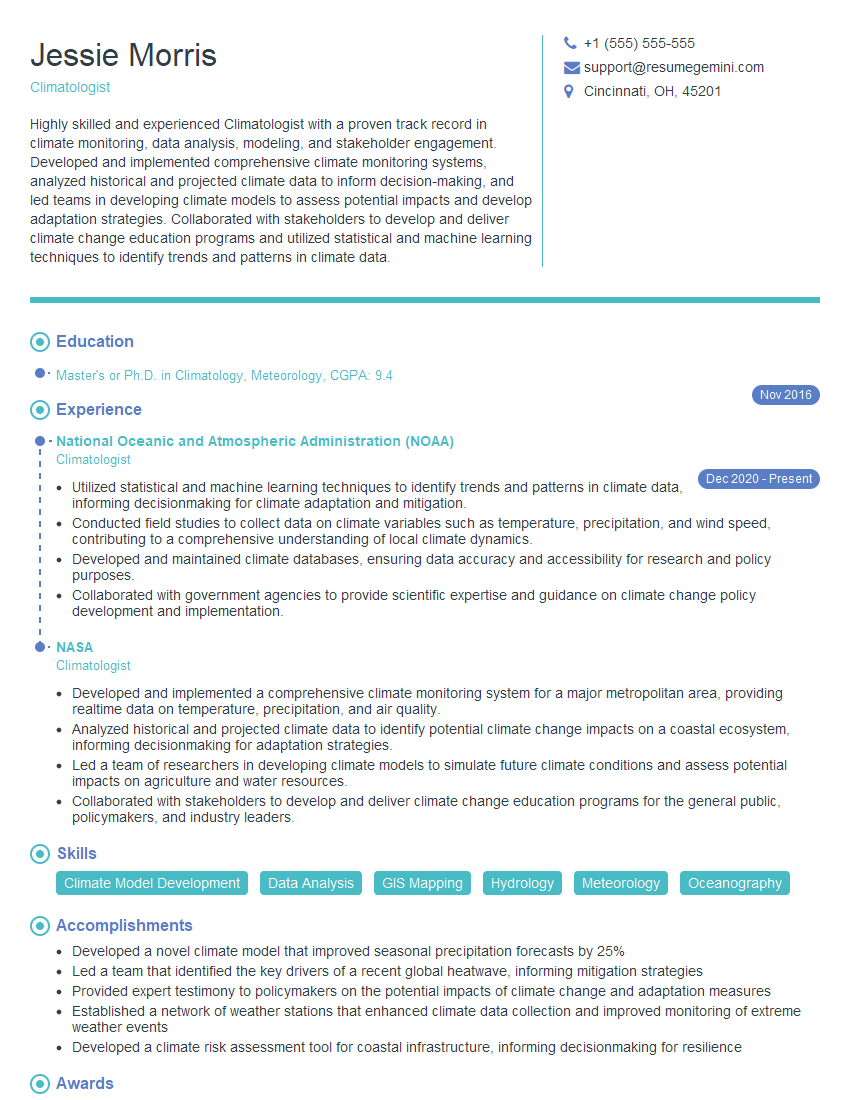
Climatologist Resume Sample
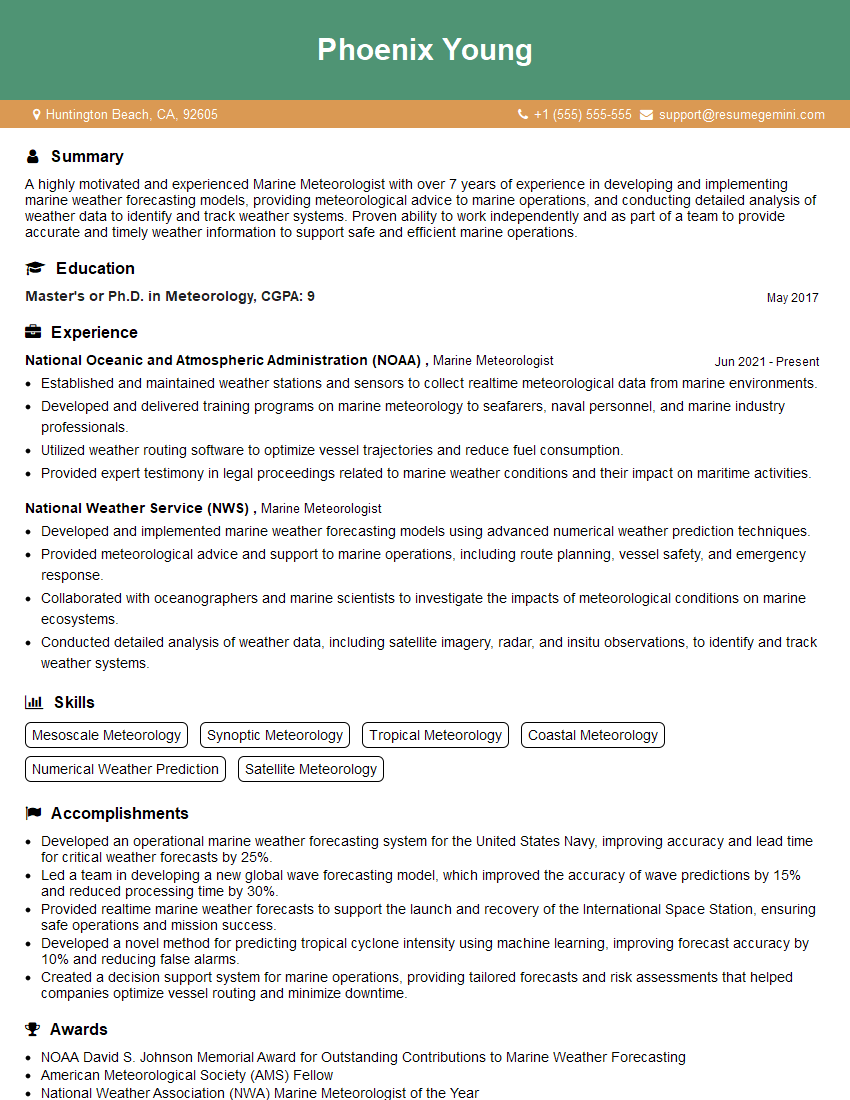
Marine Meteorologist Resume Sample
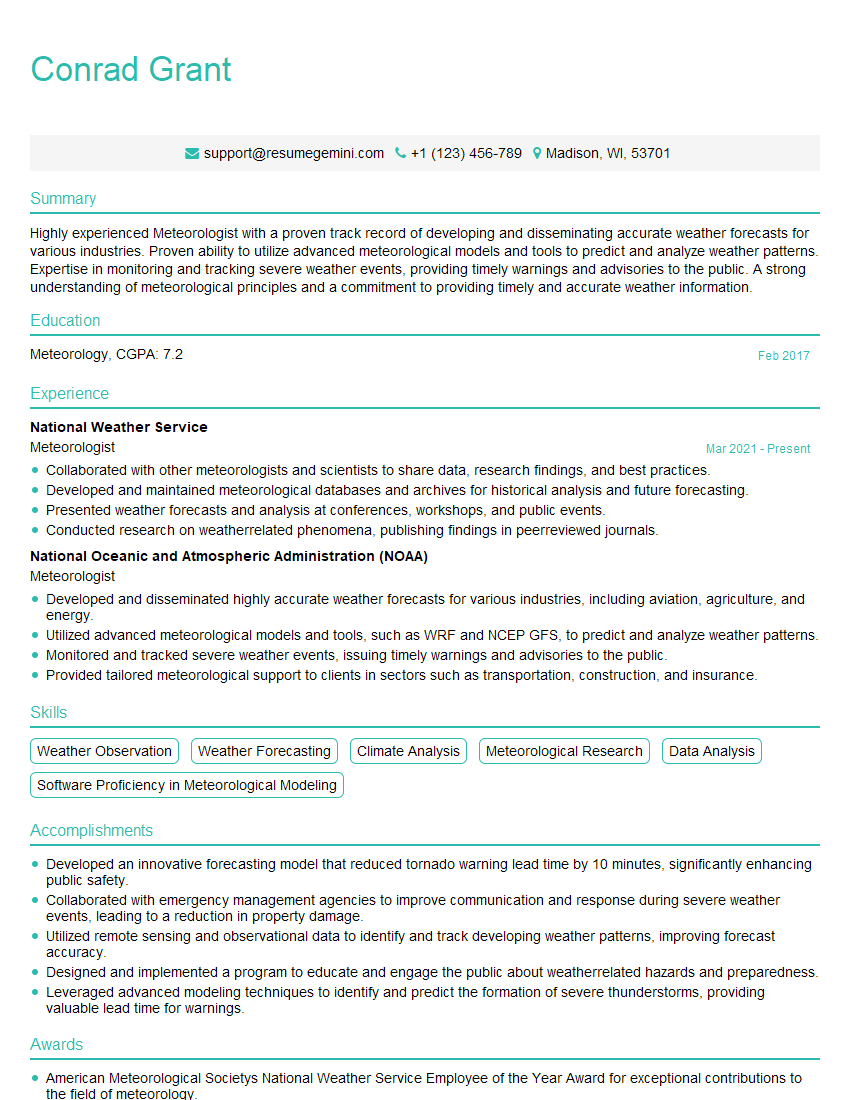
Meteorologist Resume Sample

Operational Meteorologist Resume Sample

Weather Analyst Resume Sample
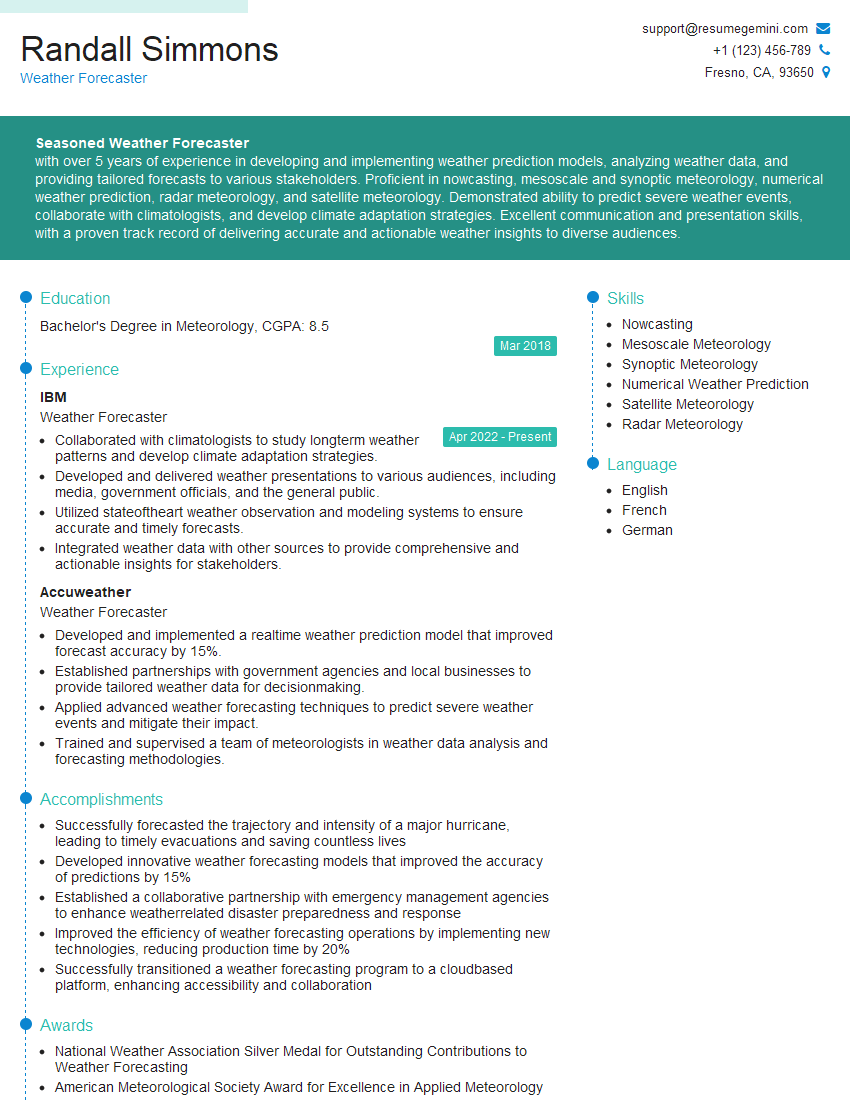
Weather Forecaster Resume Sample
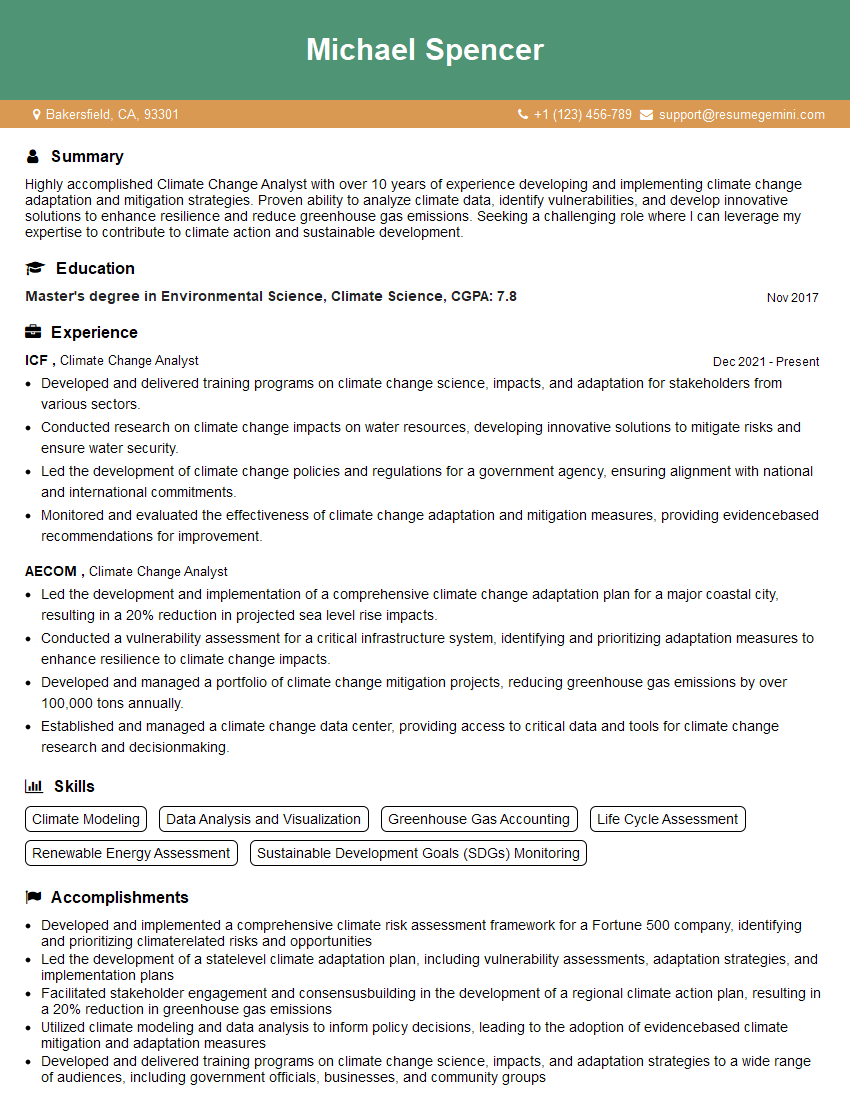
Climate Change Analyst Resume Sample

Meteorological Technician Resume Sample
Explore more articles
Users Rating of Our Blogs
Share Your Experience
We value your feedback! Please rate our content and share your thoughts (optional).
What Readers Say About Our Blog
Very informative content, great job.
good