Preparation is the key to success in any interview. In this post, we’ll explore crucial Use of weight engineering software tools (e.g., CATIA, ANSYS) interview questions and equip you with strategies to craft impactful answers. Whether you’re a beginner or a pro, these tips will elevate your preparation.
Questions Asked in Use of weight engineering software tools (e.g., CATIA, ANSYS) Interview
Q 1. Explain your experience with FEA software like ANSYS.
My experience with ANSYS spans over seven years, encompassing a wide range of applications in structural analysis and weight optimization. I’ve extensively used ANSYS Mechanical for static, dynamic, and modal analyses, leveraging its capabilities for linear and non-linear simulations. For instance, I worked on a project optimizing the chassis of a heavy-duty truck where ANSYS helped us identify stress concentration areas and reduce weight by 15% without compromising structural integrity. This involved creating detailed finite element models, applying appropriate boundary conditions and loads, and interpreting the results to guide design modifications. I’m also proficient in using ANSYS Workbench for streamlined workflow management and data visualization, including generating contour plots, animation of deformation, and detailed reports for effective communication of findings.
Beyond basic simulations, I’m experienced with advanced techniques like submodeling for detailed analysis of critical areas and optimization studies using ANSYS’s optimization tools to explore different design parameters and find the optimal balance between weight and performance. I’m comfortable with various material models within ANSYS, including non-linear material behavior and temperature-dependent properties.
Q 2. Describe your experience using CATIA for weight optimization.
My CATIA experience centers around its generative design capabilities, particularly its integration with topology optimization tools. I’ve utilized CATIA V5 and CATIA 3DEXPERIENCE to create initial designs and then refine them for weight reduction. A recent project involved the design of a lightweight aircraft component. Starting with a preliminary design in CATIA, I employed topology optimization within the software to remove unnecessary material, resulting in a component that was 20% lighter while maintaining sufficient strength. This was achieved by defining design space, loading conditions, and constraints within CATIA’s optimization environment. The optimized geometry, generated by CATIA, was then re-imported into ANSYS for detailed stress and displacement analysis to validate the design.
Beyond topology optimization, I leverage CATIA for creating detailed 3D models, surface modeling, and generating high-quality engineering drawings necessary for manufacturing. The seamless integration between CATIA and ANSYS simplifies the design-analysis workflow, accelerating the iterative process of weight optimization.
Q 3. How do you define and approach a weight optimization problem?
A weight optimization problem is defined by the need to reduce the mass of a component or assembly while maintaining or improving its performance characteristics. This involves a careful balance between minimizing weight and ensuring that the design meets all functional and safety requirements. My approach involves a systematic process:
- Define Objectives and Constraints: Clearly state the target weight reduction, functional requirements (strength, stiffness, fatigue life), manufacturing constraints (material availability, manufacturing processes), and cost limitations.
- Create a FEA Model: Develop a detailed finite element model of the component or assembly in software like ANSYS, accurately representing geometry, material properties, and boundary conditions.
- Perform Initial Analysis: Conduct a baseline FEA analysis to understand the initial stress and displacement distributions.
- Implement Optimization Techniques: Employ topology optimization (removing unnecessary material), shape optimization (modifying the shape of existing features), or size optimization (changing the dimensions of elements) using tools within ANSYS or CATIA.
- Iterative Refinement: Repeatedly analyze and refine the design based on the results of FEA, ensuring the optimized design meets all constraints. This involves a collaborative approach, involving manufacturing and other engineering disciplines.
- Validation and Verification: Validate the FEA results through experimental testing or comparison with similar, proven designs. Verify that the optimized design meets all functional requirements and safety standards.
Think of it like sculpting: you start with a block of clay (initial design) and progressively remove material (optimization) until you achieve the desired shape (optimized design) that meets your criteria (strength, weight).
Q 4. What are the key considerations when selecting materials for weight reduction?
Selecting materials for weight reduction requires careful consideration of several factors:
- Density: Lower density materials are inherently lighter. Common choices include aluminum alloys, magnesium alloys, carbon fiber composites, and titanium alloys.
- Specific Strength and Stiffness: These properties indicate the strength and stiffness per unit weight. High specific strength and stiffness are crucial for maintaining structural integrity while reducing weight.
- Cost: Material cost is a major factor, balancing the benefits of weight reduction against the increased cost of specialized materials.
- Manufacturing Considerations: The chosen material should be readily manufacturable using appropriate processes such as casting, forging, machining, or additive manufacturing.
- Durability and Corrosion Resistance: The material must withstand the intended service environment and exhibit adequate resistance to corrosion or degradation.
- Fatigue Behavior: For applications involving cyclic loading, the fatigue properties of the material are crucial.
For example, while carbon fiber composites offer excellent specific strength and stiffness, they are more expensive and require specialized manufacturing processes. Aluminum alloys, on the other hand, offer a good balance of properties, cost, and manufacturability.
Q 5. Explain the different types of finite elements used in weight engineering.
The choice of finite elements depends on the geometry, material behavior, and loading conditions of the component. Common element types used in weight engineering include:
- Solid Elements (e.g., tetrahedral, hexahedral): Used for modeling three-dimensional structures. Hexahedral elements generally provide better accuracy than tetrahedral elements, but they are more challenging to mesh complex geometries.
- Shell Elements: Suitable for modeling thin-walled structures such as plates and shells, offering computational efficiency. These elements are particularly useful for weight optimization since they accurately represent the structural behavior of thin parts while reducing the number of elements required.
- Beam Elements: Used for modeling one-dimensional structural members such as beams and rods. These elements are most efficient for slender structures and are commonly employed in structural frame analysis.
The selection of element type involves a trade-off between accuracy, computational cost, and meshing complexity. Often, a combination of element types is used in a single model to accurately represent different parts of a complex structure.
Q 6. How do you validate your FEA results?
Validating FEA results is crucial for ensuring the accuracy and reliability of the weight optimization process. I employ several validation methods:
- Mesh Sensitivity Study: Checking the convergence of the results by refining the mesh to assess the impact of mesh density on the predicted stresses and displacements.
- Comparison with Analytical Solutions: Where possible, comparing the FEA results with analytical solutions for simple cases to verify the accuracy of the model.
- Experimental Validation: Conducting physical tests on prototypes or existing similar designs to measure strains, displacements, or natural frequencies and compare them to the FEA predictions. This often involves strain gauge measurements or modal testing.
- Correlation with Existing Data: Comparing the FEA predictions with data from existing components or designs with known performance characteristics.
- Independent Verification: Having another engineer review the FEA model, boundary conditions, and results to ensure consistency and accuracy.
The level of validation required depends on the criticality of the application. For critical components, experimental validation is essential.
Q 7. Describe your experience with meshing techniques in FEA.
Meshing is a critical step in FEA, directly impacting the accuracy and computational efficiency of the analysis. My experience includes various meshing techniques:
- Structured Meshing: Generating regular, structured meshes for simple geometries. This approach is efficient but can be challenging for complex shapes.
- Unstructured Meshing: Creating meshes with irregular element shapes, suitable for complex geometries. This offers greater flexibility but might require more computational resources.
- Adaptive Meshing: Refining the mesh in areas of high stress gradients or other regions of interest to improve accuracy without unnecessarily increasing computational cost.
- Mesh Refinement Techniques: Employing different mesh refinement techniques such as h-refinement (reducing element size), p-refinement (increasing polynomial order of elements), and r-refinement (relocating nodes).
I also utilize mesh quality metrics (e.g., aspect ratio, skewness) to ensure the mesh is suitable for accurate analysis and to avoid potential numerical issues. Effective meshing is an art and a science; experience and attention to detail are crucial for producing high-quality meshes that lead to reliable results. For example, in a recent project analyzing a complex casting, I used a combination of structured and unstructured meshing with adaptive refinement to balance accuracy and computational efficiency.
Q 8. How do you handle non-linearity in your FEA models?
Non-linearity in FEA arises when the material behavior, geometry, or loading conditions deviate from a linear relationship. This means the response isn’t proportional to the input. Think of a spring: a linear spring stretches proportionally to the force applied. A non-linear spring might stretch much more easily at first and then become stiffer as the force increases. In FEA, we handle this using various techniques.
- Material Non-linearity: This is common with plasticity (permanent deformation), hyperelasticity (large deformations like rubber), and creep (time-dependent deformation). We address this by selecting appropriate material models within the FEA software (e.g., using von Mises plasticity in ANSYS or a hyperelastic model in Abaqus). The software then iteratively solves the equations, accounting for the changing material properties at each step.
- Geometric Non-linearity: This occurs when large displacements or rotations significantly alter the structure’s geometry. The classic example is a slender beam undergoing large deflections – its stiffness changes as it bends. Software handles this by updating the geometry during the solution process, often using techniques like updated Lagrangian formulation. This requires more computational effort than linear analysis.
- Contact Non-linearity: This happens when two or more bodies interact, creating unpredictable contact forces and areas of contact that change during the simulation. Software uses contact algorithms that iterate to find the correct contact forces and areas. Defining appropriate contact parameters (friction coefficients, stiffness) is crucial for accuracy.
For example, in optimizing a car’s crash structure, geometric and material non-linearity are crucial. The software needs to model the large plastic deformation of the metal during impact, along with the changing geometry of the structure. Ignoring non-linearity in this scenario would lead to highly inaccurate and potentially dangerous results.
Q 9. Explain your understanding of modal analysis and its applications in weight reduction.
Modal analysis is a technique used to determine the natural frequencies and mode shapes of a structure. It essentially finds out how a structure will vibrate if excited. Each mode shape represents a specific pattern of vibration at a particular frequency (natural frequency). In weight reduction, this is extremely useful because understanding these modes helps identify areas prone to vibration and resonance.
Applications in Weight Reduction:
- Identifying areas for stiffness increase: If a mode shape shows high displacement in a specific region at a critical frequency (e.g., an engine’s operating frequency), we know this area needs stiffness enhancement, which can often be achieved by strategically adding material only in those critical areas, resulting in a lighter design.
- Optimizing component design: By analyzing the mode shapes, we can adjust the component’s geometry or material properties to shift the natural frequencies away from critical excitation frequencies, thus minimizing vibrations. For instance, modifying the shape of a chassis to avoid resonance with the engine’s vibrations can reduce the need for heavy vibration dampeners.
- Material selection: Modal analysis can guide material selection for weight reduction. By comparing the natural frequencies of different materials with the same geometry, we can choose a lighter material that still meets the required stiffness and frequency response requirements.
Imagine designing a lightweight aircraft wing. Modal analysis allows us to ensure it won’t resonate at frequencies generated by the engines, avoiding fatigue and failure, whilst minimizing its overall weight. We could iteratively modify the wing’s design, running modal analyses at each step, until we find an optimal design that balances weight and structural integrity.
Q 10. What are the advantages and disadvantages of different optimization algorithms?
Various optimization algorithms are used in weight engineering, each with its own strengths and weaknesses. The choice depends on the complexity of the problem, computational resources, and desired accuracy.
- Gradient-based methods (e.g., steepest descent, conjugate gradient): These are efficient for smooth, continuous functions. They rely on calculating the gradient (slope) of the objective function, guiding the search towards the optimum. However, they can get stuck in local optima for complex problems with many local minima.
- Genetic algorithms: These are population-based methods that mimic natural selection. They explore the design space more widely and are less likely to get trapped in local optima, but they are computationally expensive and require careful parameter tuning.
- Simulated annealing: This probabilistic algorithm explores the design space by accepting both improving and worsening moves with a probability that decreases over time, allowing escape from local optima. It’s robust but computationally expensive.
- Topology optimization: This method aims to find the optimal material layout within a given design space, often resulting in unexpected and innovative designs. It can be computationally intensive, particularly for large and complex models.
For example, a gradient-based method might be suitable for optimizing the thickness of a simple beam to minimize weight under a given load. For a complex part like a car chassis, with many design variables and potential local optima, a genetic algorithm or simulated annealing might be more effective. Topology optimization would be ideal to explore radically new designs that minimize weight while meeting strength requirements.
Q 11. How do you interpret stress and strain results from FEA?
Stress and strain are fundamental concepts in FEA that describe a material’s response to applied loads. Stress is the internal force per unit area within a material, while strain is the deformation or change in shape caused by stress. Interpreting these results correctly is crucial for ensuring structural integrity.
- Stress: We look at the magnitude and distribution of stress to identify potential failure points. Common stress types include tensile (pulling), compressive (pushing), and shear stress. We compare the calculated stresses to the material’s yield strength or ultimate tensile strength to determine the safety factor. High stress concentrations, often at sharp corners or holes, require careful attention.
- Strain: Strain helps understand the deformation of the structure. Large strains can indicate excessive deformation, potential buckling, or interference between parts. We usually examine both the principal strains (maximum and minimum strain at a point) and the total strain to gain a complete picture.
In ANSYS, for instance, we use contour plots to visualize stress and strain distributions. A high stress concentration exceeding the yield strength indicates a potential failure point, prompting design modifications, such as adding material or using a stronger material in that area. Similarly, excessive strain might indicate a need for redesign to reduce deformation or prevent interference. We also examine the safety factor to assess design robustness.
Q 12. Describe your experience with design of experiments (DOE) in weight optimization.
Design of Experiments (DOE) is a powerful statistical method used to efficiently explore the design space and identify the most influential design parameters affecting weight. Instead of changing one parameter at a time, which is inefficient, DOE strategically varies multiple parameters simultaneously in a planned manner.
In weight optimization, DOE helps:
- Reduce the number of simulations: It minimizes the number of FEA runs needed to achieve a desired level of understanding of the design space. This is crucial because FEA simulations are often computationally expensive.
- Identify significant design parameters: DOE allows us to determine which design variables have the most impact on weight while still meeting performance requirements. This allows us to focus optimization efforts on the most crucial parameters.
- Build accurate response surface models: The results from DOE can be used to create response surface models (RSMs). These models approximate the relationship between design parameters and weight, enabling quick and efficient exploration of the design space.
For example, in optimizing a bracket’s weight, we might use a DOE approach to investigate the impact of thickness, material, and length on its weight and strength. After conducting a carefully planned set of FEA analyses, we’d use statistical software to analyze the data and create a RSM, allowing rapid assessment of the weight and strength for any combination of design parameters.
Q 13. How do you handle uncertainties and variations in material properties during analysis?
Material properties often exhibit variations due to manufacturing processes, temperature fluctuations, or inherent material variability. Ignoring these uncertainties can lead to inaccurate and potentially unsafe designs. Several methods can address this:
- Probabilistic FEA: This approach uses statistical methods to incorporate uncertainties in material properties (e.g., using probability distributions for yield strength, Young’s modulus). The software runs multiple simulations with different combinations of property values, generating a distribution of results instead of a single deterministic answer. This provides a more realistic assessment of the risk.
- Sensitivity analysis: This helps determine which material properties have the greatest influence on the final results. This allows us to focus on accurately measuring or controlling those parameters which have the biggest impact.
- Factor of safety: Applying a factor of safety to the design accounts for the uncertainty in material properties and other factors. This increases the design’s robustness but may lead to heavier designs.
Consider a bridge design. The strength of the concrete might vary slightly due to manufacturing. Probabilistic FEA can predict the probability of failure under different load scenarios and variations in concrete strength. This provides a more reliable assessment of safety than a deterministic analysis that assumes a single, perfect value for the concrete strength.
Q 14. Explain your experience with CFD and its role in weight engineering.
Computational Fluid Dynamics (CFD) simulates fluid flow and heat transfer. While not directly a weight engineering tool, it plays a crucial role, particularly in aerodynamic design and thermal management. Integrating CFD with FEA allows for a more holistic design process.
Role in Weight Engineering:
- Aerodynamic optimization: CFD can help optimize the shape of components to reduce drag. Reducing drag allows for lighter designs since less structural reinforcement is required to withstand aerodynamic loads. This is crucial for aircraft and automotive designs.
- Thermal management: CFD helps optimize cooling systems, allowing for the use of lighter materials. For instance, accurately predicting heat transfer in electronics enables the design of lighter and more efficient cooling systems.
- Coupled FEA-CFD: Combining CFD and FEA allows for a more comprehensive analysis. For example, aerodynamic loads predicted by CFD can be used as inputs for FEA to assess the structural integrity of the design, leading to weight-optimized structures that effectively withstand aerodynamic forces.
Imagine designing a racing car. CFD would be used to optimize the car’s body shape to minimize drag. The results from CFD, including pressure distribution and aerodynamic loads, would then be used as input for FEA to analyze the car’s structural integrity under these loads, allowing for a lighter, more aerodynamic chassis design.
Q 15. How do you balance weight reduction with structural integrity?
Balancing weight reduction with structural integrity is a critical aspect of weight engineering. It’s essentially a delicate dance between minimizing mass and ensuring the component or structure can withstand the intended loads and stresses without failure. We achieve this balance through a combination of techniques, primarily utilizing Finite Element Analysis (FEA) software like ANSYS.
The process involves iterative design optimization. We start by defining design goals – a target weight reduction percentage, while maintaining specific safety factors. Then we use FEA to simulate the structure under various load conditions. If the stress levels exceed allowable limits, we refine the design, perhaps by using topology optimization within CATIA or ANSYS to identify areas where material can be removed without compromising structural integrity. This is often followed by detailed stress analysis to confirm improvements. This iterative cycle continues until we achieve the desired weight reduction while meeting all safety and performance criteria.
For instance, consider designing a lightweight car chassis. We might initially model the chassis in CATIA, then import it into ANSYS for FEA. The initial analysis might reveal high stress concentrations in specific areas. We then use topology optimization within ANSYS to suggest material removal in these less critical zones, while maintaining sufficient strength in high-stress regions. We then re-analyze the optimized design, validating the structural integrity, and refining the design iteratively.
Career Expert Tips:
- Ace those interviews! Prepare effectively by reviewing the Top 50 Most Common Interview Questions on ResumeGemini.
- Navigate your job search with confidence! Explore a wide range of Career Tips on ResumeGemini. Learn about common challenges and recommendations to overcome them.
- Craft the perfect resume! Master the Art of Resume Writing with ResumeGemini’s guide. Showcase your unique qualifications and achievements effectively.
- Don’t miss out on holiday savings! Build your dream resume with ResumeGemini’s ATS optimized templates.
Q 16. Describe a challenging weight optimization project you’ve worked on and how you overcame it.
One particularly challenging project involved optimizing the weight of a satellite component – a large antenna support structure. The primary constraint was maintaining extreme rigidity under launch conditions, which involved massive vibration loads and extreme g-forces. The initial design was significantly overweight.
We tackled this by implementing a multi-faceted approach. Firstly, we used advanced composite materials simulation within ANSYS to accurately model the material’s non-linear behavior and strength. This was crucial, as traditional metallic materials would have resulted in an unacceptably heavy design. Secondly, we utilized topology optimization extensively within ANSYS, iteratively refining the design based on the stress analysis results. We experimented with different lattice structures and optimized the fiber orientation in the composite materials. Finally, we validated the final design through modal analysis, ensuring resonance frequencies didn’t overlap with critical launch frequencies. This project demonstrated the power of combining advanced materials modeling with sophisticated optimization techniques to achieve drastic weight reductions while strictly adhering to structural integrity requirements.
Q 17. What are your preferred methods for visualizing and presenting FEA results?
Effective visualization and presentation of FEA results are crucial for clear communication and decision-making. My preferred methods leverage ANSYS’s built-in post-processing capabilities combined with external tools.
I frequently use contour plots to visually represent stress, strain, and displacement distributions across the model. I also employ deformed shape visualizations to showcase structural deflections under load. For complex results, I use animation to show the evolution of stresses and displacements over time. To improve understanding for non-technical stakeholders, I create simplified diagrams and charts that highlight key results, such as maximum stress levels and safety factors. These simplified presentations effectively communicate complex information. Finally, I create comprehensive reports that combine visual representations with detailed numerical data to support design decisions.
Q 18. How do you manage and organize large FEA datasets?
Managing large FEA datasets requires a structured and systematic approach. I typically use ANSYS’s database management features to organize the results. This includes creating clearly labeled datasets, using descriptive file names, and version controlling all model files and results. We also use a combination of database tools and scripting to automate data extraction and processing. This allows us to effectively extract specific metrics from large datasets without manually searching through massive files. For example, we might write a Python script to automatically extract maximum stress values from multiple simulation runs. Properly organizing and archiving these datasets ensures data integrity and enables efficient data retrieval for future analysis and reference.
Q 19. Describe your experience with different types of boundary conditions in FEA.
My experience encompasses a wide range of boundary conditions in FEA. These conditions define how the model interacts with its environment. Common types include:
- Fixed Support: This restricts all degrees of freedom at a specific point or surface, simulating a completely rigid connection. Think of a part welded to a rigid frame.
- Simply Supported: This constraint allows rotation but prevents translation in a certain direction. This might model a beam resting on supports.
- Pinned Support: This restrains translation in all directions but allows rotation around a specific axis.
- Symmetry Boundary Conditions: These conditions exploit geometrical symmetries to reduce the model size, leading to faster simulations. This is essential for large models.
- Pressure Loads: These simulate pressure acting on a surface, like water pressure inside a pipe.
- Force Loads: These represent direct forces applied at specific points or distributed across surfaces.
Accurate selection of boundary conditions is critical. Incorrectly defined conditions lead to inaccurate results. I ensure the boundary conditions accurately reflect the real-world situation. This understanding is crucial to achieve realistic simulations.
Q 20. How do you ensure the accuracy and reliability of your FEA models?
Ensuring accuracy and reliability in FEA models is paramount. This involves a multi-step approach:
- Mesh Refinement: Using a fine enough mesh is essential to capture stress concentrations accurately. I employ adaptive mesh refinement techniques where necessary to focus mesh density on critical areas.
- Material Model Selection: I carefully choose the appropriate material models that accurately capture material behavior under the expected load conditions. This might involve non-linear material models for complex situations.
- Model Validation: Whenever possible, I compare simulation results with experimental data, like physical tests. This validation process verifies the accuracy of the model.
- Convergence Studies: I conduct mesh convergence studies to assess the influence of mesh size on the results, ensuring results are independent of mesh density. A similar approach is used for load stepping in nonlinear simulations.
- Peer Review: Having another engineer review the model setup and results is crucial to identify potential errors or biases.
This comprehensive approach minimizes errors and enhances the reliability of my FEA results, forming the cornerstone of trust in our weight engineering analysis.
Q 21. What are some common pitfalls to avoid in weight engineering?
Several common pitfalls exist in weight engineering. Avoiding these is critical for successful projects:
- Oversimplifying the Model: Ignoring details like stress concentrations or non-linear material behavior can lead to inaccurate results and compromised structural integrity.
- Neglecting Manufacturing Constraints: The design must be manufacturable. Ignoring manufacturing limitations leads to designs that are impractical or impossible to produce.
- Insufficient Validation: Not validating the FEA model against experimental data can result in significant errors, especially with complex designs.
- Ignoring Fatigue and Durability: Weight reduction should not compromise the long-term performance or fatigue life of the component. This needs detailed fatigue analysis.
- Rushing the Optimization Process: Thorough investigation and iterative optimization are needed to find the optimal balance between weight reduction and structural integrity. Skipping these steps often results in suboptimal designs.
Careful planning, thorough analysis, and a keen eye for detail are vital to avoid these common pitfalls and ensure effective weight reduction without sacrificing safety or performance.
Q 22. How familiar are you with different material modeling techniques?
Material modeling is the cornerstone of accurate weight optimization. It involves representing the mechanical behavior of different materials within the engineering software. This goes beyond simply inputting a Young’s modulus and Poisson’s ratio. We need to consider the material’s response under various loading conditions, temperatures, and even time-dependent effects.
- Linear Elastic Materials: These are the simplest models, assuming a proportional relationship between stress and strain. Suitable for many metals under low loads.
- Nonlinear Elastic Materials: These account for non-proportional stress-strain relationships, often seen in rubbers or certain plastics.
- Plasticity Models: Crucial for scenarios involving permanent deformation. These models consider yielding and hardening behavior, vital for predicting component failure under high loads.
- Viscoelastic Materials: These models are essential for materials exhibiting time-dependent behavior like creep and relaxation, common in polymers.
- Hyperelastic Materials: Used for materials undergoing large deformations like rubbers and elastomers. These often involve complex constitutive equations.
For example, designing a lightweight car chassis requires choosing the right steel grade and accurately modeling its behavior under crash conditions. Ignoring plasticity would lead to highly inaccurate predictions of crashworthiness.
Q 23. Explain your understanding of fatigue analysis in weight optimization.
Fatigue analysis is critical in weight optimization because lighter designs often experience higher stresses. It predicts component failure due to repeated cyclical loading. Ignoring fatigue can lead to premature failure, rendering weight savings meaningless.
In weight optimization, we aim to find the lightest design that meets fatigue life requirements. This usually involves iterative processes where we refine the design while simultaneously performing fatigue analysis using methods like:
- Stress-Life (S-N) Approach: This relies on experimental data to determine the relationship between stress amplitude and fatigue life. It’s relatively straightforward but can be less accurate for complex loading scenarios.
- Strain-Life Approach: This method is more accurate for high-cycle fatigue and considers plastic strain accumulation. It’s particularly useful for components subjected to complex stress states.
- Fracture Mechanics Approach: Useful for components containing cracks or flaws. It predicts crack propagation and eventual failure.
For instance, when optimizing an aircraft wing, we must ensure the wing withstands millions of cycles of loading and unloading during its operational life. Fatigue analysis is key to preventing catastrophic failure.
Q 24. What is your experience with scripting or automation in FEA software?
Scripting and automation are essential for efficient weight optimization. Manually modifying designs and running simulations repeatedly is time-consuming and prone to errors. I’m proficient in Python and have extensive experience using APDL (ANSYS Parametric Design Language) and CATIA’s automation interfaces.
For example, I’ve developed Python scripts to automate the following tasks:
- Mesh Generation: Automatically generating meshes for various design iterations, ensuring consistency and saving significant time.
- Design Parameterization: Creating parameterized models in CAD software to systematically explore a range of design variables.
- Simulation Setup: Automatically setting up boundary conditions, loads, and material properties for FEA analyses.
- Result Post-Processing: Extracting key data from FEA results and generating customized reports.
# Example Python code snippet for automating a simple design parameter change in ANSYS:# ... (Code to connect to ANSYS, read parameters, modify model, run simulation, etc.) ...
Q 25. How do you collaborate with other engineers during the weight optimization process?
Collaboration is paramount in weight optimization. It’s a multidisciplinary process involving designers, manufacturing engineers, and material scientists. I excel at clear communication and active listening.
My typical collaboration process involves:
- Regular Meetings: Holding frequent meetings to discuss design progress, challenges, and potential solutions.
- Design Reviews: Presenting design iterations to the team for feedback and ensuring alignment with overall project goals.
- Data Sharing: Utilizing collaborative platforms to share design files, simulation results, and project documentation.
- Constructive Feedback: Providing and receiving constructive feedback in a professional and respectful manner.
In a recent project, I worked closely with a manufacturing engineer to ensure the optimized design was manufacturable and cost-effective. This involved considering aspects like weldability, surface finish, and tooling constraints.
Q 26. Describe your experience using different post-processing tools for FEA results.
Post-processing is crucial for extracting meaningful insights from FEA results. I’m proficient in using ANSYS Mechanical’s post-processing capabilities as well as specialized tools like HyperView.
My experience includes:
- Stress and Strain Visualization: Generating contour plots, deformed shapes, and animations to visualize stress and strain distributions.
- Data Extraction: Extracting specific data points, such as maximum stress, minimum displacement, or fatigue life.
- Report Generation: Creating detailed reports summarizing FEA results and their implications for design optimization.
- Animation and Visualization: Creating animations to illustrate the behavior of the structure under various loading conditions.
For example, in analyzing a turbine blade, post-processing helps identify regions of high stress concentration, enabling design modifications to improve durability and reduce weight.
Q 27. What are your strengths and weaknesses as a weight engineer?
My strengths lie in my analytical skills, problem-solving abilities, and proficiency in using FEA software. I’m a quick learner, adaptable to new challenges, and a strong collaborator. I also thrive in detail-oriented tasks and possess a strong understanding of material science and manufacturing processes.
One area I’m actively working on is expanding my knowledge of topology optimization algorithms. While I understand the fundamental concepts, gaining deeper expertise in advanced techniques and their practical applications would enhance my efficiency and the scope of my contributions.
Q 28. Where do you see yourself in 5 years regarding weight engineering?
In five years, I envision myself as a highly skilled and experienced weight engineer leading complex projects. I aim to deepen my expertise in advanced optimization techniques, such as topology optimization and generative design, to contribute to even more significant weight reduction in challenging engineering applications. I also aspire to mentor junior engineers and share my knowledge, contributing to the overall growth of the field.
Key Topics to Learn for Use of Weight Engineering Software Tools (e.g., CATIA, ANSYS) Interview
- Software Proficiency: Demonstrate a strong understanding of the user interface, modeling techniques, and simulation capabilities within CATIA and ANSYS. Practice creating and manipulating models, applying constraints, and interpreting results.
- Finite Element Analysis (FEA) Fundamentals: Master the theoretical underpinnings of FEA, including meshing techniques, element types, boundary conditions, and solver settings. Understand the limitations and assumptions of FEA.
- Weight Optimization Techniques: Explore various methods for reducing weight while maintaining structural integrity. This includes topology optimization, shape optimization, and material selection strategies within the software.
- Material Properties & Selection: Gain a deep understanding of material behavior and how it impacts simulation results. Learn how to accurately input material properties into the software and select appropriate materials for weight reduction.
- Post-Processing & Result Interpretation: Develop proficiency in analyzing simulation results, identifying critical stress areas, and interpreting displacement and strain data. Learn to present findings clearly and concisely.
- Practical Applications & Case Studies: Familiarize yourself with real-world applications of weight engineering in various industries (automotive, aerospace, etc.). Prepare examples of how you’ve used these tools to solve design challenges.
- Software Specific Features: Explore advanced features specific to CATIA and ANSYS relevant to weight engineering, such as generative design tools or specific optimization algorithms.
Next Steps
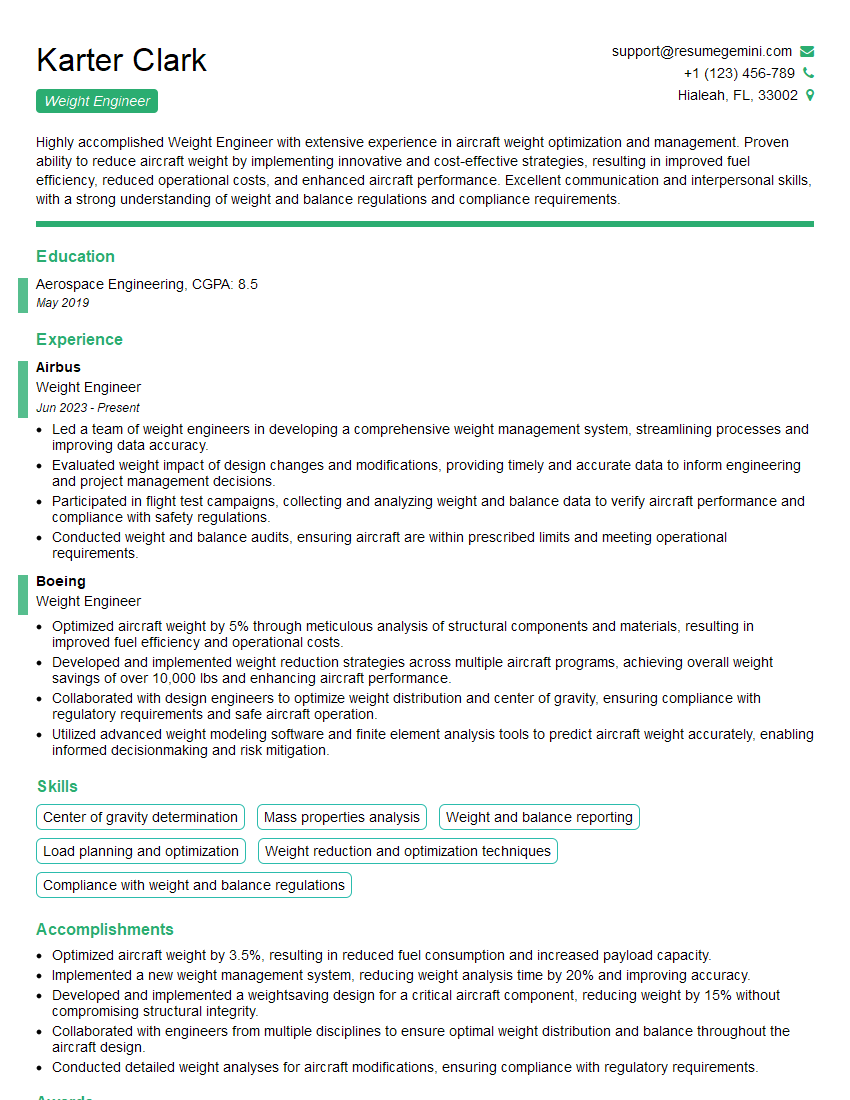
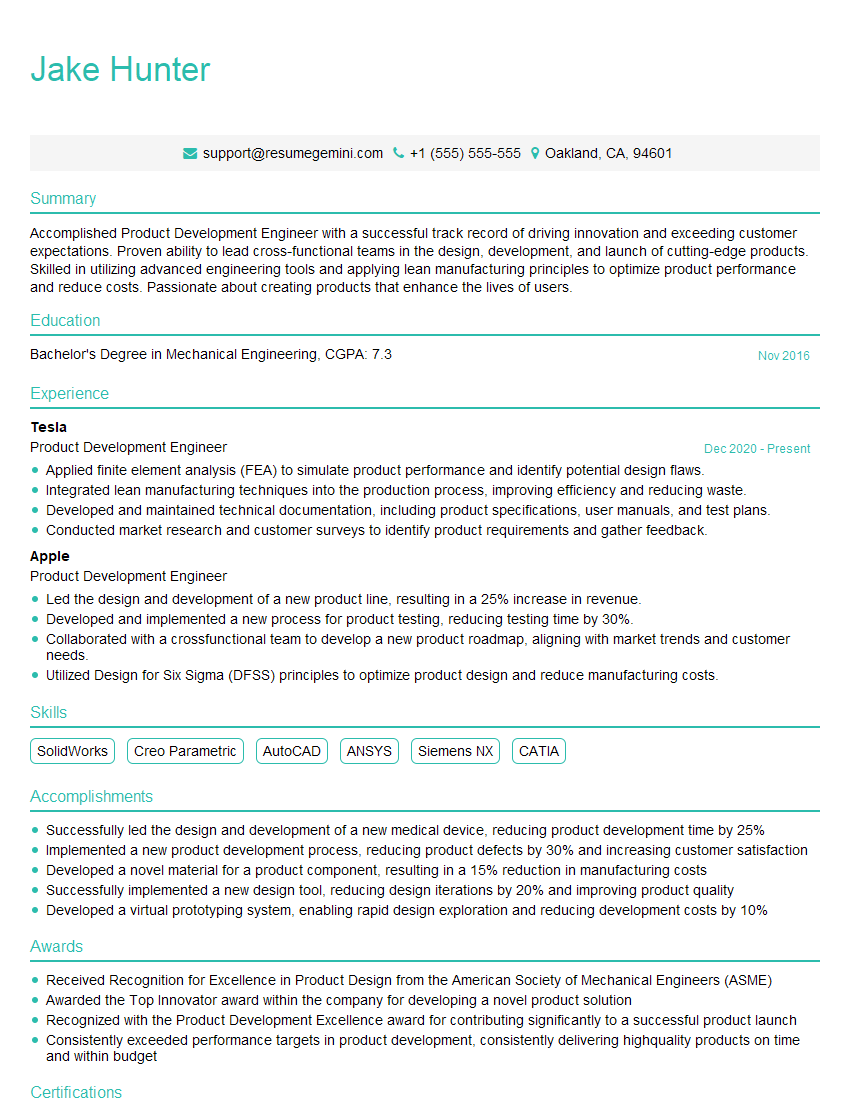
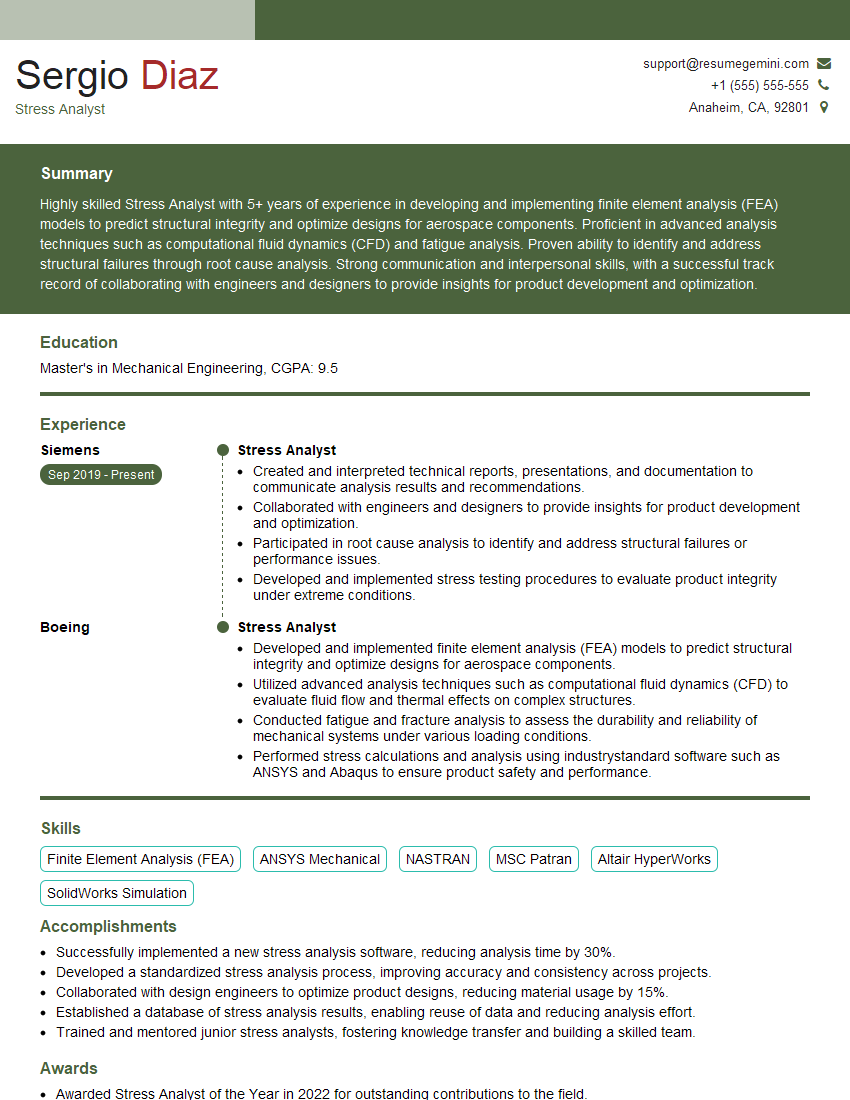
Mastering weight engineering software like CATIA and ANSYS is crucial for a successful career in many engineering disciplines. Proficiency in these tools demonstrates a valuable skillset highly sought after by employers, leading to increased job opportunities and higher earning potential. To maximize your chances, creating a strong, ATS-friendly resume is essential. ResumeGemini is a trusted resource to help you build a professional and impactful resume that highlights your skills and experience effectively. Examples of resumes tailored to showcasing expertise in CATIA and ANSYS are available to guide your resume creation process.
Explore more articles
Users Rating of Our Blogs
Share Your Experience
We value your feedback! Please rate our content and share your thoughts (optional).
What Readers Say About Our Blog
Very informative content, great job.
good