Interviews are more than just a Q&A session—they’re a chance to prove your worth. This blog dives into essential Validation Master Plan interview questions and expert tips to help you align your answers with what hiring managers are looking for. Start preparing to shine!
Questions Asked in Validation Master Plan Interview
Q 1. Describe the key components of a Validation Master Plan.
A Validation Master Plan (VMP) is a comprehensive document that outlines the overall strategy for validating all systems and processes within a pharmaceutical or similar regulated industry setting. Think of it as a roadmap guiding the validation activities to ensure the consistent production of safe and effective products. It’s a crucial document that demonstrates regulatory compliance and a commitment to quality.
- Scope Definition: Clearly defines what systems, processes, and equipment will be validated.
- Validation Methodology: Specifies the approach, techniques, and standards used for validation activities (e.g., IQ, OQ, PQ).
- Responsibility and Accountability: Outlines who is responsible for each validation activity and the approval processes.
- Documentation Requirements: Details the required documentation, including formats, templates, and retention policies.
- Deviation Management: Describes the procedure for handling deviations and out-of-specification results during validation.
- Change Control: Explains the process for managing changes to validated systems and processes.
- Training Program: Details training requirements for personnel involved in validation activities.
- Review and Approval Process: Specifies the process for reviewing and approving the VMP and all related validation documentation.
Q 2. What are the regulatory requirements for Validation Master Plans?
Regulatory requirements for VMPs vary slightly depending on the specific agency (e.g., FDA, EMA, etc.) and the type of product being manufactured. However, the overarching principle is to ensure that the manufacturing process consistently produces products that meet quality attributes and comply with Good Manufacturing Practices (GMP).
Generally, regulatory agencies expect the VMP to demonstrate a comprehensive and systematic approach to validation. This includes clear documentation, defined procedures, and evidence of successful validation activities. Failure to adequately address validation requirements can lead to regulatory warnings, product recalls, and market restrictions.
Specific regulations often referenced include 21 CFR Part 11 (for electronic records and signatures) and 21 CFR Part 210 and 211 (for current GMP). The VMP demonstrates adherence to these guidelines.
Q 3. How do you determine the scope of a Validation Master Plan?
Determining the scope of a VMP involves a careful assessment of all systems, processes, and equipment that directly or indirectly impact product quality. It’s crucial to consider the entire manufacturing lifecycle, from raw material receipt to finished product release. Think of it like building a house; you wouldn’t just validate the kitchen; you’d validate the entire structure and its utilities.
The scope should be clearly defined and documented, often using flowcharts or diagrams to illustrate the connections between different elements. A thorough risk assessment is frequently used to prioritize validation efforts, focusing on critical systems that pose a higher risk to product quality or safety. For instance, equipment directly involved in sterile manufacturing would have a higher priority for validation than less critical systems.
For example, in a pharmaceutical manufacturing setting, the scope might include equipment validation (e.g., autoclaves, filling machines), process validation (e.g., sterilization, mixing), computer system validation (e.g., manufacturing execution system, laboratory information management system), and cleaning validation.
Q 4. Explain the difference between prospective and retrospective validation.
Prospective and retrospective validation are two different approaches to demonstrating that a system or process works as intended. Imagine you’re testing a new recipe (a process):
- Prospective Validation: This is the preferred approach. It involves planning and executing validation activities before the system or process is routinely used. It’s like carefully testing your new recipe before serving it to guests. This ensures that the process is validated from the outset.
- Retrospective Validation: This approach involves reviewing historical data to demonstrate that a system or process has consistently performed as expected. It’s like reviewing your cooking journal to confirm that the same recipe worked reliably before deciding if it’s worth sharing. This approach is usually only suitable for systems or processes that have been in operation for a considerable period and have a solid history of successful operation. It is less robust than prospective validation.
Retrospective validation requires a thorough review of historical data and may require additional testing to supplement the existing data. It’s important to note that retrospective validation has limitations and may not be acceptable in all situations, particularly when introducing new technologies or processes.
Q 5. What are the different types of validation (e.g., process, cleaning, equipment)?
Validation encompasses various aspects of manufacturing to guarantee the quality and safety of products. The key types include:
- Process Validation: Verifies that a manufacturing process consistently delivers a product meeting predetermined specifications. This often involves multiple stages (e.g., Process Development, Process Performance Qualification).
- Cleaning Validation: Demonstrates the effectiveness of cleaning procedures in removing residues from equipment and preventing cross-contamination. This is essential for ensuring product purity.
- Equipment Validation: Ensures that equipment operates as intended and performs reliably. This typically involves Installation Qualification (IQ), Operational Qualification (OQ), and Performance Qualification (PQ).
- Computer System Validation (CSV): Verifies that computer systems used in manufacturing or quality control perform as intended and safeguard data integrity. This is especially crucial in today’s digitally driven environments.
- Analytical Method Validation: Confirms that analytical methods used for testing raw materials and finished products are accurate, precise, and reliable.
The specific validation types required will depend on the product, process, and regulatory requirements.
Q 6. Describe your experience with Computer System Validation (CSV).
My experience with Computer System Validation (CSV) spans several years and diverse systems. I’ve been involved in the validation of various systems, including Manufacturing Execution Systems (MES), Laboratory Information Management Systems (LIMS), and Electronic Batch Records (EBR) systems. My experience includes all phases of the validation lifecycle: requirements gathering, design, development, testing, and documentation.
I have a strong understanding of 21 CFR Part 11 and other relevant guidelines, and I’m proficient in using risk-based approaches to CSV. I’ve worked with various validation methodologies, including both waterfall and agile approaches, adapting my approach to the specific needs of each project. I emphasize the importance of a well-defined validation plan that accounts for user acceptance testing, security measures, and ongoing system maintenance. I’ve also led training sessions for end-users on validated systems, ensuring they understand the importance of data integrity and compliance.
A recent example involved validating a new LIMS system for a large pharmaceutical company. We employed a risk-based approach to prioritize validation activities, focusing on critical functionalities and data integrity aspects. This streamlined the validation process without compromising compliance requirements.
Q 7. How do you manage deviations and changes during validation activities?
Managing deviations and changes during validation activities is critical to maintain the integrity of the process. A robust deviation management system ensures that any unexpected events are thoroughly investigated and documented. The investigation needs to determine the root cause, impact on the validation, and corrective actions. Think of it like troubleshooting a car engine; you need to identify the problem, fix it, and test to ensure the issue is solved.
Changes to validated systems or processes should follow a formal change control process. This ensures that any modifications are properly evaluated for potential impact, thoroughly tested, and approved before implementation. Appropriate documentation should be maintained for all deviations and changes, including the justification, assessment, implementation, and verification of the change. This documentation is essential for demonstrating compliance to regulatory agencies.
For instance, if a deviation occurs during equipment validation, a detailed investigation is conducted, including review of operational logs, operator interviews, and potentially further testing. Depending on the severity, the deviation might require re-validation or implementation of corrective actions. All these aspects are meticulously documented to demonstrate due diligence and regulatory compliance.
Q 8. Explain your approach to risk assessment in validation.
My approach to risk assessment in validation is systematic and follows a well-defined framework. It begins with identifying all potential risks associated with a system or process, considering factors such as the impact of failure on product quality, patient safety, and regulatory compliance. We utilize tools like Failure Mode and Effects Analysis (FMEA) to systematically evaluate each risk. For each identified risk, we determine its likelihood and severity, assigning a risk priority number (RPN). This helps prioritize our validation efforts, focusing on high-risk areas first. For example, in validating a high-speed automated filling line, a risk assessment might prioritize validation activities related to filling accuracy and sterility maintenance over aspects like the aesthetics of the machine’s control panel. This prioritization ensures efficient resource allocation and a focus on critical quality attributes.
Following the risk assessment, we develop a mitigation plan, outlining steps to reduce or eliminate the identified risks. This plan may include changes to the system design, improved operating procedures, or additional testing. The effectiveness of these mitigation strategies is then assessed, and the RPN is reevaluated. The entire process is documented, ensuring traceability and transparency.
Q 9. How do you ensure the accuracy and integrity of validation data?
Ensuring the accuracy and integrity of validation data is paramount. We implement a comprehensive system of controls, starting with well-defined protocols and Standard Operating Procedures (SOPs). These SOPs dictate how data is collected, recorded, and stored, ensuring consistency. Data integrity is maintained through techniques like electronic signatures, audit trails, and version control systems. We utilize calibrated equipment regularly checked for accuracy, and employ multiple checks and balances throughout the data handling process to minimize human error. For instance, all data is reviewed by a second person before being accepted into the final validation report.
Furthermore, we employ data management systems that incorporate features like data validation rules and alerts to identify inconsistencies or potential errors. Regular audits and inspections are conducted to verify the adherence to these systems and identify any deviations. Data is stored securely in a controlled environment, according to the ALCOA+ principles (Attributable, Legible, Contemporaneous, Original, Accurate + Complete, Consistent, Enduring). These measures ensure that the data used to support the validation is reliable, trustworthy, and defensible.
Q 10. What are your strategies for managing validation projects?
My validation project management strategy centers around clear planning, effective communication, and rigorous execution. We begin by defining clear objectives, scope, and timelines, including resource allocation. A detailed project plan, often using a Gantt chart, is created outlining all tasks, dependencies, and milestones. This plan serves as the roadmap for the entire project. Regular project meetings are held to monitor progress, address challenges, and ensure all team members are aligned. Risk mitigation plans are integrated into the overall project plan to proactively address potential issues.
Furthermore, we utilize project management software to track progress, manage documentation, and facilitate communication. This ensures that all aspects of the project are thoroughly documented and traceable. We also prioritize proactive communication with stakeholders, providing regular updates and addressing concerns promptly. This ensures transparency and builds trust. In instances where unexpected delays or challenges arise, we have a documented process for escalation and resolution. Using this methodical approach, I’ve successfully managed numerous validation projects, completing them on time and within budget.
Q 11. Describe your experience with validation documentation and reporting.
My experience with validation documentation and reporting is extensive. I understand the importance of creating comprehensive, accurate, and compliant documentation that meets regulatory expectations. We adhere strictly to the principles of ALCOA+ in all documentation. Validation documentation includes protocols (describing the planned activities), execution records (documenting the actual work performed), deviations and their investigations, and summary reports (compiling the results and conclusions). All documents are meticulously reviewed and approved by relevant personnel, employing a four-eyes principle where possible. This process ensures that the documentation is consistent, complete and unambiguous.
I’m proficient in using electronic document management systems (EDMS) to store, track, and manage validation documentation. This ensures version control, access control, and easy retrieval of documents. Final validation reports are carefully structured, following a standard format, and include a clear summary of the validation activities, results, conclusions, and approvals. These reports are tailored to meet the specific regulatory requirements of the relevant agency, like the FDA or EMA, ensuring compliance.
Q 12. How do you handle validation failures and out-of-specification results?
Handling validation failures and out-of-specification (OOS) results requires a thorough and systematic investigation. Upon detecting a failure or OOS result, an immediate deviation report is filed, documenting the event, its potential impact, and initial actions taken. A root cause investigation is launched to determine the underlying cause of the failure or OOS. This investigation usually involves reviewing the validation protocol, execution records, equipment logs, and raw data. We use various techniques like fishbone diagrams and 5 Whys to systematically identify the root cause.
Once the root cause is identified, corrective and preventive actions (CAPA) are implemented to prevent recurrence. These actions may include equipment repairs, process improvements, or changes to training procedures. The effectiveness of the CAPAs is verified through retesting or revalidation. The entire process is meticulously documented, including the investigation findings, CAPA implementation, and verification of effectiveness. This detailed documentation is essential for demonstrating to regulatory agencies that the issues have been addressed and resolved.
Q 13. What is your experience with different validation methodologies?
I possess experience with various validation methodologies, including IQ (Installation Qualification), OQ (Operational Qualification), and PQ (Performance Qualification) for equipment; process validation using statistical approaches like Design of Experiments (DOE); and computer system validation (CSV) which includes various software lifecycle models. The specific methodology employed depends on the nature of the system or process being validated. For example, validating a new analytical instrument would involve IQ, OQ, and PQ, whereas validating a manufacturing process might involve a process validation study using statistical process control (SPC) techniques.
My experience also includes employing risk-based approaches to validation, focusing resources on higher-risk aspects of a system or process. This involves using tools like FMEA and risk matrices to prioritize validation activities. The chosen approach is always justified and documented, ensuring a rational and scientifically sound approach to validation.
Q 14. How do you ensure compliance with regulatory requirements (e.g., FDA, EMA, etc.)?
Ensuring compliance with regulatory requirements, such as those from the FDA and EMA, is a fundamental aspect of my work. We maintain a thorough understanding of the relevant regulations (e.g., 21 CFR Part 11, Annex 11, GMP guidelines) and integrate these requirements into all aspects of the validation process. This includes the development of validation protocols, execution of validation activities, documentation, and reporting. We maintain a robust quality management system (QMS) that includes procedures for ensuring compliance, and employs regular internal audits to identify and address any potential compliance gaps.
We also stay current with regulatory changes and updates, adapting our validation processes as needed. Furthermore, we participate in industry conferences and training programs to remain informed about best practices and regulatory expectations. By proactively addressing regulatory compliance, we ensure that our validation activities meet the highest standards and provide the necessary level of assurance for product quality, patient safety, and regulatory inspections.
Q 15. Describe your experience with validation lifecycle management.
Validation lifecycle management is the systematic approach to planning, executing, and maintaining the validation activities throughout the entire lifecycle of a system or process, from initial design to decommissioning. It’s like building a house – you wouldn’t just start laying bricks without blueprints and inspections.
My experience encompasses all phases: Requirement Specification (defining validation needs based on regulatory requirements and business needs), Risk Assessment (identifying potential failures and prioritizing mitigation strategies), Design Qualification (DQ) (verifying that the system’s design meets the requirements), Installation Qualification (IQ) (verifying that the system is installed correctly), Operational Qualification (OQ) (verifying that the system performs as intended under defined operating conditions), Performance Qualification (PQ) (verifying that the system consistently produces the desired results), and finally, Ongoing Maintenance and Change Control (managing changes and ensuring continued compliance).
For example, in a recent project involving a new manufacturing line for pharmaceuticals, I was responsible for creating and implementing the entire validation lifecycle plan. This included the development of detailed protocols, execution of validation activities, review of validation data, and preparation of comprehensive reports. The systematic approach ensured compliance and significantly reduced the risk of deviations.
Career Expert Tips:
- Ace those interviews! Prepare effectively by reviewing the Top 50 Most Common Interview Questions on ResumeGemini.
- Navigate your job search with confidence! Explore a wide range of Career Tips on ResumeGemini. Learn about common challenges and recommendations to overcome them.
- Craft the perfect resume! Master the Art of Resume Writing with ResumeGemini’s guide. Showcase your unique qualifications and achievements effectively.
- Don’t miss out on holiday savings! Build your dream resume with ResumeGemini’s ATS optimized templates.
Q 16. How do you prioritize validation activities?
Prioritizing validation activities requires a risk-based approach. We use a combination of factors to determine priority: regulatory requirements, business impact (e.g., impact on product quality, patient safety, or production efficiency), and potential risk. A risk matrix is often used to quantify and prioritize risks.
- High Risk, High Impact: Critical systems directly impacting product quality or patient safety (e.g., sterilization processes, automated dispensing systems) are prioritized first.
- Medium Risk, Medium Impact: Systems with potential impact but less critical (e.g., some utility systems) come next.
- Low Risk, Low Impact: Systems with minimal impact on the product or process (e.g., some non-critical software) are often given lower priority.
Imagine a hospital – sterilizing equipment is obviously far more critical than validating a non-critical computer system. We use a similar prioritization system in the pharmaceutical or biotech industry. The risk assessment is crucial in determining the allocation of resources and timelines for each activity.
Q 17. What are the key performance indicators (KPIs) for validation projects?
Key Performance Indicators (KPIs) for validation projects track the effectiveness and efficiency of the process. These KPIs should be defined upfront and aligned with project goals. Some important KPIs include:
- On-time completion rate: Percentage of validation activities completed on schedule.
- On-budget completion rate: Percentage of validation activities completed within budget.
- Number of deviations/non-conformances: Tracking the number of issues encountered during validation.
- Time to resolution of deviations: Measuring the time taken to address and resolve identified issues.
- Validation completion rate: The percentage of the overall validation plan that has been completed.
- Compliance rate: Percentage of validation activities that meet regulatory and internal requirements.
These KPIs allow us to track progress, identify potential bottlenecks, and make data-driven decisions to improve efficiency and ensure success. For instance, a high deviation rate might indicate a problem with the validation plan or training materials, while consistently exceeding the budget could mean that the initial resource allocation was insufficient.
Q 18. What are your experiences with different validation software tools?
My experience encompasses several validation software tools, each with its strengths and weaknesses. I’ve used tools for electronic data capture (EDC), computerized system validation (CSV), and validation lifecycle management (VLM).
- EDC Systems: These systems are crucial for managing validation data, ensuring data integrity, and providing an audit trail. I have experience with systems like Veeva Vault and Medidata Rave. They provide a centralized location for documents and data, which is important for managing and auditing validation activities.
- CSV Tools: These tools help automate and manage the validation process for computerized systems. Examples include tools that perform risk assessments and facilitate change control management. These systems help ensure that validated computerized systems continue to meet their intended use.
- VLM Software: These software packages help manage the entire validation lifecycle, from planning and execution to reporting and maintenance. These integrated platforms allow for seamless tracking and document management across the entire process, reducing manual effort and potential errors.
The selection of the right tool depends on project specifics, budget, and existing infrastructure. In my experience, selecting a tool which integrates well with other systems is often very important to reduce manual data entry and increase efficiency.
Q 19. Explain your experience in using statistical methods in validation.
Statistical methods are essential for objective assessment of validation data. We use statistical analysis to demonstrate that a process or system consistently meets predetermined specifications. This often involves hypothesis testing.
For example, during performance qualification, we might use statistical process control (SPC) charts to monitor the process over time and determine if it remains within acceptable limits. We also use methods like analysis of variance (ANOVA) to compare the performance of different instruments or methods.
In a recent project involving a cleaning validation, we used statistical methods to determine the acceptance criteria. We collected data on cleaning residue levels and used a statistical method to demonstrate that the cleaning process was effective in removing residues below specified limits. We ensured that the sample sizes were appropriate and that the chosen statistical test was justified. Proper use of statistics allows for a robust, data-driven validation process. Misuse of statistics is a major error to avoid, therefore, proper training and adherence to established methodologies are critical.
Q 20. How do you ensure effective communication and collaboration among validation teams?
Effective communication and collaboration are paramount for successful validation projects. We use several strategies to ensure this:
- Regular Team Meetings: Frequent meetings facilitate timely communication of progress, issues, and solutions.
- Project Management Software: Tools like Microsoft Teams or Asana help centralize communications and track progress.
- Clearly Defined Roles and Responsibilities: Each team member understands their roles, promoting accountability.
- Transparent Documentation: Well-maintained documentation ensures everyone has access to the latest information.
- Open Communication Channels: Encouraging open communication between team members and stakeholders prevents misunderstandings and fosters a collaborative environment.
In one project, we used a dedicated project management tool to share documents, track progress, and facilitate discussions. This central repository ensured that everyone had access to the latest information and prevented conflicts.
Q 21. Describe your experience with audits and inspections related to validation.
My experience with audits and inspections related to validation includes both participating in audits and preparing for regulatory inspections.
During audits, I’ve presented validation documentation, responded to auditor queries, and addressed any non-conformances identified. I have also been instrumental in developing and implementing corrective and preventive actions (CAPAs) based on audit findings. Preparation for regulatory inspections involves reviewing and organizing all validation documentation, ensuring compliance with relevant regulations and guidelines, and conducting mock inspections to identify and address potential weaknesses.
A successful audit or inspection reflects not only a well-executed validation program, but a strong commitment to quality and compliance. It’s crucial to ensure all documentation is readily available, easily understood, and clearly demonstrates the effectiveness of the validation processes.
Q 22. What are some common challenges encountered during validation?
Validation, while crucial for ensuring product quality and regulatory compliance, often presents significant challenges. These challenges can be broadly categorized into logistical, technical, and human factors.
- Logistical hurdles include tight deadlines, limited resources, and coordinating multiple teams across different departments. For example, aligning the schedules of IT, engineering, and quality assurance for a complex equipment validation can be incredibly challenging.
- Technical complexities often arise during the design and execution of validation protocols. Unexpected results requiring troubleshooting, interpreting ambiguous data, and dealing with outdated or insufficient instrumentation can significantly delay the process. Imagine validating a new analytical method where the initial trials show high variability – resolving the root cause and ensuring robust results requires a systematic investigation.
- Human factors such as lack of training, communication breakdowns, and insufficient knowledge of validation principles can contribute to errors and delays. For instance, poorly documented procedures or inadequate training on validation methodologies can lead to deviations and repeat testing, adding considerable cost and time.
Addressing these challenges requires proactive planning, thorough risk assessment, robust communication strategies, and a commitment to continuous improvement. Establishing clear roles and responsibilities, using appropriate validation tools, and providing comprehensive training are crucial for success.
Q 23. How do you manage and resolve conflicts within a validation project team?
Conflict resolution within a validation project team is critical for maintaining momentum and achieving successful outcomes. My approach is based on open communication, active listening, and a collaborative problem-solving methodology. I believe in creating a safe space where team members feel comfortable expressing their concerns and opinions.
- Early identification and proactive communication: I encourage regular team meetings to openly discuss potential challenges and differing perspectives. This allows for early identification of conflicts before they escalate.
- Structured problem-solving: When conflicts do arise, I facilitate a structured approach, focusing on understanding the root cause of the disagreement rather than assigning blame. Techniques like root cause analysis can be beneficial here.
- Facilitation and mediation: If necessary, I act as a mediator, guiding the team through a process of negotiation and compromise. My goal is to find mutually agreeable solutions that meet the project’s objectives while respecting individual perspectives.
- Documentation and tracking: All decisions and agreements are documented carefully to ensure clarity and avoid future misunderstandings. This is essential for traceability and audit purposes.
Ultimately, a successful approach hinges on respecting individual expertise, fostering a collaborative spirit, and focusing on the shared goal of achieving validated and compliant systems.
Q 24. How do you stay updated on current regulations and best practices in validation?
Staying updated on current regulations and best practices in validation is an ongoing process that requires a multi-pronged strategy. Regulatory landscapes evolve constantly, and keeping abreast of these changes is crucial for maintaining compliance.
- Subscription to regulatory newsletters and journals: I regularly subscribe to publications and online resources that provide updates on changes to regulations like 21 CFR Part 11, EU GMP Annex 11, and other relevant guidelines for my industry.
- Participation in industry conferences and workshops: Attending industry events provides valuable opportunities to network with other professionals, learn about best practices, and hear directly from regulatory authorities.
- Active engagement with professional organizations: Membership in relevant professional organizations, such as those focused on quality assurance or pharmaceutical science, provides access to educational resources, training materials, and networking opportunities.
- Internal training and knowledge sharing: Within my organization, I participate in and contribute to internal training programs and knowledge-sharing initiatives, disseminating new information to my colleagues.
This combination of active learning and professional engagement ensures that my knowledge base remains current, allowing me to apply the most up-to-date validation principles and techniques in my work.
Q 25. Describe your experience with validation in a specific industry (e.g., pharmaceutical, biotech).
My experience in validation primarily lies within the pharmaceutical industry, specifically in the manufacturing and testing of sterile pharmaceutical products. I’ve been involved in numerous projects, ranging from the validation of cleanrooms and sterilization processes to the validation of analytical methods and automated equipment.
For example, I led a team in the validation of a new aseptic filling line for a novel drug product. This project involved comprehensive activities, including the design and execution of media fills, environmental monitoring, and equipment qualification. We successfully navigated the complexities of the regulatory requirements, ensuring that the new line met all GMP standards. A major challenge was integrating the new line with existing systems while minimizing downtime. We used a phased approach, validating parts of the system sequentially to ensure a smooth transition and minimize disruption to production. The project’s success resulted in timely product launch and significant cost savings due to efficient validation planning.
Q 26. What is your approach to designing a robust and efficient validation plan?
Designing a robust and efficient validation plan requires a systematic approach. It’s not just about ticking boxes; it’s about building a comprehensive strategy to ensure compliance and product quality. My approach is based on a risk-based approach, focusing on the critical parameters affecting product quality and patient safety.
- Defining scope and objectives: Clearly defining the scope of the validation project is essential, identifying exactly what needs to be validated and the specific objectives to be achieved.
- Risk assessment: Conducting a thorough risk assessment to identify potential risks and prioritize validation activities. This helps allocate resources effectively and focuses on the most critical aspects.
- Developing a detailed protocol: Creating a detailed protocol that outlines the validation methodology, test parameters, acceptance criteria, and documentation requirements. This ensures consistency and traceability.
- Execution and monitoring: Executing the validation plan meticulously, closely monitoring the progress, and documenting all activities. Deviations must be documented, investigated and addressed appropriately.
- Reporting and review: Preparing comprehensive reports summarizing the validation results, addressing any deviations, and making recommendations for improvements. A formal review of the validation report by relevant stakeholders is vital before signing off.
This systematic and risk-based approach ensures that the validation plan is efficient, focusing resources on the most critical aspects while also minimizing unnecessary work. A well-designed validation plan anticipates potential challenges and establishes clear paths for addressing them.
Q 27. Explain your understanding of the 21 CFR Part 11 requirements for electronic records and signatures.
21 CFR Part 11 provides regulations for electronic records and electronic signatures in the United States. It aims to ensure the integrity, authenticity, and reliability of electronic data used in regulated industries, including pharmaceuticals. Understanding and complying with these regulations is critical for maintaining data integrity and avoiding regulatory scrutiny.
- Access Control: Part 11 specifies that access to electronic systems and data should be controlled and audited. This involves implementing robust user authentication and authorization mechanisms to track user activity.
- Data Integrity: Electronic records must be reliable, accurate, complete, consistent, and readily available. Data security measures, including backups and disaster recovery plans, are essential.
- Electronic Signatures: Electronic signatures must be unique to each user and must provide assurance that the signer intended to sign the document and is accountable for the signature. Different types of electronic signatures have varying levels of regulatory compliance.
- Audit Trails: Comprehensive audit trails are essential for tracking all changes and activities performed on electronic systems and data. These trails need to be secure and tamper-proof.
Compliance with 21 CFR Part 11 requires a well-defined strategy encompassing system design, validation, training, and ongoing maintenance. It’s not just about the technology itself but about ensuring the processes and controls are in place to guarantee the integrity of the electronic records.
Q 28. How do you ensure the traceability of validation activities throughout the lifecycle?
Traceability of validation activities throughout the lifecycle is critical for demonstrating compliance and providing a comprehensive audit trail. This involves meticulous documentation and a well-defined system for tracking all aspects of the validation process.
- Unique identifiers: Assigning unique identifiers to all validation documents, equipment, and processes ensures easy tracking and cross-referencing. This could be a batch number, a serial number, or a document reference number.
- Version control: Implementing a version control system for all documents and software to ensure that the correct versions are used and that changes are properly tracked. This prevents confusion and ensures that everyone is using the latest validated documentation.
- Electronic document management system (EDMS): Using an EDMS enables central storage of validation documents, facilitating easy access, searchability, and version control.
- Cross-referencing: Ensuring that all documents are properly cross-referenced, linking related documents and reports to provide a clear audit trail. For example, the validation report should reference the executed protocols, the raw data, and any deviations.
- Archival: Implementing a secure archiving system for all validation records to ensure long-term retention in compliance with regulatory requirements.
A robust traceability system helps demonstrate that all validation activities are performed according to documented procedures, ensuring the reliability and integrity of the validation process. This is particularly important during audits, helping to streamline the review process and reassure regulatory authorities of compliance.
Key Topics to Learn for Validation Master Plan Interview
- Defining the Scope: Understanding the purpose and objectives of a Validation Master Plan, including its alignment with regulatory requirements (e.g., GMP, FDA guidelines).
- Risk Assessment and Prioritization: Applying risk-based approaches to determine which systems and processes require validation and the level of rigor needed.
- Validation Lifecycle: Mastering the stages of validation, from user requirement specifications (URS) and design qualification (DQ) to installation qualification (IQ), operational qualification (OQ), and performance qualification (PQ).
- Documentation and Traceability: Understanding the importance of comprehensive documentation, including protocols, reports, and change control procedures, ensuring complete traceability.
- Deviation Management and CAPA: Knowing how to handle deviations from validation plans, implementing corrective and preventive actions (CAPA), and documenting the process thoroughly.
- Computer System Validation (CSV): Understanding the unique considerations for validating computer systems and software used in regulated environments.
- Validation of Analytical Methods: Familiarizing yourself with the principles and procedures for validating analytical methods used in quality control.
- Practical Application: Being able to discuss real-world scenarios and how to apply validation principles to solve specific challenges. Consider examples from your own experience or hypothetical situations.
- Regulatory Compliance: Demonstrating a strong understanding of relevant regulations and guidelines and how the Validation Master Plan ensures compliance.
Next Steps
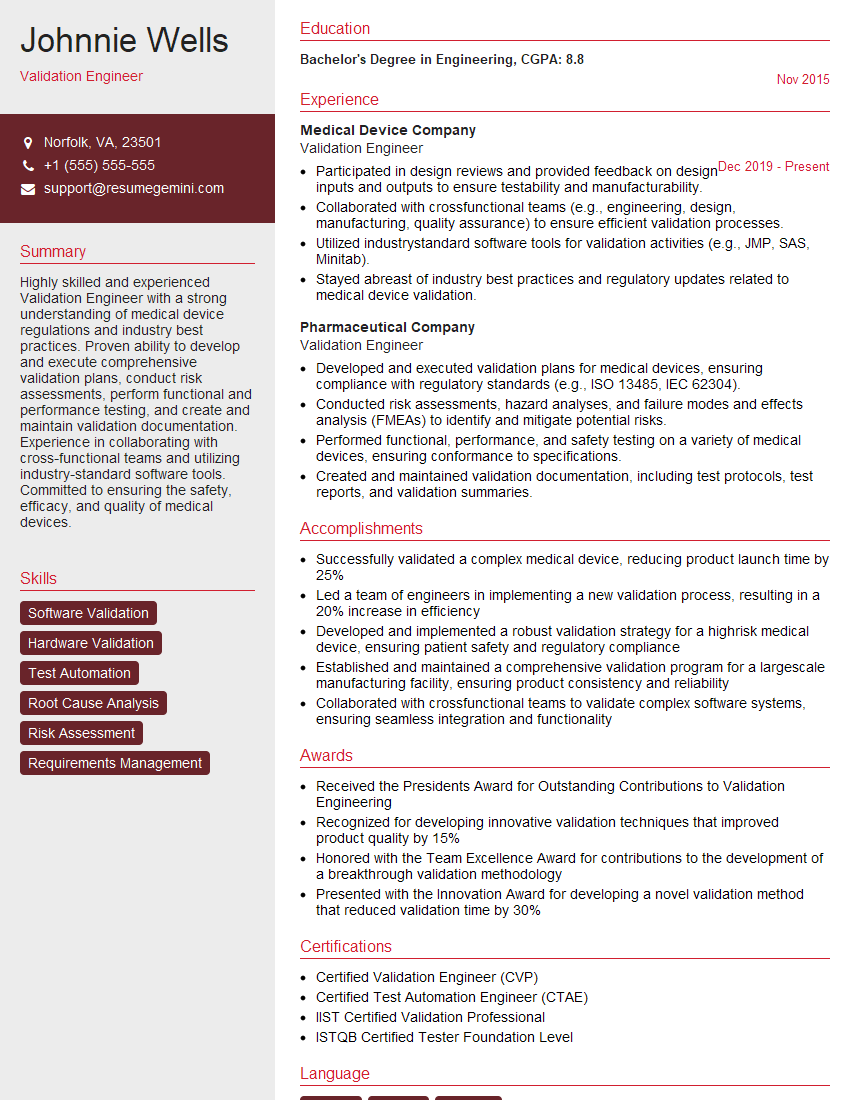
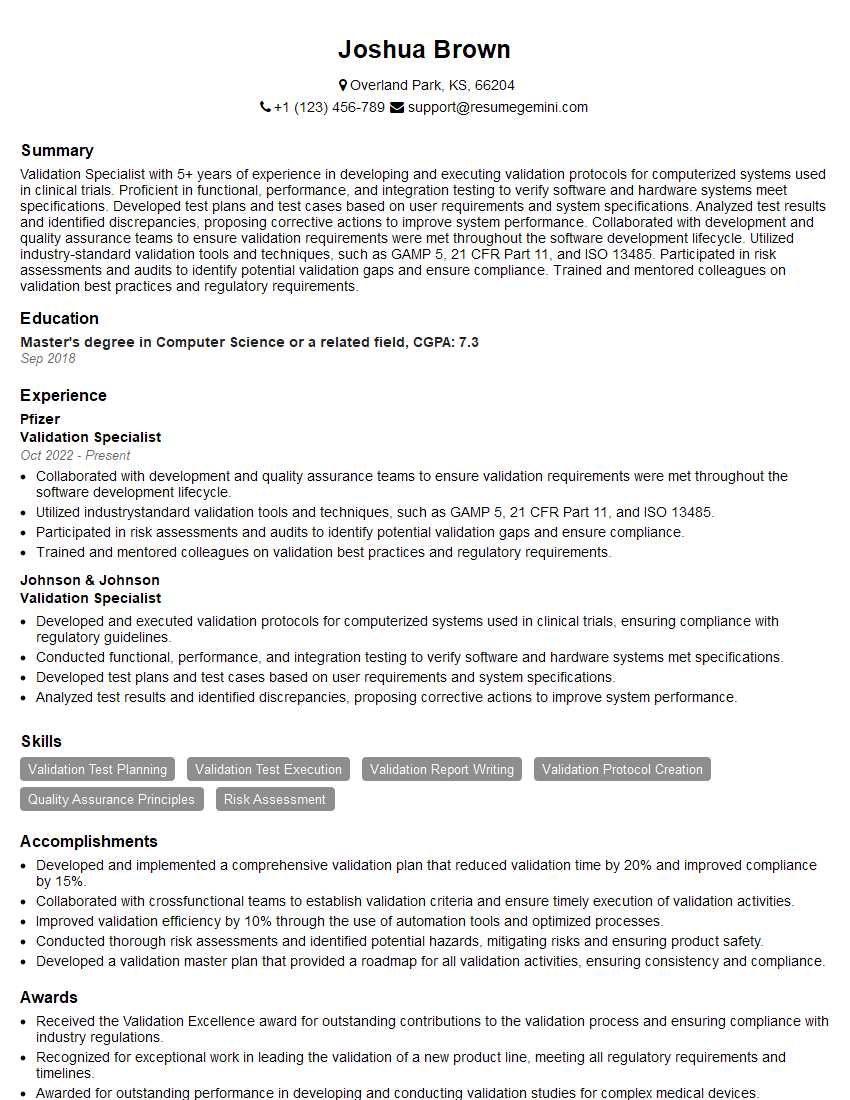
Mastering the Validation Master Plan is crucial for career advancement in regulated industries, opening doors to senior roles with increased responsibility and compensation. To significantly improve your job prospects, invest time in crafting a strong, ATS-friendly resume that highlights your relevant skills and experience. ResumeGemini is a trusted resource that can help you build a professional and impactful resume. We provide examples of resumes tailored to Validation Master Plan roles to help you create a winning application.

Explore more articles
Users Rating of Our Blogs
Share Your Experience
We value your feedback! Please rate our content and share your thoughts (optional).
What Readers Say About Our Blog
Very informative content, great job.
good