Interviews are more than just a Q&A session—they’re a chance to prove your worth. This blog dives into essential Validation of Automated and Semi-Automated Systems interview questions and expert tips to help you align your answers with what hiring managers are looking for. Start preparing to shine!
Questions Asked in Validation of Automated and Semi-Automated Systems Interview
Q 1. Explain the difference between verification and validation in the context of automated systems.
In the world of automated systems, verification and validation are distinct but equally crucial processes. Think of it like building a house: verification ensures you’re building it according to the blueprints, while validation confirms that the finished house actually meets the intended purpose.
Verification focuses on confirming that the system is built correctly. This involves checking if the software code matches the design specifications, if the hardware components function as expected, and if the system meets all the requirements defined in the design documents. It’s an internal check, focusing on adherence to specifications. Examples include code reviews, unit testing, and integration testing.
Validation, on the other hand, checks if the system performs its intended function effectively and reliably. It involves demonstrating that the system meets the user needs and regulatory requirements. This typically involves user acceptance testing (UAT) and performance testing in a real-world or simulated environment. For example, validating a blood analyzer might involve comparing its results against a gold standard method.
- Verification: Are we building the product right?
- Validation: Are we building the right product?
Q 2. Describe your experience with GAMP (Good Automated Manufacturing Practice).
I have extensive experience with GAMP (Good Automated Manufacturing Practice), having led validation projects for various pharmaceutical and biotech companies. My expertise spans all five phases of the GAMP lifecycle (Concept, Design, Build, Test, and Operate). I’ve worked with both GAMP 5 and the updated GAMP 5 Annexes, focusing on risk-based approaches to validation.
In one particular project, we implemented a new automated dispensing system for a pharmaceutical manufacturing facility. Using a GAMP 5 compliant approach, we meticulously documented every step, from the initial requirement specification to final qualification. This included developing a comprehensive validation plan outlining the testing strategy, creating and executing test scripts, and meticulously documenting deviations and their resolutions. We utilized risk assessments to prioritize critical system components and testing activities. The project’s success hinged on our strict adherence to GAMP guidelines, resulting in a fully validated system that met all regulatory requirements and improved manufacturing efficiency.
Q 3. What are the key elements of a Computer System Validation (CSV) plan?
A robust Computer System Validation (CSV) plan is the cornerstone of a successful validation project. It serves as a roadmap, outlining the entire validation process. Key elements include:
- Scope and Objectives: Clearly defining the systems and functions to be validated, and specifying the intended validation goals.
- Risk Assessment: Identifying and assessing potential risks associated with the system’s failure.
- Validation Strategy: Defining the approach (e.g., qualification, verification, and validation activities) and methodology for validation.
- Test Plan: Outlining the detailed testing procedures, including test cases, acceptance criteria, and test data.
- Test Execution and Documentation: A record of test execution, results, and any deviations or issues encountered.
- Deviation Management: A process for handling any deviations from the planned activities or unexpected results during testing.
- Approval and Sign-off: Procedures for review and approval of validation documentation by relevant stakeholders.
- Maintenance and Change Control: A plan for managing ongoing maintenance and updates to the system after validation.
A well-structured CSV plan is not merely a document; it’s a living document that evolves alongside the project and acts as a reference point for every stage.
Q 4. How do you approach risk assessment in automated system validation?
Risk assessment in automated system validation is paramount. We use a systematic approach typically based on the ICH Q9 guideline, employing methods like Failure Mode and Effects Analysis (FMEA) or Hazard and Operability Studies (HAZOP).
The process involves:
- Identifying potential hazards: This might include software bugs, hardware failures, data integrity issues, or user errors.
- Analyzing the likelihood of occurrence and severity of impact: This is usually done through qualitative or quantitative risk assessments, assigning probabilities and consequences to identified hazards.
- Evaluating the risks: Combining the likelihood and severity to determine the overall risk level.
- Implementing risk mitigation strategies: This could range from adding redundancy in hardware, implementing robust error handling in software, or providing thorough user training.
- Documenting the entire process: Maintaining comprehensive documentation throughout this process, including risk assessment reports, mitigation plans and the residual risks.
For instance, in validating a robotic arm in a pharmaceutical manufacturing setting, we would assess the risks associated with a malfunction causing product contamination. This might lead to implementing safety mechanisms, redundancy in control systems and frequent calibration to mitigate the risk.
Q 5. Explain your understanding of 21 CFR Part 11 and its relevance to automated systems.
21 CFR Part 11 is a critical regulation impacting the validation of automated systems, particularly within the pharmaceutical and medical device industries. It sets forth guidelines for electronic records and electronic signatures, ensuring the integrity, authenticity, and reliability of data generated and stored by automated systems.
Its relevance to automated systems is significant because it dictates how these systems must be designed, implemented, and validated to comply with the regulation. Key aspects include:
- System Security: Access control, audit trails, and data protection measures are necessary to ensure data integrity and prevent unauthorized access or modifications.
- Data Integrity: Automated systems must have mechanisms to prevent data corruption, loss, or alteration. Regular backups and validation of data backup and recovery processes are vital.
- Electronic Signatures: Electronic signatures used within the systems must meet specific criteria to ensure they are legally equivalent to handwritten signatures.
- Audit Trails: Comprehensive audit trails are crucial for tracking all system activities, providing a complete history of data changes and user actions.
Non-compliance with 21 CFR Part 11 can result in severe penalties, including regulatory actions and product recalls. Therefore, thorough validation ensuring full compliance is paramount.
Q 6. Describe your experience with different validation lifecycle models (e.g., V-model, Waterfall, Agile).
My experience encompasses various validation lifecycle models, including Waterfall, V-model, and Agile. The choice of model depends heavily on the project’s complexity, regulatory requirements, and the client’s preference.
Waterfall is a linear approach, best suited for projects with well-defined requirements and minimal expected changes. V-model is an extension of Waterfall, emphasizing verification and validation at each stage. Agile, on the other hand, is iterative and incremental, ideal for projects with evolving requirements and a need for flexibility. For complex systems, I often advocate for a hybrid approach, leveraging the strengths of different models. For example, I might utilize an Agile approach for the development phase and a V-model for the validation phase, ensuring comprehensive testing and regulatory compliance. Each model presents its strengths and weaknesses, but the core principle— thorough documentation and a risk-based approach—remains constant.
Q 7. How do you handle deviations and out-of-specification results during validation?
Deviations and out-of-specification (OOS) results during validation are not unexpected; they are opportunities to understand the system’s behavior and to reinforce its robustness. Our approach involves a rigorous investigation to determine the root cause and implement corrective and preventive actions (CAPA).
The process typically includes:
- Immediate documentation: Meticulously documenting the deviation or OOS result, including date, time, circumstances, and affected systems.
- Investigation: Conducting a thorough investigation to pinpoint the root cause, employing tools like fishbone diagrams or 5 Whys analysis.
- Impact Assessment: Evaluating the impact of the deviation on the system’s performance and overall validity.
- Corrective Actions: Implementing corrective actions to address the immediate issue.
- Preventive Actions: Developing preventive actions to mitigate the risk of recurrence.
- Documentation and Review: Thoroughly documenting the investigation, corrective, and preventive actions, which is subject to review and approval.
- Retesting: If necessary, retesting the system to verify the effectiveness of the implemented CAPA.
Transparency and a data-driven approach are crucial in managing deviations. Every deviation is a learning opportunity, and careful documentation helps enhance future validation projects and systems performance.
Q 8. What are some common challenges you’ve faced during automated system validation?
Validating automated systems presents unique challenges. One common hurdle is dealing with the sheer complexity of these systems. The intricate interplay of different software components, hardware integrations, and external dependencies makes pinpointing the root cause of failures a significant task. For instance, in a recent project involving an automated warehouse management system, a seemingly minor software bug in the inventory tracking module triggered a cascading failure that disrupted the entire system. Identifying this required meticulously tracing data flow and interactions between different system modules.
Another challenge stems from ensuring comprehensive test coverage. Automated systems often incorporate dynamic elements and various interfaces, requiring us to create robust test suites that anticipate unexpected scenarios. Consider, for example, network connectivity issues. A perfectly functioning system might fail miserably if a network outage occurs. Therefore, rigorous testing is needed to verify resilience under different conditions. Finally, the constant evolution of these systems via updates and new features adds to the challenge. We need efficient strategies to manage regression testing to ensure that new additions don’t negatively impact pre-existing functionalities. This often requires careful planning and prioritization of test cases.
Q 9. Describe your experience with validation documentation and reporting.
Validation documentation and reporting are crucial for ensuring compliance, reproducibility, and auditability. My experience involves creating comprehensive documentation that covers all aspects of the validation process, including requirements traceability matrices, risk assessments, test plans, test scripts, test results, and deviation reports. I adhere to standards like GAMP 5 and other relevant industry guidelines to ensure consistency and clarity. These documents are organized systematically to facilitate easy access and review. The reporting phase typically involves generating summary reports highlighting the validation status, test results, and any identified deficiencies. This information needs to be clearly presented to both technical and non-technical stakeholders, therefore using appropriate visualizations such as charts and tables is essential. I use tools like Jira and Confluence to manage and track documentation, providing central repository for easy access and version control.
Q 10. How do you ensure the traceability of requirements throughout the validation process?
Ensuring requirements traceability is paramount in validation. We employ a systematic approach involving a requirements traceability matrix (RTM). This matrix links each requirement to specific test cases, ensuring that every requirement is verified and validated. For instance, if a requirement states that the system must process 1000 transactions per second, the RTM will show the specific test cases that were designed to verify this performance criterion. The RTM also enables easy tracking and identification of any potential gaps in testing coverage. We use version control systems, integrated with our test management software, to maintain a clear audit trail of changes made to both requirements and test cases, making it easier to address any discrepancies.
Q 11. What are your preferred methods for testing automated systems (e.g., unit, integration, system testing)?
My preferred testing methods leverage a multi-layered approach combining unit, integration, and system testing. Unit testing focuses on verifying individual components in isolation using techniques like mocking and stubbing. This allows us to identify and rectify issues early in the development cycle. Integration testing then checks the interaction between different units to confirm that they function seamlessly together. Finally, system testing validates the complete system against user requirements, simulating real-world scenarios. The selection of the method depends heavily on the complexity of the system, its architecture, and the risks involved. For instance, a system with a high degree of modularity would benefit from a more intense focus on unit testing, while highly-integrated systems might require more emphasis on integration testing.
Q 12. Explain your experience with automated test scripting and execution.
I have extensive experience with automated test scripting and execution, using tools such as Selenium, Cucumber, and JUnit. I typically use a Behavior Driven Development (BDD) approach, which enhances collaboration between developers, testers, and business stakeholders. BDD allows for writing test cases in plain language, making them easily understandable by non-technical team members. For example, using Cucumber, a test scenario might be written as: Feature: User Login
Scenario: Successful Login
Given the user is on the login page
When the user enters valid credentials
And clicks the login button
Then the user should be redirected to the home page. Automation tools allow for efficient execution of tests, generating comprehensive reports that capture results and performance metrics. We use CI/CD pipelines to integrate automated testing into the build and deployment processes, providing continuous feedback on code quality.
Q 13. How do you manage and resolve conflicts between validation and production timelines?
Managing conflicts between validation and production timelines requires careful planning and proactive communication. This often involves prioritizing validation activities based on risk, focusing on the most critical functionalities first. Techniques such as parallel testing, where validation activities are conducted concurrently with development, can help reduce overall time. Transparency and regular communication with stakeholders are critical to address any potential conflicts. This may involve adjusting timelines, negotiating priorities, or seeking approval for exceptions based on a thorough risk assessment. Open and honest dialogue helps ensure that the project stays on track and that validation is not compromised while meeting production deadlines. This might mean presenting data-driven arguments on which aspects of validation can be streamlined or accelerated, while maintaining the quality and integrity of the process.
Q 14. What are your strategies for validating data integrity in automated systems?
Validating data integrity in automated systems requires a multi-faceted approach. This involves verifying the accuracy, completeness, consistency, and validity of data throughout its lifecycle. Techniques like data validation checks within the application, regular database backups, and automated data reconciliation processes are essential. Data provenance tracking – understanding the origin and history of data – is also crucial. We employ data masking and anonymization techniques where necessary to comply with privacy regulations. Automated audit trails provide a complete record of data modifications, allowing for quick identification and analysis of anomalies. Additionally, implementing regular data quality checks and reporting mechanisms helps to identify and address any inconsistencies or errors promptly, ensuring that the system maintains data integrity throughout its operations.
Q 15. Explain your understanding of different validation methodologies (e.g., IQ, OQ, PQ).
Validation of automated and semi-automated systems often employs a three-part approach: Installation Qualification (IQ), Operational Qualification (OQ), and Performance Qualification (PQ). Think of it like building a house. IQ is ensuring you have all the right materials and tools (hardware, software, infrastructure). OQ verifies that everything is installed and works correctly according to specifications (the plumbing, electricity, etc.). PQ demonstrates that the entire system consistently performs as intended under real-world conditions (the house functions as a comfortable and safe living space).
- IQ (Installation Qualification): This stage verifies that the system is installed correctly, according to the manufacturer’s instructions and relevant regulatory guidelines. It includes checks on physical installation, software installation, and infrastructure requirements (e.g., network connectivity, power supply). An example would be verifying that all sensors are correctly calibrated and connected to the system, and that the software is installed on the appropriate server with the correct version.
- OQ (Operational Qualification): This stage demonstrates that the system operates within its pre-defined parameters. It involves testing the system under various conditions to confirm functionality, accuracy, and reliability. Examples include testing the range of the sensors, verifying data acquisition speeds and accuracy, and checking alarm functions. Think of this as testing individual components before running the whole system.
- PQ (Performance Qualification): This is the final stage, verifying that the entire system performs as expected in a real-world environment. This often involves simulated or actual production runs to assess performance over time under varied conditions. For example, you might run the system continuously for 24 hours under different loads to demonstrate its durability and accuracy. This assures the system meets its intended purpose in a production setting.
Career Expert Tips:
- Ace those interviews! Prepare effectively by reviewing the Top 50 Most Common Interview Questions on ResumeGemini.
- Navigate your job search with confidence! Explore a wide range of Career Tips on ResumeGemini. Learn about common challenges and recommendations to overcome them.
- Craft the perfect resume! Master the Art of Resume Writing with ResumeGemini’s guide. Showcase your unique qualifications and achievements effectively.
- Don’t miss out on holiday savings! Build your dream resume with ResumeGemini’s ATS optimized templates.
Q 16. Describe your experience with change control processes in validated systems.
Change control in validated systems is crucial to maintain compliance and prevent unexpected issues. Every modification, no matter how small, must undergo a rigorous process to ensure it doesn’t compromise the system’s validated state. This typically involves a documented change request, impact assessment, testing, and approval.
My experience includes working with change control processes that follow a structured lifecycle model. This typically involves:
- Change Request Submission: A formal request clearly outlining the proposed change, its justification, and potential impact.
- Impact Assessment: Evaluating the potential consequences of the change on system performance, compliance, and data integrity.
- Risk Assessment: Identifying potential risks associated with the change and outlining mitigation strategies.
- Testing and Validation: Performing thorough testing to verify the change doesn’t introduce errors or negatively affect validated functionality. This might involve retesting parts of the IQ, OQ, or PQ, depending on the scope of the change.
- Approval and Implementation: Obtaining approval from relevant stakeholders and implementing the change under strict control.
- Documentation: Meticulously documenting all aspects of the change, including the testing results and approvals.
In one project, a minor software update required a comprehensive re-validation of a significant portion of the system’s performance qualification, highlighting the importance of thorough change management.
Q 17. How do you ensure the security and compliance of automated systems?
Ensuring the security and compliance of automated systems requires a multi-faceted approach. This involves implementing robust security measures and adhering to relevant regulations (like 21 CFR Part 11 for pharmaceutical systems).
- Access Control: Restricting access to the system based on roles and responsibilities. Using strong passwords and multi-factor authentication is critical.
- Data Security: Implementing encryption to protect sensitive data both in transit and at rest. Regular backups and disaster recovery plans are essential.
- Audit Trails: Maintaining comprehensive audit trails that track all system activities, including user access, data modifications, and system events. This helps to trace any issues and ensure compliance.
- System Hardening: Configuring the system to minimize vulnerabilities. This often involves regular software patching, firewall implementation, and intrusion detection systems.
- Compliance with Regulations: Adhering to all applicable regulations related to data integrity, security, and privacy (e.g., HIPAA, GDPR). This requires understanding the specific regulations and implementing procedures to meet them.
Regular security assessments and penetration testing are also vital to identify and address any potential weaknesses before they can be exploited.
Q 18. What is your experience with different validation tools and technologies?
My experience encompasses a range of validation tools and technologies, including:
- Data Acquisition Systems (DAQ): Used for collecting data from sensors and other instruments. I have experience with NI LabVIEW and other DAQ platforms.
- SCADA Systems: Supervisory Control and Data Acquisition systems are used for monitoring and controlling industrial processes. I have worked with several SCADA systems, including Wonderware and Siemens.
- LIMS (Laboratory Information Management Systems): These systems manage laboratory data and workflows. Experience includes working with Thermo Scientific SampleManager LIMS and other similar systems.
- Validation Software: Specific software tools are used to plan, execute, and document validation activities. Experience includes using validation lifecycle management software.
- Programming Languages: Proficiency in scripting languages like Python for automating validation testing and data analysis is vital.
The choice of tools depends heavily on the specific system being validated, its complexity, and the regulatory requirements.
Q 19. How do you handle unexpected issues or failures during validation testing?
Unexpected issues or failures during validation testing are inevitable. A structured approach is essential. My process involves:
- Immediate Investigation: Thoroughly investigate the cause of the failure, documenting all observations and actions taken. This often includes reviewing logs, system configurations and interviewing personnel.
- Root Cause Analysis: Employing techniques like the 5 Whys or Fishbone diagrams to identify the root cause of the failure. This ensures the problem is fixed permanently, rather than just addressing the symptoms.
- Corrective Actions: Implementing corrective actions to address the root cause and prevent future occurrences. This may involve software updates, hardware replacements, or procedural changes.
- Deviation Report: Documenting the failure, its root cause, corrective actions, and impact in a deviation report. This is critical for regulatory compliance.
- Retesting: After implementing corrective actions, retesting is crucial to ensure the system functions correctly.
For instance, in one project, a sensor malfunction caused a system failure during PQ. Following the above steps, we identified a faulty cable, replaced it, and successfully retested the system.
Q 20. Describe your experience with user acceptance testing (UAT) for automated systems.
User Acceptance Testing (UAT) is a critical phase for automated systems, ensuring the system meets the needs of its end-users. It’s more than just verifying the system works; it’s about verifying it works *for the users*.
My approach to UAT involves:
- Test Plan Development: Creating a detailed UAT test plan outlining the test cases, scenarios, and expected results. This plan should be developed collaboratively with the end-users.
- Test Case Design: Designing realistic test cases that reflect the users’ typical workflows. These should cover all aspects of the system’s functionality and usability.
- Test Environment: Setting up a dedicated test environment that mirrors the production environment as closely as possible.
- User Training: Providing the end-users with necessary training on how to use the system and conduct the UAT.
- Test Execution: The end-users execute the test cases and document their findings. This often involves user feedback sessions.
- Defect Reporting and Resolution: Any issues or defects discovered during UAT are reported, investigated, and resolved.
- Sign-off: Once all issues are resolved and the system meets the user’s acceptance criteria, they provide formal sign-off, indicating the system is ready for deployment.
Involving users early in the validation process improves the overall quality and user adoption of the automated system.
Q 21. How do you validate systems with embedded software components?
Validating systems with embedded software components requires a more comprehensive approach. It necessitates validating both the hardware and software aspects, including the interaction between them.
My approach involves:
- Software Verification and Validation: Conducting thorough software V&V activities, including unit testing, integration testing, and system testing. This verifies the software functions according to its specifications and meets its intended purpose. This might also include static and dynamic analysis of code.
- Hardware/Software Integration Testing: Testing the interaction between the hardware and software components to ensure they work together seamlessly. This can involve testing communication protocols, data exchange, and real-time performance.
- System-Level Validation: Validating the entire system, including the hardware and software, as a unified entity. This includes performing IQ, OQ, and PQ testing on the integrated system.
- Traceability Matrix: Maintaining a traceability matrix that links the software requirements to test cases and validation activities. This demonstrates comprehensive testing coverage.
- Software Configuration Management: Implementing robust software configuration management processes to ensure all versions of the software are tracked and controlled.
For example, in validating an automated medical device, we had to rigorously validate the embedded software controlling the device’s functions, as well as the interaction of this software with the device’s hardware components to ensure accurate and safe operation.
Q 22. Explain your understanding of system lifecycle management and its impact on validation.
System lifecycle management (SLM) encompasses all activities involved in a system’s life, from its initial conception to its eventual decommissioning. It’s a crucial framework that significantly impacts validation because it ensures that validation activities are planned, executed, and documented throughout the entire lifecycle, aligning with evolving regulatory requirements and business needs. Think of it as a roadmap guiding the system’s journey, ensuring its suitability, performance, and compliance at every stage.
Impact on Validation: SLM ensures that validation is not a one-time event but an ongoing process. This approach proactively addresses potential risks and ensures continuous compliance. For instance, SLM dictates the need for revalidation following significant changes (e.g., software upgrades, hardware replacements, or changes in operational procedures). Without SLM, validation might become outdated, potentially leading to non-compliance and system failures.
- Initial Phase (Development & Design): Validation planning begins early, considering factors such as user requirements, regulatory guidelines, and risk assessment. This includes defining validation protocols and acceptance criteria.
- Qualification Phase (Installation & Testing): This stage involves IQ (Installation Qualification), OQ (Operational Qualification), and PQ (Performance Qualification) to verify that the system is installed correctly, operates as intended, and consistently meets performance specifications.
- Operational Phase (Routine Use): Ongoing monitoring, periodic testing, and change management are essential. Deviation management and corrective actions are documented.
- Decommissioning Phase (Retirement): A documented decommissioning plan should outline data archiving, system removal, and final report generation.
In a recent project involving a large-scale laboratory information management system (LIMS), we implemented a rigorous SLM process. This ensured that all validation activities were aligned with the system’s various phases, culminating in a robust and compliant system that continues to meet evolving regulatory and business needs.
Q 23. What metrics do you use to measure the effectiveness of your validation efforts?
Measuring the effectiveness of validation efforts requires a multifaceted approach, going beyond simple pass/fail criteria. We employ several key metrics:
- Defect Rate: This tracks the number of critical defects found during validation testing. A lower defect rate indicates higher quality and effectiveness of the validation process.
- Validation Completion Time: This metric assesses the efficiency of the validation process. We benchmark against previous projects and identify areas for improvement in timelines.
- Compliance Rate: This assesses the percentage of validation activities that meet regulatory requirements and internal standards. A high compliance rate demonstrates the robustness of the validation program.
- Deviation Rate: Tracking deviations from established procedures or protocols helps identify potential weaknesses in the system or the validation process itself. We analyze root causes and implement corrective actions.
- User Acceptance Rate: Collecting feedback from end-users ensures that the validated system meets their needs and expectations. This is especially important for usability and effectiveness.
For instance, in validating a new automated dispensing system in a pharmaceutical manufacturing environment, we tracked the defect rate, which was consistently below 1% during testing. This indicated a high-quality and well-validated system. We also monitored the user acceptance rate, gathering feedback through surveys and user training sessions, allowing us to fine-tune the system’s usability.
Q 24. Describe your experience with auditing and inspection related to automated systems.
My experience with auditing and inspection of automated systems is extensive, spanning various industries and regulatory frameworks. Audits and inspections are crucial for ensuring compliance and identifying areas for improvement. They involve a thorough review of validation documentation, system configuration, and operational procedures.
Key Aspects:
- Review of Validation Documentation: This includes IQ, OQ, and PQ documentation, deviation reports, change control records, and maintenance logs. We ensure that documentation is complete, accurate, and compliant with relevant regulations.
- System Functionality Testing: This may involve observing system operation, reviewing audit trails, and performing limited testing to verify system functionality and data integrity.
- Operator Training and Competency: We assess the training programs and ensure that operators are adequately trained on the system’s operation and safety procedures.
- Risk Assessment and Mitigation: We review risk assessment documents and ensure that appropriate mitigation strategies are in place to address potential hazards.
During a recent GMP audit of an automated manufacturing system, we identified a minor deficiency in the change control process. By working collaboratively with the client, we implemented corrective actions, ensuring that the system maintained compliance. The auditor acknowledged the proactive approach and commended our thorough documentation.
Q 25. How do you ensure the ongoing compliance of validated systems?
Maintaining ongoing compliance of validated systems is an essential ongoing activity, not a one-time event. Several strategies are crucial:
- Change Control Process: A robust change control process ensures that all modifications to the system (hardware, software, procedures) are properly evaluated, validated, and documented. This minimizes risks associated with unplanned changes.
- Preventive Maintenance: Regular preventive maintenance prevents equipment failures and ensures continued system performance. Maintenance logs should be meticulously maintained.
- Periodic Revalidation: Depending on the system’s complexity and criticality, periodic revalidation may be necessary. This involves repeating parts of the original validation process to confirm continued compliance and performance.
- Audits and Inspections: Regular internal and external audits and inspections help to identify potential compliance issues and areas for improvement.
- Training and Competency Assessment: Ensuring that operators and maintainers are appropriately trained and competent is crucial for ongoing compliance. Regular competency assessments help to maintain a high standard of performance.
For example, a validated chromatography system would require periodic re-qualification of its performance, calibration checks of its detectors, and a documented process for addressing software updates.
Q 26. How do you maintain and update validation documentation over the system’s lifecycle?
Maintaining and updating validation documentation throughout the system’s lifecycle is critical for ensuring compliance and traceability. We use a combination of strategies:
- Version Control System: Using a version control system (e.g., electronic document management system (EDMS)) allows for easy tracking of changes and ensures that only the most current version of the documentation is accessible. This prevents confusion and ensures data integrity.
- Document Change Logs: Each document should have a change log that tracks all modifications, including the date, author, and reason for the change. This provides a clear audit trail of all revisions.
- Regular Reviews and Updates: Documentation should be reviewed and updated periodically to reflect changes to the system, procedures, or regulatory requirements. This prevents outdated information from being used.
- Electronic Signatures and Audit Trails: Employing electronic signatures and audit trails ensures that all changes are properly authorized and documented, providing a secure and traceable record.
Consider a scenario where a software update is implemented in a validated instrument. Our EDMS would track the version history, and the updated validation protocols and results would be readily accessible, with full traceability.
Q 27. What is your experience with regulatory submissions related to validated systems?
My experience with regulatory submissions related to validated systems is extensive. This includes compiling and submitting the necessary documentation to regulatory bodies like the FDA to support the approval of new systems or changes to existing ones.
Key aspects of regulatory submissions:
- Preparation of Validation Documentation: This involves compiling all relevant validation documentation, including IQ, OQ, and PQ reports, risk assessments, deviation reports, and change control records. The documentation must be complete, accurate, and in compliance with relevant regulations.
- Submission Package Preparation: The submission package is carefully prepared to ensure that it meets all regulatory requirements. This involves formatting the documents, using the correct terminology, and ensuring that all relevant information is included.
- Response to Regulatory Inquiries: We respond promptly and thoroughly to any inquiries from regulatory bodies. This demonstrates our commitment to transparency and compliance.
- Knowledge of Relevant Regulations: A deep understanding of the relevant regulations (e.g., 21 CFR Part 11, GMP guidelines) is essential for preparing accurate and compliant submissions. This understanding ensures all requirements are met.
For example, in the submission for a new automated cell culture system, we meticulously compiled all validation data, including detailed performance qualification testing results, showing the system consistently met predefined accuracy and precision criteria, satisfying regulatory requirements.
Q 28. Describe your experience working in a regulated environment (e.g., FDA, GMP).
I have significant experience working in regulated environments, primarily within the pharmaceutical and medical device industries, adhering to FDA regulations and GMP principles. My understanding extends beyond mere compliance; I actively integrate these principles into every stage of system development and validation.
Key Experiences:
- GMP Compliance: I’ve been involved in implementing and maintaining GMP compliant systems, ensuring data integrity, traceability, and accuracy in all validation activities. This includes careful attention to documentation practices, change control procedures, and deviation management.
- 21 CFR Part 11 Compliance: I have extensive experience in ensuring compliance with 21 CFR Part 11, which governs electronic records and signatures in regulated industries. This includes utilizing electronic systems and workflows that maintain data integrity and auditability.
- FDA Inspections: I’ve actively participated in FDA inspections, providing clear and concise documentation to support our validation efforts and demonstrating our commitment to compliance. These experiences have refined my ability to anticipate and address potential regulatory concerns.
- Risk Management: In regulated environments, risk management is paramount. I have integrated risk assessment methodologies into validation processes, proactively identifying and mitigating potential risks to ensure system safety and reliability.
A recent project involved the validation of a new automated filling system for a pharmaceutical client. We ensured complete compliance with 21 CFR Part 11, implementing robust electronic signature processes and maintaining detailed audit trails. The system passed a rigorous FDA inspection without any critical observations, showcasing the effectiveness of our approach.
Key Topics to Learn for Validation of Automated and Semi-Automated Systems Interview
- Validation Lifecycle: Understand the complete lifecycle, from planning and risk assessment to execution and reporting. Consider different phases like design qualification (DQ), installation qualification (IQ), operational qualification (OQ), and performance qualification (PQ).
- Regulatory Compliance: Familiarize yourself with relevant regulations (e.g., 21 CFR Part 11, GAMP 5) and their impact on validation processes for automated systems. Know how to demonstrate compliance in your work.
- Risk Assessment and Mitigation: Learn how to identify and assess risks associated with automated systems and develop strategies for mitigation. Be prepared to discuss risk-based validation approaches.
- Software Validation: Understand software validation principles, including verification and validation techniques specific to software used in automated systems. This includes aspects like software testing, traceability, and change control.
- Data Integrity: Master the principles of data integrity as they apply to automated systems. Be able to discuss methods for ensuring data accuracy, completeness, and reliability throughout the validation process.
- Automation Technologies: Demonstrate familiarity with common automation technologies used in your industry (e.g., robotics, SCADA, PLC). Understand how these technologies impact validation strategies.
- Documentation and Reporting: Understand the importance of comprehensive documentation and the creation of clear, concise validation reports. Be prepared to discuss your experience with creating and maintaining validation documentation.
- Problem-Solving and Troubleshooting: Be ready to discuss your approach to troubleshooting issues within automated systems and how you apply validation principles to identify and resolve problems effectively.
Next Steps
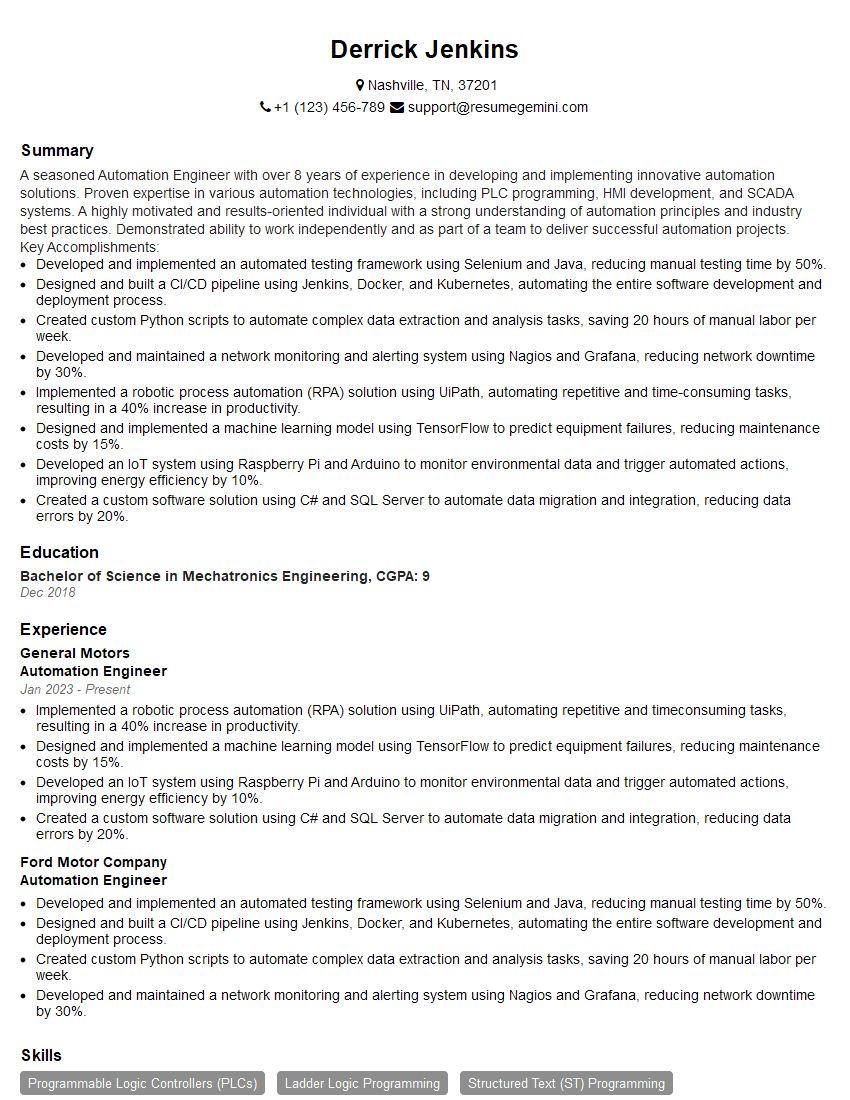
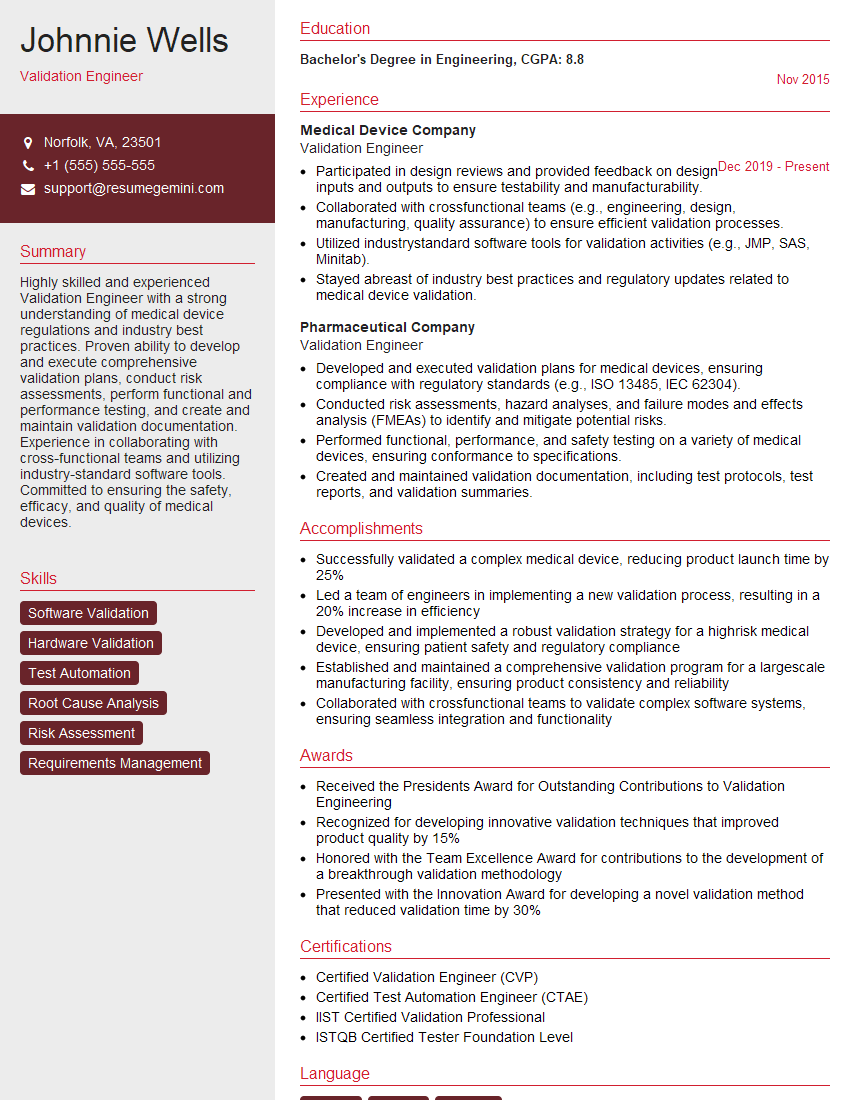
Mastering the validation of automated and semi-automated systems is crucial for career advancement in regulated industries. It demonstrates a high level of technical expertise and commitment to quality and compliance. To significantly improve your job prospects, focus on building a strong, ATS-friendly resume that highlights your skills and experience effectively. ResumeGemini is a trusted resource that can help you create a professional and impactful resume tailored to your specific needs. Examples of resumes tailored to Validation of Automated and Semi-Automated Systems are available to guide you.
Explore more articles
Users Rating of Our Blogs
Share Your Experience
We value your feedback! Please rate our content and share your thoughts (optional).
What Readers Say About Our Blog
Very informative content, great job.
good