Are you ready to stand out in your next interview? Understanding and preparing for Varroa Mite Control interview questions is a game-changer. In this blog, we’ve compiled key questions and expert advice to help you showcase your skills with confidence and precision. Let’s get started on your journey to acing the interview.
Questions Asked in Varroa Mite Control Interview
Q 1. Describe the life cycle of the Varroa destructor mite.
The Varroa destructor mite’s life cycle is fascinating and crucial to understanding its impact on honeybee colonies. It’s a parasitic mite that lives exclusively within honeybee colonies, feeding on hemolymph (bee blood) and weakening the bees. The cycle begins with a fertilized female mite entering a capped brood cell shortly before it’s sealed. Inside, the mite lays eggs. The first egg is always a female, followed by several male eggs. The female mites mate with their brothers, and then the female mites begin feeding on the developing bee pupa.
These mites reproduce within the sealed brood cell, completing their life cycle within about 7-10 days. Once the bee emerges, adult female mites leave the cell with the bee, ready to repeat the cycle. The timing of reproduction is carefully synchronized with the bee’s development to ensure the mite’s survival and continuation of the infestation. Understanding this life cycle helps target control measures to the different stages of the mite’s development.
- Phoretic Phase: Adult female mites attach to adult bees, moving around the colony and finding new brood cells.
- Reproductive Phase: The mite enters a capped brood cell with the bee larva, reproduces, and its offspring feed on the developing bee.
Q 2. What are the three primary methods of Varroa mite control?
Varroa mite control relies on a multifaceted approach, typically combining several methods for optimal effectiveness. The three primary methods are:
- Chemical Control: This involves using miticides (chemicals designed to kill mites). These can be organic acids (like oxalic acid or formic acid), synthetic miticides (e.g., amitraz, fluvalinate), or essential oils (e.g., thymol).
- Biological Control: This focuses on enhancing the colony’s natural defenses or employing biological agents to control mites. Examples include using drone brood trapping (mites prefer drone brood), resistant bee breeds (e.g., Russian bees), or introducing natural mite predators (though this is still under research).
- Mechanical Control: These are physical methods to remove mites from the colony. Examples include using powdered sugar dusting, screened bottom boards to allow mite fall, or drone brood removal.
Effective management usually involves integrating these methods, rotating treatments to avoid mite resistance, and always monitoring mite levels.
Q 3. Explain the differences between oxalic acid, formic acid, and thymol treatments.
Oxalic acid, formic acid, and thymol are all organic acids or essential oils used in Varroa mite control, but they differ significantly in their application, effectiveness, and potential risks.
- Oxalic Acid: This is a relatively mild acid, applied as a dribble or vaporization method. It’s effective against phoretic mites (mites on adult bees), but less effective against mites in capped brood. It’s generally considered safe for bees when applied correctly, though some beekeepers avoid it during honey production.
- Formic Acid: A stronger acid than oxalic, it’s applied as a slow-release pad or vaporizer. It has better penetration into capped brood than oxalic acid, making it more effective overall. However, it’s more volatile and requires careful application to avoid harming the bees and queen. Temperature is crucial for its effective and safe use.
- Thymol: This is an essential oil derived from thyme. It’s applied as a solid sublimation or liquid form. Thymol has broad-spectrum effects against mites in both the capped and uncapped stages, but it can be more stressful on the bees, especially in hot weather. It’s important to follow label directions precisely.
The choice of treatment depends on factors like the time of year, temperature, colony strength, honey production goals, and the specific mite infestation level.
Q 4. What are the advantages and disadvantages of using synthetic miticides?
Synthetic miticides offer powerful control against Varroa mites, but their use comes with significant drawbacks that need to be weighed against the benefits.
- Advantages: Highly effective at reducing mite populations, readily available, and often relatively easy to apply.
- Disadvantages: Potential for mite resistance development (this is a serious issue!), residues in honey (affecting market value and consumer health), potential harm to bees or the queen, and negative impacts on the bee’s gut microbiome. The long-term overuse of synthetic miticides can lead to the failure of other control measures in the future.
Responsible beekeeping requires minimizing the use of synthetic miticides and using them judiciously as part of an integrated pest management strategy. It’s crucial to follow label instructions carefully and consider the long-term consequences for both the colony and the environment.
Q 5. How do you monitor Varroa mite infestation levels in a bee colony?
Regular monitoring of Varroa mite infestation is crucial for effective control. There are several methods to assess infestation levels, ideally implemented throughout the beekeeping season:
- Alcohol Wash: This method involves sampling a specific number of bees from the colony, submerging them in alcohol, and counting the mites that detach.
- Sugar Shake: A less precise method but easier than an alcohol wash. Bees are shaken into a container with powdered sugar which dislodges the mites.
- Sticky Boards: Placed beneath the brood chamber, these allow the monitoring of mite fall over time; the number of mites found on the sticky board reflects the level of infestation.
- Visual Inspection: Inspecting brood for signs of infestation (like deformed wings or dead pupae) can be a useful indicator, although it’s less accurate for quantifying the infestation level.
The frequency of monitoring depends on various factors, such as the time of year, colony strength, and treatment history. More frequent monitoring is necessary during periods of high mite reproduction (e.g., during the summer months).
Q 6. Describe the alcohol wash method for Varroa mite counting.
The alcohol wash is a reliable method for estimating Varroa mite infestation levels. It provides a more accurate count than some other methods, though it’s slightly more time-consuming.
- Sample Collection: Collect approximately 300 adult bees from different areas of the hive, focusing on areas with active brood.
- Alcohol Preparation: Prepare a solution of 70% isopropyl alcohol in a container.
- Submerging Bees: Gently submerge the collected bees in the alcohol solution and stir gently.
- Mite Separation: After a few minutes (to allow mites to detach from the bees), strain the solution through a fine sieve or mesh.
- Counting Mites: Count the number of mites in the strained solution. The count represents the number of mites on 300 bees sampled.
- Calculation: To determine the infestation level, divide the number of mites by the number of bees sampled (300) and multiply by 100. This gives you the percentage of infestation.
For example, if you count 15 mites in your alcohol wash sample, the infestation level would be (15/300) x 100 = 5%. Different thresholds for treatment intervention exist based on specific location and beekeeper experience, but anything over 3% is generally considered too high and requires treatment.
Q 7. What are the signs and symptoms of a Varroa mite infestation?
Varroa mite infestations can manifest in various ways, often leading to a weakened colony and increased susceptibility to other diseases. Early detection is key for effective management.
- Visible Mites: Observing mites on adult bees or in brood cells (especially drone brood) can be an early indicator.
- Deformed Wings: Bees with deformed or shrunken wings (DWV – Deformed Wing Virus) are a clear sign of significant infestation. This is a virus transmitted by the mite.
- Poor Brood Pattern: An irregular and patchy brood pattern (with missing or dead brood) indicates significant mite infestation.
- Reduced Colony Population: A declining bee population, despite adequate resources, suggests underlying problems, often linked to mites.
- Increased Drone Brood: Colonies can show a higher proportion of drone brood, which is a preference of the Varroa mite.
- Slow or Weak Bees: Bees may exhibit sluggishness, decreased foraging activity, and overall weakness in heavily infested colonies.
The combination of several of these signs strongly suggests a Varroa mite problem requiring prompt action. Ignoring these signs can lead to colony collapse.
Q 8. How does Varroa mite infestation impact honey production?
Varroa mites are devastating parasites of honey bees, significantly impacting honey production. They weaken bees by feeding on their hemolymph (blood), essentially draining their life force. This weakens the individual bee’s immune system, making them more susceptible to diseases like viruses and other pathogens. The mites also directly damage brood (developing bees), leading to deformed wings, shortened lifespans, and reduced worker bee populations. A colony heavily infested with Varroa mites will have fewer foraging bees, resulting in a significant decrease in honey collection and overall honey yield. Imagine a farmer with healthy cows producing lots of milk versus a farmer whose cows are infested with parasites – the output is drastically reduced. The same principle applies to honey bee colonies and Varroa mites.
The severity of the impact depends on the level of infestation. A low infestation may show subtle effects, but a high infestation can lead to colony collapse and complete loss of the hive. Regular monitoring of mite levels is crucial to prevent significant honey production losses.
Q 9. Explain the role of integrated pest management (IPM) in Varroa mite control.
Integrated Pest Management (IPM) for Varroa mites emphasizes a holistic approach, prioritizing prevention and using multiple control methods strategically rather than relying solely on chemical treatments. The goal is to minimize the use of miticides while maintaining mite populations below economically damaging levels. This protects the bees, the environment, and maintains the efficacy of the miticides.
- Monitoring: Regular monitoring of mite populations is fundamental. Several methods exist, including alcohol washes and sticky boards, allowing beekeepers to accurately assess the infestation level.
- Prevention: Strong, healthy colonies are more resistant to infestations. This can be achieved through proper nutrition, good hive hygiene, and genetic selection of mite-resistant bee lines.
- Cultural Controls: Methods such as drone brood removal (explained further in another answer) and screened bottom boards are effective non-chemical controls.
- Biological Controls: Introducing natural predators or using beneficial bacteria to manage mite populations.
- Chemical Controls: Only used as a last resort and in a carefully planned manner, rotating different miticides to avoid resistance development.
IPM ensures a long-term sustainable approach to Varroa mite control, preserving the health of the bees and the environment while maximizing honey production.
Q 10. What are some non-chemical methods for Varroa mite control?
Several non-chemical methods help manage Varroa mite infestations. These are often used in conjunction with other methods as part of an IPM strategy. They’re generally gentler on the bees and the environment compared to chemical treatments.
- Drone Brood Removal: Varroa mites prefer to reproduce in drone brood cells due to their longer development time. Removing drone brood frames eliminates a significant number of mites.
- Screened Bottom Boards: These allow mites that fall off the bees to fall through the screen and not re-enter the hive. This can reduce mite numbers, especially when combined with other methods.
- Powdered Sugar Dusters: Applying powdered sugar to the bees causes them to groom themselves more vigorously, dislodging some mites in the process.
- Oxalic Acid Vaporization (OA): Although considered a chemical treatment, OA is considered relatively benign for bees when used correctly. Its impact on the environment is minimal, making it a preferable option compared to synthetic miticides in some situations. (Important: Always follow directions precisely and understand its limitations).
- Thermal Treatments: Applying controlled heat to brood frames to kill mites.
The effectiveness of each method varies, and it’s often best to employ a combination for optimal control.
Q 11. How does drone brood removal help control Varroa mites?
Drone brood removal is a highly effective non-chemical control method. Varroa mites preferentially reproduce in drone brood cells because they have a longer developmental period than worker brood cells, giving mites more time to multiply. By removing these drone brood frames at the right time (before the drone pupae are capped), a substantial number of mites are eliminated before they can reproduce further.
The timing is crucial. Frames should be removed just before the drone cells are capped, allowing most of the mites to be removed along with the drone brood. The removed frames can then be destroyed or frozen to ensure the mites are killed.
This method is best integrated into an IPM program, as it’s more effective when combined with other control measures.
Q 12. What are the potential risks associated with using miticides?
While miticides are essential in managing Varroa mite infestations, their use comes with potential risks. These risks warrant careful consideration and a responsible approach.
- Mite Resistance: Overuse or improper use of miticides can lead to the development of resistant mite populations, rendering the treatment ineffective in the future. This requires careful rotation of different miticide classes.
- Residue in Honey: Some miticides can leave residues in honey, potentially posing a health risk to consumers. Careful attention must be paid to withdrawal periods before harvesting honey.
- Toxicity to Bees: Miticides can be toxic to bees if applied improperly or if the wrong dosage is used. Always follow the manufacturer’s instructions precisely.
- Environmental Impacts: Some miticides can have negative environmental consequences, affecting non-target organisms.
Choosing miticides judiciously, using them only when necessary, and adhering strictly to application instructions are crucial to minimizing these risks.
Q 13. How do you choose the appropriate Varroa mite treatment for a given situation?
Selecting the right Varroa mite treatment involves a careful assessment of several factors:
- Severity of Infestation: A low-level infestation may be manageable with non-chemical methods, while a severe infestation may require miticides.
- Time of Year: The optimal timing for treatment varies depending on the treatment method and the bee’s brood cycle. Treatments are often more effective when there is minimal brood present in the hive.
- Bee Species and Health: Certain treatments may be better suited for specific bee species or colonies with particular health conditions.
- Availability of Treatments: Some treatments might not be registered or available in certain regions.
- Resistance: Prior miticide use history influences the choice. Rotating different miticides or treatment methods helps prevent resistance.
- Honey Harvest: Consider the honey harvest schedule to avoid contaminating the honey.
An experienced beekeeper will consider these factors and select an integrated approach that is tailored to their specific circumstances.
Q 14. What is the importance of proper timing for Varroa mite treatments?
Proper timing of Varroa mite treatments is crucial for their effectiveness. The timing is often determined by the bee’s brood cycle and the specific treatment used.
Treatments are often most effective when there is little or no brood present in the hive, as the mites primarily reproduce in brood cells. Therefore, treatments are usually applied during the late fall or early winter, when brood production is minimal, or in the early spring, before the major brood rearing season begins. Applying treatment at other times may result in less efficacy, as some mites might be protected within brood cells.
For example, oxalic acid vaporization, effective when brood is absent, would have limited effectiveness during the summer when brood levels are high.
Knowing the local climate, bee brood cycle, and the treatment’s specifications is essential to optimizing treatment success.
Q 15. How do you assess the effectiveness of a Varroa mite treatment?
Assessing Varroa mite treatment effectiveness requires a multi-pronged approach. Simply put, we need to see if the treatment is actually reducing the mite population and improving colony health. This isn’t just about looking at mite levels before and after treatment; it’s about observing the overall health and vitality of the hive.
We typically employ several methods:
Regular mite counts: Before treatment, we’ll use methods like the alcohol wash or sugar shake to determine the initial mite infestation level. Post-treatment, we repeat these counts at regular intervals to track the reduction. A significant drop indicates effective treatment. For example, if the initial count is 10% and drops to below 2% after treatment, that’s a good sign.
Monitoring colony health: Look for improved brood patterns (less spotty brood), increased bee activity, and reduced bee mortality. A healthy colony is less susceptible to diseases often associated with high Varroa mite loads, like Deformed Wing Virus (DWV).
Visual inspection: Examine bees for DWV symptoms. High numbers of bees with deformed wings is a strong indicator of mite infestation, even after treatment. A decrease in these symptoms post-treatment shows treatment efficacy.
It’s crucial to understand that a single assessment isn’t enough. Consistent monitoring over time provides the most accurate picture of the treatment’s long-term effectiveness.
Career Expert Tips:
- Ace those interviews! Prepare effectively by reviewing the Top 50 Most Common Interview Questions on ResumeGemini.
- Navigate your job search with confidence! Explore a wide range of Career Tips on ResumeGemini. Learn about common challenges and recommendations to overcome them.
- Craft the perfect resume! Master the Art of Resume Writing with ResumeGemini’s guide. Showcase your unique qualifications and achievements effectively.
- Don’t miss out on holiday savings! Build your dream resume with ResumeGemini’s ATS optimized templates.
Q 16. What are the legal regulations regarding miticide use in your area?
Legal regulations regarding miticide use vary greatly depending on location and specific products. In most regions, miticide use is strictly controlled. There are often registration requirements, application rates, and withdrawal periods to ensure both efficacy and safety for beekeepers, consumers, and the environment. Some countries may even restrict or ban the use of certain miticides due to concerns about resistance development or environmental impacts.
For example, in many areas, the use of certain neonicotinoid pesticides alongside miticides is restricted due to their potential synergistic effect, which can further harm bee colonies. Always check with your local agricultural department or beekeeping association for the most up-to-date regulations in your area. Failing to comply with these regulations can lead to serious consequences, including fines or legal action.
Q 17. Explain the concept of Varroa mite resistance to miticides.
Varroa mite resistance to miticides is a significant problem in beekeeping. Essentially, some mites within a population have genetic mutations that make them less susceptible to the effects of a particular miticide. These resistant mites survive treatment, reproduce, and eventually dominate the population, rendering the miticide ineffective.
Think of it like antibiotic resistance in bacteria. Overuse or improper use of miticides selects for these resistant mites, leading to a cycle of treatment failure. This resistance can develop against various classes of miticides, including pyrethroids, organophosphates, and amitraz. The resistant mites might not be completely immune, but their survival rate is high enough to undermine treatment effectiveness.
Q 18. How can you prevent or mitigate Varroa mite resistance?
Preventing and mitigating Varroa mite resistance requires a multifaceted strategy focusing on responsible miticide use and integrated pest management (IPM):
Integrated Pest Management (IPM): This approach doesn’t rely solely on chemical treatments. It combines various control methods, such as drone brood removal, screened bottom boards, and resistant bee breeding, to minimize the need for miticides and reduce the risk of resistance development.
Rotating miticides: Avoid using the same miticide repeatedly. Alternating between different classes of miticides can slow down resistance development because resistant mites to one class may still be susceptible to another.
Using miticides judiciously: Only apply miticides when necessary, based on accurate mite counts and colony health assessments. Avoid treating healthy colonies unnecessarily. Improper timing and dosage can also increase resistance.
Monitoring mite populations: Regular mite counts will inform treatment decisions and allow for early intervention, minimizing the need for excessive miticide use.
Breeding resistant bees: Supporting and breeding bee strains with a higher degree of natural resistance to Varroa mites reduces dependency on chemical treatments. This is a long-term strategy, but crucial for the future of beekeeping.
Q 19. What is the role of brood management in Varroa mite control?
Brood management plays a critical role in Varroa mite control because mites reproduce primarily within the capped brood cells. Controlling the brood cycle directly impacts the mite population. Several brood management techniques target mite reproduction:
Drone brood removal: Varroa mites prefer to infest drone brood due to its longer development time. Removing drone brood frames regularly removes a large number of mites.
Breaking the brood cycle: Methods such as creating artificial swarms or using a brood break can temporarily eliminate capped brood, reducing mite reproduction. This is often used in combination with other treatments.
Effective brood management, when combined with other methods, can significantly reduce mite populations and improve colony health. It’s important to note that brood management needs to be carefully timed to minimize stress on the colony.
Q 20. Describe different methods for improving bee colony health and resilience to Varroa mites.
Improving bee colony health and resilience to Varroa mites involves multiple strategies:
Strong genetics: Selecting and breeding bees with natural resistance to Varroa mites is a key long-term solution. These bees may exhibit hygienic behaviors (removing infested brood), or have traits that inhibit mite reproduction.
Good nutrition: Well-nourished colonies are more resilient to disease and mite infestations. Providing ample pollen and nectar sources, or supplementing with pollen substitutes, can bolster colony health.
Proper hive hygiene: Regular hive inspections to remove debris, old comb, and other potential mite reservoirs help prevent mite build-up.
Integrated pest management (IPM): This holistic approach incorporates several control measures rather than relying solely on miticides, enhancing long-term colony health.
Resistant bee breeding programs: Actively supporting and participating in breeding programs focused on Varroa resistance is crucial for the long-term sustainability of beekeeping.
Q 21. How can good beekeeping practices reduce the need for chemical treatments?
Good beekeeping practices are fundamental in reducing the need for chemical treatments. A healthy and strong colony is better equipped to defend itself against Varroa mites. These practices include:
Regular inspections: Early detection of mite infestations allows for timely intervention with less intensive treatments. Regularly monitoring mite levels is crucial.
Strong queens: Colonies with vigorous queens tend to be more productive and better able to withstand Varroa pressure. Regular queen replacement is important.
Proper nutrition: Well-nourished colonies are more resilient to diseases and pests. Ensuring access to diverse pollen and nectar resources is vital.
Hive hygiene: Maintaining clean and well-ventilated hives reduces the risk of disease and parasite build-up.
Varroa-resistant bee stock: Selecting or breeding Varroa-resistant bee lines reduces the need for frequent treatments.
By focusing on these practices, beekeepers can create an environment that minimizes Varroa mite populations naturally, reducing the reliance on miticides and promoting long-term colony health.
Q 22. What are the economic impacts of Varroa mite infestations on beekeeping operations?
Varroa mites inflict significant economic damage on beekeeping operations. Think of it like this: a single infested hive can quickly become unproductive, leading to substantial losses. These losses manifest in several ways.
Reduced Honey Production: Mites weaken bees, reducing their ability to forage and store honey. This directly impacts the beekeeper’s income from honey sales.
Increased Management Costs: Controlling mites requires time, effort, and resources. This includes purchasing treatments, conducting regular hive inspections, and potentially replacing lost colonies.
Colony Losses: Severe infestations can lead to colony collapse, resulting in the complete loss of a hive and the investment made in it. Replacing a lost colony is expensive and time-consuming.
Reduced Pollination Services: Weak or dying colonies are less effective pollinators, impacting pollination services provided to farmers and impacting the value of those services to the beekeeper.
The cumulative effect of these factors can significantly reduce the profitability and sustainability of a beekeeping operation. A successful beekeeper needs a proactive Varroa management strategy to minimize these economic impacts.
Q 23. How do you identify and manage other bee pests and diseases in conjunction with Varroa mite control?
Integrated Pest Management (IPM) is crucial. We can’t just focus on Varroa; a healthy hive needs a holistic approach. Identifying other pests and diseases involves regular hive inspections, looking for:
American Foulbrood (AFB): Look for sunken, perforated cappings on honeycombs and a foul odor.
European Foulbrood (EFB): Notice uneven cappings, a slightly sour smell, and larvae that appear discolored and melted.
Chalkbrood: Identify mummified, chalky-white larvae.
Small Hive Beetles: Observe adult beetles, their larvae, or damage to honeycombs.
Wax Moths: Look for webbing and damage to combs.
Management strategies should be tailored to the specific pest or disease. For example, AFB requires destroying infected colonies, while EFB can sometimes be managed with antibiotic treatments (always consulting with a veterinarian).
Crucially, a strong, healthy colony is less susceptible to pests and diseases. Good nutrition, proper hive hygiene, and genetic selection of resistant bees are all key components of an effective IPM strategy alongside Varroa control.
Q 24. What is the importance of record keeping in Varroa mite management?
Thorough record-keeping is paramount. It’s like a beekeeper’s medical chart for the hive. It allows you to track Varroa levels over time, monitor treatment efficacy, and adapt your management strategy.
Varroa Mite Counts: Regularly monitor mite levels using methods like alcohol washes or sugar shakes. Record the date, method used, and the number of mites found per 100 bees.
Treatments Applied: Note down the type of treatment used (e.g., oxalic acid, formic acid, thymol), the dosage, and the date of application.
Colony Health Observations: Document any signs of disease or pest infestation, brood patterns, and overall colony strength.
This detailed record helps identify trends, evaluate the success of different treatments, and prevent future infestations. Without it, you’re flying blind. For example, if you see a sudden spike in mite counts after a particular treatment, you can adjust your approach accordingly. This data-driven approach is crucial for effective long-term Varroa management.
Q 25. Describe the latest research advancements in Varroa mite control.
Research is constantly advancing Varroa mite control. Some exciting developments include:
Improved monitoring techniques: Researchers are developing more accurate and efficient methods for detecting Varroa mites, allowing for earlier intervention.
Resistant bee breeding programs: Significant efforts are focused on breeding honeybee strains with higher resistance to Varroa mites, reducing reliance on chemical treatments.
New treatment options: Research continues to explore alternative treatments, such as RNA interference and the use of natural compounds to suppress mite reproduction.
Integrated Pest Management (IPM) strategies: Research is emphasizing holistic approaches that combine multiple control methods to achieve sustainable Varroa management.
Staying updated on these advancements is crucial for beekeepers to optimize their mite control strategies. This is a dynamic field, and what works best today might change tomorrow.
Q 26. What are the ethical considerations related to Varroa mite control?
Ethical considerations in Varroa mite control are multifaceted. We need to balance the need to protect honeybee health with our environmental and consumer responsibilities.
Chemical use: The use of chemical miticides needs careful consideration. Minimizing environmental impact and ensuring the safety of honey and other bee products for human consumption are paramount.
Resistance development: Overuse of miticides can lead to the development of resistant mites, making control increasingly difficult. Therefore, responsible use and integrated approaches are essential.
Animal welfare: Treatments should be used responsibly, minimizing stress and harm to bees. This requires proper application techniques and adherence to label instructions.
Sustainability: Long-term sustainability requires integrated approaches that minimize reliance on chemical treatments. This includes breeding resistant bees, optimizing hive management, and adopting environmentally friendly practices.
Ethical beekeeping involves a commitment to responsible practices that safeguard both honeybee health and the environment.
Q 27. How do climate conditions affect Varroa mite populations and treatment efficacy?
Climate conditions significantly impact Varroa mite populations and treatment efficacy. Think of it like this: mites thrive in specific conditions, and treatments work differently depending on temperature and humidity.
Temperature: Warmer temperatures generally favor mite reproduction. High temperatures can also impact the efficacy of some miticides.
Humidity: High humidity can create conditions favorable for mite development and can also affect the effectiveness of some treatments.
Seasonal variations: Mite populations often peak in the late summer and fall. Treatment timing needs to be aligned with these seasonal variations.
Beekeepers need to adapt their management strategies based on local climate conditions. For example, treatments might need to be adjusted based on temperature and humidity levels to maximize effectiveness and minimize potential harm to bees.
Q 28. What are your preferred resources for staying updated on Varroa mite control best practices?
Staying current on best practices is crucial. I rely on a variety of resources, including:
Peer-reviewed scientific journals: These provide the latest research findings and evidence-based recommendations.
Government agricultural extension services: These agencies often offer valuable information and resources tailored to specific regions.
Professional beekeeping organizations: These organizations provide training, workshops, and updates on new techniques and technologies.
Reputable online forums and communities: These can be valuable platforms for exchanging information and experiences with other beekeepers.
Continuous learning is critical in this field, as research constantly evolves and best practices adapt to changing conditions.
Key Topics to Learn for Varroa Mite Control Interview
- Varroa Mite Biology and Life Cycle: Understanding the mite’s reproductive cycle, its interaction with honeybee hosts, and factors influencing its population growth is crucial.
- Monitoring and Diagnosis: Mastering various methods for detecting Varroa mite infestations, including alcohol washes, sugar shakes, and visual inspections of brood combs. This includes understanding the implications of different infestation levels.
- Integrated Pest Management (IPM) Strategies: This encompasses a holistic approach combining various control methods, weighing their efficacy and potential risks to bee health and the environment. Be prepared to discuss the rationale behind selecting specific techniques.
- Chemical Control Methods: Know the different types of miticides available, their modes of action, application methods, and potential limitations, including the development of resistance. Understanding label instructions and safety protocols is essential.
- Non-Chemical Control Methods: Familiarize yourself with techniques like drone brood removal, screened bottom boards, and other sustainable approaches to Varroa mite management. Be ready to compare their effectiveness and suitability under different conditions.
- Resistance Management: Understanding the mechanisms of mite resistance to miticides and strategies for preventing and mitigating resistance development is vital for long-term control.
- Economic and Environmental Considerations: Discuss the economic impact of Varroa mite infestations on beekeeping operations and the environmental implications of different control methods.
- Data Analysis and Interpretation: Be prepared to discuss how you would analyze data from mite monitoring to inform management decisions.
Next Steps
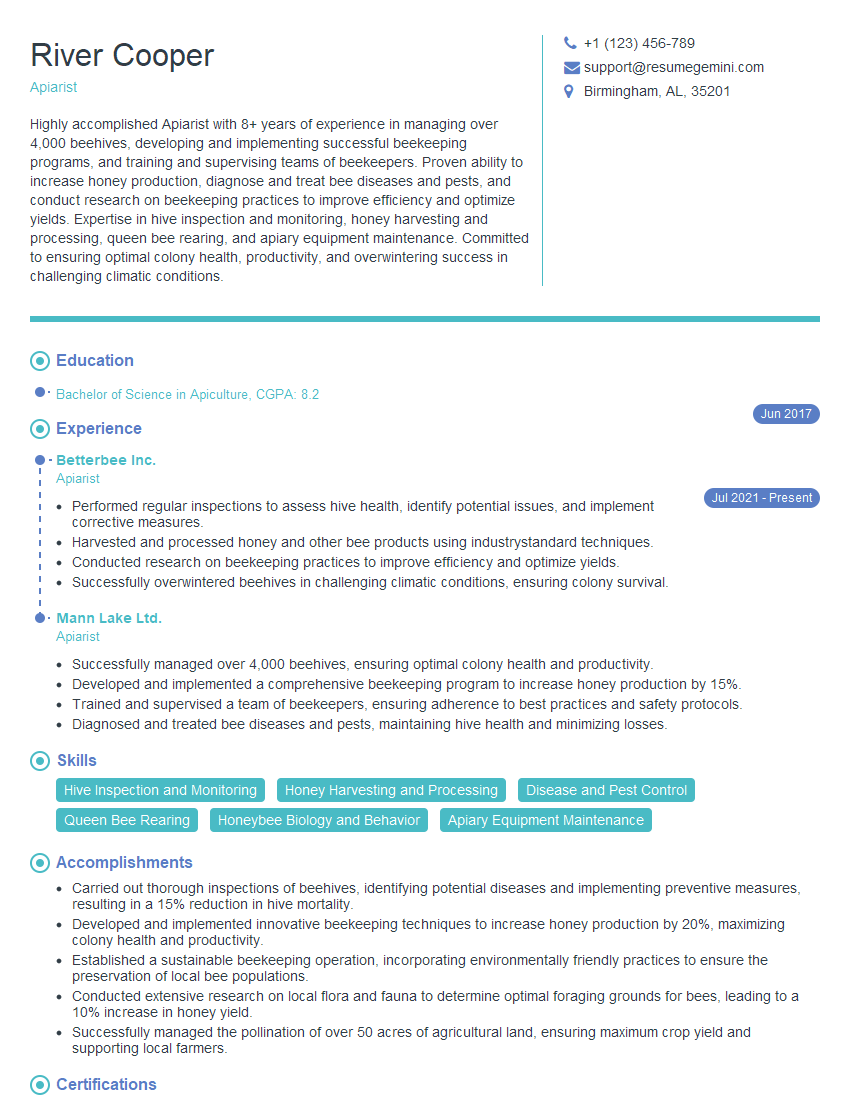
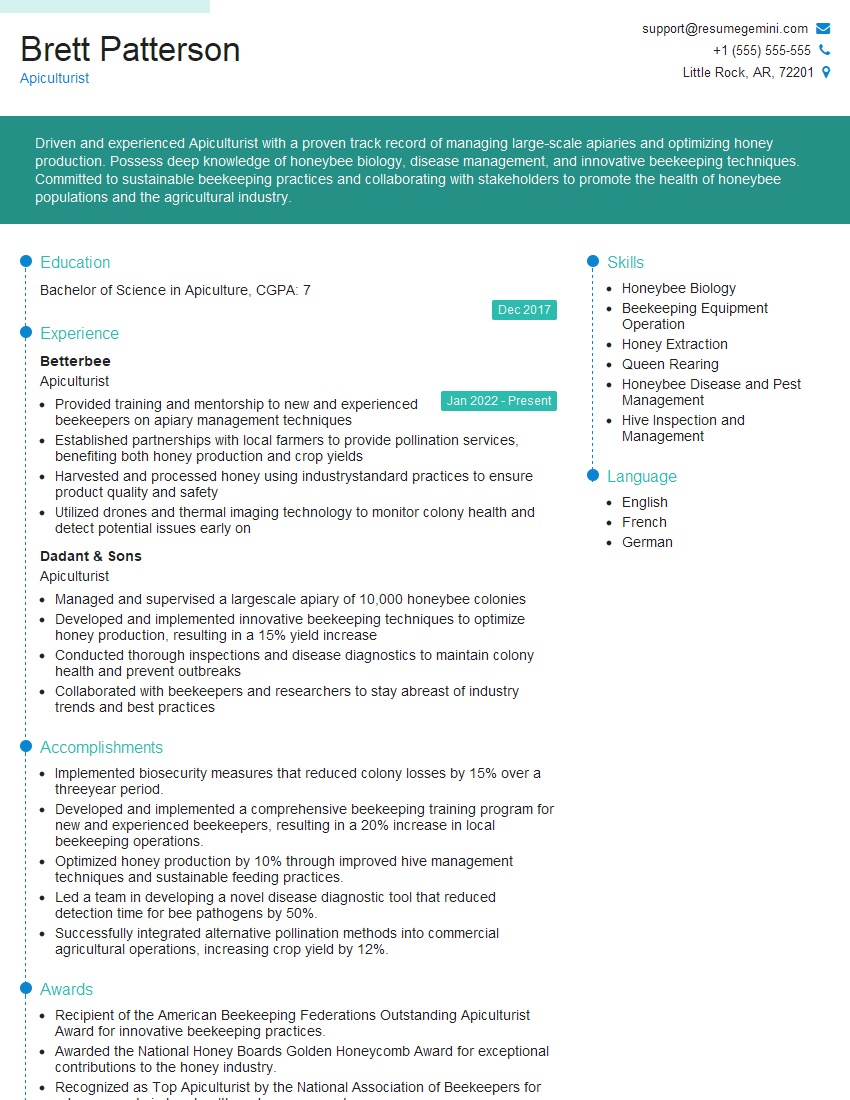
Mastering Varroa mite control is paramount for a successful career in apiculture and related fields. Proficiency in this area demonstrates crucial skills in pest management, data analysis, and practical problem-solving. To significantly boost your job prospects, crafting a compelling and ATS-friendly resume is key. ResumeGemini can help you build a professional resume that highlights your expertise in Varroa mite control. Utilize their resources to create a resume that effectively showcases your skills and experience. Examples of resumes tailored to Varroa Mite Control are available to guide you.
Explore more articles
Users Rating of Our Blogs
Share Your Experience
We value your feedback! Please rate our content and share your thoughts (optional).
What Readers Say About Our Blog
Very informative content, great job.
good