Cracking a skill-specific interview, like one for Vehicle Dynamics and Performance, requires understanding the nuances of the role. In this blog, we present the questions you’re most likely to encounter, along with insights into how to answer them effectively. Let’s ensure you’re ready to make a strong impression.
Questions Asked in Vehicle Dynamics and Performance Interview
Q 1. Explain the concept of vehicle yaw moment.
Vehicle yaw moment is the rotational force around the vehicle’s vertical axis, causing it to yaw (rotate). Imagine a spinning top; the yaw moment is analogous to the force that keeps it spinning. In a car, this moment is primarily generated by differences in tire forces at the front and rear axles. For example, if the driver turns the steering wheel, the front tires experience a greater lateral force compared to the rear tires. This difference generates a yaw moment, initiating the turn.
This moment is crucial for vehicle dynamics analysis and control. It’s influenced by factors like steering angle, tire slip angles, and braking/acceleration forces. Understanding and managing yaw moment is key to designing stable and responsive vehicles.
For example, a powerful rear-wheel-drive car accelerating aggressively on a slippery surface might experience excessive yaw moment, leading to a spin. This is because the increased rear wheel drive force can overcome the available friction, causing a significant yaw moment.
Q 2. Describe the difference between understeer and oversteer.
Understeer and oversteer describe how a vehicle responds to steering input, particularly during cornering.
- Understeer: This occurs when the vehicle’s front wheels lose grip before the rear wheels. The car continues in a straighter path than the driver intends, meaning it ‘pushes wide’ in a turn. Think of it as the car resisting your steering input. This is often caused by factors like excessive speed, worn tires, or a front-heavy weight distribution.
- Oversteer: This happens when the rear wheels lose grip before the front wheels. The rear end ‘steps out’ or slides, resulting in a larger turning radius than intended. This can feel quite dramatic and requires immediate corrective action from the driver. Oversteer often occurs in rear-wheel-drive cars during high-speed cornering or sudden acceleration.
In simpler terms: imagine pushing a shopping cart. Understeer is like the cart stubbornly going straight even when you turn the handle; oversteer is like the back of the cart swinging out unexpectedly.
Q 3. How does suspension geometry affect vehicle handling?
Suspension geometry significantly impacts vehicle handling. Key parameters like caster, camber, and kingpin inclination directly influence the stability, steering feel, and responsiveness of a vehicle.
- Caster: This is the angle of the steering axis projected onto a vertical plane. Positive caster (leaning back) improves directional stability at higher speeds, while negative caster can improve low-speed maneuverability.
- Camber: This is the angle of the wheel relative to the vertical axis when viewed from the front. Negative camber (the top of the wheel leans inward) increases tire contact patch during cornering, improving grip. However, excessive negative camber can increase tire wear.
- Kingpin Inclination: The angle between the steering axis and the vertical plane affects steering self-centering and reduces steering effort.
Improper suspension geometry can lead to poor handling, excessive tire wear, and reduced safety. For instance, incorrect camber angles can lead to uneven tire wear and reduced grip, making the vehicle more prone to accidents.
Q 4. Explain the role of anti-roll bars in vehicle dynamics.
Anti-roll bars, also known as sway bars, are components that connect the left and right suspension systems of an axle. Their primary function is to reduce body roll during cornering and maneuvering.
When a vehicle corners, the suspension on the outside of the turn compresses, while the suspension on the inside extends. Anti-roll bars resist this difference in suspension travel, reducing body roll and improving handling. They act like a spring connecting the two sides, distributing the load more evenly and minimizing the vehicle’s lean.
The stiffness of the anti-roll bar determines its effectiveness. A stiffer bar reduces body roll more significantly but can also result in a harsher ride. Conversely, softer bars offer a smoother ride but allow for more body roll.
Q 5. What are the effects of tire pressure on handling and performance?
Tire pressure has a dramatic impact on vehicle handling and performance. Incorrect tire pressure compromises safety and fuel efficiency.
- Underinflation: Leads to increased rolling resistance, reduced fuel economy, excessive tire wear on the outer edges, and a softer ride. It also decreases handling precision and increases the risk of hydroplaning.
- Overinflation: Results in a harsher ride, reduced tire contact patch (less grip), increased risk of tire damage from road imperfections, and uneven tire wear in the center.
Maintaining the correct tire pressure, as specified by the vehicle manufacturer, is crucial for optimal handling, fuel efficiency, and tire longevity. Regularly checking tire pressure is a simple yet vital step for safe driving.
Q 6. Describe different types of vehicle suspensions and their characteristics.
Several types of vehicle suspensions exist, each with unique characteristics:
- Independent Suspension: Each wheel moves independently of the others. This offers better ride comfort and handling, as it isolates wheel movements, but can be more complex and expensive.
- Dependent Suspension: Wheels on the same axle are linked together (like a solid axle). This is simpler and often more robust, but usually provides a harsher ride and less precise handling.
- MacPherson Strut: A common type of independent suspension that integrates the strut, spring, and damper into a single unit. It’s compact and cost-effective but can compromise ride comfort on rough roads.
- Double Wishbone: Another independent suspension that uses two A-shaped arms to locate the wheel. It offers excellent handling and adjustability, often used in high-performance vehicles.
- Multi-link: This sophisticated independent suspension uses multiple control arms to optimize wheel movement. It’s commonly found in luxury and high-performance vehicles and provides superior handling and ride comfort.
The choice of suspension system depends on factors like vehicle type, target market, performance goals, and cost constraints.
Q 7. Explain the concept of vehicle stability control (ESC).
Electronic Stability Control (ESC), also known as Electronic Stability Program (ESP), is a safety technology that enhances vehicle stability by automatically applying brakes to individual wheels and/or reducing engine power to prevent loss of control.
ESC works by constantly monitoring the vehicle’s direction and comparing it to the driver’s steering input. If a difference is detected, suggesting a loss of traction or an impending skid, the system intervenes to bring the vehicle back under control. This intervention is typically subtle and often unnoticeable to the driver.
ESC significantly reduces the risk of skidding and rollover accidents, making it a vital safety feature in modern vehicles. By improving vehicle stability, ESC increases driver confidence and enhances overall safety.
Q 8. How do different tire compounds affect grip and handling?
Tire compounds significantly impact grip and handling. The rubber compound’s formulation dictates its stiffness, friction coefficient, and temperature sensitivity. Softer compounds, like those used in racing slicks, offer higher grip in dry conditions due to increased contact patch deformation and higher friction. However, they wear faster and have a narrower operating temperature range. Harder compounds, common in all-season tires, provide better longevity and a wider operating temperature window but sacrifice some grip, especially in colder or wet conditions. Think of it like this: a soft compound is like a sticky substance – it grabs onto the road surface better but wears out quicker. A hard compound is like a less sticky substance, lasting longer but with less initial grip.
- Grip: Softer compounds generally provide superior grip, particularly in dry conditions, but can suffer in wet conditions or at lower temperatures. Harder compounds are more consistent across varying conditions but offer less peak grip.
- Handling: Softer compounds lead to more responsive handling and greater feedback, allowing for more precise control. Harder compounds might lead to slightly less precise handling but greater stability and predictability, particularly in adverse conditions.
For instance, a Formula 1 car uses extremely soft compounds for maximum grip during a race, sacrificing tire life for speed. A family sedan, on the other hand, employs harder, more durable compounds to balance grip with longevity and performance across various weather conditions.
Q 9. Explain the importance of braking system design in vehicle dynamics.
Braking system design is paramount to vehicle dynamics, directly impacting safety and handling. An effective braking system must provide consistent stopping power, short stopping distances, and good stability under braking, preventing skidding or lockup. Key design elements include:
- Brake Caliper Design: This determines the clamping force applied to the rotor or drum, influencing braking power and responsiveness. Different designs offer advantages in terms of weight, cooling, and force distribution.
- Brake Pad Material: The friction coefficient of the pad material directly affects braking performance and stopping distance. Different materials provide varying levels of friction, heat resistance, and wear characteristics.
- Anti-lock Braking System (ABS): This crucial safety feature prevents wheel lockup during hard braking, maintaining steering control and reducing stopping distance on slippery surfaces. ABS modulates brake pressure to each wheel individually, preventing skidding.
- Brake Booster: This amplifies the driver’s braking force, making it easier to apply sufficient braking pressure, especially at higher speeds.
- Electronic Brakeforce Distribution (EBD): This system optimizes brake force distribution between the front and rear wheels, improving stability during braking, especially under uneven weight distribution.
Poor brake design can lead to extended stopping distances, loss of control during braking, and increased risk of accidents. Consider a scenario where a vehicle’s braking system is improperly designed, resulting in inconsistent brake pressure across the wheels. This could cause the vehicle to veer off course during hard braking, leading to a potential accident.
Q 10. Describe the effect of weight distribution on vehicle handling.
Weight distribution significantly impacts vehicle handling. It refers to the proportion of a vehicle’s weight carried by each axle (front and rear). An ideal weight distribution balances handling characteristics, promoting neutral handling (where the car steers predictably) while minimizing understeer (where the car continues to go straight despite steering input) or oversteer (where the rear end slides out). A front-heavy car will tend to understeer, while a rear-heavy car is prone to oversteer. This is due to the shifting of the center of gravity.
Think of a seesaw; if most of the weight is on one side, it’s easier to tip. Similarly, if most of a car’s weight is on the front, the front wheels bear more load during turning, making it harder to initiate a turn. Conversely, if the weight is mostly on the rear, the back end is more likely to slide out during cornering.
Optimal weight distribution is typically around 50/50 front/rear for balanced handling, though this can vary depending on the intended vehicle application and design. Sports cars, for example, often have a slightly rear-biased weight distribution for agile handling, whereas family sedans tend to have a more front-biased distribution for stability.
Q 11. How does aerodynamics influence vehicle performance?
Aerodynamics plays a crucial role in vehicle performance, influencing speed, fuel efficiency, and handling. It’s all about managing airflow around the vehicle. Key aerodynamic forces include:
- Downforce: This is the downward force generated by aerodynamic components, such as spoilers and diffusers. Downforce increases grip, especially at high speeds, improving cornering ability and stability. Think of it like pressing down on a table – it becomes more stable.
- Drag: This is the resistance to motion caused by airflow. Reducing drag improves fuel efficiency and top speed. Think of pushing a large flat object through the air – it takes much more effort.
- Lift: This is the upward force generated by airflow. Excessive lift can reduce grip, especially at high speeds. This is why race cars are designed to minimize lift.
Aerodynamic design involves shaping the vehicle body to minimize drag and manage downforce and lift. For example, a sleek, streamlined body reduces drag and improves fuel economy. On the other hand, a race car might incorporate large wings and diffusers to generate substantial downforce for improved cornering speed.
The aerodynamic design of a vehicle impacts its overall performance. A well-designed aerodynamic profile can increase fuel efficiency by reducing drag, while effective downforce generation enhances high-speed stability and cornering ability. For instance, the low drag coefficient of Tesla vehicles contributes to their impressive range, while the aerodynamic design of Formula 1 cars allows for incredible speeds through corners.
Q 12. Explain the principles of vehicle modeling and simulation.
Vehicle modeling and simulation involve creating mathematical representations of a vehicle’s dynamic behavior to predict its performance under various conditions. This is done using software and involves various levels of complexity, ranging from simple ‘bicycle models’ to very detailed multi-body models. The fundamental principles involve applying Newton’s laws of motion to the vehicle components, considering forces such as tire forces, aerodynamic forces, and gravitational forces.
A simple model might focus on longitudinal dynamics (acceleration and braking), while a more complex model might encompass lateral dynamics (cornering and handling) and vertical dynamics (suspension behavior). These models incorporate parameters such as vehicle mass, tire characteristics, suspension geometry, and aerodynamic coefficients. The model is then used to simulate the vehicle’s response to various inputs, such as steering, acceleration, and braking, under various road conditions (dry, wet, icy). The simulation provides insights into the vehicle’s performance and helps engineers optimize design parameters to achieve desired performance characteristics.
The process typically involves: defining the vehicle parameters, developing the mathematical model, writing the simulation code, running the simulation, and analyzing the results to validate and refine the model.
Q 13. What software packages are you familiar with for vehicle dynamics simulation?
I am familiar with several software packages used for vehicle dynamics simulation, including:
- MATLAB/Simulink: A widely used platform offering a versatile environment for modeling and simulating complex systems, including vehicle dynamics. Its extensive toolboxes provide the necessary functionalities for creating detailed vehicle models.
- CarSim: A specialized software package specifically designed for vehicle dynamics simulation. It offers pre-built models and tools, streamlining the simulation process.
- Adams: A multi-body dynamics simulation software capable of modeling complex mechanical systems, including vehicles. It provides accurate simulation of vehicle components such as suspension, steering, and powertrain.
- MSC Adams: Another powerful multibody dynamics simulation software that enables the creation of high-fidelity models for detailed analysis of vehicle components and systems.
The choice of software often depends on the complexity of the model and the specific aspects of vehicle performance being investigated. For simple analyses, MATLAB might suffice; for highly detailed simulations involving multi-body interactions, Adams or CarSim would be more appropriate.
Q 14. How do you analyze vehicle test data to improve performance?
Analyzing vehicle test data is crucial for improving performance. The process involves collecting data from various sensors during vehicle testing, such as accelerometers, gyroscopes, GPS, and wheel speed sensors. This data is then processed and analyzed to identify areas for improvement.
The analysis may involve:
- Data Visualization: Plotting the data to understand trends and identify anomalies. For example, plotting lateral acceleration against steering angle helps in assessing vehicle handling characteristics.
- Statistical Analysis: Applying statistical methods to quantify performance metrics and identify relationships between different variables. This could involve regression analysis to correlate factors like tire slip angle and lateral force.
- Model Correlation: Comparing simulation results from vehicle models with experimental data to validate the models and refine model parameters. Differences between simulation and experiment highlight areas needing model refinement.
- Fault Detection and Diagnosis: Identifying issues in the vehicle system based on inconsistent or abnormal data patterns. For example, deviations in wheel speed during braking could indicate a problem with the braking system.
For example, if the analysis reveals excessive understeer during cornering, engineers might adjust the suspension geometry, tire characteristics, or even the vehicle’s weight distribution to improve handling. This iterative process of testing, data analysis, and model refinement is fundamental in optimizing vehicle performance and ensuring safety.
Q 15. Describe your experience with vehicle dynamics testing and instrumentation.
My experience with vehicle dynamics testing encompasses a wide range of activities, from planning and executing tests to analyzing data and generating reports. I’m proficient in using various instrumentation systems, including GPS-based data acquisition, accelerometers, gyroscopes, and strain gauges. For example, in a recent project involving a sports car, we used high-speed cameras alongside accelerometers to analyze tire slip angles and lateral acceleration during high-speed cornering. This allowed us to pinpoint areas for improving tire grip and chassis tuning. Another project involved using instrumented test vehicles to evaluate the impact of different suspension designs on ride comfort and handling, relying on data analysis software to process the substantial amounts of data generated.
My expertise extends to understanding the limitations of different sensors and how to mitigate systematic errors through careful calibration and data filtering techniques. I’m also experienced in using specialized software for vehicle dynamics simulation and model calibration, allowing for the virtual testing and optimization of vehicle designs before physical prototypes are built.
Career Expert Tips:
- Ace those interviews! Prepare effectively by reviewing the Top 50 Most Common Interview Questions on ResumeGemini.
- Navigate your job search with confidence! Explore a wide range of Career Tips on ResumeGemini. Learn about common challenges and recommendations to overcome them.
- Craft the perfect resume! Master the Art of Resume Writing with ResumeGemini’s guide. Showcase your unique qualifications and achievements effectively.
- Don’t miss out on holiday savings! Build your dream resume with ResumeGemini’s ATS optimized templates.
Q 16. Explain the concept of transient response in vehicle dynamics.
Transient response in vehicle dynamics refers to how a vehicle reacts to sudden changes in inputs, such as a sharp steering maneuver or a sudden braking event. Think of it like this: imagine pushing a swing. The initial, rapid movement immediately after the push is the transient response. The steady-state response, in contrast, would be the smooth, rhythmic swinging that follows. In vehicles, this transient response is crucial for safety and handling. A well-designed vehicle will exhibit a predictable and controllable transient response, minimizing overshoot and oscillations. A poorly designed one might oversteer or understeer dramatically, making it difficult to control.
Analyzing transient response often involves studying parameters like yaw rate, lateral acceleration, and steering wheel angle over time. These parameters are typically visualized as time-series plots, revealing any oscillations or unexpected behavior. Understanding this response is paramount for engineers designing things like Electronic Stability Control (ESC) systems, which actively intervene during transient maneuvers to maintain stability.
Q 17. How do you address challenges related to handling in adverse weather conditions?
Addressing handling challenges in adverse weather conditions requires a multi-faceted approach. The core issue lies in reduced tire-to-road friction, leading to decreased grip. Therefore, strategies must focus on improving traction and stability. This involves several considerations:
- Tire Design: Utilizing tires with optimized tread patterns and rubber compounds for wet or snowy conditions is paramount. Deeper tread depths and siping (small cuts in the tread) enhance water evacuation and provide better grip on snow and ice.
- Vehicle Control Systems: Advanced driver-assistance systems like Anti-lock Braking Systems (ABS), Electronic Stability Control (ESC), and traction control are essential. These systems monitor wheel speed and vehicle dynamics, intervening to prevent skidding or loss of control.
- Chassis Design: A well-tuned suspension system can significantly improve stability on slippery surfaces. For example, properly chosen spring rates and damping characteristics contribute to better control.
- Driver Training: Equipping drivers with the knowledge and skills to handle vehicles in challenging conditions is crucial. This involves training on techniques like smooth steering inputs and gentle braking.
For example, consider a front-wheel-drive vehicle on a snowy uphill climb. Traction control will help prevent wheelspin, while a well-tuned suspension will maintain stability and prevent unwanted body roll. Driver skill in smoothly applying throttle and steering input complements these systems for safe maneuvering.
Q 18. Explain the importance of steering system design in vehicle dynamics.
Steering system design plays a vital role in vehicle dynamics, directly influencing handling characteristics, responsiveness, and safety. A well-designed steering system provides the driver with accurate feedback and predictable control over the vehicle’s direction.
- Steering Ratio: This determines the relationship between steering wheel angle and wheel angle. A lower ratio translates to quicker responsiveness, ideal for sporty cars, while a higher ratio offers more stability at high speeds, commonly seen in larger vehicles.
- Steering Effort: The amount of force required to turn the steering wheel is crucial for comfort and controllability. Power steering systems are essential for ease of use, especially at low speeds, while adjustments to the power assistance can be made to balance responsiveness and effort.
- Steering Geometry: This includes caster, camber, and kingpin inclination. These parameters influence steering feel, return-to-center characteristics, and stability. Improper geometry can lead to undesirable handling characteristics such as wandering or poor self-centering.
- Steering Feedback: A crucial aspect of a good steering system is its ability to convey information about road conditions and tire grip to the driver. This allows for better anticipation and control.
For instance, a sports car might prioritize a quick steering ratio and direct feedback, while a large SUV might focus on stable handling and reduced steering effort for comfort.
Q 19. What are the trade-offs between ride comfort and handling performance?
There’s an inherent trade-off between ride comfort and handling performance in vehicle design. These two attributes often oppose each other. A stiff suspension system, while providing excellent handling and responsiveness by minimizing body roll and pitch, can lead to a harsh and uncomfortable ride, especially on rough surfaces. Conversely, a soft suspension system prioritizes comfort by absorbing bumps and irregularities, but it often compromises handling by allowing excessive body movement and reduced responsiveness.
This trade-off is managed through careful suspension tuning. Engineers use various components such as springs, dampers, and anti-roll bars to find an optimal balance. For example, adjustable suspension systems allow for tuning the stiffness to suit different driving conditions or driver preferences. Advanced suspension systems like active suspensions can dynamically adjust their stiffness in real-time, providing both comfort and handling benefits depending on the situation. The choice of tire also plays a role, with softer sidewall tires often prioritizing comfort while stiffer sidewalls prioritize handling.
Q 20. Explain the influence of engine placement on vehicle dynamics.
Engine placement significantly influences a vehicle’s weight distribution, which in turn affects its handling and dynamics. The ideal placement depends on the vehicle’s intended use and performance goals. A front-engine layout is the most common, offering good weight balance for everyday driving, although it can sometimes lead to understeer (the tendency for the front wheels to lose grip first during cornering). A rear-engine layout provides superior weight distribution for acceleration, as weight is shifted towards the driving wheels, but can result in oversteer (the tendency for the rear wheels to lose grip first), making it more challenging to handle, particularly for inexperienced drivers. Mid-engine configurations, placing the engine behind the driver and in front of the rear axle, typically offer an excellent balance of weight distribution, leading to exceptional handling, often found in high-performance sports cars.
The location also affects the vehicle’s center of gravity. Lower centers of gravity generally enhance stability. By positioning the engine low and centrally within the vehicle, engineers can improve the car’s handling response and reduce susceptibility to rollovers. The specific impact of engine placement is further refined by other design choices such as the transmission type and overall chassis design.
Q 21. How does the drivetrain affect vehicle handling and stability?
The drivetrain significantly impacts vehicle handling and stability. Its influence is felt through factors such as weight distribution, torque delivery, and power transfer efficiency. For example, a front-wheel-drive system places the engine and transmission at the front, influencing weight distribution and potentially causing understeer. Rear-wheel-drive vehicles tend to exhibit more neutral handling characteristics, often leading to better responsiveness in sporty driving, but they can be more susceptible to oversteer if not handled carefully. All-wheel-drive (AWD) systems improve traction and stability, particularly in adverse weather conditions, by distributing power to all four wheels. However, AWD systems can add weight and complexity, potentially impacting fuel efficiency and overall handling.
The type of transmission also plays a role. Manual transmissions often provide a more direct connection to the wheels, offering a more engaging driving experience but requiring more driver input. Automatic transmissions provide ease of use and smoother operation but can sometimes compromise responsiveness compared to manual systems. The specific type of differential used (e.g., open, limited-slip) further influences torque distribution to the wheels, impacting traction and handling during cornering.
Q 22. Describe your experience with different types of vehicle control systems.
My experience with vehicle control systems spans a wide range, encompassing both conventional and advanced systems. I’ve worked extensively with Anti-lock Braking Systems (ABS), Electronic Stability Control (ESC), Traction Control Systems (TCS), and various forms of active suspension. For instance, I was involved in the development of an ESC system for a high-performance SUV, where we focused on optimizing the control algorithms for both on-road and off-road driving conditions. This involved extensive simulations and real-world testing to ensure robust performance across various scenarios, including high-speed maneuvers and low-traction surfaces. My expertise also includes adaptive cruise control and lane-keeping assist, systems that leverage sensor fusion and advanced control techniques to enhance driver assistance and safety. In a recent project, I contributed to the development of a predictive control algorithm for active suspension, aiming to improve ride comfort and handling by anticipating road disturbances.
- ABS: Prevents wheel lock-up during braking, maintaining steering control.
- ESC: Maintains vehicle stability by detecting and mitigating skidding or loss of control.
- TCS: Prevents wheel spin during acceleration, optimizing traction.
- Active Suspension: Adjusts suspension characteristics in real-time to optimize ride and handling.
Q 23. Explain the concept of vehicle roll center and its significance.
The vehicle roll center is the point about which the vehicle body rotates during rolling motion. Imagine a line connecting the tire contact patches on one axle. The intersection of this line with a vertical line passing through the vehicle’s center of gravity (CG) defines the roll center. Its significance stems from its influence on vehicle handling and stability. A higher roll center leads to greater roll stiffness, potentially improving handling during cornering, but also increasing the tendency to roll over. Conversely, a lower roll center results in less roll, enhancing stability, but potentially at the expense of handling responsiveness. Think of it like a seesaw: a higher pivot point (roll center) makes the seesaw more sensitive to small weight changes, while a lower pivot point makes it more stable. This concept is crucial in designing suspension systems, influencing the overall dynamics and behavior of the vehicle.
The location of the roll center is heavily influenced by suspension geometry. Changes in suspension components like the location of the suspension pickup points directly impact the roll center height and consequently the vehicle’s handling characteristics. This is a key consideration during vehicle design, and often simulations and experiments are conducted to optimize the roll center height for the intended application.
Q 24. How do you validate a vehicle dynamics model against real-world data?
Validating a vehicle dynamics model against real-world data is a critical step in ensuring its accuracy and reliability. This process involves a multi-step approach. First, you define a set of key performance indicators (KPIs) that capture the essential dynamic characteristics of the vehicle, such as lateral acceleration, yaw rate, and roll angle. These KPIs are then measured during real-world tests, often using specialized instrumentation like GPS, IMUs (Inertial Measurement Units), and wheel speed sensors. These real-world data are then compared with the simulated results from the vehicle dynamics model. The comparison is done quantitatively by examining the differences (errors) between the measured and simulated KPIs. These errors are analyzed to identify potential discrepancies or areas for model refinement. Techniques like least-squares optimization or parameter estimation are often employed to adjust model parameters and improve the accuracy of the model. Visualizations, such as time-series plots comparing measured and simulated data, are also essential in identifying the nature and magnitude of discrepancies. Finally, the entire validation process is documented meticulously, highlighting the methodology, assumptions, and results, to establish the validity and confidence level of the model.
Q 25. Describe your experience with vehicle dynamics optimization techniques.
My experience with vehicle dynamics optimization includes both model-based and data-driven techniques. Model-based optimization involves using mathematical models to predict the vehicle’s behavior under various conditions. We then employ optimization algorithms, such as gradient descent or genetic algorithms, to find optimal design parameters that minimize objective functions such as maximizing cornering grip or minimizing oversteer tendencies. For example, I’ve optimized suspension parameters to balance ride comfort and handling performance using numerical optimization techniques. In data-driven optimization, we utilize real-world data obtained through vehicle testing and machine learning algorithms to refine control strategies or identify optimal design points. For instance, I’ve employed machine learning to develop an advanced control algorithm for an active suspension system that outperforms traditional methods in improving ride comfort under various road conditions. The selection of the appropriate technique depends on the problem, the availability of data, and the computational resources available.
Q 26. What are the latest trends and technologies in vehicle dynamics?
The field of vehicle dynamics is experiencing rapid evolution. Several key trends are shaping the future. One prominent trend is the increased adoption of advanced driver-assistance systems (ADAS), moving towards autonomous driving. This necessitates sophisticated vehicle dynamics control algorithms that can seamlessly integrate with sensor fusion and machine learning to enhance safety and performance. Another critical trend is the development of more sustainable and efficient vehicles, including electric and hybrid powertrains. The unique dynamic characteristics of these vehicles necessitate the development of specialized control strategies to optimize performance and stability. Furthermore, there is a significant focus on improving ride comfort and reducing NVH (Noise, Vibration, and Harshness), often leveraging advanced materials and control technologies. Digital twins and virtual prototyping are becoming increasingly prevalent, enabling efficient testing and optimization of vehicle dynamics throughout the design process. Furthermore, research into tire-road interaction modeling is advancing to improve the accuracy of vehicle dynamics simulations. Finally, there’s a growing interest in utilizing data analytics to extract valuable insights from vehicle operational data, further refining control strategies and enhancing safety.
Q 27. Explain your understanding of active suspension systems.
Active suspension systems represent a significant advancement in vehicle dynamics control. Unlike passive suspensions which rely on fixed spring and damper characteristics, active suspensions utilize actuators (like hydraulic cylinders or electric motors) to actively control the suspension forces in real-time. This allows for precise control over vehicle body motions, enhancing both ride comfort and handling. For example, an active suspension can quickly adjust to absorb bumps and maintain a constant ride height, improving comfort. Conversely, it can stiffen the suspension during aggressive maneuvers, improving handling and stability. These systems typically employ sensors to monitor vehicle body motions and road inputs, feeding the information to a control unit that adjusts the actuator forces accordingly. Sophisticated control algorithms, such as skyhook control or linear quadratic regulators, are used to optimize the suspension performance. A key challenge in designing active suspension systems is balancing the performance benefits against the increased complexity and cost.
Q 28. Describe your experience with the development and calibration of vehicle control systems.
My experience in the development and calibration of vehicle control systems involves a structured process that integrates simulation, testing, and data analysis. I’ve been involved in various projects, from initial system design and algorithm development to final calibration and validation. The process typically begins with developing a mathematical model of the vehicle and the control system. This model is then used to simulate the system’s behavior under various operating conditions. Simulation allows us to test different control algorithms and parameter settings efficiently. The next step is to conduct extensive testing using real vehicles equipped with sensors and data acquisition systems. These tests cover a wide range of driving scenarios and conditions, enabling us to compare simulated and real-world behavior. Calibration involves iteratively adjusting control parameters based on the discrepancies identified during testing. This often entails optimization techniques to fine-tune control gains and achieve the desired performance. Finally, the calibrated system is thoroughly validated to ensure that it meets all performance, safety, and regulatory requirements. Throughout this process, rigorous documentation and data analysis are crucial for traceability and accountability.
Key Topics to Learn for Vehicle Dynamics and Performance Interview
- Vehicle Handling and Stability: Understanding concepts like yaw, roll, and pitch; exploring the influence of tire characteristics, suspension geometry, and vehicle weight distribution on handling.
- Braking Systems and Performance: Analyzing braking forces, ABS functionality, and brake fade; discussing strategies for optimizing braking efficiency and safety.
- Steering Systems and Control: Investigating different steering mechanisms (rack and pinion, etc.), exploring power steering principles, and understanding the impact of steering geometry on vehicle responsiveness.
- Suspension Systems and Design: Analyzing various suspension types (MacPherson strut, double wishbone, etc.), understanding their impact on ride comfort and handling, and exploring the role of dampers and springs.
- Powertrain Dynamics: Understanding engine characteristics, drivetrain efficiency, and the impact of power delivery on vehicle performance and acceleration.
- Vehicle Modeling and Simulation: Familiarity with software tools and techniques used to model vehicle dynamics and predict performance; understanding the application of theoretical models to real-world scenarios.
- Tire Mechanics and Contact Patch: Understanding tire forces (longitudinal, lateral, aligning), the role of tire pressure and construction in handling and braking, and the concept of tire slip angle.
- Advanced Driver-Assistance Systems (ADAS): Knowledge of systems like Electronic Stability Control (ESC), traction control, and lane keeping assist; understanding their functionality and impact on vehicle safety.
- Performance Evaluation and Testing: Understanding different performance metrics (e.g., 0-60 mph time, braking distance, lateral acceleration) and standard testing procedures.
- Problem-Solving and Analytical Skills: Demonstrating the ability to diagnose vehicle dynamics issues, analyze data, and propose solutions using engineering principles.
Next Steps
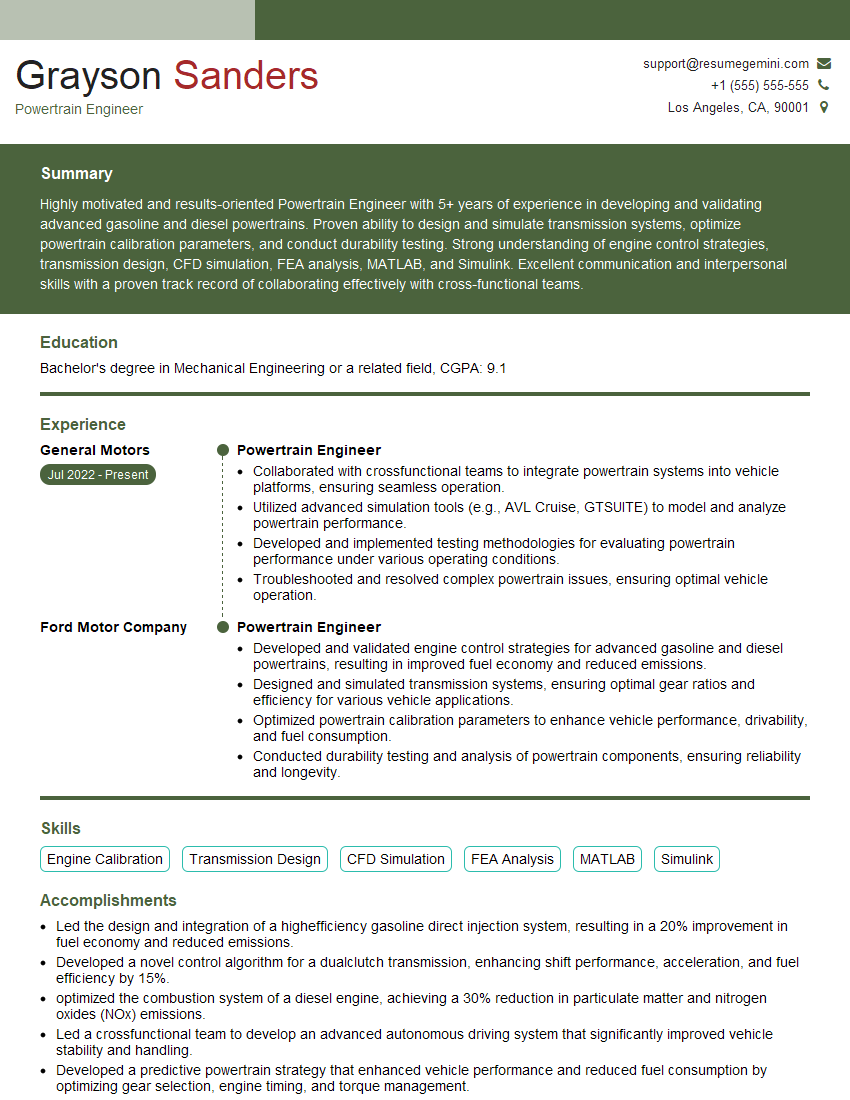
Mastering Vehicle Dynamics and Performance is crucial for a successful career in automotive engineering, opening doors to exciting roles in research, development, and testing. To maximize your job prospects, crafting an ATS-friendly resume is essential. ResumeGemini is a trusted resource that can help you build a professional resume that showcases your skills and experience effectively. We provide examples of resumes tailored specifically to Vehicle Dynamics and Performance to help you get started. Invest the time to create a strong application – it’s an investment in your future.
Explore more articles
Users Rating of Our Blogs
Share Your Experience
We value your feedback! Please rate our content and share your thoughts (optional).
What Readers Say About Our Blog
Very informative content, great job.
good