The right preparation can turn an interview into an opportunity to showcase your expertise. This guide to Ventriloquism interview questions is your ultimate resource, providing key insights and tips to help you ace your responses and stand out as a top candidate.
Questions Asked in Ventriloquism Interview
Q 1. Explain your vocal training techniques for ventriloquism.
Vocal training for ventriloquism is a multifaceted process focusing on breath control, diaphragmatic breathing, and precise mouth manipulation. It’s not about silencing your voice entirely, but rather about minimizing visible mouth movements while projecting sound from your diaphragm. Think of it like a finely tuned instrument.
Diaphragmatic Breathing: This is fundamental. You learn to control the air pressure from your abdomen, pushing the sound out without significant lip or jaw movement. It’s like learning to whisper powerfully, but silently. Imagine blowing out a candle from across the room – that controlled, subtle exhalation is key.
Mouth and Tongue Control: This involves extensive practice in subtly shaping your mouth and tongue to minimise visible movement while producing the desired sound. It’s about mastering near-invisible articulation. Think of actors speaking while chewing gum – they achieve similar levels of articulation despite visible obstructions.
Vocal Range and Tone: Ventriloquists need to develop a range of voices, adjusting pitch, timber, and resonance to create believable characters. This takes years of practice, much like singing.
Resonance Practice: Experimenting with different resonance points within your vocal tract, using the natural cavities of your face and throat to achieve different effects. This is crucial for making the sounds appear to come from your puppet.
Q 2. Describe your experience with different ventriloquism styles.
Ventriloquism encompasses various styles, each with its unique approach to character development and performance.
Traditional Ventriloquism: This focuses on mimicking natural speech and creating believable characters through precise vocal techniques and subtle mouth movements. The focus is on flawless illusion.
Comedic Ventriloquism: This involves using humor and exaggerated characters to engage the audience. The emphasis here is on comedic timing and character interaction. Think of the classic ‘dumb puppet’ routine.
Storytelling Ventriloquism: This uses the dummy as a vehicle to deliver engaging narratives and character driven stories, akin to a one-man-show. Here, the puppet adds a visual element to a more complete storytelling style.
Modern Ventriloquism: Often incorporates elements of other performance styles, such as magic or music, to add depth and uniqueness. This is where creativity and technological integration blend.
My experience spans all these styles. I’ve performed traditional shows for children, comedic acts for adults, and even integrated storytelling techniques with puppetry to create immersive experiences.
Q 3. How do you develop and maintain a convincing character voice?
Developing and maintaining a convincing character voice involves a deep understanding of characterization and vocal manipulation. It’s a process of building a persona from the ground up.
Background Creation: First, I conceptualize the character’s history, personality traits, and background. A grumpy old man will have a different voice from a mischievous child.
Vocal Experimentation: Then, I experiment with different pitches, tones, accents, and speech patterns to find the perfect vocal match for the character. This often involves listening to recordings of actors or real people with similar characteristics.
Consistency is Key: Maintaining consistency in the character’s voice is vital. I record and regularly review my work to ensure the consistency.
Physicality: To further strengthen the illusion, I also consider the puppet’s physicality – how they stand, move, and react. These physical cues reinforce the vocal character.
For example, one of my characters is a sarcastic teenager. To achieve this, I use a higher-pitched voice, incorporating teenage slang and adopting a slightly bored, eye-rolling persona with the puppet.
Q 4. Detail your process for creating and manipulating a dummy.
Creating and manipulating a dummy is a process that blends artistry and technical skill. It’s more than just crafting a figure; it’s about building a performance partner.
Design and Construction: I start with a design concept, sketching the dummy’s appearance, personality, and features. The materials range from wood and foam to fabric and paint. The mouth mechanism requires careful planning to ensure smooth movement and realistic lip synchronization.
Mouth Mechanism: This is the most critical aspect, needing precision engineering. The mechanism must allow for subtle and realistic mouth movements controlled by the ventriloquist’s hand movements. This might involve levers, strings, or even miniature servo motors for more advanced puppets.
Weight and Balance: The dummy’s weight and balance are critical for ease of manipulation. It should be lightweight yet sturdy enough to withstand handling, and should be easily positioned and moved smoothly.
Costuming and Detailing: Clothing and accessories add depth to the character, enhancing its visual appeal and personality. Details like hair, eyes, and facial features contribute to a believable and engaging persona.
The process involves multiple revisions, adjustments, and testing to achieve the desired functionality and aesthetic appeal.
Q 5. What are the different types of dummies you’ve used and what are their pros/cons?
I’ve worked with various types of dummies, each with its own advantages and disadvantages:
Traditional Cloth Dummies: These are lightweight and portable, making them easy to transport and handle. However, they might be less durable and offer limited facial expression.
Wooden or Foam Dummies: These are more robust and can withstand more physical manipulation. They allow for more intricate detail and character design, but are heavier and less portable.
Custom-Made Dummies: These are designed and crafted to specific requirements, offering maximum control over the design, mechanics, and appearance. However, they are expensive and time-consuming to produce.
Rod-Puppet Style: These use rods to control the puppet’s movements. They often allow for more complex movements, but require more skill to operate.
The choice depends on the style of performance, budget, and desired level of realism and complexity.
Q 6. How do you adapt your performance to different audiences (age, size, etc.)?
Adapting my performance to different audiences is key to successful ventriloquism. I tailor my material, character interactions, and delivery style to suit the specific group’s age, size, and overall dynamic.
Children’s Audiences: I use simpler language, brighter characters, and more interactive games. The humor is often slapstick and geared toward their understanding.
Adult Audiences: I can incorporate more sophisticated humor, satirical elements, and complex character interactions. The jokes can be more nuanced, and the storyline might be more intricate.
Large Venues vs. Intimate Settings: In large venues, I might use amplified sound and larger puppets for better visibility. In smaller settings, the interaction can be more intimate and personal.
Observing the Audience: Before beginning, I always observe the audience’s reaction to gauge their interest and modify my performance accordingly.
Essentially, it’s about building a rapport and ensuring the performance resonates with the specific audience.
Q 7. Describe a time you had to troubleshoot a technical issue during a performance.
During a performance at a large outdoor festival, the wireless microphone for my dummy malfunctioned mid-show. The audience could hear my voice clearly, breaking the illusion.
My immediate response was to improvise. I switched to a pre-planned segment that didn’t rely heavily on the wireless mic – a bit of physical comedy using the dummy, focusing on gestures and visual gags. I explained to the audience the technical hitch with a humorous self-deprecating line, engaging them in the problem-solving process. Fortunately, the technical crew quickly resolved the issue, and I was able to return to the script without significant disruption. This experience taught me the value of having backup plans, the importance of improvisation skills, and the power of audience engagement to handle unforeseen issues gracefully.
Q 8. How do you handle hecklers or unexpected audience reactions?
Handling hecklers is a crucial skill in any performance art, and ventriloquism is no exception. My approach is multifaceted. Firstly, I assess the heckle. Is it genuinely malicious, or playful? A lighthearted jab can be incorporated into the act, turning it into a comedic moment. For example, if someone yells out, “Your dummy’s got a lisp!” I might have the dummy respond, “Well, at least I’m not the one wearing a toupee that’s escaping!” This requires quick thinking and improvisation. For more aggressive hecklers, a calm and confident response is key. I might address them directly, but in character, diffusing the tension with humor. Sometimes, a simple, “Thank you for your input,” delivered with a smile can disarm a heckler. Ultimately, the goal is to regain control of the performance and keep the audience engaged, turning a potentially negative experience into a memorable one.
In extreme cases, if the heckling is disruptive and persistent, I might politely ask for assistance from venue staff. However, this is a last resort, as I find that addressing the situation directly with humor is often the most effective method.
Q 9. What is your approach to creating comedic timing within ventriloquism?
Comedic timing in ventriloquism is about more than just the words; it’s a carefully orchestrated dance of pauses, facial expressions, and the subtle interplay between the ventriloquist and the dummy. I build my routines around the principle of misdirection. The audience expects the ventriloquist to be in control, but the dummy’s unexpected responses or witty retorts create surprise and laughter. Pauses are crucial – a well-timed silence before a punchline allows the humor to sink in and intensifies the impact.
For instance, a simple exchange like: Ventriloquist: “So, what did you think of the audience?” (pause) Dummy: “They seem… easily amused.” The pause before the dummy’s dry remark increases the comedic effect. I also use physical comedy, subtle gestures from both myself and the dummy, to enhance the timing and visual appeal of the jokes.
Q 10. How do you ensure your performance is engaging and visually appealing?
Engaging the audience visually is as important as the comedic timing. I achieve this through several techniques. Firstly, character design plays a significant role. My dummies are unique, with distinct personalities and costumes that visually communicate their character. Secondly, lighting is essential. Strategic lighting can highlight specific moments in the performance, creating dramatic effects and drawing the audience’s attention to the puppetry. The use of props also contributes significantly to the visual aspect. Props can add depth and humor to the act and increase audience engagement.
Finally, movement is crucial. I ensure that both myself and the dummy engage in dynamic movements and actions, avoiding static poses. The interactions between the ventriloquist and the dummy should be lively and visually appealing, drawing the audience’s attention and keeping them invested in the act. The goal is to create a captivating spectacle, not just a spoken performance.
Q 11. Describe your experience with stage presence and audience interaction.
Stage presence and audience interaction are fundamental to successful ventriloquism. Years of performing have taught me the importance of connecting with the audience on a personal level, even through a puppet. I start by creating a welcoming atmosphere, engaging with the audience before the show even begins. During the performance, I use eye contact, not just with the audience, but also between the dummy and myself to create a dynamic interaction, making the act feel more real. I also incorporate audience participation, asking simple questions or even having the dummy interact with individual audience members. This creates a sense of shared experience, making the performance more interactive and memorable.
For example, I might ask the audience, “What’s the funniest thing that’s happened to you this week?” and then have the dummy respond in a humorous way. This direct engagement creates a sense of connection and enhances the overall performance.
Q 12. How do you incorporate improvisation into your ventriloquism act?
Improvisation is essential for adapting to unexpected situations and keeping the performance fresh and spontaneous. I incorporate improvisation by actively listening to the audience and reacting to their responses. This can involve incorporating audience suggestions into the act, or using unexpected heckles as springboards for humorous exchanges. I also build in moments of unscripted interaction between the dummy and myself.
A typical example might involve the dummy making a seemingly nonsensical comment, which I then use as an opportunity to create a completely new comedic line of dialogue. The key is to remain flexible and confident in one’s ability to think on one’s feet, turning unpredictable moments into opportunities for spontaneous humor. Practice and preparation are essential, allowing me to build a foundation of comedic material while remaining flexible enough to adapt to audience responses in the moment.
Q 13. How do you manage your voice to avoid vocal strain or damage?
Protecting my voice is paramount. Ventriloquism requires precise control of breath and vocal cords, making vocal health a top priority. I practice proper vocal technique, focusing on relaxation and breathing exercises. Before each performance, I warm up my vocal cords with gentle exercises and scales. Hydration is crucial, so I drink plenty of water throughout the day and avoid caffeine and alcohol, which can dehydrate the vocal cords.
I also avoid excessive shouting or straining my voice in daily life. If I experience any vocal discomfort, I rest my voice and consult a vocal coach or doctor. Regular vocal health checkups are important to ensure early detection and treatment of any potential problems. Protecting my voice is not just about longevity; it’s about maintaining the quality and consistency of my performances.
Q 14. What software or tools do you use to enhance your ventriloquism skills?
While ventriloquism is primarily a performance art, technology plays a supportive role. I use audio recording software to refine my voice and dummy’s character. This helps with maintaining consistency in the dummy’s voice and allows me to experiment with different vocal tones and effects. I also utilize video recording software to review performances, analyzing my comedic timing, stage presence, and audience interaction. This allows for continuous self-improvement and refinement of my act.
Furthermore, video editing software helps in creating promotional material and sharing clips online. It is also useful in crafting a unique visual presentation for my performances which enhance the overall audience experience. While technology is a helpful tool, it doesn’t replace the fundamental skills of ventriloquism—practice, stage presence, and audience interaction remain the core elements of success.
Q 15. What are your strengths and weaknesses as a ventriloquist?
My greatest strength as a ventriloquist lies in my ability to seamlessly blend character performance with vocal manipulation. I’ve spent years honing my control over jaw and lip movement, achieving near-imperceptible mouth movements, crucial for the illusion. This, coupled with my ability to create distinct and believable puppet personalities, creates a truly immersive experience for the audience. However, a weakness I constantly work on is adapting my act to different audience demographics. What works brilliantly for children might not resonate with adults, so gauging audience response and adjusting the material is an ongoing challenge. I regularly refine my act based on audience feedback and observations, striving for universal appeal.
Career Expert Tips:
- Ace those interviews! Prepare effectively by reviewing the Top 50 Most Common Interview Questions on ResumeGemini.
- Navigate your job search with confidence! Explore a wide range of Career Tips on ResumeGemini. Learn about common challenges and recommendations to overcome them.
- Craft the perfect resume! Master the Art of Resume Writing with ResumeGemini’s guide. Showcase your unique qualifications and achievements effectively.
- Don’t miss out on holiday savings! Build your dream resume with ResumeGemini’s ATS optimized templates.
Q 16. Describe your experience with sound equipment and microphones.
My experience with sound equipment is extensive. I’m proficient in using a variety of microphones, from standard dynamic mics for stage performances to more sensitive condenser mics for recording. Understanding microphone placement is critical; a poorly positioned mic can ruin the illusion by picking up unwanted mouth movements. I’ve worked with both wireless and wired systems, understanding the nuances of each. For example, I always carry spare batteries and backup equipment to prevent technical hiccups during a show. My familiarity extends to sound mixing consoles; I’m comfortable adjusting levels, EQ, and reverb to optimize the audio quality of both my voice and the puppet’s ‘voice’. I also utilize digital audio workstations (DAWs) for post-production audio enhancement when recording material for videos or online content.
Q 17. What is your familiarity with lighting and stage design for a ventriloquism act?
Lighting and stage design play a vital role in enhancing a ventriloquism act. Good lighting can emphasize the puppet’s features and create the right mood, while poor lighting can draw unwanted attention to the ventriloquist’s mouth. I prefer spotlights that highlight the puppet while keeping me subtly in shadow. The stage setup is also crucial – for example, a simple, uncluttered stage allows the audience to focus on the interaction between the puppet and myself. I often collaborate with lighting and stage designers to achieve the desired atmosphere; a spooky setting for a Halloween show demands different lighting than a bright, cheerful show for children. I’ve also experimented with using projected backgrounds and special effects to enhance the visual appeal of my performances.
Q 18. How do you market and promote your ventriloquism services?
Marketing my ventriloquism services involves a multi-pronged approach. I have a professional website showcasing my act, videos of past performances, testimonials, and contact information. Social media, specifically platforms like YouTube and Instagram, are crucial for sharing short video clips to build brand recognition and attract potential clients. I also actively network with event planners, party organizers, and entertainment agencies to secure bookings. Participating in local community events and festivals provides excellent exposure and allows me to directly interact with potential clients. I also use online advertising to reach a wider audience based on targeted interests, focusing on keywords relevant to events and entertainment.
Q 19. What are your rates and payment terms for your services?
My rates are determined by several factors, including the length of the performance, the type of event, the location, and the level of production required. I generally offer packages for different durations, including short appearances, medium-length sets, and full-length shows. My payment terms usually involve a deposit upon contract signing and the remaining balance due after the performance. I offer transparent pricing options, and I’m open to negotiating rates depending on the specific requirements and budget of the client. Detailed pricing is provided in a detailed proposal after an initial consultation.
Q 20. How do you handle contracts and negotiations for performances?
I use standardized contracts for all my performances, clearly outlining the scope of work, payment terms, cancellation policies, and responsibilities of both myself and the client. These contracts are legally sound and protect the interests of both parties. Negotiations typically involve discussing specific requirements, such as the desired performance style, audience age group, and any special requests. I am flexible and always try to find solutions that meet the client’s needs while ensuring a professional and mutually beneficial arrangement. I maintain open communication throughout the negotiation and contracting process, ensuring complete transparency and client satisfaction.
Q 21. Describe your experience with different performance venues and settings.
My experience encompasses a wide range of performance venues and settings. I’ve performed in intimate settings like private parties and corporate events, larger venues such as theaters and auditoriums, and outdoor spaces at festivals and fairs. Each setting demands a different approach; a smaller, more intimate setting allows for closer audience interaction, while a larger venue might require a more amplified sound system and broader stage presence. I’ve adapted my act to suit various audiences, from children at birthday parties to adults at corporate galas. This adaptability and experience allow me to deliver a compelling performance regardless of the context or venue.
Q 22. How do you ensure your performances are family-friendly and appropriate for various ages?
Creating family-friendly ventriloquism shows requires careful consideration of material and presentation. It’s not just about avoiding explicit language; it’s about crafting a narrative and choosing characters that resonate with all ages.
My process involves several key steps:
- Character Development: I create puppets and characters with personalities that are endearing and relatable, avoiding anything that might be seen as scary, controversial, or inappropriate for younger audiences. For example, instead of a cynical or sarcastic character, I might develop a friendly, playful one who loves to solve problems.
- Script Writing: My scripts are filled with humor that is both clever and clean, avoiding jokes that rely on innuendo or potentially offensive topics. I focus on observational humor, wordplay, and slapstick comedy that appeals to a wide range of ages.
- Content Review: Before a performance, I always have a trusted colleague or family member review my material to ensure that nothing is misinterpreted or deemed inappropriate. This ensures an extra layer of quality control.
- Performance Adaptation: I’m flexible during live performances. I adjust my material based on the audience’s reaction and age range, ensuring the engagement and laughter remain appropriate for everyone present.
Ultimately, the goal is to create a show that’s entertaining and enjoyable for everyone, from grandparents to toddlers, promoting laughter and positive emotions without compromising on comedic quality.
Q 23. Describe your process for developing new material or refining existing acts.
Developing new ventriloquism material is an iterative process that blends creativity, technical skill, and audience feedback. It’s a constant evolution.
My process is as follows:
- Brainstorming and Concept Development: I start by brainstorming ideas, considering current events, pop culture trends, and timeless comedic themes. I often find inspiration from everyday situations and interactions.
- Character Creation: Once I have a general concept, I focus on the puppet itself. Its design, personality, and voice are all critical components that dictate the direction of the act. For example, I recently developed a character based on a quirky librarian which provides ample opportunities for bookish puns and comedic scenarios.
- Scriptwriting and Refining: I write multiple drafts of the script, paying close attention to pacing, comedic timing, and audience engagement. I often test bits of the script on friends and family to gauge reactions.
- Rehearsal and Performance: Extensive rehearsal is key. I practice incorporating subtle movements and facial expressions that enhance the illusion and add humor. This is when I fine-tune the timing and delivery.
- Feedback and Iteration: I actively solicit feedback from audiences during trial performances. This feedback is invaluable in refining the act, adjusting the script, or even scrapping parts that don’t land well.
This continuous cycle of creation, testing, and refinement ensures my acts remain fresh, engaging, and well-received by audiences.
Q 24. How do you maintain the longevity of your ventriloquism career?
Maintaining a long and successful career in ventriloquism requires adaptability, continuous learning, and a proactive approach to staying relevant. It’s not just about mastering the craft; it’s about constantly evolving your brand and approach.
My strategy involves:
- Staying Current: I continuously update my material to reflect current events, trends, and humor styles. This keeps my performances fresh and relevant.
- Diversification: I explore different performance avenues, such as corporate events, private parties, television appearances, and online content creation. This broadens my audience reach and income streams.
- Networking: Building relationships with other performers, agents, and industry professionals is vital for securing opportunities and staying abreast of industry changes.
- Continuous Learning: I constantly refine my skills, exploring new vocal techniques, puppetry styles, and comedic approaches to keep my performances sharp and innovative.
- Building a Strong Brand: Creating a unique brand identity helps me stand out in a competitive field. This involves cultivating a specific style, refining my stage presence, and consistently delivering high-quality performances.
By embracing change and proactively adapting to the evolving entertainment landscape, I ensure my ventriloquism career remains vibrant and rewarding for many years to come.
Q 25. Explain how you handle criticism and feedback from audiences or clients.
Handling criticism and feedback is crucial for growth and improvement in any performance-based career. I view feedback not as a personal attack, but as an opportunity to learn and refine my act.
My approach:
- Active Listening: I pay close attention to both positive and negative feedback, trying to understand the underlying reasons behind any criticism. Is it the material? The delivery? Or something else?
- Objective Assessment: I separate constructive criticism from unhelpful or personal comments. I analyze the feedback objectively, considering whether it’s valid and relevant to my performance.
- Seeking Specifics: When receiving negative feedback, I ask clarifying questions to understand the specific aspects that didn’t resonate. This helps pinpoint the issues more effectively.
- Implementing Changes: Based on the feedback, I make necessary adjustments to my material, delivery, or presentation. This could involve rewriting parts of the script, changing the pacing, or altering my interaction with the audience.
- Maintaining Professionalism: Regardless of the feedback, I maintain a professional and respectful demeanor, thanking people for sharing their insights. This builds good relationships and shows I value their input.
By embracing constructive criticism and using it to refine my performances, I create a better show for myself and the audience.
Q 26. What is your unique selling proposition as a ventriloquist?
My unique selling proposition (USP) as a ventriloquist stems from a combination of factors that differentiate me from others in the field.
These include:
- Character-Driven Storytelling: I focus on crafting compelling narratives centered around well-developed puppet characters with distinct personalities and interactions, rather than relying solely on jokes.
- Modern and Engaging Style: My performances incorporate contemporary humor and references, ensuring relevance for modern audiences. I avoid old-fashioned tropes.
- High-Quality Puppetry: I work with custom-made puppets with realistic features and expressions that enhance the illusion and comedic effect. The puppets themselves are often a conversation starter.
- Interactive Performances: I actively engage with the audience, making them feel like part of the show. This fosters a dynamic, engaging atmosphere.
- Adaptable Acts: My shows can be tailored to different event types and age ranges, ensuring suitability for various settings.
By combining these elements, I offer a unique and memorable ventriloquism experience that stands out from more traditional performances.
Q 27. How do you incorporate audience participation in your performances?
Incorporating audience participation is crucial for creating a dynamic and interactive ventriloquism show. It transforms the performance from a one-way presentation into a shared experience.
My techniques include:
- Interactive Games and Q&A: I often include games or question-and-answer sessions where audience members can interact directly with my puppets. These sessions add an element of spontaneity and unpredictability to the show.
- Audience-Generated Content: Sometimes, I invite audience members to suggest ideas or topics for the puppet to comment on. This gives the audience a sense of ownership over the performance.
- Improv and Ad-libbing: I incorporate improvisation, using audience responses and suggestions to shape the direction of the act. This demonstrates my skill in adapting to unforeseen situations.
- Puppet Interactions with Individuals: I often select individual audience members to interact directly with the puppet characters, creating memorable moments for the selected person and adding to the overall show’s energy.
- Involving Audience Members in Sketches: In some cases, I’ll incorporate an audience member into a planned sketch, giving them a small role to play which is usually simple to perform.
By carefully integrating these techniques, I create a more engaging and enjoyable experience for everyone involved.
Q 28. What are your long-term career goals as a ventriloquist?
My long-term career goals extend beyond simply performing ventriloquism shows. I aim to establish myself as a respected and influential figure in the art form, contributing to its evolution and continued appreciation.
My aspirations include:
- Develop Original Ventriloquism-Based Entertainment: Create and produce original theatrical productions, films, or television shows that leverage the unique capabilities of ventriloquism.
- Mentorship and Education: I want to share my expertise and passion by mentoring aspiring ventriloquists and providing educational resources, possibly developing workshops or online courses.
- Expand Global Reach: Perform internationally, showcasing my art form to diverse audiences and potentially collaborating with international artists.
- Legacy and Preservation: Contribute to the preservation and advancement of ventriloquism as a performing art, possibly through archiving historical material or advocating for its recognition.
- Cross-Genre Collaboration: Incorporate ventriloquism into other art forms, such as music, dance, or theater, pushing the boundaries of creative expression.
Ultimately, my goal is to not only achieve personal success but also to contribute positively to the ventriloquism community and its lasting legacy.
Key Topics to Learn for Ventriloquism Interview
- Mouth Control & Manipulation: Mastering the techniques of silent mouth movement and lip synchronization. This includes understanding the physiology of speech and how to subtly control your own mouth movements.
- Voice Production & Character Development: Developing distinct and believable voices for your puppets, considering pitch, tone, and inflection to create engaging characters. Practical application includes creating diverse vocal personalities and adapting your style to different scripts or audiences.
- Puppetry Techniques: Understanding different types of puppets and how to effectively manipulate them to enhance your performance. This includes hand, rod, and marionette techniques, and the ability to seamlessly integrate puppet movement with your voice.
- Performance & Stage Presence: Developing strong stage presence, engaging with the audience, and handling unexpected situations. Practical application includes improvisation, audience interaction, and effective storytelling through ventriloquism.
- Scriptwriting & Storytelling: Crafting compelling scripts tailored to your puppet characters and the chosen audience. This also encompasses understanding comedic timing, character development, and plot structuring for effective storytelling.
- Vocal Projection & Breath Control: Developing clear projection and precise breath control to maintain vocal quality throughout a performance. This is crucial for longer performances and larger venues.
- Troubleshooting & Problem-Solving: Identifying and resolving technical difficulties with puppets or voice during performances. This involves quick thinking, problem-solving skills, and maintaining composure under pressure.
Next Steps
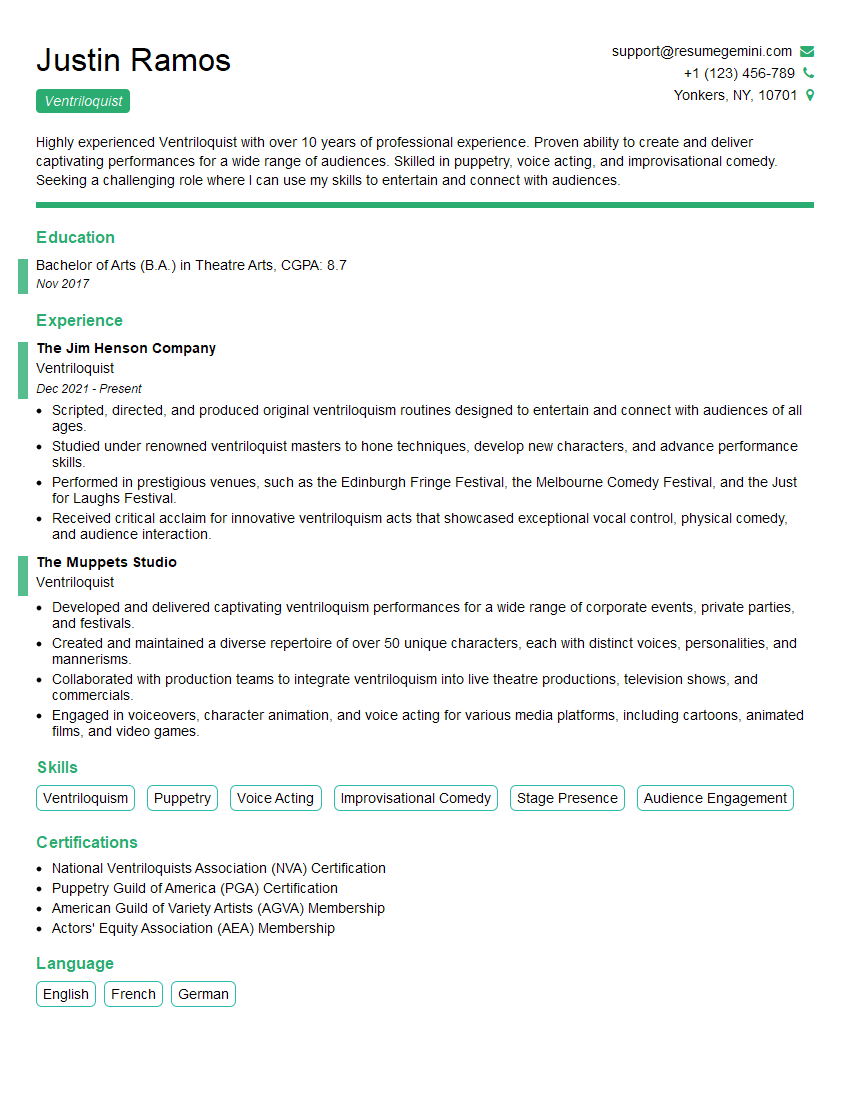
Mastering ventriloquism opens doors to diverse and exciting career paths, from stage performances and children’s entertainment to corporate events and even voice acting. To secure your dream role, a strong and targeted resume is crucial. Building an ATS-friendly resume will significantly increase your chances of getting noticed by recruiters. We highly recommend utilizing ResumeGemini, a trusted resource, to craft a professional and impactful resume tailored to highlight your unique ventriloquism skills. Examples of resumes tailored specifically to Ventriloquism are available to help guide your process.
Explore more articles
Users Rating of Our Blogs
Share Your Experience
We value your feedback! Please rate our content and share your thoughts (optional).
What Readers Say About Our Blog
Very informative content, great job.
good