Preparation is the key to success in any interview. In this post, we’ll explore crucial Wavefront Aberration Correction interview questions and equip you with strategies to craft impactful answers. Whether you’re a beginner or a pro, these tips will elevate your preparation.
Questions Asked in Wavefront Aberration Correction Interview
Q 1. Explain the concept of wavefront aberration.
Wavefront aberration refers to deviations from a perfectly planar wavefront of light. Imagine a perfectly smooth, flat lake representing an ideal wavefront. Now, imagine rocks and ripples disturbing the surface – these ripples represent aberrations. These deviations cause blurring and distortion in optical systems, degrading image quality. In essence, aberrations alter the phase of the light wave as it propagates through an optical system, resulting in a non-uniform distribution of light intensity at the image plane.
Q 2. Describe different types of wavefront aberrations (e.g., spherical, coma, astigmatism).
Several types of wavefront aberrations exist, each characterized by a distinct pattern of distortion.
- Spherical aberration: Occurs when light rays from the outer edges of a lens focus at a different point than rays passing through the center, resulting in a blurred image. Think of it like focusing a flashlight – the edges might be out of focus compared to the center.
- Coma: Creates comet-shaped images of point sources, where the light is smeared asymmetrically. Imagine a star that appears as a comet with a bright head and a long tail.
- Astigmatism: Causes point sources to be imaged as two lines oriented perpendicularly. It’s like looking through a cylindrical lens where one direction is more in focus than the other. This results in different focal lengths for different orientations.
- Defocus: A simple blurring of the image due to the image plane being at the wrong distance from the lens. Like trying to focus a camera but getting it slightly out of focus.
- Distortion: A geometric distortion that changes the shape of the image. Straight lines may appear curved.
These are just a few of the many aberrations; higher-order aberrations are also prevalent and become increasingly complex to characterize.
Q 3. Explain the principle of operation of a Shack-Hartmann wavefront sensor.
The Shack-Hartmann wavefront sensor is a crucial tool for measuring wavefront aberrations. It uses a microlens array to divide the incoming wavefront into many small segments. Each microlens focuses the light onto a corresponding detector element, creating a spot. The position of each spot is directly related to the local wavefront slope. By measuring the spot displacement from its ideal position, we can determine the local tilt of the wavefront. The combined measurements across all microlenses provide a detailed map of the wavefront’s slopes. This slope data is then used to reconstruct the overall wavefront shape.
Think of it like measuring the slope of a hill using many small level gauges across its surface. By combining these slope measurements, you can reconstruct the overall shape of the hill. Similarly, the Shack-Hartmann sensor measures slopes across many tiny portions of the wavefront, allowing for accurate wavefront reconstruction.
Q 4. How does a curvature sensor work for wavefront sensing?
A curvature sensor measures the wavefront’s curvature instead of its slope. It typically uses two detectors placed at different distances from the lens. The difference in intensity between the two images is directly related to the wavefront curvature. It is particularly well-suited for measuring low-order aberrations and is less sensitive to noise compared to other wavefront sensors. However, it has a limited accuracy for measuring higher-order aberrations. The curvature information provides a different perspective on the wavefront, allowing an independent reconstruction.
Q 5. Describe the process of wavefront reconstruction using Zernike polynomials.
Wavefront reconstruction using Zernike polynomials is a common technique to represent the measured wavefront data in a concise and mathematically manageable way. Zernike polynomials form a complete orthogonal set of functions that can describe various aberration types. Each polynomial corresponds to a specific aberration (e.g., defocus, astigmatism, coma). The measured wavefront data (e.g., from a Shack-Hartmann sensor) is then fitted to a linear combination of these polynomials. The coefficients of the polynomials represent the amplitude of each aberration type present in the wavefront. This representation is powerful because it allows for efficient computation of correction and characterization of the aberration types present.
The process involves a least-squares fit of the measured wavefront data to a truncated set of Zernike polynomials. The resulting coefficients provide a quantitative measure of each aberration mode present. It’s like decomposing a complex musical chord into its individual notes—each Zernike coefficient represents a “note” in the overall wavefront aberration.
Q 6. What are the limitations of Zernike polynomials in wavefront representation?
While Zernike polynomials are widely used and effective, they do have limitations. Firstly, they are most effective at representing low-to-mid order aberrations. Higher-order aberrations often require a large number of polynomials for accurate representation, increasing computational complexity. Secondly, the representation isn’t necessarily unique; different combinations of Zernike polynomials could describe the same wavefront. Finally, the orthogonality property of Zernike polynomials is only valid within a circular pupil. For systems with non-circular pupils (e.g., rectangular pupils), alternative basis functions are often more suitable.
Q 7. Explain the concept of adaptive optics and its role in wavefront correction.
Adaptive optics is a technology that uses a deformable mirror to compensate for wavefront aberrations. It involves three main components: a wavefront sensor (like Shack-Hartmann), a deformable mirror, and a control system. The wavefront sensor measures the aberrations, the control system computes the necessary corrections, and the deformable mirror dynamically adjusts its shape to compensate for the aberrations, producing a corrected wavefront.
Imagine a telescope looking through the turbulent atmosphere. The atmosphere distorts the incoming starlight, causing blurring. Adaptive optics measures these distortions in real-time and adjusts a deformable mirror to counteract them, resulting in sharper images. This technology is crucial for ground-based astronomy, ophthalmology (for correcting vision), and various other fields where high-quality imaging is paramount. It is effectively the process of using a feedback loop to achieve real-time correction.
Q 8. Describe different types of deformable mirrors used in adaptive optics systems.
Deformable mirrors (DMs) are the heart of adaptive optics systems, allowing for real-time correction of wavefront aberrations. Different types exist, each with its own strengths and weaknesses. The choice depends on the application’s requirements for speed, stroke, and spatial resolution.
- Membrane DMs: These use a thin, flexible membrane stretched over a frame. Actuators push or pull on the membrane, altering its shape and thus the reflected wavefront. They offer large strokes but can have lower spatial resolution compared to other types.
- Micromachined DMs: These are fabricated using microelectromechanical systems (MEMS) technology. Tiny mirrors are individually controlled, offering high spatial resolution and fast response times. However, their stroke is typically limited.
- Electrostatic DMs: These use electrostatic forces to deform the mirror surface. They offer good spatial resolution and relatively fast response times. The deformation is controlled by applying voltages to individual actuators.
- Piezoelectric DMs: These utilize the piezoelectric effect, where a material changes shape in response to an applied electric field. They offer a good combination of stroke and speed, but their response may be slower than MEMS DMs.
Imagine a flexible trampoline (membrane DM) versus a grid of tiny, independently adjustable mirrors (MEMS DM). Both can be used to change the shape of a surface, but the control and precision differ significantly.
Q 9. How does a bimorph deformable mirror work?
A bimorph deformable mirror consists of two bonded layers of piezoelectric material with different expansion coefficients. Applying a voltage across these layers causes one layer to expand or contract more than the other, leading to bending of the mirror surface. The curvature is directly proportional to the applied voltage, allowing for precise control.
Think of it like a bimetallic strip used in thermostats. Instead of temperature, voltage changes the shape. By carefully controlling the voltage on different sections of the bimorph mirror, we can achieve a desired wavefront correction.
Q 10. Explain the concept of closed-loop control in adaptive optics systems.
Closed-loop control in adaptive optics is crucial for real-time aberration correction. It involves a feedback mechanism where a wavefront sensor measures the remaining aberrations after the DM has made an initial correction. This measured error signal is then used to update the DM’s shape iteratively, minimizing the aberrations until a desired level of correction is achieved.
It’s like a self-correcting system. Imagine trying to hit a target with a laser. A wavefront sensor acts like your eyes, detecting how far off the laser is from the target. The DM is like your hand, adjusting the laser to compensate for any misalignments. This process repeats until the laser hits the target (perfect wavefront).
Q 11. What are the challenges in real-time wavefront correction?
Real-time wavefront correction presents significant challenges:
- Computational speed: Processing the wavefront sensor data and calculating the necessary DM commands must be incredibly fast to keep up with dynamic aberrations.
- Actuator limitations: DMs have limitations in their stroke and response time, which can restrict the range and speed of corrections.
- Noise and uncertainty: Noise in the wavefront sensor measurements and uncertainties in the DM’s response can lead to errors in the correction.
- Nonlinearity: The relationship between the DM’s actuator commands and the resulting wavefront shape isn’t always perfectly linear, requiring sophisticated control algorithms to handle this complexity.
For example, in astronomical adaptive optics, atmospheric turbulence changes rapidly, requiring extremely fast algorithms to maintain correction. In ophthalmology, eye movements add complexity.
Q 12. Describe different algorithms used for wavefront control.
Many algorithms are used for wavefront control, each with its own strengths and weaknesses:
- Matrix-vector multiplication: A simple and efficient method for calculating DM commands based on a linear model of the DM and wavefront sensor.
- Least-squares fitting: Finds the optimal DM shape that minimizes the squared error between the measured and desired wavefronts.
- Iterative algorithms: These involve repeated applications of simpler algorithms, often converging towards a better solution, such as gradient descent or conjugate gradient methods.
- Model-based control: This method incorporates a model of the DM and the optical system, providing more accurate and robust correction, but requires careful calibration and model identification.
The choice of algorithm depends on factors such as the DM’s characteristics, computational resources, and desired correction accuracy.
Q 13. Explain the role of wavefront aberration correction in ophthalmology.
Wavefront aberration correction plays a vital role in ophthalmology, primarily in improving the quality of vision. Aberrations in the eye’s optics, such as higher-order aberrations like coma and spherical aberration, can lead to blurred vision and reduced image quality. Wavefront sensors measure these aberrations, and custom corrective lenses or refractive surgery procedures (like LASIK) can be tailored to counteract them.
Imagine your eye’s lens as a distorted mirror. Wavefront aberration correction helps to ‘reshape’ that mirror, leading to clearer vision.
Q 14. How is wavefront aberration correction used in microscopy?
In microscopy, wavefront aberration correction significantly enhances image resolution and quality, especially in high-resolution techniques like confocal and multiphoton microscopy. Aberrations introduced by the microscope’s optics and the sample itself can blur the image. Adaptive optics systems using DMs can correct these aberrations in real-time, improving the detail and clarity of the acquired images.
Think of a telescope looking at a distant star. The atmosphere distorts the starlight (aberrations). Adaptive optics corrects these distortions to reveal the star’s true image. Similarly, in microscopy, correcting aberrations leads to sharper images of the sample.
Q 15. Discuss the applications of wavefront aberration correction in astronomy.
Wavefront aberration correction, primarily through adaptive optics (AO), revolutionizes astronomical observation by compensating for distortions introduced by the Earth’s atmosphere. This allows ground-based telescopes to achieve image quality comparable to space-based telescopes, significantly enhancing their capabilities.
- Improving Image Resolution: Atmospheric turbulence blurs starlight, limiting the resolution of ground-based telescopes. AO systems actively correct these aberrations, leading to sharper images and finer details in celestial objects.
- Enabling High-Contrast Imaging: AO is crucial for detecting faint objects near bright stars. By reducing the scattered light from the bright star, AO enables the observation of exoplanets and other faint companions.
- Spectroscopy Enhancement: Sharper images provided by AO lead to higher signal-to-noise ratios in spectroscopic observations, allowing for more accurate analysis of the chemical composition and physical properties of astronomical objects.
- Laser Guide Star AO: For very large telescopes, creating artificial ‘laser guide stars’ allows for wavefront sensing and correction even in areas of the sky without bright natural stars, expanding the observable regions.
For instance, the extremely large telescopes (ELTs) under construction rely heavily on AO to reach their full potential, enabling breakthroughs in our understanding of the universe.
Career Expert Tips:
- Ace those interviews! Prepare effectively by reviewing the Top 50 Most Common Interview Questions on ResumeGemini.
- Navigate your job search with confidence! Explore a wide range of Career Tips on ResumeGemini. Learn about common challenges and recommendations to overcome them.
- Craft the perfect resume! Master the Art of Resume Writing with ResumeGemini’s guide. Showcase your unique qualifications and achievements effectively.
- Don’t miss out on holiday savings! Build your dream resume with ResumeGemini’s ATS optimized templates.
Q 16. How does atmospheric turbulence affect wavefront aberration?
Atmospheric turbulence is the primary source of wavefront aberration in ground-based astronomy. It’s caused by variations in air density due to temperature fluctuations and wind shear. These variations act like a constantly shifting lens, bending and distorting the incoming light waves from celestial objects.
Imagine looking at a distant object through a shimmering heat haze above a hot road. This distortion is analogous to the effect of atmospheric turbulence on starlight. The wavefront, which ideally should be a smooth, planar surface, becomes irregular and distorted, leading to blurred and scattered light. The severity of the aberration depends on factors such as the altitude of the object, atmospheric conditions (seeing), and wavelength of the light.
Q 17. Explain the concept of isoplanatism and its implications for adaptive optics.
Isoplanatism refers to the degree to which the atmospheric turbulence affects the wavefronts of light from two different points in the sky in a similar manner. A perfectly isoplanatic patch would imply that a wavefront correction measured for one point will also correct for other points within that patch. However, the reality is that atmospheric turbulence introduces anisoplanatism, meaning the wavefront distortions differ across the sky.
In adaptive optics, isoplanatism is crucial. The wavefront sensor typically measures the distortions from a relatively bright reference star (or a laser guide star). This measurement is then used to correct the wavefront of light from the fainter scientific target. The size of the isoplanatic patch limits the field of view over which a single correction is effective. Larger telescopes and more advanced AO systems strive to overcome anisoplanatism limitations by using multiple guide stars or other sophisticated techniques.
Q 18. What is the Strehl ratio and how is it related to wavefront aberration?
The Strehl ratio is a metric that quantifies the quality of an optical system’s point spread function (PSF) – essentially, how much light is concentrated in the central peak of a point source’s image. A perfect optical system (no aberrations) has a Strehl ratio of 1.0. As aberrations increase, the Strehl ratio decreases.
It’s directly related to wavefront aberration because the aberrations cause the wavefront to deviate from its ideal shape. These deviations lead to destructive interference, reducing the intensity of the central peak of the PSF and consequently lowering the Strehl ratio. A lower Strehl ratio indicates poorer image quality and resolution. For example, a Strehl ratio of 0.8 might be acceptable for some applications, but for high-resolution imaging, a much higher Strehl ratio (close to 1) is desired.
Q 19. Describe the methods for evaluating the performance of a wavefront correction system.
Evaluating the performance of a wavefront correction system involves several methods, focusing on quantifying the reduction in wavefront aberrations and the improvement in image quality.
- Strehl Ratio Measurement: Directly measures the concentration of light in the central peak of the PSF.
- Wavefront Error Statistics: Analyzing metrics like the root mean square (RMS) wavefront error quantifies the overall level of residual aberrations after correction.
- Image Quality Metrics: Assessing the full width at half maximum (FWHM) of the PSF or other image sharpness metrics helps determine the system’s ability to resolve fine details.
- Modulation Transfer Function (MTF): Provides a frequency-domain analysis of the image quality, indicating the system’s ability to resolve different spatial frequencies.
- Closed-loop performance analysis: This involves measuring the system’s response time and accuracy in tracking and correcting changing atmospheric conditions.
Real-world applications often involve combining these methods to get a comprehensive assessment of the wavefront correction system’s performance. For instance, a high Strehl ratio combined with a low RMS wavefront error would indicate excellent performance.
Q 20. How does wavefront sensing affect the overall system performance?
Wavefront sensing is an integral part of a wavefront correction system. It’s the process of measuring the wavefront distortions caused by atmospheric turbulence. The accuracy and speed of the wavefront sensor directly impact the overall system performance. An inaccurate wavefront sensor will lead to suboptimal correction, resulting in residual aberrations and degraded image quality.
For instance, a slow wavefront sensor may not be able to keep up with rapidly changing atmospheric conditions, leading to blurring of the image. A wavefront sensor with high noise will introduce errors into the correction process, reducing the effectiveness of the system. Therefore, selecting a wavefront sensor with appropriate sensitivity, speed, and accuracy is critical for optimizing the performance of the entire wavefront correction system.
Q 21. Explain the difference between open-loop and closed-loop wavefront correction.
Open-loop and closed-loop are two fundamental modes of operation for wavefront correction systems.
- Open-loop correction uses a pre-determined correction based on a model of the aberrations, without real-time feedback. It’s simpler and less computationally intensive but less effective at compensating for rapidly changing atmospheric turbulence. Think of it like pre-setting your glasses prescription; it’s a static correction.
- Closed-loop correction uses a feedback loop. A wavefront sensor constantly measures the aberrations, and a deformable mirror actively adjusts its shape in real time to compensate for these distortions. This dynamic approach is much more effective at correcting atmospheric turbulence. Imagine it as adaptive glasses that automatically adjust to your vision in changing light conditions.
Closed-loop systems are far more common in high-performance applications like astronomy because their ability to track and correct dynamic aberrations is crucial for achieving high image quality. Open-loop systems might be suitable for applications where real-time correction is not critical or computationally expensive.
Q 22. What are some common sources of error in wavefront sensing and correction?
Wavefront sensing and correction, while powerful techniques, are susceptible to various errors. These errors can broadly be categorized into systematic and random errors. Systematic errors are repeatable and predictable, stemming from known sources, while random errors are unpredictable and fluctuate.
Systematic Errors: These often originate from imperfections in the optical components themselves. For example, misalignments in the Shack-Hartmann sensor lenses or imperfections in the deformable mirror surface will introduce consistent biases into the wavefront measurements and correction.
Random Errors: These are more difficult to control and often stem from noise in the detector, atmospheric turbulence (in astronomical applications), or vibrations in the system. Thermal drift in optical components can also contribute to this type of error.
Calibration Errors: Inaccurate calibration of the wavefront sensor or the deformable mirror can also lead to significant errors in the correction process. This can be due to issues in determining the precise focal length of lenses or the influence coefficients of actuators in the deformable mirror.
Computational Errors: Errors can also arise from the algorithms used to reconstruct the wavefront from the sensor data or to control the deformable mirror. For instance, an ill-conditioned reconstruction matrix can amplify noise and lead to inaccurate wavefront estimation. This is especially problematic in higher-order aberration correction.
Minimizing these errors requires careful system design, precise calibration procedures, robust algorithms, and potentially real-time feedback control loops to actively compensate for environmental variations.
Q 23. How do you calibrate a Shack-Hartmann wavefront sensor?
Calibrating a Shack-Hartmann wavefront sensor involves determining the precise relationship between the measured spot displacements and the corresponding wavefront slopes. This is crucial for accurate wavefront reconstruction. The process typically involves:
Creating a Reference Plane: A collimated, ideally flat, wavefront is directed onto the sensor. This establishes the ‘zero’ wavefront position.
Measuring Spot Positions: The positions of the spots formed by the lenslet array on the detector are precisely measured. This provides the baseline for subsequent measurements.
Introducing a Known Aberration: A known wavefront aberration, like a simple tilt, is introduced – perhaps by tilting one of the mirrors in the optical path. This can be done using a precisely controlled mirror mount.
Re-measuring Spot Positions: The spot positions are measured again after introducing the known aberration.
Calculating Lenslet Sensitivity: The difference in spot positions is used to calculate the sensor’s sensitivity – how much a spot shifts per unit of wavefront slope. This typically involves linear regression.
Repeat and Refine: Steps 3-5 are often repeated with different known aberrations, and a least squares or similar fitting procedure could be employed for improved accuracy.
This calibration process creates a calibration matrix which maps spot displacements to wavefront slopes. This matrix is crucial for the wavefront reconstruction algorithm. Regular recalibration may be necessary to account for environmental drifts or aging effects.
Q 24. Describe the challenges in correcting higher-order aberrations.
Correcting higher-order aberrations presents several challenges compared to correcting lower-order aberrations (like tilt and defocus). These challenges stem from the increased complexity and density of the aberration modes.
Increased Number of Degrees of Freedom: Higher-order aberrations require a much larger number of actuators on the deformable mirror (DM) to accurately correct them. This translates to higher cost and increased complexity of control algorithms.
Sensitivity to Noise: The higher the order of the aberration, the more sensitive the correction process becomes to noise in the wavefront sensor measurements. Small errors in measurement can lead to significant errors in the correction.
Non-linearity: The relationship between actuator commands and the resulting wavefront shape is often non-linear, especially for higher-order aberrations, making precise control more challenging. This nonlinearity may necessitate iterative correction schemes.
Computational Complexity: The computational effort required for reconstructing and correcting higher-order aberrations increases dramatically. Real-time correction might necessitate the use of high-performance computing resources.
Approaches to mitigate these challenges involve using advanced DM designs with a higher actuator density, implementing sophisticated wavefront reconstruction algorithms (e.g., incorporating regularization techniques), and developing robust control strategies to handle noise and non-linearity. Furthermore, advanced sensor designs and improved calibration procedures are critical.
Q 25. What are the advantages and disadvantages of different wavefront sensing techniques?
Several wavefront sensing techniques exist, each with its own advantages and disadvantages.
Shack-Hartmann Sensor: This is a widely used technique due to its relatively simple design, robustness, and high sensitivity. However, it can be less accurate for very high-order aberrations.
Curvature Sensor: This method offers robustness to noise, and its measurements are less sensitive to detector nonuniformity. But it can be less sensitive to low-order aberrations.
Phase Shifting Interferometry: This provides very high accuracy, particularly for low-order aberrations. It is, however, more sensitive to environmental disturbances and requires a high degree of stability in the optical system.
Pyramid Sensor: This offers a good balance between sensitivity, accuracy, and simplicity, making it suitable for a wide range of applications.
The choice of technique depends on the specific application, including the desired accuracy, the types and magnitudes of aberrations expected, the available resources, and the environmental conditions. For example, a Shack-Hartmann sensor might be preferred for adaptive optics in astronomy due to its robustness to atmospheric turbulence, while phase-shifting interferometry may be better suited for high-precision optical metrology in a controlled laboratory environment.
Q 26. How do you choose the appropriate deformable mirror for a specific application?
Selecting the appropriate deformable mirror for a specific application involves considering several critical factors:
Stroke: The maximum displacement of each actuator determines the range of aberrations that can be corrected. Higher stroke is required for larger aberrations.
Actuator Density: The number of actuators per unit area dictates the spatial resolution of the wavefront correction. Higher density is needed to correct higher-order aberrations accurately.
Influence Function: The shape of the wavefront deformation caused by a single actuator influences the overall correction capability. A well-understood influence function is critical for accurate wavefront reconstruction.
Mirror Diameter and Material: The mirror diameter must be large enough to cover the beam size. The choice of material (e.g., silicon, glass) depends on factors like cost, stiffness, and thermal stability.
Response Time: The speed at which the mirror can respond to wavefront changes is crucial for applications requiring real-time correction, like those involving dynamic aberrations.
Cost and Complexity: Different types of deformable mirrors have different costs and levels of complexity in terms of manufacturing, control, and integration.
For instance, a high-stroke, high-actuator-density mirror might be chosen for correcting atmospheric turbulence in astronomy, while a smaller, less complex mirror could suffice for correcting static aberrations in a laser system.
Q 27. Discuss the future trends in wavefront aberration correction technology.
The future of wavefront aberration correction technology is likely to be shaped by several key trends:
Micro-Electro-Mechanical Systems (MEMS): The use of MEMS technology is expected to lead to the development of smaller, lighter, faster, and potentially cheaper deformable mirrors and wavefront sensors.
Artificial Intelligence (AI) and Machine Learning (ML): AI and ML techniques can improve wavefront reconstruction algorithms, optimize control strategies, and enable more effective real-time adaptation to changing aberration conditions.
Multi-Conjugate Adaptive Optics (MCAO): MCAO systems use multiple deformable mirrors to correct aberrations originating from different layers of a medium, like the atmosphere. This will be crucial for advanced astronomical observations.
Wavefront Shaping with Spatial Light Modulators (SLMs): SLMs provide a flexible and programmable way to shape wavefronts, opening new possibilities for applications in microscopy, optical manipulation, and laser beam shaping.
Improved Calibration and Control Algorithms: Development of more robust and efficient calibration techniques and control algorithms will be key for maximizing the accuracy and speed of wavefront correction.
These trends will likely lead to significant improvements in the performance and affordability of wavefront aberration correction systems, expanding their applications across diverse fields such as astronomy, ophthalmology, microscopy, and laser processing.
Q 28. Describe your experience with specific wavefront aberration correction software or hardware.
During my career, I’ve extensively used both commercial and custom-developed software and hardware for wavefront aberration correction. I have significant experience with the Shack-Hartmann wavefront sensors from Company A, characterized by their high-speed data acquisition and robust software for wavefront reconstruction. I’ve also worked extensively with the Company B deformable mirrors, known for their high-actuator density and excellent wavefront control. My experience with these systems extends from basic calibration and control to developing advanced algorithms for real-time correction of higher-order aberrations. Additionally, I’ve been involved in the development of a custom software package that incorporates advanced optimization techniques for controlling deformable mirrors, resulting in improved correction accuracy and efficiency. My work with these tools has been primarily in the field of laser beam shaping, where precise wavefront control is crucial for various applications. For example, I used these technologies to improve the quality of laser beams used in high-precision micromachining, leading to improvements in the surface finish of manufactured parts.
My expertise is not limited to commercial off-the-shelf products. I have extensive experience in designing and integrating custom solutions. In one particular project, I designed a custom closed-loop control system using a fast feedback loop and a custom algorithm for real-time aberration correction in a high-power pulsed laser system, achieving substantial improvements in beam quality. This required a deep understanding of both hardware and software integration and highlighted my capability in developing custom solutions for specialized wavefront correction needs.
Key Topics to Learn for Wavefront Aberration Correction Interview
- Fundamentals of Wavefront Aberrations: Understanding different types of aberrations (spherical, coma, astigmatism, etc.), their origins, and their impact on image quality.
- Wavefront Sensing Techniques: Familiarize yourself with various methods like Shack-Hartmann wavefront sensors, curvature sensing, and interferometry. Compare their strengths and weaknesses.
- Adaptive Optics Systems: Deep dive into the components of an adaptive optics system, including deformable mirrors, control algorithms, and their interaction with wavefront sensors.
- Aberration Correction Algorithms: Explore different algorithms used for wavefront reconstruction and control, such as least-squares fitting and modal control.
- Practical Applications: Understand the applications of Wavefront Aberration Correction in diverse fields like astronomy, ophthalmology, microscopy, and laser surgery. Be prepared to discuss specific examples.
- Performance Metrics: Know how to quantify the effectiveness of aberration correction, including metrics like Strehl ratio and root mean square error.
- Limitations and Challenges: Be prepared to discuss the limitations of current wavefront correction techniques and potential future advancements in the field.
- Troubleshooting and Problem-Solving: Develop your ability to diagnose and solve problems related to wavefront sensing and correction in a practical setting.
Next Steps
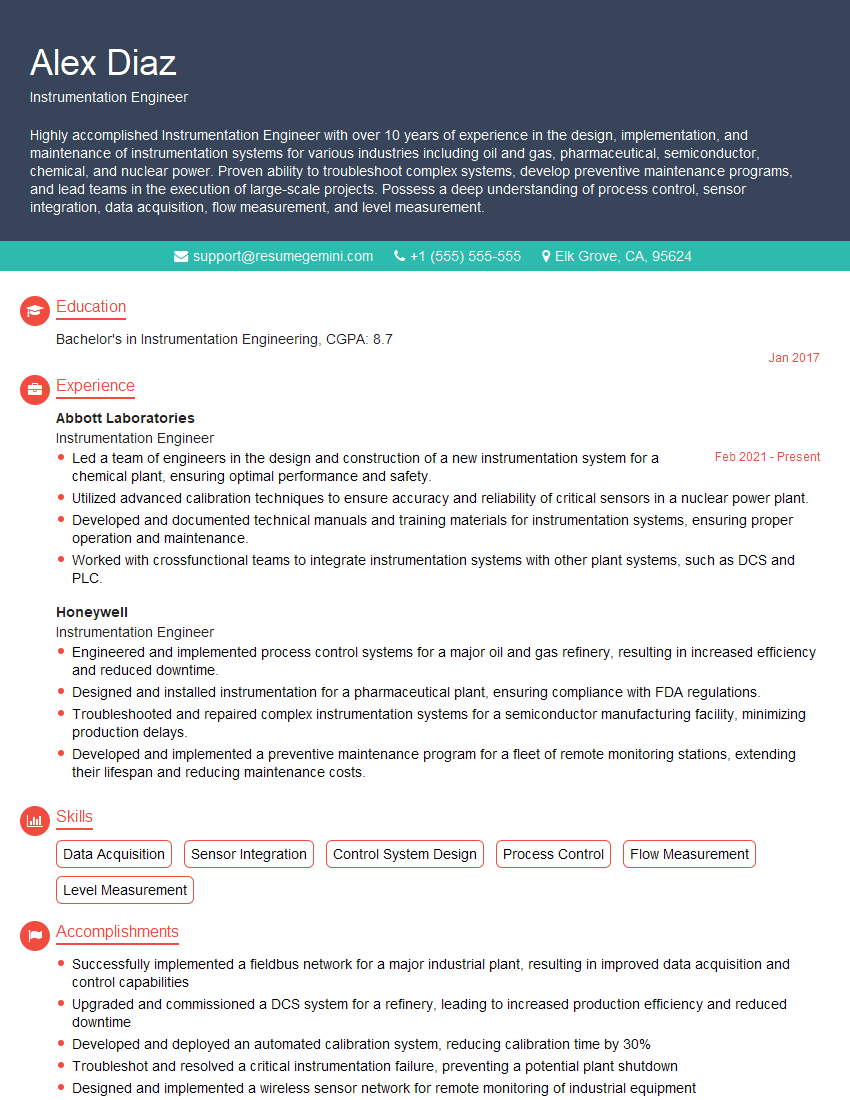
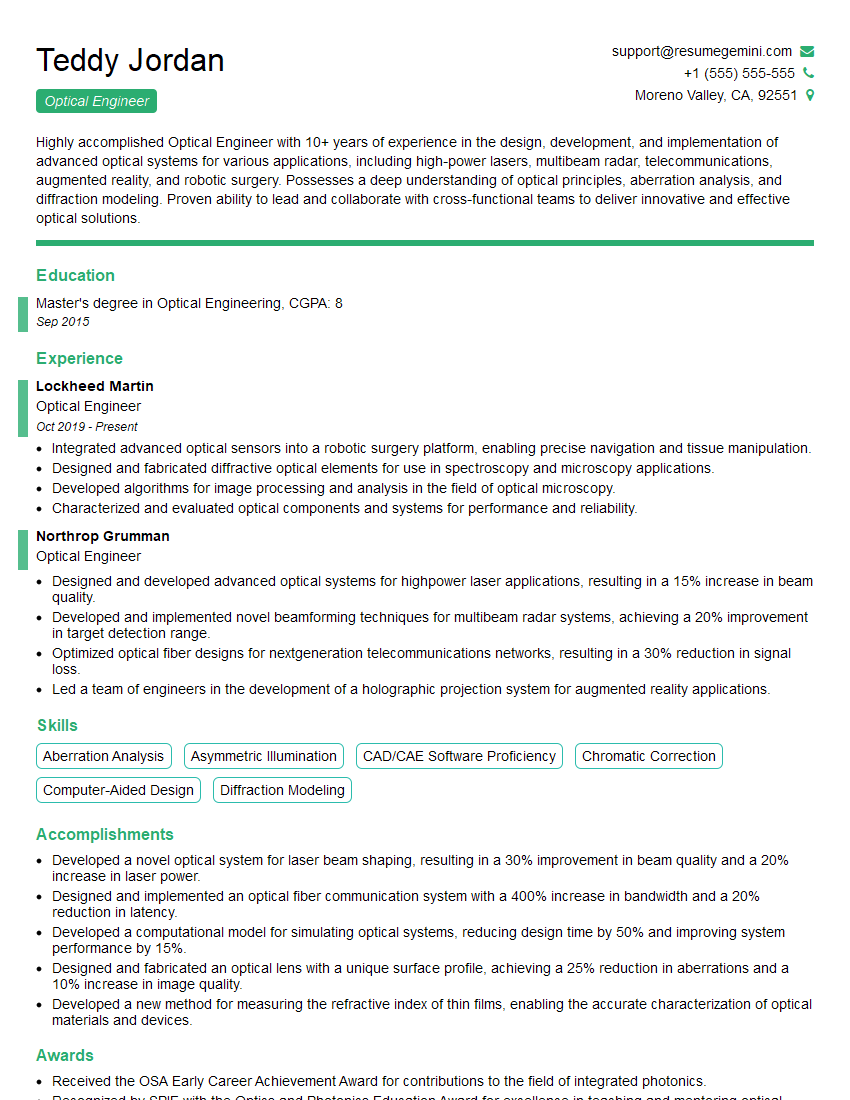
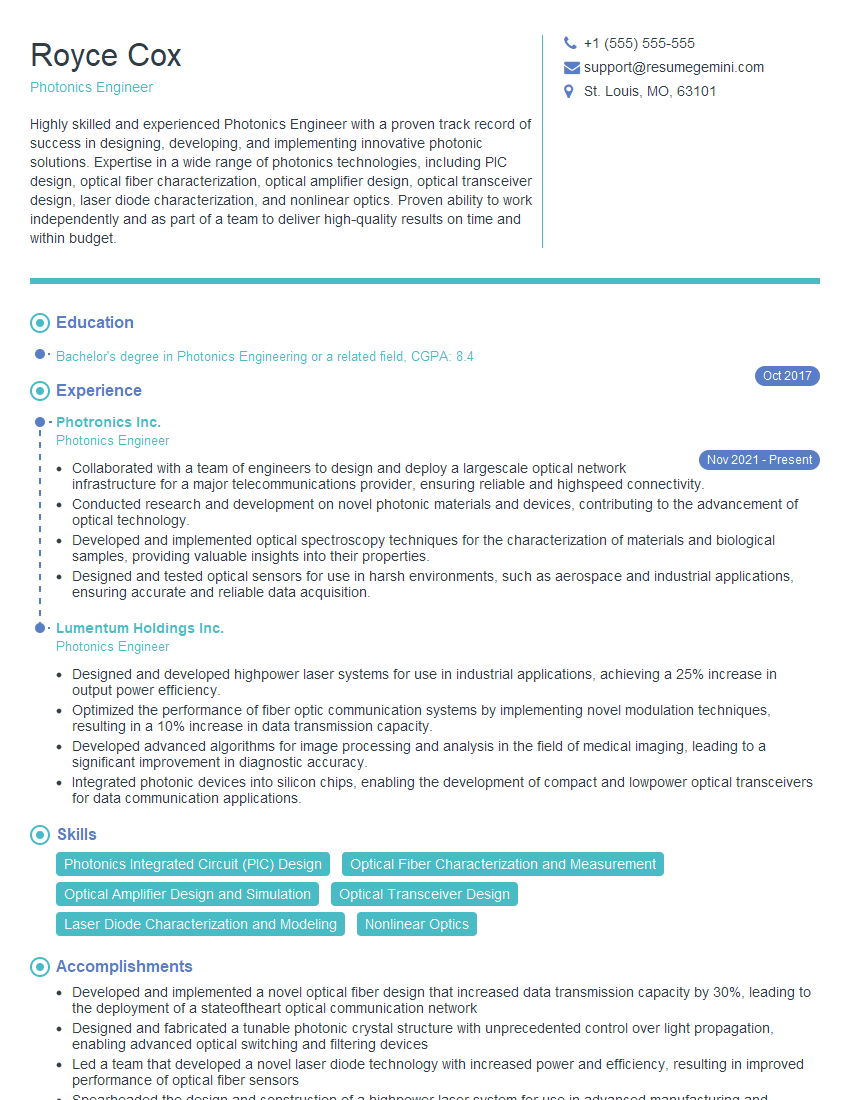
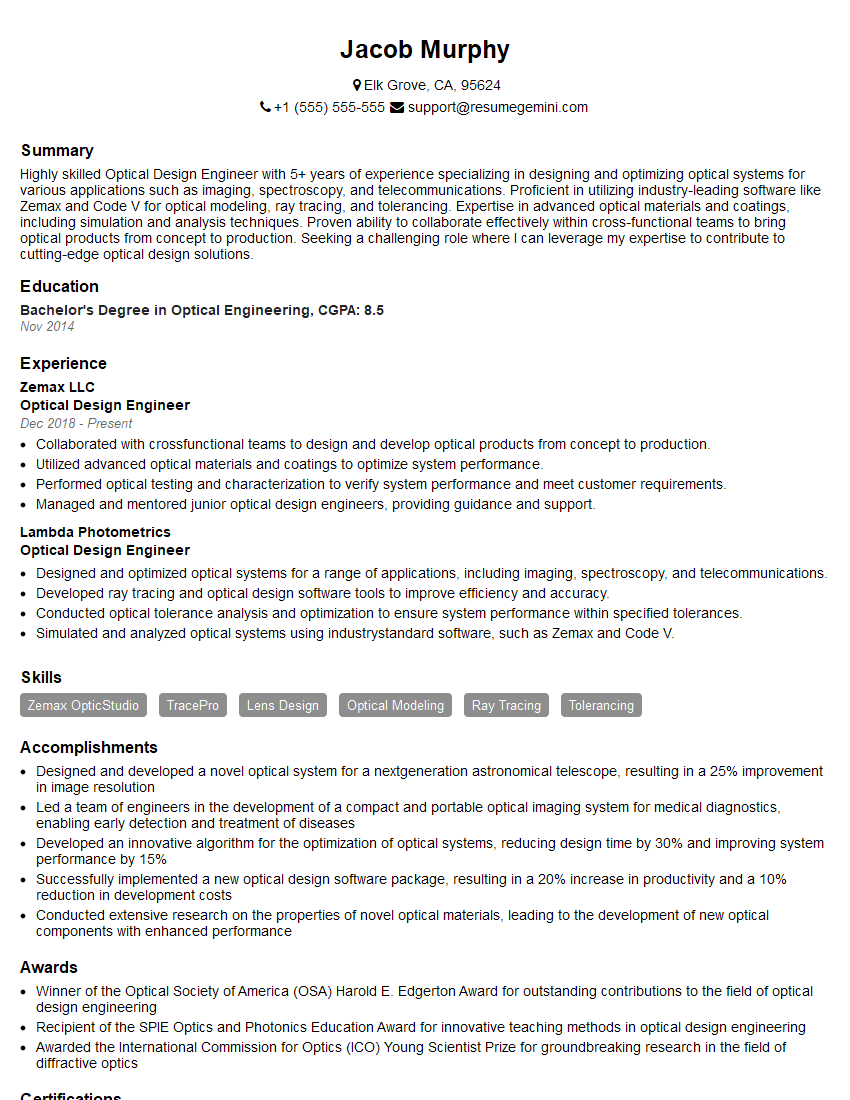
Mastering Wavefront Aberration Correction opens doors to exciting careers in cutting-edge research and development across various industries. A strong understanding of this field is highly valued by employers. To maximize your job prospects, crafting a compelling and ATS-friendly resume is crucial. ResumeGemini can significantly enhance your resume-building experience, helping you present your skills and experience effectively. ResumeGemini provides examples of resumes tailored specifically to Wavefront Aberration Correction, giving you a head start in showcasing your qualifications. Take the next step towards your dream career by leveraging these valuable resources.




Explore more articles
Users Rating of Our Blogs
Share Your Experience
We value your feedback! Please rate our content and share your thoughts (optional).
What Readers Say About Our Blog
Very informative content, great job.
good