The right preparation can turn an interview into an opportunity to showcase your expertise. This guide to Welding procedure knowledge interview questions is your ultimate resource, providing key insights and tips to help you ace your responses and stand out as a top candidate.
Questions Asked in Welding procedure knowledge Interview
Q 1. Explain the importance of a Welding Procedure Specification (WPS).
A Welding Procedure Specification (WPS) is a documented set of instructions that dictates how a specific weld should be performed to ensure consistent and high-quality results. Think of it as a recipe for a perfect weld. It outlines all the critical parameters, ensuring that every weld created using that WPS will meet the required standards and specifications of the project. Without a WPS, welders might use different techniques, leading to inconsistencies in weld quality and potentially compromising the structural integrity of the final product. This is especially critical in industries like construction, aerospace, and shipbuilding where safety is paramount.
Q 2. Describe the different types of welding processes and their respective WPS requirements.
Various welding processes exist, each with its own WPS requirements. Some common processes include:
- Gas Metal Arc Welding (GMAW): Often requires specifications for shielding gas type and flow rate, wire feed speed, voltage, and travel speed. The WPS will also detail the necessary preheat and post-weld heat treatment (PWHT) if needed.
- Shielded Metal Arc Welding (SMAW): The WPS here will specify the electrode type, diameter, current, and polarity. Preheat temperature and travel speed are also crucial parameters.
- Gas Tungsten Arc Welding (GTAW): This process necessitates precise control over parameters like shielding gas type and flow rate, welding current, and travel speed. The WPS will specify the filler metal type and size if used.
- Flux-Cored Arc Welding (FCAW): Similar to GMAW and SMAW, the WPS will specify the flux-cored wire type, shielding gas (if any), current, voltage, and travel speed.
Each process has its own nuances, and the WPS must accurately reflect these to guarantee a successful weld. For instance, a WPS for underwater welding would be drastically different from one for welding thin sheet metal.
Q 3. How do you determine the appropriate preheat temperature for a given weld?
Determining the appropriate preheat temperature depends on several factors: the base material’s type and thickness, the welding process, the environmental conditions, and the weld design. It’s not a guess; it’s based on engineering principles and material specifications. The goal is to reduce the cooling rate of the weld and prevent the formation of hard, brittle microstructures that can lead to cracking.
Typically, preheat temperatures are found in welding codes and standards (like AWS D1.1 for structural steel) or in the material’s data sheet. These documents provide tables or charts that specify the preheat temperature based on the aforementioned factors. In some cases, a qualified welding engineer may perform calculations to determine the optimal preheat temperature. For example, welding thick sections of high-carbon steel often requires significant preheat to avoid cracking, whereas thinner sections of mild steel may not necessitate any preheat.
Q 4. What are the essential elements of a WPS?
Essential elements of a WPS include:
- Base Material Specification: Type, grade, thickness, and chemical composition.
- Welding Process: e.g., GMAW, SMAW, GTAW.
- Filler Metal Specification: Type, size, and AWS classification.
- Joint Design: Type of joint (butt, fillet, lap), joint preparation (bevel angle, root opening), and edge preparation.
- Welding Parameters: Current, voltage, travel speed, shielding gas type and flow rate (if applicable).
- Preheat Temperature: If required.
- Post-Weld Heat Treatment (PWHT): If required.
- Qualification: Reference to the corresponding PQR (Procedure Qualification Record).
- Inspection Requirements: Details on the required non-destructive examination (NDE) methods (e.g., visual inspection, radiographic testing).
A complete and accurate WPS is the cornerstone of consistent weld quality and safety.
Q 5. Explain the role of PQR (Procedure Qualification Record) in welding.
The Procedure Qualification Record (PQR) is a documented record of the actual welding parameters used during a qualification test. It’s the proof that the WPS works. Imagine the WPS as the blueprint, and the PQR as the construction report showing that the blueprint was successfully followed, and the resulting weld passed all the necessary tests. The PQR contains all the details of the test weld, including the results of mechanical testing (tensile strength, bend tests) and non-destructive testing (NDT) such as radiography or ultrasonic testing. This data proves that the welding procedure is capable of producing welds that meet the required specifications. Without a validated PQR, the WPS is just a document – it lacks the proof that it delivers the promised quality.
Q 6. How do you interpret a welding symbol?
Welding symbols are a standardized graphical representation of weld requirements. They communicate vital information about the weld type, location, size, and other parameters in a concise manner. They typically include:
- Reference Line: The horizontal line from which other elements are drawn.
- Arrow: Indicates the location of the weld on the drawing.
- Basic Weld Symbol: Shows the type of weld (e.g., a square for a fillet weld, a triangle for a groove weld).
- Dimensions: Specifies the weld size (leg length for fillet welds, throat thickness for groove welds).
- Supplementary Symbols: Used to denote additional information, such as weld finishing or type of joint preparation.
Understanding welding symbols is essential for welders, inspectors, and engineers to interpret drawings and ensure that welds are executed correctly. Many resources, including welding handbooks and online tutorials, provide detailed explanations and examples of welding symbols.
Q 7. What are the common defects found in welds and how are they prevented?
Common weld defects include:
- Porosity: Gas pores trapped within the weld metal, reducing strength and fatigue resistance. Prevented by proper shielding gas, using correct welding parameters, keeping the area clean, and avoiding excessive moisture.
- Cracks: Breaks in the weld metal due to residual stresses or hydrogen embrittlement. Prevented by proper preheat, controlled cooling rates, using suitable filler material and preventing contamination.
- Incomplete Penetration: The weld doesn’t fully fuse the base materials. Prevented by using the correct welding parameters, proper joint design and preparation.
- Undercutting: A groove melted into the base material alongside the weld. Prevented by selecting appropriate welding parameters and travel speed.
- Slag Inclusions: Trapped slag from the welding process, compromising the strength and integrity of the weld. Prevented by proper cleaning between weld passes.
Prevention involves careful welder training, proper equipment maintenance, and stringent adherence to the WPS. Regular inspections and NDT are crucial for detecting defects early on.
Q 8. Describe the process of WPS qualification and approval.
WPS qualification and approval is a crucial process ensuring consistent, high-quality welds. It involves developing a Welding Procedure Specification (WPS) – a document detailing all parameters for a specific welding process – and then proving its effectiveness through testing. This process typically follows these steps:
- Procedure Development: Based on the materials, joint design, and required weld properties, a WPS is created specifying parameters like welding process, electrode type, preheat temperature, current, voltage, travel speed, etc.
- Test Weld Production: Several test welds are produced following the WPS meticulously. These welds are representative of the actual production welds.
- Non-Destructive Examination (NDE): The test welds undergo rigorous NDE, such as radiographic testing (RT), ultrasonic testing (UT), or visual inspection, to detect internal and external flaws. The acceptance criteria are predefined and based on relevant codes and standards.
- Mechanical Testing (if required): Depending on the application and the code requirements, mechanical tests like tensile, bend, and impact tests might be conducted to verify the weld’s mechanical properties.
- Documentation and Approval: If all tests meet the acceptance criteria, the WPS is approved and documented. This documentation includes the WPS itself, the test results, and the inspector’s approval signature. The approved WPS is then used to guide welders during production.
Think of it like baking a cake – the WPS is your recipe. Qualification is like making a test cake to ensure the recipe works and produces a delicious result before baking many cakes for a party.
Q 9. Explain the difference between a WPS and a WPQ (Welding Procedure Qualification).
The difference between a WPS and a WPQ lies in their purpose and scope. A Welding Procedure Specification (WPS) is a documented set of instructions outlining how a specific weld should be made. It’s a recipe. A Welding Procedure Qualification Record (WPQR), on the other hand, is the documentation that proves a WPS produces acceptable welds. It’s the proof that the recipe works.
Imagine you have a recipe for cookies (WPS). You bake a batch to check if it tastes good (testing). The detailed notes on your testing, including the results and whether the cookies were deemed successful (pass/fail) is the WPQR. The WPS itself doesn’t guarantee quality, but the WPQR demonstrates that the WPS reliably produces welds meeting specific requirements.
Q 10. How do you manage changes to an existing WPS?
Managing changes to an existing WPS requires a careful and documented approach. Any alteration, no matter how minor, can potentially affect weld quality. Here’s how it’s typically handled:
- Assess the Change: Determine the nature and extent of the proposed change. Is it a minor adjustment (e.g., slight change in amperage) or a significant modification (e.g., different welding process)?
- Review Relevant Codes: Consult relevant welding codes and standards (e.g., ASME Section IX) to understand the implications of the change and any additional qualification requirements.
- Update WPS: Update the WPS to reflect the changes, including a revision number to track modifications.
- Requalification (if necessary): If the change is significant enough, requalification may be required. This usually involves repeating the test weld procedure, NDE, and mechanical testing as needed.
- Documentation: All changes to the WPS and the justification for them must be meticulously documented and approved.
For example, switching from a 7018 electrode to a 6010 electrode would likely require requalification, due to the significant differences in properties and welding characteristics. A small adjustment to the amperage within the original WPS’s specified range might not.
Q 11. What are the safety precautions necessary when following a WPS?
Safety is paramount when following a WPS. The specific precautions will vary depending on the welding process, materials, and environment, but some common precautions include:
- Personal Protective Equipment (PPE): Always wear appropriate PPE, including welding helmet with appropriate shade, welding gloves, long-sleeved shirt, flame-resistant clothing, and safety footwear.
- Ventilation: Ensure adequate ventilation to remove harmful fumes and gases produced during welding. Use local exhaust ventilation systems where necessary.
- Fire Prevention: Keep flammable materials away from the welding area and have fire extinguishers readily available.
- Eye and Skin Protection: Welding produces intense UV radiation, so proper eye and skin protection is essential. Ultraviolet radiation burns can be severe.
- Proper Welding Techniques: Adhere to proper welding techniques as outlined in the WPS to prevent hazards such as burns, electric shock, or arc eye.
- Confined Space Precautions: If welding in confined spaces, ensure adequate ventilation and respiratory protection. Permit-required confined space entry procedures might apply.
Following a well-defined and approved WPS is a key element of a safe welding operation.
Q 12. How do you handle non-conformances during welding?
Handling non-conformances during welding requires a structured approach to maintain quality and safety. The process generally involves:
- Identification: Clearly identify the non-conformance, including the nature of the defect (e.g., porosity, cracks, undercut) and its location.
- Documentation: Record all relevant details, including the date, time, welder, WPS used, and the specific nature of the defect. Photographs or video recordings can be valuable documentation.
- Assessment: Determine the severity of the non-conformance based on relevant codes and standards (e.g., ASME Section IX). Determine if the weld is repairable or needs to be replaced.
- Corrective Action: Take appropriate corrective action, which may involve repair, rework, or scrapping the defective weld. Repair or rework procedures must be documented.
- Re-inspection: After corrective action, reinspect the weld to ensure it meets the required standards.
- Root Cause Analysis: Investigate the root cause of the non-conformance to prevent similar issues in the future. This might involve reviewing the welding procedures, welder training, or equipment maintenance.
A proper non-conformance report detailing these steps is crucial for traceability and continuous improvement.
Q 13. What are the relevant welding codes and standards (e.g., ASME Section IX, AWS D1.1)?
Several welding codes and standards are used globally, each with specific requirements and applications. Some of the most prevalent include:
- ASME Section IX: This is a widely recognized standard in the US for welding and brazing qualifications in the pressure vessel and boiler industry. It provides detailed requirements for WPS qualification, welder qualification, and inspection.
- AWS D1.1: The American Welding Society (AWS) D1.1 standard covers structural welding codes for steel.
- ISO 15614-1: This international standard covers the qualification of welding procedures for metallic materials.
- EN ISO 15614-1: This is the European equivalent of ISO 15614-1.
The choice of which code to follow depends on the project’s application, industry regulations, and contractual obligations. Using the wrong standard can lead to serious safety and quality issues.
Q 14. Explain the significance of interpass temperature control.
Interpass temperature control is vital for ensuring proper weld properties and avoiding defects. The interpass temperature refers to the temperature of the previously deposited weld bead before the next bead is applied. Controlling this temperature is critical because:
- Preventing Hydrogen Cracking: High interpass temperatures can help to release hydrogen absorbed during welding, reducing the risk of hydrogen cracking. Hydrogen is a common contaminant in welding materials and can lead to significant problems.
- Improving Weld Fusion: Maintaining a proper interpass temperature promotes better fusion between weld beads. If the previous bead cools too much, it can result in poor fusion and lack of penetration.
- Controlling Weld Metal Properties: Interpass temperature significantly influences the microstructure and mechanical properties of the weld metal. Incorrect temperature can lead to undesirable hardness or brittleness.
- Reducing Residual Stress: Controlling interpass temperature helps manage residual stresses in the weldment, reducing the risk of distortion and cracking.
Imagine welding thick steel plates. If the first bead cools completely before applying the next, the heat input of the second bead might not properly fuse it, resulting in a weak point. By maintaining optimal interpass temperature, we ensure a homogeneous weld across multiple layers, maximizing strength and quality.
Q 15. How do you verify the welder’s qualification to a specific WPS?
Verifying a welder’s qualification against a specific Welding Procedure Specification (WPS) is crucial for ensuring consistent weld quality. This is typically done through a welder performance qualification test, often called a welder qualification test (WQT) or a procedure qualification record (PQR). The welder must demonstrate their ability to produce welds that meet the requirements outlined in the WPS. This involves performing test welds according to the WPS’s parameters, including the base materials, welding process, filler metal, and pre- and post-weld heat treatments.
The process generally involves:
- Preparing test plates: The welder uses the materials specified in the WPS.
- Welding the test plates: The welder follows the exact procedures detailed in the WPS, including parameters like amperage, voltage, travel speed, and shielding gas flow (if applicable).
- Visual inspection: The welds are visually inspected for surface defects like cracks, porosity, or undercuts.
- Non-destructive testing (NDT): Depending on the WPS, NDT methods like radiographic testing (RT), ultrasonic testing (UT), or magnetic particle testing (MT) might be used to assess internal weld quality.
- Mechanical testing: In some cases, destructive tests such as tensile testing or bend testing may be performed to evaluate the weld’s mechanical properties.
If the welds pass all inspection criteria outlined in the WPS, the welder is deemed qualified to use that WPS. A written record of the qualification, often a certification, is issued, specifying the WPS the welder is qualified for and any limitations.
Example: A welder needs to be qualified to use WPS 1234, which specifies welding 10mm thick carbon steel using the Gas Metal Arc Welding (GMAW) process with a specific filler metal. The welder performs test welds according to WPS 1234, and these welds undergo visual and radiographic inspection. If both inspections show no defects, the welder becomes qualified for WPS 1234.
Career Expert Tips:
- Ace those interviews! Prepare effectively by reviewing the Top 50 Most Common Interview Questions on ResumeGemini.
- Navigate your job search with confidence! Explore a wide range of Career Tips on ResumeGemini. Learn about common challenges and recommendations to overcome them.
- Craft the perfect resume! Master the Art of Resume Writing with ResumeGemini’s guide. Showcase your unique qualifications and achievements effectively.
- Don’t miss out on holiday savings! Build your dream resume with ResumeGemini’s ATS optimized templates.
Q 16. What are the different types of welding joint designs and their suitability?
Welding joint designs are crucial for the strength and integrity of a weld. The choice of joint depends on factors such as the thickness of the materials being joined, the type of stress the weld will experience, and the accessibility of the joint. Here are some common joint types:
- Butt joint: The edges of the two parts are butted together. This is strong for tensile loads, commonly used in pipelines or structural beams. Variations include square butt, bevel butt, and double bevel butt, each offering different weld penetration and ease of welding.
- Lap joint: One piece overlaps the other. Simple to weld but less strong than butt joints, suitable for low-stress applications.
- T-joint: One piece is perpendicular to another. Used extensively in frameworks and structures, requiring careful consideration of penetration and potential for stress concentration.
- Corner joint: Two pieces meet at a corner. Used in box structures or containers, strength depends heavily on proper weld penetration and execution.
- Edge joint: The edges of two thin plates are welded together. Often used in sheet metal fabrication.
Suitability examples: A butt joint is ideal for a pressure vessel requiring high tensile strength, while a lap joint might be sufficient for a less critical application like joining sheet metal panels. The choice often depends on a balance between strength, weldability, and cost.
Q 17. How do you select the appropriate filler metal for a specific weld?
Selecting the appropriate filler metal is critical for achieving a strong, durable, and reliable weld. The choice depends on several factors:
- Base metal composition: The filler metal should be compatible with the base metal to prevent cracking, porosity, or other defects. The chemical composition must be considered.
- Welding process: Different welding processes require different filler metal types. For instance, stick welding uses coated electrodes with specific compositions, while MIG welding often uses solid wire.
- Weld joint design: The type of joint (butt, lap, T-joint, etc.) influences the amount of filler metal needed and the type of filler suitable.
- Mechanical properties: The desired tensile strength, ductility, and toughness of the weld determine the filler metal’s specifications.
- Service conditions: If the weld will be exposed to extreme temperatures, corrosive environments, or high stress, special filler metals may be necessary.
Example: For welding mild steel, an E7018 electrode (for SMAW) or ER70S-6 wire (for GMAW) is often suitable. If the application requires higher strength, an E8018-B2 electrode or ER80S-G2 wire would be selected. For stainless steel, filler metal with a matching stainless steel composition would be used. Proper selection ensures that the weld metal’s properties match the base material for optimal performance.
Q 18. Explain the importance of post-weld heat treatment (PWHT).
Post-weld heat treatment (PWHT) is a crucial step in many welding applications, particularly for high-strength steels or those prone to cracking. It involves heating the welded assembly to a specific temperature, holding it for a certain time, and then cooling it slowly. The primary purposes of PWHT are:
- Stress relief: Welding introduces residual stresses into the material. PWHT helps relieve these stresses, reducing the risk of cracking or distortion.
- Improving toughness: PWHT can refine the microstructure of the weld metal and the heat-affected zone (HAZ), improving the weld’s toughness and impact resistance.
- Improving ductility: Similar to toughness enhancement, PWHT can improve the material’s ability to deform before fracturing.
- Reducing hardness: PWHT can lower the hardness of the weld and HAZ, making the material less susceptible to brittle fracture.
The specific PWHT parameters (temperature, time, cooling rate) are determined based on the base material, welding process, and the design requirements. Incorrect PWHT can be as detrimental as no PWHT at all, potentially leading to embrittlement.
Example: In pressure vessel fabrication, PWHT is often mandatory to ensure the vessel can withstand the internal pressure without cracking. The specific temperature and hold time would be determined by the material specifications and relevant codes.
Q 19. Describe the various non-destructive testing (NDT) methods used for weld inspection.
Various non-destructive testing (NDT) methods are used to inspect welds without damaging them. The choice of method depends on the weld type, material, and the types of defects being sought.
- Visual inspection (VT): The simplest method, involving visual examination of the weld surface for cracks, porosity, undercuts, or other defects. A crucial first step in any weld inspection.
- Radiographic testing (RT): Uses X-rays or gamma rays to penetrate the weld and reveal internal flaws like cracks, porosity, or inclusions. Excellent for detecting volumetric defects.
- Ultrasonic testing (UT): Uses high-frequency sound waves to detect internal flaws. Effective for detecting both volumetric and planar defects. Offers better resolution than RT in some instances.
- Magnetic particle testing (MT): Uses magnetic fields to detect surface and near-surface cracks in ferromagnetic materials. A relatively inexpensive and portable method.
- Dye penetrant testing (PT): A surface inspection method that uses a dye to reveal surface-breaking cracks or other defects. Easy to use and relatively inexpensive.
These methods often work in tandem to give a comprehensive picture of the weld’s integrity.
Q 20. How do you interpret NDT results?
Interpreting NDT results requires training and experience. The interpretation depends on the specific NDT method used. In general, the results are compared to acceptance criteria defined in codes, standards, or the WPS.
Visual Inspection: The inspector notes the presence, size, and type of any surface defects. These observations are compared to acceptance criteria for size and type of discontinuities.
Radiographic Testing: Radiographic images (radiographs) are analyzed to identify indications (darker or lighter areas) that might correspond to flaws. The size, shape, and location of these indications are compared against acceptance standards.
Ultrasonic Testing: Ultrasonic signals are analyzed, and the presence, location, size, and type of flaws are identified based on the reflected or transmitted sound waves. These findings are compared to acceptance criteria.
Magnetic Particle Testing and Dye Penetrant Testing: The presence and patterns of indications (e.g., lines of magnetic particles or dye) are assessed visually, compared to acceptance standards based on the size, shape, and extent of the surface defect.
Acceptance/Rejection: If any flaw exceeds the acceptance criteria, the weld may be rejected and remedial action such as repair or replacement is needed. Documentation of the findings is essential. The specific acceptance criteria can vary considerably based on codes and standards and the specific application requirements.
Q 21. What are the limitations of a specific WPS?
A WPS has limitations that define its applicability. Exceeding these limitations can compromise the weld’s quality and integrity. These limitations typically include:
- Base materials: The WPS specifies the exact types and thicknesses of base materials it applies to. Using different materials invalidates the WPS.
- Welding process: The WPS is only valid for the specified welding process (e.g., SMAW, GMAW, GTAW). Changing the process requires a new WPS.
- Filler metal: The WPS specifies the exact filler metal to be used. Using a different filler metal requires a new WPS.
- Preheating/post-weld heat treatment: Any specified preheating or post-weld heat treatment must be followed exactly. Changes necessitate a new WPS.
- Joint design: The WPS typically details the acceptable joint configurations. Using a different joint design requires qualification of a new WPS.
- Welder qualification: Only welders qualified to the specific WPS can use it. Employing unqualified welders invalidates the WPS.
- Environmental conditions: The WPS may specify acceptable environmental conditions (temperature, humidity). Welding outside of these limits can cause problems.
Example: A WPS specifies welding 6mm thick aluminum using GTAW. Attempting to weld 12mm thick aluminum or using SMAW instead would exceed the WPS’s limitations and require a new WPS to be qualified.
Q 22. How do you ensure the traceability of welding materials and procedures?
Traceability in welding is paramount for ensuring the quality and safety of the final product. It’s like keeping a detailed family tree for every weld, tracking its origins from the raw materials to the finished joint. This involves meticulous record-keeping throughout the entire process.
- Material Traceability: Each batch of welding consumables (electrodes, filler wires, shielding gases) receives a unique identification number, linked to its chemical composition, manufacturer’s certification, and delivery documentation. This information is then documented and associated with specific welds or projects. Think of it like a passport for every welding material.
- Procedure Traceability: Every Welding Procedure Specification (WPS) is uniquely identified and version-controlled. Any revisions or updates are meticulously logged, ensuring that the WPS used for a particular weld is readily identifiable and its history is clear. It’s like having a detailed instruction manual for each weld, with a complete revision history.
- Welder Qualification Traceability: Welder qualification records, including their certifications and test results, are carefully maintained. This ensures that the welder performing a specific task is properly qualified to do so, mirroring the credentialing process for medical professionals.
- Heat Treatment Traceability: If heat treatment is required, the parameters (temperature, time, etc.) are recorded and linked to the specific welds. This guarantees the consistency of the post-weld process and its impact on the weld’s integrity.
By maintaining this comprehensive traceability system, we can readily investigate any issues, identify the root cause of defects, and ensure consistent, high-quality welds. This is crucial for industries with stringent quality requirements, such as aerospace or nuclear power.
Q 23. Describe your experience with different types of welding equipment.
My experience encompasses a wide range of welding equipment, from traditional methods to advanced automated systems. I’ve worked extensively with:
- Shielded Metal Arc Welding (SMAW): Proficient in using various electrode types for different materials and applications. I understand the nuances of arc control, electrode angle, and travel speed crucial for achieving quality welds.
- Gas Metal Arc Welding (GMAW): Experienced with both pulsed and conventional GMAW, using various shielding gases and wire feeds to weld various materials, including aluminum and stainless steel. I understand the impact of parameters like wire feed speed and voltage on weld penetration and bead profile.
- Gas Tungsten Arc Welding (GTAW): Highly skilled in TIG welding, adept at achieving precise welds on thin materials. My expertise includes both AC and DC welding, allowing for versatility across various materials.
- Flux-Cored Arc Welding (FCAW): Proficient in FCAW, leveraging its advantages for welding in outdoor settings and on thicker materials. I have experience using self-shielded and gas-shielded FCAW processes.
- Automated Welding Systems: I’ve worked with robotic welding systems, programming and operating them for high-volume production applications. This experience includes troubleshooting and maintaining robotic welders.
This varied experience provides me with a broad understanding of the strengths and limitations of each process, enabling me to select the most appropriate technique for any given welding task.
Q 24. What is your experience with documenting and updating welding procedures?
Documenting and updating welding procedures is a critical aspect of my role, ensuring consistent quality and compliance with relevant standards. I’ve developed and maintained WPSs using industry-standard formats, incorporating all necessary parameters such as base material, filler material, pre-heat temperature, welding process, and post-weld heat treatment.
My process involves:
- Creating WPSs: Based on the specific requirements of the job, I meticulously develop WPSs that comply with relevant codes and standards such as AWS D1.1 or ASME Section IX.
- Procedure Qualification Records (PQRs): I’ve prepared and documented numerous PQRs, including detailed records of welding parameters, visual inspections, and mechanical testing to demonstrate compliance with the WPS.
- Version Control: I maintain a rigorous version control system for WPSs, ensuring that all changes are documented, approved, and easily traceable.
- WPS Updates: When necessary, I update WPSs based on changes in material specifications, welding techniques, or regulatory requirements. All updates follow a formal change management process for accuracy and traceability.
This ensures that our welding procedures remain current, accurate, and compliant, fostering a culture of consistency and quality in our welding operations. For instance, if a new material is introduced, I ensure the WPS is updated with the appropriate pre-heat and post-weld heat treatment requirements.
Q 25. How do you troubleshoot welding problems?
Troubleshooting welding problems requires a systematic approach, combining practical experience with a methodical process of elimination. My approach involves:
- Visual Inspection: I begin by carefully examining the weld for any visible defects such as porosity, undercutting, or lack of fusion. This initial observation often points toward the root cause.
- Parameter Review: I thoroughly review the welding parameters used – voltage, amperage, travel speed, shielding gas flow rate etc. Deviations from the WPS may indicate a problem.
- Material Assessment: I examine the base material and filler material for any irregularities that could contribute to welding defects, such as contamination or improper surface preparation.
- Equipment Check: I check the welding equipment for proper functioning, ensuring that the power supply, wire feeder, and shielding gas system are operating correctly.
- Environmental Factors: I consider environmental factors such as wind, temperature, and humidity, which can significantly impact weld quality.
- Welder Technique: I evaluate the welder’s technique, ensuring they are following the WPS and utilizing proper welding practices. Sometimes, a minor adjustment in technique can greatly improve the weld.
I approach troubleshooting as a detective would – gathering clues and methodically eliminating possibilities until the root cause is identified. For example, excessive porosity might suggest a problem with shielding gas coverage, requiring adjustments to the gas flow rate or electrode angle.
Q 26. Describe a situation where you had to adapt a WPS to a specific application.
In one project involving the repair of a cracked stainless steel pipeline, the existing WPS wasn’t suitable for the specific geometry and accessibility of the crack. The original WPS was designed for flat, easily accessible welds.
To adapt the WPS, I conducted a thorough material analysis to confirm the stainless steel grade and undertook several test welds on scrap material, systematically modifying parameters like pre-heat temperature, welding current, and travel speed to achieve a suitable weld bead. The limited access required specialized tooling, and I incorporated those needs into the revised WPS.
This involved close collaboration with the engineering team to ensure the modified WPS complied with the required safety and quality standards. The revised WPS successfully addressed the unique challenges of the repair, leading to a high-quality, durable repair and validating my ability to adapt existing procedures to accommodate unique challenges.
Q 27. How do you ensure the consistency of weld quality across multiple welders?
Ensuring consistent weld quality across multiple welders involves a multi-faceted approach focused on training, standardization, and continuous monitoring.
- Rigorous Training and Qualification: Each welder undergoes comprehensive training and qualification, ensuring they are proficient in the specific welding processes and procedures required for the job. This involves practical training, written examinations, and performance-based qualification tests.
- Standardized Procedures: Clear, concise, and unambiguous WPSs are crucial. All welders must be well-versed in the WPS and understand its requirements.
- Regular Monitoring and Audits: Routine audits and inspections of weld quality are vital. Visual inspections, destructive and non-destructive testing (NDT) are conducted to assess the consistency of weld quality. Any deviations from standards trigger corrective actions.
- Performance Feedback and Continuous Improvement: Regular feedback on welder performance helps to identify areas for improvement and provides opportunities for coaching and additional training.
- Use of Consistent Equipment and Materials: Using the same welding equipment and materials minimizes variations in weld quality.
By implementing these measures, I create an environment where all welders consistently produce welds that meet the required quality standards. This fosters a culture of quality and reduces the risk of inconsistencies in the final product.
Q 28. Explain the importance of proper documentation and record-keeping in welding.
Proper documentation and record-keeping are fundamental in welding for several reasons, analogous to a surgeon meticulously documenting a surgical procedure.
- Quality Assurance: Complete documentation allows for the traceability of materials, procedures, and welders, providing evidence of compliance with standards and specifications. It serves as a verifiable record that ensures weld quality meets the required criteria.
- Troubleshooting and Root Cause Analysis: In case of defects, detailed records assist in identifying the root cause of the problem, enabling corrective actions to prevent future occurrences.
- Legal and Regulatory Compliance: Many industries have strict regulations and standards that require comprehensive documentation of welding processes. Thorough record-keeping ensures compliance and avoids potential legal issues.
- Project Management: Documentation helps in tracking progress, managing resources, and scheduling effectively.
- Continuous Improvement: Data from welding records can be analyzed to identify areas for improvement in procedures, training, or equipment. It enables data-driven decisions that enhance overall efficiency and quality.
In short, comprehensive documentation acts as a historical record of every weld, promoting accountability, quality assurance, and continuous improvement. Without it, ensuring consistent quality and safety becomes significantly more challenging, even impossible in many regulated industries.
Key Topics to Learn for Your Welding Procedure Knowledge Interview
- Welding Processes: Understanding the fundamentals of various welding processes (e.g., GMAW, SMAW, GTAW) including their applications, advantages, and limitations. Be prepared to discuss specific process parameters and their impact on weld quality.
- Weld Joint Design and Preparation: Demonstrate knowledge of different weld joint types and their suitability for specific applications. Discuss proper joint preparation techniques for optimal weld penetration and strength.
- Welding Procedure Specifications (WPS): Explain the importance of WPS documentation, including the information it contains (e.g., base materials, welding parameters, pre- and post-weld heat treatments). Be ready to interpret and apply WPS data.
- Weld Quality and Inspection: Discuss common weld defects (porosity, cracks, undercut), their causes, and methods for prevention and detection. Familiarize yourself with various non-destructive testing (NDT) methods.
- Material Properties and Selection: Understand the relationship between base metal properties (e.g., tensile strength, yield strength) and the selection of appropriate welding processes and parameters. Discuss the impact of different materials on weldability.
- Safety Procedures and Regulations: Demonstrate awareness of relevant safety regulations and procedures associated with welding, including PPE, fire safety, and hazard identification.
- Practical Application and Troubleshooting: Be prepared to discuss real-world scenarios where your welding procedure knowledge was crucial in solving a problem or ensuring the quality of a weld. This could involve adapting a WPS to a specific situation or troubleshooting a welding issue.
Next Steps: Ace Your Interview and Launch Your Career
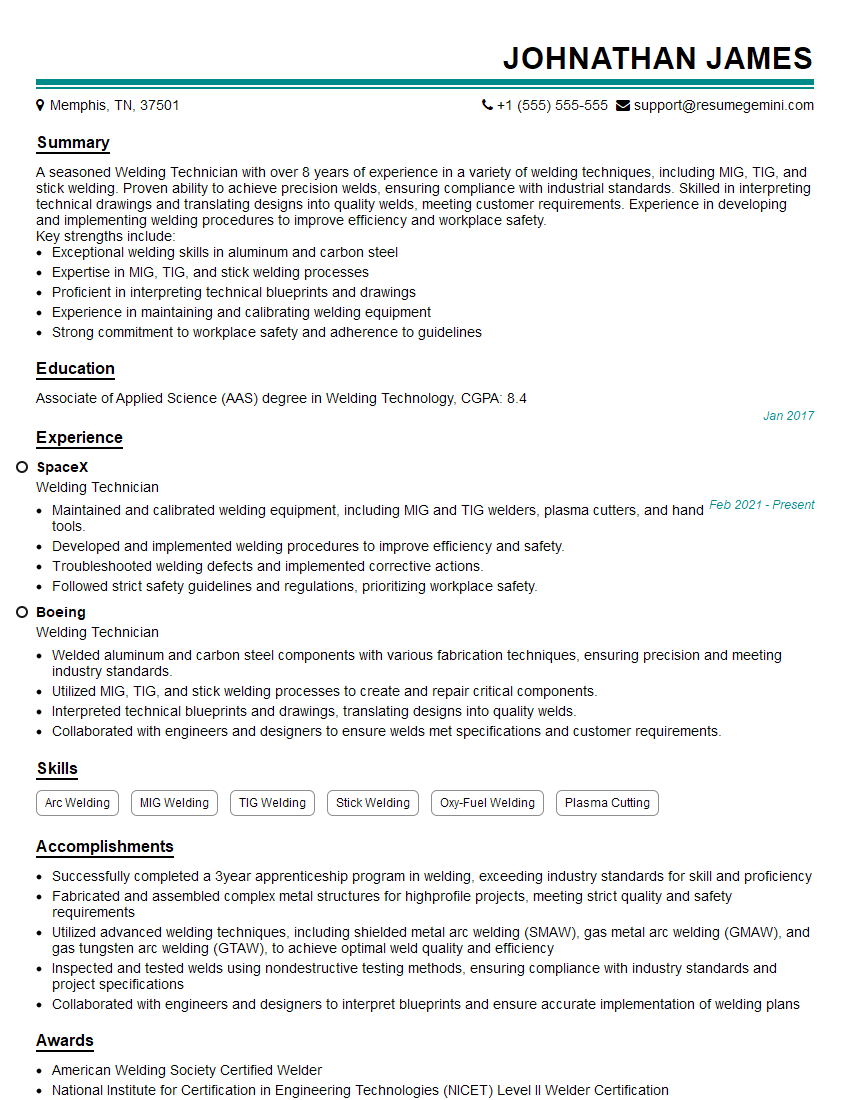
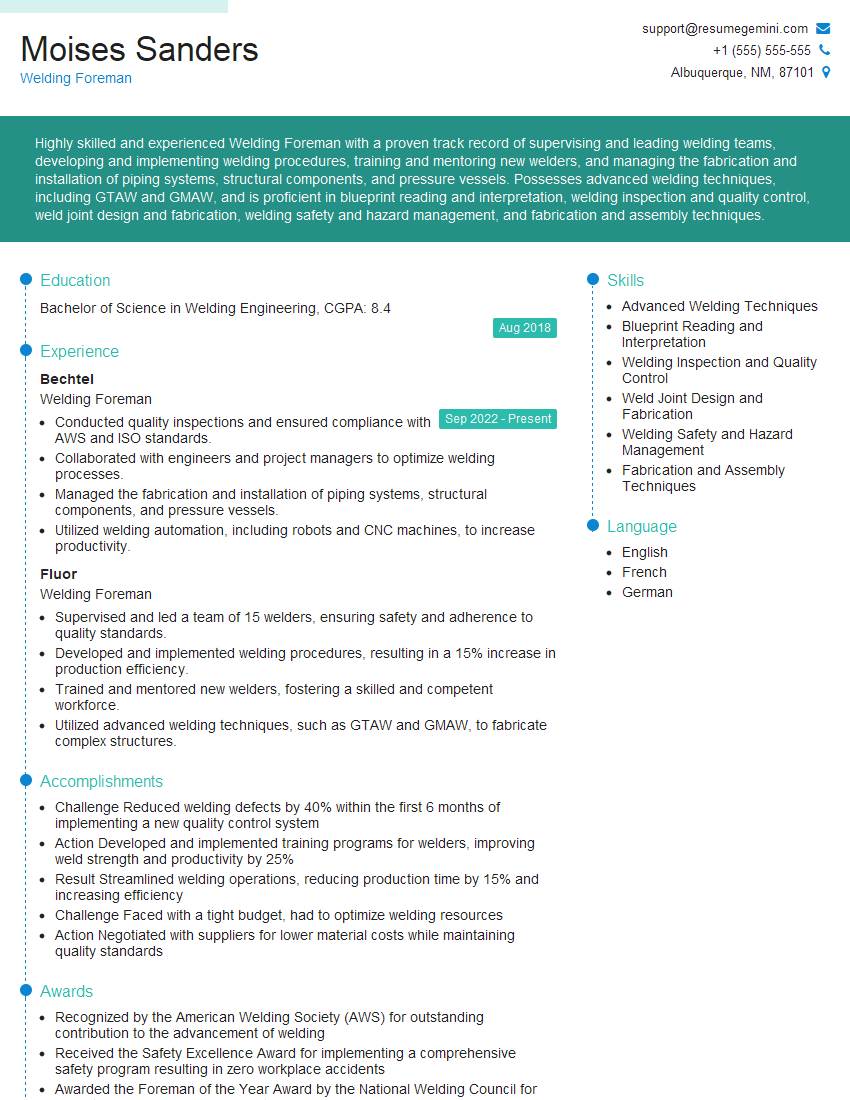
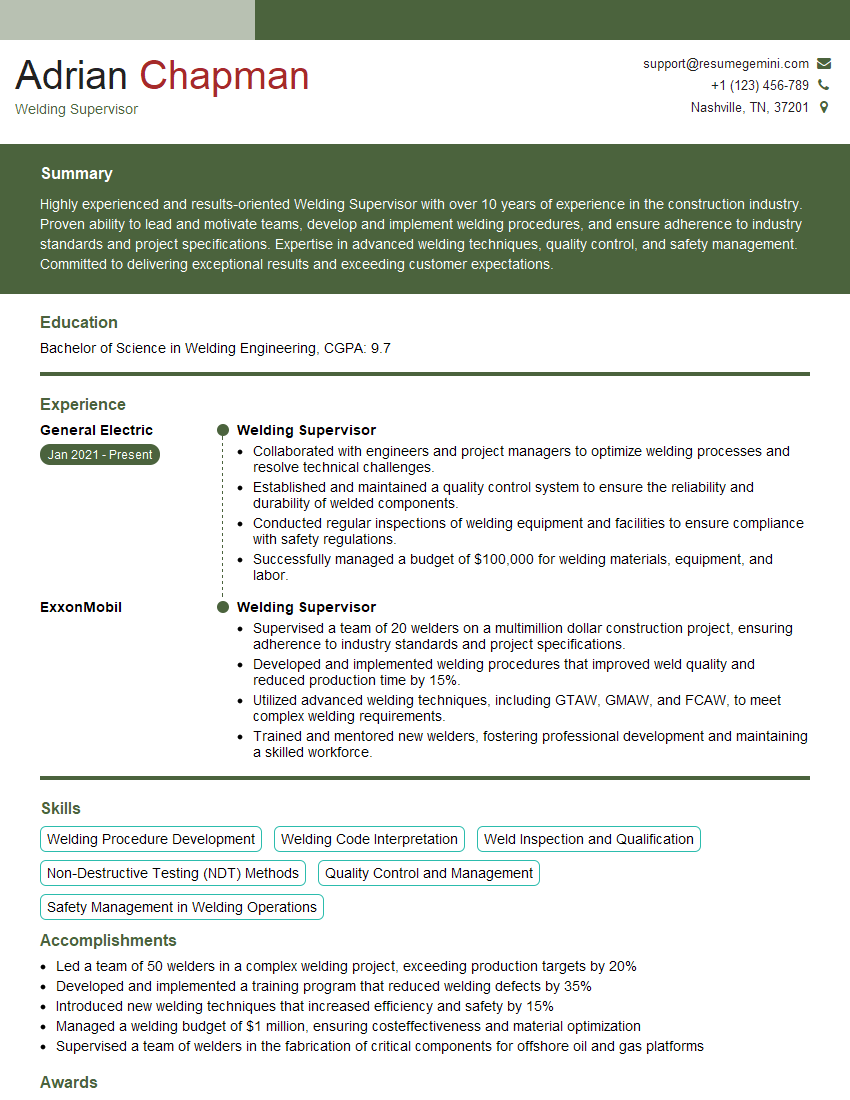
Mastering welding procedure knowledge is crucial for career advancement in this field. A strong understanding of these principles demonstrates your competence and commitment to delivering high-quality work. To maximize your job prospects, create an ATS-friendly resume that highlights your skills and experience effectively. ResumeGemini is a trusted resource that can help you build a professional and impactful resume. We offer examples of resumes tailored specifically to welding procedure knowledge expertise to help you get started. Invest the time to craft a compelling resume – it’s your first impression with potential employers.


Explore more articles
Users Rating of Our Blogs
Share Your Experience
We value your feedback! Please rate our content and share your thoughts (optional).
What Readers Say About Our Blog
Very informative content, great job.
good