Are you ready to stand out in your next interview? Understanding and preparing for Wellbore Trajectory Modeling interview questions is a game-changer. In this blog, we’ve compiled key questions and expert advice to help you showcase your skills with confidence and precision. Let’s get started on your journey to acing the interview.
Questions Asked in Wellbore Trajectory Modeling Interview
Q 1. Explain the difference between build rate and turn rate in directional drilling.
In directional drilling, both build rate and turn rate describe how the wellbore deviates from a vertical path, but they focus on different aspects. Think of it like navigating a car: build rate is how quickly you change your elevation, while turn rate is how quickly you change your direction.
Build Rate: This refers to the rate at which the wellbore inclination (angle from vertical) increases. It’s typically measured in degrees per 100 feet (or meters) drilled. A high build rate means the wellbore is rapidly becoming more inclined, while a low build rate indicates a slower increase in inclination. For instance, a build rate of 2°/100ft means the wellbore’s inclination increases by 2 degrees for every 100 feet drilled.
Turn Rate: This represents the rate at which the wellbore azimuth (direction of the wellbore in the horizontal plane, measured clockwise from North) changes. It’s also usually measured in degrees per 100 feet (or meters) drilled. A high turn rate signifies a sharp change in the horizontal direction of the wellbore, whereas a low turn rate indicates a gradual azimuth change. Imagine a slow turn vs a sharp U-turn; the turn rate is what differentiates them.
Understanding the difference between these two rates is crucial for planning and executing a successful directional drilling operation. It allows for precise control over the wellbore trajectory, optimizing the well’s placement for reservoir access and minimizing potential risks.
Q 2. Describe the various types of wellbore trajectories (e.g., vertical, deviated, horizontal, multilateral).
Wellbore trajectories can be categorized into several types, each chosen based on the geological and operational objectives:
- Vertical Wells: These wells are drilled straight down, vertically, and are typically the simplest to plan and execute. They are often used for shallow reservoirs or where directional drilling isn’t necessary.
- Deviated Wells: These wells start vertically and deviate from the vertical at a certain point, following a planned trajectory to reach a target that’s offset from the surface location. They provide access to reservoirs that are not directly beneath the drilling pad.
- Horizontal Wells: These wells are drilled to reach a reservoir and then continue at approximately a 90-degree angle to the vertical, creating a long horizontal section within the reservoir. This greatly increases the contact area with the reservoir, enhancing production.
- Multilateral Wells: These wells branch off from a main wellbore, creating multiple branches that can access different sections of a reservoir or multiple reservoirs. They offer increased reservoir drainage and improve efficiency by accessing multiple targets from a single wellhead.
The selection of a wellbore trajectory type is a critical decision, influenced by factors such as reservoir geometry, formation properties, surface constraints, and drilling limitations. Each type has its own advantages and disadvantages in terms of cost, complexity, and production potential.
Q 3. What are the key factors influencing wellbore trajectory design?
Several key factors influence wellbore trajectory design. Careful consideration of these factors ensures safe and efficient drilling operations, leading to optimal reservoir contact and production.
- Reservoir Geometry and Location: The size, shape, and depth of the reservoir dictate the necessary trajectory length, inclination, and azimuth.
- Geological Formation Properties: The strength, stress, and pore pressure of the formations influence the feasibility and challenges of drilling a specific trajectory. Unstable formations may require adjustments in the trajectory to minimize risks.
- Surface Locations and Obstacles: Surface constraints, such as pipelines, buildings, or environmental regulations, restrict the possible surface locations and potentially influence the trajectory to avoid obstacles.
- Drilling Equipment and Capabilities: The available drilling equipment and its limitations (e.g., maximum reach, bending capacity) constrain the achievable trajectory.
- Operational and Safety Considerations: Ensuring safe and efficient drilling operations while minimizing environmental impact necessitates careful planning and consideration of potential risks.
- Economic Factors: The cost of drilling a particular trajectory, including equipment, personnel, and time, is a significant factor in trajectory design decisions.
Q 4. How do you account for formation dip and azimuth in trajectory planning?
Formation dip and azimuth are crucial parameters in wellbore trajectory planning because they represent the natural inclination and orientation of geological formations. Failing to account for them can lead to inefficient well placement or even drilling difficulties.
Accounting for Formation Dip: Formation dip is the angle of inclination of the geological layer. During trajectory planning, the wellbore trajectory should be designed to intersect the target reservoir at an optimal angle to maximize the well’s contact length. This usually involves adjusting the planned inclination and azimuth of the wellbore to account for the dip angle and direction, ensuring that the wellbore follows the reservoir layer rather than intersecting it at an unfavorable angle.
Accounting for Formation Azimuth: Formation azimuth describes the direction of the dip of the geological layer. This information is critical for aligning the wellbore with the reservoir’s orientation, maximizing reservoir contact and minimizing drilling through unnecessary formations. Trajectory planning software typically integrates this data, allowing for precise directional calculations.
Ignoring formation dip and azimuth can lead to reduced reservoir contact, increased drilling costs, and compromised well performance. Accurate integration of this geological data is therefore essential for effective wellbore trajectory design.
Q 5. What are the limitations of different trajectory planning models?
Various trajectory planning models exist, each with its own strengths and limitations. The choice of model depends on the specific well design and available data.
- Simple Trigonometric Models: These are easy to use but may be inaccurate for complex trajectories or formations with significant dip. They often rely on simplified assumptions, making them less precise.
- Minimum Curvature Models: These models provide a more accurate representation of the wellbore trajectory, particularly in complex scenarios. They are widely used but can become computationally intensive for extremely complex trajectories.
- Radius of Curvature Models: Similar to minimum curvature, but they allow for better control of the wellbore’s curvature along its length, leading to smoother trajectories in challenging geological conditions.
- 3D Finite Element Models: These models provide the most accurate representation, taking into account various factors like formation stress, pore pressure, and rock mechanical properties. However, they are computationally expensive and require detailed geological data.
The limitations often involve simplifying assumptions about the formation or the drillstring behavior. For instance, simple models might not accurately capture the effects of friction and torque on the drillstring or variations in formation properties along the wellbore. The choice of model is a balance between accuracy and computational cost, which should consider the project’s specific needs.
Q 6. Explain the role of Measurement While Drilling (MWD) and Logging While Drilling (LWD) in trajectory control.
Measurement While Drilling (MWD) and Logging While Drilling (LWD) are crucial technologies for real-time monitoring and control of wellbore trajectory. They provide invaluable data for accurate trajectory tracking, adjustments, and overall drilling efficiency.
Measurement While Drilling (MWD): MWD tools are positioned within the drillstring and transmit data about the wellbore’s inclination, azimuth, and position to the surface in real-time. This enables engineers to continuously monitor the trajectory and make any necessary adjustments during drilling to maintain the planned path. MWD data helps in preventing deviations from the planned path and detecting any unplanned trajectory variations early on.
Logging While Drilling (LWD): LWD tools are also integrated within the drillstring and gather geological and formation data during drilling. While not directly focused on trajectory control, the data acquired aids in geosteering and trajectory optimization by providing insights into formation properties that may impact the drilling process and wellbore trajectory. This might include information on reservoir boundaries or challenging formations.
Together, MWD and LWD provide a comprehensive system for monitoring and control. They allow for precise well placement, maximizing reservoir contact and minimizing drilling risks. Think of them as the eyes and ears of the drilling operation, providing critical information for informed decision-making.
Q 7. Describe the process of geosteering and its importance in reservoir access.
Geosteering is a crucial aspect of directional drilling that involves using real-time data from LWD tools to actively adjust the wellbore trajectory to stay within a desired reservoir zone. Imagine navigating a ship through a narrow channel using real-time sonar; geosteering is similar in concept.
The Process: Geosteering begins with a pre-drill reservoir model that defines the target zone. During drilling, LWD tools transmit data about the formation properties (e.g., porosity, permeability, resistivity) encountered. This data is then used to compare the real-time findings with the pre-drill model. If deviations occur, the drillers make real-time adjustments to the wellbore trajectory (steering) to stay within the reservoir’s productive zone.
Importance in Reservoir Access: Accurate geosteering optimizes well placement within the reservoir, increasing the contact length with the most productive zones and thus improving well performance. This technique helps to avoid barren zones or formations that may cause problems during drilling. Efficient geosteering can result in higher production rates, extended well life, and reduced operational costs. It minimizes the risk of drilling through non-productive formations, ultimately contributing to a more profitable and efficient operation.
Q 8. How do you handle unexpected wellbore deviations during drilling operations?
Handling unexpected wellbore deviations requires a swift, coordinated response leveraging real-time data and well-established procedures. Think of it like navigating a ship – you have a planned course, but unexpected currents (in this case, geological formations) can throw you off.
Firstly, we rely on Measurement While Drilling (MWD) and Logging While Drilling (LWD) tools to provide continuous data on the wellbore’s position and inclination. Any deviation from the planned trajectory is immediately flagged. Secondly, we analyze the deviation’s cause. Is it due to unexpected formations, tool malfunction, or incorrect drilling parameters?
- Formation Challenges: Harder or softer formations than anticipated can cause the drill bit to deviate. We might adjust the drilling parameters (discussed in question 4) or employ directional drilling techniques to correct the trajectory.
- Tool Malfunction: A faulty steering tool or bent drillstring can lead to deviations. This necessitates pulling out of the hole for repairs or tool replacement, a costly and time-consuming process.
- Incorrect Parameters: Over- or underestimation of drilling parameters, such as weight on bit or torque, can cause unexpected deviations. Adjustments are made based on real-time data.
Finally, we implement corrective measures, which may include adjusting the drilling parameters, employing specialized steering tools, or even re-planning the entire trajectory. Detailed post-incident analysis helps prevent future similar occurrences.
Q 9. What are the common challenges in wellbore trajectory modeling?
Wellbore trajectory modeling presents several challenges, often intertwined and influenced by the specific geological setting and operational constraints.
- Geological Uncertainty: Subsurface formations are often complex and unpredictable. Inaccurate geological models lead to trajectory errors. Imagine trying to map a forest using only a blurry aerial photo – it’s difficult to get the detail right.
- Tool Limitations: MWD and LWD tools, while advanced, still have limitations in accuracy and real-time data transmission. This uncertainty propagates through the trajectory model.
- Drillstring Mechanics: The drillstring’s behavior is complex and influenced by factors like friction, torsion, and bending. Accurately modeling these aspects is computationally intensive.
- Real-time Data Acquisition and Processing: Processing real-time data from the wellsite and incorporating it into the model requires robust communication systems and efficient algorithms. Delays or data loss can significantly impact trajectory accuracy.
- Software Limitations: While software continues to improve, simplifications and assumptions are often inherent in the models, affecting their accuracy.
These challenges often necessitate iterative adjustments to the trajectory plan, careful monitoring during drilling operations, and a robust contingency plan in case of unexpected deviations.
Q 10. Explain different methods for correcting wellbore trajectory errors.
Correcting wellbore trajectory errors can involve a variety of techniques, depending on the magnitude and cause of the deviation. The methods are often used in combination.
- Adjusting Drilling Parameters: Modifying parameters like weight on bit, rotary speed, and inclination angle can steer the bit back towards the planned path. This is often the initial response to minor deviations.
- Using Steerable Motor Systems: These tools allow active control over the direction of the drill bit, enabling precise adjustments to the trajectory. They provide far more control than conventional rotary drilling systems.
- Applying Whipping Techniques: This method involves intentionally inducing oscillations in the drillstring to steer the bit – think of it like guiding a snake.
- Using a Different Trajectory Plan: For significant deviations or unforeseen geological challenges, a new trajectory may need to be planned, integrating the lessons learned from the initial deviation.
- Geosteering: Geosteering uses real-time data from LWD tools to make decisions about steering the well, ensuring it stays within the target reservoir. This is especially crucial when targeting narrow layers or avoiding unwanted formations.
The choice of method depends on the severity of the error, the geological context, and the available technology. For instance, minor deviations are usually addressed by parameter adjustment, while major deviations might necessitate a completely new plan and the use of advanced steerable systems.
Q 11. How do you select appropriate drilling parameters (ROP, weight on bit, torque) to achieve desired trajectory?
Selecting appropriate drilling parameters (Rate of Penetration (ROP), Weight on Bit (WOB), and Torque) is crucial for achieving the desired wellbore trajectory and maximizing efficiency while minimizing risks. It’s a delicate balancing act.
ROP determines how fast the drill bit penetrates the formation. Higher ROP usually means faster drilling, but it can also increase the risk of bit wear and potentially cause deviations.
WOB is the force applied to the drill bit, impacting its penetration rate and cutting efficiency. Higher WOB generally increases ROP but can also increase torque and the risk of bit balling (build up of cuttings on the bit face).
Torque is the twisting force on the drillstring. High torque can indicate problems like bit balling, sticking, or formation hardness.
The optimal combination of these parameters depends on several factors:
- Formation Properties: Harder formations require higher WOB and potentially lower ROP.
- Bit Type: Different bits have optimal operating ranges.
- Drillstring Design: The drillstring’s weight and strength influence the feasible range of WOB.
- Trajectory Requirements: Steeper inclinations often necessitate careful control of WOB and torque to avoid excessive bending stress on the drillstring.
To achieve the desired trajectory, we use sophisticated models that incorporate these parameters along with real-time data from MWD/LWD tools. We often use iterative approaches, adjusting the parameters based on the observed response of the wellbore and the real-time trajectory data. It’s a dynamic process requiring expertise and experience.
Q 12. Describe your experience with different wellbore trajectory planning software.
My experience encompasses a wide range of wellbore trajectory planning software, from industry-standard packages to specialized niche tools. I’m proficient in using software such as Compass, Petrel, and WellPlan.
Compass, for instance, is known for its robust capabilities in managing complex well trajectories and providing advanced visualizations. I have extensively used its features for planning and simulating deviated wells, including horizontal and multilateral wells. Petrel, with its strong geological modeling capabilities, integrates seamlessly with trajectory planning workflows, allowing for a more holistic approach. I’ve used it extensively to model complex geological scenarios and their impact on the trajectory.
Furthermore, I’ve worked with more specialized software designed for specific well types or drilling techniques, demonstrating adaptability and problem-solving capabilities. The choice of software always depends on the specific project needs and available resources. My experience spans from basic planning tools for relatively simpler well designs to high-end simulators for extremely challenging and complex projects.
Q 13. What are the safety considerations related to wellbore trajectory design and execution?
Safety is paramount in wellbore trajectory design and execution. A seemingly minor error can lead to significant consequences, including well control issues, environmental damage, or even fatalities.
- Well Control: The trajectory must be designed to avoid formations that could compromise well control, such as high-pressure zones or unstable formations. This requires careful geological analysis and risk assessment.
- Mechanical Integrity: The planned trajectory must ensure the structural integrity of the drillstring and casing throughout the drilling process. Excessive bending or torsion can lead to equipment failure and potential hazards.
- Environmental Protection: The trajectory should minimize the risk of wellbore instability, which can lead to fluid leaks and environmental contamination. Careful selection of drilling fluids and wellbore cementation is essential.
- Personnel Safety: The trajectory and drilling operations must be planned to minimize risks to personnel on the rig and in the surrounding area.
- Emergency Preparedness: Detailed emergency response plans must be in place to deal with unforeseen events like well kicks (sudden influx of formation fluids) or equipment failure.
Compliance with relevant safety regulations and best practices is non-negotiable, and adherence to rigorous safety protocols is a top priority throughout the entire process. This includes regular safety briefings and training for all personnel involved.
Q 14. How do you assess the risk associated with complex wellbore trajectories?
Assessing the risk associated with complex wellbore trajectories requires a systematic and multi-faceted approach. We can’t just rely on gut feeling; a data-driven strategy is needed.
Firstly, we conduct a thorough geological analysis, identifying potential hazards like faults, fractures, and high-pressure zones. This is often complemented by advanced techniques like seismic imaging to obtain a more detailed picture of the subsurface.
Secondly, we perform trajectory simulations using specialized software, considering various scenarios and potential deviations. This helps assess the likelihood and potential consequences of different risks.
Thirdly, we perform a quantitative risk assessment, utilizing probabilistic methods to estimate the likelihood and severity of potential events and their impact on the project’s overall objectives. We consider factors such as the cost of potential failures, downtime, and environmental impact.
Finally, we implement risk mitigation strategies. This could involve: using more robust equipment, implementing enhanced drilling techniques, developing detailed contingency plans, or even abandoning the trajectory if the risks are deemed too high.
The whole process is iterative; we continually refine our risk assessment based on new data and insights obtained throughout the drilling process. It’s similar to an insurance company assessing a risk – they look at various factors to understand the potential loss and devise strategies to mitigate it.
Q 15. Explain the impact of wellbore trajectory on reservoir drainage and production optimization.
Wellbore trajectory significantly impacts reservoir drainage and production optimization. Think of it like this: a poorly planned well path is like trying to drain a swimming pool with a tiny straw – inefficient and slow. A well-designed trajectory, however, maximizes contact with the productive zones, ensuring efficient fluid flow to the wellbore.
Impact on Reservoir Drainage: Optimal trajectory placement allows for better sweep efficiency, meaning more of the reservoir is contacted and drained. Horizontal or multilateral wells, for example, can significantly improve drainage in reservoirs with thin pay zones or low permeability, where vertical wells would only tap a small portion.
Impact on Production Optimization: Proper trajectory design minimizes wellbore length, reducing drilling time and costs. It also helps avoid damaging formations (e.g., by avoiding faults or fractures) and optimizes well placement to target specific reservoir compartments with higher permeability and pressure. This leads to increased production rates and overall recovery.
For instance, in a naturally fractured reservoir, a horizontal well strategically placed along the fractures will drain a much larger volume compared to a vertical well. Similarly, in a layered reservoir, a multilateral well with branches in different layers can access multiple zones simultaneously, greatly enhancing production compared to multiple individual vertical wells.
Career Expert Tips:
- Ace those interviews! Prepare effectively by reviewing the Top 50 Most Common Interview Questions on ResumeGemini.
- Navigate your job search with confidence! Explore a wide range of Career Tips on ResumeGemini. Learn about common challenges and recommendations to overcome them.
- Craft the perfect resume! Master the Art of Resume Writing with ResumeGemini’s guide. Showcase your unique qualifications and achievements effectively.
- Don’t miss out on holiday savings! Build your dream resume with ResumeGemini’s ATS optimized templates.
Q 16. How do you use geological data to inform wellbore trajectory design?
Geological data is absolutely crucial for designing a successful wellbore trajectory. It’s the roadmap that guides us. We use various geological datasets to understand the subsurface environment and plan the optimal well path.
- Seismic Data: Provides a 3D image of the subsurface, revealing the location of faults, fractures, and potential reservoir boundaries. This is essential for avoiding hazards and targeting specific reservoir zones.
- Well Logs: These provide detailed information about the properties of the formations penetrated by existing wells. This data includes porosity, permeability, water saturation, and lithology, all vital for identifying the best zones for production and for predicting the behavior of the formations during drilling.
- Core Data: Physical samples of the subsurface formations, providing direct information about rock strength and other crucial mechanical properties necessary for understanding potential wellbore instability risks.
- Geological Maps and Models: These synthesize the available data, providing a comprehensive understanding of the reservoir’s structure, geometry, and fluid distribution. They form the basis of the reservoir simulation models used to predict the performance of different trajectory designs.
By integrating these diverse datasets, we build a detailed geological model of the reservoir. This model then informs the trajectory design, ensuring the well is placed optimally to maximize production and minimize risks.
Q 17. Describe your experience with different types of directional drilling tools.
My experience encompasses a wide range of directional drilling tools, each suited to specific challenges and conditions. These tools are the essential instruments that allow us to steer the wellbore.
- Rotary Steerable Systems (RSS): These systems use a downhole motor to provide directional control and are highly adaptable, allowing for precise trajectory adjustments during drilling. They are commonly used in various formations and offer high-accuracy steering. I’ve extensively used several RSS technologies, from push-the-bit to point-the-bit systems, depending on formation challenges.
- Mud Motors: These tools generate torque to steer the drill bit, offering strong directional control in challenging formations. They are more robust than some other systems and effective in highly deviated sections of the wellbore.
- Geosteering Tools: These advanced tools integrate real-time data acquisition (like gamma ray and resistivity) and provide immediate feedback on the formation being drilled. This allows for real-time adjustments to the trajectory, keeping the wellbore precisely within the target reservoir zone. I’ve used various geosteering tools that provided crucial information for optimizing lateral well placements.
- Measurement While Drilling (MWD) tools: Essential for any directional drilling operation, MWD tools provide real-time information about the wellbore’s inclination, azimuth, and other crucial parameters. This data is continuously analyzed to monitor the well’s trajectory and make any necessary corrections.
The choice of directional drilling tool depends on a multitude of factors, including formation type, planned well trajectory complexity, depth, and budgetary constraints. Selecting the right tools is crucial for achieving the planned trajectory accurately and efficiently.
Q 18. How do you interpret and analyze wellbore survey data?
Wellbore survey data interpretation and analysis is a critical process that ensures the wellbore is following the planned trajectory. The data, obtained from MWD tools, usually includes inclination, azimuth, and measured depth at various points along the wellbore.
Interpretation involves several steps:
- Data Quality Control: Identifying and addressing any spurious data points or inconsistencies in the measurements.
- Minimum Curvature Algorithm: This common method is used to calculate the wellbore trajectory by fitting a smooth curve to the survey data points. Software packages are commonly used for this task.
- Error Analysis: Determining the accuracy of the survey data and identifying potential sources of error.
- Trajectory Visualization: Creating 3D models of the wellbore trajectory, facilitating visual assessment of the well’s position and alignment with the planned path.
- Comparison with Planned Trajectory: Analyzing deviations between the actual and planned trajectory to identify any significant discrepancies and understand potential causes.
Analyzing the data allows us to understand the well’s path in relation to the reservoir and nearby structures, ensuring compliance with the design and helping identify any potential issues or deviations. We also use this data to update the drilling plan as needed and to make informed decisions for further drilling operations.
Q 19. Explain the concept of a survey error budget.
A survey error budget is a pre-defined acceptable level of uncertainty in wellbore survey data. It’s essentially a tolerance range that accounts for the inherent limitations and potential errors in the measurement process. Think of it like a margin of error for the well’s position.
It is essential for managing risk because without it, minor inaccuracies in the survey data can lead to significant deviations from the planned trajectory, resulting in costly adjustments or even wellbore failure. The budget accounts for several factors:
- Tool Error: Inherent inaccuracies in the measuring tools themselves.
- Environmental Factors: Effects of temperature, pressure, and magnetic fields on the measurements.
- Operational Errors: Mistakes during survey data acquisition and processing.
The budget defines acceptable limits for these errors, allowing for a planned level of uncertainty. If the actual errors exceed the budget, corrective actions must be taken. A well-defined survey error budget is crucial for ensuring the wellbore stays within the design specifications and reduces the chance of costly surprises during drilling operations.
Q 20. What are the environmental concerns related to wellbore trajectory and drilling?
Environmental concerns related to wellbore trajectory and drilling are significant and require careful management. The primary concerns include:
- Discharge of Drilling Fluids: The disposal of drilling mud and cuttings can pollute surface water and soil if not handled responsibly. This requires careful planning, treatment of the fluids, and safe disposal practices.
- Greenhouse Gas Emissions: Drilling operations contribute to greenhouse gas emissions, particularly methane, from various sources. Strategies for reducing these emissions involve using more efficient equipment and processes.
- Habitat Disturbance: Drilling activities can directly impact wildlife habitats and ecosystems, requiring measures to minimize this impact and adherence to environmental regulations. This often requires careful site selection, environmental impact assessments and mitigation strategies.
- Seismic Activity: In some cases, drilling operations can induce minor seismic activity, which needs careful monitoring and mitigation to prevent damage to surface infrastructure and environmental damage. Careful drilling practices are crucial here, and seismic monitoring is important.
- Blowouts and Spills: The uncontrolled release of hydrocarbons or drilling fluids is a major environmental hazard and significant regulatory concern, requiring meticulous well control procedures and emergency response planning.
Responsible environmental management is crucial in modern wellbore trajectory and drilling operations. This involves strict adherence to regulations, the adoption of best practices, the use of environmentally friendly technologies, and a commitment to minimizing the environmental footprint of drilling operations.
Q 21. How do you manage wellbore instability issues during trajectory design and drilling?
Wellbore instability is a serious concern that can lead to significant cost overruns, non-productive time, and even wellbore failure. Managing it requires a multi-faceted approach during trajectory design and drilling.
Trajectory Design Strategies:
- Formation Evaluation: Detailed analysis of well logs, core data, and other geological information to identify potentially unstable formations.
- Optimized Trajectory Planning: Avoiding high-risk zones by carefully planning the trajectory to minimize the wellbore’s exposure to unstable formations.
- Mud Weight Optimization: Selecting the appropriate mud weight to prevent formation collapse and maintain wellbore stability. This must consider the pressures within the formation to prevent either fracturing or collapse.
Drilling Strategies:
- Real-time Monitoring: Using MWD and LWD tools to monitor wellbore conditions, including pressure, temperature, and formation strength indicators, which help identify early warnings of instability.
- Mud Properties Control: Maintaining the appropriate mud properties (rheology, density, filtration characteristics) to mitigate formation interaction and maintain wellbore stability.
- Directional Drilling Techniques: Using specialized drilling techniques and tools to reduce stress on the wellbore, such as reducing rate of penetration in unstable sections.
- Geochemical and Mechanical Models: Using sophisticated models to predict wellbore stability issues based on geological and operational parameters, so remedial action can be taken promptly if needed.
Proactive management of wellbore stability involves a combination of careful planning, real-time monitoring, and responsive adjustments during the drilling process. A multidisciplinary approach, involving geologists, engineers, and drilling personnel, is essential for success.
Q 22. Describe your experience with different well completion techniques and how they relate to wellbore trajectory.
Well completion techniques significantly impact wellbore trajectory design and efficiency. The type of completion dictates the necessary access points and the required wellbore geometry. For instance, a horizontal well targeting a thin shale reservoir requires a precisely planned trajectory to maximize contact with the productive zone. Conversely, a vertical well with a simple completion will have a simpler, more straightforward trajectory.
- Openhole completions: These completions necessitate a smooth wellbore for efficient stimulation and production. Any significant dog legs or tortuosity could hinder the placement of perforations and subsequent reservoir contact.
- Cased-hole completions: These allow for more complex trajectories, as the casing provides structural support and allows for more interventions. This opens the door for multilateral wells with branches reaching different reservoir sections.
- Multi-lateral wells: These require meticulously planned trajectories to optimize reservoir drainage from multiple branches, often incorporating advanced drilling techniques and navigational tools.
- Underbalanced drilling: This drilling method, often used in sensitive formations, can influence trajectory planning due to its potential to cause wellbore instability if not carefully managed. Therefore, trajectory modeling needs to consider the specific challenges of underbalanced drilling.
In my experience, I’ve worked on projects where the choice of completion dictated the trajectory design. For example, a project involving a horizontal well with a hydraulic fracturing completion required a highly accurate trajectory model to ensure the fracture propagation would be within the target zone and not affect neighbouring wells.
Q 23. How do you optimize wellbore trajectory for multilateral wells?
Optimizing wellbore trajectory for multilateral wells is a complex undertaking demanding integrated planning. The goal is to maximize reservoir contact and minimize drilling costs while ensuring efficient production from each lateral section. This involves several key steps:
- Reservoir modeling: Detailed geological models are crucial to identify the optimal locations for the main wellbore and each lateral section. These models provide insights into reservoir permeability, thickness, and pressure, influencing the placement and length of laterals.
- Trajectory planning software: Specialized software (like Compass or WellPlan) are employed to design the trajectory, considering factors like reach, inclination, azimuth, and dog legs. This software simulates the drilling process and identifies potential challenges like hole stability issues and drilling limitations.
- Collision avoidance: For complex multilateral wells, sophisticated algorithms are used to ensure that each lateral avoids collision with other wellbores, pre-existing infrastructure, or geological formations. The software will account for the wellbore’s trajectory uncertainty.
- Drilling parameters optimization: The trajectory plan also takes into account drilling parameters such as weight on bit, rotational speed, and mud type to minimize drilling time and cost while optimizing the wellbore quality.
- Real-time monitoring and adjustments: During the drilling process, real-time data (like MWD/LWD) are used to monitor and adjust the trajectory if necessary, ensuring that the planned trajectory is achieved.
Consider a scenario where a multilateral well is being planned to access three different reservoir compartments. Sophisticated trajectory modeling is required to ensure each lateral effectively targets its compartment while mitigating any risks of intersecting previously drilled sections.
Q 24. What are the economic implications of wellbore trajectory decisions?
Wellbore trajectory decisions have significant economic implications, affecting both capital expenditure (CAPEX) and operating expenditure (OPEX). A poorly planned trajectory can lead to substantial cost overruns and reduced production.
- Drilling costs: Longer and more complex trajectories increase drilling time and costs. This includes the cost of drilling equipment, personnel, and specialized services. A poorly designed trajectory could result in additional sidetracks or re-entries, adding substantial expense.
- Completion costs: The complexity of the wellbore influences completion costs, especially for multilateral wells. More complex trajectories might require more advanced completion techniques and equipment.
- Production optimization: A well-placed trajectory maximizes reservoir contact, leading to higher production rates and an improved ultimate recovery. Conversely, a poorly optimized trajectory might leave behind significant hydrocarbon reserves, reducing overall profitability.
- Risk mitigation: A well-designed trajectory reduces the risk of wellbore instability, formation damage, and other operational problems, thereby minimizing non-productive time and associated expenses.
For example, in a deepwater environment, the cost of drilling a deviated well is significantly higher than a vertical one, so careful optimization is vital to balance the increased costs with potential production gains.
Q 25. Discuss your experience using different wellbore trajectory simulation software (e.g., Compass, WellPlan).
I have extensive experience using various wellbore trajectory simulation software packages, including Compass and WellPlan. Both offer robust functionalities for planning, simulating, and analyzing well trajectories. However, each has its strengths and weaknesses.
- Compass: Known for its user-friendly interface and robust capabilities for complex trajectory simulations, including multilateral wells and advanced drilling scenarios. I’ve used it extensively for designing highly deviated wells and for optimizing drilling parameters to mitigate risks like wellbore instability.
- WellPlan: WellPlan is another powerful tool frequently used for well planning and trajectory optimization. It excels at integrating various data sources and provides advanced visualization tools to analyze the trajectory in 3D space. It has been particularly helpful in projects requiring precise placement of multiple laterals and optimizing reservoir drainage.
My experience involves not only using these software packages individually but also integrating their outputs with other reservoir simulation software to create a holistic understanding of the well’s performance. This allows for a more refined and economically viable trajectory design.
Q 26. How do you evaluate the accuracy of a wellbore trajectory model?
Evaluating the accuracy of a wellbore trajectory model is critical. This involves comparing the modeled trajectory with the actual drilled trajectory, obtained from Measurement While Drilling (MWD) or Logging While Drilling (LWD) data.
- Data comparison: The most straightforward method is a direct comparison of the planned and actual survey points. This involves calculating the deviations between the modeled and measured inclination, azimuth, and total measured depth (TMD) at various points along the wellbore.
- Error analysis: Statistical analysis, like calculating root mean square error (RMSE) or maximum deviation, provides quantitative measures of the model’s accuracy. Identifying systematic errors (consistent biases) vs. random errors is essential for improving the model.
- Sensitivity analysis: This helps determine the impact of uncertainties in input parameters (e.g., formation properties, drilling parameters) on the accuracy of the model. This allows for identification of parameters needing more precise data.
- Visualization tools: Software packages provide visualization tools that allow for a graphical comparison of the planned and actual trajectory. This allows for a qualitative assessment of the model’s accuracy and helps identify areas of significant deviation.
For example, a large discrepancy between the modeled and actual trajectory might indicate problems with the initial geological model, incorrect input parameters, or limitations in the drilling equipment used. A thorough error analysis will guide corrective measures for future wells.
Q 27. Describe your experience with real-time wellbore trajectory control during drilling operations.
Real-time wellbore trajectory control during drilling is essential for ensuring the wellbore stays within the planned trajectory and for mitigating potential risks. This involves using MWD/LWD tools and advanced control systems.
- MWD/LWD data acquisition: Real-time data from MWD/LWD tools provides continuous measurements of the wellbore inclination, azimuth, and depth. This data is crucial for monitoring the trajectory and making adjustments as needed.
- Trajectory adjustment: If the wellbore deviates from the planned trajectory, adjustments can be made to the drilling parameters (weight on bit, rotary speed, inclination angle) to steer the drill bit back onto course. This requires experienced personnel to interpret the data and make the necessary corrections.
- Advanced steering systems: Rotary steerable systems (RSS) or other advanced steering technologies allow for precise control of the wellbore trajectory during drilling. These systems are crucial for achieving complex trajectories and accurately placing the wellbore in target zones.
- Continuous monitoring and communication: Effective communication between the drilling crew, engineering team, and the control center is vital for real-time wellbore control. Regular updates and analysis of the data are necessary to ensure the well remains on target.
I’ve experienced situations where unexpected geological formations caused deviations from the planned trajectory. By utilizing real-time MWD/LWD data and adjusting drilling parameters, we were able to successfully steer the well into the target zone, preventing a costly sidetrack.
Key Topics to Learn for Wellbore Trajectory Modeling Interview
- Fundamentals of Wellbore Trajectory: Understanding basic concepts like inclination, azimuth, and dog leg severity. Practical application includes interpreting well survey data and identifying potential drilling challenges.
- Trajectory Planning and Design: Learn different planning methods (e.g., minimum curvature, tangential) and their suitability for various well types and geological formations. Practical application involves designing efficient and safe well paths, considering constraints like obstacles and target locations.
- Wellbore Surveying Techniques: Familiarize yourself with various surveying methods (e.g., gyro, MWD, magnetic) and their limitations. Practical application includes assessing the accuracy and reliability of survey data and understanding error propagation.
- Software and Tools: Gain proficiency in common wellbore trajectory modeling software packages. Practical application includes using these tools to create, analyze, and modify well trajectories.
- Advanced Trajectory Concepts: Explore topics like directional drilling techniques, build and hold strategies, and wellbore stability analysis. Practical application includes solving complex trajectory challenges and optimizing drilling operations.
- Data Analysis and Interpretation: Develop skills in analyzing and interpreting wellbore trajectory data to identify potential issues and optimize drilling efficiency. Practical application includes using data analysis to make informed decisions about trajectory adjustments.
- Problem-Solving and Decision-Making: Practice applying your knowledge to solve real-world trajectory modeling problems. This includes anticipating potential issues and developing solutions to ensure safe and efficient drilling operations.
Next Steps
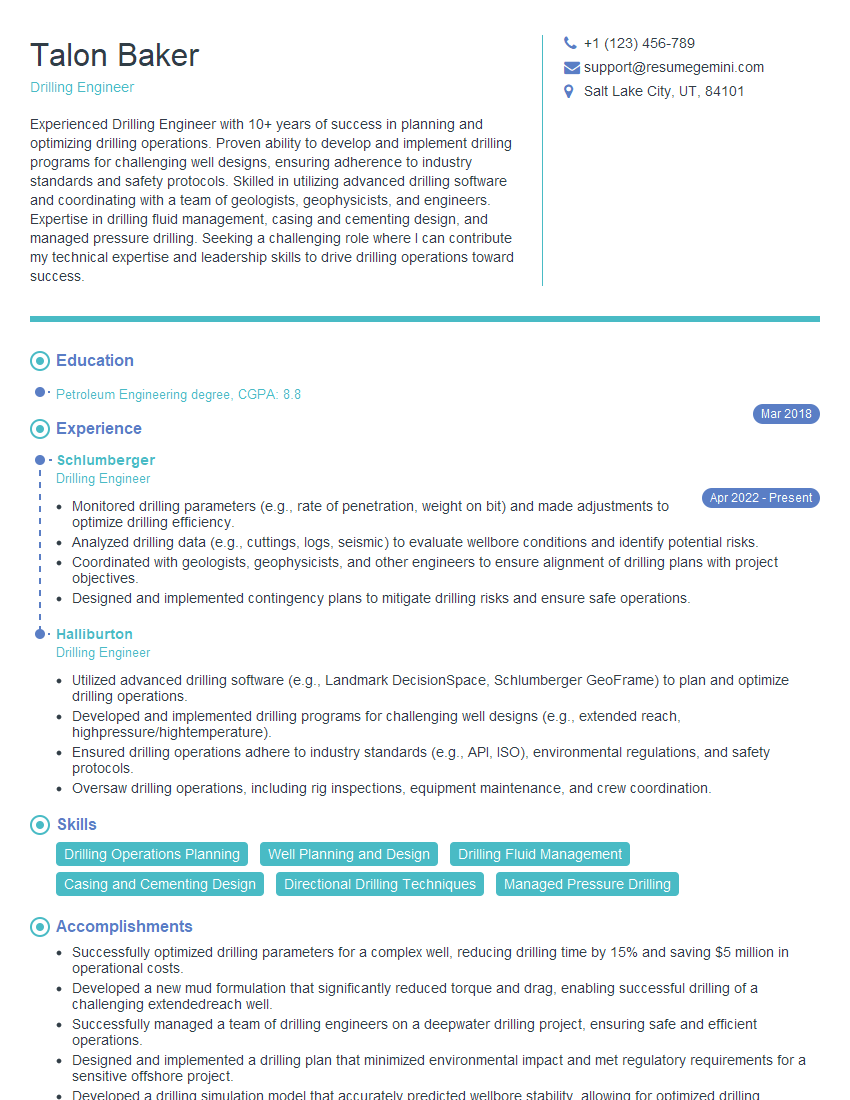
Mastering Wellbore Trajectory Modeling significantly enhances your prospects in the oil and gas industry, opening doors to advanced roles and higher earning potential. To stand out, create an ATS-friendly resume that highlights your skills and experience effectively. ResumeGemini is a trusted resource to help you build a professional and impactful resume. We provide examples of resumes tailored to Wellbore Trajectory Modeling professionals to guide you in crafting your own compelling application materials.


Explore more articles
Users Rating of Our Blogs
Share Your Experience
We value your feedback! Please rate our content and share your thoughts (optional).
What Readers Say About Our Blog
Very informative content, great job.
good