Interviews are opportunities to demonstrate your expertise, and this guide is here to help you shine. Explore the essential Wheel-to-wheel racing interview questions that employers frequently ask, paired with strategies for crafting responses that set you apart from the competition.
Questions Asked in Wheel-to-wheel racing Interview
Q 1. Describe your experience with different racing car setups and their impact on performance.
Racing car setups are incredibly nuanced, impacting performance significantly. Think of it like tailoring a suit – you need the right fit for optimal results. My experience spans various setups, from low-downforce configurations for high-speed tracks like Monza, emphasizing top speed, to high-downforce setups for twisty circuits like Monaco, prioritizing cornering grip.
For instance, adjusting the ride height alters the aerodynamic balance and affects mechanical grip. Lowering the car increases downforce but can reduce ground clearance and increase the risk of bottoming out. Conversely, a higher ride height offers more stability over bumps but sacrifices some downforce.
Similarly, changes to spring rates, damper settings, and anti-roll bars dramatically affect the car’s handling characteristics. Stiffer springs and dampers offer more control under braking and cornering but make the ride harsher, potentially impacting tire wear. Each track, and even the changing weather conditions within a race, demand a specific setup. I’ve found success by building a comprehensive understanding of these parameters and their interactions, using simulation and real-world testing to optimize performance.
Q 2. Explain the concept of slip angle and its influence on vehicle handling.
Slip angle is the angle between the direction a tire is pointing and the direction it’s actually traveling. Imagine driving a car straight and then gently turning the steering wheel; the tires are pointing in the direction of the turn, but the car initially continues to move somewhat straight. This slight difference is the slip angle.
A small slip angle generates a lateral force, allowing the car to turn. This is crucial for controlling the car’s trajectory. However, exceeding a certain slip angle (the tire’s grip limit) leads to tire slippage and loss of control—think of a tire spinning during hard acceleration or braking. Understanding and managing the slip angle through precise steering inputs, braking, and throttle control is critical for fast and controlled driving. We can visualize this like a skier carving – a slight angle of the skis creates grip and allows for a controlled turn; too great an angle, and they lose grip and slide.
Q 3. How would you analyze telemetry data to identify areas for improvement in car performance?
Telemetry data is a goldmine of information. Analyzing it systematically is key to improving car performance. My approach involves a multi-step process. Firstly, I look at lap times and sector times to identify areas where the car is losing time. Then, I dive deeper into individual channels – speed, acceleration, braking, steering angle, throttle position, gear selection, and tire temperatures.
For example, if a driver is consistently slow through a specific corner, I’ll analyze the steering angle, lateral acceleration, and slip angle data to determine if it’s due to a lack of grip, inefficient steering input, or an aerodynamic imbalance. I might see high tire temperatures indicating excessive slip or braking, hinting at setup changes or driver technique adjustments. I frequently use visualization tools to plot this data, helping me identify patterns and trends. This allows me to make data-driven decisions concerning suspension setup, aerodynamic modifications, and driver coaching.
Q 4. Discuss different tire strategies and their application in various racing conditions.
Tire strategy is a crucial element of racecraft. The choice of tire compounds and the timing of pit stops significantly influence the race outcome. Different compounds offer varying levels of grip and degradation rates. A soft compound provides excellent grip but wears out quickly, while a hard compound offers less initial grip but lasts longer.
In dry conditions, the strategy might involve starting with softer compounds for maximum initial pace, then switching to harder compounds to conserve tire life and manage degradation towards the end of the race. Conversely, in wet conditions, intermediate or wet-weather tires are crucial, with strategies adapting to changing track conditions. Data analysis, weather forecasts, and understanding the competitors’ tire strategies are all factored into these crucial decisions. The decision to run a one-stop or two-stop strategy will greatly impact the outcome.
Q 5. Explain the importance of aerodynamic balance in wheel-to-wheel racing.
Aerodynamic balance is paramount in wheel-to-wheel racing. It refers to the distribution of downforce across the front and rear axles. A well-balanced car offers predictable handling and allows the driver to exploit the car’s potential. An unbalanced car, with too much downforce on one axle, will be difficult to control, especially under braking or cornering, and prone to oversteer or understeer.
Imagine a seesaw: if the weight is unevenly distributed, it’s difficult to balance. Similarly, an aerodynamically imbalanced car will be unstable and unpredictable. Achieving balance requires careful design and adjustment of aerodynamic components such as wings, diffusers, and underbody elements. Fine-tuning the balance, often through adjustments to ride height and splitter angles, is often the difference between a competitive and a struggling car. It’s essential for ensuring stability and predictability, particularly during close racing.
Q 6. Describe your experience with different types of suspension systems and their impact on handling.
Suspension systems are the backbone of a racing car’s handling. I’ve worked extensively with various types, including double wishbone, pushrod, and pull-rod systems. Each type offers unique characteristics. Double wishbone suspensions, for example, provide excellent adjustability and are commonly used in Formula 1. Pushrod and pull-rod systems are favoured for their compactness and ability to manage suspension kinematics more efficiently.
The choice of spring rates, damper settings, and anti-roll bar stiffness all drastically impact the car’s handling. Stiffer springs provide more stability but can make the ride harsher, affecting tire wear and potentially upsetting the driver’s rhythm. Dampers control the rebound and compression of the suspension, influencing the car’s response to bumps and changes in road surface. Fine-tuning these parameters is critical to achieving a balance between handling agility and ride comfort. I tailor the suspension setup to each specific track and the individual driver’s preferences, often fine-tuning after testing sessions.
Q 7. How do you manage tire wear and degradation during a race?
Managing tire wear and degradation is crucial for maintaining performance throughout a race. This involves a combination of strategic driving techniques and data-driven decision-making.
Firstly, consistent driving is key. Aggressive driving leads to excessive tire wear, whereas smooth inputs and controlled driving minimize wear. This applies to accelerating, braking and cornering. Secondly, monitoring tire temperatures and pressures via telemetry is crucial. High temperatures indicate excessive wear, potentially requiring adjustments to driving style or strategy. Thirdly, using data to predict the rate of degradation allows for adjusting tire usage and strategizing pit stops. In certain instances, we might change driving lines or throttle application to mitigate wear on the specific tires under pressure. This balanced approach ensures optimal tire life and consistent performance throughout the race duration.
Q 8. What are the key factors you consider when developing a race strategy?
Developing a winning race strategy is a multifaceted process involving several crucial factors. It’s like orchestrating a symphony – every instrument (driver, car, team) must play in perfect harmony. The key elements include:
- Tire Strategy: Understanding tire degradation and track conditions is paramount. Will a one-stop strategy suffice, or do we need multiple pit stops? For example, in a race with high tire wear, a two-stop strategy might be optimal, focusing on shorter stints for maximum performance.
- Fuel Strategy: Balancing fuel load with performance is crucial. Heavier fuel loads slow down the car, but running out of fuel is disastrous. We use sophisticated models to predict fuel consumption based on track layout, weather, and driving style.
- Driver Performance: Knowing the driver’s strengths and weaknesses informs our decisions. Are they strong at overtaking? Do they manage tires well? Tailoring the strategy to the driver’s capabilities is essential.
- Competition Analysis: Studying the competitors’ performance, their tire and fuel strategies, and their usual driving patterns is critical to anticipating their moves and adjusting our own accordingly. We look for opportunities to overtake or defend against threats.
- Track Conditions and Weather: Unexpected weather changes can completely alter the race. Having contingency plans for various scenarios is critical. For instance, a sudden downpour might necessitate a quick pit stop for wet tires.
Ultimately, the strategy is a dynamic plan, constantly adjusted based on real-time data and on-track events.
Q 9. How would you approach a race with changing weather conditions?
Changing weather conditions are a significant challenge. We utilize multiple tools to tackle them. Firstly, we have access to advanced weather forecasting, providing predictions for the race duration. Secondly, we actively monitor the track temperature and conditions using dedicated sensors and onboard telemetry data from the car. This real-time feedback informs our decisions.
Our approach involves having pre-defined contingency plans. For example, if rain is predicted, we’ll prepare a strategy that includes extra pit stop time for tire changes and adjustments to the car’s setup. The car’s setup will be adjusted accordingly; for example, increased downforce for better grip in wet conditions and changes in the brake bias to aid stability. Communication with the driver is crucial – updating them about the changing weather and relaying adjusted strategy elements for the new conditions. We might even use different wet-weather tire compounds based on the intensity and duration of the rainfall.
Adaptability is key. We must be flexible and willing to modify the race strategy at any point based on weather information and race circumstances. It’s like navigating a ship in stormy waters – constant adjustment and vigilance are paramount.
Q 10. Explain your understanding of different braking systems and their impact on performance.
Braking systems are critical for safety and performance. We mainly use carbon-ceramic disc brakes in high-performance racing. These systems offer superior heat resistance compared to conventional steel brakes, allowing for consistent braking performance even under extreme stress.
- Carbon-Ceramic Brakes: These brakes provide exceptional stopping power and fade resistance. The carbon fiber material can handle much higher temperatures than steel, reducing brake fade. The downside is they are significantly more expensive.
- ABS (Anti-lock Braking System): ABS prevents wheel lockup during braking, enabling better control, especially on slippery surfaces. It’s a crucial safety feature, but in certain conditions, its intervention might slightly slow down the car.
- Brake Bias: This adjusts the braking force distribution between front and rear wheels. Fine-tuning brake bias is crucial for optimal handling and balance, especially when cornering at high speeds. It’s frequently adjusted based on track conditions and tire wear.
Proper braking system maintenance is vital. We regularly inspect brake pads, rotors, and calipers for wear and tear. A failure of the braking system can have catastrophic consequences. So, maintaining these systems with precision is crucial.
Q 11. Describe your experience with data acquisition systems and software.
Data acquisition systems (DAQ) are the backbone of modern motorsport. We employ sophisticated DAQ systems that collect hundreds of data points per second from various sensors throughout the car. These sensors monitor engine parameters (temperature, pressure, RPM), suspension settings, aerodynamic forces, tire pressures, and many more.
The data is then processed using specialized software such as MoTeC or similar platforms. This software provides real-time insights into car performance, allowing us to analyze and diagnose issues. We use the data for:
- Performance Analysis: Identifying areas for improvement in car setup, engine mapping, and driver technique.
- Predictive Maintenance: Detecting potential mechanical issues before they escalate.
- Race Strategy Optimization: Informing tire and fuel strategy decisions.
For example, if we notice a gradual decrease in tire pressure during a stint, we can alert the driver and adjust the driving style accordingly, or even plan for a strategic pit stop for tire changes. The software allows for visualization and analysis of all this data, generating graphs and reports that are essential in decision making.
Q 12. How would you troubleshoot a mechanical issue during a race?
Troubleshooting a mechanical issue during a race requires quick thinking and a systematic approach. The first step involves listening to the driver’s feedback. They are often the first to identify a problem. The driver might describe noises, vibrations, or changes in the car’s handling.
Once we’ve received a report, we use the telemetry data from the car to pinpoint the problem’s location and severity. For example, a sudden drop in oil pressure is a serious issue that needs immediate attention. This might indicate an engine problem, and a pit stop might be necessary.
Our troubleshooting process generally follows these steps:
- Identify the symptom: What is the driver reporting? What anomalies are observed in the telemetry data?
- Isolating the cause: Where is the problem occurring? Is it related to the engine, transmission, suspension, or other systems?
- Determining the severity: Is the problem serious enough to warrant a pit stop or can it be managed until the end of the race?
- Implementing a solution: This might involve adjustments to car settings, driver instructions, or a strategic pit stop for repairs.
Effective communication with the driver and pit crew is paramount during this process. Every second counts in a race.
Q 13. Describe your understanding of engine mapping and its impact on performance.
Engine mapping is the process of adjusting the engine’s control parameters to optimize performance for different conditions. Think of it like adjusting the carburetor of a vintage car, but done electronically and with much greater precision.
The engine management system (EMS) uses maps to determine the optimal amount of fuel and air to inject into the engine at various engine speeds (RPM) and throttle positions. These maps are created and adjusted using specialized software and dynamometer testing.
Impact on Performance:
- Power Output: Precise mapping can significantly improve power output throughout the RPM range.
- Fuel Efficiency: Optimizing the fuel-air mixture can improve fuel economy, enabling longer stints between pit stops.
- Drivability: Engine mapping influences the throttle response and overall smoothness of the engine, improving drivability.
- Emissions: In some racing categories, regulations dictate emission limits which engine mapping must take into account.
Modifying engine maps for different track conditions is critical. For example, a track with long straights might require a different map than a track with numerous tight corners, focusing on power versus torque optimization.
Q 14. How do you manage communication with the driver during a race?
Managing communication with the driver during a race is a crucial aspect of success. We use a combination of methods to maintain clear and efficient communication:
- Radio Communication: A dedicated radio system allows for real-time updates and instructions to the driver. We provide information on track conditions, competitor positions, and strategy adjustments.
- Telemetry Data: We constantly monitor the telemetry data, identifying any anomalies in car performance. This data informs our instructions to the driver, e.g., ‘Reduce throttle to manage tire wear’ or ‘Increase brake bias for the upcoming corner’.
- Pre-race Briefing: A thorough pre-race briefing covers expected track conditions, the planned strategy, and communication procedures. This minimizes ambiguity during the race.
- Clear and Concise Messaging: During the race, we avoid jargon and unnecessary details. Our communication needs to be crisp, clear, and actionable.
- Pitboard Messaging: During pit stops, pit boards display crucial information to the driver, often summarizing key strategy changes.
Good communication is a two-way street. We listen to the driver’s feedback and adjust our strategy accordingly. For example, if the driver reports a loss of grip, we might adjust the car’s setup or alter the tire strategy.
Q 15. How do you prioritize tasks under pressure during a race?
Prioritizing tasks under pressure in racing is akin to being a conductor of an orchestra, where every instrument (task) must play its part perfectly in sync. It’s about rapid assessment and decisive action. My approach is a three-step process:
- Immediate Needs First: The most critical task is always safety. If I’m losing control of the car, that becomes priority number one, even if it means losing position temporarily. This encompasses anything jeopardizing my safety or the safety of other drivers.
- Race Strategy Evaluation: Following safety, I assess the race strategy. This depends on factors like track conditions, the cars around me, and my current position. Am I in a position to attack? Should I conserve fuel and tires? Should I pit for new tires or a fresh fuel load?
- Dynamic Adaptation: The race is constantly evolving. Unexpected events like safety cars or mechanical issues can drastically change the priority list. I constantly monitor the situation and adjust my focus accordingly. For example, a sudden downpour demands immediate adjustment to driving style and tire management.
One time, I was battling for second position, pushing hard to close the gap to the leader. Suddenly, a safety car was deployed. My immediate priority switched to safely navigating the slower pace and maintaining proper car spacing rather than pushing for that position. When racing resumed, I was able to use my careful driving during the safety car period to plan a successful attack.
Career Expert Tips:
- Ace those interviews! Prepare effectively by reviewing the Top 50 Most Common Interview Questions on ResumeGemini.
- Navigate your job search with confidence! Explore a wide range of Career Tips on ResumeGemini. Learn about common challenges and recommendations to overcome them.
- Craft the perfect resume! Master the Art of Resume Writing with ResumeGemini’s guide. Showcase your unique qualifications and achievements effectively.
- Don’t miss out on holiday savings! Build your dream resume with ResumeGemini’s ATS optimized templates.
Q 16. Explain your understanding of fuel consumption strategies in racing.
Fuel consumption strategy is paramount in endurance racing, where every drop counts. It’s a complex dance between maximizing speed and minimizing fuel usage.
We analyze numerous factors:
- Track Characteristics: Some circuits require more aggressive braking and acceleration, consuming more fuel. We tailor the strategy based on this.
- Weather Conditions: Headwinds, temperature changes, and humidity affect fuel efficiency. Real-time data is used to adjust our consumption plans.
- Driving Style: Smooth driving, minimizing unnecessary acceleration and braking, drastically improves fuel economy. We aim for a consistent pace rather than short bursts of speed.
- Car Setup: Aerodynamics play a key role. Adjusting wing angles or ride height will subtly alter fuel consumption.
- Race Length and Position: A longer race will necessitate a more conservative strategy, whereas a shorter one allows for greater risk-taking. If we’re leading, we may consider using more fuel to maintain a gap. If we’re behind, we might try fuel-saving techniques.
For example, in a long-distance race, a predictive model, incorporating all the above factors, would be used to determine ideal fuel-saving techniques for various parts of the race. We might employ different fuel-saving techniques based on the race phase (initial laps, mid-race, or end-phase). We need to take into account the performance of the competitor and also our own tyre degradation strategy. In practice it’s a dynamic process that changes based on race events.
Q 17. What are some common causes of accidents in wheel-to-wheel racing?
Accidents in wheel-to-wheel racing stem from a multitude of factors, often a combination rather than a single cause:
- Driver Error: This is the most common factor, encompassing misjudgment of distance, braking points, or car behavior under stress. Overconfidence and pushing too hard also contribute significantly.
- Mechanical Failures: Tire punctures, brake failures, or steering problems can lead to sudden loss of control. Regular vehicle checks and maintenance are crucial for preventing such issues.
- Track Conditions: Oil spills, debris, or changing weather conditions (rain, especially) significantly alter traction and can cause loss of control, creating a domino effect for nearby drivers.
- Contact Between Cars: Close racing is inherent to the sport, but aggressive overtaking maneuvers without leaving enough space can easily lead to collisions.
- Inadequate Racing Lines: Drivers taking inappropriate racing lines can cause a risk for others.
It is important to remember that often, accidents arise from a complex interplay of these factors. For example, a driver might misjudge a braking point on a wet track, leading to a collision because the track conditions compromised the driver’s perception of speed and distance.
Q 18. How do you mitigate the risks of accidents?
Mitigating accident risks is a holistic approach comprising several strategies:
- Defensive Driving: This involves anticipating the actions of other drivers, maintaining a safe following distance, and avoiding unnecessary risks. It’s about protecting your own space and limiting exposure to potential collisions.
- Car Setup and Maintenance: A well-maintained car with optimal setup is less likely to encounter mechanical failures. Rigorous checks before every race are essential.
- Track Awareness: Knowing the track inside and out allows for better prediction of other drivers’ movements and helps anticipate potential hazards.
- Driver Fitness and Mental Preparedness: Being physically and mentally prepared reduces the chances of errors caused by fatigue or stress.
- Communication: Good communication with the team and fellow drivers enables early identification of potential problems.
For instance, before a race, I always review track data, analyzing corners with a history of incidents. I would also adjust my driving style based on weather conditions, ensuring I’m not pushing the car beyond its limits in tricky circumstances.
Q 19. How do you ensure effective pit stops?
Effective pit stops hinge on seamless teamwork and precise execution. Every second counts, and a poorly executed stop can cost valuable time and position. The key elements are:
- Pre-planned Strategy: Before the race, a detailed plan outlining tire changes, fuel loads, and other necessary adjustments is developed based on race progress and real-time analysis of the tyres and fuel usage.
- Crew Training and Coordination: The pit crew must be highly trained and perfectly synchronized in their actions. Clear communication and practiced routines are crucial.
- Equipment Reliability: Well-maintained equipment, from tire guns to fuel hoses, ensures smooth and rapid execution. This also includes having backup equipment in case of unexpected failure.
- Driver Consistency: A clean and precise entry and exit from the pit lane is vital to avoid time loss and risks to safety. The driver must adhere to the predefined procedure.
- Post-Pit Analysis: After each pit stop, a thorough review is conducted to identify any areas for improvement, however minor they might be.
A well-executed pit stop can significantly alter the outcome of a race; on numerous occasions I’ve seen a well-timed and efficient pit stop allow a team to overtake competitors through improved fuel efficiency and speed.
Q 20. Describe your experience with different types of race tracks.
My experience encompasses a diverse range of tracks, each presenting unique challenges:
- High-Speed Ovals: These demand exceptional car control and precision at extremely high speeds. Maintaining focus for extended periods under high-g forces is critical. Here, consistency of speed and keeping the car close to the racing line is paramount.
- Technical Street Circuits: These circuits have many corners and often narrow track width, demanding precise braking points, smooth steering inputs, and adept traffic management. Racecraft and car control are most important here.
- Fast and Flowing Circuits: These circuits, often wider, prioritize speed and car balance, requiring an aggressive driving style without losing control. A better understanding of aerodynamics plays an important role here.
Each track demands a unique approach. I adapt my driving style and car setup to optimize performance based on these characteristics. I’ve experienced that adapting quickly and learning the nuances of each circuit is one of the keys to success.
Q 21. What are your preferred methods for driver feedback analysis?
Driver feedback analysis is crucial for identifying areas for improvement in both driving technique and car setup. My preferred methods involve:
- Data Logging and Telemetry: This provides objective measurements of speed, acceleration, braking, steering, and other parameters, allowing for a precise assessment of my performance and the car’s response across various aspects of the car.
- Post-Race Debriefing: Detailed discussions with engineers and crew members allow us to analyze data alongside subjective observations, gaining a complete picture of the race.
- Onboard Camera Footage: Watching onboard footage allows me to objectively evaluate my racing line, braking points, and car control, pointing out any subtle errors that might be missed from pure telemetry data.
- Simulators and Training: Simulators help replicate various track conditions and enable extensive testing of different strategies and driving techniques in a controlled environment.
By combining quantitative data from sensors with qualitative feedback from visual aids and discussions, we can develop a more comprehensive understanding of strengths and weaknesses, both with the driver and the car.
Q 22. Describe your familiarity with different racing regulations.
My familiarity with racing regulations spans various series, from Formula 1 to IndyCar and even endurance championships like the WEC. I understand the intricacies of technical regulations, sporting regulations, and the judicial processes involved. Technical regulations govern car design, focusing on areas like aerodynamics, engine specifications, and safety features. For example, the FIA’s detailed aerodynamic regulations in Formula 1 aim to balance performance and prevent excessive downforce, influencing car design significantly. Sporting regulations dictate the format of a race, qualifying procedures, and penalties for infractions. Understanding these nuances is crucial for strategizing and ensuring compliance. Finally, I’m well-versed in the judicial aspect, which involves understanding the process of appeals and penalties for rule violations.
- Technical Regulations: These dictate things like minimum weight, engine capacity, and allowed materials.
- Sporting Regulations: These cover race procedures, driver conduct, and penalty systems.
- Judicial Processes: Understanding how appeals and investigations are handled is critical for fair competition.
Q 23. How do you handle driver errors and their impact on race strategy?
Driver errors are inevitable in racing. My approach involves a multi-faceted strategy. First, post-race analysis is critical. We review telemetry data, onboard footage, and driver feedback to pinpoint the exact cause and context of the error. Was it a mistake in braking, cornering, or judgment? Understanding the root cause allows for targeted solutions. Second, we adapt the race strategy. A driver error might necessitate a pit stop for repairs or tire changes, altering our initial plan. Third, we focus on driver coaching. This is a crucial aspect; we analyze the error with the driver, reinforcing good technique and discussing preventative measures. We might adjust driver aids or practice specific scenarios to mitigate future mistakes. Finally, we consider the broader impact on the race. For instance, an early race error might require a more aggressive or conservative strategy to recover lost ground.
For example, imagine a driver locking up their brakes and causing a spin. We would analyze the telemetry to determine if it was due to brake bias, track conditions, or simply driver error. Then, we might adjust the brake bias for future laps, coach the driver on smoother braking techniques, and revise our fuel strategy based on the time lost.
Q 24. Explain your understanding of vehicle dynamics simulation software.
Vehicle dynamics simulation software is an indispensable tool in modern motorsport. Software packages like rFpro, iRacing, and others allow us to model vehicle behavior in a virtual environment. This includes modeling various factors like tire behavior, aerodynamics, suspension characteristics, and powertrain performance. This virtual testing is cost-effective and time-efficient, allowing us to simulate a vast range of conditions and setups impossible to replicate during physical testing. We use these tools for things like:
- Setup optimization: We can simulate different suspension geometries, aerodynamic configurations, and tire pressures to find the optimal setup for various track conditions.
- Driver training: Simulators provide a safe and controlled environment for drivers to practice and improve their skills, especially in high-risk situations.
- Component development: We can test new parts, like wings or suspension components, virtually before committing to manufacturing and physical testing.
Example: Using simulation software, we might discover that increasing the front ride height by 5mm improves stability in high-speed corners, and then we would validate this on the track.
Q 25. How do you manage team dynamics and communication within a racing team?
Managing team dynamics is paramount to success. Effective communication is the cornerstone. We use daily briefings, technical meetings, and debriefs after each session to foster open dialogue and ensure everyone is on the same page. Clear roles and responsibilities are defined, preventing confusion and overlap. Open communication channels – such as Slack or dedicated team messaging systems – are crucial for quick information sharing and issue resolution during a race. Fostering a collaborative environment, where everyone feels valued and respected, is key to team morale and performance. We also actively identify and address conflicts promptly and fairly. We use regular feedback sessions to identify areas for improvement, both individually and as a team. This iterative process helps us to improve our processes and become more efficient.
Q 26. Describe a time you had to make a quick, critical decision under pressure during a race.
During a crucial endurance race, with just an hour remaining, our lead car suffered a sudden loss of power. The initial diagnosis pointed to a potential engine failure – a catastrophic outcome. Under immense pressure, I had to decide between continuing to race (risking total engine failure) and immediately pitting for a potentially lengthy repair, which would mean certain loss. After reviewing real-time telemetry data and consulting with the team’s chief mechanic, I assessed the risk and made the call to pit immediately. While we lost several positions, the mechanics identified a relatively minor fuel pump issue. A swift repair allowed us to rejoin the race and actually finish in a respectable position. This decision highlights the importance of clear communication, quick analysis, and calculated risk assessment under intense pressure.
Q 27. How would you improve the performance of a car struggling with understeer or oversteer?
Understeer (the car refusing to turn) and oversteer (the rear end sliding out) are common handling issues. Addressing them involves a systematic approach.
Understeer: This often indicates a lack of front-end grip. Solutions include:
- Reduce front ride height: Lowers the car’s center of gravity, increasing downforce on the front.
- Increase front anti-roll bar stiffness: Reduces body roll, enhancing grip.
- Soften rear springs: Transfers more weight to the front.
- Adjust brake bias to the rear: Improves rear grip.
Oversteer: This indicates too much rear grip or too little front grip. Solutions include:
- Increase rear ride height: Reduces rear downforce.
- Reduce rear anti-roll bar stiffness: Allows more body roll, improving weight transfer.
- Stiffer front springs: Improves front grip.
- Adjust brake bias to the front: Improves front braking and grip.
Note that these are general adjustments. Optimal solutions require detailed analysis using telemetry and simulation software, considering factors like track conditions and tire compounds.
Q 28. What are your future goals and aspirations in the field of wheel-to-wheel racing?
My future goals revolve around contributing to a winning team and pushing the boundaries of wheel-to-wheel racing. I aspire to lead a team through a championship season, leveraging my expertise in strategy, technology, and team management to achieve consistent top-tier results. I’m keen on exploring advanced technologies like AI-powered race strategy optimization and advanced simulation techniques to improve our competitive edge. Ultimately, I aim to leave a lasting impact on the sport, mentoring future generations of engineers and strategists while consistently striving for excellence.
Key Topics to Learn for Wheel-to-Wheel Racing Interviews
- Race Strategy & Tactics: Understanding various race strategies, including overtaking techniques, defensive driving, pit stop strategies, and fuel management. Consider the practical application of these strategies in different racing conditions (e.g., wet weather, track degradation).
- Car Setup & Engineering: Knowledge of vehicle dynamics, suspension tuning, tire selection, and aerodynamic principles. Be prepared to discuss how these elements impact performance and driving style.
- Data Analysis & Performance Optimization: Understanding telemetry data, analyzing lap times, identifying areas for improvement, and using data-driven insights to optimize performance. Practice explaining your approach to problem-solving using this data.
- Teamwork & Communication: Effective communication with engineers, crew chiefs, and fellow drivers. Discuss your experience working collaboratively in a high-pressure environment and your ability to contribute to a team’s success.
- Safety Procedures & Regulations: A comprehensive understanding of safety regulations, race procedures, and emergency protocols. Explain your awareness and commitment to safety in all aspects of racing.
- Driving Skills & Experience: Be ready to discuss your experience, highlighting specific achievements, challenges overcome, and skills honed through various racing experiences. Focus on quantifiable results whenever possible.
- Adaptability & Problem-Solving: Wheel-to-wheel racing presents unexpected challenges. Be prepared to discuss your ability to adapt to changing conditions, make quick decisions under pressure, and troubleshoot technical issues effectively.
Next Steps
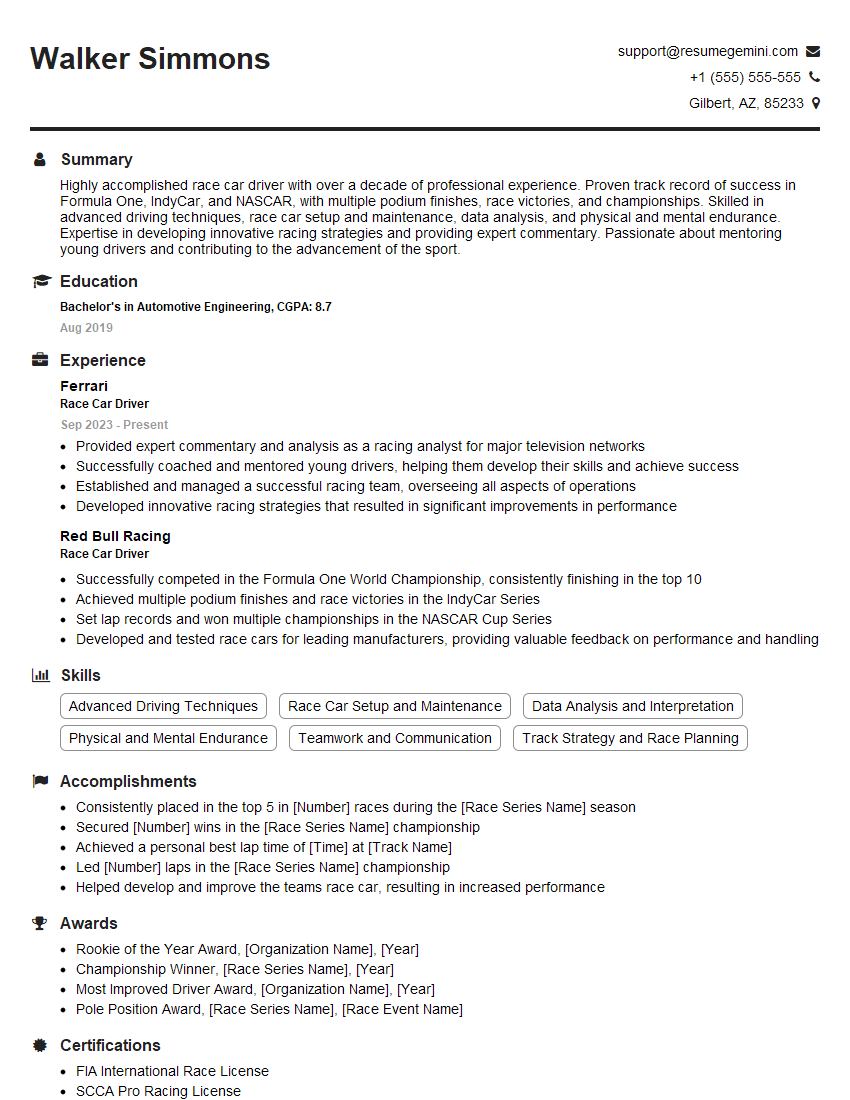
Mastering the intricacies of wheel-to-wheel racing significantly enhances your career prospects in this dynamic and competitive field. A strong understanding of the technical aspects, combined with excellent teamwork and communication skills, sets you apart from other candidates. To maximize your chances of landing your dream role, creating an ATS-friendly resume is crucial. ResumeGemini is a trusted resource that can help you build a compelling and effective resume, showcasing your skills and experience in the best possible light. ResumeGemini provides examples of resumes tailored to the wheel-to-wheel racing industry, offering valuable guidance and templates to help you present yourself professionally and effectively.
Explore more articles
Users Rating of Our Blogs
Share Your Experience
We value your feedback! Please rate our content and share your thoughts (optional).
What Readers Say About Our Blog
Very informative content, great job.
good