Unlock your full potential by mastering the most common Winch Operations interview questions. This blog offers a deep dive into the critical topics, ensuring you’re not only prepared to answer but to excel. With these insights, you’ll approach your interview with clarity and confidence.
Questions Asked in Winch Operations Interview
Q 1. Describe your experience with different types of winches (e.g., electric, hydraulic, manual).
My experience encompasses a wide range of winch types, each with its own advantages and applications. I’ve worked extensively with electric winches, appreciating their ease of control and precise speed adjustments, ideal for delicate lifting operations. For heavier-duty tasks requiring high pulling power and speed, hydraulic winches are my go-to; they excel in demanding environments and can handle significant loads. I also possess hands-on experience with manual winches, understanding their value in situations where power sources are unavailable or where precision control is paramount, especially during rescues or in confined spaces. Each type requires a unique understanding of its capabilities and limitations. For instance, while electric winches offer precise control, they might lack the sheer power of a hydraulic system. Similarly, manual winches require significant physical exertion but provide a reliable backup when other systems fail.
Q 2. Explain the process of pre-operational checks for a winch system.
Pre-operational checks are crucial for ensuring safe and efficient winch operation. My standard procedure involves a methodical inspection of the entire system. This begins with a visual inspection of the winch itself, checking for any visible damage to the drum, cable, housing, or any other component. I then carefully examine the winch line (cable or rope) for fraying, kinks, or damage, and check its length and connection to the drum. Next, I verify the proper functioning of the brake system, ensuring it engages smoothly and securely holds the load. The power source (electric or hydraulic) is checked for sufficient power and proper connection. Finally, I assess the overall rigging setup; ensuring the anchorage points are secure, and the load is properly balanced and attached. This systematic approach greatly reduces the risk of accidents.
Q 3. What are the common safety hazards associated with winch operations?
Winch operations present several inherent safety hazards. Crushing hazards from the moving winch line or load are significant risks, requiring careful planning and observation. Entanglement in the winch line or rigging is another major concern; proper personal protective equipment (PPE) including gloves and safety glasses is always mandatory. Overloading the winch beyond its safe working load (SWL) can result in catastrophic failure of the winch or rigging components. Electrocution is a risk with electric winches, especially in wet conditions. Pinch points exist between moving parts of the winch, and proper training is crucial to avoid injuries. Finally, unexpected slippage of the winch line can cause sudden movement of heavy loads. A good safety program and adherence to best practices can significantly mitigate these risks.
Q 4. How do you calculate the safe working load (SWL) of a winch?
The safe working load (SWL) of a winch isn’t calculated but rather specified by the manufacturer. It represents the maximum load the winch can safely lift or pull without risking structural damage or failure. The SWL is typically found on a data plate affixed to the winch. It’s crucial to never exceed this limit. Factors such as the angle of pull, condition of the winch line, and environmental conditions (e.g., extreme temperatures) can further affect the effective SWL; reducing the maximum load to ensure safety. Therefore, always operate with a significant safety factor, ensuring the actual load is well below the SWL.
Q 5. Describe your experience with different types of winch lines and their applications.
My experience includes working with various winch lines, each selected based on the specific application. Wire ropes offer high strength and durability, suitable for heavy lifting and demanding environments, but require regular inspection for wear and corrosion. Synthetic fiber ropes (e.g., nylon, polyester) provide good strength-to-weight ratio, and are more flexible and less prone to kinking than wire ropes, making them suitable for applications requiring maneuverability. However, they are susceptible to UV degradation and abrasion. The choice depends on factors like load capacity, required flexibility, the environment, and the type of load being handled. In some applications, specialist lines like those made with high-strength materials are needed for specific loads.
Q 6. How do you handle a winch malfunction during operation?
Winch malfunctions require immediate and decisive action. My first step is to immediately disengage the power source and apply the emergency brake. This is paramount to prevent further damage or accidents. Next, I assess the nature of the malfunction. If it’s a minor issue, such as a jammed cable, I will attempt to resolve it following safety procedures, perhaps with a colleague’s assistance. However, for significant problems, such as a mechanical failure, I’ll immediately shut down the operation, secure the load, and contact maintenance personnel. Under no circumstances would I attempt repairs without proper training and authorization. Safety is always the top priority. A detailed log of the malfunction and its resolution is always recorded.
Q 7. Explain the importance of proper rigging techniques in winch operations.
Proper rigging techniques are fundamentally important for safe and effective winch operations. They ensure that the load is properly balanced and securely attached to the winch line and to its supporting structure. Incorrect rigging can lead to loads shifting, unbalanced loads, and potentially catastrophic failure of the winch or supporting structure. The angle of the pull is crucial, and should generally be as close to vertical as possible to minimize stress on the winch and rigging components. Using proper shackles, slings, and other lifting equipment, correctly sized and rated for the load, is paramount. Ensuring sufficient anchor points with appropriate strength is just as important as proper hitching to prevent slippage. Poor rigging techniques can easily lead to accidents.
Q 8. What are the different types of winch brakes and how do they function?
Winch brakes are crucial for controlled lowering and holding loads. There are several types, each with its own mechanism:
- Mechanical Brakes: These are typically drum brakes, similar to those in a car. They use friction to slow or stop the drum’s rotation. A lever or handle engages the brake shoes against the drum. They’re simple, reliable, and require minimal maintenance but can be prone to wear and tear over time. A common example is a jaw clutch brake.
- Hydraulic Brakes: These use hydraulic pressure to actuate brake shoes or a band. They offer smoother operation and greater braking force than mechanical brakes, particularly useful for heavier loads. Hydraulic systems are more complex, requiring regular fluid checks and maintenance.
- Electric Brakes: These employ electric motors or solenoids to engage the brake mechanism. They often offer precise control and can be integrated with other winch systems for automated operation. Electric brakes are also used in conjunction with other systems like dynamic braking.
- Dynamic Brakes: These aren’t strictly brakes, but use the motor itself to create resistance, slowing the drum’s rotation by utilizing the motor as a generator. They are often used in conjunction with other braking systems to provide additional control and reduce wear on the mechanical brakes. They’re particularly effective in controlling descent speed on heavier loads.
The choice of brake type depends on factors such as load capacity, operating environment, and required level of control. For instance, a heavy-duty crane might utilize a combination of hydraulic and dynamic braking for optimal safety and efficiency.
Q 9. How do you assess the condition of winch components (e.g., drums, gears, cables)?
Assessing winch component condition is paramount for safety. My inspection process involves a thorough visual check, combined with hands-on evaluation:
- Drums: I check for any signs of damage like cracks, gouges, or excessive wear on the drum surface. I also inspect the drum flanges for wear or damage, and ensure it rotates freely. I’d carefully look at the drum’s diameter to ensure it’s uniform.
- Gears: I look for signs of wear, damage, or stripped teeth. I check for smooth operation and proper meshing of the gears. A loose or damaged gear is a significant safety hazard.
- Cables: This is critical. I examine the cable for kinks, frays, broken wires, or corrosion. I measure the cable diameter at various points to detect thinning. I also check the cable ends for proper termination and secure attachment to the drum.
- Brake System: I thoroughly inspect the brake mechanism, checking for wear on brake shoes or linings, proper function of linkages and hydraulic systems (if applicable), and adequate braking force. I’ll always manually test brakes to check for proper stopping and holding power.
Beyond visual inspection, I may use specialized tools like a cable tester to measure the remaining strength of the cable or a torque wrench to verify proper tension on bolts and fasteners. Documentation of findings is crucial for maintaining records and ensuring compliance with safety regulations.
Q 10. Describe your experience with load monitoring and tension control systems.
I have extensive experience with various load monitoring and tension control systems. These systems are essential for ensuring safe and efficient winch operations, especially with heavy or delicate loads. My experience includes:
- Load Cells: These devices measure the tension in the cable, providing real-time feedback to the operator. I’m familiar with different types, including strain gauge and hydraulic load cells, selecting the appropriate one based on load capacity and accuracy requirements.
- Tension Indicators: These provide a visual indication of cable tension, often incorporating analog or digital displays. They’re valuable for monitoring tension during operations and preventing overloading.
- Automated Tension Control Systems: I’ve worked with systems that automatically adjust winch speed to maintain a predetermined load tension. These systems utilize load cells and feedback mechanisms to adjust the winch’s speed to ensure smooth, controlled operations. These systems are critical for applications that require precise load tension, such as those involving delicate materials.
In one project involving the installation of a large communication tower, we used a sophisticated automated tension control system to maintain precise tension on the guy wires during hoisting. This prevented damage to the structure and ensured a safe and efficient installation process.
Q 11. How do you ensure the stability of a load during winch operations?
Ensuring load stability during winch operations requires a multi-faceted approach:
- Proper Rigging: Using correctly sized and rated rigging equipment (slings, shackles, etc.) is crucial. I always inspect rigging thoroughly before each operation and ensure it’s appropriate for the load and environment.
- Controlled Winch Operation: Smooth, gradual movements are key to avoiding sudden jerks or swings that could destabilize the load. This requires experienced operators skilled in using the winch controls. I always emphasis the importance of a well-trained and practiced team.
- Proper Load Distribution: Ensure the load is evenly distributed and balanced to minimize the risk of swinging or tilting. For unusually shaped or heavy loads, I would use additional support or rigging techniques.
- Environmental Factors: Consider weather conditions (wind, rain, etc.) that might affect load stability. I often use additional securing measures or postpone operations if weather conditions are unfavorable.
- Tapered or multiple lines: For particularly large and/or heavy loads, the use of multiple lines or a tapered line approach is crucial to ensure even load distribution and prevent excessive stress on a single winch or line. This minimizes risks of failure and increases safety.
For instance, when lifting a heavy transformer, I’d utilize multiple slings and carefully position them to distribute the weight evenly. I’d also ensure that the winch operation is slow and controlled to avoid any sudden movements.
Q 12. What are the emergency procedures to follow in case of a winch accident?
Emergency procedures are critical for mitigating the risks associated with winch accidents. My response would be based on the specific nature of the accident, but generally includes:
- Immediate Stop: The first and most critical step is to immediately stop the winch operation. This often involves activating emergency brakes or power shut-off.
- Assess the Situation: Determine the extent of the damage and any injuries. Ensure the safety of personnel in the area.
- Secure the Load: If the load is unstable or poses a threat, take steps to secure it to prevent further movement or damage. This might involve using additional rigging or securing mechanisms.
- First Aid and Emergency Services: If there are injuries, provide first aid and contact emergency medical services immediately. The well-being of my team is my top priority.
- Investigation and Reporting: After the immediate emergency, a thorough investigation is crucial to determine the root cause of the accident. Comprehensive documentation and reporting to relevant authorities are essential.
In a scenario where a cable snaps during a lift, I would immediately shut down the winch, assess the situation for personnel injuries, and then cautiously secure the load to prevent it from falling. I’d then initiate an accident investigation and report.
Q 13. Explain your understanding of load charts and their importance.
Load charts are essential documents that specify the safe operating limits of a winch. They provide information such as:
- Maximum Load Capacity: The maximum weight the winch can safely lift or lower.
- Line Pull: The force the winch can exert on the cable at different drum speeds.
- Cable Diameter and Length: The appropriate cable diameter and length for different loads. Different cable types have different strength characteristics.
- Safety Factors: The factors applied to ensure a margin of safety beyond the maximum load capacity.
Load charts are crucial for preventing overloading, which can lead to catastrophic equipment failure or injury. I always consult the load chart before any winch operation to ensure that the winch and rigging are suitable for the specific load, and I ensure that all team members involved are familiar with the chart.
Ignoring load charts can result in serious accidents, and it is important to ensure that the operator is trained to understand these documents and make sure they are readily available for each operation.
Q 14. What is your experience with different types of anchoring systems for winches?
My experience encompasses various anchoring systems, selected based on the specific application and load requirements:
- Deadmen Anchors: These are often used in soil or earth, driven into the ground to provide a secure anchor point. The suitability of a deadman anchor will depend on ground conditions and load requirements.
- Concrete Anchors: These are poured in concrete and offer a strong and permanent anchor point, ideal for stationary winches. Their implementation requires careful planning and execution.
- Tree Anchors: These utilize sturdy trees as anchor points, but careful assessment of tree health and strength is necessary to prevent damage or failure. This method should only be used when appropriate, with consideration of the tree’s condition and the load being supported.
- Vehicle Anchors: Winches can be anchored to vehicles, but this requires suitable attachment points and consideration of the vehicle’s weight and stability. I’d always make sure to use appropriate straps and ensure the vehicle is properly braced to prevent shifting.
- Rock Anchors: These can be used when solid rock is available. Specialized equipment and techniques are often required for effective rock anchoring.
The selection of the anchoring system is critical; a poorly chosen anchor can lead to catastrophic winch failure. My approach always starts with a careful assessment of the site, considering soil conditions, load requirements, and available anchoring resources.
Q 15. How do you handle different environmental conditions (e.g., extreme weather) during winch operations?
Operating a winch in adverse weather demands meticulous planning and execution. Safety is paramount. My approach involves a layered strategy. First, a thorough risk assessment is conducted, considering wind speed, precipitation, temperature, and visibility. This assessment guides the selection of appropriate safety equipment—for example, specialized gloves for icy conditions, waterproof clothing, and potentially delaying operations until conditions improve. Second, we utilize weather monitoring tools, continually checking forecasts to anticipate shifts in weather patterns. Third, we implement specific operational adjustments. In high winds, for instance, we might reduce the load or use additional securing lines for stability. Heavy rain might necessitate slower winch speeds to maintain control and prevent slippage. Finally, a clear communication protocol among the winch operator, spotter, and anyone else in the vicinity is vital. This ensures everyone is aware of the changing conditions and any necessary adjustments to procedures.
For example, during a recent project involving lifting heavy equipment in a blizzard, we reduced our operating speed by 50% and added an extra safety line to mitigate the increased risk of the load swinging uncontrollably in the strong winds. Continuous communication ensured the team was constantly aware of the potential hazards and the changing circumstances. We successfully completed the lift without incident.
Career Expert Tips:
- Ace those interviews! Prepare effectively by reviewing the Top 50 Most Common Interview Questions on ResumeGemini.
- Navigate your job search with confidence! Explore a wide range of Career Tips on ResumeGemini. Learn about common challenges and recommendations to overcome them.
- Craft the perfect resume! Master the Art of Resume Writing with ResumeGemini’s guide. Showcase your unique qualifications and achievements effectively.
- Don’t miss out on holiday savings! Build your dream resume with ResumeGemini’s ATS optimized templates.
Q 16. Describe your experience with winch maintenance and troubleshooting.
Winch maintenance is not just about prolonging its lifespan; it’s about ensuring safety. My experience encompasses preventative maintenance, including regular inspections of the drum, cable, brakes, and motor. I meticulously check for wear and tear, frayed cables, and any signs of damage. I follow the manufacturer’s recommended maintenance schedules, documenting all inspections and repairs. Troubleshooting involves systematic problem-solving. If the winch malfunctions, I first identify the problem using diagnostic tools and then determine the root cause. This might involve checking power supply, brake functionality, or cable integrity. I’m proficient in diagnosing issues such as cable slippage, brake failure, and motor malfunctions. I am familiar with various winch types and their specific maintenance requirements, including hydraulic, electric, and manual winches.
For instance, during a project, the winch suddenly stopped responding. Through a methodical process of elimination, I discovered a faulty connection in the power supply. A simple repair resolved the issue, preventing a costly and time-consuming delay.
Q 17. What are the legal requirements and regulations surrounding winch operations?
Winch operations are subject to stringent safety regulations, varying depending on location and industry. These regulations often cover aspects such as operator certification, equipment inspection and maintenance requirements, load capacity limits, and safety procedures. Understanding and complying with these regulations is crucial. For example, OSHA (in the US) or equivalent agencies in other countries set forth detailed standards for winch operation in construction, industrial, and other settings. These regulations often mandate regular inspections, operator training, and the use of appropriate safety equipment. Furthermore, regulations often specify load limits and the use of safety devices, such as load indicators and emergency brakes. Non-compliance can result in hefty fines and potential legal action.
A good understanding of the relevant regulations is crucial. Regular updates on these requirements are also necessary to ensure compliance at all times. This includes understanding local and industry-specific codes and guidelines that may supplement or amend general regulations.
Q 18. Explain your experience with communication protocols during winch operations.
Effective communication is the bedrock of safe winch operations. I utilize clear, concise, and standardized communication protocols, typically incorporating visual and auditory signals. These protocols are pre-determined and clearly understood by all team members. Before any operation commences, the team will review the task, clarify roles, and establish the communication methods. During operation, hand signals, radio communication, and visual indicators (e.g., lights) are employed to coordinate actions and ensure everyone is aware of the winch’s status and the load’s position. These protocols help prevent miscommunication, a leading cause of accidents.
For instance, a specific hand signal would indicate a request to stop the winch, while a different one would signal a need to increase or decrease the winch speed. Radio communication is used for relaying longer messages or providing updates.
Q 19. Describe your experience working with a team in a winch operation setting.
Teamwork is crucial in winch operations. My experience emphasizes collaboration, clear roles, and mutual respect. I believe in fostering a culture of open communication where everyone feels comfortable raising concerns or suggesting improvements. Each team member has a defined role – the winch operator, the spotter, and possibly others depending on the complexity of the operation. Before any lift, we conduct a thorough briefing to confirm understanding of the plan and to address any potential challenges. During operations, constant communication and coordinated actions ensure safe and efficient progress. I actively participate in team briefings and debriefings, ensuring lessons learned are shared and incorporated into future operations.
In one particular instance, a team member spotted a potential cable snag, alerting the operator to stop the winch, preventing a potentially dangerous incident. This collaborative effort highlights the value of clear communication and teamwork in ensuring safety and success.
Q 20. How do you manage multiple tasks and priorities while operating a winch?
Managing multiple tasks while operating a winch requires strong organizational skills and the ability to prioritize effectively. I employ a systematic approach, starting with a clear understanding of the overall goals and breaking down the tasks into manageable steps. This might involve prioritizing immediate safety concerns, coordinating with other team members, monitoring equipment performance, and managing the progress against the schedule. Time management and attention to detail are crucial to avoid errors. I frequently use checklists and other tools to help track progress and ensure no steps are missed. The ability to adapt to changing priorities is vital; unexpected issues will require immediate attention and a recalibration of plans.
For instance, I may need to simultaneously monitor the winch’s tension, communicate with the spotter, and watch for any unforeseen obstacles. Prioritizing these tasks based on risk and urgency ensures efficient and safe operation. The use of a checklist ensures that all pre-operation checks are completed and prevents errors due to oversight.
Q 21. What are your problem-solving skills when dealing with unexpected challenges during winch operations?
Problem-solving during unexpected challenges requires a calm, methodical approach. My strategy centers around a structured process: first, identifying the problem and assessing its severity; second, gathering information to understand the root cause; and third, developing and implementing a solution. This may involve adapting existing procedures, improvising, or seeking assistance from colleagues or supervisors. Analyzing previous experiences and utilizing my knowledge of winch mechanics and safety regulations informs my decision-making.
For example, if a cable snaps during operation, my immediate priority would be to secure the load and ensure the safety of everyone involved. Then, I’d assess the damage, decide on the best course of action (repair or replacement of the cable), and implement the solution while ensuring adherence to safety protocols. Thorough documentation of the incident, including the cause and the corrective actions taken, helps prevent similar situations in the future.
Q 22. Explain your knowledge of different winch control systems.
Winch control systems range from simple manual hand cranks to sophisticated computer-controlled systems. Understanding these systems is crucial for safe and efficient operation.
- Manual Winches: These are the most basic, operated by hand using a crank or lever. They are suitable for low-capacity, infrequent lifting applications, like small-scale construction or pulling heavy objects short distances. While simple, they require significant physical effort and lack precision.
- Electric Winches: These are powered by electricity and offer greater control and lifting capacity than manual winches. They can be further categorized based on control mechanisms:
- Pendant Controls: Simple on/off switches with variable speed control, commonly found on smaller electric winches.
- Remote Controls: Offer increased safety by allowing operation from a distance, essential for high-risk environments. They usually have multiple controls for speed, direction, and potentially emergency stops.
- PLC (Programmable Logic Controller) Controlled Winches: These sophisticated systems offer precise control, automated sequences, and safety interlocks. They’re ideal for complex applications demanding accurate positioning and high loads, like offshore platform operations or large-scale construction projects.
- Hydraulic Winches: Powered by hydraulic pressure, these winches are commonly used in heavy-duty applications requiring immense pulling force and precise control. They provide smooth operation and high power-to-weight ratio.
For example, I’ve extensively used both pendant and remote control electric winches in construction projects, and PLC-controlled hydraulic winches for offshore wind turbine installations. The choice of system heavily depends on the specific application and safety requirements.
Q 23. Describe your experience with using specialized lifting equipment in conjunction with a winch.
My experience includes using winches in conjunction with a wide array of specialized lifting equipment. This often requires understanding the load capacity and operational limitations of both the winch and the auxiliary equipment to ensure a safe and efficient lift.
- Cranes and Derricks: Winches often serve as auxiliary lifting mechanisms integrated into larger crane or derrick systems. This requires coordination between the winch operator and the crane operator to ensure synchronized movement and prevent overloading.
- Lifting Beams and Spreader Bars: Winches are frequently used in conjunction with lifting beams or spreader bars to lift and move heavy, oddly shaped loads. Precise winch control is essential to ensure stability and prevent load sway.
- Specialized rigging hardware: Safe operation requires familiarity with slings, shackles, and other rigging equipment, understanding their load limits and proper attachment methods to the winch drum and the load. Incorrect rigging can lead to catastrophic failures.
For instance, I was involved in a project where we used a hydraulic winch in tandem with a large crane to lift and position prefabricated sections of a bridge. Careful coordination between the winch operator and the crane operator, along with meticulous rigging, was crucial for a successful lift. Understanding the load distribution across the lifting points was paramount to prevent uneven stress and potential failure.
Q 24. How do you maintain accurate records and documentation of winch operations?
Maintaining accurate records is crucial for safety and accountability in winch operations. My documentation meticulously covers every aspect of each operation. This typically includes:
- Pre-operation Inspection Checklist: A detailed record of the winch’s condition, including its mechanical components, safety devices, and electrical systems. Any defects or issues are clearly noted.
- Load Details: Weight, dimensions, and center of gravity of the load, ensuring it’s within the winch’s capacity. This also includes the type of lifting equipment used (e.g., slings, shackles).
- Operational Log: Records the time of the lift, winch settings (speed, tension), operator’s name, and any unusual occurrences or near-miss events.
- Post-operation Inspection: Assessment of the winch and equipment after use, noting any wear and tear or potential maintenance needs.
All documentation is stored securely and made readily available for review and analysis. This meticulous record-keeping helps identify trends, prevent future incidents, and facilitate compliance audits. It’s a critical aspect of demonstrating responsible operation.
Q 25. What is your experience with different types of winch applications (e.g., construction, offshore, rescue)?
My experience spans diverse winch applications, each with its own unique challenges and safety considerations.
- Construction: Used extensively for lifting materials, equipment, and prefabricated components. Requires familiarity with various rigging techniques and adherence to strict construction site safety regulations.
- Offshore: Often used in demanding marine environments, involving significant loads and potentially hazardous weather conditions. Requires specialized training and adherence to stringent safety protocols.
- Rescue: Used in search and rescue operations for lifting people or equipment from precarious situations. Requires rapid response capabilities, precise control, and a deep understanding of rescue techniques.
For instance, I’ve worked on offshore platforms, using winches to deploy and retrieve subsea equipment, always adhering to stringent safety regulations mandated for that type of work. The added consideration of marine environments and the potential for equipment damage or injury demands higher levels of caution and precision. In another instance, I was involved in a rescue operation using a winch to lift an injured worker from a confined space. The operation demanded quick thinking, precise control, and a strong understanding of safety procedures.
Q 26. Describe your understanding of the effects of friction and tension on winch operations.
Friction and tension are fundamental forces affecting winch operations, significantly impacting efficiency, safety, and equipment lifespan.
- Friction: Friction exists between the winch drum, the rope or cable, and the sheaves (pulleys). This friction generates heat and reduces efficiency. Excessive friction can damage the rope, overheat the winch, and potentially lead to catastrophic failure. Proper lubrication is crucial to minimize friction.
- Tension: The tension on the rope or cable directly relates to the load being lifted. Precise control of tension is vital for safe and controlled operation. Over-tension can damage the rope, while insufficient tension can cause the load to slip or fall.
Understanding the interplay between friction and tension is key to selecting appropriate winch and rope/cable types for the job. For example, a high-friction situation might necessitate using a higher-capacity winch or a stronger, more abrasion-resistant cable. Regular maintenance and inspection are also vital to manage friction and ensure optimal tension control.
Q 27. What safety measures do you employ to prevent winch-related injuries?
Safety is paramount in winch operations. My approach involves a multi-layered system of preventative measures.
- Pre-operation Inspection: Thorough visual inspection of the winch, rope/cable, and all associated equipment. This includes checking for wear and tear, damage, and proper lubrication.
- Load Calculations: Accurate calculation of the load weight and center of gravity to ensure it’s within the winch’s capacity. Proper rigging techniques are essential to prevent load imbalance.
- Designated Work Area: Establishing a clear and safe work area to keep personnel away from potential hazards during operation. This often involves using barriers and warning signs.
- Emergency Stops: Ensuring readily accessible emergency stop mechanisms are functioning correctly and understood by all personnel.
- Personal Protective Equipment (PPE): Consistent use of PPE, such as hard hats, safety glasses, and gloves, by all personnel involved.
- Communication: Clear communication between the winch operator and other personnel on the site. This is often aided by hand signals and/or communication devices.
For example, during a recent project, we used a designated spotter to monitor the load and warn the winch operator of any potential hazards, ensuring a layered approach to safety. This practice significantly reduces the risk of accidents.
Q 28. How do you ensure compliance with company safety policies and procedures regarding winch operations?
Compliance with company safety policies and procedures is non-negotiable. My approach includes:
- Regular Training: Staying updated on the latest safety regulations and best practices through regular training and refresher courses.
- Following Procedures: Adherence to all company-specific safety procedures, including pre-operation and post-operation checklists, and emergency response protocols.
- Reporting Incidents: Promptly reporting any incidents, near misses, or equipment malfunctions to the appropriate personnel to allow for timely investigation and preventative action.
- Documentation: Maintaining accurate and complete records of all winch operations to demonstrate compliance and aid in auditing.
I understand that the success of any operation relies heavily on meticulous safety protocols and a commitment to best practices. Proactive safety and adherence to established protocols minimize risks and ensure responsible operations.
Key Topics to Learn for Winch Operations Interview
- Winch Mechanics: Understanding the internal components, functionalities, and limitations of various winch types (e.g., hydraulic, electric, mechanical).
- Safety Procedures and Regulations: Demonstrating knowledge of relevant safety protocols, including pre-operational checks, load calculations, and emergency procedures.
- Load Management and Calculations: Ability to accurately assess load capacity, manage tension, and prevent overloading or equipment damage.
- Troubleshooting and Maintenance: Identifying common malfunctions, performing basic maintenance tasks, and understanding repair procedures.
- Practical Applications: Discussing real-world scenarios involving winch operation in various settings (e.g., construction, marine, oil & gas).
- Communication and Teamwork: Highlighting experience in coordinating winch operations with other team members and effectively communicating safety concerns.
- Advanced Concepts (for senior roles): Exploring topics like advanced winch control systems, specialized rigging techniques, and risk assessment methodologies.
Next Steps
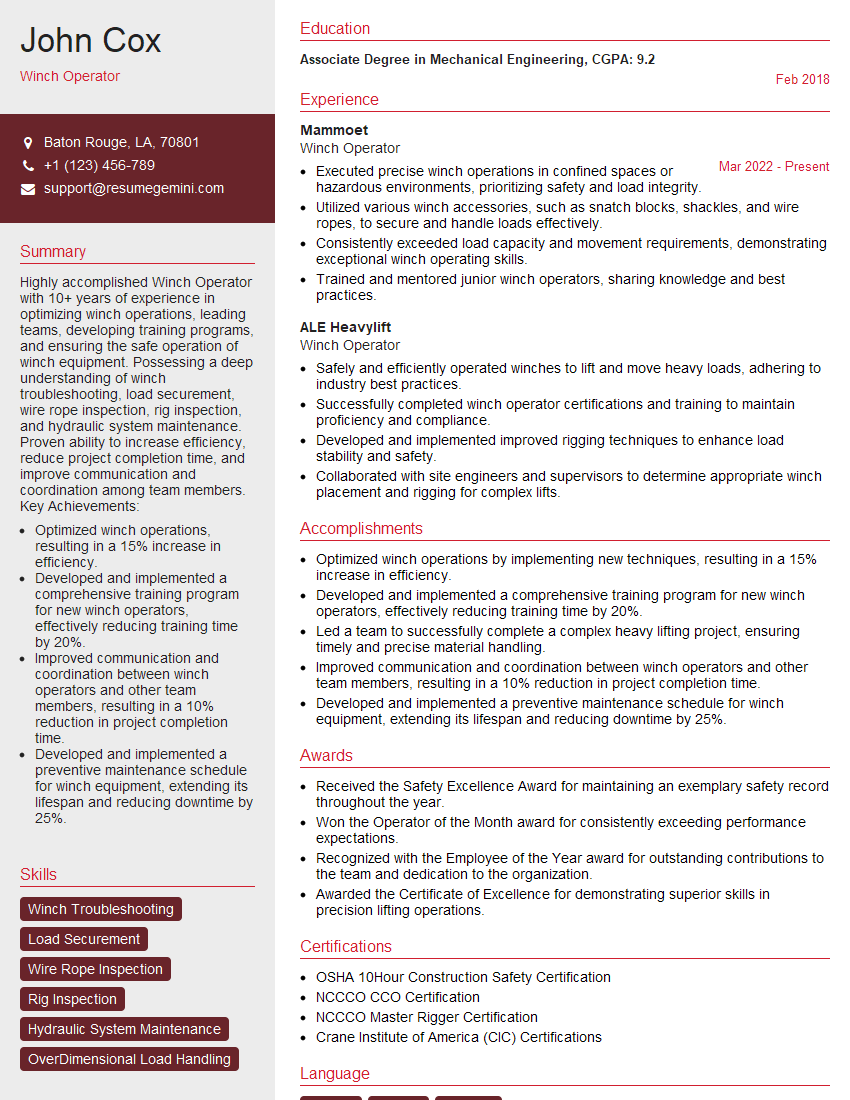
Mastering Winch Operations opens doors to rewarding and challenging careers in diverse industries. A strong understanding of these principles significantly enhances your employability and potential for career advancement. To make a compelling impression on potential employers, it’s crucial to have an ATS-friendly resume that effectively showcases your skills and experience. We strongly recommend using ResumeGemini to craft a professional resume that highlights your qualifications for Winch Operations positions. ResumeGemini provides you with the tools and resources to create a standout resume, and we offer examples of resumes tailored specifically to the Winch Operations field to help guide your creation.




Explore more articles
Users Rating of Our Blogs
Share Your Experience
We value your feedback! Please rate our content and share your thoughts (optional).
What Readers Say About Our Blog
Very informative content, great job.
good