Unlock your full potential by mastering the most common Wind Tunnel Control interview questions. This blog offers a deep dive into the critical topics, ensuring you’re not only prepared to answer but to excel. With these insights, you’ll approach your interview with clarity and confidence.
Questions Asked in Wind Tunnel Control Interview
Q 1. Explain the principles of wind tunnel testing.
Wind tunnel testing is a crucial technique for aerodynamic analysis. It involves placing a scaled model of an object (like an aircraft, car, or building) inside a controlled airflow, mimicking real-world conditions. By measuring the forces and pressures acting on the model, we can understand its aerodynamic characteristics – drag, lift, pitching moment, etc. Think of it like a giant, highly controlled fan creating a steady stream of air to study how it interacts with different shapes.
The principles are based on the laws of fluid mechanics and dimensional analysis. We use concepts like Reynolds number (which relates the inertial forces to viscous forces) to ensure the flow around the model accurately represents the full-scale object’s behavior. We carefully control factors like air speed, temperature, and turbulence to obtain meaningful and repeatable results.
Q 2. Describe different types of wind tunnels and their applications.
Wind tunnels come in various types, each suited to specific applications:
- Low-speed wind tunnels: These are commonly used for testing aircraft, cars, and buildings at speeds up to around 200 mph. They’re relatively simple to operate and maintain, making them popular for educational and initial design purposes.
- High-speed wind tunnels: Used for testing high-speed aircraft and missiles, these tunnels can generate speeds far exceeding the speed of sound. Their design and operation are significantly more complex and require specialized equipment.
- Transonic and Supersonic wind tunnels: These tunnels are specifically designed to study the airflow in the transonic (near the speed of sound) and supersonic regimes, featuring sophisticated nozzle designs to control the Mach number (the ratio of the speed of the object to the speed of sound).
- Hypersonic wind tunnels: Used for researching hypersonic vehicles and spacecraft, these tunnels generate incredibly high speeds, presenting significant engineering challenges in terms of heating and material selection.
- Vertical wind tunnels: Unlike horizontal tunnels, these are used for skydiving and flight simulation training. They create a vertical column of upward-flowing air, enabling people to float or practice maneuvers safely.
The choice of wind tunnel depends on the test article’s characteristics and the specific aerodynamic phenomena being investigated. For example, testing a Formula 1 car would typically involve a low-speed wind tunnel, while a supersonic jet fighter would require a supersonic wind tunnel.
Q 3. What are the key components of a wind tunnel control system?
A sophisticated wind tunnel control system is essential for reliable testing. Its key components include:
- Fan control: Precisely regulates the speed of the wind tunnel’s fan, controlling the airflow speed and maintaining a stable test environment. This often involves a variable frequency drive (VFD) for smooth speed adjustments.
- Flow conditioning: This involves components like honeycombs, screens, and diffusers that straighten and smooth the airflow to minimize turbulence and ensure uniform velocity across the test section.
- Test section pressure control: Maintaining a constant pressure in the test section is crucial for accurate measurements. This may involve bleed valves or other pressure regulation systems.
- Temperature control: The air temperature affects the density and viscosity, impacting the accuracy of the results. Maintaining a consistent temperature is therefore necessary, often achieved through heating or cooling systems.
- Data acquisition system interface: This component coordinates the communication between sensors and the data acquisition system, enabling the efficient collection of experimental data.
- Safety systems: Essential safety features include emergency shut-off switches, pressure relief valves, and interlocks to prevent accidents.
Modern control systems often utilize sophisticated software for automated operation, data logging, and real-time monitoring of parameters.
Q 4. How is data acquisition and processing handled in a wind tunnel?
Data acquisition in wind tunnel testing is a critical step. It involves employing various sensors to measure forces, pressures, and flow characteristics. These include:
- Force and moment balances: These precisely measure the forces (lift, drag, side force) and moments acting on the model.
- Pressure transducers: These measure the pressure distribution on the model’s surface, providing information about the local flow conditions.
- Hot-wire anemometers: These are used to measure the instantaneous velocity fluctuations in the flow field, giving insights into turbulence.
- Particle image velocimetry (PIV): This advanced technique provides detailed visualizations of the flow field by tracking the movement of small particles illuminated by lasers.
The acquired data is then processed using specialized software. This often involves calibrating the raw data, correcting for instrument errors, and reducing the data into meaningful aerodynamic coefficients. Advanced computational techniques, including statistical analysis and uncertainty quantification, are used to ensure the accuracy and reliability of the results. For instance, sophisticated software packages can handle the large amounts of data generated by PIV experiments, reconstructing detailed velocity fields.
Q 5. Explain the importance of calibration in wind tunnel testing.
Calibration is absolutely crucial for ensuring the accuracy and reliability of wind tunnel data. It involves meticulously verifying the performance of all measurement devices and the entire wind tunnel system. Think of it as regular check-ups for your measuring tools.
Calibration typically involves comparing the sensor readings to known standards under controlled conditions. For instance, a force balance might be calibrated using known weights, while pressure transducers are calibrated using precision pressure sources. The calibration process defines the uncertainties associated with each measurement, which are essential for assessing the overall accuracy of the results. Without thorough calibration, experimental results can be severely compromised, leading to flawed design decisions.
Q 6. How do you ensure the accuracy and reliability of wind tunnel data?
Ensuring the accuracy and reliability of wind tunnel data requires a multifaceted approach:
- Careful calibration: As discussed earlier, this is paramount. Regular calibration and maintenance of all equipment are necessary.
- Control of environmental factors: Maintaining stable temperature, pressure, and humidity levels in the test section is vital to minimize variations in the flow conditions.
- Minimizing flow disturbances: Proper design and maintenance of the tunnel’s flow conditioning system are essential for reducing turbulence and other disturbances in the test section.
- Model design and construction: The model should be meticulously crafted to accurately represent the full-scale object, minimizing imperfections that could affect the flow.
- Data validation and uncertainty analysis: Rigorous statistical analysis and uncertainty propagation methods are employed to evaluate the reliability and accuracy of the data and provide confidence intervals.
- Repeatability testing: Conducting multiple tests under identical conditions helps verify the reproducibility of the results, confirming the reliability of the process and the absence of systematic errors.
By implementing these steps, we can significantly enhance the confidence in the wind tunnel data and improve the reliability of the aerodynamic predictions.
Q 7. Describe your experience with different types of wind tunnel models.
Throughout my career, I’ve worked with a diverse range of wind tunnel models, from simple geometric shapes used for fundamental research to complex, detailed models representing aircraft, automobiles, and buildings. Examples include:
- Airfoils and wings: These are fundamental components, and I’ve been involved in extensive testing of various airfoil designs to optimize lift and minimize drag.
- Complete aircraft models: These are more challenging, involving intricate details of the fuselage, wings, and control surfaces. I’ve participated in projects focusing on reducing drag, enhancing maneuverability, and assessing stability characteristics.
- High-fidelity scaled models of cars: These models are meticulously designed to represent the exact geometry and surface features of full-scale vehicles to understand the aerodynamics for improving fuel efficiency and handling.
- Building models: These models have been used to understand how wind affects high-rise structures, considering aspects like wind loads and vortex shedding, crucial for structural design.
My experience covers various model construction techniques, including solid modeling using CAD software, 3D printing, and traditional machining. The level of detail in the models depends on the testing objectives and the available resources. The selection of model material is also critical to ensure structural integrity during testing while minimizing its influence on the flow.
Q 8. What are the common sources of error in wind tunnel testing, and how do you mitigate them?
Wind tunnel testing, while precise, is susceptible to various errors. These can broadly be categorized into model errors, tunnel errors, and measurement errors. Model errors stem from imperfections in the model itself, such as surface roughness or manufacturing inconsistencies. These can lead to inaccurate aerodynamic readings. Mitigation involves meticulous model construction and surface finishing, employing techniques like polishing and applying specialized coatings. Tunnel errors arise from imperfections in the wind tunnel’s design or operation, such as non-uniform flow, blockage effects (model size relative to tunnel size), and wall interference. We address these by careful calibration of the tunnel, using sophisticated techniques like 7-hole probes to map the flow field, and applying corrections based on established empirical formulas or computational fluid dynamics (CFD) simulations. Measurement errors result from inaccuracies in sensors, data acquisition systems, or human error. Regular calibration and maintenance of equipment, coupled with rigorous quality control protocols for data acquisition and processing, are key to minimizing these errors. For example, a faulty pressure transducer can introduce significant bias in pressure measurements which can be avoided by regular calibration checks. Finally, using multiple measurement techniques or redundant sensors helps cross-validate results and catch potential inconsistencies. We even use statistical methods to identify and filter out outliers from our data.
Q 9. How do you troubleshoot problems in a wind tunnel control system?
Troubleshooting a wind tunnel control system is a systematic process. It starts with identifying the symptoms of the problem—is the wind speed unstable? Are there unexpected vibrations? Is there a sensor malfunction? Once the problem is defined, we move to diagnosis. This may involve checking the status of individual components, such as the fan motor, control valves, and data acquisition system. We use a combination of visual inspection, checking diagnostic logs and alarms, and running diagnostic tests on the various subsystems. For example, a sudden drop in wind speed might indicate a problem with the fan motor or a blockage in the airflow. A systematic approach ensures that we address the root cause rather than just the symptom. The next step is to implement corrective actions based on the diagnosis. This might involve repairing a faulty component, adjusting control parameters, or replacing a sensor. Finally, thorough testing after the repair or adjustment is crucial to ensure that the system is functioning correctly and to prevent recurrence of the issue. This usually involves running a series of test runs under various conditions, comparing the results against expected values or previous test data, thereby validating the resolution.
Q 10. Describe your experience with data analysis software used in wind tunnel testing.
My experience encompasses a wide range of data analysis software used in wind tunnel testing. I am proficient in using Tecplot, a widely used software for visualizing and analyzing CFD data and wind tunnel results, enabling post-processing and analysis of pressure, velocity, and other flow field data acquired during experiments. I also have extensive experience in MATLAB and Python, leveraging their capabilities for data manipulation, statistical analysis, and creating custom scripts for automating data processing and generating reports. For instance, I’ve developed custom MATLAB scripts to process large datasets from pressure taps and hot-wire anemometry measurements, extracting relevant aerodynamic coefficients and statistical measures such as mean, standard deviation and root-mean-square. I’m also familiar with other specialized software such as LabVIEW which is commonly used for data acquisition and control in wind tunnel experiments. The choice of software depends heavily on the type of experiment and the complexity of the data analysis required.
Q 11. Explain your understanding of turbulence and its impact on wind tunnel results.
Turbulence is the random and chaotic motion of fluid particles. In wind tunnel testing, it’s a major source of error that can significantly impact the accuracy of the results. Turbulence causes fluctuations in flow velocity, pressure, and shear stress, leading to unsteady aerodynamic forces on the model being tested. The level of turbulence in the tunnel is quantified by the turbulence intensity, which is the ratio of the root-mean-square velocity fluctuation to the mean velocity. High turbulence intensity can mask subtle aerodynamic effects and lead to inaccurate measurements. For instance, in testing an aircraft wing, high turbulence can obscure the lift and drag characteristics at low angles of attack which are important for understanding stall behaviour. To minimize the effects of turbulence, wind tunnels are designed with features such as turbulence screens, honeycomb flow straighteners, and contraction sections to reduce the turbulence level upstream of the test section. The proper selection of instrumentation is also critical. High-frequency response sensors are necessary to capture the rapid fluctuations associated with turbulence. Sophisticated data processing techniques which often involve ensemble averaging or spectral analysis are then used to separate the turbulent fluctuations from the mean flow properties.
Q 12. How do you handle unexpected events or emergencies during a wind tunnel test?
Handling unexpected events is a critical aspect of wind tunnel operation. These could range from minor issues like a sensor malfunction to major emergencies like power outages or equipment failures. Our response is always guided by established safety protocols and emergency procedures. A clear communication system is crucial. Immediate notification to the control room and relevant personnel is vital. This allows for a coordinated response to minimize damage and ensure the safety of all personnel. Then a methodical approach to problem solving is important, starting with an assessment of the situation and prioritizing safety. For example, in case of a power failure, immediate shutdown of the wind tunnel is prioritized to prevent damage to equipment and personnel. Once the immediate danger is mitigated, efforts are focused on identifying the cause of the issue and implementing corrective measures. Detailed documentation of the event and the subsequent actions taken is critical for future analysis and preventing similar incidents. After the incident, a comprehensive review is conducted to identify any gaps in our procedures and refine our responses to ensure improved safety and operational efficiency.
Q 13. What safety procedures do you follow when working in a wind tunnel facility?
Safety is paramount in a wind tunnel facility. Our safety procedures are comprehensive and rigorously enforced. Before any test, a thorough pre-test inspection of the model, instrumentation, and the tunnel itself is performed to ensure that everything is working properly and poses no risk. Personal protective equipment (PPE) is mandatory, including safety glasses, hearing protection, and appropriate clothing to avoid entanglement. Strict access control is maintained, with only authorized personnel allowed in the test area during operation. Emergency shutdown procedures are clearly defined and regularly practiced. The control room is equipped with emergency stop buttons readily accessible to all operators. Regular safety training is provided to all personnel, covering topics such as emergency procedures, equipment handling, and hazard awareness. Thorough documentation of all safety-related procedures and training is kept up-to-date and easily accessible. A robust safety management system, incorporating regular safety audits and reviews, is implemented to continuously improve safety practices and ensure a safe working environment for everyone.
Q 14. Describe your experience with different types of flow visualization techniques.
My experience with flow visualization techniques includes a variety of methods, each offering unique insights into the flow field. I’ve extensively used surface oil flow visualization to study surface streamline patterns and identify separation regions on aerodynamic models. This involves applying a thin layer of oil mixed with a pigment to the model surface; the oil streaks then reveal the flow patterns. Another technique is smoke visualization, where smoke is introduced into the flow to visualize streamlines and vortices in the wake of the model. This is particularly useful for understanding the complex flow structures around complex geometries. I’ve also worked with tufts to identify flow separation and reattachment points on surfaces, giving a qualitative understanding of the flow patterns. These are small pieces of yarn attached to the surface, whose movement indicates the local flow direction. For quantitative measurements, I’ve employed Particle Image Velocimetry (PIV) and Laser Doppler Velocimetry (LDV) techniques, allowing for precise measurement of velocity fields within the flow. PIV uses laser light sheets and image processing to determine the velocity of particles seeded in the flow, offering detailed information about the flow field. The choice of technique depends on the specific flow feature of interest and the level of detail required. For example, oil flow is excellent for identifying large-scale separation regions, while PIV provides detailed velocity measurements needed for quantitative aerodynamic analysis.
Q 15. How do you interpret and present wind tunnel test results?
Interpreting wind tunnel test results involves a systematic approach combining raw data analysis, error assessment, and insightful visualization. It’s not just about numbers; it’s about understanding what those numbers *mean* in the context of the aerodynamic performance of the tested object.
First, we meticulously examine the raw data from sensors like pressure transducers, load cells (in balances), and hot-wire anemometers. We identify any outliers or inconsistencies, potentially caused by equipment malfunction or environmental factors. We then apply corrections based on calibration data and known systematic errors. For example, we might correct for model support interference or tunnel wall effects.
Next, we process the data, often using specialized software, to derive relevant aerodynamic parameters. This might involve calculating lift and drag coefficients (CL and CD), pitching moments, and pressure distributions. We’ll then compare these results to predictions from Computational Fluid Dynamics (CFD) simulations, if available, to validate the experimental data and refine our understanding.
Finally, we present the results clearly and concisely, usually through graphs, tables, and concise reports. Key findings are highlighted, and the uncertainties associated with the measurements are explicitly stated. For instance, a graph showing the variation of CL with angle of attack will include error bars representing the confidence interval. A successful presentation facilitates easy interpretation by engineers and designers, allowing them to make informed decisions about the design.
During a recent project testing a novel wing design, we discovered a previously unforeseen stall behavior at high angles of attack. This was revealed through a detailed analysis of the pressure distributions on the wing surface and wouldn’t have been apparent from a simple CL-alpha curve alone. This finding allowed the design team to implement necessary modifications to improve the safety and performance of the aircraft.
Career Expert Tips:
- Ace those interviews! Prepare effectively by reviewing the Top 50 Most Common Interview Questions on ResumeGemini.
- Navigate your job search with confidence! Explore a wide range of Career Tips on ResumeGemini. Learn about common challenges and recommendations to overcome them.
- Craft the perfect resume! Master the Art of Resume Writing with ResumeGemini’s guide. Showcase your unique qualifications and achievements effectively.
- Don’t miss out on holiday savings! Build your dream resume with ResumeGemini’s ATS optimized templates.
Q 16. What is your experience with computational fluid dynamics (CFD) and its relation to wind tunnel testing?
Computational Fluid Dynamics (CFD) and wind tunnel testing are complementary tools in aerodynamic analysis, each with its strengths and weaknesses. I have extensive experience in both, leveraging their combined power to deliver comprehensive and reliable results.
CFD uses numerical methods to solve the Navier-Stokes equations, simulating fluid flow around an object. It’s cost-effective for exploring a wide range of design options early in the development process. However, it relies on simplifying assumptions and the accuracy of the simulation depends heavily on the quality of the mesh, turbulence model, and boundary conditions. In contrast, wind tunnel testing provides experimentally verified data, offering a higher degree of confidence in the final results, especially in complex flow regimes.
I often use CFD to provide an initial design assessment, identifying potential issues and optimizing geometries before resorting to costly wind tunnel testing. Wind tunnel results then validate the CFD model and provide experimental data for fine-tuning the design. Discrepancies between CFD and wind tunnel data can illuminate limitations in the CFD model or identify unforeseen physical phenomena not captured in the simulation.
For instance, in a project involving a Formula 1 car, we used CFD to investigate the effectiveness of different diffuser designs. The CFD study significantly narrowed down the options, and wind tunnel testing validated the top-performing design and revealed subtle flow separations not predicted by CFD, leading to a minor but beneficial design adjustment. The integration of both methods resulted in an optimized aerodynamic performance.
Q 17. Explain the concept of wind tunnel blockage and its effects.
Wind tunnel blockage refers to the ratio of the model’s cross-sectional area to the wind tunnel test section’s cross-sectional area. A high blockage ratio can significantly affect the flow field around the model, introducing errors in the measurements. Imagine trying to swim in a bathtub versus an Olympic-sized pool – the bathtub walls would have a much larger influence on your swimming.
Blockage alters the freestream velocity around the model, leading to an increase in pressure near the model and a decrease in the velocity. This alteration affects the lift and drag forces measured, typically increasing them. The severity of the blockage effects depends on the blockage ratio and the model’s shape. High blockage ratios (above 5-10%) lead to significant inaccuracies and should be avoided whenever possible.
To mitigate blockage effects, engineers often employ several techniques. One approach is to choose a wind tunnel with a larger test section to minimize the blockage ratio. If this isn’t feasible, corrections can be applied to the experimental data based on established correlations or computational methods. These corrections, however, are often approximate and introduce uncertainties to the final results.
For example, during the testing of a large-scale model of a wind turbine blade, we had to carefully consider blockage effects. By selecting a tunnel with a sufficiently large test section, we minimized these effects and ensured reliable results. Even with minimal blockage, we applied established corrections to further refine our analysis and minimize any potential errors.
Q 18. How do you select appropriate instrumentation for a wind tunnel test?
Selecting appropriate instrumentation for a wind tunnel test is crucial for accurate and reliable data acquisition. The choice depends on the specific test objectives, the model’s size and complexity, and the expected flow conditions. It’s a careful balancing act between accuracy, cost, and feasibility.
For measuring forces and moments, we typically use wind tunnel balances. These highly sensitive devices are capable of measuring forces in multiple axes (lift, drag, side force) and moments (pitch, yaw, roll). The type of balance (internal or external) depends on the model size and the level of accuracy required. The choice of balance is often driven by the forces expected – small models might only need a smaller, simpler balance.
Pressure measurements are often acquired using pressure taps or pressure scanning systems. Pressure taps provide point measurements, while scanning systems provide a spatially resolved pressure field. The choice depends on the detail of pressure distribution required for the analysis. Surface pressure distributions are extremely valuable for understanding the flow behavior over the model surface.
Velocity measurements can be made using various techniques such as hot-wire anemometry, laser Doppler velocimetry (LDV), and particle image velocimetry (PIV). Hot-wire anemometry is relatively inexpensive and suitable for point measurements, while LDV and PIV provide spatially resolved velocity fields but are more complex and expensive. The optimal choice is based on the required spatial resolution and the temporal resolution (how fast the velocity is changing).
In a recent project evaluating the aerodynamic characteristics of a high-speed train, we employed a six-component internal balance to measure forces and moments, and a pressure scanning system to obtain the pressure distribution on the train’s body. This combination of techniques allowed a detailed analysis of the aerodynamic behavior.
Q 19. Describe your experience with different types of wind tunnel balances.
My experience encompasses various types of wind tunnel balances, each tailored to specific measurement needs. The choice of balance significantly influences the accuracy and reliability of the force and moment data. I have worked extensively with both internal and external balances, each possessing unique advantages and disadvantages.
Internal balances are integrated within the model, offering reduced interference and improved accuracy, especially for smaller models. However, they are more complex to design and manufacture, and their use is constrained by the model’s internal geometry. They are generally preferred when high accuracy is paramount, regardless of the added complexity.
External balances, on the other hand, are mounted outside the model, offering greater flexibility in model design. They are simpler to manufacture and maintain but can introduce interference effects due to their support structure. The support structure can interfere with the flow, causing errors in the measurements. Careful design and calibration are needed to minimize these effects.
Beyond internal and external types, I am familiar with different configurations of balances. Six-component balances measure forces and moments along six degrees of freedom (three forces and three moments), while three-component balances only measure forces. The choice depends on the complexity of the test and the specific data needed. I’ve also worked with strain gauge-based and piezoelectric balances, each possessing varying sensitivities and bandwidths.
For example, in testing a highly maneuverable UAV, we used a six-component internal balance to measure the precise forces and moments generated during sharp turns. The internal balance minimized support interference and allowed for the accurate assessment of the aircraft’s control effectiveness.
Q 20. How do you ensure the proper functioning of the wind tunnel’s power system?
Ensuring proper functioning of a wind tunnel’s power system is paramount for accurate and reliable test results. A stable and controlled airflow is essential for meaningful aerodynamic measurements. This involves regular maintenance, monitoring, and proactive problem-solving.
Regular inspections of the power system’s components, including the fan, motor, drive system, and control electronics, are crucial. This includes checking for wear and tear, lubrication levels, and potential damage. Routine maintenance schedules should be adhered to diligently. Any issues discovered during inspections should be addressed promptly to prevent malfunctions during testing.
Continuous monitoring of key parameters is crucial. These include fan speed, motor current, power consumption, and air temperature and pressure in the test section. Deviations from normal operating conditions often signal potential problems. Real-time monitoring systems, equipped with alarms, are essential to quickly identify and address abnormalities.
A comprehensive safety protocol is essential for handling high-power systems. This includes lockout/tagout procedures during maintenance and emergency shutdown mechanisms to prevent accidents. All personnel involved must receive adequate safety training before operating or maintaining the power system.
In one instance, a sudden drop in fan speed during a critical test alerted us to a potential problem in the drive system. Our monitoring system immediately triggered an alarm, allowing us to safely shut down the wind tunnel and identify a minor fault in the drive belt before it caused more serious damage. This rapid response minimized downtime and prevented potentially costly repairs.
Q 21. What are the limitations of wind tunnel testing?
Wind tunnel testing, while invaluable, does have limitations. Understanding these limitations is crucial for interpreting results accurately and avoiding misinterpretations. The results are only as good as the model and the experimental setup.
One major limitation is the difficulty in replicating real-world flight conditions perfectly. Wind tunnels are controlled environments, and factors like turbulence, temperature gradients, and atmospheric pressure differ from actual flight conditions. Reynolds number scaling—the ratio of inertial forces to viscous forces—is often challenging to match exactly. For example, testing an aircraft model in a wind tunnel will be at a different Reynolds number than its actual flight conditions.
Another limitation is model scaling. Building accurate scale models that capture all relevant aerodynamic details can be challenging, and scale effects can influence the test results. It’s difficult to perfectly replicate complex geometries and surface details at smaller scales.
Wind tunnel testing can also be expensive and time-consuming. The costs associated with tunnel time, model fabrication, instrumentation, and data analysis can be substantial, especially for large or complex models. It is a valuable tool, but access to time and resources is sometimes limited.
Furthermore, support interference from the model mounting system can alter the flow around the model, introducing errors into measurements. Clever support design techniques are employed to minimize these effects, but eliminating them entirely is impossible.
In summary, while wind tunnel testing remains a critical tool in aerodynamic analysis, engineers must acknowledge its limitations and employ appropriate correction methods and interpretation techniques to maximize its value and avoid misinterpretations.
Q 22. How do you manage and organize large datasets from wind tunnel experiments?
Managing large wind tunnel datasets requires a systematic approach. Think of it like organizing a massive library – you need a clear cataloging system to find what you need quickly and efficiently. I typically employ a combination of techniques. First, I use a well-defined file naming convention, incorporating key parameters like test date, model configuration, and test conditions. This ensures easy identification and retrieval. Second, I leverage database management systems (DBMS) like PostgreSQL or MySQL to store and query the data. These systems allow for efficient searching, filtering, and analysis of vast amounts of data. For example, I might create tables to store aerodynamic coefficients (like lift and drag) at different angles of attack, alongside relevant metadata about the test setup. Third, I utilize data visualization tools such as MATLAB, Python with libraries like Matplotlib and Seaborn, or dedicated CFD post-processing software to explore trends and patterns within the data. Finally, version control systems like Git are crucial for tracking changes and collaborating on data analysis within a team. This ensures the integrity and traceability of our results.
Q 23. Describe your experience with automated wind tunnel testing procedures.
My experience with automated wind tunnel testing is extensive. I’ve worked extensively with systems that automate everything from model positioning and angle of attack control to data acquisition and initial data processing. This automation is critical for improving efficiency and reducing human error. Imagine trying to manually adjust the model’s angle of attack in 0.1-degree increments for a complete test – it’s incredibly time-consuming and prone to mistakes. Automated systems allow us to program a series of tests, set the parameters, and let the system run autonomously, ensuring consistency and repeatability across numerous tests. We use programmable logic controllers (PLCs) and custom software interfaces to control the wind tunnel and related equipment, such as balances, pressure transducers, and flow visualization systems. A key aspect is integrating real-time data monitoring, enabling early detection of any issues during the test run. This reduces wasted time and materials by flagging potential problems early on.
Q 24. How do you ensure the repeatability of wind tunnel tests?
Ensuring repeatability in wind tunnel tests is paramount for the validity of the results. We achieve this through a multi-faceted approach. Firstly, meticulous documentation of the experimental setup is critical. This includes detailed descriptions of the model geometry, instrumentation, environmental conditions (temperature, pressure, humidity), and wind tunnel settings (speed, turbulence intensity). Secondly, standardized operating procedures are followed diligently by all team members. Every step, from model installation to data acquisition, is documented and checked. Thirdly, we perform calibration checks on all instruments regularly. This ensures that our sensors provide accurate and reliable data throughout the testing period. Think of it like calibrating a scale before weighing an object— you need to make sure your measuring tool is accurate. Fourthly, we conduct repeated tests under identical conditions. Comparing the results from multiple runs helps identify any inconsistencies and assess the uncertainty associated with the measurements. Lastly, thorough quality control procedures are in place at every step, involving multiple checks and cross-verification of data.
Q 25. What are your skills in programming languages relevant to wind tunnel data processing?
My programming skills are crucial for efficient wind tunnel data processing. I’m proficient in Python, MATLAB, and have some experience with LabVIEW. Python, with libraries like NumPy, SciPy, Pandas, and Matplotlib, is my go-to language for data manipulation, analysis, and visualization. For example, I frequently use Pandas for data cleaning and manipulation, NumPy for numerical computations, and Matplotlib for creating publication-quality plots. MATLAB’s toolboxes provide excellent capabilities for signal processing and advanced data analysis. I’ve used it extensively for tasks such as fast Fourier transforms (FFT) to analyze unsteady aerodynamic data and for implementing advanced control algorithms in the wind tunnel automation. LabVIEW’s strength lies in its capability for real-time data acquisition and control systems integration. I have employed it in the past to design custom interfaces for automated testing sequences. These programming languages, combined with my expertise in data analysis techniques, allow me to extract meaningful insights from the vast amounts of data generated in wind tunnel experiments.
# Example Python code snippet for calculating mean drag coefficient: import numpy as np drag_data = np.array([1.2, 1.3, 1.25, 1.28, 1.32]) mean_drag = np.mean(drag_data) print(f'Mean drag coefficient: {mean_drag}')Q 26. Explain your understanding of Reynolds number and its significance in wind tunnel testing.
The Reynolds number (Re) is a dimensionless quantity that describes the ratio of inertial forces to viscous forces in a fluid flow. It’s crucial in wind tunnel testing because it dictates the flow regime – whether it’s laminar (smooth) or turbulent (chaotic). The Reynolds number is calculated as Re = (ρVL)/μ, where ρ is the fluid density, V is the flow velocity, L is a characteristic length (e.g., the airfoil chord), and μ is the dynamic viscosity. In wind tunnel testing, achieving dynamic similarity, meaning matching the Reynolds number of the full-scale prototype, is vital. If the Reynolds numbers differ significantly between the model test and the full-scale application, the results might not be directly applicable. For example, if we’re testing an airplane wing, we need to ensure that the Reynolds number in the wind tunnel accurately reflects the Reynolds number the wing will experience during flight. This often requires adjusting the wind tunnel speed or using a different fluid (e.g., a denser gas). Failure to match Reynolds numbers can lead to inaccurate predictions of aerodynamic forces and flow phenomena, such as the onset of stall.
Q 27. How do you validate the accuracy of wind tunnel results?
Validating wind tunnel results involves comparing them against other data sources and analyzing potential sources of error. Several approaches are used. Firstly, we can compare the results with computational fluid dynamics (CFD) simulations. CFD provides an independent prediction of aerodynamic characteristics, allowing us to assess the agreement between experimental and numerical data. Discrepancies might highlight potential errors in either the experiment or the simulation. Secondly, we can compare the results with data from other wind tunnels or flight test data, if available. This provides a broader perspective on the aerodynamic characteristics of the model. Thirdly, we conduct uncertainty analysis to quantify the potential errors associated with our measurements. This includes accounting for uncertainties in instrumentation, calibration, data reduction, and environmental conditions. Lastly, we critically examine the experimental methodology to identify potential sources of systematic error. This might include checking for blockage effects (the model disturbing the flow in the tunnel), wall interference effects, or model support interference. By carefully evaluating these aspects, we can build confidence in the validity and reliability of the wind tunnel results.
Q 28. Describe your experience with different types of wind tunnel models (e.g., rigid, flexible, etc.)
My experience encompasses various wind tunnel models, each with its unique challenges and considerations. I’ve worked with rigid models, where the geometry is fixed and unchanging, which is the most common type. These are relatively straightforward to handle. However, I also have experience with flexible models, used to study aeroelastic phenomena like flutter and buffeting. These require sophisticated instrumentation to measure deflections and stresses in the model during the test. For flexible models, the design of the support system is critical, as it must minimize interference with the flow while allowing for free motion of the model. Additionally, I’ve worked with models incorporating moving parts, such as rotating components or control surfaces, necessitating specialized mechanisms for precise control within the wind tunnel. Each model type requires different support systems, instrumentation, and data acquisition techniques, demanding a high level of expertise in experimental design and execution. For instance, testing a flexible model might necessitate the use of strain gauges to measure structural deflections and high-speed cameras to capture flow visualization data during dynamic responses.
Key Topics to Learn for Wind Tunnel Control Interview
- Instrumentation and Sensors: Understanding the types of sensors used in wind tunnels (pressure, temperature, velocity, etc.), their principles of operation, calibration techniques, and data acquisition systems. Practical application: Troubleshooting sensor malfunctions and ensuring data accuracy.
- Data Acquisition and Processing: Familiarity with data acquisition hardware and software, signal conditioning, data filtering, and analysis techniques. Practical application: Interpreting and presenting wind tunnel test data effectively to support engineering decisions.
- Control Systems and Automation: Knowledge of control systems, including feedback loops, PID controllers, and automated test procedures. Practical application: Designing and implementing automated control strategies for wind tunnel operations.
- Aerodynamic Principles: A solid understanding of fundamental aerodynamic concepts relevant to wind tunnel testing, such as boundary layers, flow separation, and lift and drag forces. Practical application: Interpreting test results in the context of aerodynamic performance.
- Safety Procedures and Regulations: Thorough knowledge of safety protocols associated with high-velocity airflow and specialized equipment. Practical application: Ensuring a safe working environment and adhering to all relevant safety regulations.
- Troubleshooting and Problem Solving: Ability to diagnose and resolve issues related to wind tunnel operation, instrumentation, and data acquisition. Practical application: Identifying and rectifying malfunctions efficiently and effectively.
- Model Preparation and Testing: Understanding the procedures for preparing models for wind tunnel testing, including mounting, instrumentation, and data acquisition setup. Practical application: Executing wind tunnel tests accurately and efficiently.
Next Steps
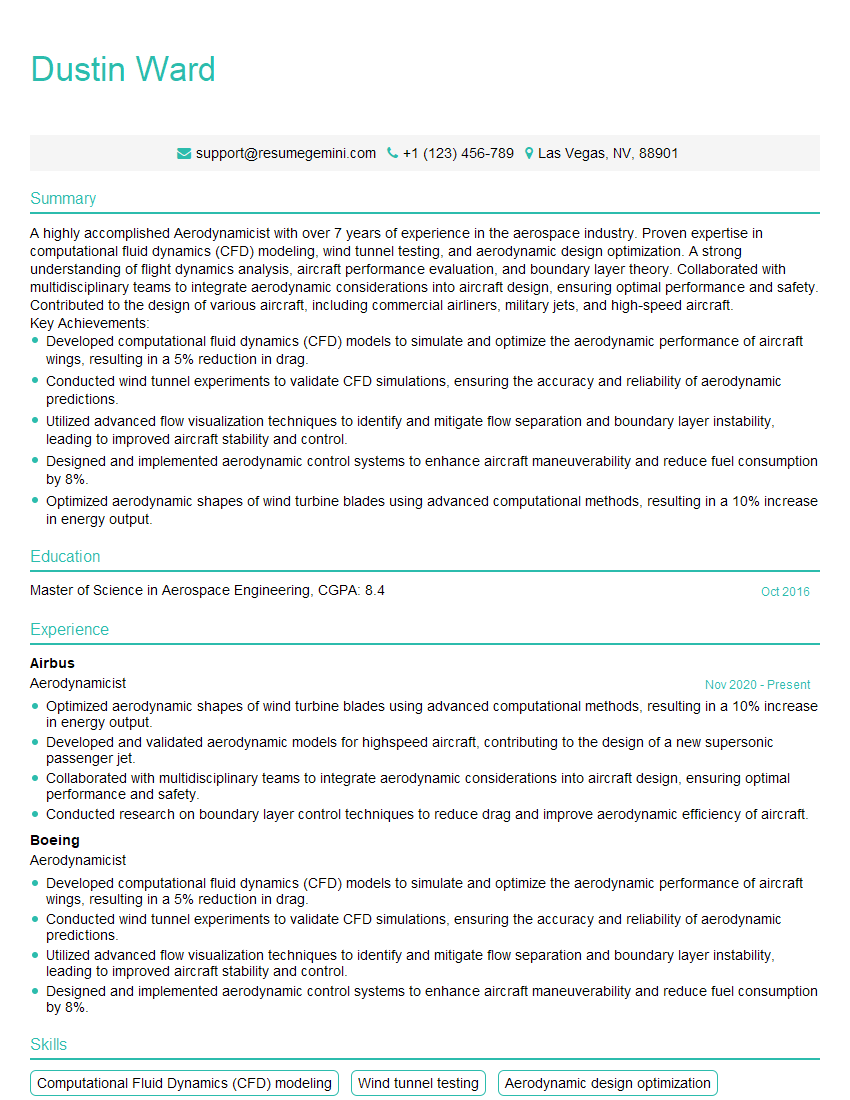
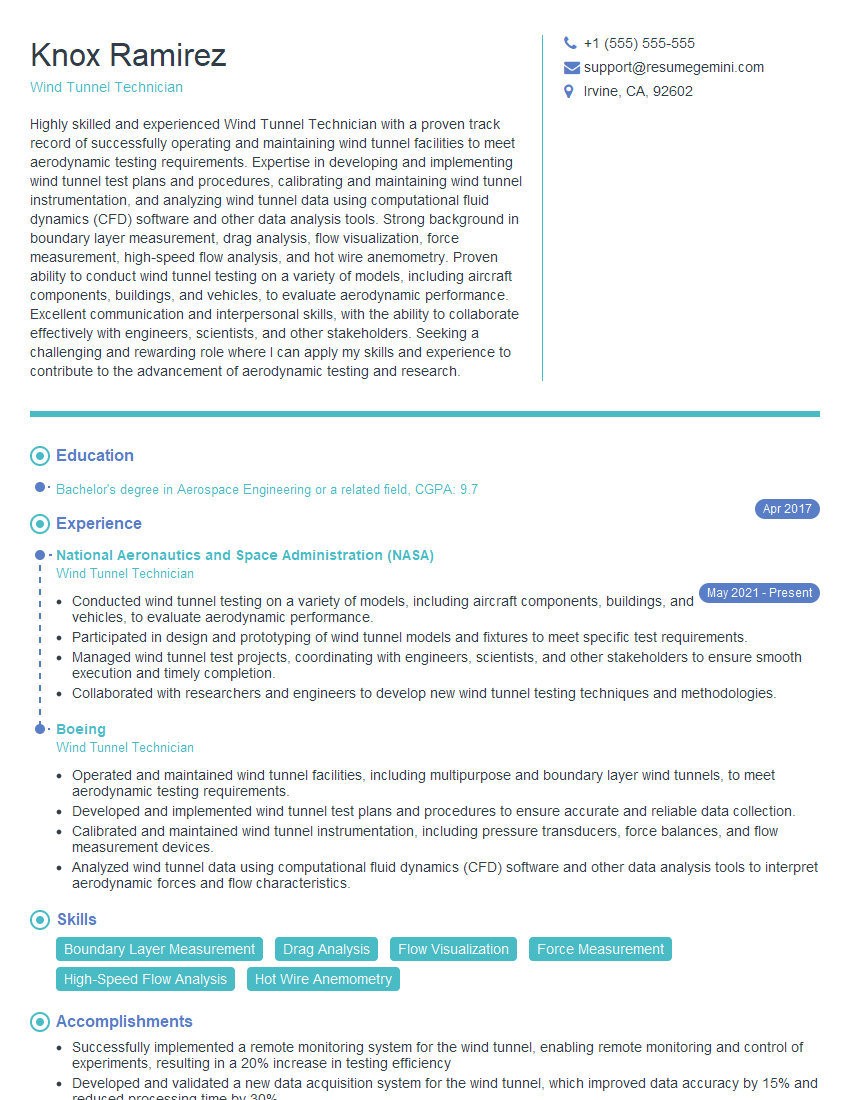
Mastering Wind Tunnel Control opens doors to exciting career opportunities in aerospace engineering, automotive design, and other related fields. A strong understanding of these principles is highly valued by employers. To maximize your chances of landing your dream role, creating a compelling and ATS-friendly resume is crucial. ResumeGemini can help you craft a professional resume that highlights your skills and experience effectively. They provide examples of resumes tailored specifically to Wind Tunnel Control positions, making the process easier and more efficient. Invest time in perfecting your resume; it’s your first impression on potential employers.
Explore more articles
Users Rating of Our Blogs
Share Your Experience
We value your feedback! Please rate our content and share your thoughts (optional).
What Readers Say About Our Blog
Very informative content, great job.
good