Every successful interview starts with knowing what to expect. In this blog, we’ll take you through the top Security Information and Event Management (SIEM) Tools interview questions, breaking them down with expert tips to help you deliver impactful answers. Step into your next interview fully prepared and ready to succeed.
Questions Asked in Security Information and Event Management (SIEM) Tools Interview
Q 1. Explain the core functionalities of a SIEM system.
At its core, a Security Information and Event Management (SIEM) system is a security monitoring solution that collects and analyzes security logs from various sources across your IT infrastructure. Think of it as a central nervous system for your security, providing a single pane of glass to view and interpret security events. Its primary functionalities revolve around:
- Log Collection: Gathering security logs from diverse sources like firewalls, routers, servers, databases, and applications. This involves configuring agents or using APIs to pull data in various formats.
- Log Normalization: Transforming log data into a consistent format, irrespective of its origin. This allows for easier correlation and analysis.
- Log Correlation: Identifying patterns and relationships between seemingly disparate events. For instance, a failed login attempt from an unusual location followed by a data exfiltration event.
- Security Monitoring and Alerting: Detecting security threats, vulnerabilities, and policy violations based on pre-defined rules and baselines. It will then alert security analysts when suspicious activity is detected.
- Reporting and Analysis: Generating reports and visualizations to understand security trends, assess risk, and demonstrate compliance.
- Security Orchestration, Automation, and Response (SOAR): Many modern SIEMs integrate with SOAR tools, allowing for automated responses to security incidents, such as blocking malicious IPs or quarantining infected systems.
For example, a SIEM might detect a pattern of unauthorized access attempts originating from a specific IP address, correlating this with unusually high data transfer volumes, indicating a potential data breach attempt. This allows security teams to react quickly and mitigate the threat.
Q 2. Describe the different types of SIEM architectures (e.g., centralized, distributed).
SIEM architectures vary depending on the size and complexity of an organization’s IT infrastructure. The two main types are:
- Centralized Architecture: In this model, all log data is collected and processed by a single SIEM server. This is simpler to manage but can become a bottleneck as the volume of data increases. Imagine a single, powerful central computer receiving information from all departments.
- Distributed Architecture: This architecture uses multiple SIEM servers to process and analyze log data from different parts of the network. This approach offers scalability and improved performance, particularly in large organizations with geographically dispersed locations. Think of it like having multiple smaller computers, each responsible for a specific area, with coordinated communication to the central hub.
- Hybrid Architecture: A blend of centralized and distributed architectures. Some logs might be processed locally before being aggregated to a central SIEM server for advanced analysis. This combines the benefits of both and helps to optimize performance based on log volume and the need for centralized visibility.
The choice of architecture is crucial and often depends on factors such as the volume of logs, the geographical distribution of IT assets, and the organization’s budget and expertise. Smaller organizations may find a centralized architecture sufficient, while larger enterprises might require a distributed or hybrid approach for better performance and resilience.
Q 3. What are the key components of a SIEM solution?
A comprehensive SIEM solution comprises several key components, working together to provide a holistic security monitoring capability:
- Log Collectors/Agents: These are software components that collect log data from various sources. They can be deployed on individual devices or centrally managed.
- Log Management System: This stores, indexes, and manages the collected log data, enabling efficient search and retrieval. It’s essentially the storage and organization system for your security information.
- Correlation Engine: The heart of the SIEM, this component analyzes log data to identify patterns and relationships, detecting potential security incidents. It’s like a detective, identifying connections between seemingly unrelated events.
- Alerting System: This component triggers alerts based on pre-defined rules or anomaly detection, notifying security personnel of potential threats in real-time.
- Reporting and Dashboarding: This allows for the visualization and presentation of security data through customizable dashboards and reports.
- User Interface: A user-friendly interface allowing security analysts to access, analyze, and manage security information effectively. The easier it is to use, the more efficient your team can be.
- Integration Layer: The ability to connect with other security tools, such as SOAR, threat intelligence platforms, and incident response systems.
The interplay of these components is critical. For instance, a log collector gathers data from a firewall, the correlation engine analyzes it for suspicious activity, and the alerting system notifies the analyst, who then uses the dashboard to investigate further.
Q 4. How do you perform log correlation and analysis within a SIEM?
Log correlation and analysis is the process of identifying relationships between different log events to detect security threats. The SIEM uses various techniques, including:
- Rule-based Correlation: Pre-defined rules are used to identify specific sequences of events that indicate a potential threat. For example, a rule might trigger an alert if a failed login attempt from an unknown IP address is followed by an attempt to access sensitive data.
- Statistical Correlation: Statistical methods are used to identify anomalies or unusual patterns in log data. This is useful for detecting zero-day attacks or sophisticated threats that may not be easily identifiable through rule-based correlation.
- Machine Learning (ML): Advanced SIEM solutions leverage ML algorithms to automatically identify patterns and anomalies in log data, improving the accuracy and efficiency of threat detection.
For example, a SIEM might correlate a login from an unusual location with a subsequent attempt to access administrative privileges and then a large file download – these three events, individually benign, taken together suggest a potential compromised account.
The correlation process typically involves using search queries, filters, and dashboards to review events. Analysts often use the SIEM’s built-in functionality to generate reports or to visualize events chronologically and spatially for a clearer picture.
Q 5. Explain the concept of baselining in SIEM.
Baselining in SIEM involves establishing a normal pattern of activity within your IT environment. It’s like creating a ‘normal’ profile for your systems. This baseline then serves as a reference point for detecting anomalies or deviations, which could indicate malicious activity. Establishing a strong baseline is crucial for effective threat detection.
The process typically involves collecting and analyzing log data over a period of time (weeks or months) to identify typical patterns. This includes metrics such as the number of login attempts, data transfer volumes, and system resource usage. Once the baseline is established, the SIEM can monitor for deviations from this norm, triggering alerts if significant differences are detected.
For example, if a server typically processes 100 requests per second, a sudden spike to 1000 requests might indicate a denial-of-service attack. By understanding what ‘normal’ looks like, the SIEM effectively flags unusual behavior that warrants investigation.
Q 6. How do you handle false positives in a SIEM environment?
False positives are alerts triggered by the SIEM that indicate a potential security incident but are actually benign events. They can overwhelm security teams and lead to alert fatigue, reducing the effectiveness of the system. Effective false positive management involves several steps:
- Refine Alert Rules: Carefully review and adjust the SIEM’s alert rules to minimize the chances of false positives. This may involve adjusting thresholds or adding additional conditions to the rules.
- Improve Log Quality: Ensure that the logs being collected are accurate, complete, and well-formatted. Poor quality logs can lead to misinterpretations and false positives.
- Use Contextual Information: Incorporate additional context into the alerting process, such as user location, device type, and time of day, to provide a more accurate assessment of the event.
- Regular Tuning and Maintenance: Continuously monitor alert rates, analyze false positives, and refine rules and configurations to optimize the system’s performance over time.
For example, a false positive might be triggered by a system administrator performing routine maintenance tasks that resemble malicious activity. Refining rules to account for such activities minimizes these false alerts.
Q 7. Describe your experience with different SIEM vendors (e.g., Splunk, QRadar, ArcSight).
Throughout my career, I’ve gained extensive experience with several leading SIEM vendors, including Splunk, QRadar, and ArcSight. Each offers unique strengths and is best suited for different organizational needs.
- Splunk: Known for its powerful search and analytics capabilities, Splunk excels at analyzing large volumes of machine data and offers advanced visualization tools. Its flexibility and extensive app ecosystem make it highly adaptable to diverse environments. However, it can be more complex to implement and manage compared to other SIEMs and can be costlier at scale.
- QRadar: QRadar is praised for its user-friendly interface and strong out-of-the-box security analytics capabilities. Its threat intelligence integration is a strong point, and it offers robust compliance reporting features. QRadar is generally considered easier to manage than Splunk, yet its features are equally powerful and adaptable to large, complex environments.
- ArcSight: ArcSight has a strong focus on security governance, risk, and compliance (GRC), offering comprehensive auditing and reporting features. It excels in large-scale deployments and is known for its ability to handle massive log volumes. It’s a robust and mature platform but might have a steeper learning curve and more complex configuration than some other alternatives.
My experience has involved designing, implementing, and managing SIEM solutions using each of these platforms, addressing diverse challenges such as log ingestion optimization, alert tuning, incident response, and regulatory compliance. I’m comfortable working with different architectures and integrating SIEMs with other security tools to create comprehensive security monitoring solutions tailored to specific client requirements. I’ve often found the best platform for a specific client depends on their existing infrastructure, budget, expertise, and specific security requirements.
Q 8. Explain the process of creating and managing SIEM alerts.
Creating and managing SIEM alerts involves a multi-step process focused on defining what constitutes a security event, then configuring the system to detect and report those events. It begins with understanding your organization’s specific security needs and threat landscape.
- Defining Rules and Filters: This is the core of alert creation. You establish rules based on specific events or patterns in your log data. For example, a rule could be triggered by an unusually high number of failed login attempts from a single IP address, or a file access attempt on a sensitive directory by an unauthorized user. This often involves using regular expressions or other pattern matching techniques.
Example: If (SourceIP = '192.168.1.100' AND EventID = '4625' AND Count > 10 in 5 minutes) THEN generate alert. - Correlation: Many SIEMs offer correlation engines. This allows you to combine multiple events to create more meaningful alerts. For instance, you might correlate a failed login attempt with a subsequent suspicious network connection to trigger a higher-priority alert.
- Alert Thresholds: Setting appropriate thresholds is crucial. Too many alerts lead to alert fatigue, while too few might miss critical threats. We utilize historical data and risk assessments to define these thresholds, ensuring that only significant events generate alerts.
- Alert Routing and Notification: Once an alert is triggered, it needs to be routed to the appropriate personnel (security analysts, incident responders). This can involve email notifications, SMS messages, or integration with ticketing systems.
- Alert Management: This is an ongoing process. We regularly review existing alerts, refine them based on performance, and add new alerts as new threats or vulnerabilities emerge. We use dashboards to track alert volumes, types and resolution times to identify areas needing improvement.
Managing alerts includes suppression of known false positives, improving alert filtering to reduce noise, and continuously tuning rules to enhance accuracy and reduce the number of false positives. The goal is a balance between comprehensive coverage and manageable alert volume.
Q 9. How do you prioritize security alerts within a SIEM?
Prioritizing security alerts is vital to efficiently managing the incident response process. We utilize a multi-faceted approach based on several factors:
- Severity: This is based on the potential impact of the event. A critical vulnerability exploit will naturally have higher priority than a minor configuration change. Many SIEMs utilize a pre-defined severity scale (e.g., critical, high, medium, low).
- Urgency: How quickly the event needs to be addressed? A denial-of-service attack in progress requires immediate attention, whereas a potential vulnerability might have a longer response timeframe.
- Risk Score: Sophisticated SIEMs calculate risk scores by incorporating factors like asset value, threat likelihood, and vulnerability severity. This provides a more nuanced prioritization than simply relying on severity.
- Asset Criticality: Alerts impacting critical systems (e.g., servers holding sensitive data, payment gateways) have higher priority than those related to less critical systems.
- Contextual Information: We use contextual data from other sources to prioritize alerts. For example, if an alert indicates suspicious activity from a known malicious IP address, it will be prioritized higher.
In practice, we often use a combination of automated and manual prioritization. The SIEM system uses pre-defined rules to assign initial priorities, while analysts can override these based on their judgment and investigation.
Q 10. How do you integrate various security tools with a SIEM?
Integrating various security tools with a SIEM is crucial for comprehensive threat detection and response. This integration is typically achieved using various methods:
- Syslog: A standard protocol for transmitting log messages. Many security devices (firewalls, routers, servers) can send their logs via Syslog to the SIEM.
- API Integrations: Many modern security tools offer APIs that enable direct integration with the SIEM. This allows for real-time data exchange and automated actions.
- Agent-Based Integration: Some SIEMs use agents deployed on endpoints to collect local logs and events. This approach is particularly useful for collecting data from systems that may not be directly reachable via network-based methods.
- Third-Party Connectors: Many SIEM vendors offer pre-built connectors for popular security tools. This simplifies the integration process significantly.
- Parsing and Normalization: The SIEM often needs to parse and normalize logs from different sources to ensure consistent data formatting before analysis. This may involve custom script development for uncommon log formats.
For example, integrating a firewall with a SIEM allows us to correlate network events with other security events, enabling a more holistic view of the security posture. Integrating an endpoint detection and response (EDR) solution provides visibility into malware behavior on endpoints.
Q 11. Describe your experience with SIEM dashboards and reporting.
SIEM dashboards and reporting are essential for visualizing security data and presenting insights to stakeholders. My experience involves designing and using dashboards to monitor key security metrics, including:
- Alert Volumes: Trends in alert counts by severity and source.
- Top Threats: Identification of the most frequent and potentially damaging threats.
- Incident Response Times: Tracking the time taken to resolve security incidents.
- Security Metrics: KPIs such as mean time to detection (MTTD), mean time to response (MTTR), and mean time to resolution (MTTR).
- Compliance Reporting: Generating reports for audits and compliance certifications (e.g., SOC 2, PCI DSS).
Reporting involves creating customized reports based on specific needs. For example, a report might summarize security events within a specific timeframe, showing trends over time. Dashboards provide a real-time overview, while reports provide more detailed analysis for specific periods. Data visualization tools are extensively used to ensure reports are clear and easily digestible. I’ve used various reporting tools including those built directly into the SIEM and external Business Intelligence platforms. My approach focuses on creating clear, concise, and actionable reports that help stakeholders make informed decisions.
Q 12. How do you ensure data integrity and security within a SIEM?
Data integrity and security within a SIEM are paramount. We employ several strategies to ensure data is accurate, reliable, and protected:
- Data Encryption: Data at rest and in transit must be encrypted to protect against unauthorized access. This typically involves using encryption protocols like TLS/SSL and strong encryption algorithms.
- Access Control: Implementing strong access control mechanisms to limit who can access the SIEM and its data. Role-based access control (RBAC) is commonly used to ensure that only authorized personnel can access specific features and data.
- Data Retention Policies: Establishing clear policies for how long data is retained within the SIEM. Compliance requirements and legal obligations should guide these policies.
- Data Validation: Implementing checks to validate the integrity of log data received from various sources. This helps identify and mitigate issues with corrupted or manipulated data. Data integrity checksums can play a role here.
- Regular Backups: Regular backups of the SIEM data are essential to protect against data loss from hardware failures, malware infections, or human error.
- Security Auditing: Actively monitoring and auditing the SIEM itself to detect any unauthorized access attempts or other security breaches. This is crucial for ensuring the system remains secure.
In practice, maintaining data integrity and security requires a proactive approach that involves regular system updates, vulnerability scans, and security training for personnel who manage the SIEM. This is an ongoing commitment rather than a one-time task.
Q 13. Explain the concept of SIEM tuning and optimization.
SIEM tuning and optimization is an iterative process aimed at improving the effectiveness and efficiency of the system. It involves fine-tuning various aspects of the SIEM to reduce noise, improve accuracy, and enhance performance.
- Alert Rule Optimization: Refining alert rules to reduce false positives and improve detection of actual threats. This often involves adjusting thresholds, adding more specific criteria, or using more sophisticated correlation techniques.
- Log Source Management: Managing the volume of log data ingested into the SIEM. This may involve selectively disabling certain log sources or reducing the frequency of data collection for less critical systems.
- Data Normalization: Ensuring consistent formatting and structure of log data from different sources. This helps improve the accuracy of correlation and analysis.
- Performance Tuning: Optimizing the system’s performance to ensure quick analysis and low latency. This might involve upgrading hardware, optimizing database queries, or using more efficient indexing techniques.
- Regular Reviews and Adjustments: Continuously reviewing the effectiveness of the SIEM’s configuration and making adjustments as needed. Regular testing, analysis of false positives/negatives and feedback are key components of this iterative process.
Optimizing a SIEM isn’t a one-time effort, it requires ongoing monitoring and adjustments based on the evolving threat landscape and the organization’s security needs. A well-tuned SIEM can significantly reduce alert fatigue, improve response times, and enhance overall security posture.
Q 14. How do you use SIEM to detect and respond to security incidents?
SIEM plays a crucial role in detecting and responding to security incidents. The process typically involves:
- Threat Detection: The SIEM monitors logs and events for suspicious activity. Automated alerts are generated when predefined rules are triggered. These alerts can indicate various threats, such as malware infections, unauthorized access attempts, or data breaches.
- Incident Investigation: When an alert is triggered, security analysts investigate the event to determine its severity and impact. They gather additional information from various sources, including logs, network traffic, and endpoint data.
- Incident Containment: Once the nature of the incident is understood, steps are taken to contain the threat and prevent further damage. This might involve isolating infected systems, blocking malicious IP addresses, or disabling compromised accounts.
- Incident Eradication: The threat is completely removed from the system. This might involve deleting malware, patching vulnerabilities, or restoring systems from backups.
- Incident Recovery: Systems and services are restored to their normal operating state. This might involve restoring data from backups or reconfiguring systems.
- Post-Incident Activity: Lessons are learned from the incident, and measures are put in place to prevent similar events in the future. This may include improving security policies, strengthening access controls, or implementing new security controls.
The SIEM serves as a central repository of information, providing a comprehensive view of the incident. This centralized view allows security teams to make informed decisions and respond effectively to security threats.
Q 15. What are some common security threats that a SIEM helps mitigate?
SIEM tools are invaluable for mitigating a wide range of security threats. Think of a SIEM as a central nervous system for your organization’s security, constantly monitoring and analyzing activity across your entire infrastructure. It helps detect and respond to threats by correlating data from various sources.
- Malware Infections: SIEMs can detect suspicious file activity, unusual process executions, and network connections indicative of malware infections by analyzing logs from endpoints, servers, and network devices. For example, a sudden surge in outbound network connections to a known malicious IP address would trigger an alert.
- Insider Threats: By monitoring user access patterns, data exfiltration attempts, and privileged account activity, SIEMs can identify potential insider threats. Unusual access to sensitive data outside of regular work hours, or excessive data downloads, would be flagged.
- Data Breaches: SIEMs can help detect data breaches by analyzing logs for unauthorized access attempts, database queries, and file transfers. A large volume of data being transferred to an external IP address outside normal business processes is a red flag.
- Phishing Attacks: By analyzing email logs and user authentication events, SIEMs can identify successful phishing attempts where compromised credentials are used to access systems.
- Denial-of-Service (DoS) Attacks: SIEMs can monitor network traffic for unusual spikes in requests or connections, indicating a potential DoS attack. A sudden increase in failed login attempts from multiple IP addresses would be suspicious.
In essence, a SIEM acts as a proactive security measure, enabling early detection and response to these threats, significantly reducing the impact of security incidents.
Career Expert Tips:
- Ace those interviews! Prepare effectively by reviewing the Top 50 Most Common Interview Questions on ResumeGemini.
- Navigate your job search with confidence! Explore a wide range of Career Tips on ResumeGemini. Learn about common challenges and recommendations to overcome them.
- Craft the perfect resume! Master the Art of Resume Writing with ResumeGemini’s guide. Showcase your unique qualifications and achievements effectively.
- Don’t miss out on holiday savings! Build your dream resume with ResumeGemini’s ATS optimized templates.
Q 16. Describe your experience with SIEM compliance requirements (e.g., PCI DSS, HIPAA).
My experience with SIEM compliance requirements, specifically PCI DSS and HIPAA, is extensive. I’ve been involved in several projects where implementing and maintaining SIEM solutions to meet these regulations was crucial.
For PCI DSS, I’ve worked on configuring SIEMs to monitor for critical events related to cardholder data, such as unauthorized access to payment systems, changes to system configurations, and suspicious network activity. This involves creating specific rules and alerts based on PCI DSS requirements, regularly reviewing logs for compliance violations, and generating reports to demonstrate adherence to the standard.
With HIPAA, the focus shifts to protecting Protected Health Information (PHI). Here, the SIEM is configured to monitor access controls, audit logs related to PHI access, and data encryption processes. The goal is to identify any unauthorized access or disclosure of PHI and ensure all activity is properly logged and auditable. I’ve also helped organizations establish procedures for incident response and remediation, in line with HIPAA’s breach notification requirements.
In both cases, proper configuration and ongoing tuning of the SIEM, along with regular compliance audits and penetration testing, are essential to maintain continuous compliance. This includes developing robust alerting and reporting mechanisms to notify security teams promptly of potential violations.
Q 17. Explain your understanding of different log formats and parsing techniques.
Understanding log formats and parsing techniques is fundamental to effective SIEM implementation. Different systems generate logs in various formats, such as syslog, CSV, JSON, LEEF (Log Event Extended Format), and vendor-specific proprietary formats. Each has its own structure and syntax.
Parsing is the process of extracting meaningful data from these raw logs. This involves understanding the log’s structure and using regular expressions or dedicated parsing tools to identify and extract relevant fields. For example, a syslog message might contain fields for timestamp, severity, host, and message. The parser would extract these fields into a standardized format for easier analysis and correlation.
Different parsing techniques include:
- Regular Expressions (Regex): Powerful for flexible pattern matching within unstructured logs.
- Structured Log Formats (e.g., JSON, LEEF): Easier to parse as data is already structured.
- Dedicated Parsing Engines: Many SIEMs have built-in parsing engines that support various formats and allow for customized parsing rules.
For instance, I’ve worked on projects where custom parsing scripts were needed to handle logs from older legacy systems with non-standard formats, ensuring all relevant security data is captured and analyzed by the SIEM.
Q 18. How do you handle large volumes of log data in a SIEM?
Handling large volumes of log data is a major challenge in SIEM deployments. The key strategies for efficient management include:
- Log Aggregation and Centralization: Collect logs from all sources into a central repository for efficient analysis.
- Data Reduction Techniques: Implement techniques such as log normalization, aggregation, and filtering to reduce the volume of data processed. This might involve removing irrelevant information or focusing on high-priority events.
- Data Deduplication: Eliminate duplicate log entries to avoid unnecessary storage and processing.
- Scalable Infrastructure: Use distributed systems, cloud-based storage, and high-performance hardware to handle large datasets efficiently. This includes utilizing technologies such as Hadoop or cloud-based storage solutions like AWS S3 or Azure Blob Storage.
- Log Management Best Practices: Establish a clear log retention policy, regularly purge older logs, and employ compression techniques to save storage space.
- Indexing and Search Optimization: Employ efficient indexing techniques to speed up searches and improve query performance. Consider using specialized search indexes for large log datasets.
The goal is to balance the need to retain sufficient data for security analysis with the practical constraints of storage and processing capacity. I frequently use a layered approach, handling high-volume logs differently based on their importance, with higher priority data receiving more thorough processing.
Q 19. Describe your experience with SIEM data normalization and enrichment.
Data normalization and enrichment are critical steps in SIEM implementations. Normalization involves transforming log data from various sources into a consistent format, allowing for easier correlation and analysis. This often involves mapping fields from different log formats into a standardized schema.
For example, different firewalls might log source and destination IP addresses in different fields. Normalization would map these fields into consistent fields, such as ‘src_ip’ and ‘dst_ip’, regardless of the original log format.
Enrichment involves adding context to log data by cross-referencing it with external data sources. This adds valuable insights that might not be apparent from the raw logs alone. For example, enriching a log entry with an IP address by using a threat intelligence feed can reveal if that IP is associated with malicious activity.
Other enrichment sources include:
- Threat Intelligence Feeds: Provide context about malicious IPs, domains, and malware signatures.
- Vulnerability Databases: Identify known vulnerabilities in affected systems.
- Asset Management Databases: Provide information about assets and their ownership.
I’ve regularly employed these techniques to significantly improve the effectiveness of SIEM alerts. By correlating enriched data, we can prioritize alerts based on actual risk and greatly reduce false positives.
Q 20. What are the limitations of SIEM tools?
While SIEM tools are powerful, they have limitations:
- Alert Fatigue: Overly sensitive rules can generate a large number of alerts, leading to alert fatigue and missed critical events. Fine-tuning rules and employing advanced analytics to reduce false positives are vital.
- Data Volume and Complexity: Processing and analyzing massive volumes of data can be resource-intensive and challenging, requiring robust infrastructure and efficient data management strategies.
- Cost: SIEM solutions, especially enterprise-grade ones, can be expensive to purchase, implement, and maintain.
- Skill Gap: Effective SIEM management requires specialized skills and expertise, which can be a significant challenge for organizations.
- Integration Challenges: Integrating various security tools and data sources into a SIEM can be complex and time-consuming.
- Lack of Context: Raw logs often lack sufficient context, requiring enrichment techniques to provide a comprehensive view of security events.
Understanding these limitations allows for a more realistic assessment of a SIEM’s capabilities and the need for complementary security measures.
Q 21. How do you ensure the scalability of a SIEM solution?
Ensuring SIEM scalability involves careful planning and implementation. Key strategies include:
- Modular Design: Adopt a modular design allowing for incremental expansion as the organization’s needs evolve. Cloud-based solutions often offer superior scalability compared to on-premise solutions.
- Distributed Architecture: Utilize a distributed architecture for processing and storage, enabling horizontal scaling as data volumes increase. This might involve using multiple servers or leveraging cloud-based services that can scale automatically.
- Database Optimization: Employ appropriate database technologies designed for handling large volumes of data efficiently. Consider using NoSQL databases or specialized log management databases.
- Load Balancing: Implement load balancing techniques to distribute processing and query loads across multiple servers, preventing performance bottlenecks.
- Capacity Planning: Regularly monitor resource utilization and perform capacity planning to anticipate and address potential scaling needs proactively.
- Data Retention Strategies: Implement efficient data retention policies, including archiving and deletion strategies, to manage data storage costs and maintain system performance.
By employing these strategies and keeping a close eye on system performance, organizations can ensure their SIEM solution can adapt to future growth and evolving security needs.
Q 22. Explain your experience with SIEM threat hunting techniques.
SIEM threat hunting is a proactive approach to security, going beyond simply reacting to alerts. It involves actively searching for malicious activity within the vast datasets collected by the SIEM. My experience encompasses using a variety of techniques, including:
Hypothesis-driven hunting: Starting with a specific threat or vulnerability (e.g., known ransomware variants), I develop hypotheses about how an attacker might exploit it within our environment. I then use SIEM queries to search for evidence supporting or refuting those hypotheses. For example, I might search for unusual process creations or network connections originating from specific IP addresses known to be associated with malicious activity.
Query-based hunting: Using SIEM’s query language (e.g., SPL in Splunk, KQL in Azure Sentinel), I develop custom queries to identify anomalies or suspicious behaviors. This often involves analyzing log data from various sources like firewalls, endpoint detection and response (EDR) systems, and application logs looking for patterns that deviate from the norm. For example, I might identify a surge in failed login attempts from a particular geographic location.
Anomaly detection: Leveraging the SIEM’s built-in anomaly detection capabilities, I can identify unusual activity based on machine learning algorithms. These algorithms identify deviations from established baselines, flagging events that warrant further investigation. For instance, an unexpected increase in data exfiltration attempts might be automatically detected and escalated.
Threat intelligence integration: Integrating threat intelligence feeds into the SIEM allows me to proactively hunt for indicators of compromise (IOCs) associated with known threats. The SIEM can then automatically search for these IOCs in its log data and alert me to any matches. This is akin to having a ‘wanted’ poster for cybercriminals within my SIEM environment.
I regularly document my hunting techniques and findings, contributing to the development of improved threat detection rules and enhancing overall security posture.
Q 23. Describe your approach to SIEM system upgrades and maintenance.
My approach to SIEM system upgrades and maintenance is meticulous and risk-averse. It’s crucial to minimize downtime and ensure data integrity throughout the process. I follow these steps:
Thorough planning and testing: Before initiating any upgrade, I conduct a comprehensive assessment of the current system, including its capacity, performance, and integration with other security tools. This is followed by rigorous testing in a non-production environment (staging environment) to identify and resolve any potential issues before deploying the update to the live system.
Incremental rollouts: Instead of a big-bang approach, I favor incremental rollouts, upgrading the SIEM system in stages. This approach allows for better control, minimizes disruption, and reduces the risk of widespread failures. For instance, we might upgrade a subset of servers or indexes before moving to the entire system.
Data backup and recovery: A robust data backup and recovery strategy is essential. Before any upgrade, a complete backup of the SIEM database is taken to ensure that data can be recovered if something goes wrong. We regularly test our backup and recovery procedures to verify their effectiveness.
Monitoring and post-upgrade assessment: Post-upgrade, continuous monitoring is crucial. I closely watch key system metrics like CPU usage, memory consumption, and query performance. This allows for quick identification and resolution of any unforeseen issues. Following the upgrade, a post-implementation review helps identify areas for improvement in future upgrade cycles.
Regular maintenance: Beyond upgrades, I schedule regular maintenance tasks such as log rotation, index management, and performance tuning to ensure optimal system efficiency and prevent performance degradation. Think of it as regular car maintenance – it prevents major problems later on.
Q 24. How do you measure the effectiveness of a SIEM implementation?
Measuring the effectiveness of a SIEM implementation goes beyond simply looking at the number of alerts generated. A holistic approach considers several key metrics:
Mean Time To Detect (MTTD): How long does it take to detect a security incident after it occurs? A lower MTTD indicates a more effective SIEM. This metric is measured by tracking the time from the first occurrence of malicious activity to the time it’s identified by the SIEM.
Mean Time To Respond (MTTR): How long does it take to respond to and contain a security incident after it’s detected? A lower MTTR showcases efficient incident response processes. This involves measuring the time from detection to containment, including investigation, remediation, and recovery efforts.
False Positive Rate: The percentage of alerts generated that are not actual security incidents. A high false positive rate leads to alert fatigue and reduced effectiveness. Regular tuning and refinement of SIEM rules are crucial to minimize this rate.
Coverage: What percentage of IT assets and security logs are monitored by the SIEM? Greater coverage ensures a more comprehensive view of the security landscape. This is determined by assessing the extent of log sources integrated into the SIEM.
Security Analyst Feedback: Regular feedback from security analysts regarding the usability, accuracy, and effectiveness of the SIEM is crucial. This helps identify areas for improvement and ensure the system is meeting their needs.
By regularly tracking and analyzing these metrics, we can continuously optimize the SIEM’s performance and effectiveness.
Q 25. How do you use SIEM for security monitoring and auditing?
SIEM plays a vital role in both security monitoring and auditing. For security monitoring, the SIEM acts as a central hub, collecting and correlating security logs from various sources. This allows security analysts to:
Real-time threat detection: Identify and respond to security incidents in real-time, based on pre-defined rules and anomaly detection. This allows for prompt remediation to prevent further damage.
Proactive threat hunting: Actively search for malicious activity within the SIEM’s data, as discussed earlier.
Security posture assessment: Gain a comprehensive understanding of the organization’s security posture by analyzing security data and identifying vulnerabilities.
For auditing, the SIEM provides a detailed and auditable trail of security events. This allows for:
Compliance verification: Demonstrate compliance with industry regulations and internal policies by providing evidence of security events and actions taken.
Forensics investigations: Conduct thorough investigations into security incidents by analyzing the complete chain of events captured by the SIEM.
Accountability: Track user activity and identify individuals responsible for security events.
Think of the SIEM as a comprehensive security camera system and a meticulous record-keeper, simultaneously monitoring for threats and documenting every event for later review.
Q 26. What are some best practices for SIEM deployment and management?
Best practices for SIEM deployment and management encompass several key areas:
Data source integration: Integrate as many relevant data sources as possible to achieve comprehensive coverage of the IT infrastructure. This includes network devices, servers, applications, cloud services, and endpoint systems.
Rule tuning and management: Regularly review and tune SIEM rules to minimize false positives and maximize the detection of real threats. A balance between sensitivity and specificity is key.
Alert management: Establish a robust alert management process to ensure timely response to security incidents. This involves defining clear escalation paths and assigning responsibility for handling alerts.
User access control: Implement strict access controls to protect the SIEM system from unauthorized access and modification. Role-based access control (RBAC) is a good approach.
Regular testing and validation: Regularly test the SIEM system to ensure it’s functioning correctly and providing accurate results. Include penetration testing to identify any gaps in detection capabilities.
Documentation: Maintain comprehensive documentation of the SIEM system’s configuration, rules, and processes. This is crucial for maintenance, troubleshooting, and auditing purposes.
Training and education: Provide adequate training and education to security analysts on how to effectively use the SIEM system.
Following these best practices ensures an efficient and effective SIEM implementation, providing maximum security value.
Q 27. Explain your experience with different SIEM use cases (e.g., malware detection, insider threat detection).
My experience with various SIEM use cases includes:
Malware detection: Using the SIEM to detect malware infections by analyzing events such as unusual process creation, network connections to malicious IPs, and file modifications. For example, I’ve used SIEM correlation rules to identify malware infections by detecting suspicious processes communicating with known command-and-control (C&C) servers. This involved establishing baselines for normal system behavior and then triggering alerts when deviations from those baselines are detected.
Insider threat detection: Leveraging the SIEM to identify potential insider threats by analyzing user activity such as unusual access patterns, data exfiltration attempts, and privilege escalation. For instance, we might flag users attempting to access sensitive data outside of normal business hours or downloading large volumes of data to external storage. This often relies on establishing user baselines and then identifying deviations.
Vulnerability management: Integrating vulnerability scanning data with the SIEM to track and prioritize remediation efforts. This provides a holistic view of security vulnerabilities across the IT infrastructure.
Compliance auditing: Using the SIEM to collect and analyze log data to demonstrate compliance with various security regulations and industry standards. This often involves creating custom reports and dashboards to show compliance with specific regulations.
Security incident response: Employing the SIEM as the central hub for collecting and analyzing security event data during incident response investigations. This allows for faster incident identification, containment, and root cause analysis.
In each case, I adapt my approach to the specific requirements of the use case, utilizing the SIEM’s capabilities to effectively detect, respond to, and prevent security incidents.
Key Topics to Learn for Security Information and Event Management (SIEM) Tools Interview
- Core SIEM Functionality: Understand the fundamental processes of log collection, normalization, correlation, and analysis. Be prepared to discuss different log sources and their importance.
- Data Parsing and Normalization: Explain how SIEM tools handle diverse log formats and transform them into a usable format for analysis. Discuss the challenges and solutions involved in data normalization.
- Alerting and Response: Describe the creation and management of security alerts, including threshold settings, correlation rules, and incident response procedures. Be ready to discuss false positives and how to mitigate them.
- Security Information and Event Management (SIEM) Tool Architecture: Familiarize yourself with the different components of a SIEM system (e.g., collectors, aggregators, analyzers, dashboards) and how they interact.
- Security Information and Event Management (SIEM) Use Cases: Be prepared to discuss practical applications of SIEM, such as threat detection, compliance auditing, and security monitoring. Provide examples of how SIEM can help identify and respond to security incidents.
- Log Management Best Practices: Discuss strategies for effective log management, including retention policies, data encryption, and access control.
- Threat Hunting and Advanced Analytics: Understand how SIEM tools can be used for proactive threat hunting and advanced analytics techniques, such as user and entity behavior analytics (UEBA).
- Integration with other Security Tools: Describe how SIEM integrates with other security tools (e.g., SOAR, EDR, vulnerability scanners) to provide a comprehensive security posture.
- SIEM Deployment and Management: Discuss the challenges and considerations involved in deploying and managing a SIEM system, including scalability, performance, and maintenance.
- Compliance and Regulations: Understand how SIEM tools can help organizations meet compliance requirements (e.g., GDPR, HIPAA, PCI DSS).
Next Steps
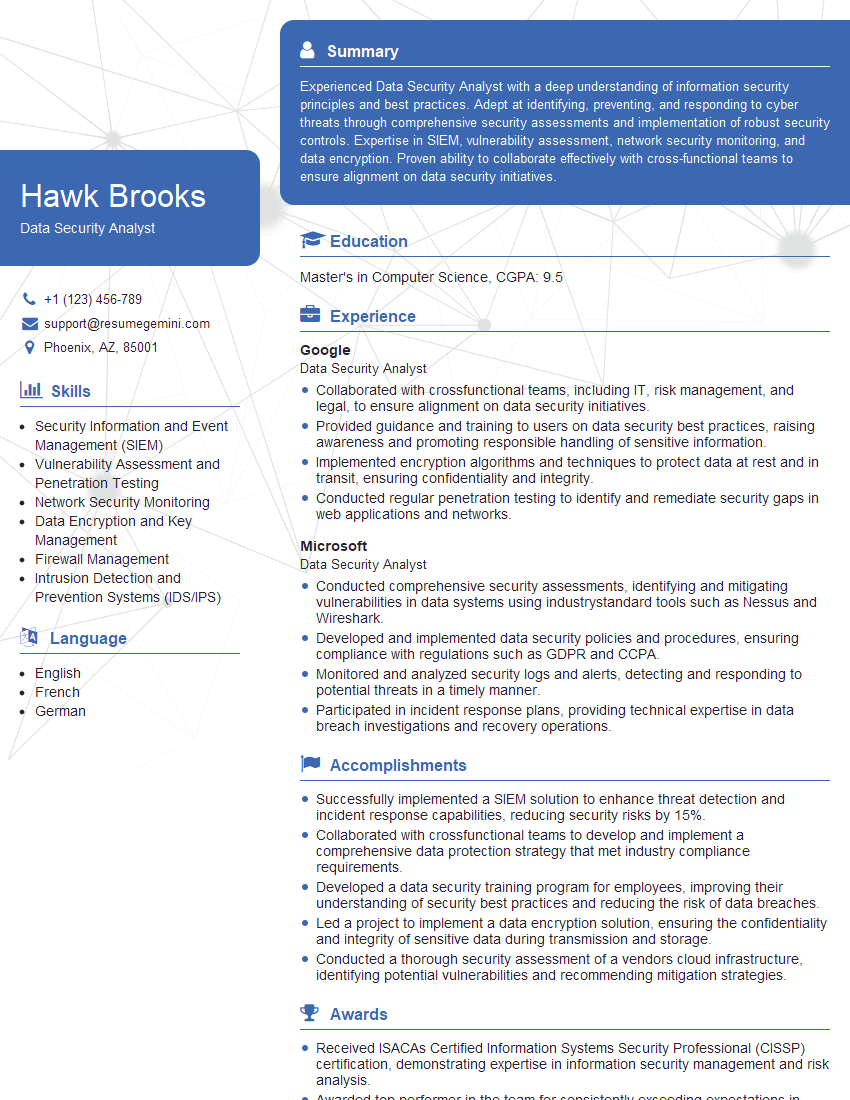
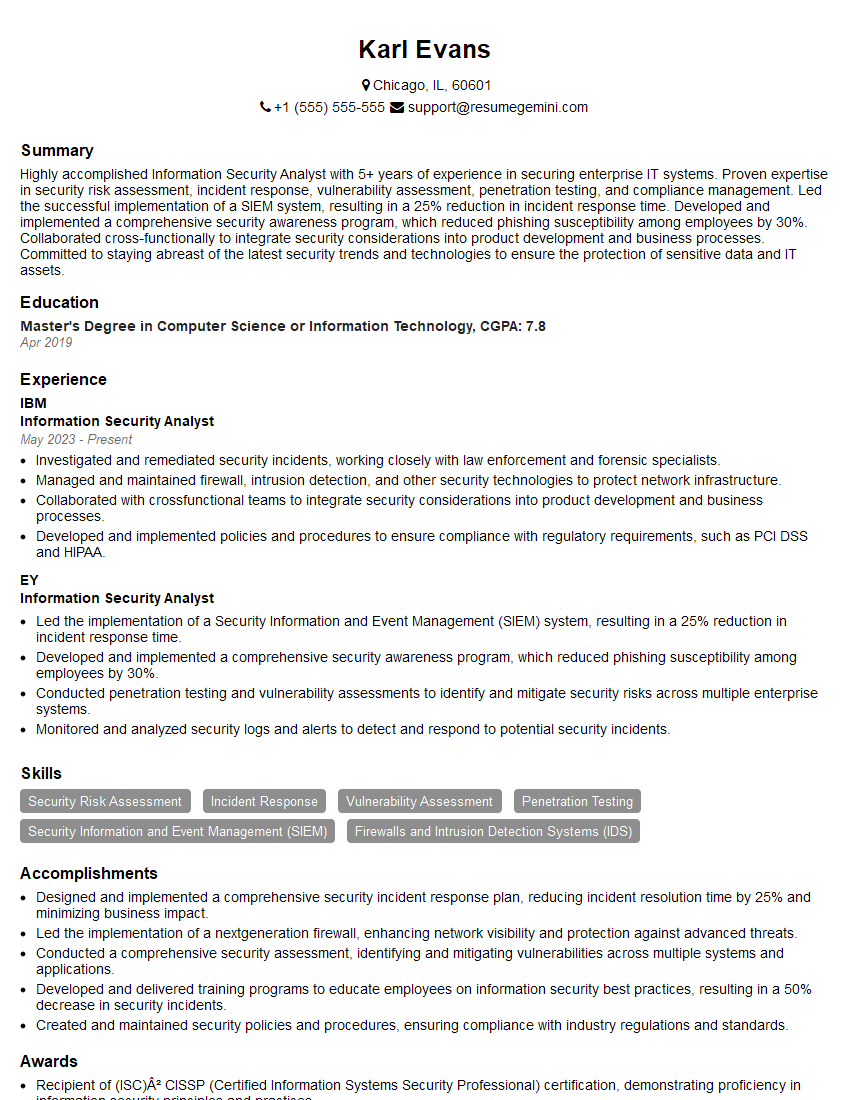
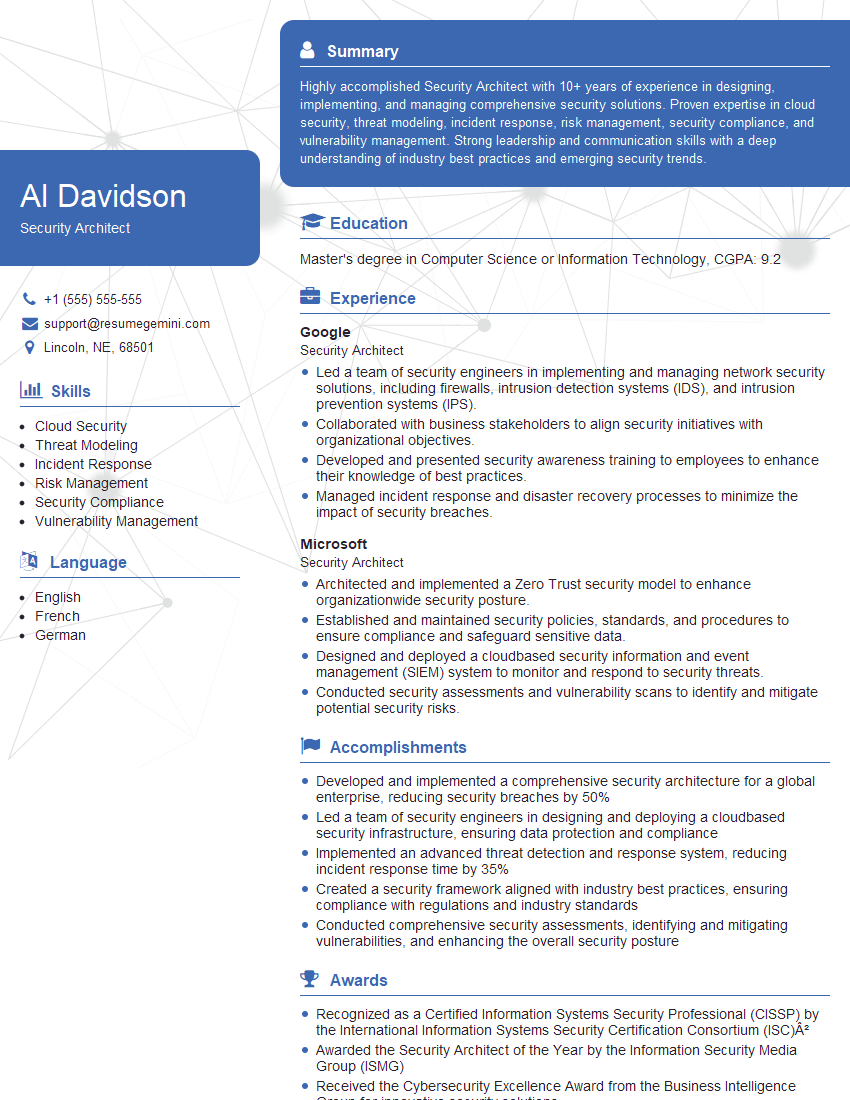
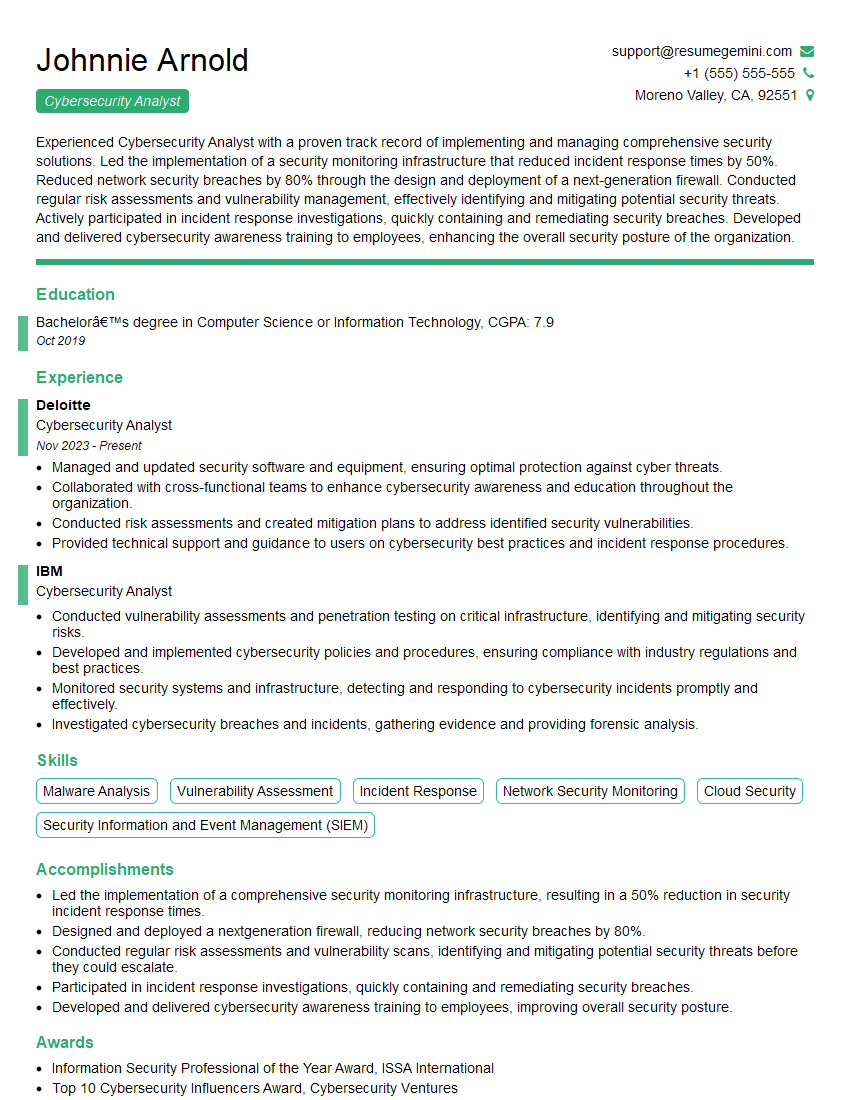
Mastering Security Information and Event Management (SIEM) tools is crucial for career advancement in cybersecurity. A strong understanding of these tools demonstrates valuable skills highly sought after by employers. To significantly boost your job prospects, creating an ATS-friendly resume is essential. ResumeGemini is a trusted resource that can help you build a professional and impactful resume. We provide examples of resumes tailored to Security Information and Event Management (SIEM) Tools to guide you in crafting your own compelling application.
Explore more articles
Users Rating of Our Blogs
Share Your Experience
We value your feedback! Please rate our content and share your thoughts (optional).
What Readers Say About Our Blog
Very informative content, great job.
good