Are you ready to stand out in your next interview? Understanding and preparing for Wind Tunnel Data Analysis interview questions is a game-changer. In this blog, we’ve compiled key questions and expert advice to help you showcase your skills with confidence and precision. Let’s get started on your journey to acing the interview.
Questions Asked in Wind Tunnel Data Analysis Interview
Q 1. Explain the process of acquiring and validating wind tunnel data.
Acquiring and validating wind tunnel data is a multi-step process crucial for reliable results. It begins with meticulous planning, including defining the test objectives, selecting the appropriate wind tunnel and instrumentation, and designing the model. Data acquisition involves running the test at various wind speeds and angles of attack, recording measurements from pressure transducers, load cells, and other sensors. This raw data then undergoes a rigorous validation process.
Validation involves several steps. First, we check for data integrity—ensuring there are no obvious errors or inconsistencies in the recordings. This may involve visual inspection of plots, comparing data from redundant sensors, and checking for spikes or unrealistic values. Second, we perform repeatability tests by running the same test conditions multiple times. The results should fall within a predetermined acceptable range. Significant deviations might indicate problems with the setup or instrumentation. Finally, we often compare the results against established data or theoretical predictions, whenever possible. This helps identify potential biases or systematic errors. For instance, comparing the lift coefficient of an airfoil against known values from established databases provides a crucial benchmark.
For example, in a recent project testing a novel wing design, we encountered an unusual spike in the drag coefficient at a specific angle of attack. Through careful investigation, we discovered a minor issue with a pressure tap that had become partially blocked, leading to inaccurate pressure readings. Addressing this issue significantly improved the data quality and reliability of the results.
Q 2. Describe different types of wind tunnel corrections and their application.
Wind tunnel corrections account for the differences between the ideal conditions assumed in theoretical models and the actual conditions within the wind tunnel. These corrections are essential for obtaining accurate aerodynamic data. Common corrections include:
- Blockage correction: Accounts for the influence of the model on the airflow in the test section, which can lead to increased velocities and distorted flow patterns. We often use empirical correlations or computational fluid dynamics (CFD) simulations to estimate this effect.
- Wall interference correction: Corrects for the interference effects of the wind tunnel walls on the model’s airflow. These effects are particularly significant in smaller wind tunnels where the model occupies a larger proportion of the test section. Methods to account for this include image techniques and boundary element methods.
- Turbulence correction: Addresses the effect of turbulence in the wind tunnel’s free stream on the model’s aerodynamics. Turbulence intensity measurements are necessary to apply appropriate corrections.
- Support interference correction: Compensates for the influence of the model’s support system on the aerodynamic forces and moments. This typically involves careful design of the support system and/or experimental techniques to minimize the influence.
The application of these corrections often involves complex mathematical models and iterative procedures. Specialized software is typically used to automate these corrections, ensuring consistency and accuracy.
Q 3. How do you identify and handle outliers in wind tunnel datasets?
Outliers in wind tunnel datasets can arise due to various factors, including sensor malfunctions, sudden gusts of wind, or human error. Identifying them is crucial for ensuring data quality. Visual inspection of scatter plots is the first step. Points significantly deviating from the general trend should raise suspicion. Statistical methods like box plots and the use of Chauvenet’s criterion or the standard deviation rule can further help identify outliers. For example, any data point more than three standard deviations away from the mean can be classified as a possible outlier. It’s important to remember that context matters. Sometimes a true outlier reflects a genuinely unusual event. For instance, a sudden change in aerodynamic behavior might indicate stall.
Handling outliers requires careful consideration. Simply discarding them is not always appropriate and could lead to biased results. Instead, a thorough investigation is necessary to determine the cause. If a sensor malfunction is identified, the corresponding data points should be removed. If the cause is unknown, a sensitivity analysis can be performed to assess the impact of the outliers on the overall results. Documentation of the outlier identification and handling process is essential for transparency and repeatability.
Q 4. What are the common sources of error in wind tunnel testing?
Wind tunnel testing is prone to various error sources. These can be broadly categorized as:
- Systematic errors: These are consistent and repeatable errors, often stemming from imperfections in the wind tunnel design or instrumentation. Examples include wind tunnel wall interference, blockage effects, and calibration errors in sensors.
- Random errors: These are unpredictable fluctuations in measurements, resulting from factors like turbulence in the flow, sensor noise, and variations in environmental conditions (temperature, pressure).
- Model related errors: Imperfections in the model construction, such as surface roughness or inaccuracies in the model geometry, can influence the results. The support system itself can also introduce errors if not carefully designed and tested.
- Human errors: Mistakes in data acquisition, processing, or analysis are always a possibility.
Minimizing these errors involves careful planning, proper calibration of equipment, rigorous testing procedures, and using appropriate data analysis techniques to identify and quantify the uncertainties.
Q 5. Explain the difference between static and dynamic wind tunnel testing.
Static wind tunnel testing involves measuring aerodynamic forces and moments on a stationary model at different angles of attack and wind speeds. It provides steady-state data which is useful for design purposes involving fixed-wing aircraft, or other structures not intended for dynamic motion.
Dynamic wind tunnel testing, on the other hand, involves subjecting the model to oscillatory motions—like pitching, rolling, or yawing—while measuring aerodynamic forces and moments. This type of testing is crucial for understanding aircraft or other dynamic systems’ response to unsteady flows and is necessary for the study of flutter, buffeting, or other dynamic phenomena.
For example, static testing is suitable for determining the lift and drag characteristics of an airfoil at various angles of attack, while dynamic testing is needed to investigate the aeroelastic stability of a wing in unsteady flows.
Q 6. How do you determine the uncertainty in wind tunnel measurements?
Determining the uncertainty in wind tunnel measurements is crucial for assessing the reliability and accuracy of the results. A comprehensive uncertainty analysis considers both random and systematic errors. We use the Guide to the Expression of Uncertainty in Measurement (GUM) as the framework. This involves identifying all sources of uncertainty, quantifying their contributions (using statistical methods and calibration data), and combining them to obtain an overall uncertainty estimate. For example, uncertainty in the wind speed, pressure measurements, balance readings, and corrections all need to be considered.
The uncertainty is often expressed as a confidence interval around the measured value. For instance, a lift coefficient of 1.2 ± 0.05 (95% confidence) means that there is a 95% probability that the true value lies within the range of 1.15 and 1.25. Reporting uncertainty is essential for transparent communication of the results and allows for meaningful comparisons between different wind tunnel tests or theoretical predictions.
Q 7. Describe your experience with data reduction techniques for wind tunnel data.
Data reduction techniques are vital for extracting meaningful aerodynamic coefficients from raw wind tunnel data. These techniques involve processing the raw measurements from pressure sensors, load cells, etc., to calculate quantities such as lift coefficient (Cl), drag coefficient (Cd), moment coefficients, and pressure distributions. These calculations typically involve dividing the measured forces and moments by reference quantities like dynamic pressure and reference area.
I have extensive experience using both manual calculations and specialized software packages designed for wind tunnel data reduction. For example, I’ve utilized Tecplot and similar programs to visualize and analyze pressure distributions over complex geometries. Software like Testlab allows for automated data processing and correction, which greatly enhances efficiency and reduces the risk of human error. I’m also proficient in scripting languages such as Python to perform custom data processing and analysis, tailoring the procedures to the specific needs of the project. This customizability is particularly valuable when dealing with unconventional measurement setups or data formats.
In one project involving the analysis of a complex aircraft configuration, using custom Python scripts allowed for automated application of corrections for model support interference, which significantly improved the accuracy of the results. These scripts also facilitated the creation of comprehensive reports which included all necessary data reduction steps and uncertainty estimates.
Q 8. How do you visualize and interpret wind tunnel data?
Visualizing and interpreting wind tunnel data involves a multi-faceted approach combining graphical representations with statistical analysis. We typically start with plotting raw data, such as force and moment coefficients (Cx, Cy, Cz, Cm, Cl, Cn) against angle of attack or Reynolds number. This initial visualization helps identify trends and potential anomalies. For example, a sudden drop in lift coefficient might indicate stall.
Further interpretation involves understanding the physical phenomena behind the data. We might use contour plots to visualize pressure distributions around an airfoil, revealing areas of high and low pressure responsible for lift and drag. Similarly, we use streamlines to visualize the flow field, identifying flow separation, vortices, and other crucial aerodynamic features. Statistical tools like regression analysis can be used to model data and predict performance at conditions not tested directly. The key is to not just see the numbers, but to understand the story they tell about the aerodynamics of the tested object.
For instance, when analyzing data from a car model, we might create visualizations showing the effect of a spoiler on the drag coefficient at various yaw angles. This aids in understanding the spoiler’s effectiveness and identifying potential design improvements.
Q 9. What software packages are you proficient in for wind tunnel data analysis?
My expertise spans several software packages commonly used in wind tunnel data analysis. I’m highly proficient in Tecplot, a powerful visualization and post-processing tool that excels at creating insightful plots from complex datasets. I also have extensive experience with MATLAB, which I utilize for data manipulation, statistical analysis, and custom code development for specialized analyses. Furthermore, I’m familiar with ANSYS and OpenFOAM, though primarily for CFD validation and comparison against experimental data. Finally, I’m experienced with in-house developed software tailored to specific wind tunnel facilities and their data acquisition systems. The choice of software depends on the specific needs of the project and the data’s complexity. For example, MATLAB might be ideal for complex statistical analysis, while Tecplot is better suited for visualizations.
Q 10. Explain your understanding of Reynolds number and its significance in wind tunnel testing.
The Reynolds number (Re) is a dimensionless quantity that describes the ratio of inertial forces to viscous forces within a fluid. It’s crucial in wind tunnel testing because it governs the flow regime—whether it’s laminar (smooth) or turbulent (chaotic). The formula for Reynolds number is Re = (ρVL)/μ, where ρ is the fluid density, V is the flow velocity, L is a characteristic length (e.g., airfoil chord), and μ is the dynamic viscosity.
The significance of Re lies in its impact on aerodynamic forces. A low Re indicates a laminar flow, while a high Re usually signifies turbulent flow. Since turbulent flow significantly alters drag and lift, achieving Reynolds number similarity between the model scale and the full-scale prototype is crucial for accurate extrapolation of wind tunnel results. For example, testing a scale model of an aircraft wing at a low Re might give misleading results concerning drag and lift if the full-scale aircraft operates at a much higher Re. This necessitates careful consideration of scaling laws and potentially employing techniques like wall-mounted roughness to introduce turbulence at the model scale.
Q 11. How do you account for model support interference in wind tunnel data?
Model support interference is a significant source of error in wind tunnel testing. The support system (sting, struts, etc.) used to hold the model in the wind tunnel flow can disrupt the airflow around the model, leading to inaccurate measurements. Several techniques mitigate this:
- Careful Design: Using slender supports with minimal blockage and strategically placed supports to minimize disruption. The design should be optimized to minimize the interference effects through computational fluid dynamics (CFD) simulations prior to wind tunnel testing.
- Support Interference Corrections: Applying corrections to the measured data based on calibration tests and theoretical models. This often involves measuring the interference effects independently and then subtracting them from the measured forces and moments.
- Advanced Support Systems: Employing sophisticated support systems such as internal balances or magnetic suspension systems, minimizing interference through reduced physical connection with the model.
For instance, when testing an aircraft model, improper support design could lead to artificially high lift and drag measurements. Addressing support interference is critical for obtaining reliable and accurate data.
Q 12. Describe your experience with different types of wind tunnel balances.
My experience includes working with various types of wind tunnel balances, each with its strengths and weaknesses:
- Internal Balances: These balances are integrated within the model itself, minimizing support interference. They are highly accurate but can be complex and expensive to design and manufacture. I have worked extensively with internal balances during high-precision aerodynamic testing.
- External Balances: These balances are located outside the model, connected to it via a support system. They are typically less expensive and easier to install than internal balances but are more susceptible to support interference. I have significant experience with calibrating and using these for general aerodynamic experiments.
- Strain Gauge Balances: These balances utilize strain gauges to measure forces and moments. They provide high accuracy and sensitivity, making them suitable for subtle aerodynamic effects. This is a very common type of balance in my experience.
- Six-Component Balances: These measure all six degrees of freedom (three forces and three moments). They are essential for comprehensive aerodynamic characterization.
Choosing the right balance depends on factors such as budget, accuracy requirements, model design, and the complexity of the experiment. For example, high-precision experiments requiring minimal support interference necessitate the use of internal balances.
Q 13. How do you handle data from different wind tunnel runs?
Handling data from different wind tunnel runs requires a systematic approach. First, data quality control is critical. This involves checking for any outliers or inconsistencies in the data which may arise from issues in the wind tunnel setup, instrument malfunction, or even operator error.
Data from various runs are then integrated using statistical methods. This can involve averaging multiple runs under identical conditions to improve the signal-to-noise ratio. Furthermore, data normalization is crucial. This might involve scaling data to a common reference point (e.g., free-stream velocity) or using statistical techniques to account for run-to-run variations. Careful documentation of each run’s parameters (e.g., airspeed, temperature, humidity) is critical for proper data analysis and comparison.
For example, if testing a wing at multiple angles of attack, we’d average the results at each angle from several runs to improve the accuracy and reduce the impact of random errors. This step involves rigorous quality control to identify and eliminate outlier data points caused by factors like equipment malfunction.
Q 14. Explain the concept of boundary layer effects and how they influence wind tunnel results.
Boundary layer effects are crucial in wind tunnel testing as they significantly influence the flow around a model and thus affect the aerodynamic measurements. The boundary layer is a thin region of fluid near a surface where the flow velocity changes from zero at the surface (no-slip condition) to the free-stream velocity. The thickness and characteristics of the boundary layer (laminar or turbulent) dramatically impact aerodynamic forces like drag and lift.
A turbulent boundary layer causes significantly higher drag than a laminar boundary layer. The boundary layer can also separate from the surface, leading to flow separation, increased drag, and loss of lift. This separation is strongly influenced by the Reynolds number, pressure gradients, and surface roughness.
In wind tunnel experiments, careful consideration must be given to minimize boundary layer effects. Techniques include: Using a low turbulence wind tunnel, implementing boundary layer trips (to encourage earlier transition from laminar to turbulent flow), and ensuring that the test section walls are sufficiently far from the model to minimize wall interference. Failing to account for boundary layer effects can lead to significant errors in the analysis and interpretation of wind tunnel data. For example, a poorly designed wind tunnel or model setup might exhibit large boundary layer effects masking the true aerodynamic characteristics of the object under test.
Q 15. What are the key considerations when designing a wind tunnel test?
Designing a successful wind tunnel test requires meticulous planning and consideration of several key factors. It’s like baking a cake – you need the right ingredients and process to get the desired outcome. Firstly, model scaling is crucial. We need to determine the appropriate scale of the model relative to the full-scale object, balancing detail with the limitations of the wind tunnel. Too small, and you lose important details; too large, and it might not fit! Secondly, test section selection is vital. The test section’s size and shape should accommodate the model and the desired flow conditions. A closed-return tunnel offers better flow uniformity, while an open-return design is simpler but may have higher turbulence. Thirdly, flow quality is paramount. We must minimize turbulence and ensure a uniform velocity profile across the test section. This often involves using screens, honeycombs, and other flow conditioning devices. Finally, instrumentation is key. Choosing appropriate sensors (pressure transducers, force balances, particle image velocimetry (PIV) systems etc.) that accurately measure the parameters of interest is vital for obtaining reliable data.
- Example: For testing a high-speed aircraft model, a supersonic wind tunnel with a larger test section might be necessary. For a building model studying wind loads, a boundary layer wind tunnel is more appropriate.
Career Expert Tips:
- Ace those interviews! Prepare effectively by reviewing the Top 50 Most Common Interview Questions on ResumeGemini.
- Navigate your job search with confidence! Explore a wide range of Career Tips on ResumeGemini. Learn about common challenges and recommendations to overcome them.
- Craft the perfect resume! Master the Art of Resume Writing with ResumeGemini’s guide. Showcase your unique qualifications and achievements effectively.
- Don’t miss out on holiday savings! Build your dream resume with ResumeGemini’s ATS optimized templates.
Q 16. How do you ensure the quality and reliability of wind tunnel data?
Ensuring data quality and reliability in wind tunnel testing involves a multi-pronged approach, similar to a rigorous scientific experiment. First, we must perform rigorous calibration of all instrumentation before, during, and after testing. This ensures accuracy and detects any drift in measurements. Next, we employ repeatability checks by repeating measurements under identical conditions. Consistent results build confidence. We also account for environmental conditions, monitoring temperature, pressure, and humidity, which all influence the flow properties. Furthermore, data reduction techniques are applied to filter noise and outliers from the raw data, using appropriate statistical methods. Finally, a thorough uncertainty analysis is performed to quantify the uncertainty associated with the measurements. This is not just about the accuracy of the instruments, but also considers uncertainties in model construction, flow conditions, and data reduction processes.
- Example: A systematic error in a pressure transducer can be identified and corrected during calibration. Consistent discrepancies between repeated runs highlight potential issues that need investigation.
Q 17. Describe your experience with uncertainty quantification in wind tunnel data analysis.
Uncertainty quantification is an integral part of my wind tunnel data analysis workflow. I use methods like GUM (Guide to the Expression of Uncertainty in Measurement) to comprehensively evaluate and propagate uncertainties. This involves identifying all sources of uncertainty, quantifying their individual contributions (e.g., instrument precision, model manufacturing tolerances, repeatability), and combining them to obtain an overall uncertainty estimate for the final results. I utilize statistical methods to determine confidence intervals and present the results with their associated uncertainty ranges. This ensures that the data’s limitations are clearly communicated, allowing for proper interpretation and informed decision-making.
- Example: When reporting a lift coefficient (Cl), we might present it as Cl = 0.8 ± 0.05, indicating a 95% confidence interval. This transparency is crucial for evaluating the reliability and significance of the results.
Q 18. How do you correlate wind tunnel data with computational fluid dynamics (CFD) results?
Correlating wind tunnel data with CFD results involves a systematic comparison and analysis. Think of it as cross-referencing two independent investigations into the same problem. First, we ensure that the CFD model accurately represents the wind tunnel model, including geometry, mesh quality, and boundary conditions. Discrepancies here will result in poor correlation. Next, we compare key aerodynamic parameters obtained from both methods, such as force and moment coefficients, pressure distributions, and velocity profiles. We aim for quantitative agreement within the uncertainties of both the experimental and computational results. Disagreements require careful investigation into potential sources of error in both the experiment and the simulation. Sensitivity studies in the CFD model can help pinpoint sensitive parameters. Visualizations, such as surface pressure contours, can highlight areas of agreement or disagreement.
- Example: We might plot wind tunnel data and CFD results for lift coefficient versus angle of attack and look for trends and discrepancies. The CFD can potentially explain detailed flow structures seen in wind tunnel visualizations, and vice versa.
Q 19. Explain your experience with pressure measurement techniques in wind tunnels.
My experience encompasses various pressure measurement techniques in wind tunnels, each with its strengths and limitations. Scans using pressure taps offer highly localized pressure data but require extensive model preparation and are limited to discrete points. Pressure sensitive paint (PSP) provides a full-field pressure distribution but is sensitive to environmental conditions and requires specialized equipment. Micro-pressure sensors offer greater spatial resolution than pressure taps, but come with complexity and higher cost. The choice of technique depends on the specific application and desired resolution. For instance, in an automotive application, PSP might be ideal to visualize the overall pressure distribution, while pressure taps are useful for detailed measurements in specific regions of interest, like the underbody.
Q 20. How do you interpret force and moment coefficients obtained from wind tunnel tests?
Force and moment coefficients, non-dimensional quantities derived from wind tunnel measurements, are crucial for understanding aerodynamic performance. The lift coefficient (Cl) represents the lift force normalized by dynamic pressure and reference area. A higher Cl indicates better lift generation. The drag coefficient (Cd) represents the drag force similarly. A lower Cd indicates lower resistance. The moment coefficients (Cm, Cl, Cn) represent the moments around the respective axes. These coefficients are functions of the angle of attack, Reynolds number, and other relevant parameters. They inform design decisions and help predict the behavior of the full-scale object. Interpreting these coefficients usually involves plotting them against the angle of attack, examining trends, and comparing them to theoretical predictions or previous data.
- Example: A high Cl at low angle of attack is desirable for aircraft wings, while a low Cd is important for reducing fuel consumption. Negative Cm values suggest static stability.
Q 21. What are the limitations of wind tunnel testing?
Wind tunnel testing, while powerful, has limitations. The most significant is the scale effect. The Reynolds number (a dimensionless quantity representing the ratio of inertial forces to viscous forces) of the model may differ from the full-scale object, leading to discrepancies in aerodynamic performance. Tunnel wall interference can distort the flow around the model, especially in smaller tunnels. Support interference from the model’s mounting system can also affect measurements. Furthermore, wind tunnels struggle to accurately simulate complex flow phenomena like separated flows, unsteady flows, or the effects of atmospheric turbulence realistically. Lastly, wind tunnel tests can be expensive and time-consuming, requiring careful planning and skilled personnel.
Q 22. Describe your experience with non-dimensionalization of wind tunnel data.
Non-dimensionalization is crucial in wind tunnel data analysis because it allows us to generalize results from a specific model and wind tunnel test to a broader range of scenarios. Essentially, we’re removing the effects of scale and specific test conditions to reveal the underlying physics. This is achieved by expressing quantities as ratios of relevant parameters. For example, instead of dealing with raw forces in Newtons, we use coefficients like the lift coefficient (Cl) and drag coefficient (Cd). These are calculated by dividing the lift and drag forces by dynamic pressure (1/2 * ρ * V²), where ρ is the air density and V is the freestream velocity, and then by a reference area.
Consider a test on a small-scale aircraft model. By non-dimensionalizing the data, we obtain coefficients that apply to a full-scale aircraft, provided the Reynolds number is matched or appropriately corrected for. We also commonly use dimensionless parameters like the Reynolds number (Re = ρVL/μ, where L is a characteristic length and μ is dynamic viscosity) and the Mach number (Ma = V/a, where a is the speed of sound), which dictate the flow regime and its compressibility effects. Proper non-dimensionalization ensures that our experimental results are robust and widely applicable, beyond the limitations of a particular wind tunnel test.
Q 23. Explain your understanding of turbulence modeling in relation to wind tunnel data.
Turbulence modeling in relation to wind tunnel data analysis is extremely important, especially for external aerodynamics. Wind tunnels can’t perfectly replicate the turbulence found in real-world atmospheric conditions. Understanding and accounting for this discrepancy is critical for accurate predictions. We often use turbulence models to simulate the effect of turbulence on the flow around a model. These models are incorporated into Computational Fluid Dynamics (CFD) simulations used to complement wind tunnel data.
For example, we might use a k-ε or k-ω SST turbulence model within our CFD simulations to predict the boundary layer development and separation. Then we compare the predicted quantities (forces, moments, pressures) with our wind tunnel measurements. Discrepancies highlight areas where the model needs refinement or reveal limitations of the wind tunnel’s ability to simulate specific turbulent features. The goal is not just to match the experimental data perfectly, but to understand the underlying physics and limitations of both the model and the experimental setup. Advanced techniques like Large Eddy Simulation (LES) can provide a more detailed representation of turbulence, especially near separation regions, although this comes at a higher computational cost.
Q 24. How do you use wind tunnel data to improve aerodynamic design?
Wind tunnel data is instrumental in aerodynamic design improvement. It allows us to quantitatively assess the aerodynamic performance of a design and identify areas for optimization. For instance, we might use wind tunnel data to measure the lift and drag of an airfoil at various angles of attack, helping us select the best airfoil shape for a specific application.
The data helps us visualize flow fields using techniques such as oil flow visualization or surface pressure measurements which highlight flow separation, vortices, and other important flow phenomena. Once we understand the flow characteristics, we can modify the design to reduce drag, increase lift, or improve stability. This iterative process, involving wind tunnel testing, data analysis, design modifications, and further testing, is central to developing high-performance aerodynamic designs for aircraft, automobiles, buildings, and other applications. In the context of a car, for example, we might use wind tunnel data to optimize its shape to reduce drag and improve fuel efficiency.
Q 25. How do you address issues related to data scaling and transformation in wind tunnel analysis?
Data scaling and transformation are crucial aspects of wind tunnel analysis. Often, we need to scale data from a model tested in a wind tunnel to predict the performance of a full-scale object. This involves considering factors such as Reynolds number effects and, for compressible flows, Mach number effects. Scaling laws, often derived from dimensional analysis, guide this process. Simple scaling might involve direct proportionality (e.g., forces scale with the square of a length scale), but accounting for Reynolds number effects can be more complex, requiring corrections based on theoretical or empirical relationships.
Data transformation might involve converting raw measurements into more meaningful quantities. For example, we might convert raw pressure measurements to pressure coefficients to facilitate comparison between tests performed at different velocities and altitudes. Statistical methods are used to handle uncertainties and noise in the data, including filtering and smoothing techniques to identify trends and remove spurious data points. We also use techniques like uncertainty quantification to assess the confidence levels associated with our conclusions. The choice of scaling and transformation methods greatly affects the accuracy and reliability of our findings and needs to be carefully selected based on the flow regime and the type of measurements collected.
Q 26. Describe your experience with surface pressure measurements and their analysis.
Surface pressure measurements provide invaluable insights into the flow field around a model. We typically use pressure taps or pressure-sensitive paint to obtain pressure data on the model’s surface. Analysis of this data reveals pressure distributions, pressure gradients, and regions of high and low pressure. These can be used to identify flow separation, stagnation points, and areas of high aerodynamic loading.
This information is crucial in understanding the forces and moments acting on the model. For example, integrating the pressure distribution over the surface of an airfoil allows us to calculate the lift and moment coefficients directly. Pressure coefficient maps, which non-dimensionalize the pressure data, enable easy comparison between different tests and designs. We also use pressure data to validate CFD simulations, helping to assess their accuracy and refine turbulence models.
Q 27. What strategies do you employ for efficient data management and organization in a wind tunnel project?
Efficient data management is essential for any wind tunnel project, especially considering the large volume of data generated. I typically use a structured approach, employing a combination of techniques. First, a clear naming convention is vital for all files, ensuring consistency and traceability. Second, data is stored in a well-organized directory structure, often using a project-based hierarchy. Third, data is meticulously documented, including details about experimental setup, calibration procedures, and data processing methods.
We often utilize data management software or spreadsheets to store and analyze the data, ensuring data integrity and accessibility. Data version control is important to track changes and revert to previous versions if needed. For extremely large datasets, specialized data management systems or cloud-based storage solutions might be necessary. Proper data management facilitates efficient analysis and enables effective collaboration among team members, contributing to project success and reproducibility.
Q 28. Explain your experience with wind tunnel testing on different types of models (e.g., airfoils, cars, buildings).
My experience encompasses wind tunnel testing on a variety of models, including airfoils, cars, and buildings. The approach to testing and data analysis varies depending on the model type. Airfoil testing typically focuses on lift, drag, and moment coefficients at different angles of attack, often in a low-turbulence environment. Analysis involves detailed examination of pressure distributions and boundary layer behavior.
Car testing is more complex, often involving measurements of drag, lift, and moments at multiple yaw angles to assess aerodynamic performance and stability. Flow visualization techniques like smoke visualization are used to identify flow separation and vortex formations. Building testing often involves assessing wind loads and pressures on the building facade, providing data for structural analysis. Scale effects are a significant consideration for large models like buildings, where the Reynolds number in the tunnel may differ significantly from real-world conditions. Specific techniques are employed to address these scaling issues, often involving advanced turbulence modeling and computational tools.
Key Topics to Learn for Wind Tunnel Data Analysis Interview
- Data Acquisition and Instrumentation: Understanding various sensors, their limitations, and data acquisition techniques used in wind tunnels. This includes understanding uncertainty quantification and error analysis.
- Data Preprocessing and Cleaning: Techniques for handling noisy data, outliers, and missing values. This involves practical experience with relevant software packages.
- Aerodynamic Force and Moment Analysis: Calculating lift, drag, pitching moment, etc., from pressure and force measurements. Understanding the theoretical basis and practical application of these calculations.
- Flow Visualization Techniques: Interpreting data from techniques like surface oil flow, tufts, and smoke visualization to understand flow separation and other phenomena.
- Computational Fluid Dynamics (CFD) Correlation: Comparing wind tunnel data with CFD simulations to validate models and identify discrepancies. Understanding the strengths and limitations of both methods.
- Uncertainty Quantification and Error Analysis: Properly assessing the uncertainty associated with wind tunnel measurements and understanding how it impacts the conclusions drawn from the data.
- Data Presentation and Reporting: Creating clear and concise reports and visualizations of wind tunnel data to effectively communicate results to engineers and stakeholders.
- Statistical Analysis Methods: Applying statistical methods (e.g., regression analysis, ANOVA) to analyze wind tunnel data and draw meaningful conclusions.
Next Steps
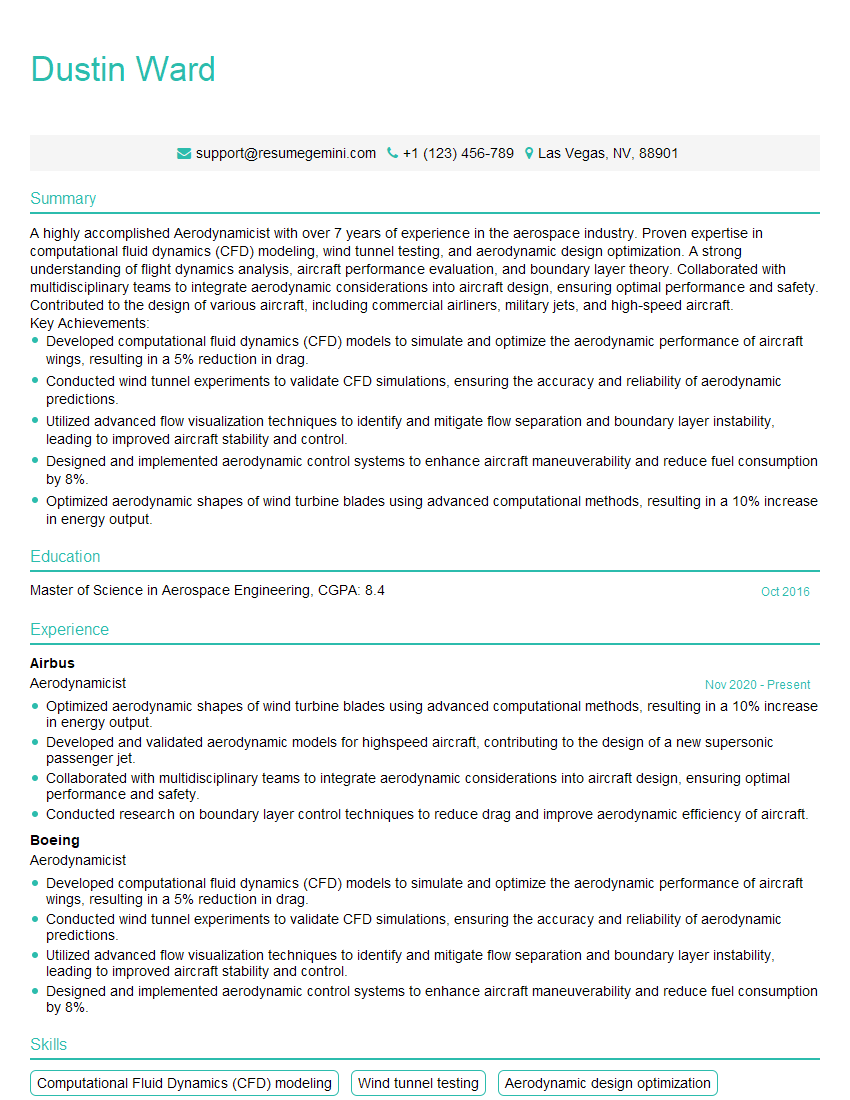
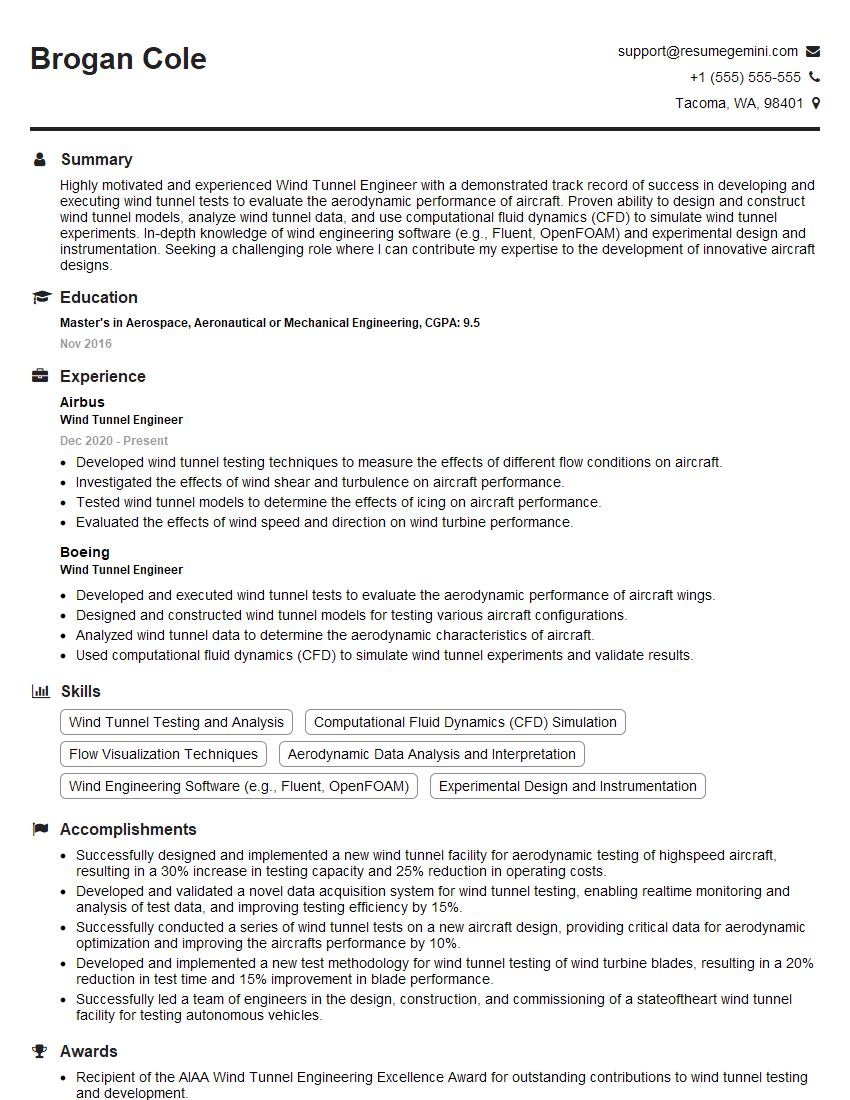
Mastering Wind Tunnel Data Analysis opens doors to exciting careers in aerospace, automotive, and renewable energy sectors, offering opportunities for innovation and significant impact. To maximize your job prospects, invest time in crafting an ATS-friendly resume that showcases your skills and experience effectively. ResumeGemini is a trusted resource that can help you build a professional and compelling resume. We provide examples of resumes tailored specifically to Wind Tunnel Data Analysis to help you get started. Take this opportunity to present yourself confidently and land your dream job!

Explore more articles
Users Rating of Our Blogs
Share Your Experience
We value your feedback! Please rate our content and share your thoughts (optional).
What Readers Say About Our Blog
Very informative content, great job.
good