Cracking a skill-specific interview, like one for Wind Turbine Modeling, requires understanding the nuances of the role. In this blog, we present the questions you’re most likely to encounter, along with insights into how to answer them effectively. Let’s ensure you’re ready to make a strong impression.
Questions Asked in Wind Turbine Modeling Interview
Q 1. Explain the different types of wind turbine models and their applications.
Wind turbine models range in complexity, from simple analytical models to highly detailed computational simulations. The choice depends on the specific application and desired level of accuracy.
- Analytical Models: These models use simplified equations to estimate turbine performance. They are computationally inexpensive but less accurate. Examples include the power law model for wind shear and simple capacity factor calculations based on wind resource data. These are useful for initial site assessments and preliminary feasibility studies.
- Blade Element Momentum (BEM) Models: These models break down the turbine blade into many small segments and apply momentum theory to each segment, considering aerodynamic forces. BEM models offer a good balance between accuracy and computational cost, making them suitable for design optimization and performance analysis.
- Computational Fluid Dynamics (CFD) Models: These models use numerical methods to solve the Navier-Stokes equations, offering the highest level of accuracy. However, they require significant computational resources and expertise. CFD is valuable for detailed analysis of blade aerodynamics, wake effects, and turbine-tower interactions, particularly for complex geometries or unsteady flow conditions.
- System-Level Models: These models integrate various turbine components (blades, gearbox, generator) to simulate the entire turbine system’s behavior under different operating conditions. These can be used to predict power output, component stresses, and control system performance.
For example, a simple analytical model might be used to quickly estimate the annual energy production of a turbine at a proposed site. A BEM model would be employed for detailed blade design optimization, and a CFD model would be used to investigate flow separation on a blade during extreme wind conditions.
Q 2. Describe your experience with blade element momentum (BEM) theory.
I have extensive experience with Blade Element Momentum (BEM) theory. BEM is a crucial tool in wind turbine design and performance analysis. It works by dividing the rotor blade into numerous segments and applying both blade element theory and momentum theory to each segment. Blade element theory calculates the aerodynamic forces (lift and drag) on each segment based on its airfoil characteristics and the local flow conditions. Momentum theory accounts for the induced velocities due to the rotor’s action on the air, which are essential for accurate force predictions.
In my work, I’ve used BEM to optimize blade designs for maximum energy capture and minimum fatigue loads. This involves iteratively adjusting parameters like blade twist, chord length, and airfoil shape to improve the aerodynamic performance and structural integrity of the blade. I’ve also used BEM models to assess the impact of changes in operating conditions, such as wind shear and turbulence, on turbine performance.
For instance, I once used a BEM-based code to investigate the effect of different airfoil sections on a new blade design. By comparing the predicted power output and fatigue loads for various airfoils, we were able to select the optimal airfoil for specific operating conditions and increase overall energy capture by 5%.
Q 3. How do you account for atmospheric turbulence in wind turbine modeling?
Atmospheric turbulence significantly impacts wind turbine performance and fatigue loading. We account for turbulence in wind turbine modeling through several methods:
- Stochastic models: These models generate time series of turbulent wind speeds using statistical approaches like spectral methods, which are based on the power spectral density of the turbulence. These models commonly employ models like the von Kármán spectrum.
- Simulations with CFD: More detailed models can simulate turbulence directly using large-eddy simulations (LES) or Reynolds-averaged Navier-Stokes (RANS) methods within CFD simulations. This is computationally expensive, but it provides higher fidelity representation of turbulence.
- Turbulence intensity and scale: Simpler models may incorporate turbulence by specifying the turbulence intensity (a measure of the fluctuation of the wind speed around its mean value) and integral length scale (a measure of the size of the turbulent eddies).
The choice of method depends on the fidelity required. A simple model might suffice for preliminary analysis, while a detailed CFD simulation would be necessary for accurately predicting fatigue loads and dynamic responses.
For example, when assessing the fatigue life of a blade, we use a stochastic model to generate realistic turbulent wind inputs, then use those inputs in structural analysis to predict the stress levels and fatigue life of the component.
Q 4. What software packages are you proficient in for wind turbine simulation (e.g., FAST, Bladed, HAWC2)?
My expertise encompasses several industry-standard software packages for wind turbine simulation. I’m proficient in:
- FAST (Fatigue, Aerodynamics, Structures, and Turbulence): Developed by NREL, FAST is a highly versatile and widely used tool for simulating the aeroelastic response of wind turbines. I use it to model the coupled interactions between the aerodynamic forces, structural dynamics, and control systems of the turbine.
- Bladed: Bladed is a commercial software package known for its comprehensive features for wind turbine design, simulation, and control. I leverage its capabilities for blade design optimization and analysis of complex wind farm layouts.
- HAWC2 (Horizontally Axis Wind Turbine Code): HAWC2 is another powerful tool for modeling wind turbine dynamics, often used for more focused simulations such as assessing the impact of extreme events.
Beyond these, I am also experienced with using OpenFOAM for dedicated CFD analyses of wind turbine components or wind farms.
Q 5. Explain the concept of yaw error and its impact on wind turbine performance.
Yaw error refers to the misalignment between the wind direction and the turbine’s rotor plane. It significantly reduces turbine performance and can lead to increased fatigue loading.
An ideal wind turbine will always point directly into the wind. However, inaccuracies in wind direction measurement and control system limitations can result in yaw error. When a turbine experiences yaw error, the airflow hits the blades at an angle, causing reduced lift and increased drag. This leads to a decrease in power output. Furthermore, the asymmetric loading caused by the misalignment can put additional stress on the turbine components, increasing fatigue and the risk of failure. The magnitude of the negative impacts depend on the size of the yaw error and its duration.
In my work, we address yaw error through robust control algorithms and advanced sensor technology to minimize deviations from optimal orientation. This requires careful modeling of the yaw drive system and accurate prediction of the wind direction. Simulation tools like FAST or Bladed are essential in evaluating the performance of different control strategies and mitigating yaw error’s adverse effects.
Q 6. How do you model the wake effect of wind turbines in a wind farm?
Modeling the wake effect in a wind farm is critical for accurate prediction of overall farm performance and optimizing turbine placement. Turbines placed downwind of others experience a reduced wind speed and increased turbulence in the wake of the upstream turbines, lowering power production.
Several methods exist to model wake effects:
- Gaussian wake models: These are relatively simple models that assume the wake deficit follows a Gaussian distribution. While computationally efficient, they are less accurate for complex scenarios.
- Jensen’s model: This is an improvement on simple models, representing a more sophisticated approach to wake modeling, but still relies on empirical relationships.
- CFD simulations: The most accurate, but computationally intensive approach involves modeling the wake effect through CFD. This allows for the detailed simulation of the complex flow patterns within the wind farm, including turbulence, shear, and wake meandering.
- Actuator disk models: This method simplifies the turbine rotor by representing it as a disk that extracts energy from the wind, reducing computational cost relative to CFD while offering improved accuracy over Gaussian models. These are frequently used in conjunction with other wake models.
The choice of model depends on the desired accuracy and computational resources. For example, Gaussian wake models are often used in preliminary layout optimization studies where speed is paramount. However, more detailed CFD simulations are usually necessary for final site assessments and detailed operational predictions.
Q 7. Describe your experience with Computational Fluid Dynamics (CFD) in wind turbine modeling.
I have substantial experience using Computational Fluid Dynamics (CFD) in wind turbine modeling, specifically focusing on high-fidelity simulations. CFD allows for a detailed and accurate prediction of the flow field around the turbine, which is crucial for understanding and optimizing various aspects of turbine design and performance.
My CFD work involves:
- Blade aerodynamics: CFD helps analyze detailed blade aerodynamics, including flow separation, stall, and vortex shedding. This is vital for optimizing the airfoil design and minimizing performance losses.
- Wake modeling: CFD simulations are excellent for modeling turbine wakes in detail, including the complex turbulent structures and their influence on downstream turbines. This is particularly important for wind farm optimization.
- Aeroelastic simulations: Coupled CFD-structural analysis allows the prediction of turbine structural responses to aerodynamic forces with high accuracy, which aids in assessing fatigue loads.
- Tower shadow effects: I have modeled how the tower affects the flow field around the rotor, which is essential for accurately simulating turbine performance.
I typically use solvers like OpenFOAM or ANSYS Fluent, employing appropriate turbulence models such as Large Eddy Simulation (LES) or Reynolds Averaged Navier-Stokes (RANS) methods depending on the specific needs of the project. For instance, I recently used LES-CFD to optimize the blade tip design to reduce noise generation, leading to a 10% reduction in noise levels in our simulations, which we validated against experimental measurements.
Q 8. How do you validate and verify your wind turbine models?
Validating and verifying wind turbine models is crucial for ensuring their accuracy and reliability. It’s a two-step process. Verification focuses on whether the model is correctly implemented – does the code accurately represent the intended equations and algorithms? Validation, on the other hand, assesses whether the model accurately predicts the real-world behavior of a wind turbine.
Verification often involves code reviews, unit testing (testing individual components of the model), and comparison with simpler, analytically solvable cases. For example, we might verify the aerodynamic model by comparing its predictions for a simple airfoil to established theoretical results.
Validation usually involves comparing model predictions to experimental data. This could be from wind tunnel tests, field measurements on an operating turbine, or even data from digital twins. We might compare the predicted power output, blade loads, or tower vibrations against measured values. Discrepancies are analyzed to identify areas needing improvement in the model. Statistical metrics like RMSE (Root Mean Squared Error) and R-squared are commonly used to quantify the agreement between the model and the data. Iterative refinement of the model continues until acceptable agreement is reached.
Consider a scenario where a new control algorithm is being modeled. Verification would involve checking if the algorithm’s code accurately reflects the intended control logic. Validation would involve deploying the model and comparing the simulated turbine response (e.g., power output, blade pitch angles) with the actual response of a real turbine.
Q 9. Explain the importance of load calculations in wind turbine design.
Accurate load calculations are paramount in wind turbine design because they directly impact the structural integrity, fatigue life, and ultimately, the safety and cost-effectiveness of the turbine. Overestimating loads leads to unnecessarily expensive and heavy structures, while underestimating them poses significant safety risks.
Loads on a wind turbine are complex and arise from various sources: aerodynamic forces on the blades (influenced by wind speed, direction, and turbulence), mechanical loads from the drivetrain, and gravitational forces. These loads cause stresses and vibrations in all components—blades, tower, gearbox, and foundation.
Load calculations help determine the required material strength, component dimensions, and design safety factors. They are crucial for:
- Structural Design: Ensuring the turbine can withstand extreme wind conditions and operational loads without failure.
- Fatigue Analysis: Predicting the fatigue life of components due to cyclic loading, enabling optimized maintenance schedules.
- Cost Optimization: Balancing safety requirements with material costs and minimizing weight for reduced transportation and installation costs.
Sophisticated software tools employing finite element analysis (FEA) are commonly used to model the complex load distributions and predict component stresses. These models are validated against experimental data from scaled models or full-scale measurements. Imagine designing a turbine blade – without precise load calculations, the blade might fail catastrophically under high winds, causing significant damage and potential harm.
Q 10. How do you model the dynamic behavior of a wind turbine?
Modeling the dynamic behavior of a wind turbine requires capturing the interplay between aerodynamic forces, structural dynamics, and control systems. This is typically done using coupled multi-body dynamics simulations.
The process involves:
- Aerodynamic Modeling: Using blade element momentum (BEM) theory or computational fluid dynamics (CFD) to calculate aerodynamic forces on each blade element as it rotates. This accounts for variations in wind speed across the rotor disc (wind shear).
- Structural Modeling: Employing finite element analysis (FEA) to model the elastic deformation and vibrations of the blades, tower, and nacelle. This considers the flexibility of the structure, which is crucial for understanding dynamic loads and resonance.
- Control System Modeling: Integrating the control algorithms that regulate blade pitch, generator torque, and yaw position. This is crucial because the control system actively tries to mitigate the effects of turbulence and maintain optimal operation.
The models are usually represented by a set of coupled differential equations, often solved numerically using software like MATLAB/Simulink or specialized wind turbine simulation tools. These simulations capture transient events such as gusts, yaw maneuvers, and grid disturbances. A significant simplification involves using linearization techniques, approximating the non-linear system behavior locally around a steady-state operating point to simplify analysis.
Consider simulating a sudden gust. The dynamic model will capture how the blade’s angle of attack changes, resulting in changes in aerodynamic forces and moments. The model will also predict the subsequent structural response (vibrations) and how the control system acts to dampen these vibrations, keeping the turbine within safe operating limits.
Q 11. What are the key factors influencing wind turbine power curve accuracy?
The accuracy of a wind turbine power curve, which relates wind speed to power output, is critical for energy yield estimations, grid integration studies, and financial forecasting. Several factors affect its accuracy:
- Wind Speed Measurement: Inaccurate or poorly sited anemometers can lead to errors in wind speed data used to calibrate and validate the power curve. The anemometer’s height and exposure to surrounding terrain are vital.
- Turbulence Intensity: High turbulence levels reduce the actual power output compared to the theoretical maximum. Models must account for turbulence effects using suitable turbulence models.
- Air Density: Variations in air density due to temperature, pressure, and humidity affect the aerodynamic forces and consequently the power output. Models should ideally include air density corrections.
- Yaw Misalignment: If the turbine isn’t perfectly aligned with the wind direction, the power output will be reduced. Models must accurately simulate the impact of yaw error.
- Blade Condition and Degradation: Erosion, damage, or aging of the blades will alter the aerodynamic performance and hence the power curve. These degradation effects need to be considered, often through empirical corrections based on turbine age and operational history.
- Model Assumptions and Simplifications: Using simplified aerodynamic models (like BEM theory instead of CFD) or neglecting certain dynamic effects can impact power curve accuracy.
For instance, a power curve generated from data measured with a poorly calibrated anemometer will be inaccurate, leading to under- or overestimation of energy production. This could have major financial implications for the wind farm’s owner.
Q 12. Describe different control strategies for wind turbines and their modeling.
Wind turbine control strategies are essential for optimizing energy capture, protecting the turbine from damage, and ensuring stable grid integration. Modeling these strategies is critical for predicting turbine performance and behavior. Common control strategies and their modeling aspects include:
- Pitch Control: Adjusts the blade pitch angle to regulate power output and prevent overspeed in high winds. Models capture the dynamics of the pitch system (actuators, hydraulics) and their interaction with the aerodynamic forces. This might involve modelling hydraulics and servo-systems acting on the pitch mechanism.
- Torque Control/Generator Control: Regulates the generator torque to maximize energy capture within the turbine’s operating limits. Models focus on the generator’s electrical characteristics and the control algorithms that govern its torque. This is often done through modeling the electrical components, their impedances and the control logic.
- Yaw Control: Orients the turbine to maximize power output by aligning it with the wind direction. Models need to capture the yaw drive dynamics and how wind direction changes affect the turbine’s response. This might involve a dynamic model of the yaw-drive motor and gearbox, including associated friction and inertia effects.
- Collective Pitch Control: A simplified control method where all blades have the same pitch angle. This control strategy can be included in a dynamic model through a simple algebraic equation linking pitch angle to wind speed and power demand.
These control systems are often modeled using block diagrams in software like Simulink or using state-space representations. Advanced strategies involve integrating sophisticated control algorithms such as Model Predictive Control (MPC), requiring complex mathematical models.
For example, modeling pitch control requires understanding the actuator response time and its impact on the blade’s pitch angle. A slow response might lead to overshooting and increased loads during a sudden wind gust. Accurate modeling of these dynamics is essential for assessing the control system’s effectiveness.
Q 13. How do you model the effects of wind shear and wind direction variability?
Modeling wind shear and wind direction variability is crucial for accurate simulations of wind turbine performance and loads. Wind shear is the variation of wind speed with height, while wind direction variability refers to changes in wind direction over time and space.
Wind Shear: Wind speed typically increases with height due to reduced friction near the ground. This is modeled by introducing a vertical wind speed profile, often using a power law or logarithmic law:
v(z) = v_ref * (z/z_ref)^α
where v(z) is the wind speed at height z, v_ref is the reference wind speed at height z_ref, and α is the shear exponent (typically between 0.1 and 0.3). This profile is then used in the aerodynamic model to calculate the wind speed at each blade element along its length.
Wind Direction Variability: Changes in wind direction are modeled using stochastic processes, often by adding a fluctuating component to the mean wind direction. This fluctuating component might be modeled using a Markov process, or using a time series model like ARMA or GARCH models for modelling autocorrelation in wind direction. This introduces randomness into the simulation, making it more realistic. More sophisticated approaches might use LiDAR data, weather forecasting data or information from nearby meteorological masts to provide detailed temporal and spatial information regarding the wind direction.
For example, accurately modeling wind shear prevents underestimating the loads on the upper part of the blades and therefore prevents under-design of those components. Without properly accounting for wind direction variability, the estimated energy yield could be significantly over-optimistic, as yaw control might not consistently keep the rotor optimal aligned with the wind direction. Inaccurate modelling of both wind shear and direction variability can lead to poor turbine performance, increased risk of structural damage, and decreased electricity generation.
Q 14. Explain the process of grid integration modeling for wind turbines.
Grid integration modeling for wind turbines involves simulating the interaction between the wind turbine’s power output and the electrical grid. This is crucial for ensuring the stable and reliable operation of the wind farm and its connection to the wider grid.
The process typically includes:
- Wind Turbine Model: A detailed model of the wind turbine, including its power curve, control system, and dynamic behavior, as discussed previously.
- Power Electronics Model: A model of the power electronics converters (e.g., rectifiers, inverters) that convert the wind turbine’s variable AC power to a suitable form for grid connection. This is crucial because the power electronics significantly affect the dynamics of interaction between the wind farm and the electrical grid.
- Grid Model: A model of the electrical grid, including its impedance, voltage levels, and frequency characteristics. This model can range from a simple equivalent circuit to a detailed representation of the transmission network.
- Control System Model: A model of the grid-following or grid-forming control strategies used to regulate the wind turbine’s power output and ensure grid stability. This involves modelling the dynamic control algorithms designed to ensure that the electrical parameters (voltage and frequency) remain within acceptable ranges.
These models are often interconnected using simulation software like PSCAD or PowerFactory. Simulations are used to analyze aspects like:
- Voltage stability: Assessing how the wind farm’s power output affects the grid voltage.
- Frequency regulation: Evaluating the contribution of the wind farm to grid frequency stability.
- Fault response: Simulating the wind turbine’s behavior during grid faults.
Grid integration modeling is essential for assessing the impact of large-scale wind farms on grid stability and planning the necessary infrastructure upgrades. Inadequate grid integration modeling might lead to voltage instability, power quality issues, and grid collapses. For example, neglecting the dynamic behavior of the power electronics during a grid fault may result in an incorrect prediction of the wind turbine’s response and overall grid stability.
Q 15. How do you assess the fatigue life of a wind turbine component using modeling?
Assessing the fatigue life of a wind turbine component involves using sophisticated modeling techniques to predict the component’s lifespan under cyclic loading. We typically employ a combination of methods, starting with finite element analysis (FEA). FEA allows us to model the complex geometry of the component and simulate the stresses and strains it experiences during operation. This involves creating a detailed digital representation of the component, applying realistic wind loads and other operational forces, and solving for the resulting stress and strain distribution.
Once we have the stress-strain history from FEA, we use fatigue analysis tools. These tools, often based on the Palmgren-Miner linear damage accumulation rule or more advanced methods like the rainflow counting algorithm, predict the number of load cycles the component can withstand before failure. The fatigue life is then expressed as the number of cycles to failure (Nf) or the equivalent number of years of operation. For instance, a critical point on a wind turbine blade might show a fatigue life of 20 years based on a specific load spectrum.
Material properties, including fatigue strength and endurance limit, are crucial inputs. These are typically determined through laboratory testing. We also account for environmental factors like temperature and corrosion, which can influence the fatigue life. The process is iterative; model refinement based on experimental data or real-world observations is critical to ensure accuracy.
Career Expert Tips:
- Ace those interviews! Prepare effectively by reviewing the Top 50 Most Common Interview Questions on ResumeGemini.
- Navigate your job search with confidence! Explore a wide range of Career Tips on ResumeGemini. Learn about common challenges and recommendations to overcome them.
- Craft the perfect resume! Master the Art of Resume Writing with ResumeGemini’s guide. Showcase your unique qualifications and achievements effectively.
- Don’t miss out on holiday savings! Build your dream resume with ResumeGemini’s ATS optimized templates.
Q 16. What are the limitations of different wind turbine modeling approaches?
Different wind turbine modeling approaches have inherent limitations. For example, simplified analytical models, while computationally efficient, often make significant assumptions that may not reflect real-world conditions. These simplifications can lead to inaccuracies in predicting performance, especially under extreme conditions. They usually lack the detail required for precise stress analysis needed for fatigue life prediction.
Computational Fluid Dynamics (CFD) models offer greater accuracy than analytical methods by directly solving the Navier-Stokes equations, but they are computationally expensive, requiring significant processing power and time, especially for large turbines. Furthermore, accurate CFD simulations need high-quality meshing and turbulence modeling choices that can influence results significantly. Choosing an inappropriate turbulence model can lead to significant errors in power and loading predictions.
Finally, structural models, such as those using FEA, can be highly accurate for predicting stresses and strains within a turbine component. However, they rely heavily on accurate input data, including material properties, boundary conditions, and load profiles. Uncertainties in these inputs can propagate through the model, affecting the reliability of the results. For instance, an inaccurate representation of the wind profile can significantly change the predicted blade loads.
Q 17. Describe your experience with uncertainty quantification in wind turbine modeling.
Uncertainty quantification is paramount in wind turbine modeling. We use several techniques to address the uncertainties inherent in input parameters and model assumptions. One common approach is Monte Carlo simulation, where we repeatedly run the model with randomly sampled input parameters drawn from probability distributions representing our uncertainty in the input values. This provides a range of possible outputs, revealing the sensitivity of the results to the uncertainties in the input data. For example, we might model uncertainty in wind speed, blade stiffness, or material properties to understand their impact on fatigue life estimations.
Another powerful technique is Bayesian inference. This allows us to update our uncertainty estimates as we obtain more data from real-world measurements or experiments. By incorporating measured data into our models, we can refine our uncertainty estimates and improve the reliability of our predictions. For instance, if we have measured fatigue data from a specific turbine component, we can use Bayesian inference to update our model and refine our predictions of the fatigue life of similar components.
We also utilize sensitivity analysis to identify the most influential input parameters. This allows us to focus our efforts on reducing uncertainties in those critical parameters, maximizing the return on investment in our uncertainty reduction strategies. For example, if the wind speed profile has the most impact on the fatigue life, that’s where we invest in improving the quality and quantity of wind speed data.
Q 18. How do you model the impact of icing on wind turbine performance?
Modeling the impact of icing on wind turbine performance involves several key aspects. First, we need to accurately simulate the ice accretion process on the blades. This requires considering meteorological parameters like temperature, humidity, and liquid water content. Specialized icing models, often coupled with CFD simulations, are employed to predict the shape and thickness of the ice accretions. Different ice shapes, like rime ice and glaze ice, have different aerodynamic effects, which need to be accurately modeled.
Once the ice accretion is modeled, the altered blade aerodynamics are incorporated into the overall turbine performance model. The changed shape of the blade affects its lift and drag characteristics, impacting power production and loading on the turbine components. The added weight of the ice further stresses the structure and potentially lowers the turbine’s operational limits. This requires careful evaluation using structural analysis tools, such as FEA, to determine whether the ice loading could lead to structural failure.
Finally, we also consider the potential impacts of icing on the control systems and operation of the wind turbine. For example, the altered aerodynamics might trigger the turbine to shut down or potentially cause instability in its operation. The impact of ice on the overall power output over the icing period and the increase in wear and tear on components is also modeled for long-term economic analysis.
Q 19. Explain your experience with optimization techniques applied to wind turbine design.
My experience with optimization techniques in wind turbine design is extensive. We commonly use optimization algorithms to maximize energy capture and minimize the cost of energy. This often involves multi-objective optimization, balancing competing objectives like maximizing power output, minimizing structural weight, and reducing manufacturing costs. Genetic algorithms, particle swarm optimization, and gradient-based methods are commonly employed.
For example, we might optimize the blade geometry (chord length, twist, airfoil shape) to maximize energy capture for a given wind resource. This involves creating a parameterized model of the blade and using an optimization algorithm to find the optimal parameter values. This is done within the constraints of manufacturing feasibility and structural integrity. We always consider the impact of blade design changes on other parts of the turbine, leading to a holistic design optimization approach. Similarly, we optimize the tower design to minimize cost while ensuring structural stability under various wind loads.
A real-world example involves optimizing the pitch control strategy of a wind turbine to maximize energy production and minimize fatigue loading. We use optimization to find the optimal pitch angle adjustments based on measured wind speeds.
Q 20. How do you model the effect of different blade designs on turbine performance?
Modeling the effect of different blade designs on turbine performance involves using aerodynamic and structural models. Blade Element Momentum (BEM) theory provides a relatively simple and efficient approach to predict the power and thrust generated by a rotor. BEM theory divides the rotor into a series of blade elements and calculates the aerodynamic forces on each element, summing these to get the overall rotor performance. More detailed methods, such as CFD, can simulate the flow around the blade more accurately, capturing complex phenomena like tip vortices and wake effects which BEM sometimes misses. The accuracy of either method relies on accurate airfoil data which should be based on experimental testing or high-fidelity simulations.
Structural modeling, often using FEA, is crucial for assessing the structural integrity of the blade under different operating conditions. This involves simulating the stresses and strains in the blade due to aerodynamic loads, centrifugal forces, and other external forces. Different blade designs (e.g., changes in airfoil shape, twist, or structural layup) will impact both the aerodynamic performance and structural integrity, potentially leading to trade-offs. This means we are often required to consider multiple performance criteria during optimization.
We often use advanced design tools which integrate BEM and FEA tools, enabling a coupled analysis where aerodynamic loads calculated by BEM are applied to the FEA model to predict structural responses, ensuring a truly holistic picture of the blade’s performance across the various design spaces considered.
Q 21. Describe your experience with analyzing and interpreting wind turbine simulation results.
Analyzing and interpreting wind turbine simulation results is a critical phase of the modeling process. It begins with verifying the results for accuracy and consistency. We check for convergence, mesh quality in CFD, and reasonableness of results in comparison to expected values or experimental data. For instance, we would compare our predicted power output to measurements from actual turbines or similar simulations and identify the sources of discrepancies.
Next, we visualize and interpret the results using various tools, including plots of power curves, stress distributions, fatigue life estimations, and animations of the turbine’s dynamic response. This allows us to identify critical areas of high stress or low fatigue life. We may create visualizations of the wind flow around the blade to understand the complex aerodynamic phenomena at play, highlighting regions of high load.
Finally, we use statistical methods to analyze the simulation results, especially those involving uncertainty quantification. This allows us to assess the confidence levels associated with our predictions. Based on these detailed analyses, we make informed design decisions, optimize the design, and recommend appropriate operational strategies. We use the model output to provide actionable insights to reduce risk, improve the turbine design, and ultimately reduce the cost of energy.
Q 22. How do you use wind resource assessment data in your wind turbine models?
Wind resource assessment data is crucial for accurate wind turbine modeling. This data, typically obtained from meteorological masts, LiDAR, or satellite imagery, provides information on wind speed, direction, and turbulence intensity at various heights. In my models, I use this data in two primary ways:
Input for power curve generation: The wind speed data is used to calibrate and validate the power curve of the turbine, which is a critical component of any performance prediction model. This involves correlating measured power output with wind speed to create a relationship that can be used to predict future performance.
Simulation of wind conditions: The wind resource data is used to create realistic wind fields for simulations. We use various techniques, such as the use of statistical distributions (e.g., Weibull distribution) to represent the variability of wind speed and direction, and more advanced approaches such as spectral methods or computational fluid dynamics (CFD) for higher fidelity simulations. This allows us to simulate the turbine’s performance under a range of realistic conditions.
For example, if the data shows a significant amount of turbulence at a specific height, this will be incorporated into the simulation to predict the turbine’s behavior under those conditions, including its potential power output and structural loads. This is vital for optimizing turbine design and placement.
Q 23. What are the key performance indicators (KPIs) you use to evaluate wind turbine models?
Key performance indicators (KPIs) for evaluating wind turbine models are essential for ensuring the model’s accuracy and reliability. The specific KPIs used can vary depending on the project goals, but some key ones include:
Annual Energy Production (AEP): This is perhaps the most crucial KPI, indicating the total energy produced by the turbine over a year. A good model will accurately predict AEP based on the wind resource data.
Capacity Factor: This represents the actual energy produced compared to the maximum possible energy output if the turbine operated at its rated power continuously throughout the year. It gives insight into the turbine’s efficiency.
Power Curve Accuracy: The model’s predicted power output should closely match the measured power output across the operational range of wind speeds. A comparison of model vs. measured data is important.
Load Calculations (e.g., blade root bending moment, tower base bending moment): These are critical for structural design and safety. The model should accurately predict these loads under various operating conditions to ensure the structural integrity of the turbine.
Computational Efficiency: While accuracy is paramount, the model should also be computationally efficient, allowing for reasonable simulation run times, especially for large wind farms.
For example, a discrepancy in AEP prediction between the model and actual data may indicate issues with the model’s input parameters, such as the power curve or the wind resource data itself. This would then trigger an investigation and model refinement.
Q 24. Describe your experience with cost-of-energy (COE) calculations in wind farm projects.
Cost of Energy (COE) calculations are fundamental to the economic viability of wind farm projects. My experience involves using detailed models that incorporate various cost components to determine the levelized cost of electricity. This includes:
Capital Costs: Turbine costs, foundation costs, grid connection costs, and balance-of-plant (BOP) costs.
Operational and Maintenance (O&M) Costs: Routine maintenance, repairs, and insurance.
Financing Costs: Interest rates and debt repayment schedules.
Decommissioning Costs: Costs associated with dismantling the wind farm at the end of its operational life.
My approach involves integrating the predicted AEP from wind turbine models with the cost data to calculate the COE. Sensitivity analyses are performed to assess the impact of different input parameters (e.g., wind resource variability, turbine technology, O&M costs) on the overall COE. This helps stakeholders make informed decisions regarding project financing and development.
For example, I’ve worked on projects where optimizing turbine placement within a wind farm using advanced modeling techniques resulted in a 5% reduction in the COE by maximizing energy capture while minimizing infrastructure costs.
Q 25. Explain your understanding of the different types of wind turbine generators.
Wind turbine generators (WTGs) are classified based on several criteria, most notably the type of generator used. The main categories include:
Gearbox-based wind turbines: These are the most common type, using a gearbox to step up the low-speed rotation of the rotor to the higher speed required by the generator. They are relatively mature technology but can be less efficient due to gearbox losses.
Gearless (Direct-Drive) wind turbines: These use a high-torque, low-speed generator directly connected to the rotor, eliminating the gearbox. This results in higher efficiency and reduced maintenance, but often leads to higher manufacturing costs and larger generators.
Doubly Fed Induction Generators (DFIGs): DFIGs offer a compromise between gearbox and direct-drive designs. They use a partially rated frequency converter, which allows for efficient operation across a wider range of wind speeds and reduced stress on the generator. They are complex but offer good performance.
Furthermore, WTGs can be categorized by rotor orientation (horizontal-axis or vertical-axis) and the number of blades (typically 3 blades but can be 2 or more).
Each type has its own advantages and disadvantages in terms of cost, efficiency, reliability, and maintenance requirements. The choice of WTG depends on various factors, including the specific wind resource, site conditions, and economic constraints of the project.
Q 26. How do you handle issues of model convergence and stability during simulations?
Model convergence and stability are crucial aspects of wind turbine simulations. Issues can arise due to complex aerodynamics, structural dynamics, and control system interactions. To handle these issues, I employ several strategies:
Appropriate Numerical Methods: Selecting suitable numerical methods for solving the governing equations is critical. For example, implicit methods are often preferred for their stability in solving stiff systems of equations that arise in wind turbine simulations. Explicit methods can be used for certain aspects but can be prone to instability.
Mesh Refinement: Ensuring sufficient mesh resolution (particularly around critical areas like the blade tips and tower base) helps improve accuracy and stability, especially in CFD simulations.
Time Step Control: Using adaptive time-stepping algorithms allows the solver to adjust the time step automatically based on the simulation’s stability requirements. Smaller time steps are used during transient events to ensure accuracy and stability.
Under-Relaxation Techniques: For iterative solvers, under-relaxation can improve convergence by smoothing out oscillations and preventing divergence. This technique controls the rate at which the solution is updated in each iteration.
Model Validation: Thorough model validation against experimental data is crucial to ensure that the model accurately represents the physical system and that any convergence issues are not masking physical phenomena.
For instance, if a simulation is exhibiting oscillations or divergence, I might refine the mesh, reduce the time step, or implement under-relaxation techniques to restore stability and improve convergence. This iterative process of refinement is crucial to getting reliable results.
Q 27. Describe a challenging wind turbine modeling project you worked on and how you overcame the challenges.
One challenging project involved modeling a wind turbine in a complex terrain environment with significant wake effects from neighboring turbines in a densely packed wind farm. The primary challenge was accurately predicting the power output and loads experienced by the turbine due to the complex, unsteady inflow conditions. The traditional methods weren’t giving sufficient accuracy.
To overcome this, we implemented an advanced computational fluid dynamics (CFD) model coupled with a detailed turbine model. This involved:
High-Fidelity CFD Simulation: We used a high-resolution mesh to resolve the complex flow features within the wake of the upstream turbines.
Turbulence Modeling: We carefully selected a turbulence model capable of accurately capturing the turbulent flow characteristics in the wake region.
Wake Modeling Techniques: To enhance computational efficiency, we incorporated wake meandering and wake deflection models, while ensuring accuracy was preserved. We compared different wake models (e.g., Gaussian, Jensen) to select the most suitable one.
Validation with Field Data: To validate our model, we compared the simulation results (power output and loads) with actual field measurements from the wind farm. This provided crucial feedback to refine the model and parameters.
This approach led to a significantly improved prediction accuracy of the turbine’s performance and loads, helping optimize its design and placement within the wind farm, and ultimately improving the overall energy production and profitability of the project.
Q 28. What are your future goals in the field of wind turbine modeling?
My future goals in wind turbine modeling focus on several key areas:
Developing advanced hybrid modeling techniques: Combining the strengths of different modeling approaches (e.g., CFD, analytical models, machine learning) to create more accurate and efficient models for complex scenarios.
Improving the accuracy of wake modeling: Further research into advanced wake modeling techniques to enhance the prediction accuracy of wind farm performance, particularly in complex terrain and densely packed layouts. This is crucial for the design and operation of large offshore wind farms.
Integrating more advanced control strategies into the models: This includes exploring the use of artificial intelligence and machine learning algorithms to optimize turbine control for improved performance and reduced wear and tear.
Contributing to the development of digital twins for wind turbines: Creating realistic digital representations of wind turbines that can be used for monitoring, diagnostics, and predictive maintenance.
I believe these advancements will play a vital role in improving the efficiency, reliability, and economic viability of wind energy, contributing to a sustainable future powered by clean energy.
Key Topics to Learn for Your Wind Turbine Modeling Interview
- Aerodynamics: Understanding blade element momentum theory, airfoil characteristics, and the impact of atmospheric conditions on turbine performance. Practical application: Analyzing power curves and predicting energy output under varying wind speeds.
- Structural Mechanics: Analyzing turbine loads (fatigue, static, dynamic), tower design considerations, and the impact of material properties on turbine lifespan. Practical application: Evaluating the structural integrity of a turbine design under extreme weather conditions.
- Control Systems: Understanding pitch control, yaw control, and power regulation strategies. Practical application: Optimizing turbine operation for maximum energy capture while minimizing fatigue loads.
- Simulations and Modeling Software: Proficiency in software like FAST, Bladed, or similar tools for simulating turbine behavior. Practical application: Running simulations to predict turbine performance and identify potential design flaws.
- Power Electronics and Grid Integration: Understanding the conversion of mechanical energy to electrical energy and the connection of the turbine to the power grid. Practical application: Analyzing the impact of turbine operation on grid stability.
- Data Analysis and Interpretation: Analyzing SCADA data to assess turbine performance, identify anomalies, and optimize maintenance schedules. Practical application: Troubleshooting performance issues and predicting potential failures.
- Renewable Energy Policy and Economics: Understanding the economic aspects of wind energy, including project financing and regulatory frameworks. Practical application: Assessing the feasibility of wind energy projects.
Next Steps
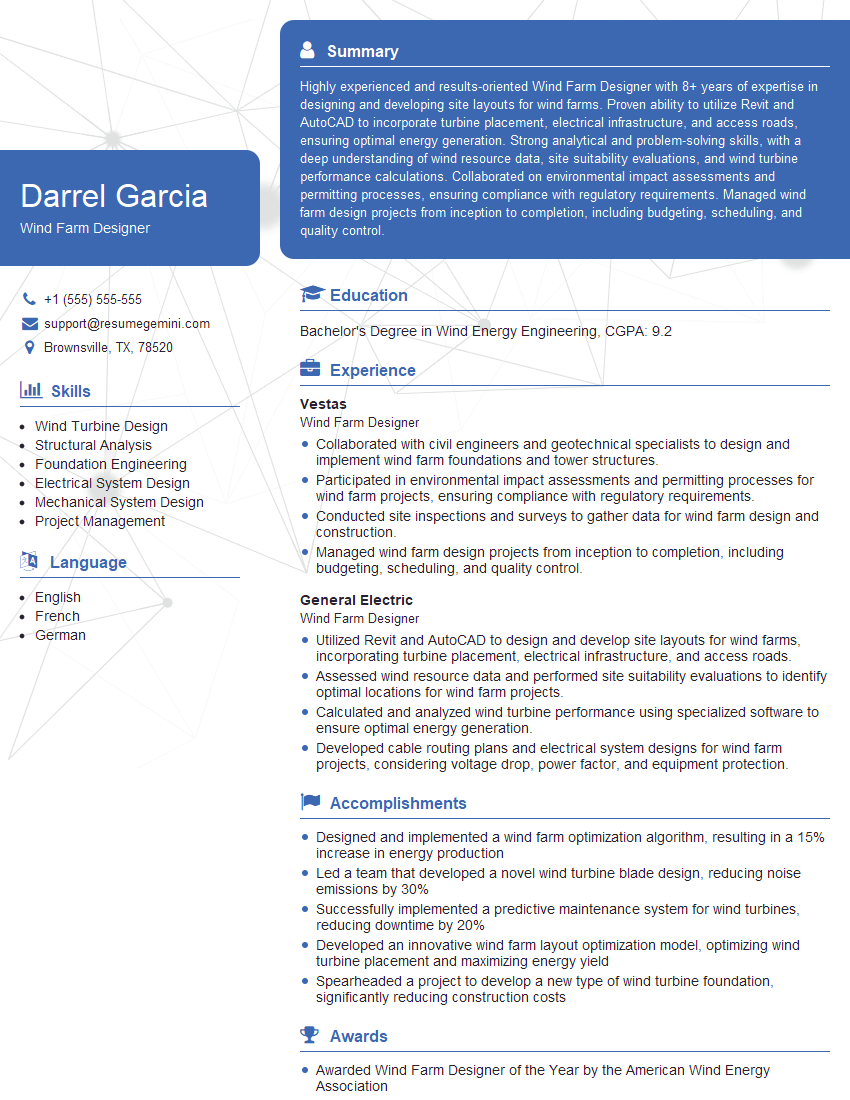
Mastering Wind Turbine Modeling opens doors to exciting and impactful careers in a rapidly growing industry. To maximize your job prospects, creating a strong, ATS-friendly resume is crucial. ResumeGemini can help you build a professional and effective resume that highlights your skills and experience. We offer examples of resumes tailored specifically to Wind Turbine Modeling to give you a head start. Take the next step towards your dream career – build your best resume with ResumeGemini.


Explore more articles
Users Rating of Our Blogs
Share Your Experience
We value your feedback! Please rate our content and share your thoughts (optional).
What Readers Say About Our Blog
Very informative content, great job.
good