Are you ready to stand out in your next interview? Understanding and preparing for Industrial Sewing Principles interview questions is a game-changer. In this blog, we’ve compiled key questions and expert advice to help you showcase your skills with confidence and precision. Let’s get started on your journey to acing the interview.
Questions Asked in Industrial Sewing Principles Interview
Q 1. What types of industrial sewing machines are you familiar with?
My experience encompasses a wide range of industrial sewing machines, categorized primarily by their stitch type and application. I’m proficient with machines like:
- Lockstitch machines: These are the workhorses of the industry, creating a strong, secure stitch ideal for most fabrics. I’ve extensively used single-needle and multi-needle lockstitch machines for applications from light-weight garments to heavy-duty upholstery.
- Chainstitch machines: These produce a chain-like stitch, often used for overlocking or finishing seams, providing a neat and durable edge. My experience includes using both single-chain and double-chain stitch machines for diverse projects.
- Overlock/Serger machines: These machines simultaneously sew, trim, and finish raw edges, preventing fraying and creating professional-looking seams. I’m familiar with both basic and advanced overlock machines, capable of handling various fabric weights and textures.
- Blind stitch machines: These produce almost invisible stitches, perfect for hemming and joining delicate fabrics. I’ve used them in garment construction and upholstery work.
- Post-bed machines: These machines feature a flat bed with a higher post to support larger fabric panels, useful for upholstery or heavy materials. This is a skill I’ve applied extensively in my upholstery experience.
My experience isn’t limited to a specific brand; I’ve worked with machines from various manufacturers, adapting quickly to their unique functionalities.
Q 2. Describe your experience with different sewing machine needles and their applications.
The needle is the heart of any sewing machine, and selecting the right one is crucial for optimal stitch quality and to prevent damage to the machine and fabric. Different needle types cater to specific fabric weights and textures:
- System needles (130/705H): These are the most common type, universally compatible with many industrial machines. I use these for a wide variety of fabrics, from lightweight knits to medium-weight wovens.
- Stretch needles: Designed with a slightly rounded point to prevent skipped stitches on stretchy fabrics like knits. I’ve often used these when working with jersey, spandex, or other elastic materials.
- Leather needles: These needles have a sharp, triangular point that penetrates dense materials like leather, without causing tearing. My experience with these has been vital in the upholstery industry.
- Jeans needles: With a reinforced shaft and a strong point, these are suitable for heavy-duty denim and canvas. I rely on these when working on durable garments or heavy-duty applications.
- Ballpoint needles: These have a rounded tip that rolls between the fibers of knit fabrics, preventing damage and ensuring smooth stitches. I frequently use these for fine knits and delicate lingerie fabrics.
Choosing the correct needle size, indicated by a number (e.g., 14, 16, 18), is also essential. A larger number indicates a thicker needle, suitable for heavier fabrics. Incorrect needle selection can lead to broken needles, skipped stitches, or damaged fabric – a problem I carefully avoid through meticulous attention to detail.
Q 3. How do you troubleshoot common sewing machine malfunctions?
Troubleshooting industrial sewing machines requires a systematic approach. I typically follow these steps:
- Identify the problem: Carefully observe the issue. Is the machine making unusual noises? Are stitches skipping or breaking? Is the fabric feeding incorrectly? Understanding the nature of the problem is the first step towards fixing it.
- Check the obvious: Ensure the bobbin is properly wound and inserted, the needle is correctly inserted and not bent, and the tension is properly adjusted. Often, these simple checks solve the majority of issues.
- Inspect the needle plate and feed dogs: Make sure these parts are clean and free of debris that may interfere with fabric movement. I frequently clean these areas, preventing build-up and maintaining machine efficiency.
- Adjust tension: Incorrect tension can cause numerous problems. I adjust the upper and lower tensions systematically, testing until the stitches are even and consistent.
- Check the timing: If all else fails, the machine’s timing might need adjustment. This requires more advanced knowledge and might necessitate calling a technician. However, basic understanding of timing can help prevent major damage.
- Consult manuals: Machine manuals provide valuable troubleshooting guides, specifications and diagrams. I’ve always relied on these in order to understand the machine’s inner workings.
Through years of experience, I’ve developed an intuitive sense of identifying the root cause of sewing machine malfunctions, rapidly solving most issues on the spot.
Q 4. Explain the process of setting up a sewing machine for a specific fabric type.
Setting up a sewing machine for a specific fabric involves a multi-faceted approach:
- Needle selection: Choosing the correct needle type and size is the first step, as mentioned before.
- Stitch length: A shorter stitch length is usually preferred for lighter, more delicate fabrics, while heavier fabrics benefit from a slightly longer stitch. The machine’s stitch length dial is crucial to fine-tune.
- Stitch width (if applicable): Some machines allow adjusting the stitch width, which is vital when working with zig-zag stitches for various applications.
- Presser foot pressure: The pressure needs to be adjusted based on fabric weight. Heavy fabrics require more pressure to prevent skipped stitches; delicate fabrics need less pressure to avoid puckering.
- Tension adjustment: This is vital to get even stitches. Adjust the upper and lower tensions to find the sweet spot for even stitch formation. I often fine-tune the tension by testing on scrap fabric.
- Feed dog adjustment: For some fabrics, adjusting the feed dogs might be necessary to ensure smooth fabric feeding. For slippery fabrics, I might need to slow down the feed speed.
For example, working with silk would require a fine needle, short stitch length, low presser foot pressure, and careful tension adjustment. In contrast, sewing heavy denim necessitates a strong needle, longer stitch length, higher presser foot pressure, and likely adjustments in both upper and lower tensions.
Q 5. What are the different types of seams used in industrial sewing and when would you use each?
Industrial sewing utilizes a variety of seams, each chosen based on the garment’s function and aesthetic requirements:
- Straight seam: The most basic seam, created by stitching two fabric edges together. Ideal for strength and simplicity, often used in structural seams of garments and upholstery.
- French seam: A highly durable seam, ideal for fine fabrics as it encloses raw edges entirely, providing a clean, professional finish. I utilize this seam frequently for higher-end garments.
- Flat felled seam: Very strong and durable, suitable for areas experiencing heavy stress, commonly found in workwear or outdoor clothing. It is a process I often implement in heavy-duty applications.
- Overlock seam (serged): A seam that simultaneously stitches and finishes raw edges. Used for neatness and durability, especially on knit fabrics or edges prone to fraying.
- Double topstitched seam: Provides extra strength and a decorative element, enhancing the garment’s appearance. I use this technique commonly in heavy fabrics or whenever extra durability is needed.
- Lapped seam: One fabric edge overlaps the other, providing a clean finish, especially suitable for tailored garments.
Selecting the appropriate seam is crucial for the garment’s functionality and overall quality; a poorly chosen seam can compromise the item’s longevity or appearance.
Q 6. How do you maintain the quality of stitches and prevent common sewing defects?
Maintaining stitch quality and preventing defects involves meticulous attention to detail throughout the sewing process:
- Regular machine maintenance: Keeping the machine clean, lubricated, and properly tuned is essential. I perform regular cleaning and oiling to ensure smooth operation and prevent damage.
- Consistent tension: Consistent upper and lower tension is critical for achieving even stitches and avoiding skipped stitches or puckering. Careful adjustments are key here.
- Correct needle selection: Selecting the right needle for the fabric ensures the needle penetrates the fabric smoothly and prevents broken needles or damaged fabric.
- Proper fabric handling: Feeding the fabric smoothly and consistently prevents skipped stitches or puckering. I utilize techniques to control fabric tension and feed rate to minimize errors.
- Quality thread: Using high-quality thread ensures consistent stitch formation and prevents breakage. I always select the right thread type for the fabric and application.
Common defects like skipped stitches, broken needles, uneven stitches, and puckering can often be traced back to one of these factors. Addressing these potential issues proactively helps prevent costly rework and ensures a high-quality final product.
Q 7. What safety precautions do you follow while operating industrial sewing machines?
Safety is paramount when operating industrial sewing machines. I always adhere to these precautions:
- Proper machine setup: Before starting, I ensure the machine is properly set up, all guards are in place, and the area is clear of obstructions.
- Appropriate clothing: I avoid wearing loose clothing or jewelry that could get caught in the machine. Long hair is always tied back. Safety is my top priority.
- Needle handling: I handle needles with care, using needle threaders and avoiding touching the point.
- Machine maintenance: I never attempt machine maintenance while the machine is running or plugged in. All maintenance is performed after completely powering down the machine.
- Emergency stop: I’m always aware of the emergency stop button and how to use it in case of an accident or malfunction.
- Eye protection: In cases of high-speed sewing, I often use safety glasses to protect my eyes from flying debris or needle breakage.
Safety procedures are not just guidelines; they’re critical to prevent injury and ensure a safe working environment. A safe workplace leads to increased productivity and reduced downtime.
Q 8. How do you calculate the required fabric for a given garment?
Calculating the required fabric for a garment involves more than just adding up the pattern pieces. It requires understanding fabric width, grainlines, and accounting for seam allowances and potential waste.
Step 1: Measure the Pattern Pieces: Carefully measure the length and width of each pattern piece, including seam allowances. For example, a sleeve pattern might measure 24 inches long and 10 inches wide including seam allowance.
Step 2: Account for Fabric Width: Consider the width of your fabric (usually 45 inches or 60 inches). This dictates how efficiently you can lay out the pattern pieces. A wider fabric often allows for less waste.
Step 3: Layout Planning: Sketch a layout plan on paper, arranging pattern pieces to minimize waste. Consider the fabric’s grainlines (warp and weft) – some fabrics require pieces to be cut on the grain for optimal drape and strength.
Step 4: Calculate Total Fabric Needed: After creating an efficient layout, calculate the total length of fabric required. If your layout requires 48 inches in length and your fabric is 45 inches wide, you’ll need at least one yard (36 inches) of fabric. Add extra for potential errors or miscuts.
Step 5: Consider Fabric Shrinkage: Pre-wash your fabric to account for shrinkage before cutting. This is especially critical with natural fabrics like cotton and wool.
Example: Let’s say you are making a shirt with pattern pieces totaling 60 inches in length, and your fabric is 45 inches wide. A simple layout might require 1.33 yards (60 inches / 45 inches ≈1.33 yards) to allow for a vertical layout. But if the pattern allows it, a layout utilizing width more efficiently could potentially reduce waste. Always add extra for safety!
Q 9. Describe your experience with pattern making and adjustments.
My experience with pattern making and adjustments spans over 10 years, working with a wide range of garments, from simple t-shirts to complex tailored suits. I’m proficient in both drafting patterns from scratch using industry-standard techniques and adapting existing patterns.
I utilize various methods for pattern adjustments, including: Full-bust adjustments to accommodate different body shapes; shoulder adjustments to correct sloping shoulders or alterations in posture; waist adjustments to modify garment fit around the waistline. I’m adept at using slopers (basic block patterns) as a foundation and modifying them to achieve the desired silhouette.
I’ve handled countless situations requiring pattern alterations, including adapting patterns for different fabric types (e.g., adjusting seam allowances for stretch fabrics), fitting patterns to unconventional body sizes, and adjusting for desired style changes. A recent project involved adjusting a pattern for a plus-size client with a low neckline to enhance comfort and flattering fit.
I use a variety of tools for pattern making and adjustment: pattern paper, rulers, French curves, scissors, and software like Adobe Illustrator, which helps with creating precise and scalable patterns.
Q 10. How do you manage production deadlines and maintain efficiency?
Managing production deadlines and maintaining efficiency is paramount in industrial sewing. My approach involves a multi-pronged strategy that centers on careful planning, effective team communication, and proactive problem-solving.
1. Detailed Production Planning: This includes breaking down large projects into smaller, manageable tasks with assigned deadlines for each stage. I utilize project management tools to track progress, identify potential bottlenecks, and ensure tasks align with the overall timeline.
2. Optimized Workflow: I’m skilled in optimizing sewing workflows to minimize wasted time and materials. This involves careful sequencing of operations, efficient material handling, and effective machine utilization. Lean manufacturing principles greatly inform my approach.
3. Communication and Team Collaboration: Open and frequent communication with the team is essential. I use daily check-ins and progress reports to ensure everyone is aligned on goals and to identify and resolve issues promptly.
4. Proactive Problem Solving: I anticipate potential problems and devise contingency plans. This reduces delays caused by unexpected issues. For example, if a particular machine malfunctions, I have backup plans to continue production efficiently.
5. Continuous Improvement: I’m committed to continuous improvement of my methods. I regularly evaluate processes to identify areas where efficiency can be further enhanced.
Q 11. What is your experience with different stitching techniques (e.g., lockstitch, chainstitch)?
I have extensive experience with various stitching techniques, including lockstitch and chainstitch, and understand their specific applications and limitations.
Lockstitch: This is the most common stitch type used in industrial sewing. It forms a strong, secure stitch that is highly versatile and suitable for a wide range of fabrics and applications. I use lockstitch machines for seams, hems, and other construction details. I understand the importance of proper needle and tension adjustments for achieving optimal stitch quality with lockstitch.
Chainstitch: Chainstitch is commonly used for decorative stitching, overlocking, or creating a flexible, slightly stretchy seam. It creates a chain of loops and is less durable than lockstitch, making it unsuitable for high-stress areas. I understand the different types of chainstitch and how to adjust the machine for different fabric weights and stitch lengths.
Beyond these two, I’m familiar with other stitch types, including blind stitch (for invisible hems), coverstitch (for decorative and functional finishes), and zigzag stitch. My ability to choose the right stitch for a specific application is crucial in ensuring the quality and longevity of the finished garment.
Q 12. Explain your understanding of different sewing machine feeds (e.g., walking foot, feed dogs).
Different sewing machine feeds are essential for handling various fabric types and achieving consistent stitch quality. Understanding their functionalities is key to efficient and high-quality sewing.
Feed Dogs: These are the standard feed mechanism on most industrial sewing machines. They move the fabric forward, providing a consistent feed rate. They are effective for most fabrics but can be problematic with slippery or bulky materials.
Walking Foot: A walking foot is a specialized presser foot with its own feed mechanism. This is crucial for sewing multiple layers of fabric, or fabrics with differing thickness or textures, because it prevents slippage and ensures even feeding. I frequently use it when sewing heavy fabrics, quilted materials, or working with multiple layers.
Other Feed Mechanisms: Some advanced machines offer other feed types, such as differential feed, which allows for precise fabric manipulation during sewing. This is particularly useful when working with stretchy fabrics or creating gathers.
My proficiency in selecting and adjusting the appropriate feed mechanism is crucial for achieving uniform stitches and preventing fabric puckering or slippage, leading to higher quality garments.
Q 13. How do you identify and resolve fabric tension issues?
Fabric tension issues are a common problem in sewing and can lead to puckering, skipped stitches, or broken threads. Identifying and resolving these issues requires a systematic approach.
1. Identifying the Problem: Examine the stitching carefully. Puckering indicates the upper tension is too tight. Loose, wavy stitching indicates the upper tension is too loose. Broken threads can be due to tension issues, needle problems, or fabric damage.
2. Checking the Machine: Ensure proper threading of both upper and lower threads. Check the tension discs on the machine and make necessary adjustments. Ensure the needle is appropriately sized and sharp for the fabric type.
3. Checking the Fabric: The fabric itself can also contribute to tension issues. Stiff or heavy fabrics may require adjustments to stitch length and tension. Stretchy fabrics might require a differential feed mechanism.
4. Systematic Adjustment: Make incremental adjustments to the upper tension while observing the effects on the stitching. I often use a test swatch to experiment with the settings before moving to the actual garment.
5. Addressing Other Factors: Other factors can mimic tension issues, including incorrect needle type, a blunt needle, inappropriate stitch length, or improper bobbin winding. It’s vital to check these as well.
Troubleshooting involves a combination of careful observation and systematic adjustments, relying on experience to arrive at optimal settings for each specific situation.
Q 14. What is your experience with different types of industrial sewing machine motors?
My experience encompasses several types of industrial sewing machine motors, each with its own advantages and disadvantages. The choice depends on the application, the required sewing speed, and budget considerations.
1. Servo Motors: These are now the most common type in high-end industrial sewing machines. Servo motors provide precise speed control and are energy efficient. They are best suited for demanding tasks requiring intricate stitching and accurate speed adjustments. They are also quieter than traditional motor types.
2. Direct-Drive Motors: These motors are integrated directly into the sewing machine head, eliminating the need for belts and pulleys. This design enhances precision and reduces maintenance requirements while offering direct control and higher speeds. They are generally more expensive than other motor types.
3. Clutch Motors: Clutch motors provide a high speed capacity and are often used in high-production settings. They typically feature a clutch mechanism that enables immediate stop-start functionality. However, they can be noisy and less energy-efficient compared to newer motor types.
My understanding of these different motor types helps me select the appropriate machine for a given task. Choosing the right motor for the job directly influences productivity, stitch quality, and overall operational cost.
Q 15. Describe your experience with quality control procedures in industrial sewing.
Quality control in industrial sewing is paramount. It’s not just about finding defects; it’s about preventing them. My experience encompasses a multi-stage approach, beginning with fabric inspection for flaws like inconsistencies in weave, color, or damage. This is followed by meticulous checks throughout the production process, including: pre-sewing checks of cut pieces for accuracy and consistency; in-process checks during sewing to ensure stitch quality, seam allowance adherence, and correct assembly; and finally, a thorough final inspection before packaging. I’m proficient in using various quality control tools like measuring instruments (calipers, rulers), stitch testers, and checklists to maintain consistent standards. For example, in a recent project producing tailored suits, we implemented a ‘four-eyes’ system where each garment was checked by two different inspectors to minimize human error. This proactive approach drastically reduced returns and ensured customer satisfaction.
- Fabric Inspection: Checking for flaws before cutting.
- Pre-Sewing Check: Verifying cut pieces’ accuracy.
- In-Process Check: Monitoring stitch quality and assembly.
- Final Inspection: Thorough examination before packaging.
Career Expert Tips:
- Ace those interviews! Prepare effectively by reviewing the Top 50 Most Common Interview Questions on ResumeGemini.
- Navigate your job search with confidence! Explore a wide range of Career Tips on ResumeGemini. Learn about common challenges and recommendations to overcome them.
- Craft the perfect resume! Master the Art of Resume Writing with ResumeGemini’s guide. Showcase your unique qualifications and achievements effectively.
- Don’t miss out on holiday savings! Build your dream resume with ResumeGemini’s ATS optimized templates.
Q 16. How do you work with a team to complete a sewing project efficiently?
Teamwork is essential in industrial sewing. Effective collaboration hinges on clear communication, defined roles, and mutual respect. I’ve found that a well-structured workflow, where each team member understands their specific tasks and their contribution to the overall goal, is crucial. I actively participate in team meetings to discuss project requirements, timelines, and potential challenges. My experience includes leading and mentoring junior team members, providing guidance and support to ensure consistent quality and efficient production. In one instance, we were facing a tight deadline for a large order of denim jackets. By delegating tasks effectively and proactively addressing minor issues before they escalated, we were able to meet the deadline successfully, delivering high-quality products and maintaining team morale.
- Clear Communication: Regular updates and open dialogue.
- Defined Roles: Each member understands their responsibility.
- Mutual Respect: Fostering a collaborative environment.
- Proactive Problem Solving: Addressing issues promptly.
Q 17. How familiar are you with different fabric types and their sewing characteristics?
I possess extensive knowledge of various fabric types and their unique sewing characteristics. This understanding is critical for selecting appropriate needles, thread, stitch types, and machine settings to achieve optimal results. For instance, delicate fabrics like silk require fine needles and a lower stitch tension to prevent damage, while durable fabrics like canvas need heavier needles and higher tension for robust seams. My experience encompasses a wide range of materials, including cotton, linen, wool, silk, polyester, nylon, and leather, each with its own draping, elasticity, and fraying properties that influence the sewing process. I am also familiar with the challenges presented by different fabric weights and finishes, such as stretch fabrics or water-resistant materials, and how to adapt sewing techniques accordingly.
- Cotton: Versatile, relatively easy to sew.
- Silk: Delicate, requires fine needles and lower tension.
- Linen: Can be slightly stiff, needs careful handling.
- Leather: Requires specialized needles and techniques.
Q 18. What is your experience with using digital pattern making software?
I am proficient in using various digital pattern-making software, including [mention specific software names like e.g., Gerber Accumark, Optitex, or other relevant software]. This expertise allows me to create accurate and efficient patterns, significantly reducing production time and waste. My skills include creating base patterns, grading sizes, making pattern adjustments based on fit requirements, and generating marker layouts for optimal fabric utilization. Digital pattern making is invaluable for creating complex designs or intricate details accurately and consistently. For instance, in a recent project, I used digital software to develop a complex pattern for a structured blazer, ensuring perfect fit and minimizing fabric waste compared to traditional methods. This digital proficiency leads to a more efficient and accurate pattern-making process.
Q 19. How do you ensure the accuracy of measurements in garment production?
Accuracy in measurements is fundamental to garment production. I utilize various techniques to ensure precision, starting with accurate measurements taken from the customer or a sample. Precise measuring tools like measuring tapes, rulers, and calipers are essential. I double-check all measurements and use consistent units throughout the process. Furthermore, I employ quality control checks at each stage, including pre-cutting checks to ensure that pattern pieces are cut to the correct dimensions, and post-sewing checks to verify that the final garment conforms to the specified measurements. Any discrepancies are addressed immediately. For example, in a recent project, we introduced a color-coded system for marking measurements on patterns to eliminate confusion and improve accuracy.
- Precise Measuring Tools: Measuring tapes, rulers, calipers.
- Double-Checking: Verifying all measurements.
- Consistent Units: Maintaining consistent units throughout.
- Quality Control Checks: Inspections at each production stage.
Q 20. Describe your understanding of production planning and scheduling.
Production planning and scheduling involve forecasting demand, allocating resources, and setting realistic timelines. I’m experienced in creating production schedules that consider factors like order volume, fabric availability, labor capacity, and machine availability. This typically involves using software tools to plan and track production. I also account for potential delays or bottlenecks by building buffer time into the schedule. Effective planning ensures timely completion of projects and minimizes disruptions. For example, in a project involving a large number of custom-made shirts, I developed a detailed production schedule that meticulously mapped out each step, from fabric cutting to final inspection, assigning tasks to each team member and ensuring a smooth workflow.
- Demand Forecasting: Predicting order volume.
- Resource Allocation: Optimizing fabric, labor, and machinery use.
- Timeline Creation: Setting realistic deadlines.
- Buffer Time: Accounting for potential delays.
Q 21. How do you handle unexpected problems on the sewing line?
Unexpected problems are inevitable in any production environment. My approach involves a systematic problem-solving strategy. First, I identify the problem and its root cause. This might involve analyzing the faulty garment, interviewing the involved team members, or examining machine settings. Next, I implement a solution, which could involve repairing a broken machine, adjusting machine settings, retraining staff, or sourcing replacement materials. Finally, I document the problem, solution, and preventative measures to avoid similar issues in the future. In one instance, a batch of shirts experienced inconsistent stitching due to a faulty needle. I quickly identified the problem, replaced the needle, and implemented a more stringent needle inspection procedure to prevent recurrence. This proactive approach minimized production downtime and maintained product quality.
- Problem Identification: Analyzing the issue and its root cause.
- Solution Implementation: Repairing, adjusting, or retraining.
- Documentation: Recording the problem, solution, and preventive measures.
Q 22. What are your strengths and weaknesses as an industrial sewing professional?
My greatest strength lies in my meticulous attention to detail and my ability to troubleshoot complex sewing machine issues. I’m adept at understanding stitch formation, tension adjustments, and the nuances of different fabric types. This allows me to consistently produce high-quality work, even under pressure. For example, I once identified a subtle timing issue in a high-speed lockstitch machine that was causing inconsistent stitching, saving the company significant time and material waste. My weakness, however, is sometimes getting overly focused on perfectionism, which can occasionally impact my speed. I’m actively working on improving my time management skills to balance quality with efficiency.
Q 23. Describe a time you had to adapt to a new sewing machine or technique.
During my time at [Previous Company Name], we transitioned from using traditional single-needle machines to a new computerized multi-needle sewing system for producing upholstery panels. Initially, the learning curve was steep; the programming interface and the machine’s automated features were vastly different. To adapt, I systematically worked through the machine’s manual, focusing on each function individually. I started with simple stitch patterns, practicing consistently until I mastered the controls. I then moved on to more complex designs, gradually increasing the speed. I also collaborated with experienced colleagues, observing their techniques and seeking guidance when needed. This structured approach allowed me to become proficient with the new machine within a week, significantly improving our production efficiency.
Q 24. What is your experience with different types of industrial sewing machine presser feet?
My experience encompasses a wide array of industrial sewing machine presser feet. I’m familiar with standard straight stitch feet, zipper feet (both open-toe and closed-toe), rolled hem feet, blind stitch feet, cording feet, and gathering feet. The choice of presser foot depends critically on the type of stitch, fabric, and desired seam finish. For example, a rolled hem foot is essential for creating professional-looking rolled hems on lightweight fabrics, while a zipper foot is crucial for smoothly sewing zippers without disturbing the zipper teeth. Understanding the specific function of each foot is key to producing consistent and high-quality seams.
Q 25. How do you maintain a clean and organized work area?
Maintaining a clean and organized workspace is paramount for efficient and safe operation. My approach involves a multi-pronged strategy. First, I ensure all tools and materials are stored in designated locations after each use. This prevents clutter and facilitates quick access. Second, I regularly clean the sewing machine and its surrounding area, removing fabric scraps, thread trimmings, and dust. This prevents machine malfunctions and maintains a safe work environment. Finally, I follow a 5S methodology – Sort, Set in Order, Shine, Standardize, and Sustain – to maintain a consistently clean and efficient workspace. This system ensures that everything is in its place, easy to find, and ready for immediate use.
Q 26. What are the different types of thread used in industrial sewing?
Industrial sewing employs a variety of threads, each with specific properties suited for different applications. Common types include:
- Polyester threads: Strong, durable, and resistant to stretching. Ideal for heavy-duty applications.
- Cotton threads: Naturally soft and absorbent; excellent for certain fabrics but less durable than polyester.
- Nylon threads: Highly elastic and resilient; often used for stretch fabrics or applications requiring high elasticity.
- Rayon threads: Smooth, lustrous, and softer than polyester; popular for decorative stitching.
- Metallic threads: Add decorative flair and are used for specific embellishments.
Q 27. How do you ensure the consistent quality of your work?
Consistent quality is achieved through a combination of meticulous preparation, precise execution, and rigorous quality checks. Before starting any project, I carefully review the specifications, ensuring a clear understanding of the requirements. During the sewing process, I maintain consistent tension, stitch length, and feed dog pressure. I regularly inspect the work in progress to identify and correct any defects early on. Finally, I conduct a thorough final inspection of the finished product, checking for any inconsistencies in stitching, fabric alignment, or overall finish. This multi-layered approach ensures that the final product meets the highest quality standards.
Q 28. Describe your experience with different types of sewing machine lubricants.
My experience encompasses various industrial sewing machine lubricants, each designed for specific components and applications. I’m familiar with lightweight oils for delicate mechanisms, heavier-duty greases for bearings and gears, and specialized lubricants for high-speed machines. The correct lubricant is critical for machine longevity and performance. Using the wrong lubricant can lead to premature wear and tear, component failure, and potentially costly repairs. For example, using a heavy-duty grease on delicate parts can lead to sluggish operation, while using a lightweight oil on high-stress components can result in insufficient lubrication and increased wear. Regular lubrication, using the correct type and amount, is essential for maintaining the smooth, efficient operation of industrial sewing machines.
Key Topics to Learn for Your Industrial Sewing Principles Interview
- Machine Operation & Maintenance: Understanding the mechanics of industrial sewing machines, including different types (e.g., lockstitch, overlock), their functionalities, and routine maintenance procedures. Practical application: Troubleshooting common machine malfunctions and performing minor repairs.
- Seam Construction & Techniques: Mastering various seam types (e.g., flatlock, French seams) and their suitability for different fabrics and applications. Practical application: Selecting the appropriate seam for a given project based on fabric type, garment style, and desired durability.
- Fabric Knowledge & Selection: Familiarity with different fabric types (e.g., woven, knit, non-woven), their properties (e.g., drape, strength, stretch), and appropriate sewing techniques for each. Practical application: Determining the best fabric choice for a particular garment or project and adjusting sewing parameters accordingly.
- Pattern Making & Cutting: Understanding basic pattern making principles, grading, and marking techniques. Practical application: Interpreting and modifying existing patterns and ensuring accurate cutting for efficient production.
- Quality Control & Inspection: Identifying common sewing defects and understanding quality control standards within the industry. Practical application: Implementing quality checks throughout the production process to ensure consistent high-quality output.
- Safety Procedures & Ergonomics: Adhering to safety regulations and best practices for operating industrial sewing machinery and maintaining a safe work environment. Practical application: Proper needle and thread handling, machine guarding, and maintaining a comfortable workstation to avoid injury.
- Production Efficiency & Time Management: Understanding techniques to optimize sewing speed and efficiency without compromising quality. Practical application: Planning workflows, utilizing time-saving techniques, and meeting production deadlines.
Next Steps
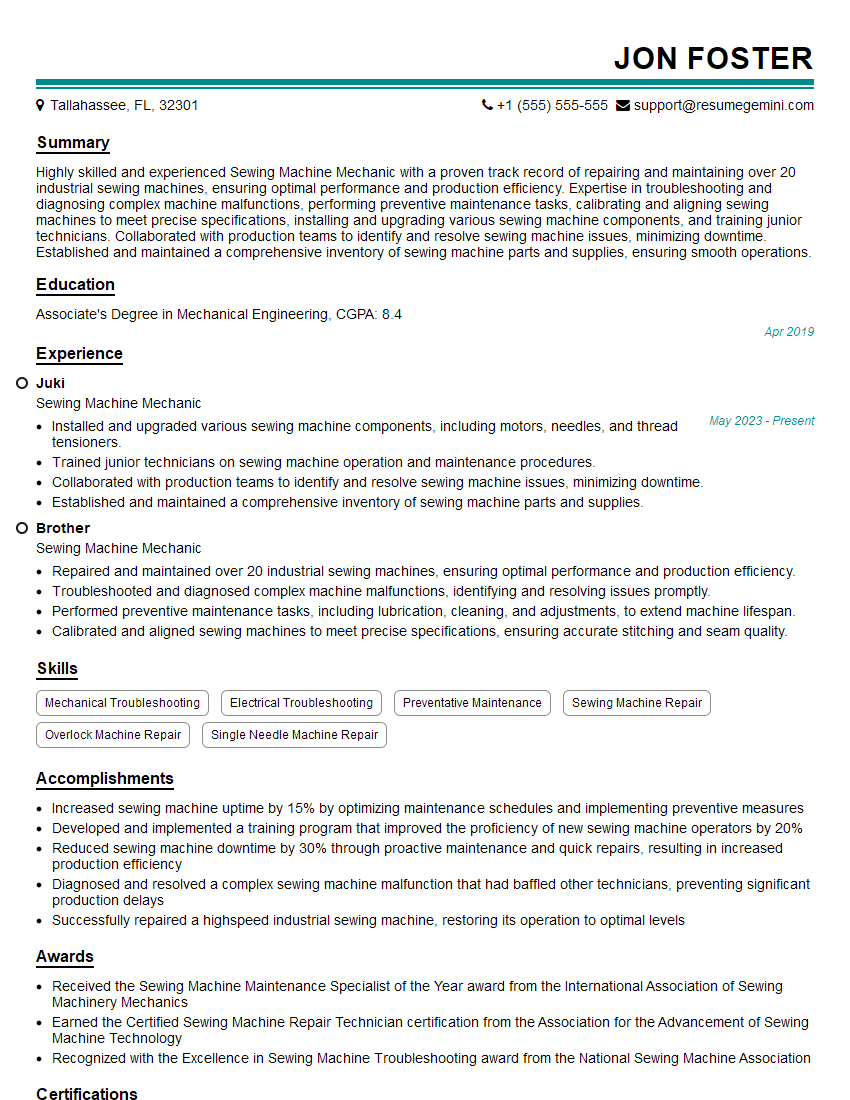
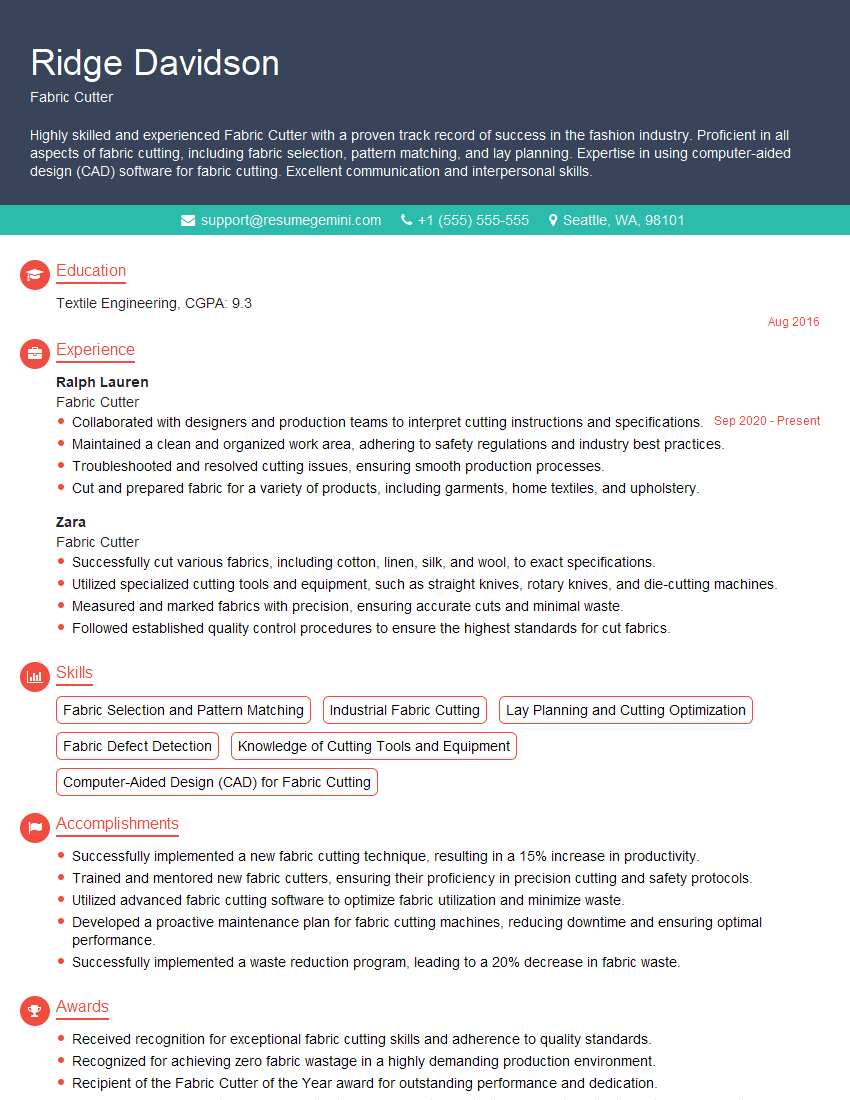
Mastering Industrial Sewing Principles is crucial for career advancement in the apparel and textile industries, opening doors to higher-paying roles and greater responsibilities. A well-crafted resume is your first impression; make it count! Building an ATS-friendly resume increases your chances of getting noticed by recruiters. ResumeGemini is a trusted resource that can help you create a professional and impactful resume tailored to the specific requirements of your target jobs. Examples of resumes tailored to Industrial Sewing Principles are available to guide you.

Explore more articles
Users Rating of Our Blogs
Share Your Experience
We value your feedback! Please rate our content and share your thoughts (optional).
What Readers Say About Our Blog
Very informative content, great job.
good