The right preparation can turn an interview into an opportunity to showcase your expertise. This guide to Wood Drying Theory interview questions is your ultimate resource, providing key insights and tips to help you ace your responses and stand out as a top candidate.
Questions Asked in Wood Drying Theory Interview
Q 1. Explain the difference between air drying and kiln drying.
Air drying and kiln drying are both methods of reducing the moisture content of wood, but they differ significantly in their speed, control, and cost. Air drying relies on natural atmospheric conditions – primarily temperature, humidity, and airflow – to gradually remove moisture from the wood. This is a slow process, often taking months or even years, depending on the wood species, size of the lumber, and climatic conditions. Think of it like letting laundry dry on a clothesline; it’s effective, but slow and susceptible to unpredictable weather.
Kiln drying, on the other hand, uses a controlled environment within a specially designed chamber to accelerate the drying process. The kiln precisely regulates temperature, humidity, and airflow to create optimal drying conditions, dramatically reducing drying time to weeks, or even days for smaller pieces. This offers greater control over the final moisture content and minimizes the risk of defects. It’s analogous to using a dryer – faster, more controlled, and more energy-intensive.
Q 2. Describe the various types of wood drying kilns and their applications.
Several types of wood drying kilns cater to different needs and scales of operation. Some common types include:
- Conventional Kilns: These are the most common type, using steam or hot water to heat the kiln and fans to circulate air. They offer good control and are suitable for various species and sizes of lumber. Think of this as a large, sophisticated version of a home dryer.
- Dehumidification Kilns: These kilns use dehumidifiers to remove moisture from the air, maintaining low humidity levels throughout the drying process. This allows for faster drying at lower temperatures, reducing the risk of surface checking. This approach is like using a desiccant to quickly remove moisture.
- Solar Kilns: These kilns use solar energy to heat the wood, offering a more environmentally friendly approach, but they are less controllable and suitable mainly for smaller-scale operations in sunny climates. Consider this a natural, sun-powered version, ideal for smaller projects or regions with ample sunlight.
- Vacuum Kilns: These kilns operate under a vacuum, reducing the boiling point of water within the wood, allowing for faster and more uniform drying, especially useful for high-value, delicate species. They are like a specialized, high-tech solution ideal for delicate woods requiring precise control.
The choice of kiln depends on factors such as the volume of wood to be dried, the species of wood, the required drying time, and the available budget.
Q 3. What are the key factors affecting the rate of wood drying?
The rate of wood drying is influenced by a complex interplay of factors. Key among them are:
- Wood Species: Different species have different densities and permeability, significantly affecting how quickly moisture moves out of the wood. Dense hardwoods dry slower than softwoods.
- Piece Size and Shape: Thicker and wider pieces dry slower due to the longer distances moisture needs to travel to reach the surface. The shape also plays a role; boards dry faster than thick posts.
- Temperature and Humidity: Higher temperatures and lower humidity accelerate the drying process by increasing the vapor pressure gradient between the wood and the surrounding air. Think of it like the effect of hot, dry wind on laundry.
- Airflow: Proper airflow is crucial for removing the moisture-laden air from around the wood and replacing it with dry air. Poor circulation leads to uneven drying and defects.
- Initial Moisture Content: The higher the initial moisture content, the longer the drying time. This is pretty intuitive – a wetter piece takes longer to dry.
Q 4. Explain the concept of equilibrium moisture content (EMC).
Equilibrium Moisture Content (EMC) refers to the moisture content at which wood neither gains nor loses moisture when exposed to a particular temperature and relative humidity. Imagine it as the point where wood and its environment are in perfect moisture balance. EMC is crucial because wood will naturally strive to reach EMC in its environment; if the surrounding air is very dry, it’ll lose moisture and potentially shrink; if it’s very humid, it’ll absorb moisture and swell.
EMC varies depending on the wood species and the environmental conditions (temperature and relative humidity). Knowing the EMC is essential for selecting the appropriate final moisture content for the intended application. For example, wood used for outdoor furniture would need a lower EMC than wood for indoor furniture to avoid expansion and contraction due to moisture changes.
Q 5. How do you determine the appropriate drying schedule for a specific wood species?
Determining the appropriate drying schedule is a critical step in preventing wood defects. It involves considering several factors: the wood species, the dimensions of the lumber, the desired final moisture content, and the type of kiln being used. There isn’t a single, universally applicable schedule.
A professional approach involves consulting established drying schedules for the specific wood species, available from industry sources or research publications. These schedules typically outline recommended temperature and humidity profiles over time. However, it often requires adjustments based on the lumber’s dimensions and the kiln’s characteristics. Experienced wood dry operators usually refine these schedules through trial and error, monitoring the wood’s moisture content throughout the drying process using electronic moisture meters. Specialized software can also be used to model and optimize drying schedules to minimize the likelihood of defects.
Q 6. What are the common defects associated with improper wood drying?
Improper wood drying can result in various defects that significantly reduce the wood’s quality and value. Common defects include:
- Checking: Cracks that extend from the surface into the wood, often caused by uneven drying.
- Case Hardening: Uneven moisture distribution, causing the surface to dry faster than the interior, resulting in internal stresses that can lead to warping or splitting. It’s like a hard shell forming around a softer core.
- Honeycombing: Internal cracks that create a honeycomb-like structure, typically due to excessive drying rates.
- Warping: Distortion of the wood’s shape, often caused by unequal shrinkage during drying.
- Surface Checking: Small cracks on the surface of the wood, typically resulting from rapid drying.
- Shrinkage: A natural process, but excessive shrinkage due to rapid drying can lead to significant dimensional changes and potential cracking.
These defects can drastically reduce the strength, stability, and aesthetic appeal of the wood, making it unsuitable for many applications.
Q 7. Describe the process of stress relieving wood after drying.
Stress relieving, also known as stress relaxation, aims to reduce internal stresses within the wood after drying. These stresses develop due to uneven shrinkage during the drying process, making the wood prone to warping or cracking. Stress relieving is crucial for high-value lumber or pieces intended for applications where dimensional stability is critical. Several methods exist for stress relieving:
- Heat Treatment: This involves subjecting the wood to elevated temperatures for a specific duration, softening the wood’s structure and relaxing the internal stresses. The idea is to gently ‘re-anneal’ the wood.
- Steam Treatment: Similar to heat treatment, but utilizing steam to introduce moisture and reduce stresses. It’s like a gentler approach compared to just using heat alone.
- Controlled Atmospheric Conditions: Storing the wood under controlled temperature and humidity conditions allows gradual relaxation of stresses over time. This is a slower but effective method, often used for small items.
The choice of stress-relieving method depends on the type and dimensions of the wood, the severity of the internal stresses, and the desired level of stress reduction. It’s important to note that stress relieving often reduces the wood’s strength somewhat, so it should only be carried out when absolutely necessary.
Q 8. Explain the role of humidity and temperature in the wood drying process.
Humidity and temperature are the two most critical environmental factors governing the wood drying process. Think of it like this: wood contains moisture, and we’re trying to remove it. Temperature drives the evaporation of this moisture – higher temperatures increase the rate of evaporation. However, the air surrounding the wood also has its own moisture content (humidity). If the air is already very humid, it’s less able to absorb the moisture from the wood, slowing down the drying process. Ideally, you want a high temperature to encourage evaporation but a low humidity to ensure the released moisture is readily absorbed by the surrounding air. Imagine trying to dry a wet towel in a humid bathroom versus a dry, sunny room – the latter will dry much faster.
To illustrate, let’s say you’re drying oak lumber. A higher temperature (say, 140°F) will speed up drying, but if the humidity in the kiln is also high (above 60%), the drying will be slow and potentially lead to defects like checking (cracking). A lower humidity (around 40%) at the same temperature will result in faster, more even drying.
Q 9. How do you monitor and control the drying process to prevent defects?
Monitoring and controlling the drying process is crucial to avoid defects. We use a variety of instruments and techniques. Key monitoring aspects include:
- Temperature sensors: Strategically placed throughout the kiln to ensure uniform temperature distribution.
- Humidity sensors: These measure the moisture content of the air inside the kiln to monitor drying rates and prevent excessive moisture loss.
- Moisture meters: These are used to measure the moisture content of the wood itself, providing real-time data on the drying progress. Different meters are used for different scenarios – some are surface meters measuring only the surface moisture content, while others are pin-type meters which allow penetration into the wood and a measurement of the internal moisture content.
- Kiln automation systems: Modern kilns use computer-controlled systems to precisely regulate temperature, humidity, and airflow, often incorporating feedback loops from the sensors.
Control involves adjusting these parameters based on the readings. For instance, if the wood is drying too quickly, we might reduce the temperature or increase the humidity. If it’s drying too slowly, the opposite adjustments can be made. A skilled operator interprets the sensor data and makes informed decisions to keep the wood within the optimal drying range while accounting for the specific wood species and dimensions.
Q 10. What are the safety precautions involved in operating a wood drying kiln?
Wood drying kilns present several safety hazards, necessitating stringent precautions:
- High temperatures: Burns are a significant risk. Appropriate personal protective equipment (PPE), such as heat-resistant gloves and clothing, is essential. Regular kiln inspections for proper operation are necessary to avoid overheating issues.
- Moving parts: Many kilns have fans, conveyors, or other moving parts that could cause injuries. Lockout/tagout procedures must be followed before any maintenance or repair.
- Fire hazard: Wood is flammable, particularly when exposed to high temperatures. Kilns should be equipped with fire suppression systems, and regular inspections should check the fire safety equipment and its functionality. The use of flammable substances like solvents in or around the kiln must be avoided.
- Carbon monoxide poisoning: Some kiln designs utilize combustion systems, potentially releasing carbon monoxide. Adequate ventilation and carbon monoxide detectors are necessary to prevent hazardous levels from accumulating.
- Electrical hazards: Proper grounding and insulation of electrical components are crucial to prevent shock hazards. Regular checks of electrical components and wiring is important.
Regular training for kiln operators on safety procedures, proper use of PPE, and emergency protocols is paramount.
Q 11. Explain the principles of heat transfer in wood drying.
Heat transfer in wood drying is primarily through three mechanisms: conduction, convection, and radiation.
- Conduction: Heat moves through the wood from the hotter surface to the cooler interior. This is why the outer layers of the wood dry faster than the core.
- Convection: Heat is transferred by the movement of air within the kiln. Fans circulate heated, dry air, absorbing moisture from the wood’s surface. Effective ventilation patterns are essential for efficient convective heat transfer.
- Radiation: Heat is emitted from the kiln’s heating elements and transferred directly to the wood. This is especially significant in kilns that utilize direct-fired heating.
The interplay of these mechanisms determines the overall drying rate and uniformity. Understanding these mechanisms is fundamental to kiln design and operation. For example, the placement of heating elements and the design of air circulation systems directly impact the efficiency of these heat transfer mechanisms. Therefore, optimizing their interplay is key to a successful wood drying operation.
Q 12. Describe the effect of wood density on drying time.
Wood density significantly impacts drying time. Denser woods contain more cells and thus more water to remove, leading to longer drying times. Think of it like sponges – a denser sponge will take longer to dry than a less dense one. Similarly, a dense hardwood like oak will require considerably longer drying than a less dense softwood like pine. The increased mass of denser woods also slows down the rate of moisture movement from the interior of the board to the surface. This slower moisture movement makes the wood more prone to developing internal stresses and associated defects if not handled with care in the kiln drying process.
In practice, this means adjusting drying schedules. We would use slower drying rates and longer drying times for dense woods to prevent defects, whereas less dense woods can tolerate quicker drying schedules.
Q 13. What is the importance of proper wood ventilation during drying?
Proper ventilation is critical for efficient and defect-free wood drying. It ensures uniform air circulation within the kiln, removing the moisture released by the wood and preventing localized areas of high humidity. This helps maintain a consistent temperature and humidity gradient, essential for even drying. Without adequate ventilation, the wood would essentially be drying in its own humid environment, greatly slowing down the process and potentially leading to defects like mold growth, decay or uneven drying. Think of it like trying to dry clothes in a sealed bag versus hanging them in the open air – the open air allows the moisture to escape rapidly.
In kiln design, the fan system plays a critical role, as it controls the volume and velocity of air circulation within the kiln. The arrangement of lumber within the kiln also plays an important role in effective ventilation, as certain stacking arrangements may impede uniform airflow.
Q 14. How do you address the issue of case hardening in wood drying?
Case hardening is a serious defect where the outer layers of the wood dry faster than the interior, creating significant internal stresses. The outer layers become very hard and rigid, while the inner core remains wet and soft. This difference in moisture content can cause the wood to warp, split, or crack as the core continues to dry and shrink. This is quite similar to trying to rapidly dry a thick clay slab – the outside will dry quickly and contract while the inside remains wet and thus the outside will crack.
Addressing case hardening requires careful control of the drying schedule. Specifically:
- Slow initial drying: Gentle drying conditions at the beginning allow for uniform moisture removal from the surface to the core.
- Controlled humidity: Maintaining a higher relative humidity during the early stages helps prevent excessive surface drying.
- Proper ventilation: Ensures even moisture removal throughout the wood piece.
- Periodic conditioning: Involves briefly raising the humidity to allow the moisture to equalize throughout the board. This is often done strategically at multiple phases in the kiln drying schedule.
In severe cases, remedial measures like steaming the wood before further drying may be necessary to release the built-up internal stresses.
Q 15. Explain the concept of fiber saturation point.
The fiber saturation point (FSP) is a crucial concept in wood drying. It represents the moisture content (MC) at which the cell walls of wood are completely saturated with water, while the cell cavities are empty. Think of it like a sponge: at the FSP, the sponge’s material is completely wet, but there’s no more water sitting in the spaces between the sponge’s fibers. This point typically ranges from 25% to 30% MC, depending on the wood species. Below the FSP, shrinkage occurs as water is removed from the cell walls, leading to changes in wood dimensions. Understanding the FSP is critical for controlling shrinkage and preventing defects during drying.
For example, if you’re drying lumber, knowing the FSP helps you determine when to slow down the drying process to avoid rapid shrinkage and cracking. Above the FSP, water removal is primarily from the cell cavities and doesn’t cause significant dimensional changes.
Career Expert Tips:
- Ace those interviews! Prepare effectively by reviewing the Top 50 Most Common Interview Questions on ResumeGemini.
- Navigate your job search with confidence! Explore a wide range of Career Tips on ResumeGemini. Learn about common challenges and recommendations to overcome them.
- Craft the perfect resume! Master the Art of Resume Writing with ResumeGemini’s guide. Showcase your unique qualifications and achievements effectively.
- Don’t miss out on holiday savings! Build your dream resume with ResumeGemini’s ATS optimized templates.
Q 16. What are the different types of drying stresses that can occur in wood?
Several types of drying stresses can develop in wood during the drying process. These stresses arise from the uneven removal of moisture, causing differential shrinkage between different parts of the wood piece.
- Shrinkage stresses: These are the most common and result from the unequal shrinkage of wood fibers across the grain and along the grain as moisture is lost. This can lead to warping, bowing, and checking (surface cracks).
- Tensile stresses: These develop as the outer layers of a piece of wood dry faster than the inner layers, creating tension within the wood. This can cause splitting or cracking.
- Compressive stresses: Conversely, the inner layers can be compressed by the shrinking outer layers, leading to internal stresses that can also cause defects.
- Hollowing: Occurs when the outer layers of a board dry faster causing the board to shrink and leave a void inside.
Imagine a log: the outer rings dry faster, shrinking more than the inner ones, placing stress on the entire piece. Understanding these stresses helps predict and prevent defects.
Q 17. Describe the methods for measuring moisture content in wood.
Several methods are available for measuring moisture content (MC) in wood, ranging from simple to highly sophisticated techniques.
- Oven-dry method: This is the most accurate method, involving weighing a sample before and after drying it in an oven at 103°C (217°F) until a constant weight is achieved. It’s the reference method for other methods.
MC = [(Wwet - Wdry) / Wdry] x 100WhereWwetis the initial weight andWdryis the weight after oven drying. - Moisture meter: These instruments use electrical resistance or pin-type sensors to measure the moisture content directly in the wood. They are fast and convenient but accuracy depends on the meter type and wood species.
- Microwave method: A faster method that uses microwave energy to dry a smaller sample.
The choice of method depends on the required accuracy and speed of measurement. The oven-dry method is the most accurate, while moisture meters are quicker but less accurate.
Q 18. How do you prevent checking and splitting during wood drying?
Checking (surface cracks) and splitting (larger cracks through the wood) are significant problems during wood drying. Preventing them requires careful control of the drying process and an understanding of wood properties.
- Slow and controlled drying: This prevents rapid moisture loss from the surface, reducing the development of tensile stresses that cause checking.
- Proper ventilation: Adequate airflow removes moisture effectively, preventing moisture gradients within the wood.
- Careful selection of lumber: Lumber with fewer defects is less prone to checking and splitting.
- Appropriate drying schedule: Matching the drying schedule to the wood species and dimensions is crucial.
- Use of drying aids: Certain chemicals can be applied to the wood to help control the drying rate.
- End coatings: Applying coatings to the ends of the wood reduces moisture loss from those areas, preventing end checking.
Imagine a clay pot: if you dry it too quickly, it’ll crack. Similarly, rapid drying of wood causes stress that leads to defects.
Q 19. What are the advantages and disadvantages of different drying methods?
Various drying methods exist, each with advantages and disadvantages:
- Air drying: Simple, low cost, but slow and susceptible to weather variations. Advantages: Low initial investment; Disadvantages: long drying time, susceptible to weather conditions, potential for defects.
- Kiln drying: Faster, more controlled, but requires higher initial investment. Advantages: Faster drying time, more precise control over drying process, minimizes defects. Disadvantages: Higher initial cost, requires skilled operators.
- Solar drying: Uses solar energy, environmentally friendly, but less controllable. Advantages: Low energy cost, environmentally friendly; Disadvantages: slow drying time, reliant on weather conditions, may not be suitable for all climates.
- Dehumidification drying: Highly efficient, controlled, but also relatively expensive. Advantages: Precise control of humidity, fast drying, reduction in defects; Disadvantages: High initial cost, technical expertise required.
The best method depends on factors like budget, wood species, desired drying time, and available resources. A large scale operation would benefit from kiln drying while smaller scale operations could use air drying or solar drying.
Q 20. Explain the importance of understanding wood anatomy in relation to drying.
Understanding wood anatomy is crucial for successful wood drying. The structure of wood, including the arrangement of cells (earlywood and latewood), cell wall thickness, and the presence of rays, directly influences its drying behavior.
For example, the density and porosity of wood affect the rate of moisture movement. Wood with thick cell walls dries slower than wood with thinner cell walls. The presence of large rays can create pathways for moisture movement, influencing drying behavior. Knowing the grain orientation helps predict the direction of shrinkage. Understanding this anatomy helps predict how wood will behave during drying and allows you to tailor drying schedules and methods accordingly. An understanding of earlywood vs. latewood is key for predicting the shrinkage in a given wood piece. Earlywood is typically less dense and dries faster than latewood, leading to potential internal stresses.
Q 21. How does wood species influence the drying process?
Wood species significantly influence the drying process due to variations in their anatomical structure, density, and chemical composition. Some species dry quickly and easily, while others are prone to defects if not dried carefully.
For instance, hardwoods generally dry slower than softwoods due to their denser structure and thicker cell walls. Species like aspen dry relatively easily, while others like oak or cherry require more careful control to prevent checking and splitting. The permeability of the wood also plays a role; more permeable species will dry faster. Understanding a specific species’ properties is essential for creating a drying schedule that minimizes defects and ensures high-quality lumber. Consulting established drying schedules for a specific species is vital for successful drying.
Q 22. Describe the role of computer controls in modern kiln drying.
Computer controls have revolutionized modern kiln drying, transforming it from a largely manual process to a precise, automated system. They allow for sophisticated monitoring and control of critical parameters like temperature, humidity, and airflow, leading to significant improvements in drying efficiency and wood quality.
Imagine trying to control the temperature and humidity of a large kiln manually – it would be incredibly difficult and prone to errors. Computer systems, however, can continuously monitor these factors using sensors placed throughout the kiln. They then use sophisticated algorithms to adjust heating, ventilation, and humidification systems automatically, maintaining optimal drying conditions throughout the entire process. This precision minimizes the risk of defects like checking, splitting, and warping.
Many modern kilns utilize programmable logic controllers (PLCs) or even more advanced systems incorporating artificial intelligence (AI) for predictive maintenance and optimization. These systems can be programmed with specific drying schedules tailored to the species and dimensions of the wood being dried, further enhancing consistency and quality.
Q 23. How do you troubleshoot common problems encountered during wood drying?
Troubleshooting in wood drying often involves systematic investigation of the drying process and the resulting wood quality. It’s akin to detective work, systematically eliminating possibilities.
- Excessive drying: This manifests as cracks, splits, and excessive shrinkage. Causes include high temperatures, low humidity, or inadequate ventilation. The solution often involves reducing temperature, increasing humidity, or improving airflow.
- Case hardening: The outside of the wood dries faster than the inside, creating internal stresses. This is indicated by surface checking that may hide serious internal damage. The fix involves slowing down the drying process, often with increased humidity in the later stages.
- Slow drying: This might be due to poor air circulation (blocked vents, improper stacking), too-low temperatures, or high humidity. Solutions involve improving ventilation, increasing temperature, or reducing humidity.
- Mold or fungal growth: This occurs in damp conditions. Improved ventilation and potentially the use of fungicides might be necessary. Regular kiln cleaning is crucial for prevention.
Careful monitoring of wood moisture content using a moisture meter at various points throughout the drying process is essential for early detection and prevention of these problems. Regularly checking the kiln’s performance data logged by the control system is also very useful.
Q 24. What are some sustainable practices in wood drying?
Sustainable wood drying aims to minimize environmental impact while maintaining quality. Key aspects include:
- Energy efficiency: Using renewable energy sources like solar or biomass to power kilns drastically reduces carbon footprint. Employing efficient kiln designs and optimizing drying schedules also plays a vital role.
- Water management: Minimizing water usage in the drying process is critical. Many modern kilns incorporate systems for recovering and reusing condensate, reducing water waste.
- Waste reduction: Proper kiln maintenance minimizes energy waste. Optimizing drying schedules reduces the risk of defects, minimizing waste due to rejects.
- Responsible sourcing: Using wood from sustainably managed forests ensures the long-term availability of timber for drying.
For example, a solar-powered kiln combined with a condensate recovery system represents a highly sustainable approach. Careful selection of wood species and dimensions for optimized drying schedules further minimizes waste and energy consumption.
Q 25. Describe your experience with different types of wood drying equipment.
My experience encompasses a range of wood drying equipment, from traditional dehumidification kilns to advanced solar kilns and vacuum kilns.
- Dehumidification kilns: These are widely used and very effective. They precisely control humidity, crucial for preventing defects. I’ve worked extensively with various models, optimizing their settings for different wood species.
- Solar kilns: These are more sustainable but require favorable climatic conditions. My experience includes optimizing solar kiln designs for specific locations and improving their efficiency through design modifications.
- Vacuum kilns: These are ideal for high-value wood species, offering fast drying times and excellent quality. I have practical experience with vacuum kiln operations, including optimizing pressure and temperature cycles.
- Conventional kilns: While less precise than modern options, I have experience in optimizing their performance through airflow management and temperature control techniques.
Understanding the strengths and weaknesses of each type is critical to selecting the appropriate equipment based on factors like wood species, budget, and environmental considerations.
Q 26. How do you ensure the quality and consistency of the dried wood?
Ensuring consistent quality revolves around meticulous control and monitoring at every stage.
- Precise scheduling: Tailoring drying schedules to specific wood characteristics – species, dimensions, initial moisture content – is paramount. Modern kiln software facilitates this precision.
- Continuous monitoring: Regular checks of temperature, humidity, and airflow, coupled with frequent moisture content measurements using calibrated meters, are essential for detecting and correcting deviations.
- Proper stacking and ventilation: Correct stacking prevents air blockages and ensures uniform drying. Regular inspection of the wood during the drying process helps identify and address any issues early on.
- Quality control testing: After drying, rigorous testing for moisture content, shrinkage, and defects ensures the wood meets the specified quality standards.
Think of it as baking a cake: consistent results require precise measurement of ingredients, careful monitoring of temperature, and timely adjustments during the baking process. Wood drying demands a similar level of precision and attention to detail.
Q 27. Explain the economic aspects of efficient wood drying.
Efficient wood drying translates directly into economic benefits. Reduced energy consumption, minimized waste from defects, and faster drying times all contribute to increased profitability.
- Lower energy costs: Optimized drying schedules and efficient kiln designs minimize energy consumption, leading to significant cost savings.
- Reduced waste: Preventing defects like checking and splitting minimizes waste, increasing yield and reducing material costs.
- Faster turnaround times: Efficient drying processes reduce the time wood spends in the kiln, freeing up space and accelerating production cycles.
- Higher-value products: High-quality dried wood commands higher prices in the market, leading to increased revenue.
The initial investment in advanced kiln technology might be significant, but the long-term savings in energy, reduced waste, and increased efficiency quickly offset the upfront costs, leading to substantial returns on investment.
Q 28. Describe your experience with wood drying standards and regulations.
I’m familiar with various wood drying standards and regulations, both national and international. These standards often address safety, environmental protection, and wood quality. Specific regulations vary by region and may focus on aspects like kiln emissions, energy efficiency, and workplace safety.
For example, I’m knowledgeable about [mention specific standards or regulations relevant to your area of expertise, e.g., International Organization for Standardization (ISO) standards related to wood drying, or specific national regulations on kiln emissions]. Adherence to these standards ensures the safety of the workers, the protection of the environment, and the production of high-quality dried wood that meets market demands. Understanding and complying with these regulations is crucial for responsible and sustainable wood drying practices.
Key Topics to Learn for Wood Drying Theory Interview
- Moisture Content and its Measurement: Understanding equilibrium moisture content, different methods for determining moisture content (e.g., oven-dry method, electrical resistance), and their implications for drying processes.
- Wood Anatomy and its Influence on Drying: How the cellular structure of wood (e.g., density, porosity, grain orientation) affects drying rates, shrinkage, and potential defects.
- Drying Stress and Shrinkage: Analyzing the stresses developed during drying, understanding the relationship between shrinkage and moisture loss, and predicting potential defects like checking and warping.
- Drying Methods and Technologies: Familiarizing yourself with various drying methods (kiln drying, solar drying, air drying), their advantages and disadvantages, and the principles behind each technique. This includes understanding different kiln types and controls.
- Drying Schedules and Control: Developing and implementing effective drying schedules based on wood species and desired end-use. Understanding the role of temperature, humidity, and airflow in controlling the drying process.
- Defect Prevention and Quality Control: Identifying and preventing common drying defects (e.g., checking, splitting, collapse), implementing quality control measures, and understanding the economic impact of defects.
- Case Hardening and its Mitigation: Understanding the causes and effects of case hardening and implementing strategies to prevent this critical drying defect.
- Mathematical Modeling of Wood Drying: Familiarity with basic principles of diffusion and heat transfer as applied to wood drying; ability to interpret drying curves.
- Sustainability and Energy Efficiency in Wood Drying: Understanding the environmental impact of wood drying and exploring sustainable and energy-efficient drying practices.
Next Steps
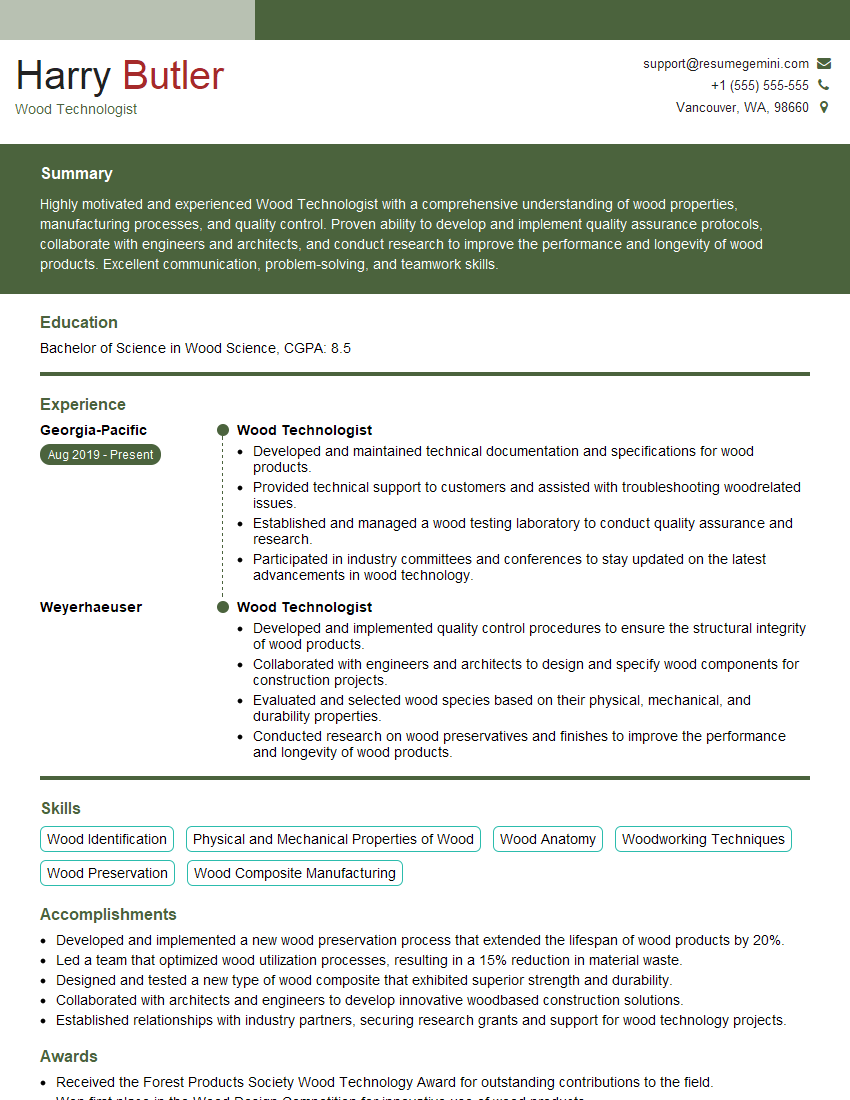
Mastering Wood Drying Theory is crucial for career advancement in the wood industry, opening doors to specialized roles and increased earning potential. A strong understanding of these principles demonstrates your technical expertise and problem-solving skills to potential employers. To maximize your job prospects, it’s essential to present your skills effectively. Creating an ATS-friendly resume is key in ensuring your application gets noticed by recruiters. ResumeGemini is a trusted resource that can help you build a professional and impactful resume tailored to highlight your expertise in Wood Drying Theory. Examples of resumes specifically tailored to this field are available to further guide you.
Explore more articles
Users Rating of Our Blogs
Share Your Experience
We value your feedback! Please rate our content and share your thoughts (optional).
What Readers Say About Our Blog
Very informative content, great job.
good