Every successful interview starts with knowing what to expect. In this blog, we’ll take you through the top Writing and Arranging Choral Music interview questions, breaking them down with expert tips to help you deliver impactful answers. Step into your next interview fully prepared and ready to succeed.
Questions Asked in Writing and Arranging Choral Music Interview
Q 1. Explain your process for arranging a choral piece from a pre-existing melody.
Arranging a choral piece from a pre-existing melody is a fascinating process that involves careful consideration of several key elements. My approach begins with a deep immersion in the melody itself. I listen repeatedly, identifying its inherent emotional character, rhythmic profile, and melodic contours. Then, I consider the specific characteristics of the vocal forces I’m writing for – the number of voices (SATB, SSA, etc.), their individual ranges, and their overall balance.
Next, I create a harmonic foundation. This might involve analyzing the existing melody for inherent harmonies or crafting new harmonies that complement and enhance the melodic line. I might use simple diatonic harmony or explore more chromatic possibilities depending on the style and desired effect. For instance, a simple folk melody might benefit from a straightforward diatonic approach, while a more dramatic piece could lend itself to more complex chromaticism.
After establishing the harmony, I begin to distribute the melody among the vocal parts, carefully considering tessitura (comfortable vocal range) for each section. I strive to create interesting countermelodies and inner voices that complement, contrast, and enrich the main melody without overwhelming it. This often involves careful attention to voice leading – ensuring smooth transitions between chords and avoiding awkward leaps or parallel fifths/octaves. Finally, I refine the arrangement, adding dynamics, articulation markings, and other expressive elements to shape the musical narrative and bring out the full emotional potential of the piece.
For example, when arranging a simple hymn tune, I might add a descant (a high, independent melody) in the soprano section to provide a sense of grandeur, or I might create a rich harmonic texture in the lower voices to provide a solid foundation for the melody.
Q 2. Describe your experience with different choral voicing techniques.
My experience with choral voicing techniques is extensive, encompassing a wide range of styles and approaches. I’m comfortable with both traditional and more contemporary techniques. Traditional voicing often emphasizes a clear melodic line in the soprano, with supporting harmonies in the alto, tenor, and bass. This approach often results in a clear, homophonic texture. I frequently employ techniques like close voicing (where the parts are very close together in pitch) for a rich, full sound or open voicing (where parts are spaced further apart) to create a lighter, more transparent texture.
Beyond traditional techniques, I’m proficient in various contemporary methods including divisi (splitting sections into two or more independent parts), antiphonal singing (where different sections sing in response to one another), and polyphonic textures, where multiple independent melodic lines intertwine. The choice of voicing technique depends heavily on the musical style and the desired expressive effect. For instance, a Renaissance motet might call for a rich, polyphonic texture, whereas a modern gospel arrangement might employ more contemporary techniques like divisi and call-and-response patterns.
Furthermore, I frequently employ techniques like chord inversions to add harmonic color and avoid vocal strain. For instance, instead of always using a root position chord, I might use a first inversion or second inversion depending on the vocal range and the overall texture of the piece.
Q 3. How do you approach writing for various vocal ranges and tessituras?
Writing for various vocal ranges and tessituras requires a deep understanding of the human voice. I begin by considering the specific ranges of the voices I’m writing for – soprano, alto, tenor, and bass. It’s crucial to stay within the comfortable range of each voice part to avoid vocal strain and fatigue. I consult resources such as vocal range charts to ensure that the notes I’m assigning are appropriate for the singers. A well-written choral arrangement is one where each singer feels comfortable and can sing freely without strain.
Beyond simply staying within range, I also consider the tessitura—the average pitch within a given vocal part. A piece with a high tessitura will tire sopranos quickly, while one with a low tessitura may strain the basses. I aim for a balanced tessitura across all parts, ensuring that no single section is consistently singing in an uncomfortable or overly challenging range. Sometimes, I might slightly shift the tessitura to create a specific effect; for instance, a low tessitura for a section might create a sense of gravitas, whereas a high tessitura might evoke a sense of excitement or joy.
Finally, I always keep in mind the individual characteristics of different vocal types within each range. For example, some sopranos are naturally brighter than others, and some basses have a deeper, richer tone. When writing, I adjust my approach to complement these vocal characteristics, leading to a more nuanced and expressive performance.
Q 4. Discuss your understanding of choral textures and their effect on musical expression.
Choral textures are the foundation of a piece’s expressive potential. They describe the way different vocal parts interact, creating a diverse sonic landscape. Understanding and manipulating textures is crucial for achieving the desired musical expression. I use a variety of textures in my arrangements, including homophony (single melody with harmonic accompaniment), polyphony (multiple independent melodies), and heterophony (simultaneous variations of a single melody).
Homophonic textures are often used to convey clarity and directness, ideal for conveying simple, powerful messages. Polyphonic textures, on the other hand, can create a richer, more complex, and layered soundscape; suitable for intricate narratives or introspective moods. Heterophonic textures, though less common, can be highly effective in creating a unique sonic atmosphere, often associated with folk traditions or improvisational styles.
The skillful transition between textures is essential. Moving from a dense, polyphonic section to a sparse, homophonic section can create powerful dramatic contrasts. A sudden shift from a quiet, transparent texture to a loud, full texture can build tension or create a sense of climax. For example, in a dramatic piece, I might use a dense, polyphonic texture during a conflict and then switch to a lighter, homophonic texture during a resolution, thus conveying the shift in the emotional landscape of the piece.
Q 5. What software or notation programs are you proficient in?
I am proficient in several music notation software programs. My primary tools include Sibelius and Finale, both industry-standard programs offering powerful tools for creating and editing scores. These programs allow me to create highly detailed scores with precise control over every aspect of the arrangement, from individual note placement to dynamic markings and articulation. Sibelius’s streamlined interface makes the workflow efficient, and Finale’s comprehensive functionality is invaluable for complex projects. I’m also familiar with Dorico, a newer program with impressive capabilities, and I’ve used various music editing applications on mobile devices for quick sketches and initial ideas.
Q 6. How do you ensure balance and clarity in your choral arrangements?
Ensuring balance and clarity in choral arrangements is paramount. This involves a multi-faceted approach that begins even before notation. I always start by considering the acoustic properties of the space where the piece will be performed. A large, reverberant space may require different voicing techniques than a smaller, more intimate setting. I also carefully consider the individual vocal ranges and capabilities of the singers to avoid any one section overpowering another.
During the compositional process, I use several techniques to achieve balance. I frequently employ dynamic contrasts to highlight certain sections or voices and provide relief for others. I also use careful voice leading and orchestration, avoiding parallel fifths and octaves to prevent muddy textures. The choice of voicings, as discussed earlier, plays a crucial role. For example, open voicings create more transparency, while close voicings create a fuller sound.
Beyond these technical considerations, I pay careful attention to text articulation and phrasing. Properly articulated text enhances clarity and helps individual singers contribute to the overall clarity. Regular rehearsals and feedback from singers are essential in achieving the desired balance and clarity.
Q 7. Explain your approach to rhythmic complexity in choral writing.
Rhythmic complexity in choral writing can add depth and interest to a piece but should always serve the musical expression. I approach rhythmic complexity carefully, ensuring it enhances rather than detracts from the overall musicality. I begin by considering the style of the piece. A Renaissance motet might incorporate complex rhythmic patterns more naturally than a simple hymn.
When introducing rhythmic complexity, I ensure that the rhythms are carefully crafted and clearly notated. I avoid overly complex rhythms that are difficult to sing or understand. I often use rhythmic motifs—short, repeated rhythmic patterns—to create coherence and build momentum. I might also employ rhythmic syncopation (placing accents on unexpected beats) to add excitement and interest.
Crucially, I ensure that rhythmic complexity supports the text and the overall emotional trajectory of the piece. I avoid using complex rhythms simply for the sake of complexity; rather, they should serve a specific purpose—perhaps to emphasize a particular word or phrase, or to create a sense of unease or excitement. Overly complex rhythms, especially if not handled deftly, can obscure the musical message and make the piece difficult to sing and appreciate.
Q 8. Describe your experience with different choral styles (e.g., Renaissance, Baroque, Romantic, Contemporary).
My experience spans a wide range of choral styles, each demanding a unique approach to arrangement and composition. In Renaissance music, I focus on the clear textures and imitative counterpoint, paying close attention to the vocal ranges and the use of modal harmony. Think of the exquisite layering in a Palestrina motet – that’s the kind of precision I strive for. Baroque choral works often involve more dramatic contrasts and elaborate ornamentation; I might use techniques like terraced dynamics and ornamentation to emphasize the grandeur of Bach’s chorales, for instance. The Romantic period brings a greater emphasis on emotional expression and lush harmonies. Here, I focus on shaping phrasing to convey the emotional arc of the music, perhaps employing techniques like rubato or expressive crescendos. Finally, Contemporary choral music offers immense creative freedom. I enjoy exploring extended vocal techniques, unconventional harmonies, and rhythmic complexities, drawing inspiration from diverse musical idioms. A recent project involved incorporating elements of world music into a contemporary piece, which was a fascinating challenge.
Q 9. How do you handle challenges in achieving specific musical effects in a choral arrangement?
Achieving specific musical effects in choral arrangements often requires creative problem-solving. For example, if I need to create a sense of mystery and suspense, I might employ techniques like using hushed dynamics, sparse textures, and unexpected harmonic shifts. To build a powerful climax, I’d likely utilize a gradual crescendo, adding voices and instrumental accompaniment strategically. If the goal is to create a feeling of joy and exuberance, I’d use bright, major tonalities, brisk tempos, and lively rhythmic figures. Sometimes, achieving a desired effect might involve revising the arrangement itself, simplifying overly complex passages or redistributing vocal parts to better balance the sound. I frequently experiment with different vocal combinations and voicings to achieve the desired color and timbre.
Q 10. How do you incorporate dynamics and articulation to enhance the musicality of a choral piece?
Dynamics and articulation are essential for breathing life into a choral piece. Dynamics – the variations in loudness – help to create shape and expression. Think of a gradual crescendo building towards a powerful climax, followed by a sudden diminuendo to emphasize the emotional impact. Articulation – how notes are connected or separated – significantly impacts the rhythmic precision and stylistic character. Legato (smoothly connected notes) creates a flowing, lyrical quality, while staccato (short, detached notes) adds energy and precision. I often use a combination of both, shaping phrases with legato lines and punctuating important moments with staccato articulation. Careful attention to phrasing and breathing also plays a crucial role in shaping musical lines and ensuring a cohesive performance.
Q 11. Describe your understanding of counterpoint and its application in choral composition.
Counterpoint, the art of combining independent melodic lines, is fundamental to choral composition. Understanding counterpoint allows me to create rich, textured harmonies while maintaining clarity and independence in each vocal part. In a simple two-part counterpoint, for instance, I’d ensure that the melodic lines complement each other, avoiding parallel fifths or octaves that might sound muddy. More complex counterpoint, like that found in Renaissance polyphony, involves intricate interweaving of melodic lines, requiring careful consideration of voice leading, rhythm, and harmony. A solid understanding of counterpoint enables me to create arrangements that are both harmonically rich and melodically interesting, engaging the listener on multiple levels.
Q 12. How do you ensure your choral arrangements are both musically satisfying and technically feasible for the singers?
Balancing musical satisfaction with technical feasibility is crucial. While I aim for musical richness and complexity, I always consider the capabilities of the singers. I avoid writing passages that are excessively difficult or beyond the singers’ range or technical abilities. Before finalizing an arrangement, I conduct thorough rehearsals and make adjustments as needed. For example, I might simplify a difficult passage, re-voice certain sections, or add breath marks to ease the physical demands on singers. Collaboration with the choir is key; their input is invaluable in determining what works best for both the musical vision and the singers’ capabilities. The aim is always a satisfying musical outcome that’s accessible and enjoyable for the performers.
Q 13. What strategies do you use to ensure rhythmic precision in your choral arrangements?
Achieving rhythmic precision requires meticulous attention to detail in both the composition and rehearsal stages. In the composition process, I use clear and concise notation, ensuring that rhythmic patterns are easily understood. I also employ rhythmic devices, such as syncopation and hemiola, judiciously to add interest without sacrificing clarity. During rehearsals, I use a variety of techniques to reinforce rhythmic accuracy. This includes detailed explanations, rhythmic exercises, and the use of rhythmic conducting patterns. The use of a metronome or backing track can be helpful in establishing a steady pulse. I might also divide the choir into smaller sections for individual practice before combining them, which helps build rhythmic accuracy and ensemble cohesion.
Q 14. How do you select appropriate choral literature for different performance contexts?
Selecting appropriate choral literature depends heavily on the performance context. A concert in a cathedral will have a very different atmosphere and audience expectation than a performance at a school assembly. For a sacred concert, I’d choose works appropriate for the venue and reflective of the liturgical context. This might include motets, anthems, or choral masses. For a more informal setting, I might select lighter pieces that appeal to a broader audience. I also consider the skill level of the choir. A beginner choir will require simpler arrangements, while a more advanced choir can handle more complex works. The size and vocal makeup of the choir are also relevant factors in the selection process. Understanding the audience, venue, and choir’s capabilities are all critical components of choosing appropriate choral repertoire for a performance.
Q 15. Describe your approach to preparing a choir for a challenging performance.
Preparing a choir for a challenging performance requires a multifaceted approach focusing on meticulous planning, effective communication, and fostering a supportive environment. It’s not just about hitting the right notes; it’s about conveying the emotion and story within the music.
- Detailed Analysis: I begin by thoroughly analyzing the piece, identifying technical hurdles (complex rhythms, challenging intervals, unusual vocal ranges) and expressive nuances (dynamic contrasts, phrasing, articulation). I create a detailed breakdown of each section, noting potential problem areas.
- Individual and Section Work: Rehearsals are structured to address individual and sectional challenges. Difficult passages are tackled step-by-step, starting with smaller units, then gradually building to the whole section. I might use rhythmic exercises or vocal warm-ups specifically tailored to address the piece’s demands.
- Building Confidence: I emphasize positive reinforcement and celebrate small victories. Confidence is crucial, especially when facing challenging material. I create opportunities for singers to show their strengths and build upon them.
- Performance Simulations: As the performance date approaches, we conduct mock performances under conditions as close to the actual concert as possible. This helps to manage stage fright and ensure the choir is fully prepared for the event. We’ll address any lingering issues that arise during these simulations.
- Collaboration: Open communication with the choir is vital. I encourage singers to voice their concerns or questions to create a collaborative environment.
For instance, when preparing a choir for Bach’s Mass in B Minor, I’d focus heavily on intonation, precise articulation, and dynamic control, potentially using recordings of historically informed performances for guidance.
Career Expert Tips:
- Ace those interviews! Prepare effectively by reviewing the Top 50 Most Common Interview Questions on ResumeGemini.
- Navigate your job search with confidence! Explore a wide range of Career Tips on ResumeGemini. Learn about common challenges and recommendations to overcome them.
- Craft the perfect resume! Master the Art of Resume Writing with ResumeGemini’s guide. Showcase your unique qualifications and achievements effectively.
- Don’t miss out on holiday savings! Build your dream resume with ResumeGemini’s ATS optimized templates.
Q 16. How do you incorporate rests and pauses effectively in a choral piece?
Rests and pauses are not simply silences; they are powerful tools for shaping the musical narrative and creating emotional impact. They provide breathing room, allowing the audience to process the music and anticipate what comes next. Effective use requires careful consideration of both musical structure and emotional expression.
- Structural Emphasis: Rests can define phrases, creating a sense of punctuation. A well-placed rest can highlight the preceding musical idea or prepare for a new one. Think of the dramatic pauses in a dramatic speech; the same principle applies in music.
- Emotional Expression: Pauses can amplify emotions. A long pause before a climactic passage builds anticipation, while a shorter pause can create a sense of tension or surprise. The length and type of pause profoundly affect the emotion conveyed.
- Textual Interpretation: When working with choral music with text, rests often coincide with significant punctuation marks or emotional shifts in the lyrics. A longer pause might follow a period, while a shorter pause might mark a comma.
- Dynamic Shaping: Pauses can work in conjunction with dynamics (loudness and softness). A diminuendo (gradual decrease in volume) leading into a pause can create a feeling of suspense or reflection.
Consider the use of rests in a piece like Requiem by Mozart. The pauses between certain sections create a reflective mood and enhance the solemn tone of the piece.
Q 17. What are the common challenges you face when writing for a large choir?
Writing for a large choir presents unique challenges that go beyond simply writing for a larger ensemble. Blending large vocal sections effectively and achieving clarity in texture are crucial.
- Maintaining Balance: Ensuring a balanced sound between sections (sopranos, altos, tenors, basses) is crucial. It requires careful consideration of vocal ranges and tessitura (the most comfortable range of notes for a particular voice type), to prevent one section from overpowering another. This often involves strategic doubling or division of sections.
- Achieving Clarity: In a large choir, individual vocal lines can get lost in the overall texture. To counteract this, I might use techniques such as clear melodic lines, varied rhythmic patterns, and strategic use of dynamics and articulation to prevent the music from becoming muddled.
- Accommodating Vocal Ranges: Large choirs often have a broader range of vocal abilities. Therefore, the arrangement should accommodate a wide variety of vocal skills and ranges while still sounding unified. This may involve adapting existing arrangements or writing different versions for various skill levels.
- Technical Limitations: Large choirs might have logistical limitations during rehearsals and performances. The arrangement should account for these and provide clear and organized scores for easy navigation.
For instance, when composing for a large collegiate choir, I’d pay special attention to writing balanced SATB (Soprano, Alto, Tenor, Bass) parts and avoid overly dense textures, especially in lower registers where blending can be more difficult.
Q 18. How do you create a sense of unity and cohesion within a complex choral arrangement?
Creating unity and cohesion in a complex choral arrangement relies on several key techniques that weave the individual parts into a unified whole. It’s like orchestrating a conversation where each voice has its unique character but contributes to the overall narrative.
- Motivic Development: Repeating or transforming musical ideas (motives) throughout the arrangement establishes a sense of connection between different sections. This creates a sense of unity, even in the midst of complexity.
- Harmonic Coherence: A well-defined harmonic structure provides a strong foundation for the entire piece. Careful use of chord progressions and voice leading creates a sense of flow and continuity.
- Textural Consistency: Although there may be moments of dense or sparse texture, maintain a consistent approach to voicing and weaving the parts together. Using similar rhythmic or melodic patterns across sections can build cohesion.
- Careful Voice Leading: Smooth transitions between chords and musical phrases are crucial. Careful voice leading prevents abrupt jumps in pitch or tone and maintains a seamless flow.
- Strategic use of imitation and counterpoint: Techniques such as canons, rounds, or counterpoint, where different voices imitate or interact with each other, enhance the overall unity and create a richer musical texture.
For example, in a complex fugue, the recurring subject matter and the interplay between voices contribute to the overall sense of unity, despite the multiple independent lines.
Q 19. What are your preferred methods for conducting rehearsals and addressing vocal issues?
My rehearsal methods are highly adaptable, focusing on clear communication and personalized feedback. Addressing vocal issues requires a combination of technical instruction and individual attention.
- Structured Rehearsals: I structure rehearsals to address different aspects of the piece systematically. We might start with warm-ups tailored to the piece’s demands, followed by section work, then full choir rehearsals. I allocate time for individual coaching as needed.
- Targeted Feedback: I use a combination of verbal and non-verbal cues to provide targeted feedback. For instance, I might use gestures to indicate phrasing or intonation issues, or I might work individually with singers to address technical challenges.
- Addressing Vocal Issues: Identifying vocal problems requires careful listening. I will often address posture, breath control, resonance, and diction to help correct vocal issues. If needed, I’ll recommend consultation with a vocal coach.
- Positive Reinforcement: Creating a positive and supportive learning environment is vital. I offer constructive criticism but focus on celebrating successes and highlighting singers’ strengths. This creates a collaborative atmosphere and helps singers feel empowered rather than discouraged.
If a section struggles with intonation in a particular passage, I might employ exercises to improve their interval recognition, or if breathing is an issue, I might use various breath exercises to improve their technique. I believe in a holistic approach to choral singing that addresses both musical and technical aspects.
Q 20. How do you handle requests for revisions or changes to your choral arrangements?
Handling revision requests requires a collaborative and professional approach, focusing on clear communication and mutual understanding.
- Understanding the Rationale: I begin by actively listening to the reasons for the requested changes. Understanding the conductor’s or client’s perspective is crucial to providing effective revisions.
- Feasibility Assessment: I assess the feasibility of the changes, considering their impact on the overall musical structure and coherence. Sometimes, a minor alteration might have far-reaching effects that necessitate a broader revision.
- Transparent Communication: I maintain open communication, discussing the potential impact of the requested changes and offering alternative suggestions if needed. This ensures that both parties are on the same page.
- Iterative Process: Revisions are often an iterative process. I may provide multiple revisions until we arrive at a mutually acceptable version. I always provide explanations for any changes I make.
I’ve had instances where a conductor requested a tempo change that necessitated re-writing certain passages to maintain musical integrity and expressiveness. Open dialogue and mutual respect are essential during such situations.
Q 21. Explain your understanding of copyright and permissions regarding choral music.
Copyright and permissions in choral music are crucial aspects of ethical and legal practice. Understanding these principles protects both composers and performers.
- Copyright Ownership: The composer holds the copyright to their original work. This right grants them exclusive control over the reproduction, distribution, and performance of their music. This protection typically lasts for the life of the composer plus 70 years.
- Licensing and Permissions: Performing a copyrighted choral piece publicly usually requires obtaining a license from the copyright holder or a licensing agency. This applies to both live performances and recorded performances for commercial purposes. The license specifies the terms of use and usually involves a fee.
- Public Domain: Works whose copyrights have expired are considered to be in the public domain and can be used without permission. However, you should still credit the original composer if possible.
- Mechanical Rights: For recordings, separate mechanical licenses might be needed. Mechanical licenses are required whenever a musical work is copied or reproduced, such as when a work is recorded on a CD or for streaming services.
- Ethical Considerations: Even when a work is in the public domain, ethical considerations encourage giving credit to the composer and respecting the integrity of the work.
Ignoring copyright laws can lead to legal action and penalties. It’s essential to check with relevant performing rights organizations and publishers to ensure that you have the necessary permissions before performing or distributing choral music.
Q 22. How do you incorporate the unique characteristics of specific voice types into your arrangements?
Understanding the unique timbral qualities of each voice type – soprano, alto, tenor, and bass – is paramount in choral arrangement. I approach this by considering their individual ranges, strengths, and vulnerabilities. Sopranos, for instance, excel in high, lyrical lines, while basses are ideally suited for low, resonant harmonies. I avoid writing passages that are excessively taxing for any voice part. For example, I might give the altos a more comfortable range in a piece with a particularly challenging soprano melody, perhaps assigning them a countermelody or supportive harmony instead of a demanding vocal line. This approach ensures a balanced and well-supported sound where each voice type contributes effectively and without strain.
Consider a piece requiring a powerful climax. I might use the tenors and basses to build a strong foundation, layering the sopranos and altos above for a shimmering effect. Conversely, for a gentle, lyrical section, I might favor a lighter texture with independent melodic lines for each voice, focusing on the beautiful blend of their unique timbres. Careful consideration of the tessitura (comfortable vocal range) for each part is crucial. I regularly use software to analyze the range and frequency of each voice line in my arrangements, allowing for adjustments before rehearsal.
Q 23. Describe your experience with preparing scores for publication.
Preparing scores for publication is a meticulous process demanding attention to detail and adherence to professional standards. My experience encompasses every stage, from initial manuscript preparation to final file delivery. I utilize notation software such as Sibelius or Finale to ensure accuracy and consistency. This includes meticulous engraving, ensuring clarity of notes, rests, dynamic markings, articulation, and phrasing. I adhere to specific style guides and publishers’ requirements regarding formatting, page layout, and instrumentation. This often involves multiple rounds of revisions and careful proofing, checking for any inconsistencies or errors. I’m comfortable with different file formats required for printing (PDF, MusicXML) and online distribution. A recent project involved preparing a choral anthology, necessitating close collaboration with the publisher on aspects such as the table of contents, indexing, and copyright management.
Q 24. How familiar are you with different conducting techniques for choral music?
My familiarity with conducting techniques for choral music is extensive. I understand the importance of clear and precise baton technique, effective cueing, and shaping musical phrases through gestures. Beyond basic techniques, I’m proficient in techniques specific to choral conducting, such as managing breath control, diction, balance between voice parts, and creating a unified sound. I’m also familiar with various conducting styles, adapting my approach based on the musical style and the specific needs of the choir. For instance, a more dramatic style might require larger, more expansive gestures, while a delicate piece would benefit from subtle and nuanced cues. I recognize that effective communication is crucial; therefore, I use both verbal and non-verbal cues to convey my musical vision to the choir.
Furthermore, I understand the importance of rehearsal techniques such as sectional rehearsals, full choir rehearsals, and the use of recordings for self-assessment. This enables me to address individual and collective challenges effectively, tailoring my approach based on the choir’s specific capabilities and limitations.
Q 25. How do you manage your time effectively when working on multiple choral arrangement projects?
Managing multiple choral arrangement projects effectively requires meticulous planning and organizational skills. I utilize project management tools to create detailed timelines, setting realistic deadlines for each stage of the process (composition, arrangement, scoring, proofing). This might involve using a spreadsheet or dedicated software to track progress, deadlines, and allocate time for each project. I prioritize tasks based on urgency and importance, focusing on the most time-sensitive projects first. I frequently break down large projects into smaller, more manageable tasks, allowing for regular checkpoints and evaluations of progress. This incremental approach minimizes stress and keeps me on track.
Moreover, I maintain a detailed archive of my work, making it easy to refer to previous projects and templates, thereby streamlining future tasks. Regular breaks and self-care are also crucial for maintaining focus and productivity. Avoiding burnout is essential for consistently delivering high-quality work.
Q 26. How do you collaborate effectively with singers and other musicians?
Collaboration is essential in choral music. I prioritize open communication and active listening when working with singers and other musicians. I believe in fostering a respectful and supportive environment where everyone feels comfortable sharing their ideas and concerns. Before starting a project, I discuss the musical goals with the singers, understanding their capabilities and preferences. During rehearsals, I provide constructive feedback, addressing both individual and ensemble challenges. I value their input, understanding that their perspective often enhances the overall quality of the arrangement.
With other musicians, such as instrumentalists or composers, I focus on clear communication regarding stylistic choices, technical requirements, and deadlines. This may involve regular meetings, email exchanges, or shared online documents. A collaborative approach ensures everyone’s understanding and contribution to the final product. For example, I recently collaborated with a pianist on a choral arrangement, incorporating his input on instrumental accompaniment and texture. This mutual understanding resulted in a richer and more compelling final version.
Q 27. Explain your process for selecting harmonies that complement the melody and overall mood of a piece.
Selecting harmonies that complement the melody and overall mood of a piece is a crucial aspect of choral arrangement. My process involves a careful consideration of several factors: the melody’s key, mode, and melodic contour; the overall mood or emotion of the piece; and the specific timbral qualities of the choir. I often begin by analyzing the melody’s inherent harmonies, identifying the most natural and expressive chords. I might use a combination of diatonic, chromatic, and modal harmonies, depending on the musical style and the desired effect.
For instance, a joyful piece might benefit from bright, major harmonies, while a melancholic piece might utilize minor harmonies or more chromatic passages. I experiment with different voicings (the arrangement of notes across the different vocal parts), ensuring that the harmonies are well-balanced and sonorous. I avoid overly dissonant or jarring harmonies unless they are used intentionally to create a specific effect. I might utilize techniques like suspension, passing chords, and secondary dominants to add interest and depth to the harmonic progression. Throughout the process, I continuously evaluate the overall effect of the harmonies, making adjustments to ensure they effectively support and enhance the melody and the overall emotional impact of the piece.
Q 28. Discuss your experience with working within specific stylistic parameters, or limitations, for choral settings.
Working within specific stylistic parameters is a common aspect of choral arrangement. My experience includes adapting to various styles, from Renaissance polyphony to contemporary minimalism. Understanding the stylistic conventions of each period is crucial; this involves researching the relevant historical context, common compositional techniques, and characteristic harmonic language. For example, a Renaissance-style arrangement requires a focus on clear textures, contrapuntal lines, and a limited harmonic palette. Conversely, a contemporary piece might incorporate atonal harmonies, unusual rhythms, and extended vocal techniques.
When working with commissioned pieces, adhering to specific requirements from clients or conductors is important. This might include limitations on instrumentation, vocal range, or specific musical elements. I always discuss these parameters clearly with the client at the outset of the project, clarifying expectations and ensuring a shared understanding of the desired aesthetic. This clarity ensures that the final arrangement meets all specified limitations while preserving the integrity and artistry of the composition. A recent project involved arranging a gospel piece for a youth choir, demanding attention to both the stylistic conventions of gospel music and the vocal capabilities of young singers. This required careful selection of harmonies and rhythmic patterns to create a piece that was both stylistically appropriate and accessible to the performers.
Key Topics to Learn for a Writing and Arranging Choral Music Interview
- Choral Composition Techniques: Understanding different compositional styles (e.g., Renaissance, Baroque, Romantic, contemporary), voice leading principles, and texture creation for choral arrangements.
- Score Preparation and Notation: Proficiency in music notation software (Sibelius, Finale, Dorico), including accurate engraving, part extraction, and preparation of performance materials.
- Vocal Technique and Range: Demonstrating a deep understanding of vocal ranges, tessitura, and vocal writing considerations to create effective and singable choral arrangements.
- Harmony and Counterpoint: A strong grasp of harmonic principles, including chord progressions, voice leading, and counterpoint techniques to create rich and interesting textures.
- Orchestration and Instrumentation (if applicable): Knowledge of instrumental timbres and how they can complement or contrast with choral voices in arrangements involving accompaniment.
- Text Setting and Interpretation: Ability to effectively set text to music, considering rhythm, phrasing, and the emotional impact of the lyrics.
- Practical Application: Prepare examples of your own choral arrangements, demonstrating your skills in voice leading, harmony, and overall compositional choices. Be ready to discuss the creative process behind your work.
- Problem-Solving Approaches: Be ready to discuss how you approach challenges in arranging, such as balancing vocal parts, resolving complex harmonies, or adapting pieces for specific vocal ensembles.
- Understanding Different Choral Styles and Repertoire: Demonstrate familiarity with diverse choral traditions and the ability to analyze and interpret existing choral works.
Next Steps
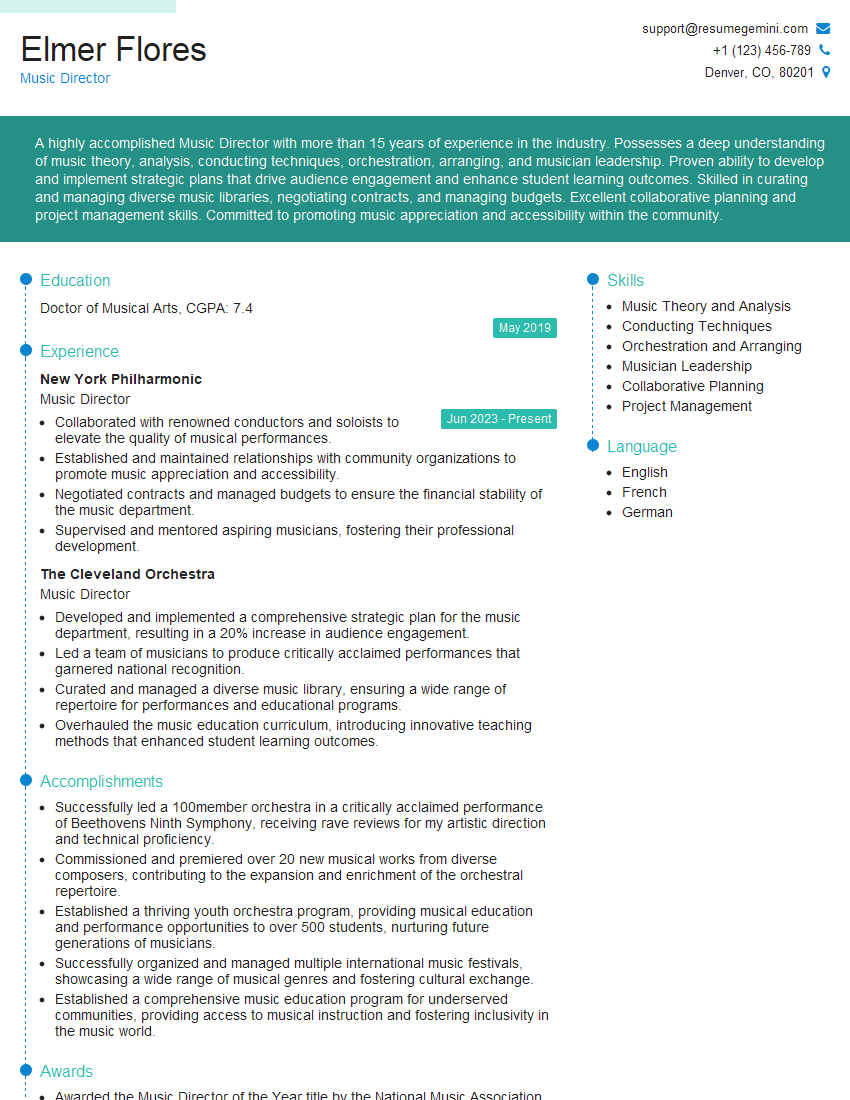
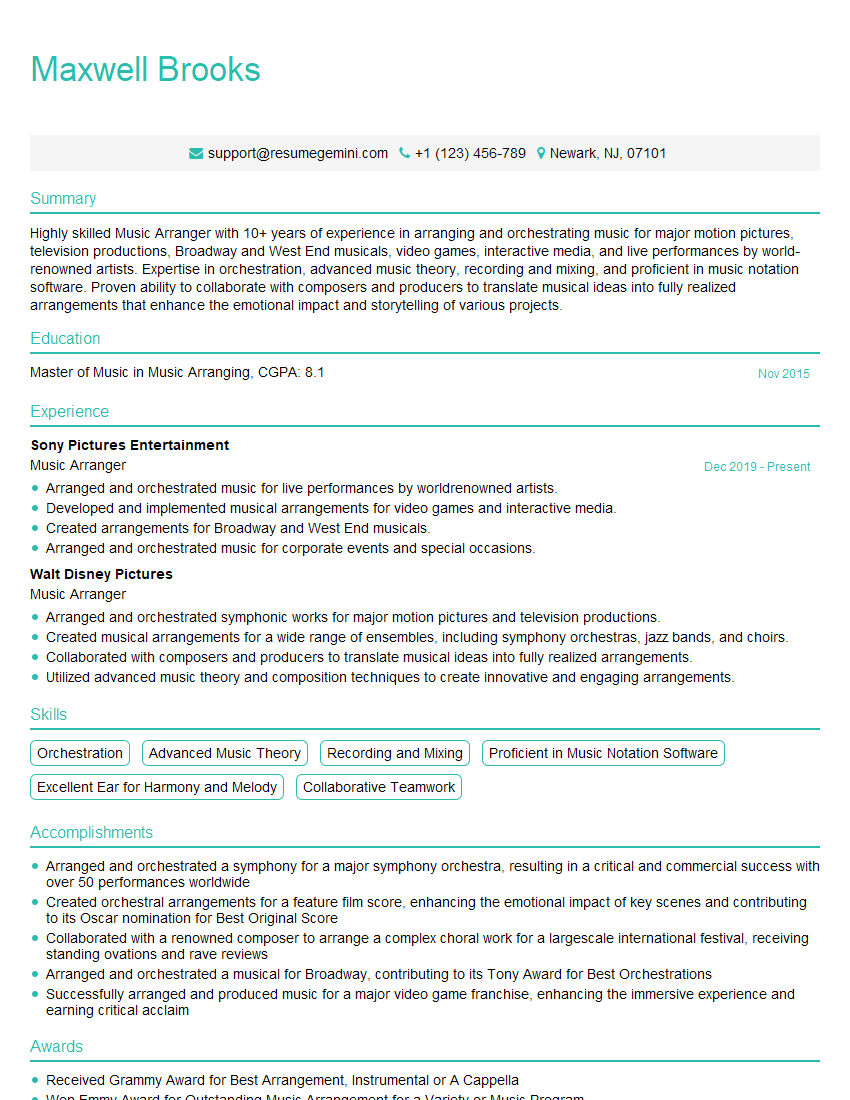
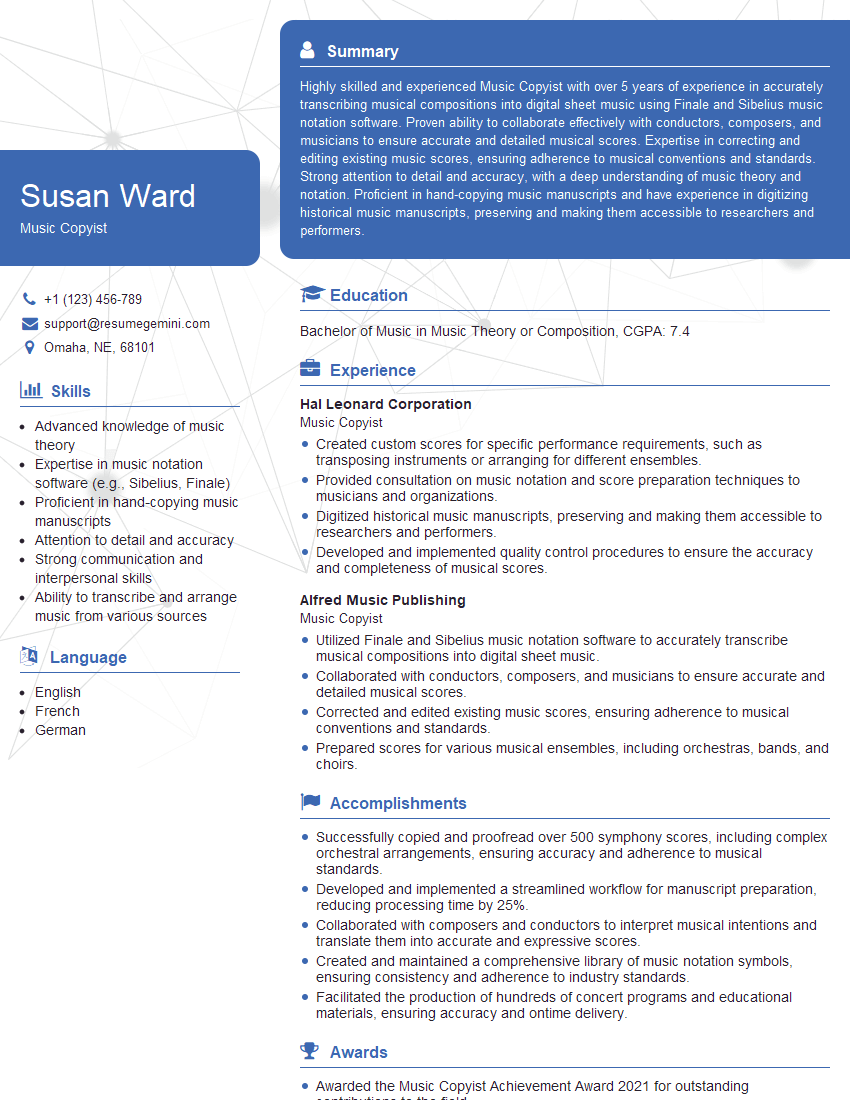
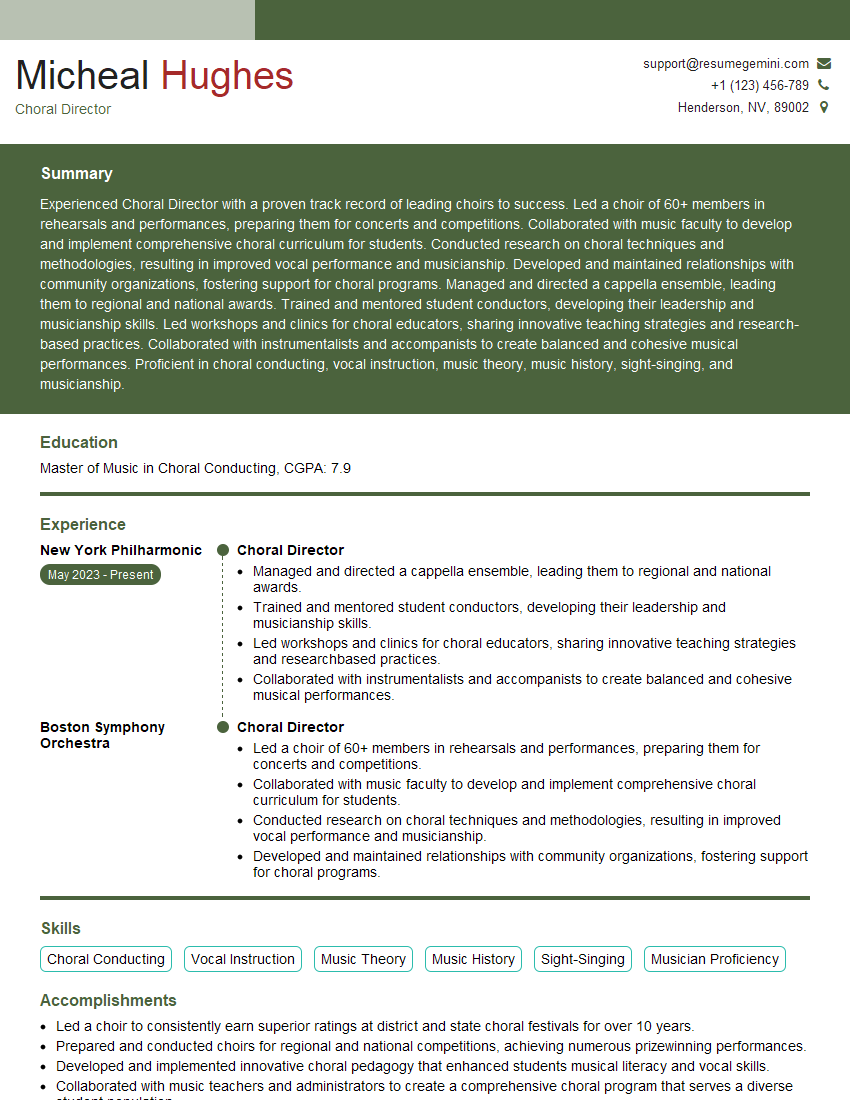
Mastering the art of writing and arranging choral music opens doors to exciting career opportunities in diverse settings, from educational institutions and church choirs to professional ensembles and publishing houses. To significantly boost your job prospects, focus on creating a compelling and ATS-friendly resume that highlights your skills and experience effectively. ResumeGemini is a trusted resource that can help you build a professional and impactful resume tailored to the specific demands of the choral music field. Examples of resumes tailored to Writing and Arranging Choral Music are available to help you get started. Investing time in crafting a strong resume will increase your chances of securing interviews and landing your dream job.
Explore more articles
Users Rating of Our Blogs
Share Your Experience
We value your feedback! Please rate our content and share your thoughts (optional).
What Readers Say About Our Blog
Very informative content, great job.
good