The right preparation can turn an interview into an opportunity to showcase your expertise. This guide to Yarn Macrame interview questions is your ultimate resource, providing key insights and tips to help you ace your responses and stand out as a top candidate.
Questions Asked in Yarn Macrame Interview
Q 1. What knotting techniques are you proficient in (e.g., square knot, spiral knot, larks head knot)?
My proficiency in macrame knotting techniques is extensive. I’m highly skilled in the fundamental square knot (also known as a reef knot), which forms the basis of many macrame designs. This knot is incredibly versatile, allowing for intricate patterns and textures. I also master the spiral knot, which creates beautiful, flowing cords and fringes, adding a unique aesthetic to my pieces. Beyond these, I’m comfortable with the larks head knot, used primarily for attaching cords to a foundation, and various other decorative knots such as the half hitch and the double half hitch, crucial for creating complex patterns and textures. I also regularly employ variations on these basic knots, creating unique knot combinations and textures that give my work its distinctive style.
- Square Knot: The foundation of many macrame projects, creating strong and stable structures.
- Spiral Knot: Used for creating textured cords, fringes and decorative elements.
- Larks Head Knot: Essential for securely attaching working cords to a base or foundation.
- Half Hitch & Double Half Hitch: Creates various fills, patterns and textures.
Q 2. Describe your experience with different yarn types and their suitability for macrame projects.
My experience spans a wide range of yarn types, each offering unique properties that affect the final piece. For example, 3mm cotton cord is incredibly popular for its durability, ease of handling, and ability to hold knots securely. It’s perfect for wall hangings, plant hangers, and other projects requiring strength. I also frequently use hemp cord, which adds a rustic, earthy feel. Its slightly coarser texture contributes to a more bohemian aesthetic. Thinner, softer yarns like linen or even recycled cotton can create delicate pieces but may require more careful knotting and are less durable. Synthetic yarns, such as acrylic, offer bright colours and are easy to clean, but sometimes lack the tactile quality of natural fibres. Choosing the right yarn depends entirely on the desired aesthetic and the project’s intended function. For instance, a delicate plant hanger might call for a softer yarn, while a sturdy wall hanging would benefit from something stronger like cotton or hemp.
Q 3. How do you determine the appropriate yarn weight and quantity for a given macrame design?
Determining the appropriate yarn weight and quantity is crucial for successful macrame. I start by meticulously analyzing the pattern or design. The complexity of the knotting, the size of the finished piece, and the thickness of the yarn all inform my calculations. For example, a large wall hanging using a chunky yarn will naturally require a significantly larger quantity than a small keychain using a thinner yarn. I usually work with a yarn weight chart to ensure consistency, and I tend to overestimate the yarn needed, especially for complex projects, to avoid running short mid-project. Often, I create sample swatches to test the chosen yarn’s drape and knotting behaviour before committing to a larger quantity.
Q 4. Explain your process for creating a macrame pattern from scratch.
Creating a macrame pattern from scratch is a process that involves sketching, knotting, and refinement. I begin by sketching the desired shape and overall design. Then, I experiment with different knotting combinations to achieve the desired texture and visual effect. This often involves creating small prototypes or swatches to test the feasibility of my ideas. I meticulously document each step with detailed notes and diagrams to help translate my physical creations into a coherent and reproducible pattern. This process requires considerable patience and involves many revisions until I am satisfied with the overall look and structural integrity of the design. Once the prototype is refined, I create clear instructions, including written descriptions, diagrams, and even photos or videos, to ensure others can easily reproduce the design.
Q 5. How do you plan and manage your time effectively when working on a complex macrame project?
Time management is critical, especially for large-scale macrame projects. I start by breaking down the project into smaller, manageable tasks. This makes the project feel less daunting. I set realistic deadlines for each stage and use a project management tool to track my progress and stay organized. Prioritization is key; I focus on the most crucial steps first, ensuring a solid foundation before moving on to more intricate details. I also schedule dedicated work sessions, setting aside uninterrupted time to focus entirely on the project to maintain momentum and avoid distractions. Regular breaks are essential to prevent burnout and maintain quality of work.
Q 6. Describe your experience with different macrame finishing techniques.
My macrame finishing techniques are diverse and tailored to the specific project. For example, I use various methods to secure loose ends, including carefully weaving them into the design, knotting them securely, or using fray check to prevent unraveling. I also employ different methods for adding embellishments like beads or feathers, ensuring their secure attachment. After completing a piece, I carefully inspect it to ensure structural integrity and evenness of knots. Sometimes, a light press with a steam iron is used to improve the overall appearance. Choosing appropriate finishing techniques significantly contributes to the overall quality and longevity of the final product.
Q 7. How do you maintain the quality and consistency of your macrame work?
Maintaining quality and consistency requires attention to detail at every stage. I start by using high-quality materials, which directly impacts the final piece’s durability and aesthetic appeal. I maintain consistent tension while knotting, which is essential for creating a uniform and professional-looking finish. Regularly checking my work for errors and inconsistencies during the knotting process is important to catch and correct any mistakes early on, avoiding the need for extensive rework. Finally, I implement rigorous quality control checks after each project is completed, ensuring the piece meets my standards of excellence before it is considered finished.
Q 8. How do you troubleshoot common problems encountered during macrame creation (e.g., uneven knots, tangled yarn)?
Troubleshooting in macrame is crucial for achieving clean, professional results. Uneven knots often stem from inconsistent tension while tying. To fix this, I always emphasize consistent tension throughout the knotting process. Practice makes perfect – consistent pressure is key. If knots are too loose, re-tie them carefully, ensuring the working strands are snug against the base cords. Tangled yarn, a common frustration, can be avoided by using a yarn swift or keeping your working yarn neatly organized. If tangles occur, patiently untangle them, working from the outside in to avoid further complications. For severe tangles, I might even use a crochet hook to gently separate the strands.
Another common issue is uneven spacing between knots. This can be avoided by using a ruler or measuring tape to ensure consistent spacing between each knot row, particularly when working with geometric patterns. It’s about developing a keen eye for detail and consistency.
- Uneven Knots: Check tension consistency, re-tie loose knots.
- Tangled Yarn: Use a yarn swift or keep your yarn organized. Gently untangle, working from the outside in.
- Uneven Spacing: Use a ruler for consistent spacing between knot rows.
Q 9. What are your preferred tools and materials for macrame, and why?
My preferred tools and materials are chosen for their quality, durability, and ease of use. I primarily use high-quality cotton cord, because it’s strong, relatively easy to work with, and creates beautiful, durable pieces. For finer details or specific projects, I also incorporate other materials like linen or recycled sari silk. The choice of cord depends on the project’s scale and desired aesthetic. For example, a thick cotton cord is ideal for wall hangings, while thinner cords are better for intricate jewelry.
My essential tools include sharp scissors for clean cuts (blunt scissors can fray the cord), a macrame board or dowel for keeping my work organized, and measuring tapes for accuracy in knot placement and overall dimensions. I often use a tapestry needle for weaving in loose ends for a professional finish. A good pair of scissors is paramount; I invest in high-quality ones that stay sharp.
Q 10. How do you ensure the safety and durability of your macrame creations?
Safety and durability are paramount in my macrame work. I always start by selecting high-quality, strong materials. Cotton cord is my go-to because of its strength and ease of use. When finishing a piece, I secure all loose ends securely by using either a knotting technique appropriate for the project or by carefully weaving in the ends with a tapestry needle to prevent unraveling. I always double-check knots for firmness and stability. For projects designed for high-use situations (like plant hangers), I will use extra strong cord and reinforce critical knots. For children’s toys, I use only non-toxic and durable materials and closely inspect all knots for potential hazards.
Regularly checking for loose knots or frayed cords is crucial to maintaining durability. In addition to quality materials, careful attention to technique – ensuring each knot is tied correctly and tightly – is fundamental to creating long-lasting pieces.
Q 11. Describe your experience using different macrame patterns and how you adapt them.
I have extensive experience with a wide range of macrame patterns, from simple square knots to intricate spiral patterns and complex beaded designs. I’m proficient in both traditional and modern techniques. Adapting patterns is a significant part of my process. For example, I might take a basic square knot pattern and alter it by changing the cord thickness or adding beads to create a completely new look. I’ve adapted many patterns to suit specific client requests by adding or removing elements, modifying the color scheme, or adjusting the overall size and shape.
One example is taking a plant hanger pattern and adapting it for a wall hanging by extending the length and creating a different finish at the bottom. Adapting existing patterns is about understanding the underlying principles and then using your creativity to change them. It is all about understanding the fundamental knotting techniques and then using them creatively.
Q 12. What is your experience with designing custom macrame pieces based on client specifications?
Designing custom macrame pieces based on client specifications is a large part of my work. I collaborate closely with clients to understand their vision, discussing their preferred colors, materials, sizes, and styles. I create detailed sketches and mock-ups to ensure the final product aligns with their expectations. I’m adept at translating abstract ideas into concrete designs, offering suggestions and alternatives while respecting the client’s artistic direction.
For example, I recently created a large-scale wall hanging for a client’s living room using a combination of textures and colors inspired by her favorite landscape. The process involved several consultations and revisions to refine the design before starting the actual macrame work.
Q 13. How do you price your macrame creations?
Pricing my macrame creations is a multifaceted process that considers several factors. The primary factors include the cost of materials (cord, beads, findings), the time investment required to create the piece, the complexity of the design, and my level of expertise. I also factor in the overhead costs associated with my business, such as studio space and marketing. I analyze the market value for comparable pieces to ensure competitive yet fair pricing.
For custom projects, the pricing is determined through a detailed quote that includes all the relevant costs and a breakdown of the design process. Transparency is key; clients appreciate understanding how the price is determined.
Q 14. How familiar are you with different types of macrame cord?
I am very familiar with various types of macrame cord. My experience encompasses cotton cord (in various thicknesses and plies), hemp cord, linen cord, jute cord, recycled sari silk, and even leather cords. Each cord type offers unique characteristics influencing the final outcome. Cotton is a classic choice offering versatility, strength and a soft texture. Hemp and jute are more rustic and eco-friendly options. Linen gives a luxurious look and feel. The choice depends on the desired look, feel, and durability of the finished product.
For example, cotton cord is perfect for creating delicate jewelry, while hemp cord is a better option for robust wall hangings. My knowledge extends to understanding the properties of each cord type; for instance, I know that hemp cord can be quite stiff, which may require special techniques to work with, while cotton is more pliable.
Q 15. Describe your understanding of color theory and its application in macrame design.
Color theory is fundamental to creating visually appealing and impactful macrame designs. It’s about understanding how colors interact – their relationships in terms of hue, saturation, and value – to create specific moods and effects. In macrame, this translates to choosing yarn colors that complement each other, create contrast, or evoke a particular feeling.
For example, using analogous colors (colors next to each other on the color wheel, like blues and greens) creates a calm and harmonious piece, perfect for a relaxing bedroom setting. Conversely, complementary colors (colors opposite each other on the color wheel, like red and green) create a vibrant and energetic piece, ideal for a more lively space. I often use a color scheme before starting a project, maybe a triad (three colors evenly spaced on the color wheel) for a bolder, more sophisticated feel.
Understanding value (lightness or darkness of a color) is also critical. Varying the values of your yarn colors adds depth and dimension to the design. Think about a wall hanging: strategically using darker shades in the background and lighter shades in the foreground can create a sense of movement and interest. I often experiment with different shades of the same color to create a subtle, sophisticated look, rather than relying solely on dramatically contrasting colors.
Career Expert Tips:
- Ace those interviews! Prepare effectively by reviewing the Top 50 Most Common Interview Questions on ResumeGemini.
- Navigate your job search with confidence! Explore a wide range of Career Tips on ResumeGemini. Learn about common challenges and recommendations to overcome them.
- Craft the perfect resume! Master the Art of Resume Writing with ResumeGemini’s guide. Showcase your unique qualifications and achievements effectively.
- Don’t miss out on holiday savings! Build your dream resume with ResumeGemini’s ATS optimized templates.
Q 16. What are your strategies for marketing and selling your macrame products?
My marketing strategy is multi-faceted, focusing on both online and offline presence. Online, I leverage Etsy, Instagram, and a personal website to showcase my work and connect with potential customers. High-quality photographs are crucial, highlighting the texture and detail of each piece. Engaging captions and consistent posting are key to building a strong online presence. I also use targeted advertising on social media to reach specific demographics interested in handmade home decor.
Offline, I participate in local craft fairs and markets. This allows for direct interaction with customers, providing a chance to explain my craft and build relationships. Word-of-mouth referrals are also incredibly valuable; satisfied customers often recommend my work to their friends and family. I also collaborate with local interior designers and boutiques, providing them with exclusive pieces to sell in their stores.
Q 17. How do you handle customer feedback and potential issues with your macrame work?
Customer feedback is invaluable to me. I actively encourage customers to share their thoughts and experiences. I respond promptly and professionally to all feedback, whether positive or negative. For positive feedback, I express my gratitude and appreciate their support. For negative feedback or issues, I listen carefully and try to understand the problem. My aim is to find a mutually agreeable solution, whether it’s a repair, replacement, or refund. I view every issue as an opportunity to improve my work and customer service. Transparency and open communication are crucial in handling these situations; I always strive to maintain a positive relationship with my customers, even when things don’t go exactly as planned. For example, if a customer finds a minor flaw, I will offer a partial refund or a small discount on their next purchase.
Q 18. Describe a challenging macrame project you have completed and how you overcame obstacles.
One challenging project was a large-scale wall hanging incorporating complex knotting techniques and a diverse range of yarns with varying thicknesses. The biggest obstacle was maintaining consistent tension throughout the piece, especially with the varied yarn weights. The different yarns had different degrees of ‘give’, making it difficult to create a uniform look.
To overcome this, I developed a meticulous planning process, including detailed sketches and yarn charts. I experimented with different knotting techniques to achieve consistent tension with each yarn type. I also practiced the knotting sequences repeatedly before starting the main project, ensuring I was comfortable and efficient with the required skills. This attention to detail resulted in a finished piece that showcased the complexity of the design while maintaining the desired visual consistency.
Q 19. How do you stay updated on current trends and techniques in the macrame field?
I stay updated on current trends and techniques in macrame through a variety of methods. I actively follow macrame artists and designers on Instagram and Pinterest. These platforms showcase innovative techniques and designs, providing inspiration and exposure to new ideas. I also subscribe to relevant online magazines and blogs dedicated to fiber arts.
Furthermore, attending workshops and classes taught by experienced macrame artists is beneficial, allowing for hands-on learning and networking opportunities. It’s important to continuously experiment and refine one’s skills. This continuous learning process helps me develop new skills and keep my work fresh and relevant to the evolving trends in the market.
Q 20. What are your strengths and weaknesses as a macrame artist?
My strengths lie in my attention to detail, creative problem-solving, and the ability to translate complex ideas into visually appealing macrame pieces. I am meticulous in my work and take pride in creating high-quality, durable products. I’m also adept at adapting my techniques to meet specific customer requests.
One area I’m always working on is time management. Balancing the demands of creating intricate pieces with marketing and managing customer inquiries can sometimes be challenging. I’m actively implementing project management tools to improve this aspect of my business.
Q 21. What are your career goals in relation to macrame?
My career goals revolve around building a sustainable and thriving macrame business. I aspire to expand my online presence and explore opportunities to teach workshops and classes, sharing my passion and expertise with others. Ultimately, I envision creating a brand recognized for its high-quality, unique designs and exceptional customer service. I hope to combine my love of art with entrepreneurial success, establishing a business that supports both my artistic growth and financial well-being. A long-term goal would be to have my work featured in publications or galleries.
Q 22. How do you ensure the ethical sourcing of your materials?
Ethical sourcing of materials is paramount in my work. I prioritize suppliers who demonstrate commitment to sustainable practices and fair labor conditions. This means actively researching my suppliers, verifying their certifications (e.g., Fair Trade, GOTS for organic cotton), and directly engaging with them to understand their production processes.
For example, I source my cotton from a cooperative in Peru known for its commitment to environmental responsibility and fair wages for its artisans. This ensures not only the quality of my materials but also the ethical integrity of my craft. I also actively look for recycled or upcycled materials whenever possible, minimizing my environmental impact. Transparency is key; I am always happy to discuss my sourcing practices with clients who are interested.
Q 23. How do you maintain your work space organization while crafting?
Maintaining a well-organized workspace is crucial for efficiency and creativity in macrame. My approach is based on a system of dedicated zones: a cutting and preparation area with ample space for spreading out my cord; a working area with a comfortable chair, good lighting, and easily accessible tools; and a storage area for completed projects, extra cord, and tools, organized by type and color.
I utilize clear storage containers and labels to keep everything easily accessible. This prevents tangles and allows me to quickly find the materials I need. Regular decluttering and cleaning sessions are also vital to maintain my space and ensure a creative workflow. Thinking of my space as a ‘studio’ rather than just a workspace helps me to invest in it and take pride in keeping it organized.
Q 24. Describe your approach to project planning and timeline management.
Project planning and timeline management are integral to successful macrame creation, especially for commissioned pieces. I begin with a detailed consultation with the client, meticulously documenting their requirements, including size, color scheme, and desired style. I then create a detailed design sketch, incorporating technical drawings to accurately represent the knotting patterns and dimensions. This step allows for client review and potential adjustments before the project commences.
Following the design phase, I develop a comprehensive timeline, breaking down the project into manageable tasks with estimated completion times. This timeline is shared with the client, ensuring transparency and managing expectations. I use project management software to track my progress, setting reminders for each task and allowing for flexibility in case of unexpected delays. Regular updates are provided to clients to keep them involved throughout the creative process.
Q 25. How do you handle revisions and modifications to existing macrame designs?
Handling revisions and modifications in macrame requires careful consideration and precise execution. I begin by discussing the requested changes with the client, ensuring a clear understanding of their vision. The modification process might involve adjustments to knotting patterns, color palettes, or overall dimensions. For minor adjustments, I may be able to incorporate them directly into the ongoing project. More significant revisions may require unraveling sections and restarting parts of the work.
Detailed documentation of every stage of the project is essential, allowing me to easily revert to previous versions if necessary. I also keep a detailed record of materials used, which aids in accurate cost adjustments for revisions. Open communication with the client throughout the revision process ensures their satisfaction and a successful outcome.
Q 26. Explain your experience with macrame-specific software or design tools.
While there isn’t macrame-specific software in the same way there is for 3D modeling, I utilize various digital tools to enhance my design and project management. For example, I use graphic design software (like Adobe Illustrator) to create detailed design sketches and patterns, ensuring accuracy and consistency. I also use project management apps to track deadlines, materials, and client communications. These tools help me to visualize the final product before starting, reducing potential errors and increasing overall efficiency.
Furthermore, I utilize online platforms and resources to find inspiration and research new techniques. Pinterest and Instagram are valuable sources for discovering innovative patterns and staying abreast of current trends in the field. This combination of digital tools and traditional methods enhances my creative process significantly.
Q 27. What is your understanding of copyright and intellectual property in relation to macrame designs?
Understanding copyright and intellectual property is crucial in the macrame field. Original designs, patterns, and unique knotting techniques are protected by copyright. This means that unauthorized copying or reproduction of someone else’s work is infringement. I understand the importance of respecting the intellectual property rights of other artists and avoid replicating their designs without explicit permission.
Similarly, I protect my own original designs by keeping thorough records of my creative process, documenting my work through photography and detailed descriptions. I am cautious about sharing my patterns widely online, ensuring that my intellectual property is adequately secured. I am always mindful of the legal implications of my work and strive to operate within the bounds of copyright law.
Q 28. How would you approach teaching macrame to beginners?
Teaching beginners requires a structured and patient approach. I start with fundamental knots, such as the square knot and larks head knot, ensuring students achieve proficiency before moving to more complex patterns. Hands-on demonstrations coupled with clear explanations are crucial. I use a combination of visual aids, such as diagrams and videos, along with physical demonstrations, to aid comprehension.
I focus on building confidence through gradual progression. Beginning with simple projects, like plant hangers or small wall hangings, allows students to develop their skills and gain a sense of accomplishment. I encourage experimentation and creativity while providing guidance and constructive feedback. Creating a relaxed and supportive learning environment is key to fostering a positive learning experience for everyone.
Key Topics to Learn for Yarn Macrame Interview
- Knotting Techniques: Mastering various knots (e.g., square knot, half hitch knot, spiral knot) and their applications in different macrame projects.
- Pattern Reading and Interpretation: Understanding and accurately following macrame patterns, including diagrams and written instructions.
- Material Selection and Preparation: Choosing appropriate yarn types (cotton, hemp, etc.) and thicknesses for specific projects, along with proper cord preparation techniques.
- Project Planning and Design: Conceptualizing and planning macrame projects, including sketching designs, calculating yarn requirements, and selecting appropriate tools.
- Troubleshooting and Problem-Solving: Identifying and resolving common issues encountered during the macrame process, such as uneven tension, knotting errors, and finishing challenges.
- Finishing Techniques: Mastering various finishing methods (e.g., fringe making, beading, weaving) to enhance the aesthetic appeal and durability of finished projects.
- Safety Procedures: Understanding and adhering to safety guidelines related to working with sharp tools (scissors) and preventing injuries.
- Macrame History and Trends: Demonstrating knowledge of the history and evolution of macrame, including contemporary trends and styles.
- Tools and Equipment: Familiarity with different macrame tools and their uses (e.g., scissors, measuring tape, beads, combs).
- Advanced Macrame Techniques: Exploring advanced techniques such as creating intricate patterns, incorporating various textures, and working with different materials to showcase your expertise.
Next Steps
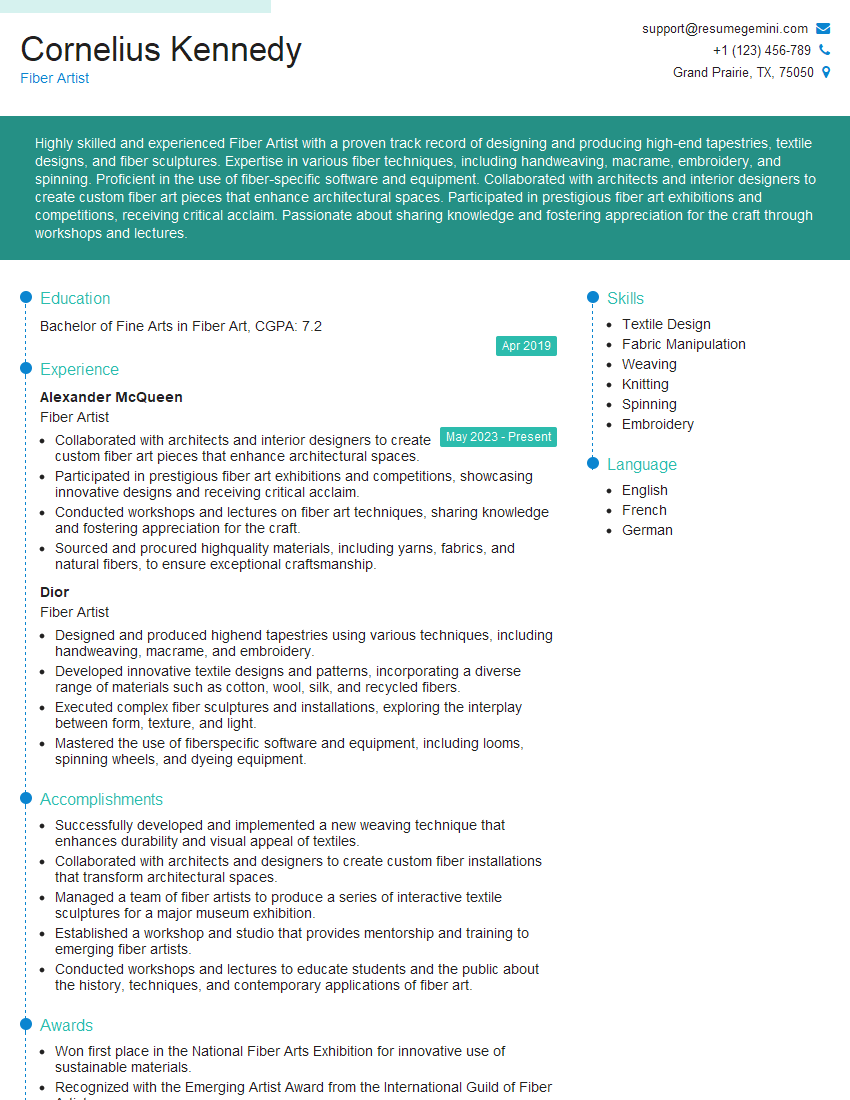
Mastering Yarn Macrame opens doors to exciting career opportunities in crafting, design, and potentially teaching. To significantly enhance your job prospects, create a resume that showcases your skills effectively and is easily parsed by Applicant Tracking Systems (ATS). ResumeGemini is a trusted resource that can help you build a professional and impactful resume tailored to the Yarn Macrame industry. Examples of resumes specifically designed for Yarn Macrame professionals are available, further assisting you in crafting a winning application.
Explore more articles
Users Rating of Our Blogs
Share Your Experience
We value your feedback! Please rate our content and share your thoughts (optional).
What Readers Say About Our Blog
Very informative content, great job.
good