Cracking a skill-specific interview, like one for Yarn Manufacturing Processes, requires understanding the nuances of the role. In this blog, we present the questions you’re most likely to encounter, along with insights into how to answer them effectively. Let’s ensure you’re ready to make a strong impression.
Questions Asked in Yarn Manufacturing Processes Interview
Q 1. Explain the different types of yarn manufacturing processes.
Yarn manufacturing processes broadly categorize into two main types: spinning and non-spinning methods. Spinning involves twisting short fibers (staple fibers) into continuous strands, while non-spinning methods use continuous filaments (like those found in silk or synthetic fibers) to create yarn. Let’s delve deeper:
- Spinning Methods: This encompasses several techniques, each optimized for different fiber types and yarn qualities. These include:
- Ring Spinning: The most widely used method, known for producing strong, even yarns. It utilizes a rotating spindle and traveler to twist the fibers.
- Rotor Spinning: A high-speed process creating softer, bulkier yarns, ideal for sportswear and home textiles. It utilizes centrifugal force for twisting.
- Air-Jet Spinning: Uses compressed air to twist the fibers, resulting in fine, strong yarns with a unique texture.
- Open-End Spinning (OE): A fast and cost-effective method, producing yarns suitable for carpets, upholstery, and other less demanding applications. It uses air currents to twist the fibers.
- Friction Spinning: Relatively new technology, producing yarns with unique properties like high tenacity and elasticity.
- Non-Spinning Methods: These methods involve fewer steps and are suitable for continuous filaments.
- Filament Winding: Simply winding continuous filaments onto a bobbin, producing yarns of high uniformity and strength.
- Core-spun yarns: Combine a core fiber (often a continuous filament) with a staple fiber sheath. This method creates yarns with enhanced properties.
The choice of process depends on the desired yarn properties (strength, softness, cost, etc.) and the type of fiber being used. For example, high-quality cotton shirts might use ring-spun yarn, while a sports jersey could use rotor-spun yarn for its comfort and bulk.
Q 2. Describe the steps involved in the spinning process.
The spinning process, taking ring spinning as a prime example, involves several key steps:
- Fiber Opening and Cleaning: Removing impurities and aligning fibers for even yarn formation.
- Carding: Further aligning and disentangling fibers, creating a thin, continuous web.
- Combing (optional): A refining step for finer yarns, removing short fibers and improving parallel alignment.
- Drawing: Combining several card slivers to increase evenness and reduce fiber variations.
- Roving: Slightly twisting and attenuating the drawn sliver, creating a soft, preparatory strand.
- Spinning: The core process where the roving is twisted and attenuated (thinned) using a spindle and traveler (in ring spinning), creating the final yarn.
- Winding: The yarn is wound onto a package, such as a bobbin or cone, ready for further processing or use.
Each step plays a crucial role in achieving the desired yarn quality. Imagine building a rope – each strand needs to be straight and properly aligned before twisting. Similarly, careful preparation of fibers is key to producing high-quality yarn.
Q 3. What are the key quality parameters for yarn?
Key quality parameters for yarn are crucial for ensuring the final product meets its intended performance and aesthetic standards. These parameters include:
- Strength: The yarn’s ability to withstand tensile force before breaking.
- Elongation: The extent to which the yarn can stretch before breaking.
- Evenness (Uniformity): The consistency of the yarn’s thickness along its length.
- Hairiness: The number of protruding fibers from the yarn surface, affecting the yarn’s feel and appearance.
- Count: A measure of the yarn’s fineness, expressed in various systems (e.g., English, metric).
- Twist: The number of turns per inch (or cm), affecting yarn strength and texture.
- Color: Uniformity and consistency of color throughout the yarn.
- Imperfections (Neps, slubs, knots): Undesirable variations or discontinuities in the yarn.
These parameters are interconnected; for example, higher twist generally leads to increased strength but can reduce softness. Measuring these aspects using specialized instruments ensures consistent quality throughout the production process.
Q 4. How do you measure yarn strength and elongation?
Yarn strength and elongation are measured using a universal testing machine. This machine applies a controlled tensile force to a yarn sample, measuring the force at break (strength) and the percentage of elongation (stretch) before breaking.
The process involves clamping the yarn sample between two grips and gradually increasing the tensile force. Sensors measure the force applied and the sample’s extension. The results are typically expressed in:
- Strength: cN/tex (centinewtons per tex) or grams per denier (g/den), where tex and denier are units of yarn linear density.
- Elongation: Percentage (%) of the original length.
For example, a strong yarn might have a strength of 40 cN/tex and an elongation of 8%, while a weaker, more elastic yarn could have a strength of 20 cN/tex and an elongation of 15%. These values help manufacturers determine if their yarn meets the desired specifications for a particular application.
Q 5. Explain the concept of yarn count and its significance.
Yarn count refers to the fineness or thickness of a yarn. It’s essentially a measure of the linear density, indicating how much yarn weight is present in a given unit length. Various systems exist, including:
- English Count: The number of hanks (840 yards) weighing one pound. A higher number signifies finer yarn.
- Metric Count (Tex): The weight in grams of 1000 meters of yarn. A lower number signifies finer yarn.
- Denier: The weight in grams of 9000 meters of yarn. A lower number signifies finer yarn.
Yarn count is critical because it directly influences the fabric’s properties. Finer yarns (higher count) produce smoother, more refined fabrics, while coarser yarns (lower count) result in heavier, more textured fabrics. The choice of count depends on the intended application; fine yarns are preferred for delicate garments, while thicker yarns are used for things like carpets or towels.
Q 6. What are the common yarn defects and their causes?
Common yarn defects significantly impact the quality and appearance of the final fabric. They arise from various sources in the production process, including fiber inconsistencies, machine malfunction, or improper processing parameters. Here are some common ones:
- Slubs: Thick places in the yarn, caused by inconsistent fiber distribution during the spinning process.
- Neps: Small entangled clusters of fibers that do not properly integrate into the yarn.
- Thin places: Weak areas in the yarn caused by insufficient fiber delivery during spinning.
- Breakages: Complete yarn breaks, caused by tension problems, fiber weakness, or machine issues.
- Hairiness: Excessive protruding fibers on the yarn surface, impacting the look and feel.
- Knots: Where broken fibers are joined, creating a noticeable lump in the yarn.
Identifying and understanding the cause of these defects is crucial for effective quality control and process optimization. For instance, slubs might indicate an issue with the carding machine, while frequent breakages suggest a problem with the yarn tension or the fiber quality.
Q 7. How do you troubleshoot yarn breakage during production?
Troubleshooting yarn breakage during production requires a systematic approach. Here’s a step-by-step strategy:
- Identify the frequency and location of breakage: Is it happening consistently throughout the machine or only in certain sections? This helps pinpoint the potential cause.
- Check the raw material: Examine the fiber for weakness, short fiber content, or impurities. Weak fibers are prone to breaking during the twisting process.
- Inspect machine settings: Verify the correct settings for drafting, twisting, and tension. Incorrect settings often lead to excessive stress on the yarn.
- Examine the machine components: Check for wear and tear in parts such as rollers, guides, and the spindle. Worn components can cause uneven tension and yarn breakage.
- Assess the environmental factors: High humidity or temperature fluctuations can affect fiber properties and increase breakage.
- Analyze the yarn itself: Test the yarn’s strength and elongation using a testing machine. This will help to identify if the problem is with the fiber or the spinning process.
- Implement corrective actions: Once the cause is identified, take appropriate action; this could involve replacing worn parts, adjusting machine settings, or changing the raw material.
Think of it like diagnosing a car problem; you need to systematically check different parts until you find the root cause. Detailed record-keeping is crucial in identifying patterns and preventing future yarn breakage incidents.
Q 8. Describe different types of spinning machines and their applications.
Spinning machines are the heart of yarn manufacturing, transforming loose fibers into continuous strands. Different machines cater to various fiber types and desired yarn characteristics. Here are a few key examples:
Ring Spinning: This is the most widely used method, especially for high-quality yarns. It involves twisting fibers around a rotating spindle, creating a strong and even yarn. Think of it like twisting a rope – the more twists, the stronger the rope. Ring spinning is versatile and produces yarns suitable for apparel, upholstery, and many other applications.
Rotor Spinning: A faster and more cost-effective method than ring spinning, rotor spinning uses a rotating rotor to entangle and twist the fibers. This creates a softer, bulkier yarn, often used in applications like carpets, blankets, and less demanding apparel items. It’s like using a whisk to blend ingredients quickly.
Air-Jet Spinning: This method uses high-velocity air jets to create the twist, resulting in a very fine and even yarn. It’s particularly well-suited for producing yarns from finer fibers like cotton and linen. It’s a more precise method, like using a delicate tool for intricate work.
Open-End Spinning (OE): This is a relatively fast and efficient method, ideal for staple fibers. Fibers are opened and oriented before being twisted, creating a relatively strong yarn. OE yarns are commonly used in applications where strength isn’t the primary concern.
The choice of spinning machine depends on factors such as fiber type, yarn quality requirements, production speed, and cost considerations. For example, a luxury cashmere sweater would likely use ring-spun yarn for its superior quality and smoothness, while a durable carpet would likely use rotor-spun yarn for its resilience and bulk.
Q 9. Explain the role of twisting in yarn manufacturing.
Twisting is the crucial step that transforms a loose collection of fibers into a cohesive yarn. It’s the process of spirally arranging and binding the fibers together, providing yarn with its essential strength, cohesiveness, and structure. Without twisting, the fibers would simply fall apart.
The amount of twist, known as the ‘twist multiplier’, is carefully controlled. More twist results in a stronger, smoother, and less hairy yarn, but it can also make the yarn less flexible and more prone to breaking. Less twist creates a fluffier, softer yarn but reduces its strength. The twist also impacts the yarn’s ability to absorb dyes and the final fabric’s drape and texture.
Think about braiding hair: each strand represents a fiber and the braiding action is the twisting that holds it together and creates a strong and flexible structure. The same principle applies to yarn manufacture.
Q 10. What are the different types of fibers used in yarn production?
Yarn production uses a wide variety of fibers, both natural and synthetic. Each fiber imparts unique properties to the yarn. Here are some key examples:
Natural Fibers: Cotton, wool, silk, linen, hemp, ramie, and jute are commonly used. Cotton is known for its softness and breathability; wool for warmth and elasticity; silk for its luxurious feel and drape; and linen for its strength and durability. Each natural fiber has its own distinct characteristics.
Synthetic Fibers: Polyester, nylon, acrylic, rayon, and spandex are popular synthetic options. Polyester offers strength and wrinkle resistance; nylon is known for its durability and elasticity; acrylic mimics wool in softness and warmth; rayon offers a silk-like drape; and spandex provides stretch.
The selection of fiber depends on the end use of the yarn. For example, a summer dress might use a blend of cotton and linen for breathability and durability, while a warm winter coat might incorporate wool and polyester for warmth and resilience.
Q 11. How does fiber length affect yarn properties?
Fiber length significantly impacts yarn properties. Longer fibers generally produce stronger, smoother, and more even yarns. This is because they interlock more effectively during the spinning process, resulting in a more cohesive structure. Shorter fibers, on the other hand, lead to weaker, hairier, and less even yarns. The shorter the fibers, the more likely the yarn will pill or break during use.
Imagine building a rope: long strands of rope are much stronger and easier to weave together than short pieces. Similarly, longer fibers create a more durable yarn.
Fiber length is expressed in terms like staple length (for short fibers) and filament length (for long, continuous fibers). The choice of fiber length depends on the intended application of the yarn. High-quality apparel yarns typically use longer fibers, while less demanding applications may utilize shorter fibers to reduce costs.
Q 12. Explain the importance of blending fibers in yarn manufacturing.
Blending fibers allows manufacturers to combine the desirable properties of different fibers, creating yarns with enhanced characteristics. This is a powerful technique to achieve specific yarn properties that are difficult or impossible to achieve with a single fiber type. A blend can improve strength, softness, drape, elasticity, and cost-effectiveness.
For instance, blending cotton with polyester can create a durable and wrinkle-resistant yarn suitable for shirts and trousers. Blending wool with nylon can increase the yarn’s elasticity and prevent excessive stretching. A blend of cotton and silk can produce a luxurious, soft yarn with a beautiful drape. The proportions of each fiber in the blend are carefully determined based on the desired final characteristics of the yarn. Blending helps create a ‘synergy’ where the combined properties are better than the sum of their parts.
Q 13. Describe the process of yarn dyeing and finishing.
Yarn dyeing and finishing are crucial post-spinning processes that enhance the yarn’s aesthetic appeal and functionality. Dyeing imparts color, while finishing treatments improve yarn characteristics like softness, drape, and resistance to shrinkage or creasing.
Dyeing: This can be done in various ways, including dyeing the fibers before spinning (fiber dyeing), dyeing the yarn after spinning (yarn dyeing), or dyeing the finished fabric (piece dyeing). Yarn dyeing provides a more even color distribution than fabric dyeing. The choice of dye depends on the fiber type and desired colorfastness.
Finishing: This involves various treatments such as:
- Singeing: Burning off protruding fibers to improve smoothness.
- Sizing: Applying a protective coating to improve yarn strength and handle during weaving.
- Heat setting: Applying heat to stabilize the yarn and prevent shrinkage.
- Softening: Using chemicals to enhance the softness of the yarn.
These processes significantly influence the final appearance, feel, and performance of the yarn. A well-finished yarn is crucial for creating high-quality fabrics.
Q 14. What are the environmental considerations in yarn manufacturing?
Yarn manufacturing has significant environmental implications, particularly concerning water and energy consumption, waste generation, and chemical usage. Sustainable practices are essential to minimize these impacts.
Water Usage: Dyeing and finishing processes are water-intensive. Recycling and efficient water management systems are crucial to reduce water consumption and prevent pollution.
Energy Consumption: Spinning and finishing processes require significant energy. Improving energy efficiency through process optimization and using renewable energy sources can significantly reduce the carbon footprint.
Waste Generation: Yarn manufacturing generates various forms of waste, including fiber scraps, wastewater, and chemical byproducts. Implementing waste reduction strategies, such as recycling and reuse programs, is vital to minimize environmental harm.
Chemical Usage: Dyeing and finishing often involve chemicals that can be harmful to the environment and human health. Choosing eco-friendly dyes and chemicals, and implementing proper waste management systems, is crucial to reduce pollution.
Adopting eco-friendly practices and embracing sustainable technologies is becoming increasingly important for yarn manufacturers to meet growing consumer demand for environmentally responsible products.
Q 15. How do you ensure consistent yarn quality throughout the production process?
Ensuring consistent yarn quality is paramount in yarn manufacturing. It’s a multifaceted process that begins with meticulous raw material selection and continues throughout every stage of production. Think of it like baking a cake – if your ingredients are subpar or your baking process inconsistent, your final product won’t be up to standard.
Raw Material Selection: We rigorously inspect the cotton, wool, or other fibers for length, strength, cleanliness, and uniformity. Any inconsistencies at this stage will directly impact the final yarn quality.
Process Monitoring: Throughout the entire process – from carding and combing to spinning and winding – we use advanced machinery equipped with sensors that constantly monitor key parameters like fiber alignment, twist level, and yarn tension. Any deviation from pre-set parameters triggers an alert, allowing for immediate corrective action.
Regular Calibration and Maintenance: Our machinery undergoes regular calibration and preventative maintenance to ensure accuracy and optimal performance. This is crucial for preventing defects and maintaining consistent yarn properties.
Statistical Process Control (SPC): We employ SPC techniques to continuously track and analyze key yarn characteristics, identifying trends and potential problems before they escalate. Control charts help visualize data and quickly reveal anomalies.
Quality Audits: Regular quality audits are conducted by independent inspectors to verify compliance with quality standards and identify areas for improvement. These audits provide an unbiased assessment of our processes.
Career Expert Tips:
- Ace those interviews! Prepare effectively by reviewing the Top 50 Most Common Interview Questions on ResumeGemini.
- Navigate your job search with confidence! Explore a wide range of Career Tips on ResumeGemini. Learn about common challenges and recommendations to overcome them.
- Craft the perfect resume! Master the Art of Resume Writing with ResumeGemini’s guide. Showcase your unique qualifications and achievements effectively.
- Don’t miss out on holiday savings! Build your dream resume with ResumeGemini’s ATS optimized templates.
Q 16. Explain the role of quality control in yarn manufacturing.
Quality control in yarn manufacturing is an essential function aimed at ensuring the final product meets specified quality standards and customer expectations. It’s not just about detecting defects; it’s about preventing them. Imagine it as a quality gatekeeper, ensuring only high-quality yarn passes through to the next stage.
In-process Inspection: At various stages of production, yarn samples are tested for properties like strength, evenness, and imperfections. This allows for early detection and correction of any problems.
Defect Analysis: When defects are found, a thorough investigation is conducted to identify the root cause. This helps implement corrective actions to prevent similar issues in the future.
Data Analysis: Quality data is analyzed to track key metrics, identify trends, and monitor overall process performance. This data-driven approach allows for continuous improvement.
Customer Feedback: We actively solicit and analyze customer feedback to identify areas where quality can be enhanced. Customer satisfaction is paramount.
Q 17. How do you manage yarn inventory and reduce waste?
Efficient inventory management and waste reduction are critical for profitability in yarn manufacturing. It’s about optimizing stock levels to meet demand while minimizing storage costs and preventing waste. Think of it as a carefully choreographed dance between supply and demand.
Demand Forecasting: Accurate demand forecasting allows for precise production planning, reducing the risk of overproduction or shortages. We utilize sophisticated forecasting models that take into account historical data, seasonality, and market trends.
Just-in-Time (JIT) Inventory: We implement JIT principles to minimize inventory holding costs. Raw materials and finished goods are delivered only when needed, reducing storage space and the risk of obsolescence.
Waste Reduction Strategies: We continuously explore ways to reduce waste throughout the production process. This involves optimizing machine settings, improving operator training, and recycling waste materials where possible.
Inventory Tracking System: A robust inventory tracking system is essential for maintaining accurate records of raw materials, work-in-progress, and finished goods. This ensures we always have enough materials without excessive stock.
Q 18. Describe your experience with different yarn testing methods.
I have extensive experience with various yarn testing methods, crucial for ensuring quality and meeting customer specifications. These tests are like a comprehensive health check for the yarn.
Strength Testing: Using tensile testers, we measure the yarn’s breaking strength and elongation, indicating its durability and resistance to breaking.
Evenness Testing: We use evenness testers to measure variations in yarn thickness, ensuring consistent quality and preventing irregularities in the final fabric.
Hairiness Testing: This measures the amount of protruding fibers, affecting the yarn’s appearance and feel. Lower hairiness generally leads to better fabric quality.
Twist Testing: Twist is crucial for yarn strength and stability. We measure the number of turns per inch using a twist tester.
Colorfastness Testing: We assess how well the yarn’s color resists fading when exposed to light, washing, and rubbing.
Q 19. How do you handle machine breakdowns and downtime in yarn production?
Machine breakdowns and downtime are inevitable in yarn manufacturing, but their impact can be minimized with proactive strategies. We treat downtime like a medical emergency – quick diagnosis and effective treatment are key.
Preventative Maintenance: Regular preventative maintenance is crucial in reducing the frequency of breakdowns. We follow a strict schedule of inspections and repairs.
Rapid Response Team: We have a dedicated team trained to quickly diagnose and repair equipment malfunctions, minimizing downtime.
Spare Parts Inventory: We maintain an adequate inventory of spare parts to minimize repair time. Waiting for parts can significantly extend downtime.
Root Cause Analysis: After every breakdown, a thorough root cause analysis is conducted to identify the underlying problem and prevent recurrence.
Production Scheduling Adjustments: In the event of unexpected downtime, we adjust our production schedule to minimize disruption to overall output. This might involve prioritizing urgent orders or re-allocating resources.
Q 20. Explain your experience with yarn production planning and scheduling.
Yarn production planning and scheduling require meticulous coordination and optimization to meet customer demand while effectively utilizing resources. Think of it as orchestrating a complex symphony, where each instrument (machine) plays its part in harmony.
Master Production Schedule (MPS): We develop an MPS based on customer orders, forecasts, and available capacity. This provides a high-level overview of production needs.
Capacity Planning: We carefully assess the capacity of our machinery and personnel to ensure that the production schedule is achievable.
Material Requirements Planning (MRP): MRP is used to determine the quantities and timing of raw materials needed for production, ensuring timely procurement.
Scheduling Software: We utilize specialized scheduling software to optimize production sequences, minimizing idle time and maximizing efficiency.
Performance Monitoring: We continuously monitor production progress against the schedule, identifying and addressing any deviations promptly.
Q 21. What are the safety protocols you follow in a yarn manufacturing facility?
Safety is paramount in a yarn manufacturing facility. We have a comprehensive safety program designed to prevent accidents and protect our employees. It’s not just about rules; it’s about fostering a safety-conscious culture.
Machine Guarding: All machinery is equipped with appropriate safety guards to prevent accidental contact with moving parts.
Personal Protective Equipment (PPE): Employees are provided with and required to wear appropriate PPE, such as safety glasses, earplugs, and protective clothing.
Regular Safety Training: Employees receive regular safety training covering topics such as machine operation, hazard identification, and emergency procedures.
Emergency Response Plan: We have a detailed emergency response plan in place to handle various scenarios, including fire, chemical spills, and medical emergencies.
Regular Safety Inspections: Regular safety inspections are conducted to identify and address any potential hazards.
Q 22. How do you improve efficiency in yarn manufacturing processes?
Improving efficiency in yarn manufacturing hinges on optimizing every stage of the process, from fiber selection to final packaging. Think of it like a well-oiled machine – each part needs to work seamlessly for maximum output.
Process Optimization: This involves streamlining workflows, minimizing downtime, and eliminating bottlenecks. For example, implementing automated systems for tasks like winding and spinning can significantly reduce manual labor and increase speed.
Preventive Maintenance: Regular maintenance of machinery is critical. Scheduling preventative checks reduces unexpected breakdowns, maximizing uptime and minimizing production losses. Imagine a car needing regular oil changes – the same principle applies to yarn manufacturing equipment.
Inventory Management: Efficient inventory management ensures a constant supply of raw materials and prevents production delays. Just-in-time inventory systems can significantly reduce storage costs and waste.
Employee Training: Well-trained operators are essential for efficient production. Regular training sessions on best practices and safety procedures improve productivity and quality.
Data Analytics: Utilizing data analytics to monitor key performance indicators (KPIs) allows for identification of areas for improvement. For example, tracking yarn breakage rates can highlight issues with machine settings or raw material quality.
Q 23. Describe your experience with different types of yarn structures (e.g., single, ply, core-spun).
My experience encompasses a wide range of yarn structures. Understanding these structures is crucial for tailoring yarn to specific applications, from delicate apparel to robust industrial fabrics.
Single Yarn: This is the simplest form, a continuous strand of fibers twisted together. Think of a basic cotton thread used for sewing.
Ply Yarn: This involves twisting two or more single yarns together. This increases strength and improves the yarn’s overall properties. A common example is a two-ply yarn often used in knitting.
Core-Spun Yarn: This involves wrapping fibers around a core yarn. This offers unique properties like increased bulk and improved drape, often used in luxury fabrics or performance sportswear.
Fancy Yarns: This category encompasses a vast array of structures, including slub yarns (with intentionally thicker sections), boucle yarns (with loops), and novelty yarns with unique textures. These are used to add visual interest and texture to fabrics.
In my experience, selecting the appropriate yarn structure is key to meeting customer specifications and achieving the desired final product characteristics.
Q 24. Explain your understanding of different yarn finishes (e.g., mercerized, combed).
Yarn finishes significantly impact the final product’s look, feel, and performance. These are often applied to enhance the yarn’s properties or achieve a specific aesthetic.
Mercerization: This treatment involves treating cotton yarn with a caustic soda solution. It enhances luster, strength, and dye uptake, resulting in a smoother, brighter fabric with improved dye fastness. Think of the shimmering quality of some high-end cotton shirts – that’s often mercerization at work.
Combing: This process removes short, weak fibers from the yarn, resulting in a finer, smoother, and stronger yarn with improved uniformity and reduced pilling. Combed cotton, for example, feels much softer and has a superior drape compared to carded cotton.
Other Finishes: Other common finishes include bleaching (to whiten the yarn), singeing (to remove protruding fibers), and various types of chemical treatments to enhance softness, wrinkle resistance, or water repellency.
The choice of finish depends on the desired end-use and the type of fiber being used. Proper finish selection is essential for achieving the desired quality and performance characteristics of the final fabric.
Q 25. How do you handle customer complaints regarding yarn quality?
Handling customer complaints effectively is paramount for maintaining client relationships and ensuring product quality. My approach is systematic and focuses on resolution and prevention.
Gather Information: First, I thoroughly investigate the complaint, documenting details such as the specific yarn lot, the nature of the defect, and the customer’s description of the problem. Visual aids like photographs are extremely helpful.
Root Cause Analysis: I then conduct a root cause analysis to pinpoint the source of the issue. This might involve examining the raw materials, the manufacturing process, or even the testing methods.
Corrective Action: Once the root cause is identified, I implement corrective actions to prevent similar issues from recurring. This might include adjusting machine settings, improving quality control checks, or retraining personnel.
Resolution and Communication: I promptly communicate with the customer, updating them on the investigation progress and proposed solutions. A sincere apology and a clear explanation of the actions taken are critical. Offering a replacement or credit, as appropriate, demonstrates commitment to customer satisfaction.
Preventative Measures: Finally, I implement preventative measures to avoid future complaints. This might involve improving quality control processes, updating equipment, or developing new training materials.
Q 26. What are the latest technological advancements in yarn manufacturing?
The yarn manufacturing industry is undergoing a significant transformation driven by technological advancements.
Automation and Robotics: Advanced automation and robotics are increasing efficiency and reducing labor costs. Automated winding, spinning, and twisting machines are becoming increasingly common.
Smart Manufacturing: The use of sensors, data analytics, and artificial intelligence (AI) is enhancing production monitoring, predictive maintenance, and process optimization. This leads to increased efficiency and reduced waste.
Advanced Materials: New fiber types with enhanced properties are being developed, opening possibilities for creating yarns with improved performance characteristics. For example, high-performance fibers used in sportswear are constantly being improved.
Sustainable Technologies: There’s a growing focus on sustainable manufacturing practices, including using recycled materials, reducing energy consumption, and minimizing waste. This is driven by environmental concerns and consumer demand for eco-friendly products.
These advancements are not only improving efficiency and product quality but also driving innovation in the industry.
Q 27. How do you maintain and improve the efficiency of yarn manufacturing equipment?
Maintaining and improving the efficiency of yarn manufacturing equipment is crucial for ensuring consistent production and minimizing downtime. My approach is proactive and multifaceted.
Preventive Maintenance Schedules: Implementing rigorous preventative maintenance schedules is key. This involves regular inspections, lubrication, and part replacements to prevent breakdowns and extend the lifespan of equipment.
Operator Training: Training operators on proper machine operation and maintenance procedures is equally important. This reduces the risk of operator error and ensures the equipment is used efficiently and correctly.
Regular Inspections: Frequent inspections help identify potential problems early on, allowing for timely repairs and preventing major breakdowns. Early detection often saves significant time and money.
Data-Driven Maintenance: Utilizing data collected from machine sensors can help predict potential failures and optimize maintenance schedules. This shift from reactive to proactive maintenance is a significant improvement.
Equipment Upgrades: Investing in equipment upgrades can significantly enhance efficiency and reduce downtime. This may involve replacing older machines with newer, more efficient models or integrating automation technologies.
Q 28. Describe your experience with implementing lean manufacturing principles in a yarn production setting.
Lean manufacturing principles are highly applicable in yarn production to eliminate waste and improve efficiency. Think of it as squeezing out every drop of unnecessary expense and effort.
Value Stream Mapping: I’ve used value stream mapping to identify and eliminate non-value-added steps in the production process. This allows us to focus resources on activities that directly contribute to creating a quality product.
5S Methodology: Implementing the 5S methodology (Sort, Set in Order, Shine, Standardize, Sustain) significantly improved workplace organization and efficiency. A clean, organized workspace leads to fewer errors and improved safety.
Kaizen Events: We regularly conducted Kaizen events (continuous improvement activities) to identify and solve small, incremental problems in the production process. Small improvements, when implemented consistently, create significant gains.
Kanban Systems: Using Kanban systems to manage inventory and production flow improved material flow and reduced lead times. This prevents bottlenecks and ensures materials are available when needed.
Total Productive Maintenance (TPM): Implementing TPM increased equipment uptime and reduced maintenance costs by involving all personnel in equipment maintenance.
Through implementing these lean principles, we were able to achieve significant improvements in efficiency, reduce waste, and improve overall product quality.
Key Topics to Learn for Yarn Manufacturing Processes Interview
- Fiber Properties and Selection: Understanding the characteristics of different fibers (cotton, wool, synthetic) and their impact on yarn quality and performance. This includes staple length, fineness, strength, and elasticity.
- Spinning Systems: A thorough grasp of various spinning technologies, including ring spinning, rotor spinning, air-jet spinning, and their respective advantages and disadvantages. Practical application includes understanding the trade-offs between yarn quality, production speed, and cost.
- Yarn Structure and Properties: Comprehending concepts like yarn count, twist, hairiness, and their influence on the final fabric properties. This includes practical problem-solving, such as identifying the cause of defects in yarn structure.
- Yarn Quality Control: Knowledge of different testing methods used to assess yarn quality, including strength testing, evenness testing, and imperfection analysis. This includes practical application of statistical process control (SPC) techniques.
- Troubleshooting and Maintenance: Familiarity with common problems encountered in yarn manufacturing processes and the procedures to troubleshoot and resolve them. This includes preventative maintenance and understanding the role of automation in minimizing downtime.
- Raw Material Handling and Management: Understanding the importance of efficient raw material handling and storage to minimize waste and maintain consistent yarn quality. This includes understanding the impact of environmental conditions on raw materials.
- Waste Reduction and Sustainability: Knowledge of sustainable practices within yarn manufacturing, including minimizing waste generation, energy efficiency, and responsible disposal of byproducts.
Next Steps
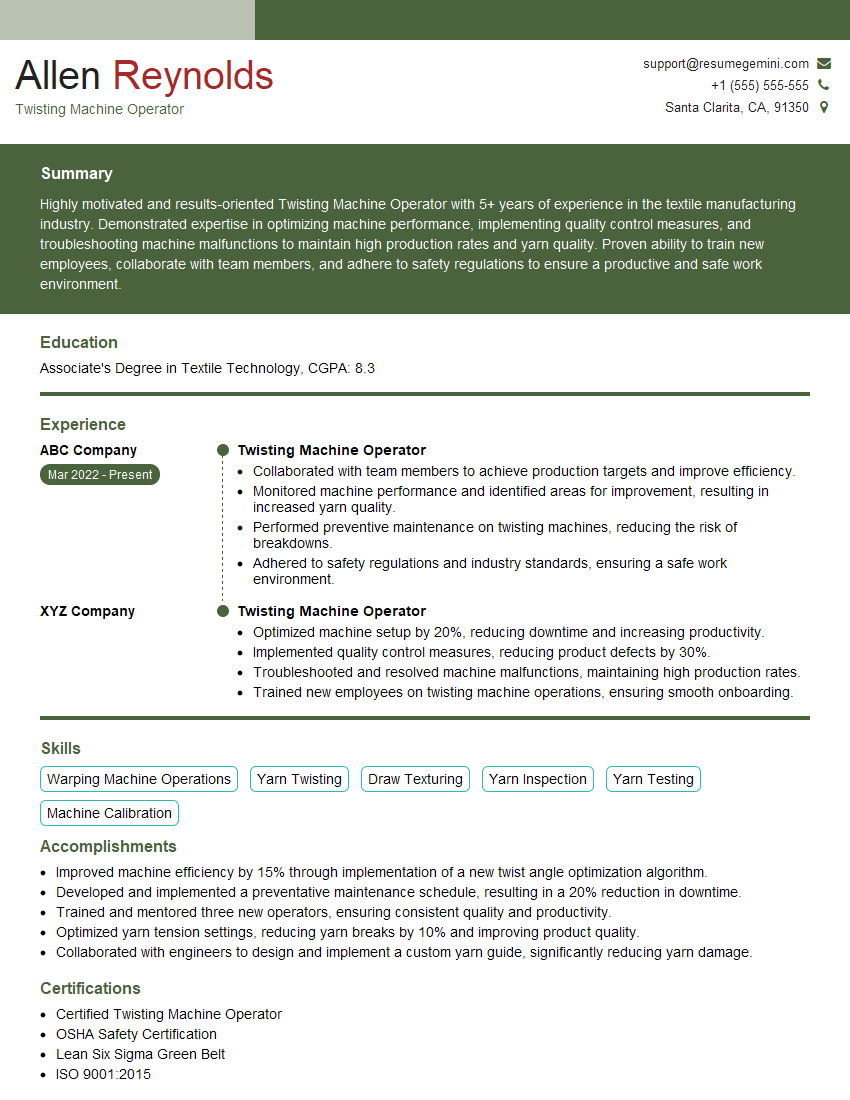
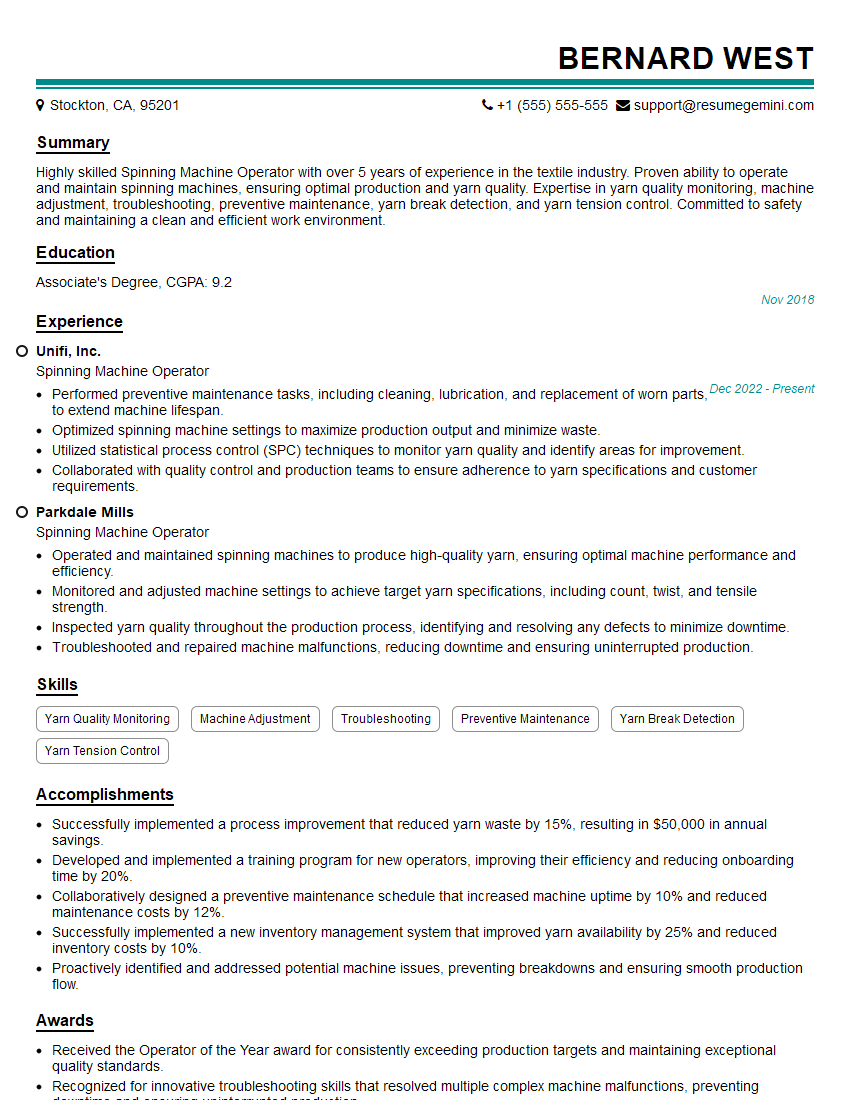
Mastering Yarn Manufacturing Processes is crucial for career advancement in the textile industry, opening doors to specialized roles and higher earning potential. To maximize your job prospects, creating a strong, ATS-friendly resume is essential. ResumeGemini can significantly enhance your resume-building experience, helping you craft a compelling document that highlights your skills and experience effectively. ResumeGemini provides examples of resumes tailored to Yarn Manufacturing Processes to help you build a winning application.

Explore more articles
Users Rating of Our Blogs
Share Your Experience
We value your feedback! Please rate our content and share your thoughts (optional).
What Readers Say About Our Blog
Very informative content, great job.
good