Preparation is the key to success in any interview. In this post, we’ll explore crucial Yarn Tufting interview questions and equip you with strategies to craft impactful answers. Whether you’re a beginner or a pro, these tips will elevate your preparation.
Questions Asked in Yarn Tufting Interview
Q 1. Describe your experience with different types of tufting machines.
My experience encompasses a wide range of tufting machines, from basic hand-held units ideal for small-scale projects and prototyping to large-scale industrial machines capable of high-volume production. I’m proficient with both cut-pile and loop-pile machines, understanding the nuances of each. For example, I’ve worked extensively with single-needle machines for intricate designs requiring precise control, and multi-needle machines for faster production runs on larger rugs. I’ve also worked with different brands, each with its own specific features and maintenance requirements. My experience includes troubleshooting mechanical issues, performing routine maintenance, and optimizing machine settings for different yarn types and desired pile heights.
Specifically, I’m familiar with the following types: electric single needle tufting machines, pneumatic multi-needle tufting machines, and even some older, manual models. Each has its own advantages and disadvantages, influencing choices based on project scale, budget, and desired outcome.
Q 2. Explain the process of setting up a tufting machine for a specific project.
Setting up a tufting machine for a specific project involves a meticulous process ensuring the final product meets the design specifications. It begins with carefully selecting the appropriate machine based on the project’s complexity and scale. Next, the primary cloth is mounted securely onto the machine’s backing frame. The pattern, whether digitally printed or hand-drawn, is then precisely aligned. The chosen yarn is loaded onto the machine’s yarn feed system, with careful attention paid to tension adjustments. This stage is critical as it determines the pile height and density. Finally, we conduct test runs to verify consistent stitch length, density, and yarn feed, making adjustments as necessary before starting the full-scale production. We’ll also adjust the needle height according to the pile height we want to achieve.
For instance, if I were working on a rug with a high-pile, plush texture, I would choose a machine capable of creating thick pile and adjust the settings accordingly. In contrast, for a low-pile rug with a flat texture, the settings would be adjusted for a shorter pile height. Regular checks during the setup process prevent costly mistakes down the line and ensure a high-quality final product.
Q 3. How do you ensure consistent yarn tension during the tufting process?
Maintaining consistent yarn tension is paramount for achieving a uniform and high-quality tufted product. Inconsistent tension leads to variations in pile height, density, and overall appearance. This is controlled through a combination of techniques. Firstly, the machine itself has tension adjustment mechanisms; these need regular monitoring and calibration to counteract any slack or excessive tightness. Secondly, the type and quality of yarn play a crucial role. Some yarns are inherently more prone to slippage. Careful selection is, therefore, important. Thirdly, regular checks during operation are critical. Visual inspection for any noticeable variations in pile height are a good starting point, supplemented with using measuring tools for precise evaluation. Problems with the yarn feed system often cause inconsistencies. It’s essential to identify and address any issues promptly.
For instance, I use a tension gauge during set-up and at regular intervals throughout the process to ensure the yarn tension remains within the optimal range. If I notice inconsistencies, I adjust the machine settings or replace any faulty parts in the yarn-feeding mechanism to fix the root cause. Regular maintenance is also key to prevent this issue.
Q 4. What are the common causes of yarn breakage and how do you address them?
Yarn breakage is a common problem in tufting. Several factors contribute, including improper yarn tension (too tight or too loose), low-quality yarn prone to fraying or snapping, and machine malfunction, specifically issues with the needle or yarn feed system. Another factor includes using the wrong kind of yarn for the project. For instance, excessively coarse or fine yarns may not work efficiently with a particular machine.
Addressing yarn breakage involves a systematic approach. I first identify the root cause. If it’s due to tension issues, I adjust the settings. If it’s related to yarn quality, I switch to a more robust and suitable yarn. If it’s a machine problem, like a damaged needle, I promptly repair or replace the faulty component. Regular preventative maintenance can lessen the frequency of this problem.
Example: On one project, frequent yarn breakage was traced to a small defect in the yarn-feeding mechanism. After replacing the damaged part, the problem was resolved. This highlights the importance of proactive maintenance.
Q 5. Describe your experience with different types of yarns and their suitability for tufting.
My experience covers a wide variety of yarns, each with unique properties affecting the final product. I’ve worked with natural fibers like wool (known for its softness and durability but can be more challenging to work with), cotton (budget-friendly, absorbent, but less durable), and silk (luxurious, but delicate and costly). I have also extensive experience with synthetic fibers like nylon (highly durable, resistant to wear, and relatively inexpensive), acrylic (affordable, versatile in color, and easy to maintain), and polyester (strong, colorfast, but can sometimes feel less luxurious).
The suitability of a yarn depends on the desired outcome. For instance, wool is perfect for a luxurious rug designed for warmth and comfort, while nylon is ideal for high-traffic areas requiring durability. Acrylic might be chosen for a vibrant, child-friendly rug due to its affordability and easy maintenance.
I consider factors such as fiber content, ply, twist, and thickness when selecting a yarn. These factors influence not only the final look and feel of the product but also its durability and maintenance requirements.
Q 6. How do you maintain the quality of tufted products?
Maintaining the quality of tufted products involves several key strategies, starting even before the tufting process. Careful selection of materials—high-quality yarn and backing cloth—is crucial. During the tufting process, consistent yarn tension and precise machine operation prevent defects. After tufting, proper finishing is vital. This includes trimming the pile to achieve a uniform height and density, and carefully applying any backing or serging to enhance durability and prevent unraveling. Regular quality checks are implemented throughout the entire process, identifying and addressing problems early on.
For instance, I often use a quality control checklist to ensure each stage meets the set standards. This includes checking for consistent pile height, yarn density, and the absence of any defects like missed stitches or yarn snags. After completion, I make sure the rug is thoroughly inspected before packaging to maintain the highest quality standards.
Q 7. Explain your understanding of tufting patterns and how they are implemented.
Tufting patterns are implemented to create visually appealing designs. These can range from simple geometric patterns to intricate, complex designs. There are various methods for implementing patterns. Digitally printed patterns onto the primary backing cloth allows for high-resolution and complex designs. For simpler patterns, stencils can be employed. These are often hand-drawn and then used as a guide during tufting. The machine itself is not directly ‘programmed’ with patterns in the same way a computer printer is; the operator’s skill and precision in following the pattern is key. This often involves careful positioning of the yarn in line with the template used.
Example: For a rug with a geometric design, I’d use a stencil, ensuring precise positioning of the yarn according to the stencil to reproduce the pattern accurately. For a complex pattern like a realistic landscape, I’d likely work from a digitally printed template. This enables better precision and detail in the final product.
Q 8. How do you troubleshoot issues with tufting machine malfunctions?
Troubleshooting tufting machine malfunctions requires a systematic approach. I start by identifying the specific problem – is the machine making unusual noises? Is the yarn feeding improperly? Are there inconsistencies in the pile height or density? My process involves:
- Visual Inspection: Carefully examine the machine for any obvious problems like loose parts, broken needles, or clogged areas. This often reveals the source quickly.
- Check Yarn Feed: Ensure the yarn is properly tensioned and feeding smoothly. Kinks or knots in the yarn are common culprits. Sometimes, adjusting the yarn guide or cleaning the feed mechanism is sufficient.
- Needle Inspection: Bent or damaged needles can cause skipped stitches or uneven pile. Regular needle replacement is crucial for maintaining quality. I’ll inspect them for wear and tear and replace any that are problematic.
- Electrical Components: If the problem seems electrical (e.g., motor not running, inconsistent power), I’ll check the power supply, fuses, and any control panels. In complex cases, a qualified electrician might be needed.
- Lubrication: Regular lubrication of moving parts is essential. Insufficient lubrication can lead to increased friction, wear, and potential breakdowns. I always refer to the machine’s manual for the correct lubrication schedule and procedures.
- Systematic Elimination: If the issue isn’t immediately obvious, I’ll systematically test each component of the machine, eliminating possibilities one by one until the source is identified. I keep detailed logs to track repairs and identify recurring problems.
For instance, I once had a machine producing uneven pile. After a thorough inspection, I discovered a slightly bent needle. Replacing the needle immediately resolved the problem. This highlights the importance of meticulous attention to detail.
Q 9. Describe your experience with different tufting techniques (e.g., loop pile, cut pile).
I’m proficient in both loop pile and cut pile tufting techniques. Loop pile, which creates a looped texture, is achieved by using a specialized needle that forms loops of yarn on the backing. This results in a durable and often plush surface, perfect for carpets and rugs. I’ve worked extensively with various loop pile heights and densities, adjusting the machine settings to achieve the desired look and feel.
Cut pile tufting, on the other hand, creates a more textured, velvety surface by using a knife to cut the loops of yarn. This offers a wider range of design possibilities, enabling intricate patterns and textures. I have experience with both hand-cut and machine-cut pile, understanding the nuanced differences in the final product’s appearance and durability. I’ve worked on projects requiring both techniques—sometimes even combining them for a unique effect—tailoring my approach to the specific design requirements.
Q 10. What safety precautions do you follow while operating tufting machinery?
Safety is paramount when operating tufting machinery. My safety procedures always include:
- Personal Protective Equipment (PPE): Always wearing safety glasses, gloves, and closed-toe shoes is non-negotiable. Hearing protection is also vital to mitigate the noise generated by the machines.
- Machine Guards: Ensuring all safety guards are in place and functioning correctly before starting any work. Never operate a machine with a faulty or missing guard.
- Lockout/Tagout Procedures: Following strict lockout/tagout procedures whenever performing maintenance or repairs on the machine to prevent accidental startup.
- Proper Training: I have received comprehensive training on the safe operation and maintenance of tufting machines. I always adhere to the manufacturer’s instructions and safety guidelines.
- Regular Maintenance: Consistent maintenance and lubrication of the machine minimizes the risk of unexpected malfunctions and hazards. I also maintain detailed records of any maintenance activities.
- Emergency Procedures: I’m familiar with emergency procedures, including how to shut down the machine quickly and safely in case of an accident or malfunction. I know where the nearest emergency shut-off switches are located.
One time, a new team member wasn’t wearing safety glasses and got a piece of yarn in their eye. It reinforced the importance of rigorous safety protocol enforcement. I’ve always ensured that all team members are properly trained and adhere to safety guidelines.
Q 11. How do you calculate the yarn consumption for a specific project?
Calculating yarn consumption requires careful planning and accurate measurements. The process generally involves these steps:
- Determine Project Dimensions: Precisely measure the length and width of the tufted area. This is fundamental for accurate calculations.
- Yarn Weight and Density: Identify the yarn’s weight (grams or ounces per unit length) and the desired pile density (number of stitches per square inch or centimeter). This information is critical as yarn consumption is directly related to the density and weight.
- Calculate Total Area: Multiply the length and width to find the total area of the project.
- Estimate Yarn Length per Stitch: This depends on the desired pile height. It often requires prior experience and might involve some experimentation, but most tufting machines have data that can aid this calculation.
- Compute Total Yarn Length: Multiply the total area by the number of stitches per square unit and then by the yarn length per stitch. This yields the total yarn length required.
- Convert to Weight: Finally, convert the total yarn length to weight using the yarn’s weight per unit length.
For example, a rug measuring 4ft x 6ft with a pile density of 10 stitches/sq inch and a pile height of 1 inch might require around X amount of yarn (the exact amount would depend on the yarn weight per unit length). Accurate calculation helps avoid waste and ensures sufficient material is on hand.
Q 12. Explain your experience with quality control procedures in tufting.
Quality control is integrated throughout the tufting process. My experience encompasses:
- Pre-Tufting Inspection: I start by inspecting the backing material for defects like holes, creases, or inconsistencies. The yarn is also checked for color variations, strength, and evenness. This prevents defects from propagating through to the finished product.
- Process Monitoring: During the tufting process itself, I regularly monitor the machine’s operation for any signs of malfunctions such as uneven pile height, skipped stitches, or yarn breakage. Adjustments are made as needed to ensure consistency.
- Post-Tufting Inspection: After tufting, a thorough visual inspection is performed to identify and address any defects. This involves checking for irregularities in pile height, density, and color consistency across the entire piece.
- Shearing and Finishing: Shearing and finishing are critical for achieving the desired final appearance and texture. I ensure proper shearing techniques to create an even pile height and surface.
- Documentation: Maintaining detailed records of all quality control checks is essential. These records aid in tracking problems, identifying areas for improvement, and ensuring consistent quality across all projects.
In one project, we had an issue with inconsistent dye lots causing noticeable color variations. By implementing stricter quality control measures during yarn selection and process monitoring, this issue was swiftly resolved, saving costs and time.
Q 13. Describe your experience with different types of backing materials used in tufting.
I’ve worked with a variety of backing materials in tufting, each with its own properties and applications:
- Primary Backings: These form the base of the tufted product. Common examples include woven polypropylene, jute, and cotton. The choice depends on factors such as desired durability, cost, and aesthetic considerations. Woven polypropylene is popular for its strength and affordability, while jute provides a more natural look.
- Secondary Backings: These are applied to the back of the primary backing to enhance durability, stability, and dimensional stability. Latex and other adhesives are frequently used to bind the primary and secondary backings together, creating a more robust finished product.
- Considerations: The selection of the backing material heavily influences the final product’s quality and performance. Factors such as the backing’s weight, strength, and texture will impact the overall feel and durability of the finished rug or carpet.
For example, using a heavier-weight polypropylene backing is ideal for high-traffic areas, ensuring longevity. Conversely, a lighter-weight cotton backing may be preferable for a thinner, more delicate rug.
Q 14. How do you identify and resolve defects in tufted products?
Defect identification and resolution in tufted products requires careful observation and understanding of the tufting process. Common defects include:
- Uneven Pile Height: This is often caused by malfunctioning needles or inconsistent yarn feed. The solution may involve needle replacement, adjustments to the yarn tension, or even re-tufting the affected area.
- Skipped Stitches: Similar to uneven pile, this often points to needle issues or problems with the machine’s mechanism. Repairing the machine and/or re-tufting are common solutions.
- Yarn Breakage: This may be caused by weak yarn, incorrect yarn tension, or machine malfunction. Replacing the broken yarn and addressing underlying causes is essential.
- Color Variations: These can stem from inconsistent dye lots or improper yarn handling. The solution involves carefully matching yarn colors and improving handling processes.
- Other Defects: Other defects may include puckering, creasing, or damage to the backing material. Addressing these issues may require specific repairs depending on the cause and the extent of the damage.
When identifying defects, I use a systematic approach, documenting the location, type, and extent of the problem. This allows for efficient repair and helps pinpoint the root cause to prevent future recurrences. For instance, a recurring issue with skipped stitches led me to discover a problem with the machine’s timing belt, something easily fixed with timely preventative maintenance.
Q 15. What is your experience with pre- and post-tufting processes?
Pre-tufting processes are crucial for ensuring a smooth and efficient tufting operation. This stage involves meticulously preparing the primary backing (usually a woven fabric) and setting up the tufting machine. It includes inspecting the backing for flaws, properly stretching and securing it onto the tufting machine’s frame, and ensuring the tension is consistent across the entire surface. This prevents issues like wrinkles or uneven pile height in the final product. Post-tufting processes are equally important and focus on finishing the tufted piece. This often involves cleaning the rug to remove excess yarn, shearing the pile to create a consistent height, and then potentially applying latex backing to add durability and prevent shedding. A final inspection ensures quality control before the product is packaged.
For example, in one project involving a large-scale custom rug, I carefully pre-stretched the backing, using a tension meter to ensure consistent tension throughout. This prevented warping during the tufting process, resulting in a flawless, high-quality final product. Post-tufting, we used a high-powered vacuum to remove loose fibers and then carefully sheared the pile to achieve the client’s specified height and texture.
Career Expert Tips:
- Ace those interviews! Prepare effectively by reviewing the Top 50 Most Common Interview Questions on ResumeGemini.
- Navigate your job search with confidence! Explore a wide range of Career Tips on ResumeGemini. Learn about common challenges and recommendations to overcome them.
- Craft the perfect resume! Master the Art of Resume Writing with ResumeGemini’s guide. Showcase your unique qualifications and achievements effectively.
- Don’t miss out on holiday savings! Build your dream resume with ResumeGemini’s ATS optimized templates.
Q 16. How do you ensure the accuracy of tufting designs?
Accuracy in tufting designs is paramount. We utilize a combination of methods to ensure precision. Firstly, we leverage sophisticated design software (I’ll discuss specific examples later) to create highly detailed digital renderings of the design. These digital designs are then carefully translated into machine-readable formats, frequently using specialized software to control the tufting machine’s pattern programming. Secondly, we employ meticulous pre-production checks involving both visual inspection of the setup and test runs of small sections of the design. This allows for early correction of any discrepancies. Finally, during the actual tufting process, continuous monitoring ensures the machine adheres to the programmed design accurately.
For instance, during a recent project with a complex geometric pattern, a minor error was detected in the software’s translation of the digital design. By using the test run and close monitoring of the early stage of the tufting, this small issue was corrected before significant material waste and unnecessary time had been spent, saving both materials and time.
Q 17. Describe your experience with maintaining tufting machine records and documentation.
Maintaining accurate records and documentation for tufting machines is essential for efficient operation, troubleshooting, and compliance. We maintain detailed logs for each machine, including dates of service, parts replaced, maintenance performed, and any operational issues encountered. This also includes records of the yarn used in each project and relevant specifications, such as the yarn type, color, and lot number. This detailed information is crucial for quality control, traceability, and to diagnose any issues efficiently. We utilize both digital and physical record-keeping systems. For instance, all maintenance is logged in a centralized digital database accessible to all technicians. This ensures clear tracking of equipment history and simplifies preventative maintenance scheduling.
In one instance, a specific machine malfunctioned. Using the detailed records, we quickly identified that a certain part had been showing signs of wear for several weeks, based on our previous maintenance records. We had already scheduled its replacement, but due to an unexpected supply chain issue, we slightly miscalculated the timing. This record keeping allowed me to efficiently identify the root cause and quickly resolve the machine problem with minimal disruption to production.
Q 18. How do you contribute to a safe and efficient work environment in a tufting facility?
Contributing to a safe and efficient work environment is a top priority. This involves adhering to all safety regulations, ensuring proper machine maintenance, and promoting a culture of safety awareness among all team members. We regularly inspect equipment for potential hazards and conduct safety training to ensure everyone is aware of the safe operating procedures. We also utilize appropriate personal protective equipment (PPE), such as safety glasses and gloves, and maintain a clean and organized workspace to minimize trip hazards and prevent accidents. Ergonomic considerations are factored into workstation setup to minimize strain on workers and ensure their comfort. Open communication ensures that any safety concerns are addressed promptly and efficiently.
For example, I spearheaded the implementation of a new safety training program that focuses on practical, hands-on training and regular refresher courses, which resulted in a significant decrease in minor workplace incidents. A clean and well-organized workshop also significantly decreased the risk of workplace accidents caused by tripping.
Q 19. Explain your understanding of different tufting design software.
My experience encompasses various tufting design software packages, including industry-standard programs such as AutoCAD, Adobe Illustrator, and specialized tufting design software. AutoCAD is frequently used for precise geometric designs and detailed layouts, while Adobe Illustrator excels in creating intricate vector-based artwork. Specialized tufting software packages offer features specifically tailored to the nuances of yarn placement and pile height control, directly translating designs into machine-readable code. Understanding the capabilities of each platform allows me to choose the most appropriate software for specific project requirements. The choice depends heavily on the complexity of the design and the capabilities of the tufting machines being used.
For example, a recent project requiring a highly intricate floral design benefited from using Adobe Illustrator for its precise vector capabilities, which allowed for smooth transitions between colors and seamless curves. The design was then successfully translated into machine-readable code using a specialized tufting program.
Q 20. How do you adapt to changes in production requirements and deadlines?
Adaptability is essential in this fast-paced industry. I approach changes in production requirements and deadlines by first carefully reviewing the new parameters. This involves understanding the scope of the changes, their impact on the production schedule, and the potential resources needed. Once this assessment is done, I develop a revised plan, which often includes re-prioritizing tasks, optimizing workflows, and potentially adjusting team assignments to meet the revised deadlines efficiently. Open communication with the team and management is vital to ensure everyone is aligned with the revised plan and any potential challenges are proactively addressed. We might use Agile methodologies for smaller changes and a more traditional project management approach for larger alterations in scope.
In one scenario, an urgent order required us to expedite production for a large-scale project. By optimizing the workflow, implementing some minor process changes, and ensuring seamless communication across the team, we successfully completed the order ahead of the revised deadline without compromising quality.
Q 21. How do you handle challenging situations or unexpected problems during tufting?
Handling unexpected problems requires a systematic approach. My first step is to assess the situation thoroughly to identify the root cause of the problem. This often involves collaborating with colleagues to gather information and analyze the data. Once the cause is identified, I develop a solution, focusing on effective and efficient problem-solving. This might involve making minor adjustments to the machine settings, replacing faulty components, or even re-evaluating the design. Following implementation of the solution, we monitor the situation closely to ensure it has been successfully addressed. Documentation of the problem, its solution, and lessons learned is critical to prevent recurrence. A proactive approach, focusing on preventative maintenance and thorough checks, is crucial to minimize such disruptions.
For instance, during a tufting operation, we experienced a sudden, unusual increase in yarn breakage. By systematically inspecting the machine, we discovered a minor misalignment in the yarn guide causing excessive friction. A quick adjustment resolved the issue, and detailed documentation of this problem prevented its recurrence.
Q 22. Describe your experience with working within a team environment in a tufting setting.
Teamwork in tufting is crucial for efficient production. In my previous role at [Previous Company Name], we consistently worked in teams of 4-6, each member specializing in a different aspect of the process – from yarn preparation and machine setup to quality control and finishing.
For instance, during a rush order for a large custom rug, we effectively divided tasks. One team member focused on maintaining consistent yarn feed, another on pattern accuracy, and I specialized in troubleshooting machine malfunctions and ensuring smooth operation. Our collaborative effort enabled us to complete the order ahead of schedule and to a high standard of quality. Open communication, mutual respect, and a willingness to help each other were key to our success. We regularly held short briefings to coordinate our work and address any arising issues proactively.
Q 23. What are your strengths and weaknesses as a tufting technician?
My strengths as a tufting technician include my meticulous attention to detail, my proficiency in troubleshooting machine malfunctions, and my ability to maintain high production speeds while adhering to quality standards. I’m also adept at learning new techniques and adapting to different tufting machine types. For example, I quickly mastered the operation of the new computerized tufting machine introduced at my previous workplace, significantly improving our production efficiency.
An area I am actively working to improve is my time management skills during particularly complex pattern setups. While I can execute these accurately, I’m striving to streamline my process and reduce setup time to maximize productivity. I am participating in a time management workshop offered by my previous employer to address this specifically.
Q 24. Describe your experience with cleaning and maintaining tufting machines.
Maintaining tufting machines is paramount to ensuring consistent production quality and preventing costly downtime. My experience encompasses daily cleaning procedures, such as removing yarn debris, lubricating moving parts, and checking for any signs of wear and tear. I’m also proficient in performing preventative maintenance tasks like changing needles, cleaning the cutting blades, and adjusting the tension mechanisms.
More significantly, I am skilled in diagnosing and resolving common machine malfunctions. For example, I effectively resolved a recent issue with inconsistent yarn feed by identifying and replacing a faulty sensor. My approach is methodical; I document all maintenance activities and promptly report any significant issues to prevent larger problems. This proactive approach ensures prolonged machine lifespan and optimizes production efficiency.
Q 25. What are your salary expectations for this tufting position?
Based on my experience and skills, and considering the salary range for similar tufting technician positions in this region, my salary expectation is between $[Lower Bound] and $[Upper Bound] annually. I am open to discussing this further based on the specifics of the role and the company’s compensation structure.
Q 26. Where do you see yourself in five years in the tufting industry?
In five years, I envision myself as a skilled and respected lead tufting technician, possibly supervising a small team. I plan to enhance my expertise in advanced tufting techniques, such as 3D tufting and the use of specialized yarns. I also aspire to contribute to process improvement initiatives within the company, enhancing efficiency and quality. I aim to leverage my experience and leadership skills to guide and mentor other technicians, fostering a positive and productive work environment.
Q 27. What are your career goals related to yarn tufting?
My career goals center around becoming a highly proficient and knowledgeable tufting technician, eventually progressing to a supervisory or management role within the industry. I am particularly interested in exploring innovative tufting techniques and technologies, and I want to contribute to the advancement of the craft. My long-term aspiration is to be a respected expert, possibly through participation in industry events and sharing my knowledge and experience with others.
Q 28. Are you comfortable working in a fast-paced production environment?
Absolutely. I thrive in fast-paced production environments. In my previous role, we frequently handled rush orders and met tight deadlines. I am comfortable working under pressure and maintain focus and efficiency even when faced with demanding production schedules. My ability to prioritize tasks, troubleshoot problems quickly, and work effectively as part of a team allows me to adapt seamlessly to the dynamic nature of a busy production floor.
Key Topics to Learn for Your Yarn Tufting Interview
- Yarn Selection and Properties: Understanding different yarn types (e.g., wool, acrylic, cotton), their textures, and suitability for various tufting projects. Consider the impact of yarn weight and ply on the final product.
- Tufting Gun Operation and Maintenance: Mastering the mechanics of the tufting gun, including proper needle adjustments, tension control, and preventative maintenance to ensure optimal performance and longevity.
- Design and Pattern Transfer: Explore techniques for transferring designs onto fabric, including using stencils, projectors, or freehand methods. Understanding scale and proportion is crucial.
- Tufting Techniques and Styles: Familiarize yourself with different tufting styles (e.g., high-pile, low-pile, textured), and the techniques employed to achieve specific effects. Consider the use of different backing fabrics.
- Cutting and Finishing: Learn about post-tufting processes, such as trimming excess yarn, cleaning the tufting, and finishing techniques to achieve a professional look. Understand the importance of quality control at each stage.
- Troubleshooting and Problem Solving: Develop your ability to identify and resolve common issues that may arise during the tufting process, such as uneven tufting, yarn breakage, or machine malfunctions. Problem-solving skills are highly valued.
- Safety Procedures and Best Practices: Understand and adhere to all safety regulations associated with operating tufting equipment. This demonstrates responsibility and professionalism.
Next Steps
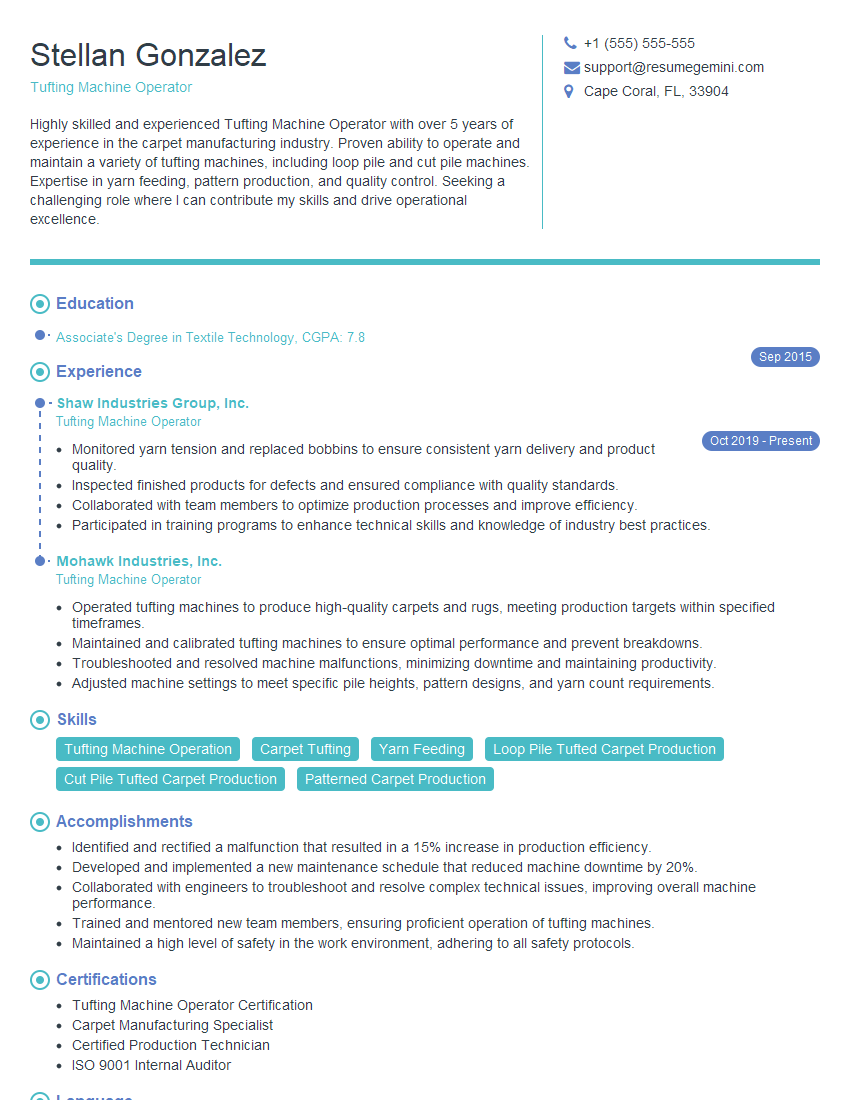
Mastering the art of yarn tufting opens doors to exciting career opportunities in a growing creative industry. To maximize your job prospects, it’s crucial to present your skills effectively. Crafting an ATS-friendly resume is key to getting your application noticed. We highly recommend using ResumeGemini to build a professional and impactful resume that highlights your yarn tufting expertise. ResumeGemini offers examples of resumes tailored to the Yarn Tufting field, ensuring your application stands out from the competition. Take the next step towards your dream career today!
Explore more articles
Users Rating of Our Blogs
Share Your Experience
We value your feedback! Please rate our content and share your thoughts (optional).
What Readers Say About Our Blog
Very informative content, great job.
good