Interviews are opportunities to demonstrate your expertise, and this guide is here to help you shine. Explore the essential Ability to develop and rehearse new music interview questions that employers frequently ask, paired with strategies for crafting responses that set you apart from the competition.
Questions Asked in Ability to develop and rehearse new music Interview
Q 1. Describe your process for developing a new musical piece from concept to completion.
Developing a new musical piece is a journey, not a sprint. It begins with a spark – an idea, a melody, a feeling. My process unfolds organically, but generally follows these steps:
- Concept & Exploration: I start by exploring the initial idea. This might involve sketching melodies on a piano, humming ideas into a voice recorder, or free-flowing improvisation. I consider the overall mood, form, and potential instrumentation.
- Composition: This phase involves notating the piece, fleshing out melodies, harmonies, and rhythms. I use notation software (more on that later) to capture my ideas efficiently and iterate on them. This is often an iterative process, where I might compose a section, then listen back, revise, and add more layers.
- Instrumentation & Arrangement: Here, I decide which instruments will best convey the emotional texture and musical ideas. I assign melodic and harmonic elements to different instruments, considering their timbre (tone color) and capabilities. This is where my understanding of orchestration comes in handy.
- Revision & Refinement: Once a complete draft exists, I meticulously revise and refine the piece. I often listen to it multiple times, from different perspectives, looking for imbalances, awkward transitions, or moments that could be improved. This might involve adjusting dynamics, harmonies, or even reworking entire sections.
- Finalization: The final stage involves preparing the score and parts for the musicians, ensuring that everything is clear and accurate. I often include performance markings and annotations to guide the interpretation of the piece.
For example, I once started with a simple piano melody that evoked a feeling of longing. Through the process described above, it evolved into a full orchestral piece with multiple movements, incorporating string textures, woodwind solos, and a powerful brass climax.
Q 2. How do you approach arranging music for different instrumental combinations?
Arranging music for different instrumental combinations requires a deep understanding of each instrument’s capabilities and limitations. I consider factors like timbre, range, and technical demands.
- Timbre Matching: I select instruments whose timbres complement each other and enhance the overall emotional impact of the piece. For instance, I might use warm string tones for lyrical passages and bright brass for dramatic moments.
- Range and Register: I ensure that melodies and harmonies are written within the comfortable range of the chosen instruments. Writing a melody for a flute that’s too high will strain the performer, whereas writing a bass line for a cello that’s too low might sound muddy.
- Technical Considerations: I consider the technical skills required by each instrument. I wouldn’t write a passage requiring complex double-tonguing for a beginner clarinetist. The arrangement needs to be playable and expressive for the musicians involved.
- Balance and Texture: I strive for a well-balanced sound, avoiding parts that are too loud or too quiet. I also consider the texture—the combination of different instrumental lines—to create a varied and engaging musical experience. A dense orchestral texture will sound very different from a sparse chamber ensemble arrangement.
For instance, a piece arranged for string quartet will require a very different approach than an arrangement for a full orchestra. The string quartet will demand more economical writing, focusing on the interplay between the four instruments. The orchestra arrangement, however, allows for greater harmonic richness and textural density.
Q 3. Explain your methods for rehearsing a complex musical piece with a group of musicians.
Rehearsing a complex piece requires a structured and collaborative approach. My methods include:
- Sectionals: I often start by working with individual sections (strings, winds, brass, etc.) to ensure each part is understood and technically mastered before bringing everyone together. This minimizes confusion and allows for focused attention on individual challenges.
- Individual Coaching: I work closely with musicians to address specific technical or musical issues. Sometimes, simply demonstrating the intended phrasing or articulation is sufficient.
- Full Ensemble Rehearsals: These are dedicated to integrating the different sections, balancing the sound, and working on overall interpretation. I might start with slow tempos and gradually increase the speed, ensuring accuracy and musicality at each stage.
- Balanced Feedback: I create a safe environment for musicians to offer feedback and contribute creatively. This process is vital for building unity and ownership of the music.
- Recording and Playback: I often use recordings to help musicians identify areas that need improvement. This provides an objective viewpoint that can be surprisingly insightful.
For example, in rehearsing a particularly challenging passage in a choral work, I might first work with the sopranos and altos separately, addressing pronunciation and intonation issues. Then, I’ll work with all four vocal sections, gradually building up to the full, fast tempo. The process is incremental and focuses on overcoming obstacles step by step.
Q 4. What strategies do you use to identify and address musical challenges during rehearsals?
Identifying and addressing musical challenges during rehearsals is a constant process. I use several strategies:
- Active Listening: I pay close attention to the musicians’ performance, listening for inconsistencies in tempo, rhythm, intonation, and dynamics.
- Problem Isolation: Once a problem is identified, I try to isolate the specific cause. Is it a technical issue? A misunderstanding of the score? A lack of coordination between sections?
- Targeted Exercises: I often devise specific exercises to help musicians overcome technical challenges. For example, if there’s a difficult rhythmic passage, we might practice it in isolation, gradually increasing the tempo.
- Creative Problem Solving: Sometimes, the solution involves re-thinking the musical phrasing, dynamics, or orchestration. I remain flexible and willing to adjust the score to facilitate better performance.
- Performance Analysis: Post-rehearsal analysis is essential, where we discuss what worked well and what needs further improvement. We examine not only technical aspects but also the overall musical interpretation.
For instance, if a passage is consistently out of tune, I might investigate if it’s due to an inaccurate intonation, a problematic harmony, or the need for more careful blending between the sections. The solution isn’t always obvious, and it often requires investigation and experimentation.
Q 5. How do you incorporate feedback from musicians into the rehearsal process?
Incorporating feedback is crucial. I create an open and respectful environment where musicians feel comfortable expressing their thoughts and concerns. My approach includes:
- Regular Check-ins: I regularly ask for feedback during rehearsals, inviting musicians to share their observations and suggestions.
- Constructive Dialogue: I engage in constructive dialogue, clarifying misunderstandings and working towards solutions that satisfy both artistic vision and practical considerations.
- Active Listening: I truly listen to the feedback, even if it challenges my initial ideas. Sometimes, valuable perspectives emerge that enhance the final product.
- Compromise and Collaboration: If necessary, I’m willing to compromise and adapt my vision based on the musicians’ valuable insights. Collaboration is key to creating a successful musical outcome.
For example, a violinist might suggest an alternative bowing technique for a particular passage that improves the clarity of the melody. I would carefully consider this suggestion, and if it enhances the performance, I’d happily incorporate it.
Q 6. How do you adapt your rehearsal techniques for different musical genres?
My rehearsal techniques adapt to different genres. While the core principles of collaboration and problem-solving remain constant, the specifics change:
- Classical Music: Emphasis is placed on accuracy, articulation, and dynamics, reflecting a tradition of precise interpretation.
- Jazz: Rehearsals are often more improvisational, focusing on exploration, interaction, and spontaneous creativity. A higher level of flexibility and adaptability is needed.
- Pop/Rock: Rehearsals are often geared towards achieving a polished, tight performance, emphasizing the technical prowess of the band and their ability to recreate the recorded track.
- World Music: Rehearsals would often involve exploring the stylistic nuances and cultural contexts of the music. Understanding rhythmic complexity and unique instrumental techniques becomes paramount.
For example, a rehearsal for a classical string quartet would prioritize precise intonation and nuanced phrasing, while a rehearsal for a jazz combo would encourage improvisation and exploration of rhythmic variations and harmonic substitutions.
Q 7. What software or tools do you use to assist in music development and rehearsal?
Technology plays a significant role in music development and rehearsal. I utilize several software and tools:
- Digital Audio Workstations (DAWs): Software like Logic Pro X, Ableton Live, and Pro Tools are essential for composing, arranging, recording, and editing music. They allow for precise control over every aspect of the sound.
- Notation Software: Sibelius and Finale allow for efficient creation and editing of musical scores and parts. They also enable efficient sharing of materials with musicians.
- Audio Editing Software: Audacity (free) and other editing software are useful for manipulating recordings, isolating sections, and creating practice loops.
- Cloud-Based Collaboration Tools: Google Drive and other platforms enable musicians to access scores and recordings from anywhere, facilitating streamlined workflow.
For example, using a DAW, I can easily experiment with different instrumentation, layering sounds, and adjusting the mix before committing to the final arrangement. The notation software allows for creating professional quality scores that can be shared with performers.
Q 8. Describe your experience with music notation software (e.g., Sibelius, Finale).
My experience with music notation software spans over a decade, primarily using Sibelius and Finale. I’m proficient in both, leveraging their strengths for different tasks. Sibelius, with its intuitive interface, excels in quick sketching and initial composition. Its playback engine is also excellent for early-stage assessment. Finale, on the other hand, shines in its detailed engraving capabilities and advanced features for complex scores. I often use Finale for final publication-ready scores, especially when dealing with large ensembles or intricate musical passages. For example, when preparing a score for a symphony orchestra, Finale’s capabilities for managing multiple instrument parts and creating clean, professional-looking parts are indispensable. I also utilize the software’s features for creating custom templates and automating repetitive tasks, significantly speeding up the workflow.
Beyond basic input and editing, I’m skilled in using advanced features such as creating custom libraries of instruments, employing sophisticated playback options, and exporting scores in various formats for printing, sharing, or use with other software. I can confidently say I’m adept at using these tools to efficiently create, edit, and refine musical scores, improving both my own compositional process and the overall clarity and professionalism of the final product.
Q 9. How do you manage time effectively during rehearsals?
Effective time management during rehearsals is crucial. My approach is threefold: meticulous planning, flexible adaptation, and focused execution. Before each rehearsal, I create a detailed agenda outlining specific goals and time allocations for each section. This agenda isn’t rigid; it’s a guide that allows for adjustments based on the ensemble’s progress and challenges. For instance, if a particular passage proves more difficult than anticipated, I’ll allocate more time to it, perhaps even breaking it down into smaller sections for focused practice. I use a timer to ensure we stay on track, providing clear and concise feedback throughout the session. This prevents rehearsals from dragging on unnecessarily, maintaining focus and energy levels. Furthermore, I always prioritize the most challenging or crucial aspects of the piece, ensuring these receive adequate attention.
Communication is key. I regularly check in with the musicians to gauge their understanding and address any immediate concerns, preventing small problems from snowballing into larger issues. This proactive approach allows for efficient use of rehearsal time and creates a more positive learning environment. Post-rehearsal, I take time to reflect on the session, noting areas of strength and weakness to inform future plans.
Q 10. Describe a time you had to overcome a significant challenge during a music rehearsal.
During rehearsals for a contemporary opera, we encountered significant challenges with a complex, rhythmically challenging passage. The singers struggled to maintain rhythmic precision and ensemble cohesion. The initial attempts were fragmented and lacked the dynamic energy required. To address this, I implemented a multi-faceted approach. First, we meticulously dissected the passage, focusing on rhythmic subdivisions and phrasing. I used a combination of conducting techniques, including beat subdivision and rhythmic cues, to improve their sense of rhythmic alignment. Secondly, we introduced visual aids – using a rhythmic chart projected onto a screen – making it easier for them to grasp the intricate rhythmic patterns. Finally, we employed a process of iterative practice, starting slowly and gradually building speed and dynamics, allowing the singers time to internalize the rhythms and develop muscle memory. Through careful analysis, adapted teaching strategies and persistent practice, we transformed the passage from a chaotic struggle to a dynamic and successful performance. This experience highlighted the importance of patient persistence and adaptable techniques in overcoming significant musical obstacles.
Q 11. How do you create a positive and productive rehearsal environment?
Creating a positive and productive rehearsal environment is paramount. I foster this by prioritizing clear communication, mutual respect, and a collaborative spirit. Rehearsals begin with a brief overview of the day’s objectives, ensuring everyone is on the same page. I actively encourage open dialogue and feedback, creating a safe space for musicians to express their thoughts and concerns without fear of judgment. I actively listen to their suggestions, demonstrating value for their contributions. Positive reinforcement plays a crucial role; I acknowledge and celebrate their achievements, boosting morale and confidence. This positive feedback loop helps maintain focus and motivation throughout the rehearsal process. I also ensure breaks are incorporated to prevent fatigue and maintain energy levels. A relaxed and respectful atmosphere enhances creativity and facilitates efficient learning.
Q 12. How do you handle disagreements among musicians during rehearsal?
Disagreements among musicians are inevitable, and handling them constructively is key. My approach involves facilitating open and respectful dialogue. I encourage musicians to clearly articulate their perspectives, fostering active listening from all parties involved. I guide the discussion, ensuring it remains focused on the musical goals and avoids becoming personal. I often reframe disagreements as opportunities for creative exploration, encouraging musicians to find solutions that incorporate different viewpoints. If a consensus can’t be immediately reached, I might suggest alternative approaches or solutions, facilitating compromise and collaboration. Ultimately, the goal is to find a solution that respects everyone’s input while upholding the artistic vision. Fairness and transparency are paramount throughout the process.
Q 13. How familiar are you with different musical rehearsal techniques (e.g., sectional, full band)?
I’m highly familiar with various musical rehearsal techniques, including sectional rehearsals, full-band rehearsals, and a blend of both. Sectional rehearsals are invaluable for addressing individual section challenges, allowing for focused work on specific technical aspects, balance, and blend. This approach ensures everyone is heard clearly. For example, focusing solely on the string section allows for detailed attention to intonation and bow technique. Full-band rehearsals are used to integrate the individual sections, addressing ensemble issues and overall balance. I often alternate between sectional and full-band rehearsals, starting with individual sections to address particular issues then bringing everything together to integrate the parts into a cohesive whole. My approach is dynamic and adapts to the specific needs of the piece and the musicians involved. I also frequently utilize other techniques like run-throughs, focused work on specific passages, and conducting various sight-reading exercises.
Q 14. Describe your experience with conducting rehearsals.
My experience with conducting rehearsals is extensive. I’ve led rehearsals for diverse ensembles ranging from small chamber groups to large orchestras and choirs. My conducting approach is characterized by clear communication, precise musical direction, and a collaborative spirit. I’m adept at shaping phrasing, dynamics, and articulation, using clear gestures and precise cues. I understand the importance of creating a supportive environment where musicians feel empowered to explore their musicality. I regularly provide constructive feedback, encouraging both individual and ensemble excellence. I also effectively manage rehearsal time, balancing focused work on challenging passages with opportunities for expression and exploration. My goal in conducting isn’t merely to dictate, but rather to facilitate a shared understanding of the music and to inspire musicians to achieve a unified, powerful performance. This holistic approach to conducting has resulted in numerous successful performances and has shaped my belief in collaborative musical leadership.
Q 15. How do you maintain the energy and focus of musicians during long rehearsals?
Maintaining energy and focus during long rehearsals requires a multifaceted approach. It’s not just about the music; it’s about the people making the music. Think of it like a marathon, not a sprint.
- Strategic Breaks: I incorporate regular, short breaks – five to ten minutes every hour – to allow musicians to stretch, hydrate, and clear their minds. These aren’t just passive breaks; I often encourage light physical activity or quick team-building exercises to boost morale.
- Varying Activities: Monotony is the enemy of focus. I mix up the rehearsal schedule, alternating between challenging sections, easier passages, and even incorporating fun improvisational games to keep things dynamic and engaging.
- Positive Reinforcement: Frequent positive feedback, both individually and collectively, is crucial. Celebrating small victories and acknowledging effort keeps the energy high. Constructive criticism, when offered, is always sandwiched between praise to maintain motivation.
- Clear Communication: Open and honest communication is paramount. I make sure everyone understands the goals for the rehearsal and encourages them to voice any concerns or fatigue they might be experiencing.
- Proper Environment: A comfortable and well-ventilated rehearsal space is essential. Ensuring adequate lighting, comfortable seating, and access to refreshments also contributes significantly to the overall experience.
For example, during a recent orchestral rehearsal of a complex Mahler symphony, we implemented these strategies. We took short breaks to do some simple vocal exercises and team breathing, completely shifting the atmosphere and allowing for renewed focus. The result was a far more productive rehearsal than if we had just pushed through without these breaks.
Career Expert Tips:
- Ace those interviews! Prepare effectively by reviewing the Top 50 Most Common Interview Questions on ResumeGemini.
- Navigate your job search with confidence! Explore a wide range of Career Tips on ResumeGemini. Learn about common challenges and recommendations to overcome them.
- Craft the perfect resume! Master the Art of Resume Writing with ResumeGemini’s guide. Showcase your unique qualifications and achievements effectively.
- Don’t miss out on holiday savings! Build your dream resume with ResumeGemini’s ATS optimized templates.
Q 16. How do you use technology to enhance the rehearsal process?
Technology plays a vital role in modern music rehearsal. It’s not about replacing human interaction, but rather augmenting it.
- Digital Score Libraries: Using software like Sibelius or Finale allows for easy access to scores, annotations, and revisions for all musicians. This minimizes paper clutter and allows for quick adjustments during rehearsals.
- Recording and Playback: Recording rehearsals allows for detailed analysis of performance. We can identify subtle timing issues, intonation problems, or balance concerns easily. Playback can also help musicians internalize sections they struggle with.
- Click Tracks and Metronomes: These tools are invaluable for developing precise timing and rhythmic accuracy, particularly in complex or unconventional music. Using a click track isn’t about being rigid; it’s about establishing a solid foundation for creative expression.
- Virtual Collaboration Tools: Software like Zoom or Google Meet enable remote rehearsals and collaboration, which is particularly beneficial when working with musicians geographically dispersed.
- Audio Editing Software: Software such as Audacity or Pro Tools allows for isolating specific instruments or sections to address individual issues more effectively.
For instance, when preparing a recording of a jazz ensemble, we utilized a click track during initial rehearsals to solidify the rhythmic foundation, and then we slowly phased it out as the ensemble developed strong internal rhythmic cohesion. Post-rehearsal, we used audio editing software to isolate parts that needed specific attention.
Q 17. Explain your understanding of music theory and its application in music development.
Music theory is the language of music. A deep understanding of it is crucial for developing and refining musical ideas.
- Harmony: Understanding harmony allows me to create compelling chord progressions, effective voice leading, and sophisticated harmonic textures. This is crucial for creating emotionally resonant and structurally sound pieces.
- Melody: Understanding melodic construction, including intervals, scales, and modes, helps in creating memorable and expressive melodies. I use this knowledge to craft melodies that fit the style and emotional context of the music.
- Rhythm: Understanding rhythm and meter allows me to create interesting and varied rhythmic patterns. I apply this to create exciting grooves, rhythmic complexity, and appropriate syncopation.
- Form: Knowledge of musical forms, such as sonata form, rondo form, or twelve-bar blues, provides a framework for organizing musical ideas effectively. This allows for a clear structure that keeps the listener engaged.
- Counterpoint: Understanding counterpoint, especially in classical music, enables the creation of complex and interesting textures, where multiple melodic lines interact harmoniously.
For example, when composing a new piece, I might start with a basic harmonic progression in C major, and then use my knowledge of secondary dominants and chromaticism to create harmonic interest and unexpected turns. This understanding of music theory isn’t about rigid rules; it’s about a toolkit for creative expression.
Q 18. How do you ensure the accuracy of musical parts during rehearsals?
Ensuring accuracy involves a combination of techniques and attentive listening.
- Section Rehearsals: Before working with the full ensemble, I conduct section rehearsals focusing on individual parts. This helps to identify and correct problems early on, preventing them from compounding during full rehearsals.
- Careful Listening: Active listening is vital. I pay close attention to intonation, articulation, rhythm, and dynamics, addressing any discrepancies immediately.
- Use of a Conductor (if applicable): If a conductor is involved, they act as a vital intermediary, ensuring everyone is performing accurately.
- Playback and Comparison: Comparing live performances with recordings allows for precise analysis of errors and effective feedback.
- Individual coaching: When necessary, individual coaching sessions are provided to help musicians improve accuracy in specific passages.
During a recent string quartet rehearsal, we used playback to compare our performance to a recording of the piece, which led to the identification and correction of some subtle rhythmic inaccuracies in the second movement.
Q 19. How do you balance creativity and technical precision during rehearsals?
Balancing creativity and technical precision is a constant juggling act, but essential for creating compelling music.
- Incremental Refinement: I start by establishing a solid technical foundation. Once the basic elements are in place, we can explore creative interpretations without compromising accuracy.
- Guided Improvisation: Structured improvisational exercises allow musicians to explore their creativity within a defined framework, ensuring that their creative impulses enhance, not detract from, the overall piece.
- Constructive Feedback: Feedback focuses both on technical accuracy and artistic expression. I help musicians find ways to express themselves creatively while maintaining a high level of precision.
- Trust and Collaboration: A collaborative environment fosters both creativity and a desire for accuracy. Trust between the musicians and the leader is essential for open experimentation and refinement.
For example, while working on a contemporary composition, we started with meticulously rehearsing the notated sections. Once the foundation was strong, we explored various approaches to the more ambiguous passages, encouraging experimentation but always guiding it back to structural integrity.
Q 20. Describe your experience working with different musical styles.
My experience spans a wide range of musical styles, from classical and baroque to jazz, pop, and contemporary classical.
- Classical Music: My work in classical music emphasizes precision, historical accuracy, and nuanced interpretation.
- Jazz: My experience in jazz encompasses improvisation, rhythmic complexity, and spontaneous interaction between musicians.
- Pop Music: My pop music projects focus on creating catchy melodies, strong arrangements, and effective communication of the lyrical content.
- Contemporary Classical Music: Working with contemporary pieces necessitates a deep understanding of avant-garde techniques and experimental approaches to music composition.
This diversity has enriched my understanding of music and broadened my skills, allowing me to adapt my approach to different stylistic contexts. Each style presents unique challenges and opportunities, and my ability to navigate them is a testament to my versatility.
Q 21. How do you incorporate improvisation into your rehearsal process?
Improvisation is a powerful tool for fostering creativity and musicianship, even in pieces that are primarily notated.
- Guided Improvisation: I often begin by establishing a harmonic or rhythmic framework, and then encourage musicians to improvise within that structure. This allows for exploration while ensuring musical coherence.
- Call and Response: Improvisational exercises using a call and response structure can be used to develop both individual and group musical expression.
- Theme and Variations: Using a pre-composed theme as a starting point, musicians can improvise variations on the melody, harmony, or rhythm. This helps to develop compositional skills and musical fluency.
- Free Improvisation (with caution): While free improvisation can be very effective, its use is more appropriate in certain contexts. It requires a high level of musical maturity and understanding. I introduce it gradually, ensuring everyone feels comfortable and supported.
For example, when working on a new jazz piece, we used a call and response style improvisation exercise to develop our collective understanding of the song’s groove and harmonies before diving into more spontaneous improvisations during the performance. It helped build both individual expression and overall ensemble cohesion.
Q 22. How do you assess the progress of a musical piece during rehearsals?
Assessing the progress of a musical piece during rehearsals is a multifaceted process that involves careful observation, active listening, and constructive feedback. It’s not just about technical proficiency; it’s about the overall artistic expression.
- Technical Proficiency: I assess the accuracy of notes, rhythms, and dynamics. Are the musicians playing in tune? Is the tempo consistent? Are the articulations clear? I might use specific examples, such as, “The transition from measure 15 to 16 needs a smoother legato,” or “The rhythmic precision in the triplets needs more attention.”
- Musicality and Interpretation: I evaluate the musicians’ understanding of the piece’s style, phrasing, and emotional content. Do they convey the intended mood? Are there effective dynamic contrasts? I look for expressive qualities. For instance, I might say, “The climax in section B could have more intensity and power.”
- Ensemble Cohesion: I pay close attention to the balance between sections and the overall blend of instruments or voices. Are the parts working together seamlessly? Are there any sections where one instrument overshadows the others? I might ask for adjustments to ensure a uniform and well-balanced sound. An example would be, “The strings need to slightly reduce their volume in measure 30 to allow the clarinet melody to breathe.”
- Progress Tracking: I keep a detailed log of our progress, noting areas of strength and weakness. This helps me identify patterns and prioritize the focus of subsequent rehearsals. I might use a spreadsheet or a simple notebook to track specific issues.
By combining these aspects, I create a holistic picture of the progress, guiding the musicians towards a polished and expressive performance.
Q 23. How do you address performance anxiety in musicians during rehearsals?
Performance anxiety is a common challenge for musicians. Addressing it requires a combination of empathy, practical strategies, and creating a supportive environment.
- Understanding the Source: I begin by acknowledging the anxiety and validating the musicians’ feelings. It’s crucial to understand the root cause – is it fear of failure, pressure from expectations, or something else?
- Breathing and Relaxation Techniques: I introduce simple breathing exercises and relaxation techniques, such as progressive muscle relaxation, to help musicians manage their physical responses to anxiety. This can be incorporated during rehearsal breaks.
- Gradual Exposure: We start with smaller sections of the music, building confidence gradually before tackling the entire piece. Small victories build momentum and reduce overall anxiety.
- Positive Self-Talk and Visualization: I encourage musicians to practice positive self-talk and visualization techniques, imagining successful performances. This fosters a sense of control and confidence.
- Building Confidence: I focus on celebrating achievements and progress, rather than dwelling on mistakes. A supportive and encouraging environment can significantly reduce anxiety levels. I might remind them of their past successes, or focus on the improvements made since the previous rehearsal.
Remember, managing performance anxiety is an ongoing process, requiring patience and understanding from both the conductor and the musicians.
Q 24. What are your strategies for motivating musicians during rehearsals?
Motivating musicians requires a combination of understanding their individual needs, creating a collaborative environment, and fostering a shared sense of purpose.
- Clear Goals and Expectations: Establishing clear goals for each rehearsal and the overall project keeps the musicians focused and engaged. I use SMART goals (Specific, Measurable, Achievable, Relevant, Time-bound) to ensure clarity and accountability.
- Positive Reinforcement: I regularly praise and acknowledge individual and group achievements, celebrating both large and small successes. This reinforces positive behavior and encourages continuous improvement.
- Open Communication: I create an environment where musicians feel comfortable sharing their ideas, concerns, and challenges. This fosters a sense of ownership and responsibility.
- Collaborative Problem-Solving: Instead of dictating solutions, I encourage musicians to participate in finding solutions to challenges, promoting teamwork and creative thinking. I pose questions such as, “What approaches could we try to improve the balance between the woodwinds and brass?”.
- Variety and Breaks: Incorporating variety in rehearsal activities and providing regular breaks helps to maintain energy levels and prevent burnout. A 5-10 minute break every hour can help maintain focus and productivity.
Motivation isn’t just about rewarding; it’s about creating a supportive and stimulating environment where musicians feel valued and empowered.
Q 25. How do you provide constructive criticism to musicians during rehearsals?
Constructive criticism is about offering feedback that is specific, actionable, and supportive. It’s not about criticizing the musician; it’s about improving the music.
- Specific and Detailed Feedback: I avoid vague statements and instead provide specific examples of what needs improvement. For instance, instead of saying “that section was sloppy,” I’d say, “The rhythm in measures 22-24 could be tighter, perhaps by focusing on the offbeats.”
- Focus on Observable Behaviors: I frame feedback around observable behaviors, avoiding subjective judgments. I focus on what the musicians are doing, not on their inherent abilities.
- Sandwich Approach: I often use the “sandwich” approach: start with positive reinforcement, offer constructive criticism, and end with another positive statement. This helps to soften the criticism and maintain a positive atmosphere.
- Collaborative Problem-Solving: I actively involve musicians in the process of finding solutions. I might ask, “What do you think would help improve the intonation in this passage?” This encourages self-reflection and ownership of the improvement process.
- Focus on Progress, Not Perfection: I emphasize the importance of progress over perfection. Small steps forward are celebrated, fostering a growth mindset.
Constructive criticism should always be delivered with empathy and respect, aiming to support the musicians’ growth and development.
Q 26. Describe your experience with recording music in a studio setting.
My experience in studio recording has been extensive, encompassing various genres and technologies. It’s a vastly different process compared to live performance, demanding meticulous preparation and attention to detail.
- Pre-Production: This stage involves selecting the right studio, arranging the music precisely, and creating detailed charts for the musicians. It is crucial to have a clear understanding of the sonic palette desired for each instrument.
- Session Preparation: This includes working closely with the recording engineer to calibrate microphones, set levels, and determine the desired sound for each instrument. This also includes briefing the musicians on the specific requirements of the recording session.
- Tracking: This is where the actual recording happens. I pay close attention to detail – ensuring correct tempos, note accuracy, and proper dynamics. Multiple takes are often required to capture the perfect performance for each section.
- Editing and Mixing: This post-production phase involves careful editing of the individual tracks, adjusting levels, applying effects, and ensuring a seamless blend of all instruments. Working closely with the engineer is key to achieve the desired final product.
- Mastering: The final stage involves optimizing the overall sound of the recording, ensuring it is ready for distribution across various media.
Studio recording demands a high level of technical understanding and collaboration, but the result is a precise and high-quality final product that represents the musical vision accurately.
Q 27. How do you ensure that the final product meets your artistic vision?
Ensuring the final product meets my artistic vision requires a multi-stage approach starting from the initial conception of the piece.
- Clear Artistic Vision: I begin with a very clear artistic vision, articulating the desired emotional impact, style, and overall aesthetic of the music. This vision guides all subsequent stages of development.
- Detailed Score and Arrangements: Creating detailed scores and arrangements are essential. These serve as a blueprint, ensuring that everyone involved is working towards a unified goal.
- Careful Selection of Musicians: I carefully select musicians whose skills and interpretations align with my artistic vision. The right individuals are crucial for realizing the artistic potential of the work.
- Rehearsal Process: I carefully plan and manage the rehearsal process to refine the nuances of the performance, ensuring that the musicians’ understanding matches mine.
- Recording and Post-Production: During recording and post-production, I actively collaborate with the engineers and producers, offering guidance on the desired sounds and ensuring the final product accurately reflects my vision. Continuous feedback during these stages is crucial.
- Critical Listening and Revision: Even after the recording is complete, I engage in critical listening, identifying any areas for refinement. I may decide on additional mixing or mastering adjustments to get it precisely as intended.
By combining these strategies, I can ensure that the final product not only meets but surpasses my artistic vision, resulting in a satisfying and impactful musical experience for the audience.
Q 28. What are your long-term career goals in music development and rehearsal?
My long-term career goals revolve around continued growth and innovation in music development and rehearsal techniques. I aspire to become a leading figure in my field, mentoring and inspiring the next generation of musicians.
- Expanding Expertise: I plan to deepen my knowledge in various musical genres and styles, exploring new compositional and arranging techniques. I also wish to explore new technologies, incorporating them into rehearsal and performance practices.
- Mentorship and Education: I am passionate about mentoring aspiring musicians and conductors, sharing my experience and expertise to help them reach their full potential. This could involve teaching, conducting masterclasses, and offering workshops.
- Collaborative Projects: I intend to collaborate with other musicians, composers, and artists on diverse and ambitious projects, pushing boundaries and expanding my creative horizons.
- Technological Innovation: I want to actively explore the use of new technologies to enhance the effectiveness and efficiency of rehearsals. This could involve integrating virtual reality tools, advanced music notation software, or employing data analysis to optimize practice sessions.
- Artistic Leadership: I aim to assume greater leadership roles in the music world, contributing to the development of new musical initiatives and fostering innovation within the field.
My ultimate goal is to leave a lasting impact on the music world, inspiring both musicians and audiences alike.
Key Topics to Learn for Ability to Develop and Rehearse New Music Interview
- Musical Idea Generation & Development: Explore techniques for brainstorming musical ideas, including melodic, harmonic, and rhythmic development. Consider how you approach initial sketches and refine them into complete compositions.
- Arranging and Orchestration: Discuss your understanding of arranging music for different ensembles or instrumentation. Explain your approach to balancing individual parts while maintaining a cohesive whole. Consider examples of your work.
- Rehearsal Techniques & Strategies: Describe your methods for efficient and effective rehearsals, including strategies for addressing challenges, providing constructive feedback, and fostering collaboration within a musical group.
- Technical Proficiency & Musicianship: Highlight your proficiency in relevant musical software (e.g., Sibelius, Finale, Logic Pro X) and your ability to apply music theory to practical composition and arrangement.
- Problem-Solving & Creative Adaptation: Discuss how you approach challenges in the composition and rehearsal process. How do you adapt to unexpected issues or creative roadblocks?
- Collaboration & Communication: Describe your experience collaborating with other musicians, composers, or producers. How do you effectively communicate your musical vision and receive feedback?
- Copyright & Legal Aspects: Demonstrate an understanding of copyright law and best practices for protecting your original compositions.
Next Steps
Mastering the ability to develop and rehearse new music is crucial for career advancement in various musical fields, opening doors to exciting opportunities in composition, arrangement, performance, and music production. To maximize your job prospects, it’s essential to present your skills effectively through a well-crafted, ATS-friendly resume. ResumeGemini is a trusted resource to help you build a professional resume that highlights your unique abilities and experiences. Examples of resumes tailored to showcasing expertise in developing and rehearsing new music are available through ResumeGemini, helping you stand out from the competition.
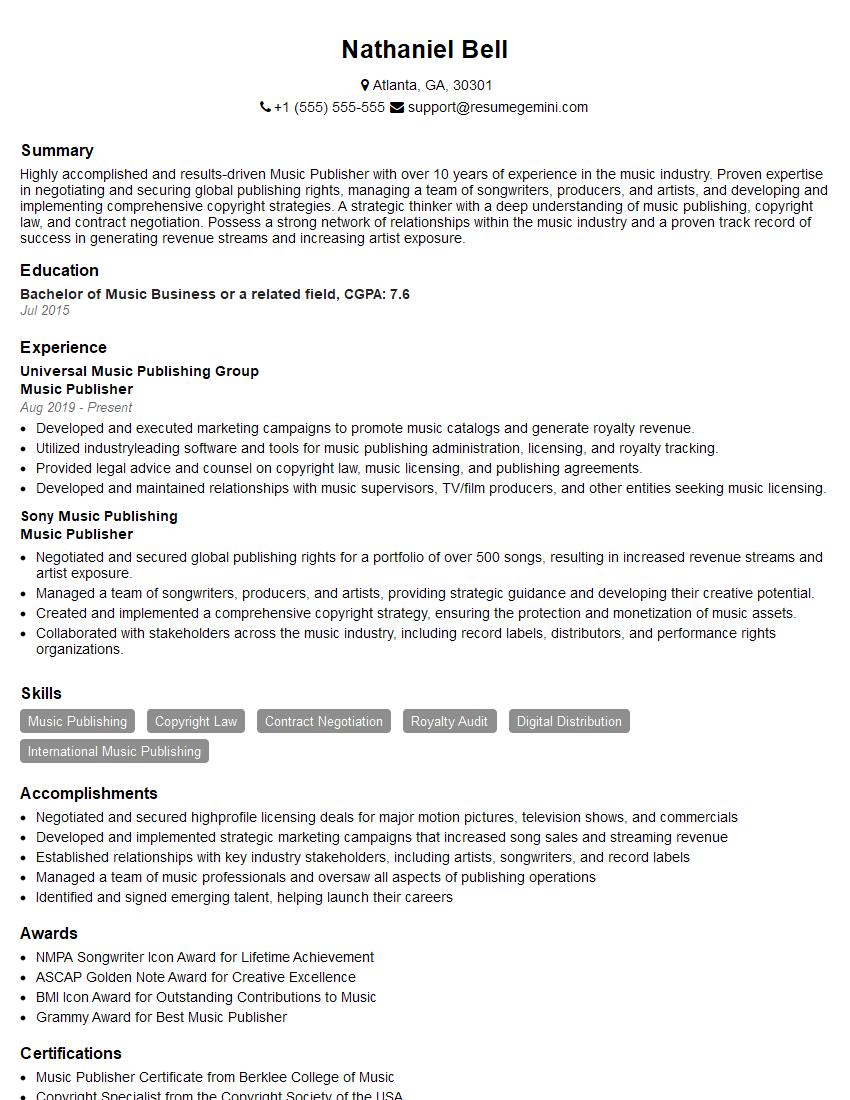
Music Publisher Resume Sample
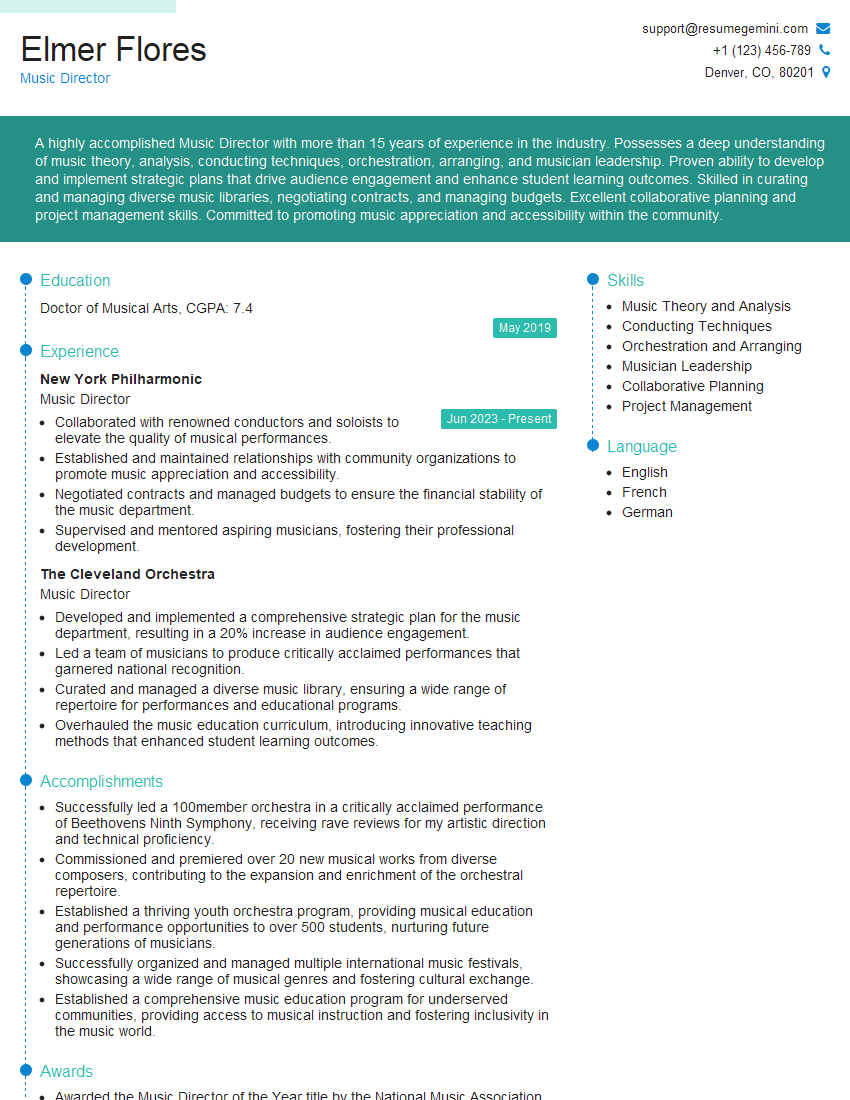
Music Director Resume Sample
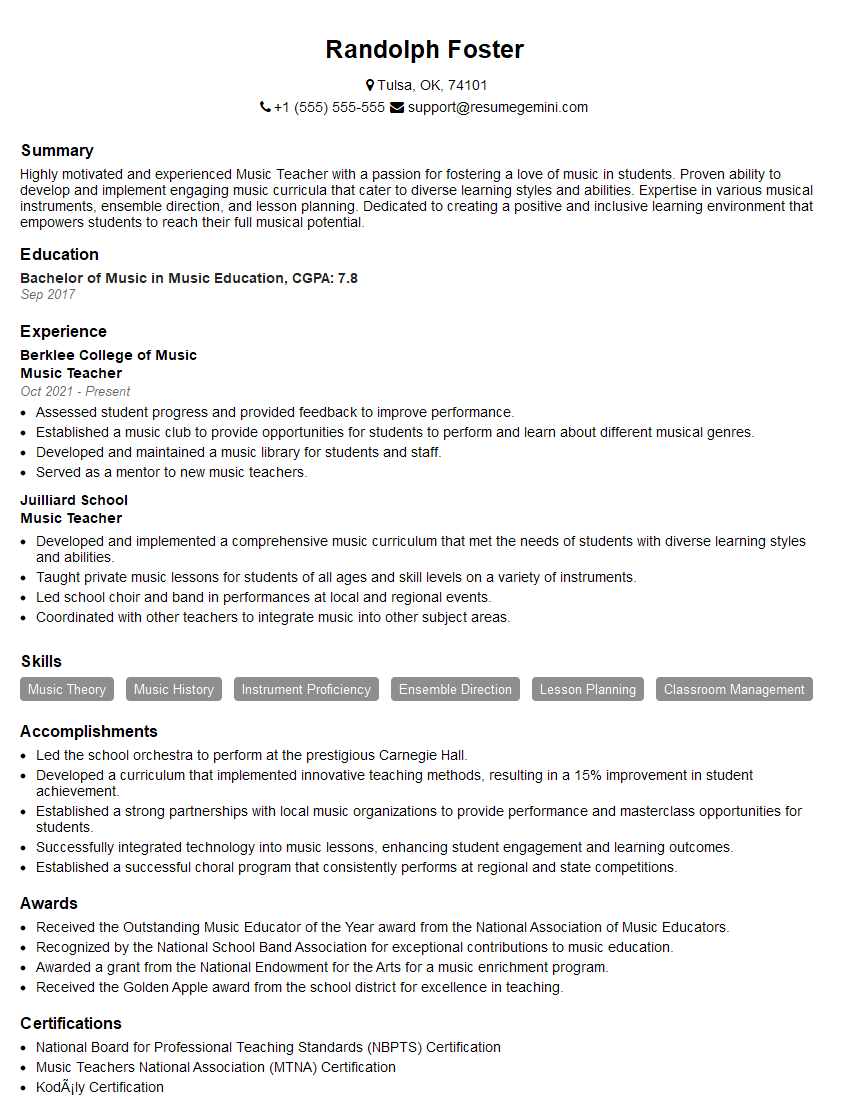
Music Teacher Resume Sample
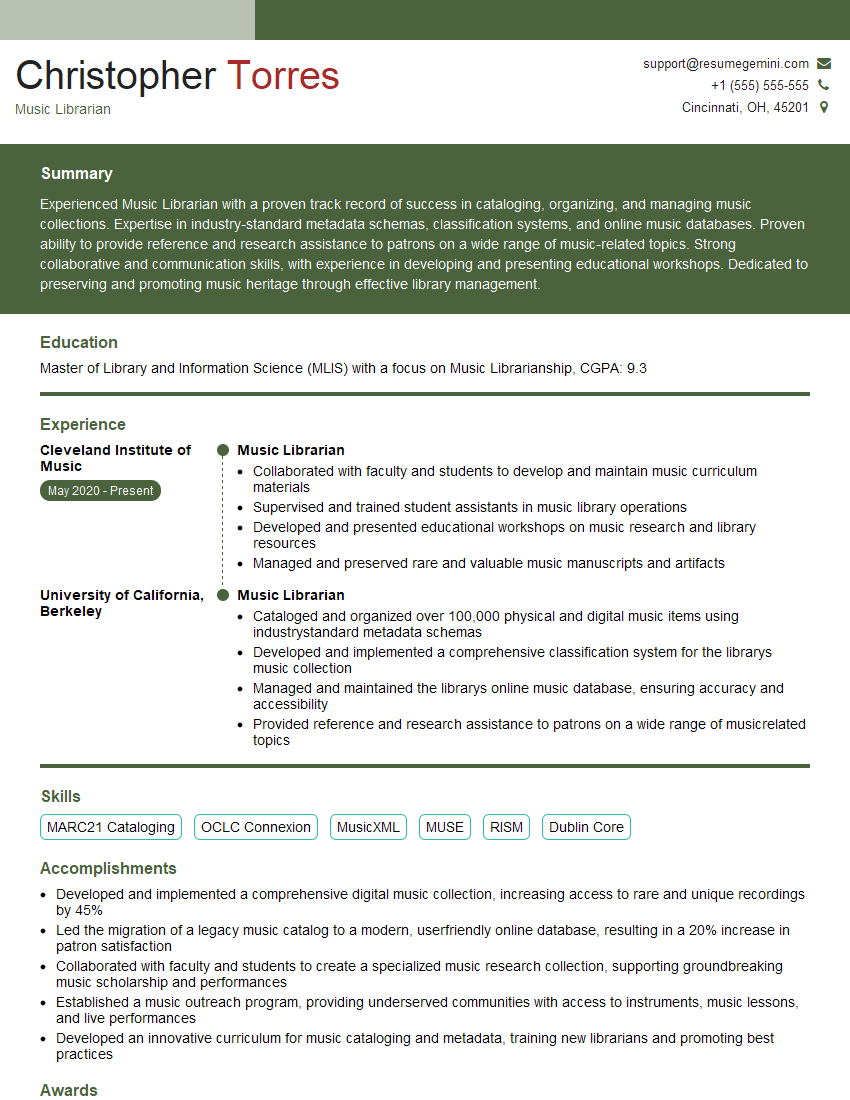
Music Librarian Resume Sample
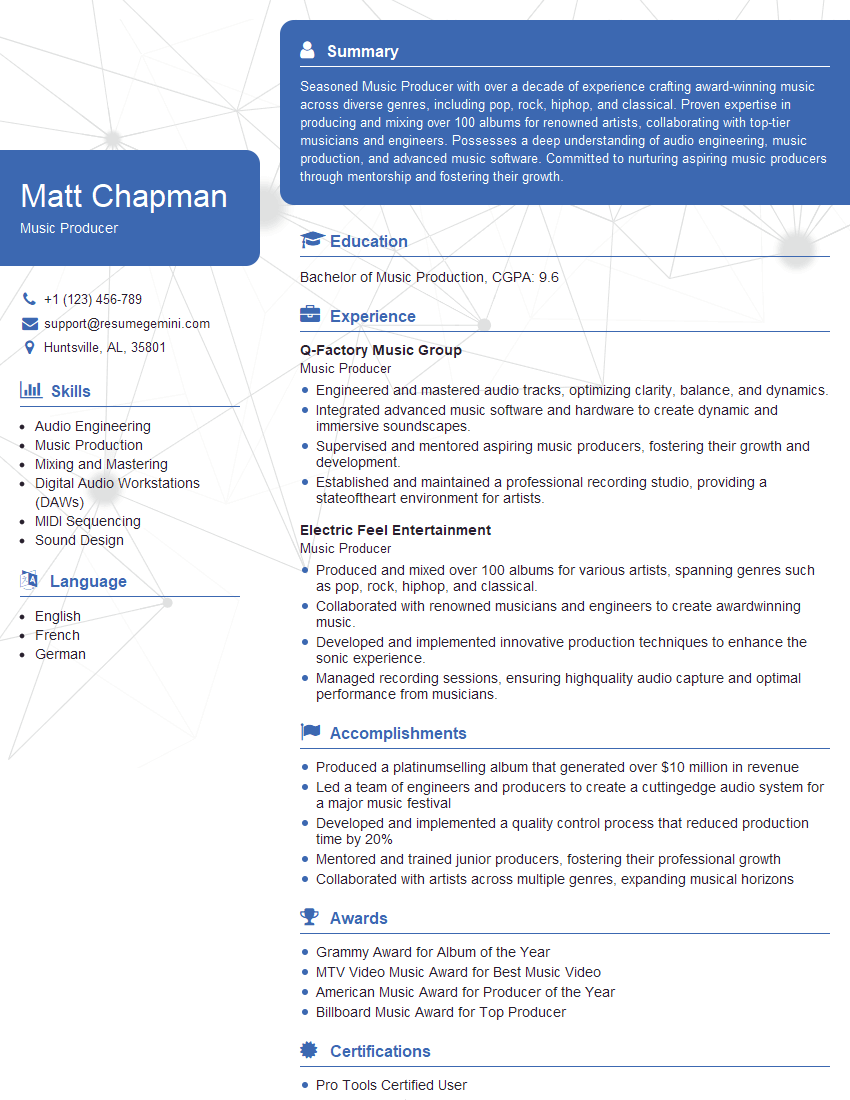
Music Producer Resume Sample
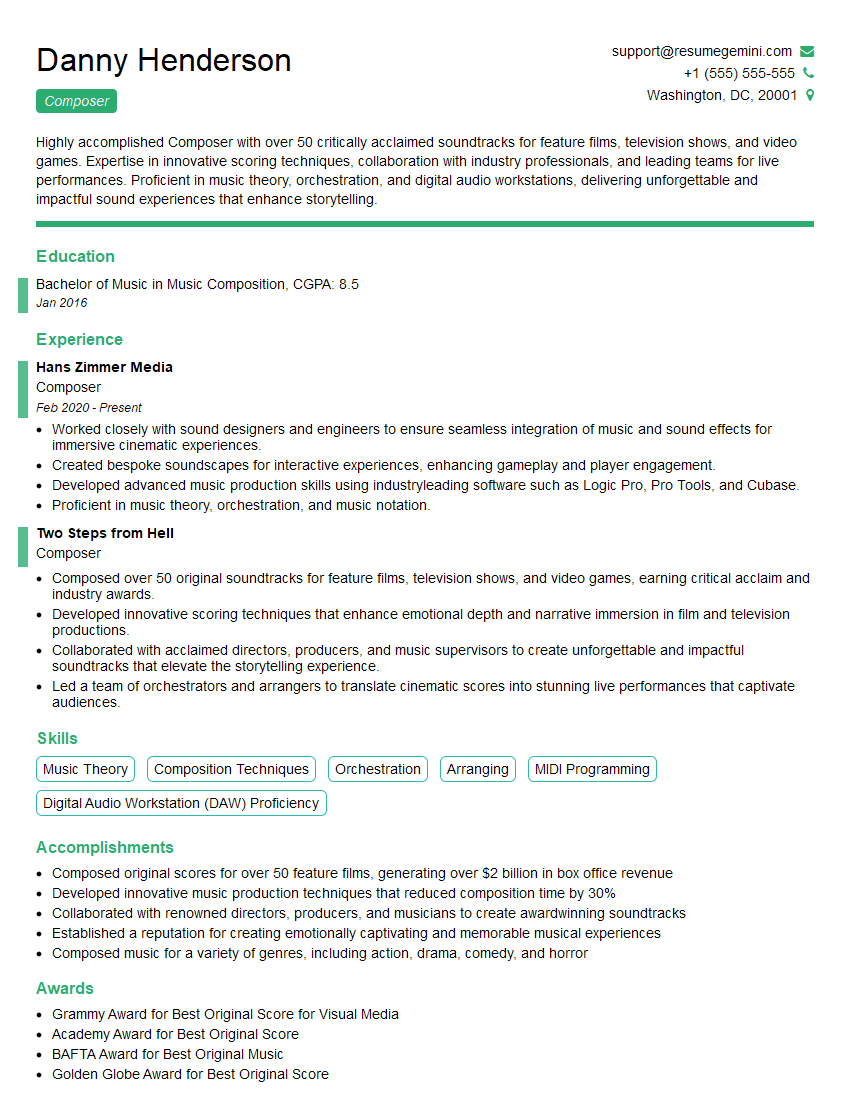
Composer Resume Sample
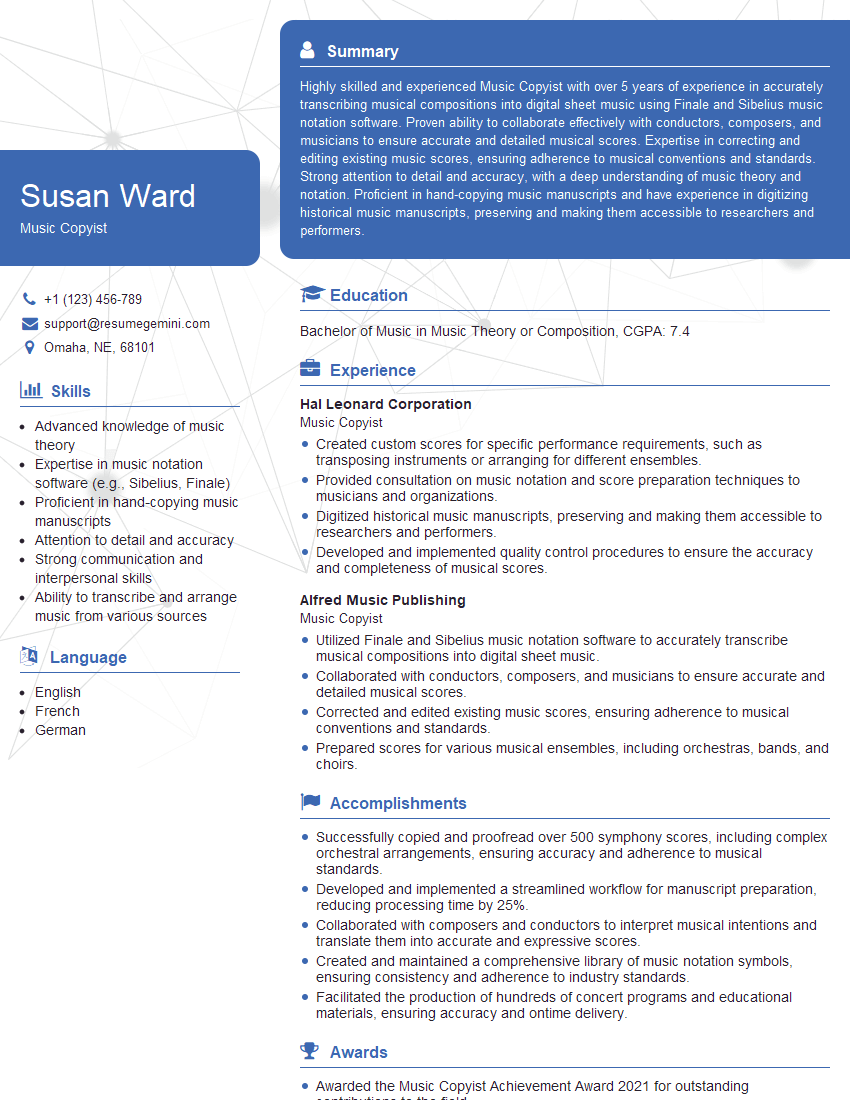
Music Copyist Resume Sample
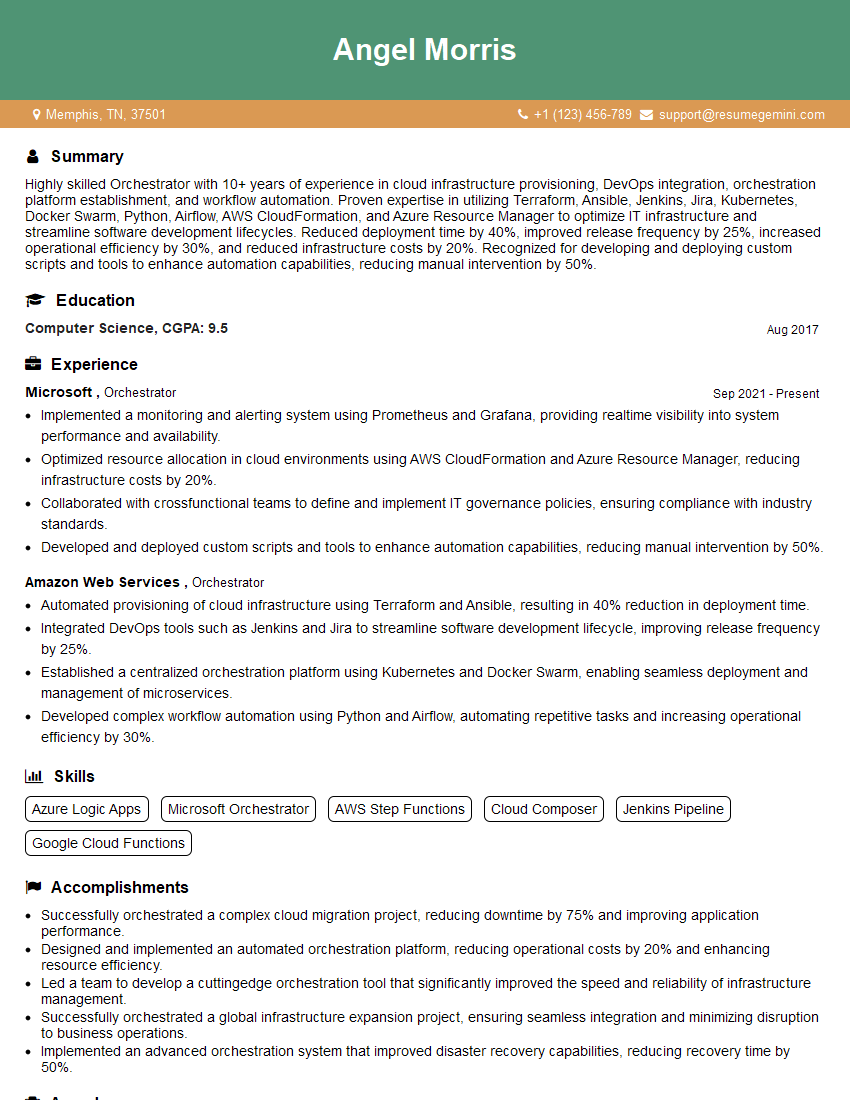
Orchestrator Resume Sample
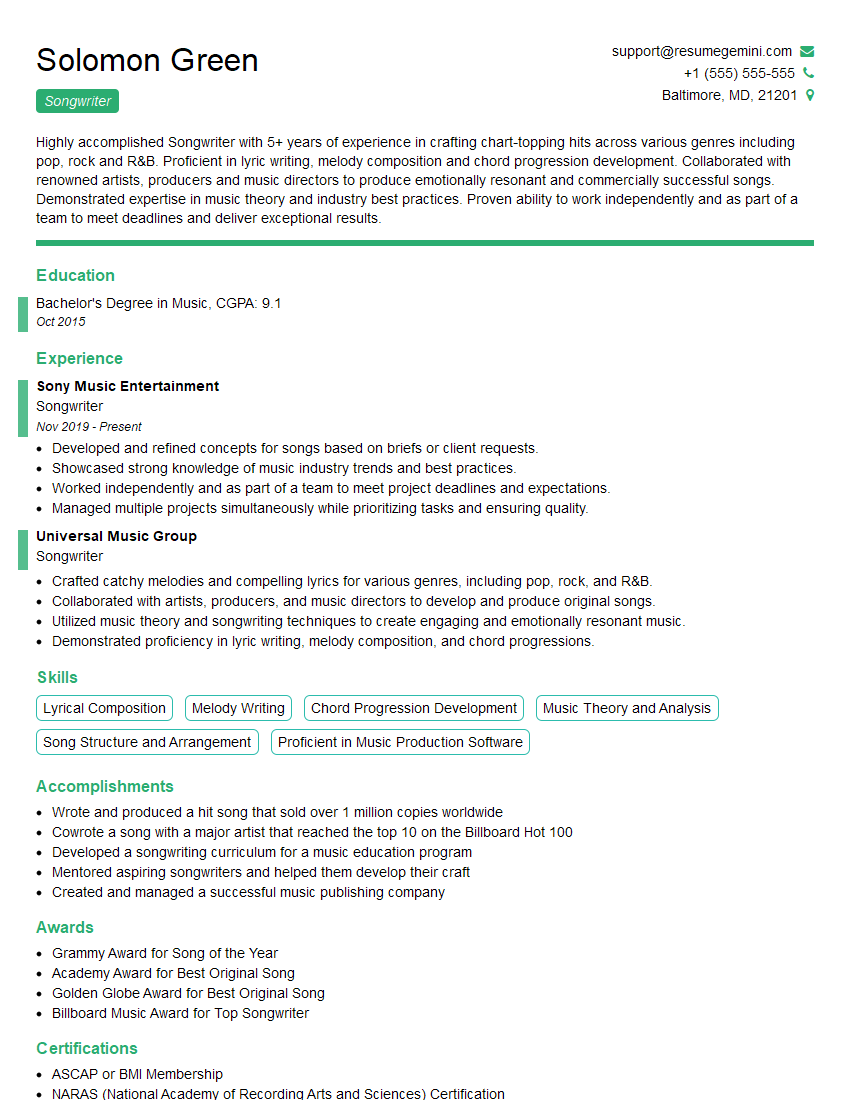
Songwriter Resume Sample
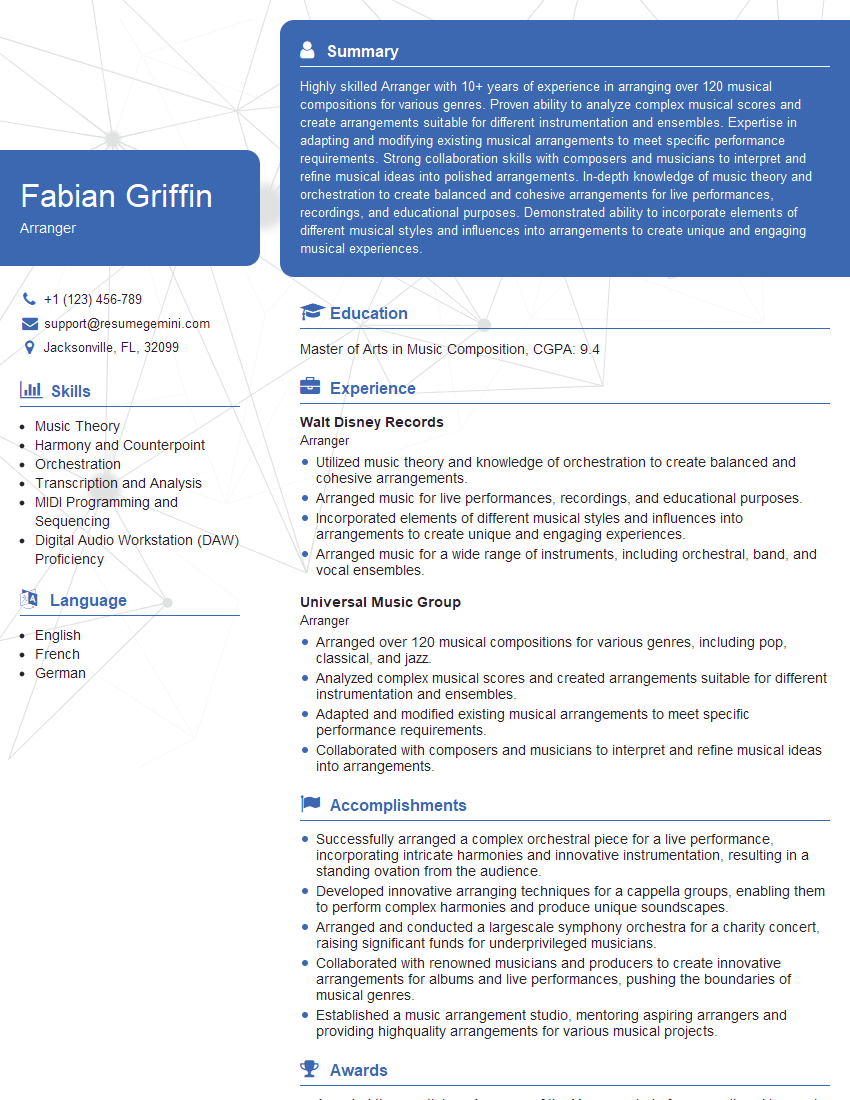
Arranger Resume Sample
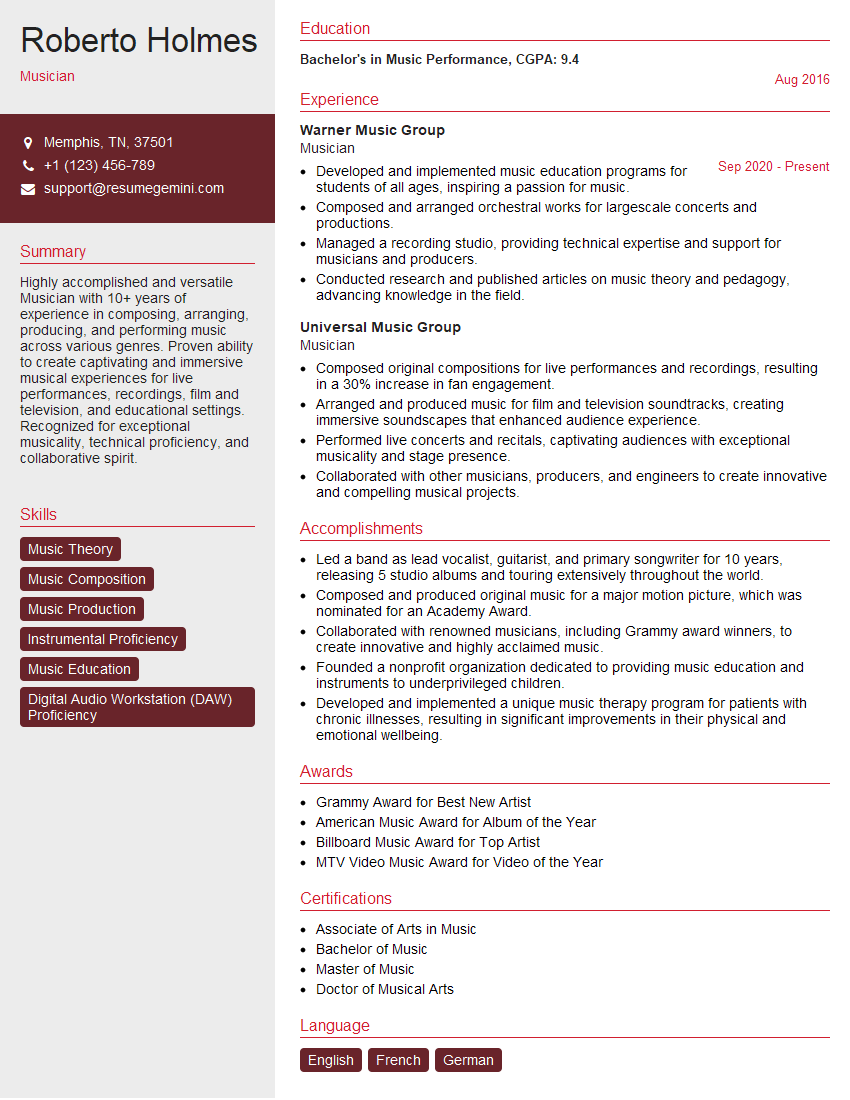
Musician Resume Sample
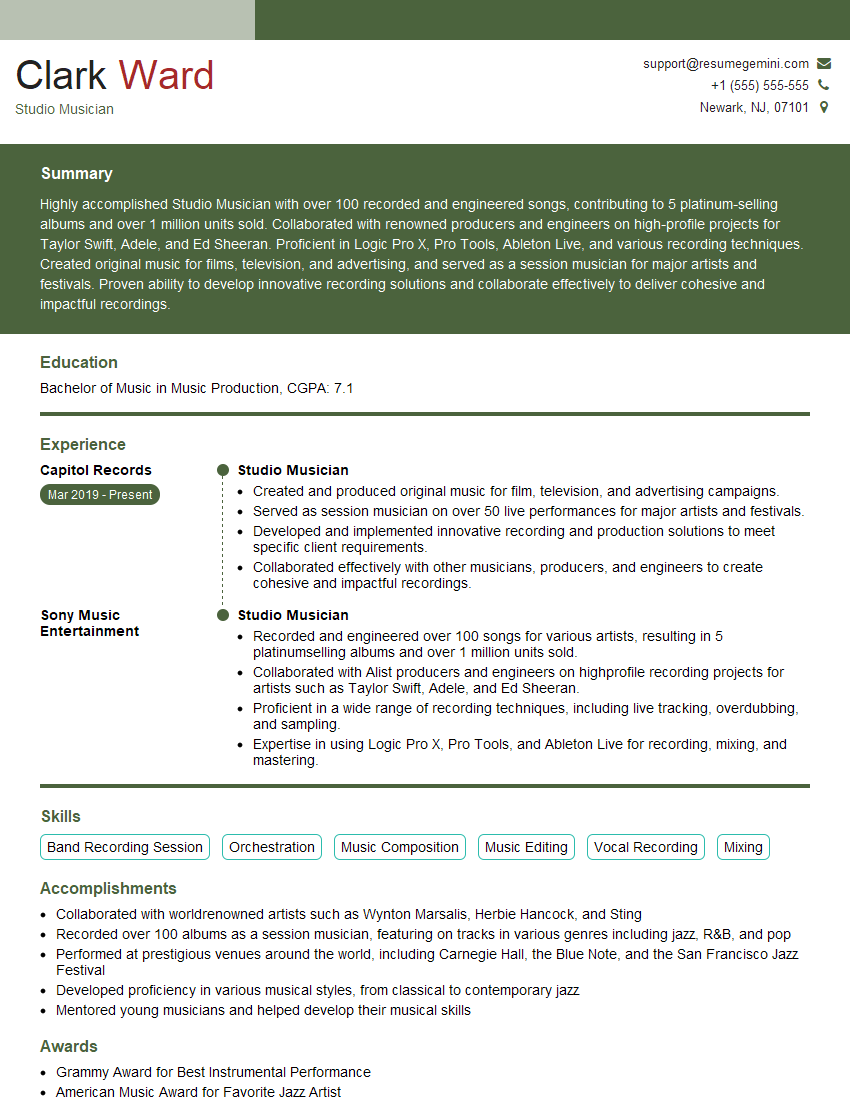
Studio Musician Resume Sample
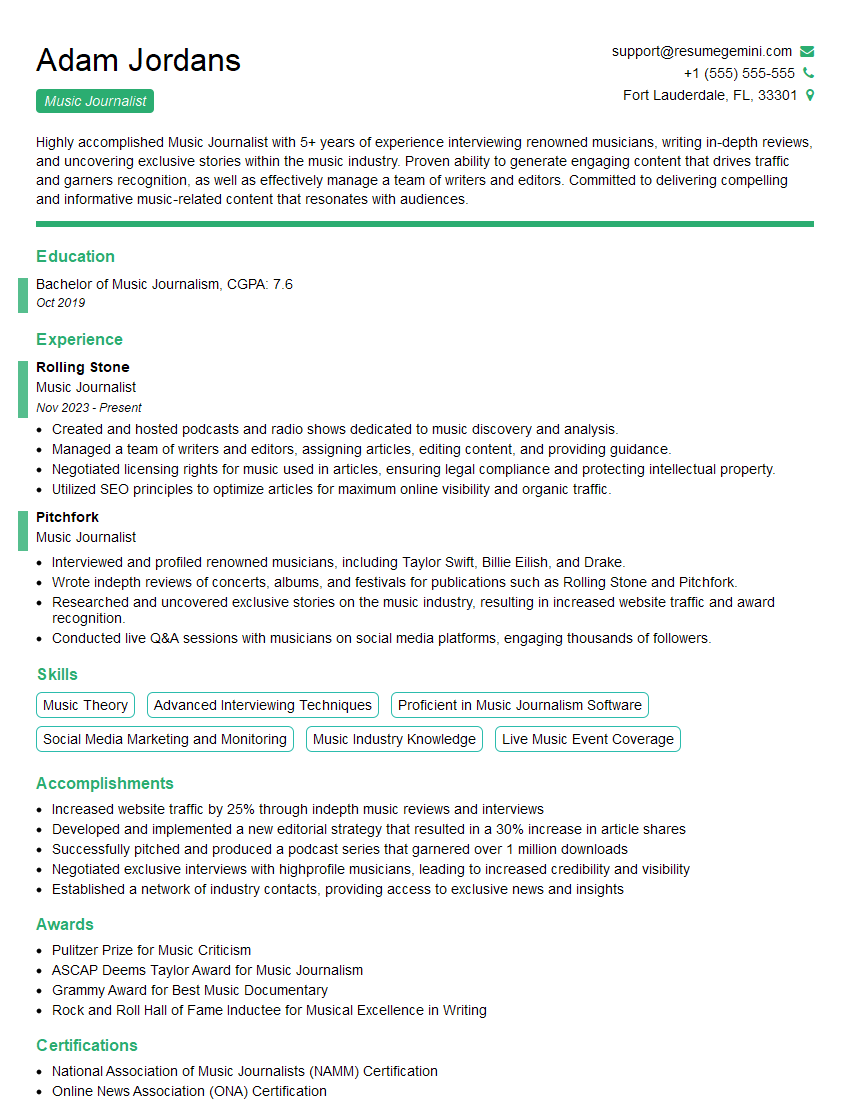
Music Journalist Resume Sample
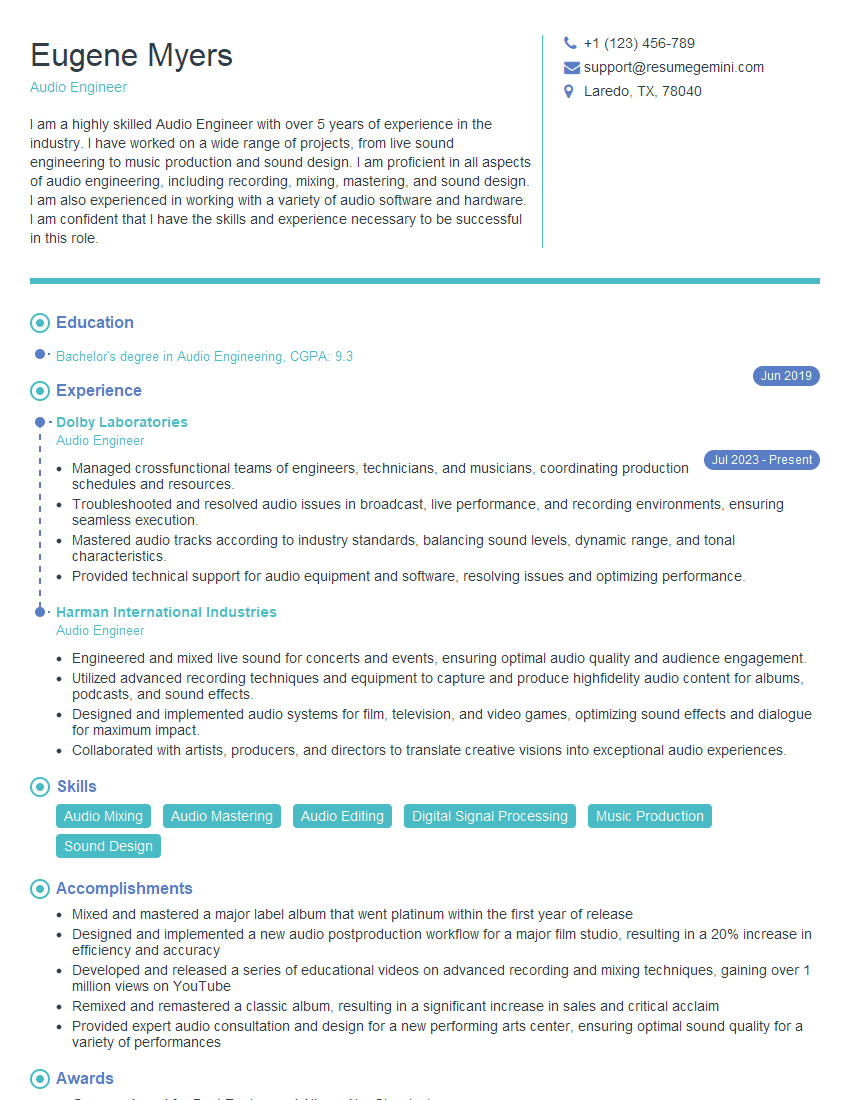
Audio Engineer Resume Sample
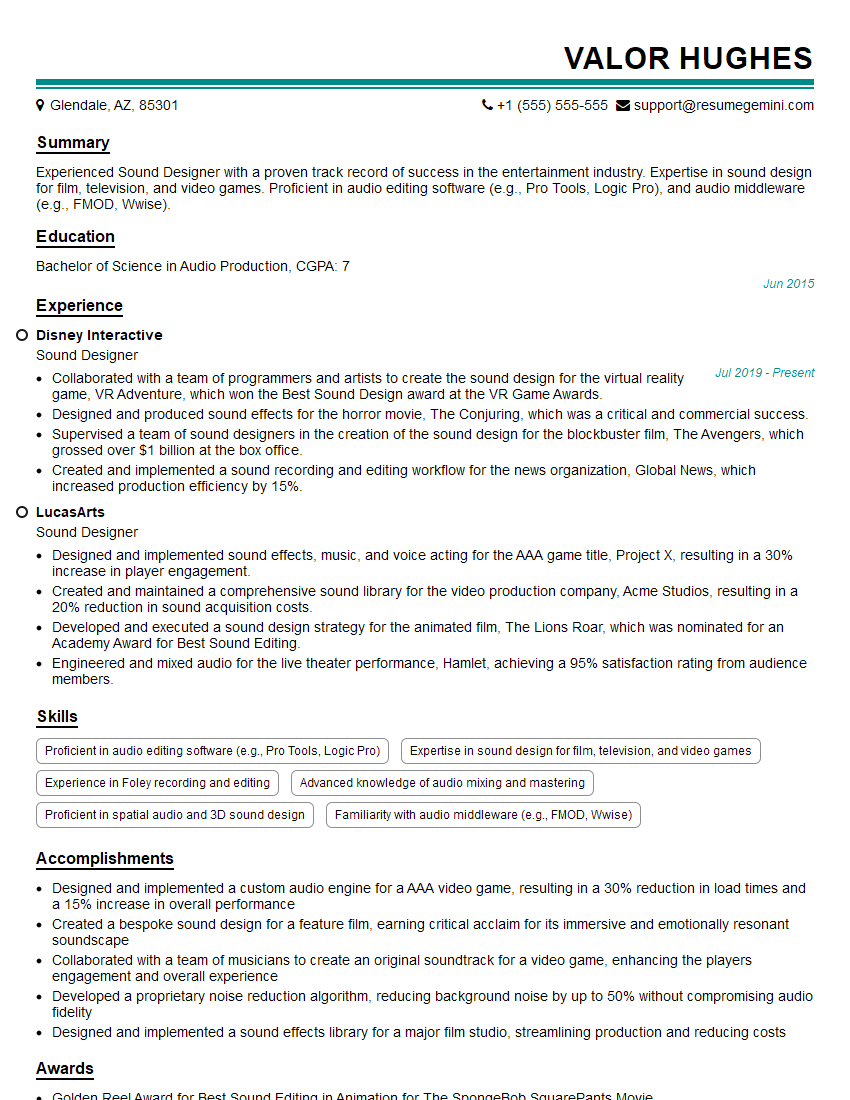
Sound Designer Resume Sample
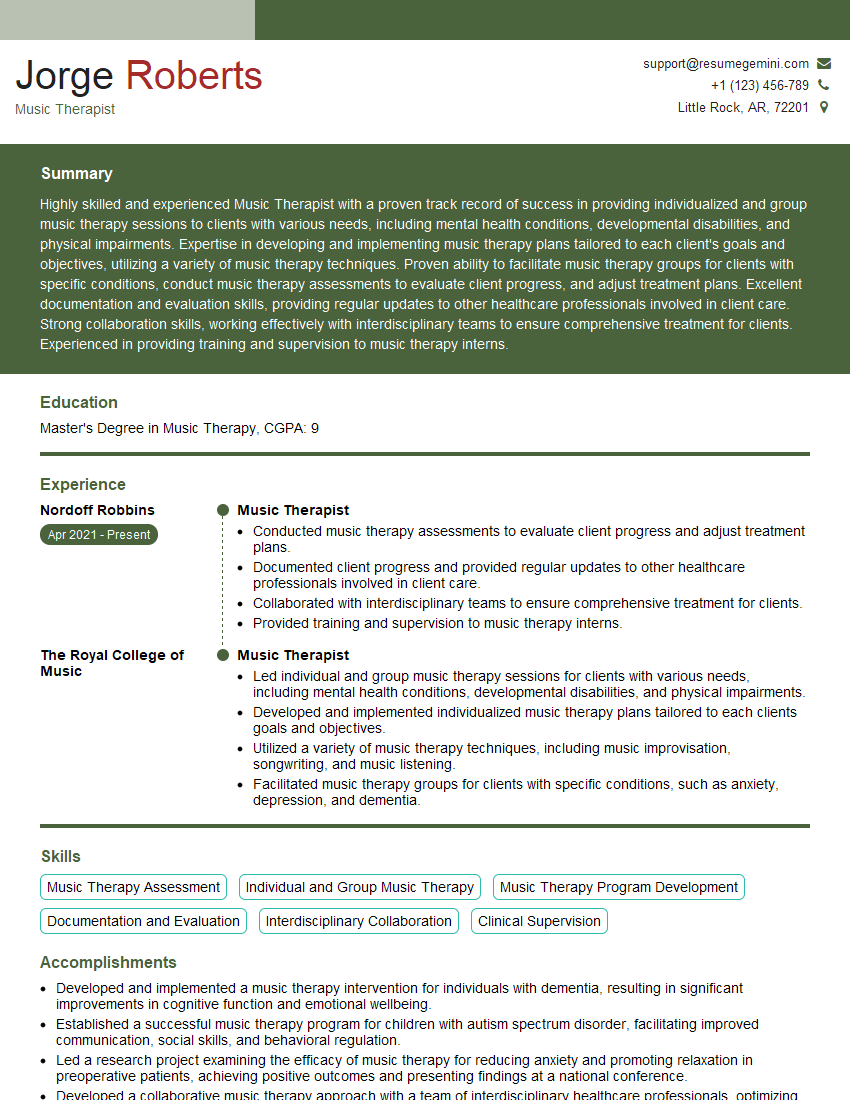
Music Therapist Resume Sample
Explore more articles
Users Rating of Our Blogs
Share Your Experience
We value your feedback! Please rate our content and share your thoughts (optional).
What Readers Say About Our Blog
Very informative content, great job.
good