Feeling uncertain about what to expect in your upcoming interview? We’ve got you covered! This blog highlights the most important Advanced Knowledge of Orchestral Instruments and Techniques interview questions and provides actionable advice to help you stand out as the ideal candidate. Let’s pave the way for your success.
Questions Asked in Advanced Knowledge of Orchestral Instruments and Techniques Interview
Q 1. Describe the differences in playing techniques between a Baroque and a modern violin.
The playing techniques of Baroque and modern violins differ significantly, primarily due to changes in instrument construction and performance practice. Baroque violins generally have a higher, brighter tone due to their shallower body and gut strings. Bowing techniques reflected this; Baroque violinists used a lighter touch, focusing on articulation through detached notes (détaché) and a more restricted range of bow speed variations. Their vibrato was often less pronounced or absent altogether, contributing to a clearer, more ornamented style.
Modern violins, with their deeper bodies and metal strings, possess a richer, more resonant sound. This allows for a wider dynamic range and more expressive playing. Modern techniques embrace a broader spectrum of bowing styles – from the fluid legato to powerful accents – and utilize a more pronounced vibrato for expressive purposes. Think of the dramatic, soaring melodies of a Romantic concerto compared to the lighter, dance-like movements of a Baroque sonata. The differences aren’t just stylistic but are fundamentally tied to the instruments’ acoustic properties.
Q 2. Explain the various bowing techniques used in orchestral playing, including their nuances and applications.
Orchestral bowing techniques are incredibly diverse, contributing greatly to the expressive potential of string playing. Let’s explore some key techniques:
- Détaché: Separate, distinct notes played with a clear articulation. This is the foundation of many bowing techniques.
- Legato: Smooth, connected notes, creating a flowing line. Achieved by minimizing the interruption between strokes.
- Martelé: A detached bowing style emphasizing a strong, accented attack. Imagine the forceful punctuation of a staccato chord.
- Ricochet: A bouncing bow technique producing a rapid series of notes, akin to the sound of raindrops.
- Spiccato: A detached style where the bow bounces lightly on the string, producing a bright, clear sound.
- Col legno: Striking the strings with the wood of the bow, creating a percussive effect. This is used sparingly but adds a unique textural element.
The choice of bowing technique is crucial for interpreting musical nuances. A delicate legato conveys serenity, while a forceful martelé can portray aggression. Musicians constantly adjust their bowing to match the dynamics, tempo, and emotional content of the music.
Q 3. How do you address intonation issues in a string section?
Addressing intonation issues in a string section requires a multi-pronged approach combining individual skill, section leadership, and attentive listening.
Firstly, each player must focus on developing perfect pitch and ear training. Regular tuning practice and scales are crucial. Secondly, a strong section leader is essential. They provide a reference pitch and subtly guide intonation through subtle cues. A common strategy is to utilize a tuning device (like a tuner or a pitch pipe) to ensure the section is correctly centered. Finally, attentive listening is paramount. Players should constantly monitor their sound relative to the other players in the section and the conductor’s overall interpretation. Frequent section rehearsals focused on intonation exercises will significantly improve the section’s overall tuning.
Q 4. Discuss the challenges of playing in tune within a large ensemble.
Playing in tune within a large ensemble presents significant challenges, mainly due to the complexities of acoustic interactions, individual variations in pitch perception, and the inherent imperfections of instruments. Temperature and humidity fluctuations also affect the pitch stability of stringed instruments.
Overcoming these challenges requires careful attention to individual intonation, a strong section leader, and a collaborative spirit. Regular tuning sessions, a common reference pitch, and attentive listening are vital. The conductor plays a critical role in guiding the intonation of the entire ensemble. A good conductor uses subtle cues and adjustments to ensure the ensemble is playing in tune and balance.
Q 5. What are the key characteristics of different orchestral woodwind families?
The orchestral woodwind family encompasses a diverse range of instruments, each with unique characteristics:
- Flutes: Characterized by their bright, clear tone and agile playing. They often occupy the highest register in the orchestra.
- Oboes: Known for their warm, slightly nasal tone, often playing lyrical and expressive melodies.
- Clarinets: Versatile instruments with a rich, expressive tone capable of a wide dynamic range. They are exceptionally versatile, often playing both melodic and harmonic roles.
- Bassoons: The deeper-toned counterparts to oboes, offering a rich, mellow sound, often providing a harmonic foundation.
- Saxophones: While not traditionally part of the classical orchestra, they are increasingly included, and have a wide vocal-like dynamic range. They bridge the gap between woodwinds and brass.
These instruments interact dynamically, creating a complex and colorful tapestry of sound. Their timbral variety is essential to the orchestral palette.
Q 6. Explain the role of embouchure in brass instrument performance.
Embouchure, the way a brass player forms their mouth and lips around the mouthpiece, is fundamental to brass playing. It dictates the airflow, the vibration of the lips, and consequently, the pitch, tone, and volume of the sound. A properly formed embouchure involves a precise aperture of the lips, balanced lip tension, and a controlled airflow.
Think of it as a finely tuned valve system. An overly tense embouchure results in a strained, tight sound, while a relaxed embouchure produces a weak, imprecise tone. The embouchure is not static; players continuously adjust it depending on the note, dynamics, and style of the piece. It’s a highly developed skill that requires years of practice and refinement to master.
Q 7. Describe different types of mutes and their effects on the sound of brass instruments.
Mutes significantly alter the timbre and volume of brass instruments. Various types exist, each producing distinct effects:
- Straight Mute: This common mute dampens the sound, creating a softer, more muffled tone.
- Cup Mute: Produces a more mellow, rounded sound, often with a slightly muted high range.
- Harmon Mute: Creates a unique, buzzing, almost ethereal quality, significantly reducing the instrument’s brilliance.
- Bucket Mute: A large, bulky mute that substantially dampens and alters the instrument’s tone, creating a thick, muted sound.
The choice of mute depends heavily on the musical context. A straight mute might be used to create a subtle change in color, while a harmon mute could be employed for a specific atmospheric effect. Mutes are used not just to reduce volume but also to add textural variety and create specific sonic qualities.
Q 8. How does the acoustics of a concert hall impact orchestral performance?
The acoustics of a concert hall profoundly impact orchestral performance, shaping the sound’s clarity, resonance, and overall balance. Think of it like this: a hall’s architecture is the instrument’s amplifier. Different halls possess unique acoustic properties, influenced by factors like size, shape, materials used in construction (wood, concrete, etc.), and the presence of reflective surfaces.
For instance, a hall with high ceilings and reflective surfaces might produce a rich, reverberant sound ideal for Romantic-era works, where a lush, sustained tone is desired. Conversely, a hall with more absorptive materials and lower ceilings might yield a drier, more focused sound better suited for Baroque music which prioritizes clarity and precision. The placement of the orchestra itself within the hall also matters. A poorly designed placement might lead to certain sections being overpowered, or a muddy overall texture. Experienced conductors and sound engineers meticulously consider these factors when planning a performance, often making adjustments to microphone placement or even slightly altering orchestral balances based on the acoustic profile of each venue.
A hall with excessive reverberation – what we sometimes call a ‘live’ hall – can cause difficulties in articulation and balance, making it harder to distinguish individual instrumental lines, especially in fast passages. Conversely, a ‘dry’ hall might lack the natural warmth and resonance that many instruments benefit from, leading to a thin, less engaging sound.
Q 9. Explain the importance of articulation and phrasing in orchestral performance.
Articulation and phrasing are fundamental to conveying musical expression in orchestral performance. They are like the punctuation and intonation of a sentence, bringing clarity and meaning to the music. Articulation refers to the manner in which notes are attacked and released; it encompasses techniques like legato (smooth, connected notes), staccato (short, detached notes), and marcato (emphatic, accented notes). Phrasing, on the other hand, dictates the shape and contour of musical ideas, guiding the listener’s emotional journey through the music.
Imagine playing a simple melody. Playing it entirely legato might create a sense of longing, while a staccato interpretation could convey a feeling of excitement or urgency. The careful shaping of phrases, with proper breathing and dynamic nuance, is what turns a sequence of notes into a compelling musical narrative. In an orchestra, the consistent application of articulation and phrasing across all sections is crucial for achieving a cohesive and expressive performance. A lack of unified articulation would sound choppy and disjointed, while inconsistent phrasing would fracture the musical flow, making it challenging for the audience to understand the composer’s intentions.
For example, the opening of Beethoven’s 5th Symphony relies heavily on precise articulation to convey the dramatic impact of the famous four-note motif. The conductor’s interpretation and the players’ adherence to that vision directly influence the overall performance and audience engagement.
Q 10. What is your experience with sight-reading orchestral music?
Sight-reading orchestral music is a crucial skill for any professional orchestral musician. My experience in sight-reading is extensive. From early training, I’ve practiced regularly, building confidence and technique. It involves more than just reading notes; it’s about quickly grasping the overall context, identifying key melodic and harmonic ideas, and adjusting to the technical demands of the passage.
I find regular practice with diverse scores—everything from Baroque concertos to contemporary minimalist works—essential to maintaining and enhancing my proficiency. I approach sight-reading sessions strategically, focusing on understanding the harmonic structure first, then moving to phrasing and articulation before finally engaging in full technical execution. I regularly participate in orchestral rehearsals where sight-reading new pieces is common practice.
While complete perfection in sight-reading is rarely possible, the goal is to execute a piece musically with reasonable accuracy and expression, allowing for correction and improvement in subsequent rehearsals. My ability to quickly decipher the score and adapt to different styles and technical challenges is an asset in both orchestral settings and chamber music collaborations.
Q 11. Describe your proficiency in various musical styles represented in the orchestral repertoire.
My proficiency spans a wide range of orchestral styles, encompassing Baroque, Classical, Romantic, Impressionistic, 20th-century, and contemporary music. Each style demands a different approach, requiring a deep understanding of its historical context, compositional techniques, and performance practices.
For example, performing Baroque music requires a clear, articulate style, often with ornamentation informed by historical performance practices. Romantic music often demands a more expressive, passionate approach, with attention to dynamics and rubato (flexible tempo). 20th-century and contemporary music can feature extended techniques, unconventional notations, and diverse harmonic languages, necessitating a high level of adaptability and openness to experimentation. I have performed works by Bach, Mozart, Beethoven, Brahms, Debussy, Stravinsky, and numerous contemporary composers, continuously expanding my repertoire and deepening my understanding of these various musical styles. This versatility is vital for a successful orchestral career.
Q 12. How do you maintain your instrument and ensure its optimal performance?
Maintaining my instrument (let’s assume for this example I play the clarinet) is paramount to its optimal performance. This involves a meticulous routine of cleaning, lubrication, and regular professional maintenance. After every performance, I thoroughly clean the instrument, paying special attention to the pads and keywork to prevent corrosion. I use specialized cleaning swabs and cloths to remove moisture and debris.
Regular lubrication of the keywork ensures smooth, responsive action, preventing sticking or squeaking. I use a high-quality instrument lubricant and follow manufacturer recommendations diligently. At least once a year, I take the clarinet to a qualified repair technician for a complete overhaul, including pad replacement if necessary, and adjustment of any mechanical issues. This proactive maintenance ensures that the instrument remains in optimal playing condition, allowing me to produce consistent tone quality and intonation.
Beyond the physical maintenance, I also focus on the care of the reed. Regular reed testing and changing are necessary for consistent tone and response. I experiment with different types of reeds to find the best fit for my instrument and playing style, optimizing my tone. By combining meticulous cleaning and regular professional servicing, my instrument is kept in a state where it supports my musical expression at the highest level.
Q 13. How do you handle pressure and maintain focus during a demanding orchestral performance?
Handling pressure and maintaining focus during a demanding orchestral performance requires a combination of mental and physical preparation. Years of experience have taught me the importance of consistent practice and a thorough understanding of the score. The more prepared I am, the less anxiety I experience.
I use mindfulness techniques such as deep breathing exercises before a performance to center myself and reduce stress. During performance, maintaining focus requires intense concentration and active listening. I focus on my own part, while also being attuned to the balance and dynamics of the orchestra as a whole. A strong foundation in musical theory and a good understanding of the conductor’s interpretation are also critical for success.
Furthermore, being part of a larger ensemble creates a shared responsibility for success. Relying on and supporting your fellow musicians and the conductor creates a powerful team dynamic, where collective focus supports individual focus. A collaborative atmosphere relieves individual pressure significantly. A positive mental attitude, trust in one’s abilities, and a calm, composed demeanor are also essential for navigating the pressures of a high-stakes performance.
Q 14. How familiar are you with the standard orchestral repertoire?
My familiarity with the standard orchestral repertoire is extensive. I possess a deep knowledge of the major works within the core canon, encompassing symphonies, concertos, overtures, and other orchestral pieces from various periods and composers. This understanding isn’t simply about recognizing the titles; it includes an in-depth grasp of their compositional structures, harmonic progressions, melodic motifs, and historical significance.
I’m adept at navigating scores from different periods and styles, identifying key features, and appreciating the nuances of various interpretations. This familiarity allows me to contribute effectively to orchestral performances, offering valuable insights during rehearsals and contributing to a unified, cohesive performance. Continuously expanding my repertoire and exploring lesser-known works also remains a crucial part of my professional development. It keeps my knowledge current and ensures I remain versatile and adaptable in the ever-evolving world of orchestral music.
Q 15. Describe your experience with different types of conducting techniques.
Conducting techniques are as diverse as the composers and musical styles themselves. My experience encompasses a range from the highly expressive, expansive gestures of Romantic-era conducting, which emphasize emotional interpretation and dynamic shaping, to the more precise, technically focused approaches favoured in contemporary music, where clarity and articulation are paramount.
Romantic Style: Think of the sweeping, dramatic arcs of a conductor like Leonard Bernstein. This style relies on large, visible gestures to convey the emotion and architecture of the music. It’s less about microscopic detail and more about capturing the overall emotional arc.
Modern/Contemporary Style: Here, precision is key. Conductors might use smaller, more precise cues to ensure clarity in complex, rhythmically challenging passages. Think of Pierre Boulez’s meticulous attention to detail; his conducting often resembled a precise engineering feat.
Historical Informed Performance: My experience also includes historically informed performance practice, which involves researching and recreating the performance styles of specific historical periods. This could involve using period-specific baton techniques or adopting a less intrusive conducting style, such as that commonly associated with the 18th Century.
I adapt my technique to the specific demands of the score and the orchestra, always aiming for clear communication and musical expression.
Career Expert Tips:
- Ace those interviews! Prepare effectively by reviewing the Top 50 Most Common Interview Questions on ResumeGemini.
- Navigate your job search with confidence! Explore a wide range of Career Tips on ResumeGemini. Learn about common challenges and recommendations to overcome them.
- Craft the perfect resume! Master the Art of Resume Writing with ResumeGemini’s guide. Showcase your unique qualifications and achievements effectively.
- Don’t miss out on holiday savings! Build your dream resume with ResumeGemini’s ATS optimized templates.
Q 16. What strategies do you use for learning complex orchestral scores?
Learning complex orchestral scores requires a multi-faceted approach. It’s not just about reading the notes; it’s about understanding the underlying structure, the composer’s intentions, and the individual instrumental parts.
Part-by-part Analysis: I begin by studying each individual instrumental part, understanding its melodic and rhythmic contribution within the context of the whole. This helps me appreciate the challenges and nuances faced by each section.
Score Reduction: Creating simplified versions or reductions of the score, focusing on the main melodic lines and harmonic structure, can give a clearer overview of the piece’s architecture and can help identify key relationships between instruments.
Listening and Comparative Analysis: Listening to multiple recordings of the same work, conducted by different maestros, exposes different interpretive possibilities and helps build an understanding of the score’s varied potential.
Detailed Notation: I meticulously annotate my scores with dynamic markings, phrasing indications, and articulations, essentially building a ‘performance plan’ that reflects my interpretation.
Rehearsal and Feedback: Rehearsals provide invaluable feedback. Listening to the orchestra play allows for adjustments to my interpretation and conducting techniques based on the actual sound produced.
This iterative process of analysis, rehearsal, and refinement is crucial for a successful performance of any complex orchestral work.
Q 17. Explain your understanding of musical dynamics and how they’re used in an orchestral context.
Musical dynamics are the variations in volume, intensity, and expressiveness in music. In an orchestral context, they’re essential for shaping the emotional narrative and creating contrast.
Dynamics are expressed through a range of markings, from pianissimo (ppp – very soft) to fortissimo (fff – very loud), and everything in between (piano, mezzo piano, mezzo forte, forte). Beyond these basic markings, a conductor must also consider subtle gradations in volume, known as crescendo (gradually getting louder) and diminuendo (gradually getting softer). Furthermore, dynamics are often interwoven with other expressive elements such as tempo and articulation to create a rich sonic tapestry.
For example, a sudden fortissimo chord can create a dramatic climax, while a gradual crescendo to a pianissimo can build suspense and anticipation. In Mahler’s symphonies, for instance, the dynamic range is often incredibly vast, and the careful management of these fluctuations is critical to conveying the composer’s intended emotional journey.
Q 18. Discuss your experience with ensemble blending and balance.
Ensemble blending and balance are fundamental to a successful orchestral performance. It’s about ensuring that all the instrumental sections work together harmoniously, producing a unified and balanced sound.
Achieving this involves careful listening and individual attention to each section. It requires identifying and addressing imbalances, ensuring that no single section overpowers or is drowned out by others. This can involve techniques like:
Section-specific rehearsals: Working individually with different sections to refine their intonation, articulation, and balance within their own section.
Careful placement of instruments: Strategic positioning of instruments within the orchestra to optimize blending and projection.
Dynamic control and articulation: Precise conducting cues to ensure the dynamic level and articulation style within each section is consistent and contributes to overall balance.
Blending different timbres: This is especially important in moments where multiple instruments are playing simultaneously. A conductor should guide the players to ensure that the various timbres blend smoothly and naturally, without any harsh or jarring contrasts.
Ultimately, achieving good ensemble blending is an iterative process requiring constant attention, adjustments, and a deep understanding of each instrument’s sonic characteristics and capabilities.
Q 19. How do you approach performance anxiety and pressure?
Performance anxiety is a common experience for musicians. My approach is multifaceted and focuses on preparation, mindfulness, and self-compassion.
Thorough preparation: The more thoroughly I prepare, the more confident I feel. This includes detailed score analysis, ample rehearsal time, and a focus on addressing any technical challenges.
Mindfulness and breathing techniques: I use techniques such as deep breathing and meditation to calm my nerves before performances. These help regulate my heart rate and focus my attention.
Positive self-talk: I consciously focus on positive affirmations and remind myself of my skills and preparation. Replacing negative thoughts with positive ones can significantly improve my mental state.
Visualization: I mentally rehearse the performance, visualizing a successful outcome. This helps build confidence and reduces anxiety.
Acceptance and self-compassion: I acknowledge that some anxiety is normal and even beneficial to a certain extent. The key is to manage it rather than eliminate it entirely.
I view performance anxiety as a challenge to be overcome, not a barrier to be avoided. By developing effective coping strategies, I’ve learned to transform performance anxiety into a productive force.
Q 20. Explain your understanding of score analysis and interpretation.
Score analysis and interpretation are deeply interconnected processes. It’s about going beyond simply reading the notes and delving into the composer’s intentions, musical context, and stylistic features to create a compelling and authentic performance.
My approach involves:
Understanding the historical context: Researching the composer’s life, musical influences, and the historical period in which the work was written provides crucial insights into the music’s meaning and style.
Identifying formal structures: Analyzing the work’s formal structure, such as sonata form or rondo, reveals the underlying architecture and helps to understand the narrative flow.
Analyzing harmony and counterpoint: Understanding the harmonic language and contrapuntal lines reveals the composer’s use of dissonance and consonance, and how they contribute to the emotional impact.
Exploring melodic and rhythmic elements: Studying the melodic contours and rhythmic patterns reveals the composer’s expressive intentions and helps to shape phrasing and articulation.
Considering dynamics and articulation markings: Analyzing the composer’s dynamic and articulation markings provides essential clues to the desired emotional expression and character of the music.
Ultimately, score analysis and interpretation are a collaborative process, integrating my own understanding with the composer’s intent to create a nuanced and compelling performance that honors both the historical context and the expressive possibilities of the music.
Q 21. What are some common challenges faced by orchestral musicians, and how do you approach them?
Orchestral musicians face a unique set of challenges, ranging from technical demands to interpersonal dynamics.
Technical Proficiency: Maintaining a high level of technical proficiency on their instruments requires constant practice and dedication. The demands of orchestral repertoire are often extremely high.
Blending and Balance: Achieving a unified and balanced sound requires cooperation and mutual respect among musicians.
Intonation and Tuning: Maintaining accurate intonation in a large ensemble presents a constant challenge that demands careful attention to detail.
Physical Demands: Playing orchestral instruments can be physically demanding, requiring endurance, strength, and proper posture.
Interpersonal Dynamics: Working within a large ensemble requires effective communication and cooperation among individuals with diverse personalities and playing styles. Managing conflicts and ensuring a positive working atmosphere is important.
My approach to these challenges is to foster a collaborative and supportive environment where musicians feel comfortable communicating their needs and concerns. This includes providing clear and constructive feedback, celebrating successes, and addressing problems openly and honestly. I believe a positive and supportive team environment enhances performance quality significantly.
Q 22. Describe your experience working with conductors of different styles and personalities.
My experience working with conductors has been incredibly enriching, showcasing the vast spectrum of interpretative styles and leadership approaches. I’ve collaborated with conductors who favor a highly detailed, meticulously structured rehearsal process, focusing on precise articulation and dynamic nuance. For example, working with Maestro X, known for his historically informed performances, involved painstaking attention to ornamentation and articulation specific to the Baroque period. Conversely, I’ve also worked under conductors with a more spontaneous, collaborative approach, emphasizing emotional expression and individual artistry. With Conductor Y, the focus was on capturing the overall dramatic arc of the piece, allowing for greater interpretive freedom within the ensemble. This diversity has honed my adaptability, enabling me to quickly understand and respond to different conducting styles, ultimately contributing to a cohesive and impactful performance.
Q 23. Explain your understanding of different period performance practices.
Period performance practice is a fascinating field that involves understanding and recreating the stylistic conventions of different historical eras. It’s more than just playing the notes; it’s about understanding the instruments, the social context, and the aesthetic ideals of the time. For example, Baroque performance often involves using period instruments (or their modern equivalents), employing ornamentation practices typical of the era, and adhering to a less-rigid tempo and dynamic approach than what became common in later periods. The Classical period saw a shift toward a clearer, more homophonic texture, demanding a different approach to phrasing and articulation. The Romantic era, in contrast, often emphasizes expressive freedom and large dynamic ranges. Understanding these nuances allows for a deeper and more authentic interpretation of the music, revealing dimensions often lost in modern performance practices.
- Baroque: Ornamentation, terraced dynamics, continuous bowing.
- Classical: Clarity, balance, homophonic texture.
- Romantic: Expressive freedom, rubato, large dynamic contrasts.
Q 24. Describe your familiarity with various orchestral transcriptions and arrangements.
My familiarity with orchestral transcriptions and arrangements is extensive. I’ve worked on transcriptions ranging from solo piano pieces arranged for full orchestra (like Rachmaninoff’s Piano Concertos), to chamber works expanded for larger ensembles, to original compositions written directly for orchestra. The process often requires careful consideration of the original work’s texture, harmony, and instrumentation to ensure a seamless and effective translation. For instance, transcribing a string quartet for a full string orchestra necessitates thoughtful doubling of parts and careful consideration of the orchestral balance to avoid muddiness. Similarly, arranging a solo piano piece often involves creating interesting orchestral textures that maintain the character of the original composition while also providing a richer and more colourful listening experience. I approach each transcription as a unique challenge, always aiming to maintain the composer’s intent while capitalizing on the broader palette of orchestral sound.
Q 25. How do you contribute to a positive and collaborative orchestral environment?
Contributing to a positive and collaborative orchestral environment is crucial for a successful performance. This involves active listening, respectful communication, and a willingness to support fellow musicians. I always strive to be punctual and prepared, showing respect for everyone’s time and effort. During rehearsals, I actively participate in discussions regarding interpretation and technical challenges, offering constructive feedback and readily accepting suggestions from others. Furthermore, a positive attitude and a sense of camaraderie are essential; I believe that celebrating each other’s successes and providing encouragement during difficulties fosters a supportive and collaborative atmosphere conducive to musical excellence. A shared sense of purpose and mutual respect are vital for producing a performance that surpasses the sum of its parts.
Q 26. Discuss your experience with recording orchestral music and the associated technical aspects.
My experience in orchestral recording encompasses various aspects, from the initial setup and microphone placement to the final mixing and mastering stages. I understand the importance of accurate intonation, precise timing, and consistent dynamic control, all crucial for a successful recording. Technical aspects like microphone selection (e.g., close miking for individual instruments versus distant miking for a wider stereo image), signal processing (e.g., equalization and compression), and the use of digital audio workstations (DAWs) are integral to achieving a polished final product. I’ve worked with both live and overdubbing techniques. For instance, in one recording, we used spot miking for the solo violin to emphasize its prominence and capture nuances, while employing more ambient miking for the string sections to create a rich sonic texture. The collaboration between the conductor, recording engineer, and musicians is vital to capture the intended artistic vision with exceptional fidelity.
Q 27. What is your approach to learning new and challenging orchestral music?
Learning new and challenging orchestral music involves a multi-faceted approach. I start with a careful analysis of the score, identifying key structural elements, melodic lines, harmonic progressions, and rhythmic complexities. This analytical stage is followed by focused listening to recordings of different performances, to understand various interpretations and stylistic approaches. Next, I break down complex passages into smaller, manageable segments, focusing on mastering technical challenges such as difficult fingerings or bowings. I then spend time practicing these segments repeatedly, gradually increasing speed and accuracy. Collaborative practice with other section members is critical, allowing us to achieve consistent intonation and balance. Finally, I work on integration of the individual parts within the larger orchestral context, focusing on articulation, phrasing, dynamics, and expression. Regular review and refinement are key to ensuring a polished and insightful performance.
Q 28. How do you effectively communicate musically within an ensemble setting?
Effective musical communication within an ensemble relies on a combination of nonverbal cues and mindful listening. Nonverbal communication, like subtle head nods, eye contact, and responsive bowing, helps maintain cohesion and rhythmic precision. Active listening is equally important; I’m constantly monitoring the intonation and timing of my fellow musicians and adjusting my own playing accordingly. This includes being mindful of balance and blend within my section and the orchestra as a whole. Open communication, whether through verbal cues or non-verbal signals is critical for achieving a unified and expressive performance. For example, during a passage with complex rhythmic interplay, subtle eye contact and shared anticipation between section members aids synchronization and creates a powerful musical experience for the audience.
Key Topics to Learn for Advanced Knowledge of Orchestral Instruments and Techniques Interview
- Orchestral Instrument Families: Deep understanding of the characteristics, ranges, and techniques specific to each instrument family (strings, woodwinds, brass, percussion).
- Advanced Instrumental Techniques: Mastery of extended techniques, such as multiphonics, flutter-tonguing, and harmonics, and their application in diverse musical contexts.
- Score Reading and Analysis: Proficiently analyzing orchestral scores, identifying instrumental parts, and understanding compositional techniques impacting instrumental performance.
- Ensemble Playing and Collaboration: Demonstrating experience and understanding of effective ensemble playing, including intonation, balance, and phrasing within an orchestra.
- Historical Context and Evolution of Orchestral Techniques: Knowledge of the historical development of orchestral instrumentation and performance practices across different periods.
- Sound Production and Acoustics: Understanding the physics of sound production in orchestral instruments and how acoustic environments influence performance.
- Problem-Solving in Orchestral Settings: Ability to identify and resolve technical challenges encountered during rehearsals or performances (e.g., intonation issues, balancing sections).
- Repertoire Knowledge: Familiarity with a wide range of orchestral repertoire, demonstrating an understanding of stylistic differences and compositional approaches.
Next Steps
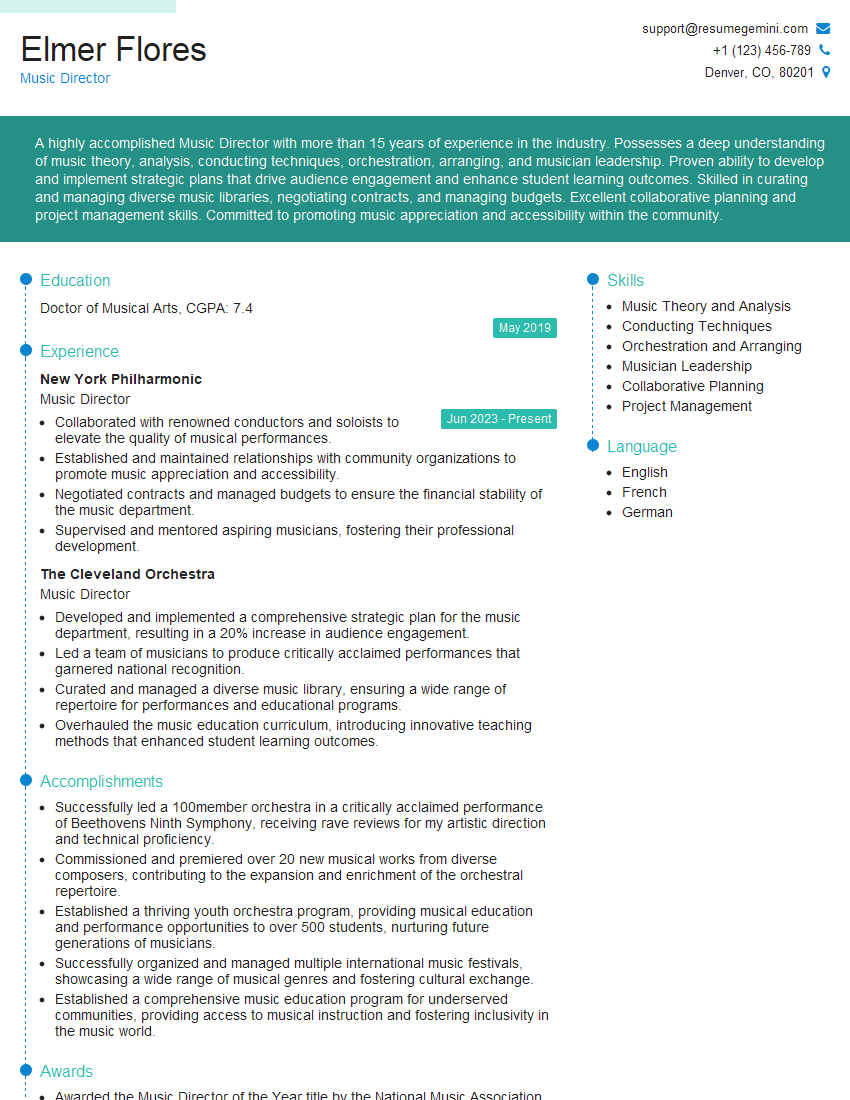
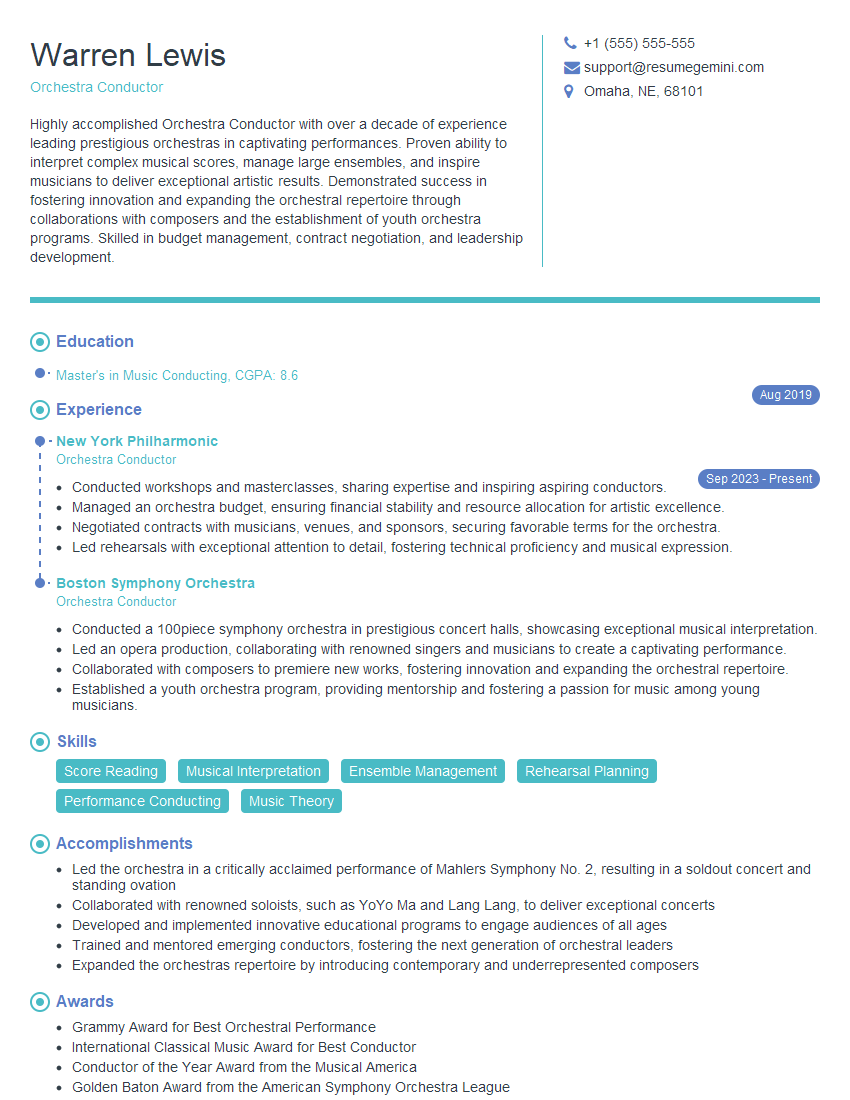
Mastering advanced knowledge of orchestral instruments and techniques is crucial for career advancement in the competitive music industry. A strong understanding of these areas opens doors to a wider range of opportunities, including prestigious orchestra positions, teaching roles, and conducting opportunities. To maximize your job prospects, crafting an ATS-friendly resume is essential. ResumeGemini can help you build a professional and effective resume that highlights your skills and experience. We provide examples of resumes tailored to showcase advanced knowledge of orchestral instruments and techniques, ensuring your application stands out. Take the next step toward your dream career; leverage ResumeGemini’s resources today.
Explore more articles
Users Rating of Our Blogs
Share Your Experience
We value your feedback! Please rate our content and share your thoughts (optional).
What Readers Say About Our Blog
Very informative content, great job.
good