Interviews are more than just a Q&A session—they’re a chance to prove your worth. This blog dives into essential Applying Security Best Practices interview questions and expert tips to help you align your answers with what hiring managers are looking for. Start preparing to shine!
Questions Asked in Applying Security Best Practices Interview
Q 1. Explain the principle of least privilege.
The principle of least privilege dictates that users and processes should only have the minimum access rights necessary to perform their tasks. Think of it like a keycard system for a building; you only get access to the areas relevant to your job, not the entire building. This significantly reduces the impact of a security breach. If a malicious actor compromises a user account with limited privileges, the damage they can inflict is far less than if that account had excessive access.
For example, a database administrator might only need read access to production databases to monitor performance and write access to staging databases for testing. They wouldn’t need administrative access to the entire server infrastructure, which would introduce unnecessary risk. This principle applies not just to users but also to applications and services. Each should operate with the most restrictive permissions possible, limiting the potential damage from compromise.
- Reduced Attack Surface: Limiting privileges shrinks the potential points of attack.
- Improved Security Posture: Reduces the risk of data breaches and unauthorized actions.
- Simplified Auditing: Easier to track and monitor user activity.
Q 2. Describe the difference between symmetric and asymmetric encryption.
Symmetric and asymmetric encryption differ fundamentally in how they handle keys. Symmetric encryption uses the same secret key for both encryption and decryption – think of it like a shared secret code. Asymmetric encryption, on the other hand, employs a pair of keys: a public key for encryption and a private key for decryption. It’s like having a mailbox (public key) where anyone can drop a letter (encrypted message), but only you have the key to open it and read the letter (private key).
Symmetric Encryption: Faster and computationally less expensive, making it suitable for encrypting large amounts of data. However, the challenge lies in securely sharing the secret key between parties. Examples include AES (Advanced Encryption Standard) and DES (Data Encryption Standard).
Asymmetric Encryption: Provides a mechanism for secure key exchange and digital signatures. It’s slower than symmetric encryption but solves the key distribution problem inherent in symmetric systems. RSA (Rivest-Shamir-Adleman) and ECC (Elliptic Curve Cryptography) are common examples. Often, both methods are used together; asymmetric cryptography is used to securely share a symmetric key, which is then used for encrypting the bulk data.
Q 3. What are the key components of a robust security awareness training program?
A robust security awareness training program should be multifaceted and engaging, covering various aspects of cybersecurity. Here are key components:
- Regular Training Modules: Regular, short training sessions, rather than infrequent, lengthy ones, improve retention. Topics should cover phishing, social engineering, password security, malware awareness, and data protection.
- Interactive Content: Gamification, quizzes, and simulations make learning more engaging and memorable.
- Phishing Simulations: Regularly test employee awareness by sending simulated phishing emails to gauge their ability to identify and report suspicious activities. Analyze results to identify areas needing improvement.
- Tailored Training: Content needs to be specific to the roles and responsibilities of employees. A marketing professional needs different training than a system administrator.
- Policy Reinforcement: Training should explicitly cover organizational security policies and procedures.
- Feedback Mechanisms: Regular assessments and feedback loops help to reinforce learning and measure the effectiveness of the program.
- Management Buy-in: Leadership’s active participation and support are crucial for the success of any security program.
Q 4. How do you perform a vulnerability assessment?
A vulnerability assessment is a systematic process to identify security weaknesses in an organization’s systems and infrastructure. It’s like a health checkup for your IT systems. It doesn’t exploit vulnerabilities, but it identifies them. This typically involves using automated tools and manual techniques to scan for known vulnerabilities. The process can be broken down into these key steps:
- Planning and Scoping: Define the assets to be assessed, the timeframe, and the tools to be used.
- Information Gathering: Collect data about the target systems, including network maps, software versions, and configurations.
- Vulnerability Scanning: Use automated tools (like Nessus or OpenVAS) to scan for known vulnerabilities and misconfigurations based on a vulnerability database.
- Manual Verification: Follow up on the automated scan results by manually verifying critical findings. This might involve penetration testing (explained in a later answer).
- Reporting and Remediation: Document the findings in a comprehensive report detailing the identified vulnerabilities, their severity, and recommended remediation steps. Prioritize remediation based on the risk level.
Q 5. Explain the importance of multi-factor authentication (MFA).
Multi-factor authentication (MFA) significantly enhances security by requiring users to provide multiple forms of authentication to verify their identity. It’s like having two keys to unlock a door instead of just one. Even if one factor is compromised, the attacker still needs the others to gain access. This drastically reduces the chances of unauthorized access, especially in the face of password breaches.
MFA typically involves a combination of factors like something you know (password), something you have (phone, security token), and something you are (biometrics). Using MFA adds a layer of defense against phishing, brute-force attacks, and stolen credentials.
- Increased Security: Prevents unauthorized access even if passwords are compromised.
- Reduced Risk of Breaches: Mitigates the impact of stolen credentials.
- Compliance Requirements: Many industries and regulations mandate MFA for enhanced security.
Q 6. What are the key elements of an incident response plan?
A comprehensive incident response plan outlines the steps an organization takes to prepare for, identify, analyze, contain, eradicate, recover from, and learn from security incidents. It’s like a fire drill, but for cybersecurity threats. Key elements include:
- Preparation: Establish roles and responsibilities, identify communication channels, and create procedures for various types of incidents.
- Detection and Analysis: Define processes for detecting and analyzing security incidents. This might involve security information and event management (SIEM) systems and threat intelligence feeds.
- Containment: Isolate affected systems to prevent further damage and lateral movement.
- Eradication: Remove the root cause of the incident, such as malware or a compromised account.
- Recovery: Restore affected systems and data from backups, ensuring business continuity.
- Post-Incident Activity: Conduct a thorough review to determine what happened, why it happened, and what can be done to prevent similar incidents in the future. This includes documenting lessons learned.
- Communication Plan: Outline how to communicate internally and externally during and after an incident.
Q 7. Describe your experience with penetration testing methodologies.
My experience with penetration testing methodologies encompasses both black-box and white-box testing approaches, adhering to ethical guidelines and legal considerations. Black-box testing simulates a real-world attack where the tester has limited or no prior knowledge of the target system. This mirrors the perspective of a malicious actor. In contrast, white-box testing involves having complete knowledge of the system, allowing for a more thorough and in-depth assessment.
I’m proficient in using various tools and techniques, including network scanning, vulnerability analysis, exploitation, and social engineering simulations. My approach is systematic and risk-based, prioritizing the most critical assets and focusing on high-impact vulnerabilities first. For example, in a recent engagement, I used a combination of automated vulnerability scanning, manual exploitation techniques, and social engineering to assess the security posture of a client’s web application. The findings helped them identify and remediate critical flaws in their authentication system and data protection measures. I always ensure thorough documentation of the testing process, including the methodologies employed, findings, and recommendations for remediation.
Q 8. How do you identify and mitigate security risks?
Identifying and mitigating security risks is a continuous process that involves proactive measures and reactive responses. It begins with a thorough understanding of the organization’s assets, their value, and the potential threats they face. This often starts with a risk assessment, a systematic process to identify vulnerabilities and their likelihood of exploitation.
Identifying Risks: This involves various methods, including:
- Vulnerability Scanning: Automated tools scan systems and applications for known weaknesses.
- Penetration Testing: Simulated attacks to identify exploitable vulnerabilities.
- Threat Modeling: A structured approach to identify potential threats and their impact.
- Security Audits: Formal reviews of security policies, procedures, and controls.
- Incident Response Reviews: Analyzing past incidents to identify weaknesses in security posture.
Mitigating Risks: Once risks are identified, mitigation strategies are implemented. These could include:
- Patching Vulnerabilities: Applying updates to software and systems to address known vulnerabilities.
- Implementing Security Controls: Deploying firewalls, intrusion detection systems, access controls, etc.
- Security Awareness Training: Educating employees about phishing, social engineering, and other threats.
- Data Loss Prevention (DLP): Implementing measures to prevent sensitive data from leaving the organization’s control.
- Incident Response Plan: Developing and testing a plan to handle security incidents effectively.
For example, in a recent project, we identified a critical vulnerability in a web application through penetration testing. This vulnerability could have allowed unauthorized access to sensitive customer data. We mitigated the risk by immediately patching the application, implementing multi-factor authentication, and reinforcing security awareness training for developers.
Q 9. What are your preferred security frameworks (e.g., NIST, ISO 27001)?
My preferred security frameworks are NIST Cybersecurity Framework (CSF) and ISO 27001. These are widely adopted and provide comprehensive guidance for establishing and maintaining a robust security program.
NIST CSF: Provides a flexible framework focusing on five core functions: Identify, Protect, Detect, Respond, and Recover. It helps organizations manage and reduce cybersecurity risk by aligning their security activities with industry best practices. I find its emphasis on risk management and continuous improvement particularly valuable.
ISO 27001: Is an internationally recognized standard for establishing, implementing, maintaining, and continually improving an information security management system (ISMS). It provides a structured approach to managing information security risks and ensuring compliance with regulatory requirements. It’s particularly beneficial for organizations needing a certified ISMS and demonstrates a commitment to data security to stakeholders.
In practice, I often use elements from both frameworks to tailor a security program to specific client needs. For example, I might utilize the risk assessment process detailed in ISO 27001 and align the resulting security controls with the NIST CSF core functions. This allows for a comprehensive and adaptable security strategy.
Q 10. Explain the concept of Zero Trust Security.
Zero Trust Security is a security model based on the principle of ‘never trust, always verify.’ Unlike traditional perimeter-based security, which assumes that anything inside the network is trustworthy, Zero Trust assumes no implicit trust, regardless of location (inside or outside the network).
This means that every user, device, and application must be authenticated and authorized before accessing any resource, even if they’re already connected to the internal network. Access is granted based on least privilege, meaning users only have access to the resources absolutely necessary for their job.
Key components of Zero Trust include:
- Strong Authentication: Multi-factor authentication (MFA) is crucial.
- Microsegmentation: Dividing the network into smaller, isolated segments to limit the impact of breaches.
- Continuous Monitoring and Logging: Constantly monitoring user activity and network traffic for suspicious behavior.
- Data Loss Prevention (DLP): Protecting sensitive data from unauthorized access or exfiltration.
- Device Posture Assessment: Ensuring that devices meet security requirements before accessing resources.
Think of it like a well-guarded vault. Even if someone gains access to the building, they still need the right key and authentication to access the contents. This model significantly reduces the impact of successful breaches by limiting lateral movement and data exposure.
Q 11. How do you handle security incidents?
Handling security incidents requires a structured approach, usually following a well-defined incident response plan. This typically involves these phases:
- Preparation: Developing and testing the plan, establishing roles and responsibilities, and creating communication channels.
- Identification: Detecting the incident through monitoring tools or reports.
- Containment: Isolating affected systems or networks to prevent further damage.
- Eradication: Removing the threat and restoring affected systems to a secure state.
- Recovery: Restoring data and services, and ensuring business continuity.
- Lessons Learned: Reviewing the incident to identify areas for improvement in security posture.
During an incident, clear communication is paramount. Keeping stakeholders informed and collaborating effectively across teams is essential. Detailed documentation of each step is also critical for post-incident analysis and legal requirements. For instance, in a past incident involving a ransomware attack, we quickly contained the spread by isolating affected servers, engaged with forensic experts for eradication, and prioritized data recovery from backups. Post-incident, we implemented stricter access controls and enhanced employee training on phishing awareness.
Q 12. What is your experience with SIEM tools?
I have extensive experience with various SIEM (Security Information and Event Management) tools, including Splunk, QRadar, and Azure Sentinel. SIEM tools are essential for collecting, analyzing, and correlating security logs from diverse sources to detect and respond to security threats.
My experience includes:
- Implementing and configuring SIEM systems: Setting up data sources, creating dashboards, and defining alerts.
- Developing security monitoring rules: Creating customized rules to detect specific threats and anomalies.
- Analyzing security logs: Investigating security incidents and identifying root causes.
- Generating reports: Providing management with regular reports on security posture and incident trends.
For example, using Splunk, I developed custom dashboards to visualize security events in real-time and created alerts that automatically notified the security team of suspicious activities. This enabled us to detect and respond to threats much faster than traditional methods.
Q 13. Describe your experience with security monitoring and logging.
Security monitoring and logging are crucial for detecting and responding to security threats. This involves collecting logs from various sources (servers, network devices, applications) and analyzing them to identify suspicious activity.
My experience encompasses:
- Log Management: Implementing centralized log management solutions to collect, store, and analyze logs from diverse sources.
- Security Monitoring: Setting up monitoring tools and dashboards to track security events in real-time.
- Alerting: Configuring alerts to notify security teams of critical security events.
- Log Analysis: Investigating security incidents by analyzing logs to identify root causes and attacker techniques.
- Compliance Reporting: Generating reports to demonstrate compliance with security standards and regulations.
In a previous role, we implemented a comprehensive logging and monitoring system using ELK stack (Elasticsearch, Logstash, Kibana) to collect and analyze logs from all our systems. This allowed us to detect and respond to a data breach attempt in its early stages, minimizing the damage.
Q 14. What are common web application vulnerabilities?
Web applications are particularly vulnerable to various attacks. Some of the most common vulnerabilities include:
- SQL Injection: Attackers inject malicious SQL code into input fields to manipulate database queries. This can lead to data breaches or system compromise. Example: An attacker might enter
' OR '1'='1into a login form to bypass authentication. - Cross-Site Scripting (XSS): Attackers inject malicious scripts into web pages to steal user data or hijack sessions. This often involves inserting JavaScript code into input fields.
- Cross-Site Request Forgery (CSRF): Attackers trick users into performing unwanted actions on a web application. This might involve exploiting a user’s authenticated session to make unauthorized requests.
- Insecure Direct Object References (IDOR): Attackers exploit vulnerabilities in how web applications handle object references to access unauthorized resources. This could allow an attacker to access another user’s data by manipulating URLs.
- Broken Authentication and Session Management: Weak password policies, lack of multi-factor authentication, and insecure session handling create vulnerabilities that attackers can exploit.
- Security Misconfiguration: Improperly configured web servers, databases, or applications can expose vulnerabilities.
Mitigating these vulnerabilities requires secure coding practices, regular security testing, and the implementation of appropriate security controls. Using frameworks like OWASP (Open Web Application Security Project) provides valuable guidelines for secure development and best practices.
Q 15. How do you prioritize security vulnerabilities?
Prioritizing security vulnerabilities is crucial for efficient resource allocation. We can’t fix everything at once, so a structured approach is vital. I typically use a risk-based prioritization system, considering factors like likelihood and impact. Think of it like this: a small leak in your roof (low likelihood, low impact) is less urgent than a major crack (high likelihood, high impact).
- Likelihood: How likely is the vulnerability to be exploited? This involves considering factors like the vulnerability’s public exposure, the attacker’s skill level, and the presence of exploit code.
- Impact: What are the consequences if the vulnerability is exploited? This includes assessing data breaches, system downtime, financial losses, and reputational damage. A vulnerability allowing access to sensitive customer data has far greater impact than one that only affects system performance.
- Severity: This combines likelihood and impact. Common scoring systems like CVSS (Common Vulnerability Scoring System) help quantify severity. I use these scores as a starting point, then adjust based on specific business context.
For example, a high-severity vulnerability affecting a critical system (like a database server) would take precedence over a low-severity vulnerability in a less critical system (like a development server), even if the low-severity vulnerability is easier to exploit. I also consider factors like regulatory requirements and contractual obligations when prioritizing vulnerabilities.
Career Expert Tips:
- Ace those interviews! Prepare effectively by reviewing the Top 50 Most Common Interview Questions on ResumeGemini.
- Navigate your job search with confidence! Explore a wide range of Career Tips on ResumeGemini. Learn about common challenges and recommendations to overcome them.
- Craft the perfect resume! Master the Art of Resume Writing with ResumeGemini’s guide. Showcase your unique qualifications and achievements effectively.
- Don’t miss out on holiday savings! Build your dream resume with ResumeGemini’s ATS optimized templates.
Q 16. Explain your understanding of data loss prevention (DLP).
Data Loss Prevention (DLP) is a set of strategies and technologies designed to prevent sensitive data from leaving the organization’s control. It’s like having a sophisticated security guard at every exit point of your business, carefully checking what’s leaving and ensuring nothing valuable gets stolen.
My understanding of DLP encompasses various techniques:
- Network-based DLP: This monitors network traffic for sensitive data patterns, preventing unauthorized transmission. Think of it as inspecting every package leaving your office building.
- Endpoint-based DLP: This monitors data on individual computers and devices, preventing sensitive data from being copied to unauthorized locations such as USB drives or cloud storage services. This is like checking the contents of every employee’s briefcase before they leave.
- Storage-based DLP: This scans data at rest to identify sensitive information and ensure it is appropriately secured. This is like conducting regular inventories of your valuable assets.
- Data Discovery and Classification: This is the first, crucial step in DLP. It involves identifying and classifying sensitive data based on business rules, regulatory requirements (like GDPR or HIPAA), and data sensitivity labels. This is the process of determining which items are valuable enough to warrant special protection.
Implementing effective DLP requires a combination of technical solutions and policies, including employee training and awareness.
Q 17. Describe your experience with security audits and compliance checks.
I have extensive experience conducting and participating in security audits and compliance checks across various regulatory frameworks, including ISO 27001, SOC 2, HIPAA, and PCI DSS. A security audit is like a thorough medical checkup for your IT infrastructure, identifying potential weaknesses before they’re exploited.
My approach involves:
- Planning and Scoping: Clearly defining the scope, objectives, and timelines of the audit.
- Evidence Gathering: Collecting evidence through interviews, document reviews, system scans, and penetration testing.
- Vulnerability Assessment: Identifying security weaknesses and vulnerabilities based on industry best practices and regulatory standards.
- Reporting and Remediation: Documenting findings, prioritizing vulnerabilities, and recommending remediation strategies.
- Follow-up and Monitoring: Tracking progress on remediation efforts and ensuring ongoing compliance.
In a recent audit of a healthcare provider, for instance, I identified a vulnerability in their patient portal that could have allowed unauthorized access to protected health information (PHI). My recommendations involved implementing multi-factor authentication and stronger encryption, leading to a significant improvement in their security posture and ensuring HIPAA compliance.
Q 18. What are your experiences with cloud security best practices (e.g., AWS, Azure, GCP)?
I possess significant experience with cloud security best practices across major cloud providers (AWS, Azure, GCP). Cloud security is distinct from on-premise security, requiring a different mindset and a focus on shared responsibility. The cloud provider is responsible for the underlying infrastructure’s security (the building), while the customer is responsible for the security of their data and applications (what’s inside the building).
My expertise encompasses:
- Identity and Access Management (IAM): Implementing robust IAM policies to control access to cloud resources, using principles of least privilege and multi-factor authentication.
- Data Security: Employing encryption both in transit and at rest, implementing data loss prevention (DLP) measures, and utilizing data masking for development/testing environments.
- Network Security: Configuring virtual networks (VPNs), firewalls, and intrusion detection/prevention systems (IDS/IPS) to protect cloud resources.
- Security Monitoring and Logging: Establishing comprehensive logging and monitoring systems to detect and respond to security incidents, using tools like CloudTrail, Azure Monitor, and Cloud Logging.
- Compliance and Governance: Ensuring cloud deployments adhere to relevant regulatory requirements and internal security policies.
For example, during a recent project migrating a client’s on-premise application to AWS, I implemented a secure architecture using VPCs, security groups, IAM roles, and encryption at rest and in transit to ensure compliance with industry best practices and PCI DSS requirements.
Q 19. How do you stay up-to-date with the latest security threats and vulnerabilities?
Staying current in cybersecurity is like being a detective constantly updating their knowledge of criminal methods. It’s an ongoing process.
My strategies include:
- Following Security News and Blogs: I regularly read industry publications, blogs, and newsletters (e.g., KrebsOnSecurity, Threatpost) to stay abreast of emerging threats and vulnerabilities.
- Participating in Online Communities and Forums: Engaging with security professionals on platforms like LinkedIn and security-focused subreddits allows for the exchange of information and insights.
- Attending Conferences and Webinars: Conferences and webinars provide valuable opportunities to learn from experts and network with peers.
- Obtaining Certifications: Pursuing relevant certifications (like CISSP, CISM, CCSP) keeps my knowledge current and demonstrates commitment to ongoing professional development.
- Performing Vulnerability Scans and Penetration Testing: Hands-on experience in identifying vulnerabilities helps me better understand real-world threats and defense mechanisms.
Recently, following reports on a new ransomware variant, I updated our organization’s security policies and implemented additional security measures to mitigate the risks associated with that specific threat.
Q 20. Explain your understanding of risk assessment methodologies.
Risk assessment methodologies provide a structured approach to identifying, analyzing, and mitigating security risks. It’s like a pre-flight checklist for your security systems, ensuring everything is in order before takeoff.
I’m familiar with several risk assessment methodologies, including:
- NIST Cybersecurity Framework: A widely used framework that provides a comprehensive approach to managing cybersecurity risk.
- ISO 27005: An ISO standard that outlines a risk management process for information security.
- OWASP Risk Rating Methodology: A methodology specific to web application security.
Regardless of the specific methodology, a typical risk assessment involves:
- Asset Identification: Identifying all valuable assets that need protection (data, systems, applications).
- Threat Identification: Identifying potential threats that could compromise these assets (malware, phishing, insider threats).
- Vulnerability Identification: Identifying weaknesses in the organization’s security controls that could be exploited by threats.
- Risk Analysis: Assessing the likelihood and impact of each risk.
- Risk Response: Developing strategies to mitigate risks (avoidance, mitigation, transfer, acceptance).
For example, in a recent risk assessment, we identified that our reliance on a legacy system posed a significant risk. The analysis revealed a high likelihood of exploitation due to lack of patches and a high impact due to potential data loss. The resulting risk response involved migrating the data to a modern, secure platform.
Q 21. What is your experience with network security technologies (e.g., firewalls, IDS/IPS)?
Network security technologies are the foundational elements of any robust security posture. They act as the guardians of your network perimeter, preventing unauthorized access and malicious activities.
My experience with network security technologies includes:
- Firewalls: I have hands-on experience configuring and managing both hardware and software firewalls (e.g., Cisco ASA, Palo Alto Networks, AWS Web Application Firewall). Firewalls act as the gatekeepers, controlling network traffic based on predefined rules, blocking malicious traffic while allowing legitimate access.
- Intrusion Detection/Prevention Systems (IDS/IPS): I’m proficient in deploying and managing IDS/IPS solutions (e.g., Snort, Suricata, Cisco IPS). These systems monitor network traffic for suspicious activity and either alert administrators (IDS) or automatically block malicious traffic (IPS).
- Virtual Private Networks (VPNs): I have experience configuring and using VPNs to secure remote access and protect sensitive data during transmission. VPNs create secure tunnels, encrypting data as it travels across the network.
- Network Segmentation: I understand and apply network segmentation to isolate critical systems and limit the impact of a security breach. Segmenting your network is like dividing your city into districts to contain fires.
In a previous role, I implemented a multi-layered security approach using firewalls, intrusion detection systems, and VPNs to protect a company’s network from external threats. This included implementing security information and event management (SIEM) tools to collect and analyze security logs from various network devices, helping to improve threat detection and response capabilities.
Q 22. How do you implement access controls?
Implementing robust access controls is fundamental to any security strategy. It’s all about ensuring that only authorized users or systems can access specific resources. This involves a multi-layered approach, often combining several methods.
- Role-Based Access Control (RBAC): This assigns permissions based on a user’s role within the organization. For example, an administrator might have full access, while a regular employee only has access to specific applications and data relevant to their job. This simplifies management and reduces the risk of granting excessive privileges.
- Attribute-Based Access Control (ABAC): This is a more granular approach, using attributes like time of day, location, or device to determine access. Imagine a system that only allows access to sensitive data from a corporate network during business hours. ABAC can enforce this policy dynamically.
- Mandatory Access Control (MAC): This is often used in high-security environments. It uses security labels assigned to both subjects (users) and objects (data) to enforce access. This is very strict and requires careful planning.
- Discretionary Access Control (DAC): This allows the owner of a resource to control access. While simpler to implement, it’s less secure as it relies on the owner’s diligence.
In practice, a combination of these methods is often employed. Consider a banking system: RBAC defines the roles (teller, manager, auditor), ABAC controls access based on location and time (preventing night-time access from unusual locations), and MAC might be layered on top for exceptionally sensitive data. Effective implementation also includes regular audits and reviews of access rights to ensure they remain appropriate.
Q 23. Describe your understanding of different types of malware.
Malware is a broad term encompassing any malicious software designed to harm, disrupt, or gain unauthorized access to a system. Different types leverage various techniques and have distinct goals.
- Viruses: These require a host program to replicate and spread. Think of them as biological viruses; they need a carrier to infect other systems.
- Worms: Self-replicating programs that spread without needing a host program. They can quickly consume network bandwidth and cripple systems.
- Trojans: These disguise themselves as legitimate software but contain malicious code. They often create backdoors for attackers to control the system.
- Ransomware: This encrypts a user’s files and demands a ransom for decryption. It’s a particularly damaging form of malware.
- Spyware: This secretly monitors a user’s activity, collecting sensitive information like passwords and browsing history.
- Adware: This displays unwanted advertisements, often slowing down the system and potentially redirecting to malicious websites.
- Rootkits: These conceal the presence of malware on a system, making it very difficult to detect and remove.
Understanding these different types is crucial for effective malware prevention and detection. A multi-layered security approach, including anti-virus software, firewalls, and employee training, is essential to mitigate the risks.
Q 24. What is your experience with security incident reporting and documentation?
Security incident reporting and documentation is critical for effective incident response and future prevention. My experience involves a structured approach:
- Immediate Containment: The first step is to isolate the affected system or network to prevent further damage.
- Evidence Collection: Gather all relevant information, including logs, system snapshots, and network traffic data. This evidence is vital for investigation and analysis. Chain of custody is paramount.
- Root Cause Analysis: Determine the cause of the incident to prevent similar events in the future. This may involve analyzing logs, interviewing personnel, and examining vulnerabilities.
- Remediation: Implement necessary fixes to the system or network to restore functionality and security.
- Documentation: Comprehensive documentation of the entire process – from initial detection to final remediation – is crucial. This includes details about the incident, the response taken, and lessons learned. This documentation is used for future incident response, audits, and continuous improvement of security protocols.
I’ve used various incident tracking systems and documentation templates to ensure consistent and thorough reporting. I also believe in post-incident reviews to identify areas for improvement in our security processes and awareness training for employees.
Q 25. Explain your understanding of cryptography and its applications.
Cryptography is the practice and study of techniques for secure communication in the presence of adversarial behavior. It’s the foundation of modern digital security.
- Symmetric-key cryptography: Uses the same key for both encryption and decryption. Examples include AES and DES. It’s faster but requires a secure method for key exchange.
- Asymmetric-key cryptography (Public-key cryptography): Uses a pair of keys: a public key for encryption and a private key for decryption. RSA and ECC are common examples. This solves the key exchange problem but is computationally more intensive.
- Hashing: Creates a one-way function that generates a fixed-size output (hash) from any input. Used for data integrity checks and password storage (salted and hashed passwords).
- Digital Signatures: Use asymmetric cryptography to verify the authenticity and integrity of data. This ensures that data hasn’t been tampered with and comes from the claimed sender.
Applications are widespread: from securing online transactions (HTTPS) and protecting sensitive data (database encryption) to authenticating users (digital certificates) and ensuring data integrity (blockchain technology). A deep understanding of cryptography is critical for designing secure systems and mitigating various threats.
Q 26. Describe your experience with blockchain security.
My experience with blockchain security focuses on understanding and mitigating the unique vulnerabilities of this technology. Blockchain’s decentralized and immutable nature offers significant security advantages, but it also presents new challenges.
- 51% Attacks: A major concern, where a malicious actor controls more than half the network’s computing power to manipulate the blockchain.
- Smart Contract Vulnerabilities: Bugs in smart contracts can lead to significant financial losses or security breaches. Thorough auditing and testing are crucial.
- Private Key Management: Loss or theft of private keys can result in the loss of assets. Secure key management practices are paramount.
- Oracle Manipulation: Oracles, which provide external data to smart contracts, can be manipulated, leading to incorrect contract execution.
- Sybil Attacks: Malicious actors create multiple identities to gain undue influence on the network.
Secure blockchain development requires rigorous testing, robust auditing practices, and careful consideration of potential attack vectors. It’s vital to stay updated on the latest research and best practices in this rapidly evolving field.
Q 27. How do you balance security with usability?
Balancing security and usability is a constant challenge. Overly restrictive security measures can frustrate users and lead to workarounds that compromise security. Conversely, weak security measures leave systems vulnerable. The key is finding the right balance.
- User-centric design: Security measures should be designed with the user in mind. Simple, intuitive interfaces and clear explanations help users understand and comply with security policies.
- Multi-factor authentication (MFA): Adds an extra layer of security without significantly impacting usability. While requiring more steps, it significantly reduces the risk of unauthorized access.
- Principle of least privilege: Grant users only the access they need to perform their tasks. This limits the potential damage from compromised accounts.
- Progressive disclosure: Present users with only the necessary security information at any given time. Avoid overwhelming them with complex details.
- Regular security awareness training: Educating users about security threats and best practices helps them understand why certain security measures are in place and encourages responsible behavior.
For example, implementing strong password policies is crucial for security, but overly complex policies might lead users to write down passwords or use easily guessable ones. Finding the right balance often involves careful risk assessment and iterative improvements based on user feedback and security monitoring.
Key Topics to Learn for Applying Security Best Practices Interview
- Risk Assessment and Management: Understanding methodologies like NIST Cybersecurity Framework and identifying, analyzing, and mitigating security risks in various contexts (e.g., cloud, network, application).
- Security Architecture and Design: Applying security principles throughout the software development lifecycle (SDLC), including secure coding practices, vulnerability management, and penetration testing.
- Access Control and Authentication: Implementing and managing robust authentication mechanisms (e.g., multi-factor authentication, role-based access control) and authorization policies to protect sensitive data.
- Data Security and Privacy: Understanding data loss prevention (DLP) strategies, encryption techniques, and compliance with regulations like GDPR and CCPA.
- Incident Response and Disaster Recovery: Developing and practicing incident response plans, including containment, eradication, recovery, and post-incident activity; understanding business continuity and disaster recovery strategies.
- Security Awareness Training: Explaining the importance of educating employees on security threats and best practices, and developing effective training programs.
- Security Auditing and Compliance: Understanding various security audit methodologies and frameworks (e.g., ISO 27001, SOC 2) and ensuring compliance with relevant regulations and standards.
- Cloud Security: Addressing security challenges specific to cloud environments, including infrastructure as a service (IaaS), platform as a service (PaaS), and software as a service (SaaS).
- Network Security: Implementing and managing firewalls, intrusion detection/prevention systems (IDS/IPS), and virtual private networks (VPNs) to protect network infrastructure.
- Problem-solving and Analytical Skills: Demonstrating the ability to analyze security incidents, identify root causes, and propose effective solutions. Be prepared to discuss your approach to problem-solving in a security context.
Next Steps
Mastering Applying Security Best Practices is crucial for career advancement in the ever-evolving cybersecurity landscape. It demonstrates a commitment to protecting sensitive information and building robust, secure systems. To significantly increase your job prospects, create an ATS-friendly resume that highlights your skills and experience effectively. ResumeGemini is a trusted resource to help you build a professional and impactful resume. Examples of resumes tailored to Applying Security Best Practices are available to help you get started.

Compliance Officer Resume Sample
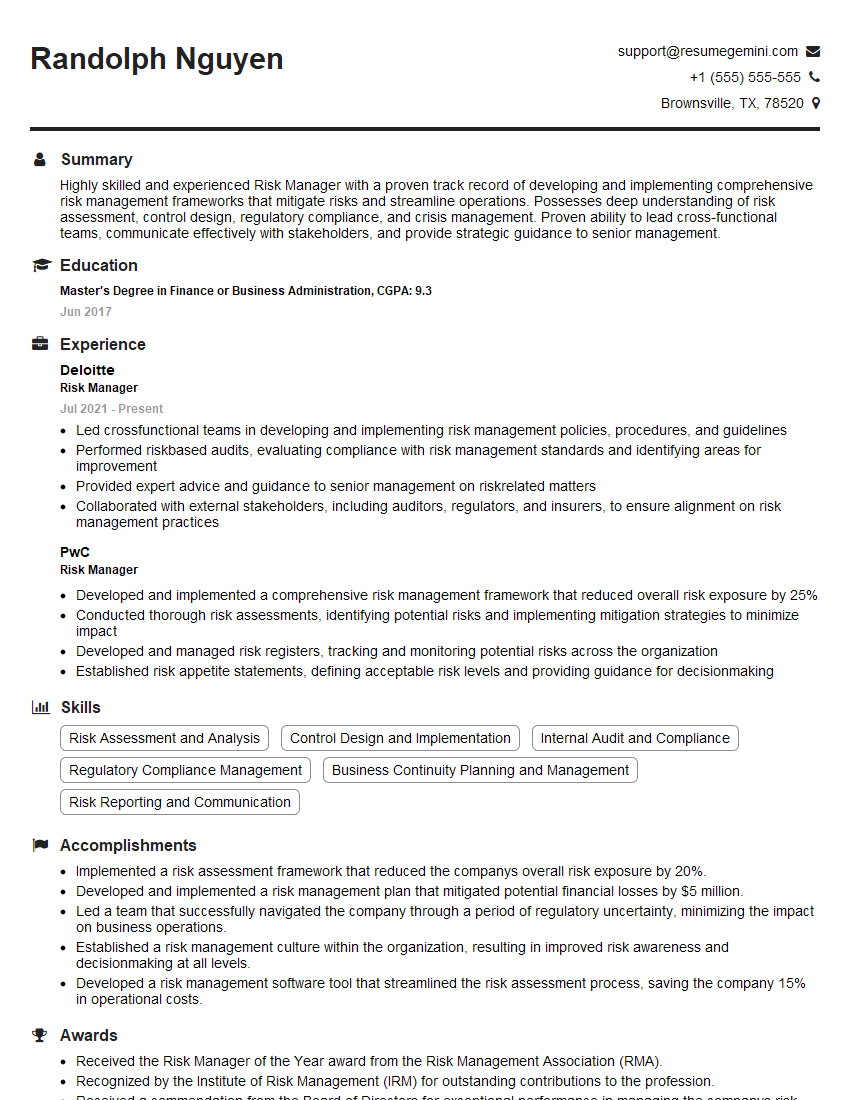
Risk Manager Resume Sample
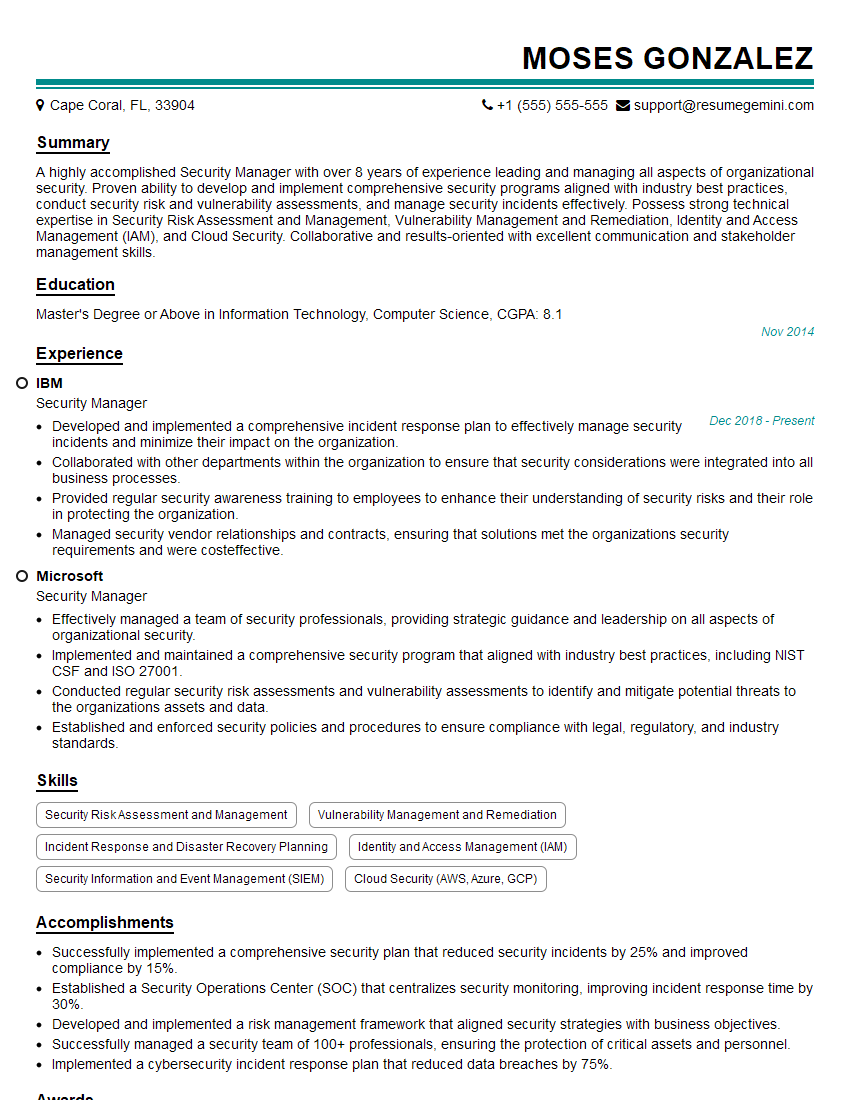
Security Manager Resume Sample

Security Administrator Resume Sample
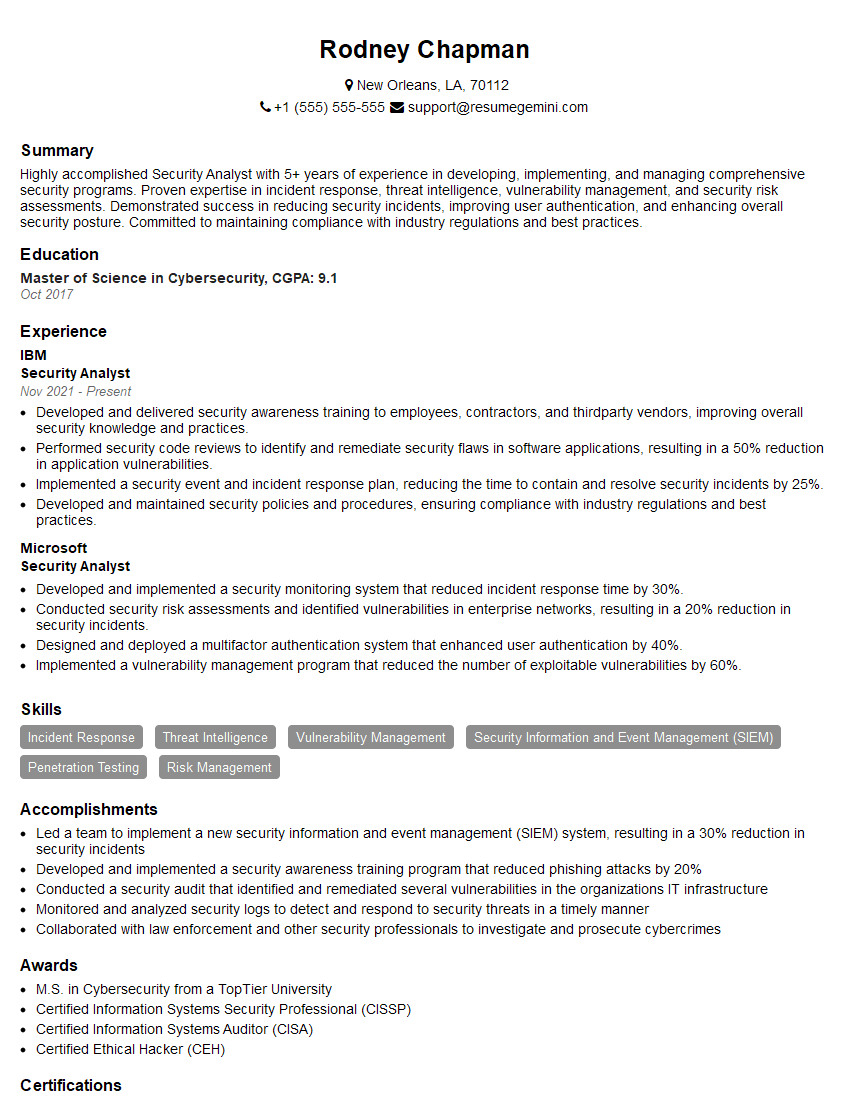
Security Analyst Resume Sample
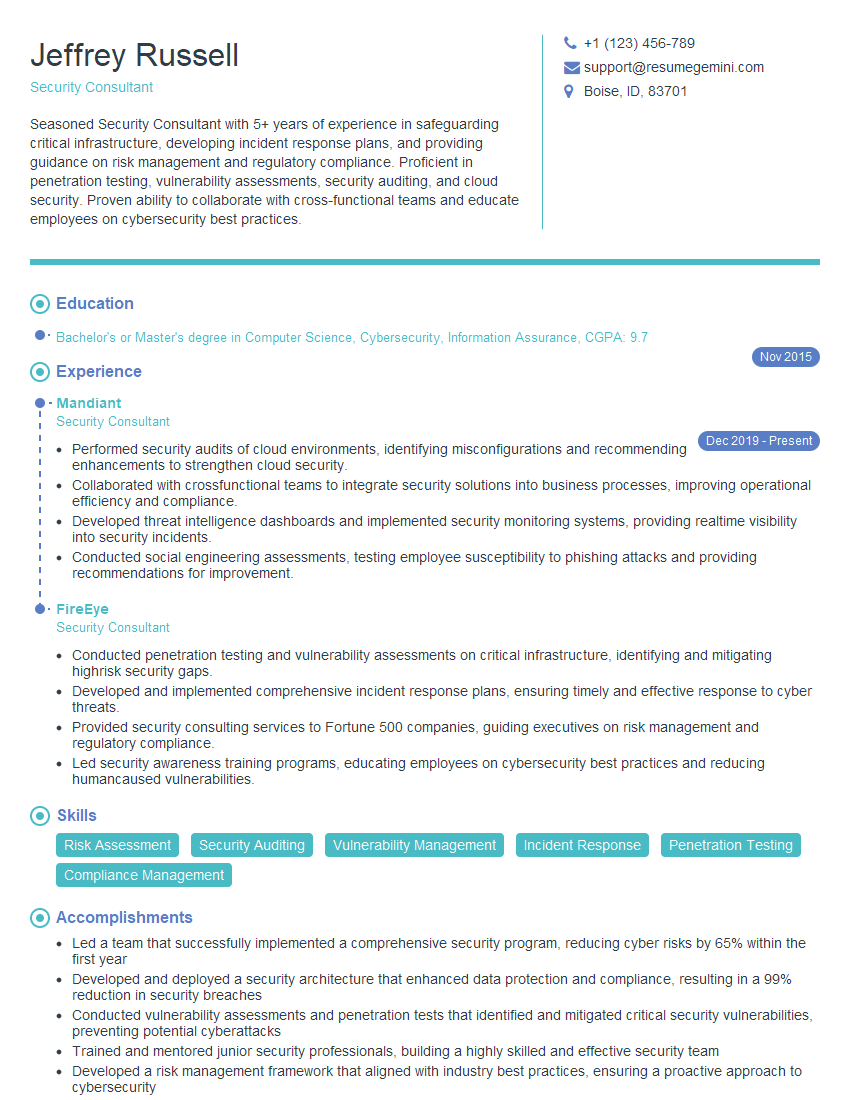
Security Consultant Resume Sample
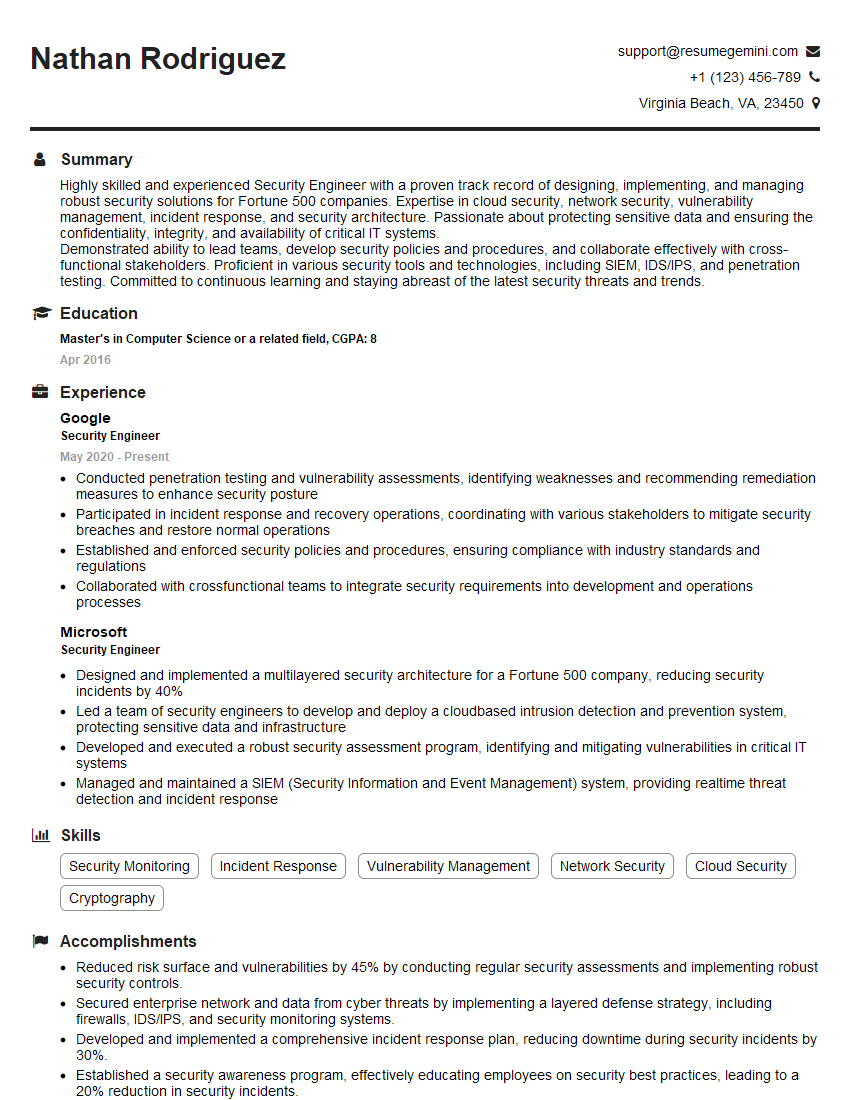
Security Engineer Resume Sample
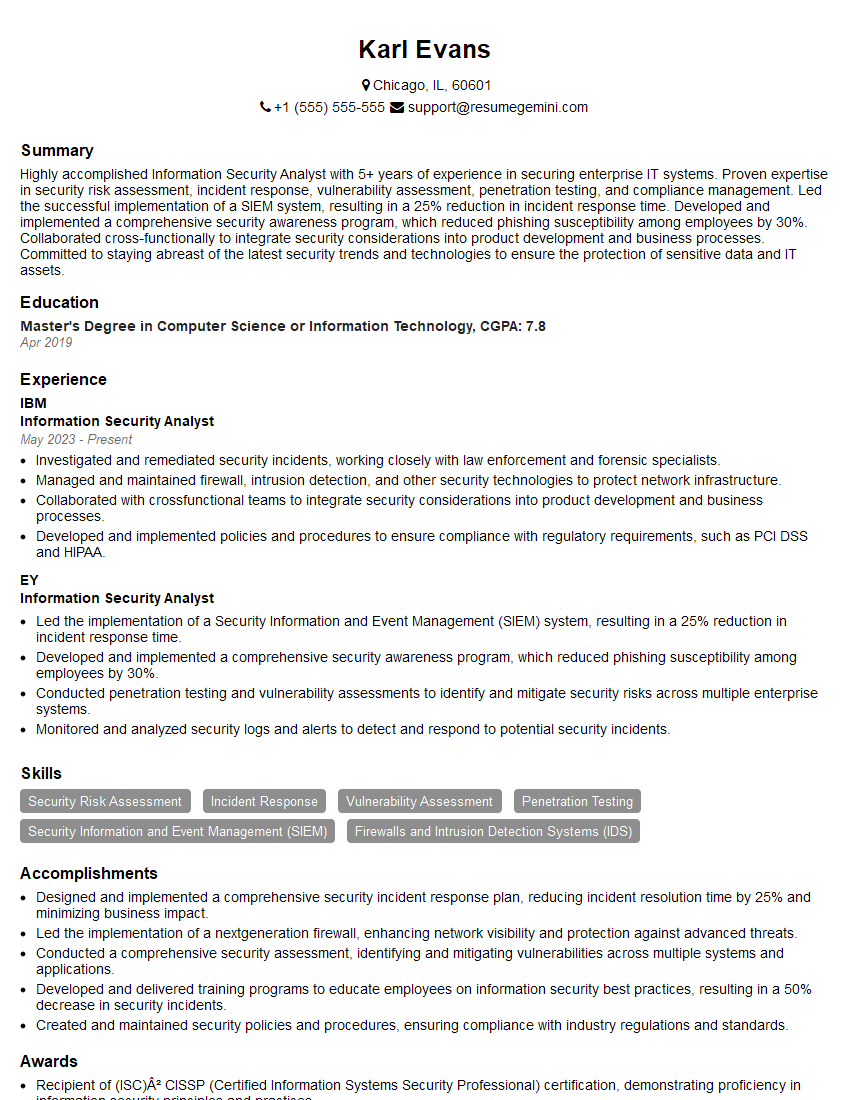
Information Security Analyst Resume Sample
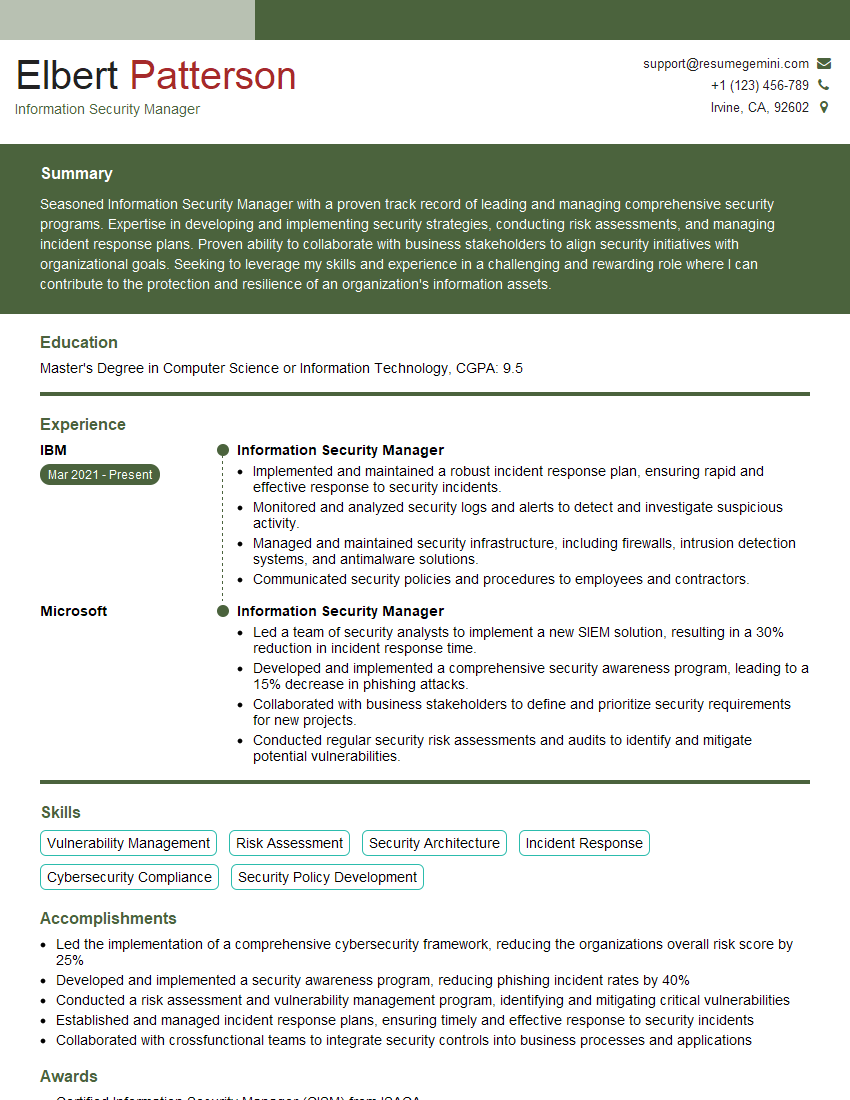
Information Security Manager Resume Sample
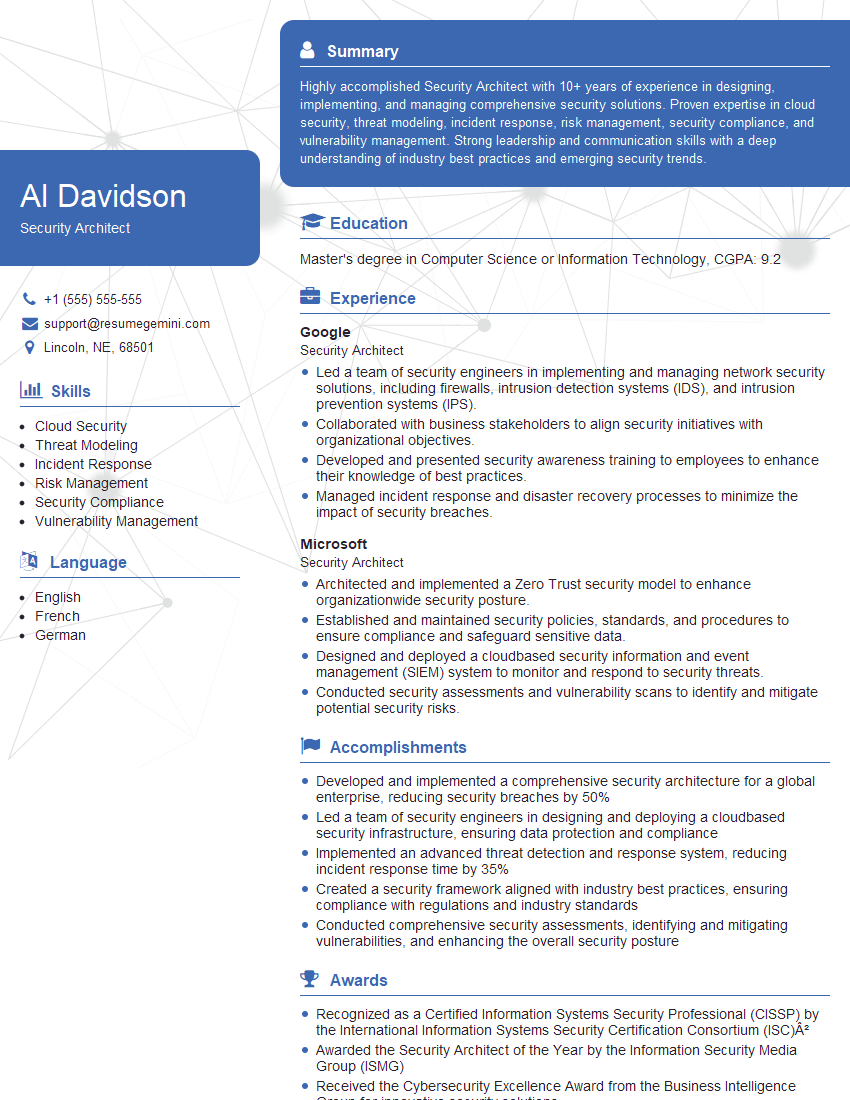
Security Architect Resume Sample
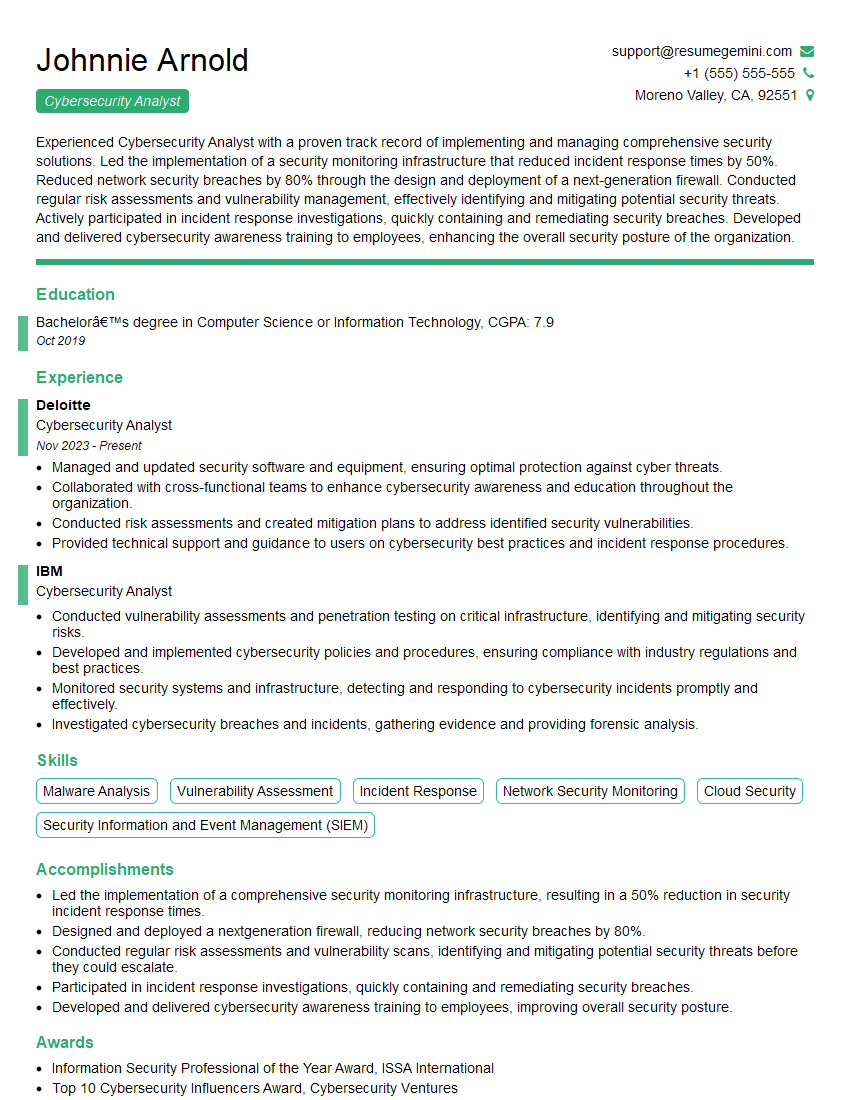
Cybersecurity Analyst Resume Sample
Explore more articles
Users Rating of Our Blogs
Share Your Experience
We value your feedback! Please rate our content and share your thoughts (optional).
What Readers Say About Our Blog
Very informative content, great job.
good