Cracking a skill-specific interview, like one for Assembling Garments, requires understanding the nuances of the role. In this blog, we present the questions you’re most likely to encounter, along with insights into how to answer them effectively. Let’s ensure you’re ready to make a strong impression.
Questions Asked in Assembling Garments Interview
Q 1. Describe your experience with various types of sewing machines.
My experience encompasses a wide range of sewing machines, from basic single-needle machines to advanced industrial models. I’m proficient with both mechanical and computerized machines, understanding their distinct functionalities and capabilities. For instance, I’ve extensively used single-needle machines for delicate tasks like hand-sewing buttonholes and finer details, while industrial machines like lockstitch and overlock machines have been my go-to for high-volume production of seams and finishing edges. My experience includes using machines with various stitch lengths, widths, and types of presser feet. I am also familiar with specialized machines such as button-attaching machines and blind-hem machines, which are crucial for efficient and high-quality garment production.
- Single-needle machines: Ideal for precision work and intricate detailing.
- Industrial lockstitch machines: Used for creating strong and durable seams in high-volume production.
- Overlock machines (sergers): Finish seams to prevent fraying and add professional finishing touches.
- Computerized machines: Offer programmable stitch patterns and settings for customized designs and greater efficiency.
Q 2. What types of fabrics are you familiar with working with?
My fabric expertise spans a broad spectrum, including natural fibers like cotton, linen, silk, and wool, as well as synthetics such as polyester, nylon, and rayon. I’m also comfortable working with blends of these materials and specialized fabrics like leather, suede, and denim. Understanding the unique properties of each fabric is crucial – for instance, the drape of silk requires a different approach than the stiffness of denim. My experience extends to working with varying fabric weights, from lightweight chiffons to heavy-duty canvas, each requiring adjustments in needle size, stitch settings, and machine tension to achieve optimal results. I know how to handle delicate fabrics that require extra care to avoid damage and ensure smooth sewing.
For example, working with silk requires using a sharp needle and a low stitch tension to prevent the fabric from snagging. Conversely, heavy canvas needs a sturdier needle and a higher tension to create a strong, secure stitch.
Q 3. Explain your experience with different stitching techniques.
My stitching repertoire is extensive, encompassing various techniques vital for professional garment assembly. I’m proficient in basic stitches like straight stitching, zigzag stitching, and backstitching, which form the foundation of most garment construction. Beyond the basics, I’m skilled in more specialized techniques such as top-stitching, which adds a decorative or functional element, and blind-hem stitching, creating an almost invisible hem finish. I also utilize techniques like French seams, which produce a clean, professional finish, and flat-felled seams, known for their durability. Experience with different types of seams directly impacts the overall garment quality and aesthetic appeal.
- Straight Stitch: Basic seam for joining fabric pieces.
- Zigzag Stitch: Used for finishing edges, preventing fraying, and adding decorative effects.
- French Seam: Encloses raw edges for a very clean, professional finish (often used in high-end garments).
- Flat-felled Seam: Extremely durable seam, frequently used in sturdy garments like denim clothing.
Q 4. How do you ensure quality control during garment assembly?
Quality control is paramount in garment assembly. My approach involves meticulous checks at each stage of production. This begins with inspecting the fabric for any defects before cutting. During the cutting process, I ensure accurate pattern placement. Throughout the sewing process, I meticulously check stitch consistency, seam alignment, and overall garment fit. I regularly examine the finished garment for any flaws, ensuring the seams are strong and well-finished, and the overall construction meets the highest standards. If any defects are found, I immediately address them to maintain consistent quality. For example, if I notice a skipped stitch, I’ll carefully reinforce that section before proceeding. This proactive approach ensures the final product meets the required quality standards.
Q 5. What is your experience with pattern reading and interpretation?
Pattern reading and interpretation are fundamental skills in garment assembly. I can accurately interpret technical drawings and markings on patterns to create precise garment components. My experience extends to understanding various pattern markings, such as notches, grain lines, and seam allowances. I can adapt patterns to different sizes and body types as needed. I’m familiar with different pattern grading methods, allowing me to efficiently scale up or down patterns. A thorough understanding of pattern design is crucial in producing well-fitting garments.
For example, I can correctly identify dart placements on a pattern piece to create shaping in a garment. A misplaced dart can significantly affect the overall fit and silhouette.
Q 6. Describe your troubleshooting skills when dealing with machine malfunctions.
Troubleshooting machine malfunctions is a critical skill I’ve honed over the years. My approach involves systematically identifying the problem. I start by checking the basic things: power supply, needle condition, thread tension, and correct threading. If the issue persists, I check the machine’s manual, looking for common problems and solutions. If I can’t resolve the issue, I will not hesitate to call a qualified technician for assistance, preventing further damage and ensuring minimal production downtime. For instance, if a machine is consistently producing skipped stitches, I would meticulously check the needle for damage or bending before investigating thread tension and other potential issues.
Q 7. How do you maintain a consistent production pace?
Maintaining consistent production pace is a balancing act between speed and accuracy. I establish a realistic production schedule that aligns with the complexity of the garment and the desired quality standards. I prioritize efficiency by organizing my workspace effectively and using time-saving techniques like pre-cutting fabric and streamlining the sewing process. I focus on maintaining a steady rhythm while consistently monitoring the quality of my work. This allows for a more consistent output without sacrificing accuracy or quality. Through experience, I’ve developed effective strategies to manage my time and prioritize tasks for optimal production.
Q 8. Explain your understanding of garment construction terminology.
Garment construction terminology is the language we use to describe the various components and processes involved in making clothes. Understanding this terminology is crucial for clear communication and efficient teamwork. It encompasses everything from the names of different fabrics (like cotton twill or silk charmeuse) to the types of seams (like French seams or flat-felled seams) and construction techniques (like darts, pleats, or gathers).
- Fabric Types: Knowing the difference between knit and woven fabrics is essential, as they require different sewing techniques. Knit fabrics stretch, while woven fabrics generally do not.
- Seams: A seam is where two pieces of fabric are joined together. Different seams serve different purposes, affecting the garment’s durability, appearance, and flexibility. For example, a French seam is ideal for fine fabrics, creating a neat and durable finish, while a serged seam is more appropriate for stretchy fabrics to prevent fraying.
- Construction Techniques: Techniques like darts (triangular folds of fabric) and pleats (folded fabric) shape the garment and create a flattering fit. Gathers create volume and fullness.
- Pattern Pieces: These are the individual parts of a pattern that when sewn together form a garment. Understanding the pattern pieces and their placement is key to accurate assembly.
Think of it like learning a new language – once you master the vocabulary, constructing garments becomes much easier and more efficient.
Q 9. How do you handle discrepancies or errors during the assembly process?
Discrepancies and errors happen, even to the most experienced garment assemblers. My approach is methodical and involves a few key steps:
- Identify the Error: Carefully examine the garment to pinpoint the exact nature and location of the discrepancy. Is it a measurement issue, a stitching error, a fabric defect, or something else?
- Assess the Severity: Determine the impact of the error. Is it a minor flaw easily corrected, or does it require significant rework?
- Develop a Solution: Based on the assessment, choose the most efficient and effective method for correction. This might involve re-measuring, unpicking seams, replacing faulty fabric, or even re-cutting a pattern piece.
- Implement the Solution: Carefully execute the correction, ensuring accuracy and attention to detail.
- Quality Check: After correcting the error, thoroughly inspect the garment to ensure the fix has been successful and hasn’t introduced any new problems.
- Document the Issue: Record the type of error, the solution implemented, and any preventative measures that can be taken to avoid similar mistakes in the future. This is invaluable for continuous improvement.
For instance, if I notice a mismatched seam allowance, I carefully unpick the seam, readjust the fabric to the correct allowance, and re-sew, ensuring a clean, precise finish.
Q 10. What safety procedures do you follow when working with sewing machines?
Safety is paramount when working with sewing machines. My safety procedures include:
- Proper Machine Maintenance: Regularly cleaning and oiling the machine to ensure it operates smoothly and reduces the risk of malfunctions.
- Correct Needle Selection: Using the correct needle type and size for the fabric prevents needle breakage and potential injury.
- Finger Guard Usage: Utilizing the finger guard, when available, helps protect my fingers from the needle.
- Appropriate Speed: Adjusting the sewing machine speed to a comfortable and safe pace, especially when working with intricate designs or delicate fabrics.
- Loose Clothing: Avoiding loose clothing or jewelry that could get caught in the machine.
- Machine Maintenance: Keeping the machine clean of loose threads and fabric scraps that could clog the machine or cause injury.
- Reporting Hazards: Immediately reporting any malfunctioning equipment or unsafe conditions to my supervisor.
It’s akin to driving a car – always check your equipment, and adhere to safe practices to prevent accidents.
Q 11. How familiar are you with different types of seams and their applications?
I’m very familiar with various seam types and their appropriate applications. The choice of seam depends on the fabric type, garment style, and desired finish. Some examples include:
- French Seam: Encloses raw edges, ideal for fine fabrics like silk or linen. It’s a durable and elegant finish.
- Flat-Felled Seam: Extremely strong and durable, often used in workwear or jeans.
- Serged Seam: Uses an overlock stitch to finish raw edges, preventing fraying and perfect for knit fabrics.
- Zigzag Seam: A simple, versatile seam for preventing fraying. Good for stretchy fabrics.
- Seam Allowance: Consistent seam allowance (the distance between the stitching line and the raw edge) is critical for a well-fitting garment.
Choosing the right seam is crucial for both the look and longevity of the garment. A poorly chosen seam can compromise the structural integrity of the garment or create a less professional finish.
Q 12. Describe your experience working with different types of fasteners (buttons, zippers, etc.)
I have extensive experience working with various fasteners, including buttons, zippers, hooks and eyes, and snaps. My skills include:
- Button Attachment: I can sew buttons on by hand or machine, using different techniques like shank buttons or four-hole buttons.
- Zipper Insertion: I’m proficient in inserting both metal and plastic zippers, including invisible zippers and center-front zippers. This requires precise measuring and stitching.
- Hook and Eye Application: I can attach hooks and eyes securely and neatly, ensuring they function correctly.
- Snap Installation: I can install snaps using a specialized tool, creating a clean and functional closure.
I always ensure the fasteners are securely attached and function correctly. For example, when inserting a zipper, I take extra care to ensure the teeth are aligned properly to avoid jamming. Each fastener has specific techniques for optimal strength and aesthetic appeal.
Q 13. How do you prioritize tasks and manage your time effectively in a fast-paced environment?
In fast-paced environments, effective task prioritization and time management are critical. I use several strategies:
- Prioritization Matrix: I assess tasks based on urgency and importance (Eisenhower Matrix). This helps me focus on high-priority tasks first.
- Time Blocking: I allocate specific time blocks for different tasks, helping to maintain focus and avoid distractions.
- Break Down Tasks: I break down large tasks into smaller, more manageable steps to prevent feeling overwhelmed.
- Planning and Sequencing: I carefully plan my workflow, ensuring tasks are sequenced logically to maximize efficiency (e.g., prepping all the components before starting assembly).
- Regular Checks and Adjustments: I regularly check my progress against my schedule and make adjustments as needed to stay on track. This involves flexibility and adaptability to shifting priorities.
Imagine a large production line; orchestrating the tasks efficiently is crucial to meet deadlines and maintain quality.
Q 14. Describe your experience with using measuring tools and templates.
I’m highly proficient in using a variety of measuring tools and templates. Accuracy is paramount in garment assembly. My experience includes:
- Measuring Tapes: Using measuring tapes to take accurate body measurements and pattern measurements.
- Rulers: Employing rulers to check seam allowances, pattern markings, and ensure precise cutting.
- French Curves: Using French curves to smoothly shape curved pattern pieces.
- Pattern Templates: Utilizing pre-made patterns and templates, which are essential for consistent sizing and shape.
- Seam Gauge: Precise measurement of seam allowances, particularly important for a professional finish.
Accuracy in measurement directly translates to a well-fitting garment. A single millimeter off can make the difference between a perfect fit and a garment that doesn’t look or feel right. Experience builds precision and efficiency in using these tools.
Q 15. What is your experience with working from technical specifications or blueprints?
Throughout my career, I’ve consistently relied on technical specifications and blueprints to guide my garment assembly. These documents are essential for accurately reproducing designs and ensuring consistency across production runs. My experience encompasses interpreting various types of technical drawings, including those utilizing 2D and 3D renderings, pattern pieces, and detailed stitch specifications. For example, I’ve worked extensively with Gerber Technology’s AccuMark software, which allows for detailed pattern creation and digital manipulation. This experience translates directly to ensuring accurate measurements, appropriate fabric selection, and precise placement of components. I can quickly identify any discrepancies or ambiguities in the documentation and proactively seek clarification from design or management teams to avoid costly errors.
In one instance, we were working on a complex tailored jacket with many intricate details and layered constructions. The initial blueprint had a minor inaccuracy in the pocket placement. By carefully reviewing the specifications and comparing them against the sample garment, I identified the issue before mass production began, preventing significant rework and saving the company considerable time and resources. My attention to detail and understanding of technical specifications ensures consistent high-quality output.
Career Expert Tips:
- Ace those interviews! Prepare effectively by reviewing the Top 50 Most Common Interview Questions on ResumeGemini.
- Navigate your job search with confidence! Explore a wide range of Career Tips on ResumeGemini. Learn about common challenges and recommendations to overcome them.
- Craft the perfect resume! Master the Art of Resume Writing with ResumeGemini’s guide. Showcase your unique qualifications and achievements effectively.
- Don’t miss out on holiday savings! Build your dream resume with ResumeGemini’s ATS optimized templates.
Q 16. What is your experience with quality control processes and defect identification?
Quality control is paramount in garment assembly. My experience encompasses implementing and adhering to rigorous quality control procedures, starting from the initial fabric inspection to the final garment inspection. I’m proficient in identifying defects at each stage of the process – from mismatched seams and inconsistent stitching to incorrect fabric placement and faulty hardware. My approach is systematic, focusing on visual inspection, careful measurement, and functional testing. I’m well-versed in using various quality control tools such as measuring tapes, rulers, and gauge systems. This understanding is crucial not only for producing quality products but also for understanding the root causes of defects.
For example, during a recent project involving the assembly of delicate silk blouses, I noticed a consistent issue with the neckline finishing. By systematically inspecting each garment, I identified that the problem stemmed from an improperly calibrated sewing machine. This allowed us to address the root cause and prevent further defects, showcasing my ability to troubleshoot and improve the production process.
Q 17. How do you handle difficult or challenging tasks in a team environment?
Teamwork is crucial in garment assembly. I thrive in collaborative environments, understanding that shared expertise is key to efficiency and success. When confronted with difficult tasks, I approach the situation constructively and collaboratively. I actively participate in brainstorming sessions, sharing my insights, and offering solutions. I believe in open communication and transparency, ensuring everyone is on the same page. My ability to actively listen and consider diverse viewpoints fosters a supportive and productive team atmosphere.
For instance, during a rush order for a large quantity of customized uniforms, our team faced a tight deadline. Rather than assigning blame, we collectively identified the bottlenecks in the production process and worked together to streamline operations. By sharing responsibilities and efficiently collaborating, we successfully met the deadline without compromising quality.
Q 18. Describe your ability to work accurately and efficiently under pressure.
Accuracy and efficiency under pressure are essential skills in my field. I have honed my ability to maintain focus and meet deadlines, even in high-pressure environments. This involves prioritizing tasks, optimizing workflows, and utilizing time-management techniques. My organizational skills and ability to multitask are particularly valuable in handling fluctuating workloads. I remain calm under pressure, focusing on producing high-quality work, rather than allowing stress to impact accuracy.
In one scenario, we had a significant order for dresses with a very short turnaround. We faced unexpected machine malfunctions and material shortages. I maintained composure, effectively prioritized tasks, and collaborated with team members to manage resources and ensure the timely completion of the order.
Q 19. How do you maintain cleanliness and organization at your work station?
A clean and organized workstation is fundamental to both efficiency and safety in garment assembly. I meticulously maintain my workspace by implementing a consistent cleaning and organization system. This involves regularly clearing away scraps, organizing tools and materials logically, and ensuring proper storage of unfinished garments. I firmly believe a well-organized workspace promotes accuracy, reduces errors, and helps maintain the overall quality of the work.
This includes regularly cleaning my sewing machine and other equipment to ensure smooth and efficient operation. I also regularly check my tools for wear and tear, replacing or sharpening them as needed to maintain efficiency and precision.
Q 20. What are your strengths and weaknesses as a garment assembler?
My key strengths as a garment assembler include my meticulous attention to detail, proficiency in various sewing techniques, and my ability to work accurately and efficiently under pressure. My understanding of quality control procedures, as well as my ability to work collaboratively within a team, are also critical assets. One area I am continually striving to improve is my speed in handling complex garment designs. While I maintain high accuracy, I am actively seeking to improve my efficiency by mastering new techniques and optimizing my workflows.
Q 21. What is your experience with different types of garment finishing techniques?
My experience with garment finishing techniques is extensive, encompassing a range of methods depending on the garment type and desired aesthetic. I am proficient in various techniques including hemming (such as blind hems, rolled hems, and double-needle hems), topstitching, button attachment (including shank buttons and covered buttons), zipper insertion (both invisible and conventional zippers), and various types of seam finishing (like serging, overlocking, and pinking). I am also experienced in embellishment techniques like attaching lace, embroidery, and appliqués. Furthermore, I have experience in more specialized finishing techniques such as hand-finishing delicate fabrics and applying interfacing for reinforcement.
For instance, I recently worked on a collection of high-end evening gowns that required intricate hand-finishing. This involved meticulously hand-stitching delicate lace and beading, demonstrating my proficiency in both machine and hand-sewing techniques. Understanding the nuances of different finishing techniques enables me to consistently produce high-quality, well-finished garments.
Q 22. How do you adapt to changes in production requirements or schedules?
Adapting to changes in production is crucial in garment assembly. It’s like navigating a river – the flow (production schedule) is constantly shifting. My approach involves a multi-step process. First, I carefully review the revised requirements, understanding the new deadlines and any alterations to the garment specifications. Then, I prioritize tasks based on urgency and impact, using techniques like Kanban or prioritization matrices if necessary. For example, if a rush order comes in requiring a specific number of shirts within a tight deadline, I would immediately adjust the workflow to allocate more resources to that order while ensuring that other ongoing projects remain on track, possibly by adjusting staffing assignments and machine allocation. Finally, I maintain open communication with my team and supervisors, ensuring everyone is informed and working collaboratively towards the new goals. This proactive and adaptable approach ensures we meet changing demands efficiently and effectively.
Q 23. Describe a time you had to solve a problem related to garment assembly.
During the production of a new line of tailored jackets, we encountered a significant issue with the shoulder seams consistently puckering after pressing. This impacted the final garment’s appearance and quality. To troubleshoot, I systematically examined each step of the assembly process, focusing on the cutting, stitching, and pressing phases. I discovered the problem stemmed from inconsistencies in the seam allowance during the initial cutting stage. After careful analysis of our pattern making and cutting process, we made small adjustments to our templates ensuring the seam allowance was correctly uniform. We also reviewed and standardized our pressing techniques with the team, specifically focusing on pressure and temperature settings. The improved consistency resolved the puckering issue, resulting in a significantly improved product. It highlighted the importance of meticulous attention to detail at each stage of garment construction.
Q 24. What are your salary expectations for this role?
My salary expectations for this role are in the range of [Insert Salary Range], based on my experience of [Number] years in garment assembly, my proven track record of increasing efficiency and reducing production errors, and my expertise in [Mention specific skills, e.g., advanced pressing techniques, specific machinery operation]. I am also confident that my contributions will quickly exceed the value of this compensation.
Q 25. Why are you interested in this particular garment assembly position?
I’m highly interested in this position because of [Company Name]’s reputation for [Mention specific company attributes, e.g., innovative designs, commitment to quality, employee development]. The opportunity to work with your team on [Mention specific projects or products] particularly excites me. My skills and experience in [Mention relevant skills] align perfectly with the requirements of this role, and I’m eager to contribute to the success of your company. I’m also drawn to your company’s focus on [mention company values that resonate with you].
Q 26. What are your long-term career goals in the garment industry?
My long-term career goals involve progressing within the garment industry, potentially into a supervisory or management role. I’m keen to develop my expertise in [Mention specific areas, e.g., quality control, production management, new technology implementation], and ultimately contribute to the optimization of garment production processes. I’m also interested in exploring opportunities to enhance my skills in [Mention specific skills, e.g., sustainable manufacturing practices, digital pattern making]. The goal is to use my experience and skills to improve efficiency and quality standards across the industry.
Q 27. What are your experience with different types of pressing and finishing equipment?
My experience encompasses a wide range of pressing and finishing equipment, including industrial steam presses (both manual and automated), buck press machines, collar and cuff presses, and various finishing irons. I’m proficient in using these machines to achieve specific finishing effects, from crisp creases to soft draping, depending on the fabric and garment style. I understand the importance of adjusting pressure, temperature, and steam settings according to the fabric type to avoid damage or unwanted results. For example, delicate silks require a lower temperature and gentler pressure than heavier fabrics like denim. This hands-on knowledge enables me to meet high standards of quality and ensure a flawless finish on every garment.
Q 28. Describe your understanding of ergonomic principles and their importance in garment assembly.
Ergonomic principles are paramount in garment assembly, as repetitive movements and awkward postures can lead to musculoskeletal injuries. My understanding encompasses maintaining proper posture, using appropriate tools and equipment (e.g., ergonomic chairs, adjustable work surfaces), taking regular breaks, and employing proper lifting techniques. For instance, I ensure that I have my workstation set up correctly to avoid straining my neck and back while sewing. This includes having the correct height for my sewing machine and sufficient lighting. Furthermore, I am always mindful of the importance of rotating tasks and stretching regularly to reduce strain and fatigue. Prioritizing ergonomics not only prevents injuries but also boosts productivity and improves overall well-being for the entire assembly team. Implementing these principles enhances efficiency and protects the health and well-being of the workers – a significant factor in maintaining a productive and happy workplace.
Key Topics to Learn for Assembling Garments Interview
- Garment Construction Techniques: Understanding various stitching methods (e.g., straight stitch, zigzag stitch, overlock stitch), seam finishes, and their applications in different garment types.
- Fabric Handling and Properties: Knowledge of different fabric types (e.g., cotton, silk, synthetics), their drape, and how to handle them appropriately during the assembly process to avoid damage or defects.
- Pattern Interpretation and Usage: Ability to accurately read and interpret garment patterns, understand marking symbols, and ensure precise placement of pattern pieces for consistent garment construction.
- Quality Control and Inspection: Understanding quality standards in garment assembly, identifying common defects (e.g., uneven stitching, loose threads, misaligned seams), and implementing corrective measures.
- Sewing Machine Operation and Maintenance: Proficiency in operating various types of sewing machines, understanding basic troubleshooting, and performing routine maintenance to ensure optimal performance.
- Workflow Optimization and Efficiency: Strategies for maximizing efficiency in the garment assembly process, identifying bottlenecks, and suggesting improvements to workflow.
- Safety Procedures and Ergonomics: Adherence to safety regulations in the workplace, proper use of equipment, and understanding ergonomic principles to prevent injuries.
- Teamwork and Communication: Collaboration effectively within a team environment, communicating clearly with supervisors and colleagues, and contributing to a positive work atmosphere.
Next Steps
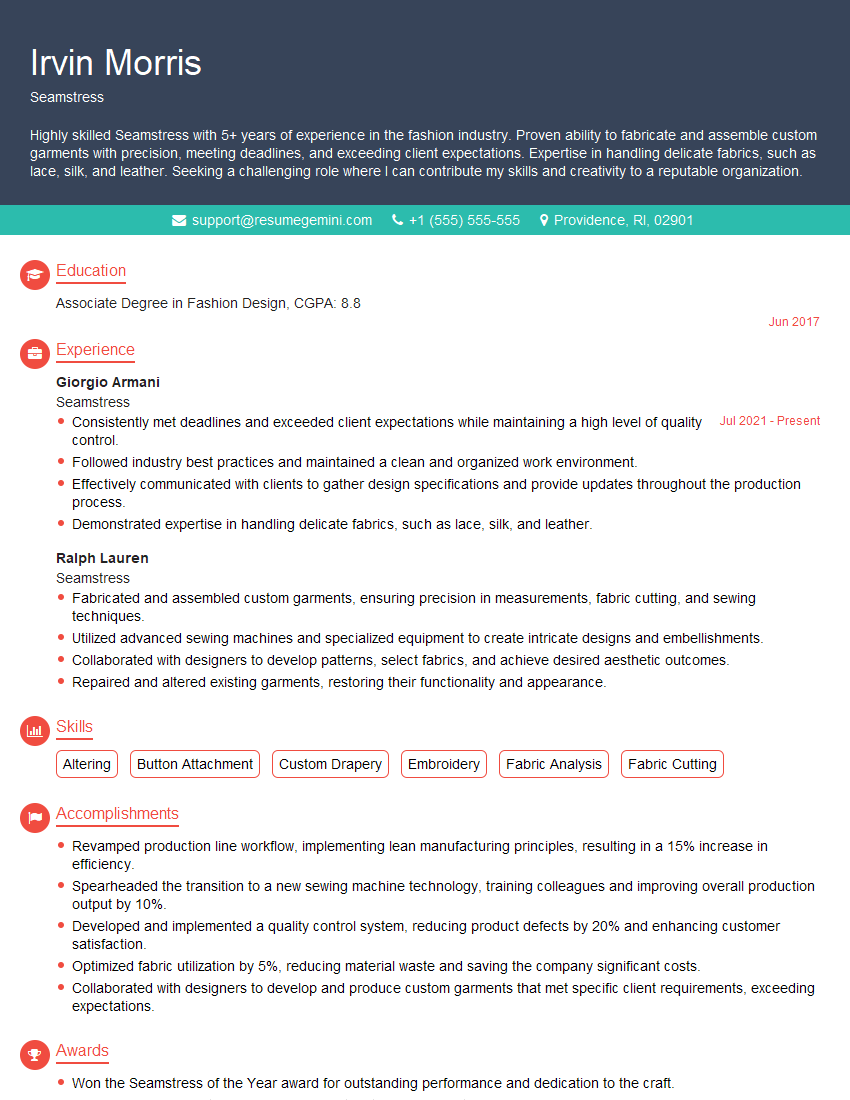
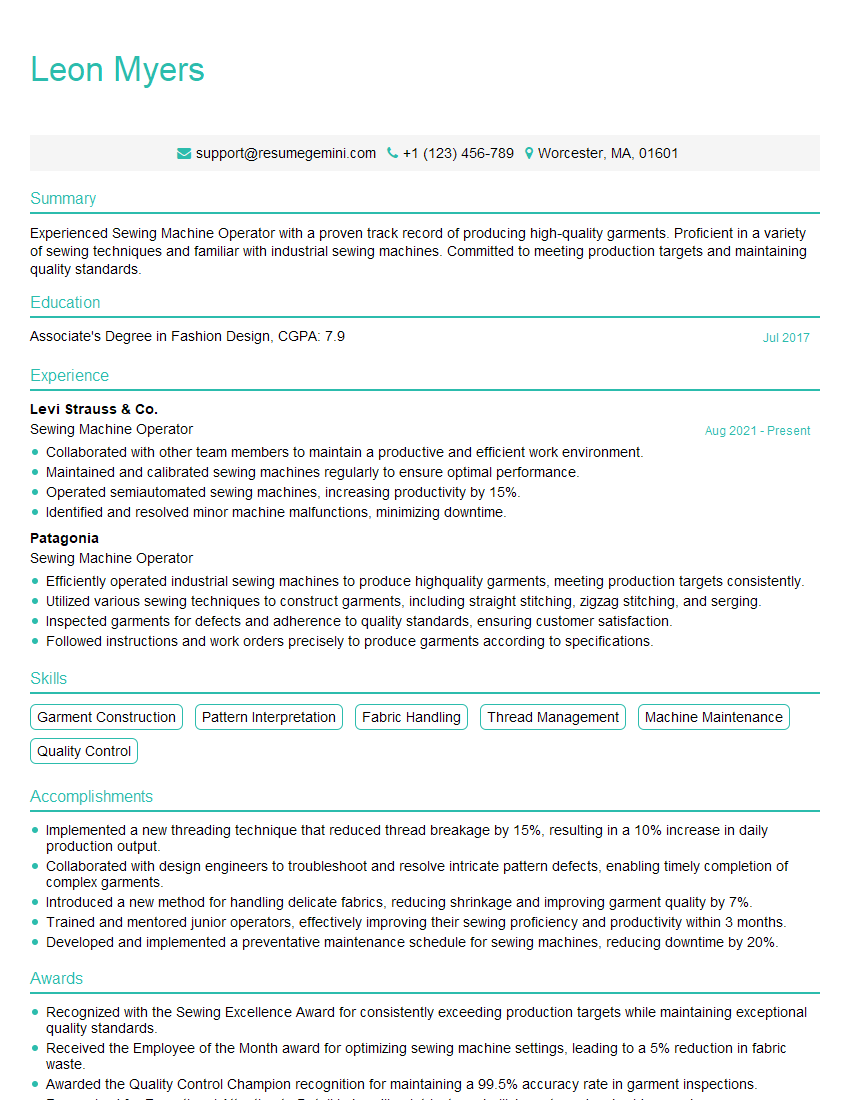
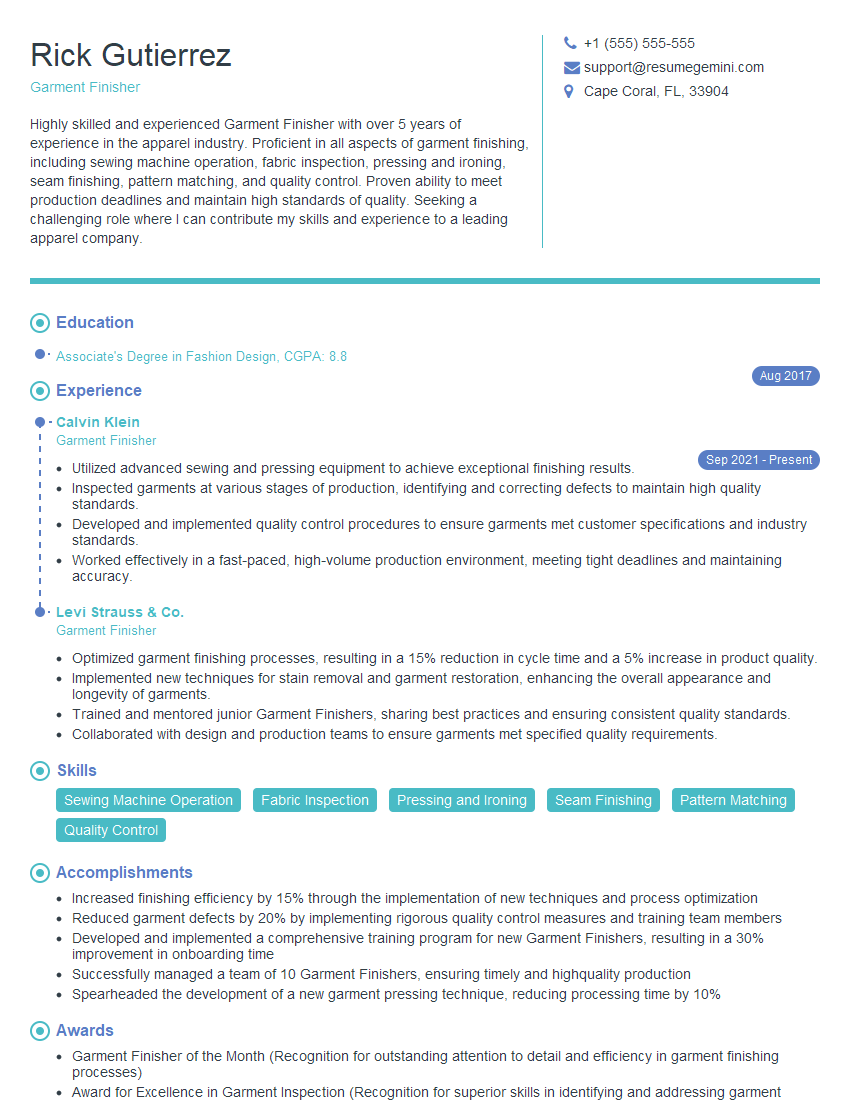
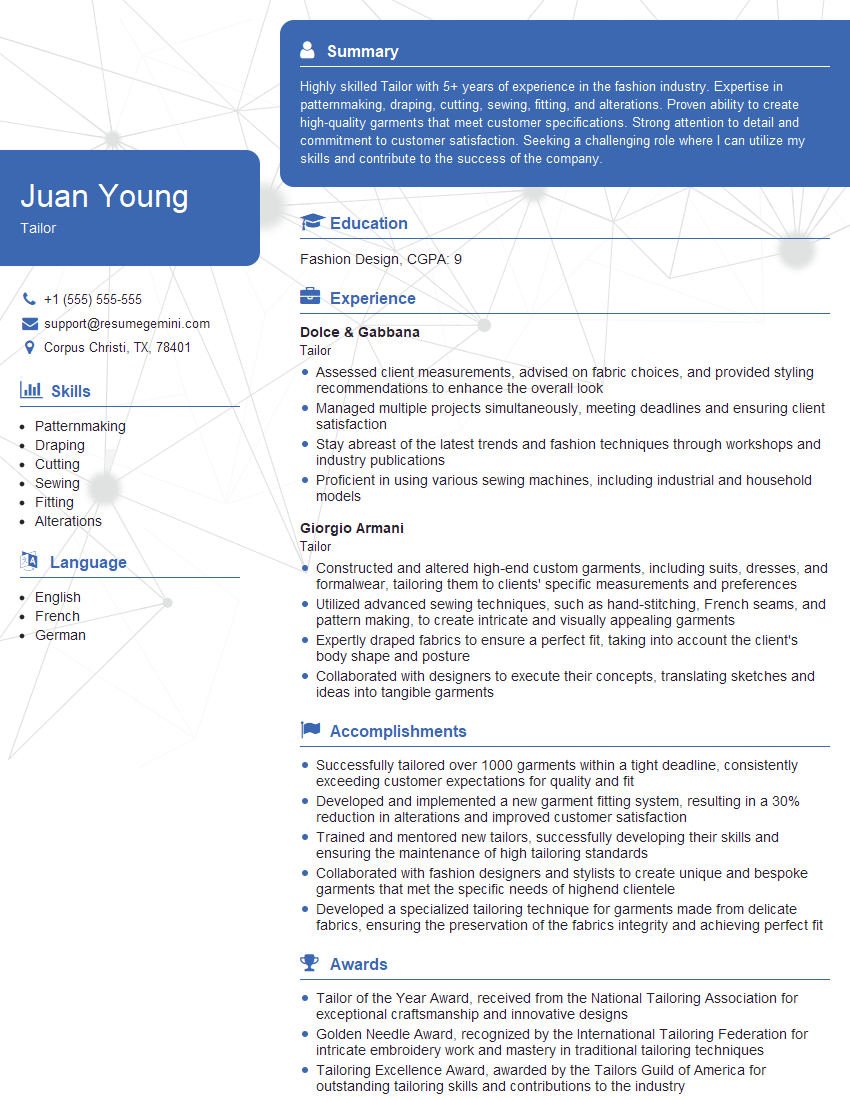
Mastering garment assembling skills opens doors to rewarding careers in the fashion and apparel industry, offering opportunities for growth and specialization. To maximize your job prospects, crafting a strong, ATS-friendly resume is crucial. ResumeGemini is a trusted resource that can help you build a professional and impactful resume. Take advantage of their tools and resources, including examples of resumes tailored to Assembling Garments, to present your skills and experience effectively. A well-crafted resume is your first step towards landing your dream job.

Explore more articles
Users Rating of Our Blogs
Share Your Experience
We value your feedback! Please rate our content and share your thoughts (optional).
What Readers Say About Our Blog
Very informative content, great job.
good