Interviews are opportunities to demonstrate your expertise, and this guide is here to help you shine. Explore the essential Bird Banding Techniques interview questions that employers frequently ask, paired with strategies for crafting responses that set you apart from the competition.
Questions Asked in Bird Banding Techniques Interview
Q 1. Describe the different types of bird bands used and their applications.
Bird bands come in various types, each designed for specific applications. The most common are metal bands, often made of aluminum or stainless steel. These are durable and provide long-term identification, ideal for tracking migratory birds over many years. We typically use a unique combination of numbers and letters, almost like a bird’s license plate, to identify each individual.
Another type is the plastic band, usually colored and often used in conjunction with metal bands. These colored bands allow for easier visual identification at a distance, especially useful for species where close-up observation is difficult. For instance, a researcher might use a combination of a metal band with a unique code and a bright orange plastic band to easily spot a particular species of duck in a flock.
We also utilize electronic tags such as GPS transmitters or data loggers. These advanced technologies allow for real-time tracking of bird movements and provide incredibly detailed data on their behavior, habitat use, and migration patterns. However, these are typically used on larger birds that can easily carry the extra weight. They’re invaluable for studying birds that are difficult to recapture for data collection. Imagine being able to track the exact flight path of a peregrine falcon during its migration – that’s the power of electronic tags.
Q 2. Explain the proper techniques for capturing and handling birds during banding.
Capturing and handling birds requires meticulous care and adherence to established protocols. The methods vary depending on the species and the environment. Mist nets, which are fine mesh nets stretched between poles, are commonly used for capturing smaller birds. It’s crucial to check nets frequently, to avoid undue stress on the bird. The bird is then carefully removed and placed in a soft bag to minimize movement and stress.
Larger birds might be captured using traps or even by hand, if handled by experienced personnel. Once a bird is captured, it’s essential to handle it gently, minimizing any physical contact or unnecessary movement. We aim to keep the bird calm and secure. Imagine holding a tiny hummingbird – it requires an incredibly gentle touch.
Throughout the process, we maintain a calm and quiet environment. Sudden movements or loud noises can frighten the bird and increase stress levels. Speed is key: the bird should be banded and released as quickly as possible to minimize its time in captivity.
Q 3. What are the ethical considerations involved in bird banding?
Ethical considerations are paramount in bird banding. The primary concern is the well-being of the bird. We minimize stress and ensure the bird is not harmed during capture, handling, and banding. This includes following established protocols, using appropriate techniques, and adhering to all relevant regulations. We must respect the bird’s natural behavior and limit any interference to the absolute minimum required for data collection.
Another important aspect is obtaining necessary permits and licenses. All banding operations must comply with local, national, and international regulations. Failure to comply is a serious ethical and legal breach. Our actions must always be guided by science and the conservation of bird populations. We are stewards of these animals and must act responsibly.
Q 4. How do you ensure the safety and well-being of birds during the banding process?
Ensuring the safety and well-being of birds is our top priority. This is achieved by employing skilled personnel, using appropriate techniques, and conducting all procedures in a calm and efficient manner. We only work with birds that are healthy enough to withstand the procedure, avoiding handling stressed or injured animals.
The banding itself must be performed swiftly and correctly, to minimize trauma and the risk of injury. The band should fit snugly, but not too tight, preventing constriction while still preventing its removal. If complications arise, appropriate veterinary care is sought. Following banding, the bird is carefully monitored for a brief period to ensure it has fully recovered and can fly away unaided.
Q 5. What are the potential risks and challenges associated with bird banding?
Bird banding, while beneficial, does present certain risks and challenges. One major risk is potential injury to the bird during capture or handling. Improper techniques or handling stressed birds can lead to injuries, stress, or even mortality. This is why rigorous training and adherence to protocols are crucial.
Weather conditions can also impact banding operations. Inclement weather can make capturing and handling birds more difficult and may increase the risk of injury. Logistical challenges include access to remote areas and the need for specialized equipment. Funding is always a consideration, to ensure access to the necessary resources and training.
Another challenge is the potential for bias in data collection. For instance, capturing certain individuals more easily than others can skew the results. Careful planning and consideration are essential to minimize these biases.
Q 6. How do you minimize the stress on birds during capture and handling?
Minimizing stress during capture and handling is achieved through a combination of careful techniques and a calm environment. We use appropriate capture methods, minimizing the time the bird spends in captivity. Gentle handling and a quiet environment help keep the bird calm. The speed and efficiency of the banding procedure directly reduces the bird’s exposure to stress.
Properly designed traps and nets reduce injury risk. Once caught, minimizing handling and keeping the bird contained in a dark, quiet container reduces anxiety. This is akin to providing a bird with a temporary, comfortable ‘safe space’. Rapid processing and release helps ensure the bird can resume its natural activities as quickly as possible.
Q 7. Explain the process of data recording and management in bird banding.
Data recording and management are critical aspects of bird banding. Every detail of the banding event is meticulously recorded, including the date, location, species, age, sex, measurements (such as wing length and weight), and the unique band number. This information is entered into a database, often using specialized software, allowing for long-term tracking and analysis.
Data integrity is of utmost importance. Data are regularly checked for accuracy and completeness, and any errors are corrected promptly. The data is then used for a wide variety of studies, contributing to our understanding of bird migration, population dynamics, habitat use, and much more. The data is also shared with other researchers and organizations, contributing to the larger body of knowledge on avian biology and conservation.
Modern technologies, such as mobile data entry systems, improve data collection efficiency and accuracy in the field, streamlining the process significantly.
Q 8. How do you identify different bird species for banding?
Accurate bird species identification is crucial before banding. We rely on a combination of visual cues and, in some cases, measurements. Think of it like a meticulous detective work! First, we carefully observe the bird’s size, shape, plumage (color and pattern of feathers), and beak structure. Field guides, detailed illustrations, and extensive experience play a vital role here. For instance, distinguishing between a Black-capped Chickadee and a Carolina Chickadee requires close examination of their head markings and size. If the identification remains ambiguous, we might utilize additional tools such as high-quality photos for later analysis or even refer to an ornithological expert.
- Visual Identification: This involves looking at the bird’s overall appearance, including its size, shape, color patterns, and markings.
- Field Guides and Resources: Experienced banders consult field guides and other resources for detailed descriptions and illustrations of bird species.
- Measurements: In some cases, we measure the bird’s wing length, tail length, and other morphological characteristics to aid identification, especially with similar-looking species.
Q 9. Describe the importance of data accuracy in bird banding studies.
Data accuracy is paramount in bird banding studies because the reliability of our conclusions hinges on it. Inaccurate data can skew results, leading to flawed interpretations that may have serious conservation implications. Imagine trying to understand bird migration patterns with inaccurate location data – the conclusions would be meaningless! Every detail, from species identification to date and location of banding, must be meticulously recorded. This ensures the integrity of long-term population monitoring, migration studies, and assessments of survival rates. Data validation procedures, involving double-checking and cross-referencing information, are critical to maintain accuracy.
- Species Identification: Incorrect identification leads to erroneous data on population size and distribution.
- Location Data: Inaccurate GPS coordinates can distort the understanding of bird movements and habitat use.
- Date and Time: Precise recording of date and time is crucial for analyzing seasonal patterns and migration timing.
Q 10. What software or tools are commonly used for managing bird banding data?
Several software applications are utilized for efficient bird banding data management. These programs streamline data entry, analysis, and reporting. Think of them as sophisticated filing systems for bird data! Popular choices include:
- BAND: A widely used program specifically designed for managing bird banding data. It facilitates data entry, error checking, and various analytical functions.
- Spreadsheets (Excel, Google Sheets): While simpler, spreadsheets can be used for smaller-scale projects or as supplementary tools for data organization.
- Database Management Systems (DBMS): For large-scale projects or collaborative efforts, DBMS like Access or MySQL offer robust data storage and retrieval capabilities.
These software tools typically allow for the entry and organization of data including bird species, age, sex, weight, location, and date of banding. They facilitate data analysis through functions such as calculating recapture rates and generating reports for research publications or conservation efforts.
Q 11. How do you handle unexpected situations during a banding operation (e.g., injured bird)?
Unexpected situations are part and parcel of bird banding. The safety and well-being of the bird always comes first! Our training equips us to handle various scenarios. For instance, if a bird is injured, our priority shifts to immediate care. This might include cleaning and dressing wounds, or stabilizing fractures, and in severe cases we might need to euthanize the bird to avoid unnecessary suffering. For less severe injuries, a decision is made on whether the bird can be banded. If not, it is carefully released. Documentation of such incidents, including the nature of the injury, treatment administered, and outcome, is essential. In all cases, we adhere to ethical guidelines established by bird banding organizations to minimize stress and potential harm to the bird. We might even call upon a wildlife veterinarian depending on the severity of the situation.
Q 12. Explain the significance of bird banding in conservation efforts.
Bird banding plays a crucial role in conservation. It’s like having a bird’s-eye view (pun intended!) of their lives, providing invaluable insights for effective conservation strategies. By tracking individuals over time, we gather data on population dynamics, migration patterns, survival rates, and habitat use. This information allows us to identify populations at risk, pinpoint critical habitats, and assess the impact of environmental changes and human activities. For example, identifying a decline in a specific bird species’ population might prompt further investigation into possible threats, leading to the implementation of conservation measures such as habitat restoration or pollution control.
- Population Monitoring: Long-term monitoring helps understand population trends and identify species of concern.
- Habitat Assessment: Banding data informs about habitat use and crucial areas for conservation.
- Impact Assessment: The effects of environmental change and human activities on birds can be assessed.
Q 13. How do you calculate recapture rates and what do they signify?
Recapture rate is a key metric in bird banding, representing the percentage of banded birds that are recaptured during subsequent banding sessions. This calculation provides insights into the bird’s survival and movement patterns. It’s calculated as (number of recaptures / number of initial bandings) * 100. For instance, if 100 birds were banded and 20 were recaptured, the recapture rate is 20%. A higher recapture rate might indicate a stable population in a specific area with high site fidelity (tendency to return to the same location). Lower recapture rates, however, could suggest higher mortality, emigration, or difficulties in recapture. These rates require cautious interpretation as they can be influenced by several factors, including banding effort, migration patterns, and the bird’s life history.
Q 14. What are the limitations of bird banding as a research method?
While bird banding is a powerful research method, it has limitations. One crucial limitation is the potential impact on the birds themselves. Even with careful handling, banding can cause stress or even injury. Furthermore, the data collected is only representative of the banded birds, and those birds might not be fully representative of the whole population. Banding also has practical limitations. It’s not feasible to band every individual in a population, and banding success can vary depending on species, age, and accessibility. Finally, the interpretation of banding data requires careful consideration of various factors that might influence the results, and statistical analysis plays an important role in reducing bias and drawing sound conclusions.
Q 15. Describe the different types of bird banding studies (e.g., migration, population dynamics).
Bird banding studies are designed to answer a wide range of ecological questions. The type of study largely dictates the banding methods and data collected. Here are some key examples:
- Migration Studies: These studies track the movements of birds throughout the year. We might band birds in their breeding grounds and then rely on resightings (someone reporting a band number) or recapture at different locations, or even using geolocators to determine their exact location. This helps us understand migration routes, stopover sites, and the timing of migration, informing conservation efforts regarding habitat protection along flyways. For example, we might band Monarch butterflies to track their massive migration south for the winter.
- Population Dynamics Studies: These focus on understanding population sizes, birth rates, death rates, and survival rates of bird populations. By banding birds and monitoring their survival over time, we can estimate population trends and identify factors that affect population growth or decline. This is crucial for managing populations of endangered species. A long-term study of a declining songbird population, for instance, might reveal the impact of habitat loss on its survival.
- Behavior Studies: Banding can be integrated into behavioral studies to track individual birds’ movements within a specific area or their responses to environmental changes. For instance, we might band birds to study their foraging behavior or their breeding success. This is often done in conjunction with other methods like observation and GPS tracking.
- Dispersal Studies: These focus on how far young birds move away from their natal areas. By banding nestlings and then monitoring their subsequent locations, we can understand the spatial scales of dispersal and the factors that influence it. This is vital for understanding how populations are connected and how genetic diversity is maintained.
Career Expert Tips:
- Ace those interviews! Prepare effectively by reviewing the Top 50 Most Common Interview Questions on ResumeGemini.
- Navigate your job search with confidence! Explore a wide range of Career Tips on ResumeGemini. Learn about common challenges and recommendations to overcome them.
- Craft the perfect resume! Master the Art of Resume Writing with ResumeGemini’s guide. Showcase your unique qualifications and achievements effectively.
- Don’t miss out on holiday savings! Build your dream resume with ResumeGemini’s ATS optimized templates.
Q 16. How do you determine the appropriate sample size for a bird banding study?
Determining the appropriate sample size for a bird banding study is crucial for obtaining statistically reliable results. It depends on several factors:
- Research Question: The complexity of the question and the level of precision required influence sample size. A simple study might require a smaller sample than a complex one.
- Population Size: A larger population generally requires a larger sample size to accurately represent the population.
- Expected Variability: If there’s high variability within the population (e.g., in age or sex), a larger sample is needed to capture this variability.
- Desired Confidence Level and Margin of Error: Researchers often specify the confidence level (e.g., 95%) and margin of error (e.g., ±5%) they are willing to accept. Statistical power analysis is used to calculate the minimum sample size needed to achieve these criteria. This is commonly done using statistical software.
- Practical Considerations: Factors like available resources (time, personnel, funding) and the feasibility of capturing and banding the target species also play a role in determining sample size. Sometimes you might adjust the scope of the question to match your resources.
Often, we use power analysis software to determine the appropriate sample size given the factors above. If a preliminary sample is taken, the observed variability can inform a more refined sample size calculation.
Q 17. How does bird banding contribute to our understanding of bird behavior?
Bird banding significantly advances our understanding of bird behavior by providing long-term data on individual birds. It allows us to:
- Track Movements: Determine migration routes, wintering grounds, and home ranges. For instance, banding studies have revealed that some birds migrate thousands of miles.
- Study Survival Rates: Assess factors influencing survival, such as habitat quality, predation, or disease. This could help in identifying threats to bird populations.
- Analyze Breeding Success: Monitor reproductive rates and factors that influence reproductive success, such as nest predation or food availability. We might band nesting birds and track the survival and fledging success of their offspring.
- Understand Site Fidelity: Determine whether birds return to the same breeding or wintering areas year after year. This is crucial for understanding habitat requirements.
- Investigate Social Interactions: Observe behaviors such as territoriality, mate selection, and parental care. Banding allows us to individually identify birds and follow their interactions over time.
Data from banding studies combined with other techniques like GPS tracking and stable isotope analysis provides a richer understanding of bird behaviors and their ecological significance.
Q 18. Explain the process of obtaining permits for bird banding activities.
Obtaining permits for bird banding activities varies by country and region but generally involves these steps:
- Identify the relevant authority: This might be a national wildlife agency, a state or provincial agency, or a local environmental agency. For instance, in the U.S., this would typically be the U.S. Fish and Wildlife Service.
- Submit a detailed research proposal: The proposal should outline the research objectives, methodology (including banding techniques), study area, species to be banded, the number of birds to be banded, and the intended duration of the study. The scientific merit of your proposal is critical.
- Demonstrate qualifications: Applicants typically need to demonstrate experience in bird handling, banding techniques, and data management. Providing a CV and letters of support are often required.
- Obtain necessary permits: The agency will review the proposal and, if approved, issue permits authorizing the banding activities. Permits often have specific conditions related to the number of birds that can be banded, the techniques permitted, and the reporting requirements.
- Attend training (if required): Many jurisdictions require banders to complete specialized training courses on proper bird handling and banding techniques.
The permit application process usually takes several months to complete; therefore, it’s crucial to plan well in advance.
Q 19. What are the legal regulations concerning bird banding in your region?
Legal regulations concerning bird banding vary considerably by region. In many jurisdictions, it’s illegal to band birds without a permit. Regulations often address:
- Species Protection: Certain bird species are protected by law and require special permits for banding. Threatened and endangered species often have very strict regulations.
- Banding Techniques: Regulations may specify the types of bands to be used, and they usually mandate the use of humane handling techniques to minimize stress and injury to the birds. For example, there might be specific rules for the size and material of bands to avoid injury.
- Data Reporting: Researchers are typically required to submit regular reports on banding activities, including the number of birds banded, their locations, and any observations made. Data reporting is essential to ensure that long-term trends can be observed.
- Ethical Considerations: Regulations often emphasize the ethical treatment of birds during banding and the importance of minimizing disturbance to the birds and their habitats.
- Penalties for violations: Violations of bird banding regulations can lead to significant fines and other penalties.
It’s essential to thoroughly research the specific regulations in your region before undertaking any bird banding activities. Consult with your regional wildlife agency to ensure compliance.
Q 20. How do you ensure the long-term sustainability of bird banding projects?
Long-term sustainability of bird banding projects requires careful planning and management:
- Secure Funding: Funding is crucial for ensuring the continuity of the project. This may involve seeking grants from research organizations, government agencies, or private foundations.
- Develop a Robust Data Management System: A well-organized and accessible database is essential for storing and managing the data collected over time. Data standardization across many projects is also very important for long-term synthesis and comparison. A clear and standardized data entry system is vital.
- Train Personnel: Ensuring that there’s sufficient trained personnel to conduct the banding and data analysis is crucial. Providing training opportunities helps to ensure the project’s expertise is maintained.
- Collaborate and Network: Collaborating with other researchers and organizations can broaden the scope of the project, increase access to resources, and ensure data sharing.
- Adapt to Changing Circumstances: Bird populations and environmental conditions can change over time, requiring the project to adapt its methods and goals to stay relevant.
- Disseminate Findings: Regularly communicating findings through publications, presentations, and reports helps to raise awareness and ensure the impact of the research is understood and utilized. Open access publishing is a good practice for this.
Sustainability also requires engaging with local communities and stakeholders to build support for the project and ensure its long-term value.
Q 21. Describe your experience with data analysis in bird banding projects.
My experience with data analysis in bird banding projects involves a range of techniques, from simple descriptive statistics to sophisticated statistical modeling. The specific methods employed depend on the research questions and the type of data collected:
- Descriptive Statistics: Calculating summary statistics (e.g., means, medians, standard deviations) to describe basic characteristics of the data (e.g., survival rates, age at first breeding, migration distances).
- Survival Analysis: Employing statistical models (e.g., Kaplan-Meier curves, Cox proportional hazards models) to analyze bird survival and identify factors affecting survival rates. This is often done using software like R or SAS.
- Capture-Recapture Modeling: Using capture-recapture models (e.g., Jolly-Seber models) to estimate population size and other demographic parameters from banding data.
- Geographic Information Systems (GIS): Using GIS software to map bird locations and analyze spatial patterns in movement, habitat use, and population distribution. We integrate banding data with other environmental variables.
- Statistical Software: I’m proficient in statistical software packages such as R, SAS, and SPSS for data analysis.
Ris particularly useful for complex statistical modeling, and I often create custom scripts to handle large datasets. For example,lm(survival ~ age + sex, data = mydata)is a basic linear model in R to test the effects of age and sex on bird survival.
Data visualization is a critical component of my analysis, allowing me to effectively communicate findings to both scientific and non-scientific audiences. I frequently use graphs, maps, and other visual aids to present results clearly and concisely.
Q 22. How do you interpret the results of a bird banding study?
Interpreting bird banding data involves much more than just counting birds. We’re looking for patterns and insights into bird populations, migration, survival rates, and habitat use. It’s like putting together a giant puzzle, where each banded bird is a piece.
Survival Rates: By recapturing banded birds, we can estimate how many birds survive from one year to the next. A low recapture rate might suggest high mortality due to habitat loss or disease. For example, if we band 100 birds and recapture only 20 the following year, we’d investigate potential causes for the 80% loss.
Migration Patterns: Banding data from different locations helps us understand migration routes and timing. If we band birds in Canada and then recapture them in Mexico, we’ve documented a migration route. Combining this with GPS data gives us a very detailed picture.
Population Size Estimation: Techniques like mark-recapture modeling allow us to estimate the total population size of a species in a given area. This is crucial for conservation efforts.
Habitat Use: By noting where birds are banded and recaptured, we can identify important habitats for breeding, feeding, and overwintering. A consistent pattern of birds being recaptured near a specific wetland suggests its importance for that species.
Statistical analysis (discussed in a later answer) is crucial for drawing meaningful conclusions from the data, as raw numbers alone can be misleading. We always consider potential biases in our sampling and interpretations. For instance, banding might be more successful in easily accessible habitats, which could skew our understanding of habitat use.
Q 23. Explain your experience with collaborating with other researchers in bird banding studies.
Collaboration is fundamental to successful bird banding. I’ve worked extensively with researchers from universities, government agencies (like the US Geological Survey), and non-profit conservation organizations. Effective collaboration requires clear communication, shared goals, and a well-defined workflow.
Data Sharing: We use standardized data formats and databases to ensure consistency and ease of sharing across different teams and projects. This is critical for large-scale studies requiring data from multiple locations.
Expertise Sharing: Bird banding often requires diverse skill sets, ranging from field techniques to statistical modeling. Collaborators bring their unique expertise, enriching the project’s outcomes. For example, I’ve partnered with experts in GIS mapping to visualize our banding data and understand spatial patterns.
Project Management: Successful collaborations require clear project management, including defining roles, responsibilities, timelines, and communication protocols. We use shared online platforms to manage projects and documents.
One memorable collaboration involved a multi-year study on migratory songbirds, where we pooled data from banding stations across three states. This collaboration allowed us to draw conclusions about migration patterns that would have been impossible with data from a single location.
Q 24. Describe your knowledge of relevant statistical analysis methods used in ornithology.
Ornithology relies heavily on statistical methods to analyze banding data. We use a range of techniques depending on the research question.
Survival Analysis: Methods like Kaplan-Meier estimators and Cox proportional hazards models are used to analyze bird survival rates and identify factors influencing survival (e.g., age, sex, habitat).
Mark-Recapture Modeling: This is crucial for estimating population size and density. Common methods include the Jolly-Seber model and the Cormack-Jolly-Seber model.
Regression Analysis: Techniques like linear and generalized linear models are employed to investigate relationships between bird characteristics (e.g., age, weight) and other variables (e.g., habitat quality, breeding success).
Spatial Analysis: GIS (Geographic Information Systems) and spatial statistics are used to analyze the spatial distribution of banded birds and their relationship to environmental factors.
Software packages like R and SAS are commonly used for these analyses. Choosing the appropriate method depends critically on the study design and the nature of the data. It’s crucial to check assumptions of the chosen statistical model and account for potential biases in the data.
Q 25. How do you handle data inconsistencies or errors in bird banding datasets?
Data inconsistencies and errors are unavoidable in bird banding, especially when dealing with large datasets and multiple researchers. Rigorous quality control measures are essential throughout the entire process.
Data Entry Checks: We use double-entry methods or data validation tools to minimize errors during data entry. We also set up checks to detect impossible values (e.g., a negative weight).
Data Cleaning: Identifying and correcting errors or inconsistencies requires careful scrutiny of the dataset. This may involve reviewing original field notes or contacting other researchers who collected the data. Inconsistent data can often be identified visually using histograms or scatterplots.
Outlier Analysis: Statistical methods can help identify outliers (extreme values) that may represent errors or genuinely unusual events. We investigate these carefully to decide whether they should be corrected, removed, or retained.
Imputation: In some cases, missing data may be imputed (filled in) using statistical methods. However, this should be done cautiously, as it can introduce bias. It is better to understand and document missing data rather than arbitrarily filling it.
Transparency about data quality is crucial. We document all data cleaning and imputation procedures, along with reasons for decisions made. This allows for independent verification and replication of results.
Q 26. What are your strengths and weaknesses related to bird banding techniques?
My strengths lie in my meticulous attention to detail in the field and my strong analytical skills. I excel at designing effective banding studies, carefully collecting data, and rigorously analyzing the results. I also have significant experience with various statistical methods used in ornithology. I’m adept at working independently and as part of a team.
One area where I could improve is expanding my knowledge of advanced GPS tracking technology and its integration with bird banding data. Although I’m familiar with the basics, incorporating this technology more effectively into my studies would enhance my research capabilities.
Q 27. How do you stay current with the latest advancements in bird banding technology?
Staying current is vital in this rapidly evolving field. I regularly attend conferences, such as those hosted by the International Bird Banding Association, and actively participate in professional networks. I read peer-reviewed journals like the Journal of Avian Biology and The Auk to keep up with new research and methodologies.
Online Resources: I use online resources and databases to access the latest banding techniques, technological advancements, and data analysis tools.
Workshops and Training: I actively seek out workshops and training opportunities to update my skills and knowledge of new technologies.
Collaboration: Engaging in collaborative projects with researchers from different institutions exposes me to diverse approaches and cutting-edge technologies.
For example, recent advancements in miniaturized GPS transmitters have revolutionized our ability to track birds’ movements. Staying informed about these changes allows me to design more sophisticated and informative banding studies.
Q 28. Describe a challenging situation you faced during a bird banding project and how you overcame it.
During a study on the effects of habitat fragmentation on a rare bird species, we encountered extreme weather conditions during the peak breeding season. Heavy rainfall and flooding made accessing many of our banding sites impossible for several weeks. This threatened to significantly reduce our sample size and compromise the study’s statistical power.
To overcome this, we adapted our sampling strategy. We prioritized easily accessible sites and used alternative methods, such as nest searching, to collect data where banding was not feasible. We also collaborated with local conservation groups to monitor affected nests and collect any casualties. We carefully documented the limitations imposed by the weather in our final report, and used statistical methods that could account for the unequal sample sizes and missing data.
Although the weather significantly impacted the study’s logistics, we managed to collect sufficient data to draw meaningful conclusions about the effects of habitat fragmentation, showcasing adaptability and resilience in the face of unforeseen challenges.
Key Topics to Learn for Bird Banding Techniques Interview
- Bird Handling and Restraint: Safe and ethical techniques for handling various bird species, minimizing stress and injury. Includes understanding different restraint methods based on species and size.
- Banding Techniques: Proper application of different band types (e.g., metal, plastic), ensuring accurate placement and minimizing potential harm. Understanding the importance of leg size measurement and band selection.
- Data Recording and Management: Accurate and efficient recording of band numbers, species, location, date, and other relevant data. Familiarity with data entry systems and software used in bird banding projects.
- Ethical Considerations: Understanding and adhering to ethical guidelines for bird banding, including permits, regulations, and minimizing disturbance to bird populations and habitats. Knowledge of relevant legislation and best practices.
- Bird Identification: Accurate identification of bird species, including visual identification, vocalizations, and behavioral characteristics. This is critical for data accuracy and responsible banding practices.
- Data Analysis and Interpretation: Basic understanding of how banded bird data is used for population studies, migration patterns, and conservation efforts. Ability to interpret trends and patterns from collected data.
- Equipment and Maintenance: Knowledge of the tools and equipment used in bird banding, including their proper use, maintenance, and storage. Troubleshooting common issues with equipment.
- Field Safety and Procedures: Understanding and practicing safe field techniques, including working in diverse environments and potential hazards. Knowledge of emergency procedures.
Next Steps
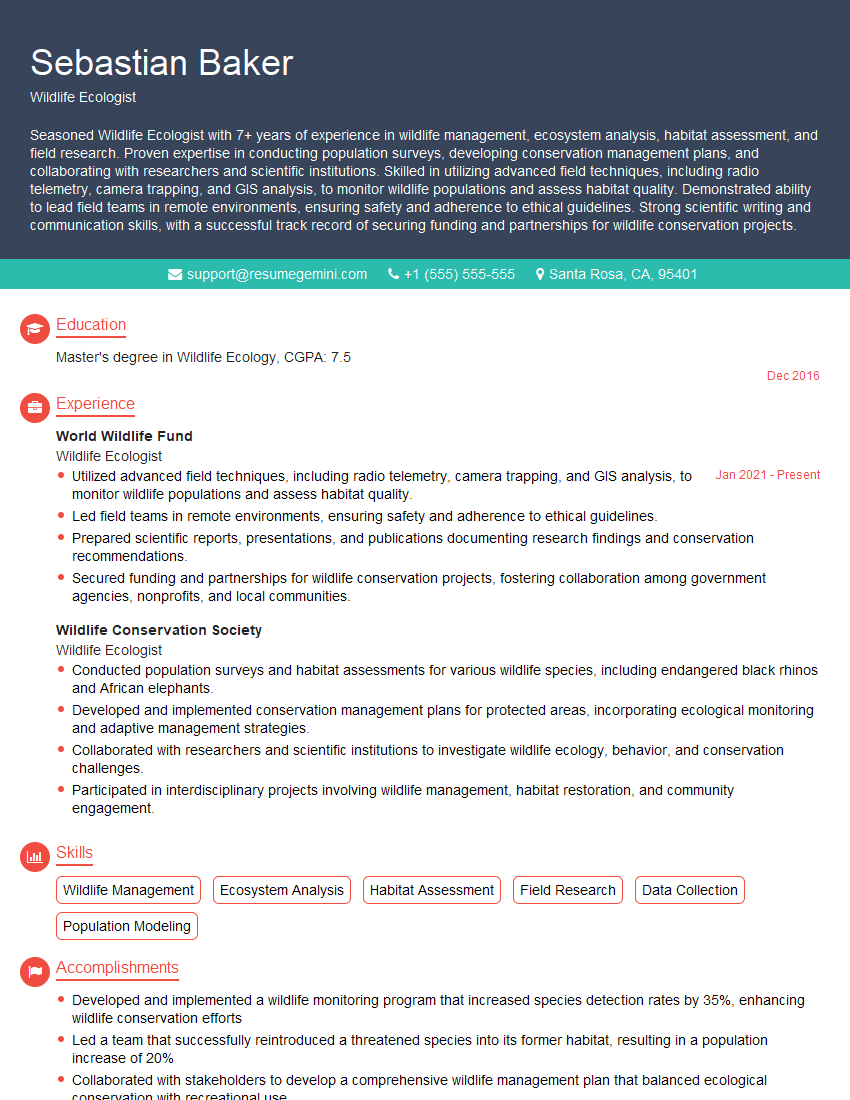
Mastering bird banding techniques opens doors to exciting careers in ornithology, conservation, and wildlife research. A strong foundation in these skills is highly sought after by employers. To maximize your job prospects, focus on crafting an ATS-friendly resume that highlights your expertise. ResumeGemini is a trusted resource to help you build a professional and impactful resume. They provide examples of resumes tailored to bird banding techniques, ensuring your qualifications shine.

Explore more articles
Users Rating of Our Blogs
Share Your Experience
We value your feedback! Please rate our content and share your thoughts (optional).
What Readers Say About Our Blog
Very informative content, great job.
good