Feeling uncertain about what to expect in your upcoming interview? We’ve got you covered! This blog highlights the most important Brakes interview questions and provides actionable advice to help you stand out as the ideal candidate. Let’s pave the way for your success.
Questions Asked in Brakes Interview
Q 1. Explain the difference between disc and drum brakes.
Disc and drum brakes are two primary types of braking systems used in vehicles, differing significantly in their design and operation. Imagine disc brakes as a clamp squeezing a spinning disc, while drum brakes are more like shoes rubbing against the inside of a rotating cylinder.
Disc Brakes: These utilize a caliper that squeezes brake pads against a rotating disc (rotor) attached to the wheel. This clamping action generates friction, slowing the wheel’s rotation. Disc brakes offer superior heat dissipation, leading to better braking performance under heavy use, like during mountain driving or emergency stops. They also tend to be more resistant to brake fade.
Drum Brakes: In drum brakes, brake shoes are pressed against the inner surface of a rotating drum. This frictional contact slows the wheel. Drum brakes are generally simpler and less expensive to manufacture, but they are more prone to overheating and brake fade, especially during continuous braking.
In Summary:
- Disc Brakes: Better heat dissipation, superior stopping power, less prone to fade, generally more expensive.
- Drum Brakes: Simpler design, less expensive, prone to fade, generally used on rear wheels in modern vehicles due to cost considerations.
Q 2. Describe the function of an Anti-lock Braking System (ABS).
An Anti-lock Braking System (ABS) is a safety feature that prevents wheel lockup during braking. Think about slamming on your brakes on a slippery surface – your wheels might lock, causing a skid, and you’ll lose steering control. ABS prevents this.
ABS works by rapidly pumping the brakes, allowing the wheels to maintain some rotation even under heavy braking. This ensures better steering control and shorter stopping distances on slippery surfaces. A sensor constantly monitors each wheel’s speed. If a wheel starts to lock up, the ABS control unit rapidly modulates brake pressure to that specific wheel, preventing lockup. This happens many times per second, often unnoticed by the driver except for a pulsing feel in the brake pedal.
In essence: ABS increases steering control and reduces stopping distances on slick surfaces by preventing wheel lock-up through rapid brake pressure modulation.
Q 3. How does Electronic Stability Control (ESC) work?
Electronic Stability Control (ESC), often called Electronic Stability Program (ESP), is an advanced safety system that helps maintain vehicle stability and prevent loss of control, especially during sharp turns or slippery conditions. It’s like having a skilled driver assisting you in maintaining control.
ESC uses a network of sensors (yaw rate sensor, wheel speed sensors, steering angle sensor) to monitor the vehicle’s movement. If the vehicle starts to deviate from the driver’s intended path (e.g., oversteering or understeering), the ESC intervenes. It individually applies brake pressure to specific wheels and/or reduces engine power to help steer the car back onto the intended path.
For Example: If you’re going around a corner too fast and the rear of the car starts to skid (oversteer), ESC will apply brake pressure to the inside rear wheel and reduce engine power, helping the car regain stability.
In Summary: ESC enhances vehicle stability by detecting and correcting loss of control through precise braking and engine power adjustments.
Q 4. What are the main components of a hydraulic brake system?
A typical hydraulic brake system relies on the principle of transferring force using pressurized fluid. Imagine a simple lever system, but instead of mechanical linkage, we use fluid pressure.
The main components include:
- Master Cylinder: This is the heart of the system, converting pedal pressure into hydraulic pressure.
- Brake Lines: These tubes carry the pressurized fluid from the master cylinder to the wheel cylinders or calipers.
- Wheel Cylinders (Drum Brakes) or Calipers (Disc Brakes): These convert hydraulic pressure into mechanical force, actuating the brake shoes or pads.
- Brake Pads or Shoes: These are the friction material that creates the stopping force.
- Brake Fluid: The hydraulic fluid that transmits pressure throughout the system.
- Brake Booster (Optional): Assists in creating the necessary hydraulic pressure, reducing the effort needed from the driver.
Q 5. Explain the principle of brake force distribution.
Brake force distribution refers to how braking force is divided between the front and rear wheels. It’s crucial for optimal braking performance and stability. A perfectly balanced distribution would mean the optimal amount of braking force applied to the front and rear wheels for a given situation.
The distribution isn’t static; it varies depending on factors like vehicle load, road conditions, and braking intensity. Front-heavy vehicles naturally require more braking force at the front because they have more weight transfer to the front wheels during braking. Advanced systems, often in conjunction with ABS and ESC, dynamically adjust this distribution for superior control and stopping power.
For Example: During hard braking, more braking force is automatically sent to the front wheels due to increased weight transfer.
In Summary: Proper brake force distribution ensures balanced braking, optimizing stopping distances and preventing skidding or loss of control.
Q 6. What are the common causes of brake fade?
Brake fade is a reduction in braking effectiveness caused by overheating of the brake components. Imagine repeatedly using a handbrake on a steep incline; eventually, it might fail to effectively slow down, much like the effect of brake fade. It’s particularly dangerous because it’s a gradual loss of stopping power, often only noticeable when you try to brake hard.
Common causes include:
- Overheating: Prolonged or intense braking generates excessive heat, causing brake fluid to boil (vapor lock), reducing pressure and effectiveness.
- Contamination: Oil or grease on brake pads or rotors significantly reduces friction.
- Worn brake pads or shoes: Reduced material thickness diminishes the frictional surface area.
- Brake fluid degradation: Over time, brake fluid can absorb moisture, reducing its boiling point and effectiveness.
Prevention: Regular inspection, proper maintenance (fluid changes), and avoiding excessive braking help mitigate the risk of brake fade.
Q 7. Describe different types of brake fluid and their properties.
Brake fluid is a crucial component, responsible for transmitting pressure throughout the braking system. Different types exist, primarily categorized by their boiling point and other properties.
Common types include:
- DOT 3: A relatively common and cost-effective option, suitable for most passenger vehicles. It has a moderate boiling point.
- DOT 4: Offers a higher boiling point than DOT 3, providing better performance under high-temperature braking conditions. Often used in high-performance vehicles.
- DOT 5.1: Provides an even higher boiling point than DOT 4, designed for demanding applications like racing or heavy-duty vehicles.
- DOT 5: This is silicone-based and is NOT compatible with other DOT types. It has a very high boiling point but is less commonly used due to its slower response time and incompatibility with other fluids.
Important Note: Never mix different types of brake fluid, as this can lead to dangerous consequences, compromising braking system performance.
Q 8. How do you diagnose a brake system leak?
Diagnosing a brake system leak involves a systematic approach. First, visually inspect the entire brake system for obvious leaks – look for wet spots, puddles of brake fluid, or fluid trails on components like brake calipers, wheel cylinders, brake lines, and hoses. Pay close attention to areas where lines connect to components, as these are common leak points. A low brake fluid level in the master cylinder reservoir, even without visible leaks, also suggests a leak somewhere in the system. For less obvious leaks, you might need a pressure test. This involves pressurizing the brake system with a specialized tool and observing for pressure drops, indicating a leak. The location of the pressure drop will pinpoint the leak source.
Example: Imagine you notice a wet spot under a specific wheel. Carefully examine the brake caliper and brake lines associated with that wheel. If the leak is subtle, carefully wipe the area and re-inspect after a short drive to see if the leak re-appears.
Q 9. Explain the process of bleeding brake lines.
Bleeding brake lines is crucial to remove air trapped in the system, which can compromise braking performance. The process involves opening bleeder valves on each caliper, one at a time, while an assistant pumps the brake pedal. The air bubbles will be pushed out with the brake fluid. A clear tube attached to the bleeder valve allows for easy visualization of the fluid. It’s important to keep the brake fluid reservoir topped up during bleeding to avoid introducing air. Bleeder valves are typically located on the top of the caliper. You typically start with the wheel furthest from the master cylinder and work your way towards the closest. Once the fluid runs clear (without bubbles), the system is properly bled.
Process:
- 1. Open the bleeder valve.
- 2. Have an assistant pump the brake pedal several times.
- 3. Hold the brake pedal down and close the bleeder valve.
- 4. Repeat until clear fluid is obtained, and no more air bubbles are seen.
Important: Always use the correct type of brake fluid specified for your vehicle. Using the incorrect fluid can damage components. Also, properly dispose of used brake fluid as it is hazardous waste.
Q 10. What are the safety regulations related to brake systems?
Brake system safety regulations vary by region and jurisdiction, but several common themes exist. Regular vehicle inspections are mandatory in most places, and brake systems are a primary focus. Minimum brake performance standards are often defined, specifying stopping distances and effectiveness under various conditions. Manufacturers are obligated to meet stringent safety standards in the design and manufacturing of brake systems. Components like brake pads and rotors must meet specific material and performance requirements. For commercial vehicles, regulations are even more stringent, with more frequent inspections and stricter standards for maintenance and performance. Malfunctioning brake systems lead to serious penalties.
Example: In many jurisdictions, failing a brake inspection results in the vehicle being taken off the road until repairs are made. Commercial drivers can face license suspension or other penalties for operating vehicles with inadequate brakes.
Q 11. Describe different types of brake pad materials and their advantages/disadvantages.
Brake pad materials significantly impact braking performance, longevity, and cost. Common materials include:
- Semi-metallic: A mix of metal and non-metallic materials. They offer a good balance of performance, longevity, and cost. They can produce more brake dust than other types.
- Ceramic: Made primarily of ceramic fibers. They offer excellent stopping power, reduced brake dust, and quiet operation but are generally more expensive.
- Organic: Composed of organic materials. These are less expensive but offer lower stopping power and have a shorter lifespan compared to others. They also tend to produce more noise.
- Sintered metal: Usually used in performance vehicles, they provide excellent fade resistance under high temperatures, but are quite aggressive on rotors and are noisy.
The choice of brake pad material depends on the vehicle’s intended use, driving style, and budget.
Q 12. How do you inspect brake rotors for wear and damage?
Inspecting brake rotors involves checking for wear, scoring, cracking, and warping. Visual inspection reveals scoring (grooves), cracks (fractures), and excessive wear (thinness). Using a brake rotor gauge measures the minimum thickness allowed by the manufacturer. Warped rotors can be identified by measuring the rotor thickness at different points around its circumference. An uneven thickness suggests warping. A warped rotor can cause vibrations in the brake pedal and steering wheel while braking.
Example: If the rotor thickness falls below the manufacturer’s minimum specification, it needs replacement. Similarly, if significant scoring, cracking, or severe warping is observed, it must be replaced.
Q 13. Explain the function of a brake caliper.
A brake caliper is a crucial component of the braking system that houses the brake pads and applies clamping force to the rotors to slow or stop the vehicle. When the brake pedal is pressed, hydraulic pressure forces pistons within the caliper to push the brake pads against the rotor, generating friction. This friction converts kinetic energy into heat, slowing the vehicle down. The caliper design varies (fixed, floating). A fixed caliper has pistons on both sides of the rotor, while a floating caliper has pistons on one side and uses a sliding mechanism on the other to keep the pads in contact with the rotor.
In simple terms: Think of the brake caliper as a clamp that squeezes the brake pads onto the spinning rotor.
Q 14. What are the different types of brake actuators?
Brake actuators are the components that convert driver input (brake pedal pressure) into the hydraulic or pneumatic force needed to actuate the brakes. Common types include:
- Hydraulic master cylinder: The most common type, it converts pedal pressure into hydraulic pressure in the brake lines.
- Vacuum booster: Assists the driver by using engine vacuum to reduce the effort required to press the brake pedal.
- Electric brake actuators: Used in regenerative braking systems and electronic braking systems (like ABS). They use electric motors to control brake pressure.
- Pneumatic brake systems: Primarily used in large vehicles, air pressure is employed instead of hydraulic fluid.
The type of brake actuator determines how the braking system operates and its characteristics.
Q 15. How does a parking brake system work?
A parking brake, also known as an emergency brake or handbrake, is a secondary braking system designed to hold a vehicle stationary, particularly on inclines or in emergencies. It’s independent of the main service brake system, offering redundancy. Most modern vehicles use either a cable-actuated system or an electric system.
Cable-actuated systems use a cable connected to a lever (handbrake) or pedal (foot-operated parking brake) that mechanically pulls on the rear brakes. These brakes are often drum brakes, simpler and less expensive than disc brakes, but less effective at high speeds. The cable tightens the brake shoes against the drum, preventing the wheels from rotating.
Electric parking brakes (EPBs) are becoming increasingly common. They use electric motors to actuate the rear brakes, often disc brakes. A switch or button controls the system, and it typically includes an automatic engagement feature. Sensors monitor the brake application, ensuring that sufficient pressure is applied.
Think of it like this: The main brakes are like your primary means of stopping while driving, while the parking brake is your safety net, ensuring the car doesn’t roll away when parked.
Career Expert Tips:
- Ace those interviews! Prepare effectively by reviewing the Top 50 Most Common Interview Questions on ResumeGemini.
- Navigate your job search with confidence! Explore a wide range of Career Tips on ResumeGemini. Learn about common challenges and recommendations to overcome them.
- Craft the perfect resume! Master the Art of Resume Writing with ResumeGemini’s guide. Showcase your unique qualifications and achievements effectively.
- Don’t miss out on holiday savings! Build your dream resume with ResumeGemini’s ATS optimized templates.
Q 16. Describe the process of brake pad replacement.
Replacing brake pads is a relatively straightforward task, but safety is paramount. Always work on a level surface with the vehicle securely supported using jack stands, never relying solely on a jack. The specific procedure varies slightly depending on the vehicle make and model, but the general steps remain consistent.
- Secure the vehicle: Engage the parking brake and chock the wheels opposite the ones being worked on.
- Remove the wheel: Loosen the lug nuts before jacking up the vehicle, then completely remove the nuts and take off the wheel.
- Expose the caliper: You’ll see the brake caliper clamping onto the rotor. Sometimes there are retaining clips or pins holding the pad retaining plate. Remove these.
- Remove the old pads: Carefully push the caliper piston back into the caliper using a specialized tool (to avoid damaging the seals) to create enough space to remove the old, worn brake pads.
- Install new pads: Insert the new brake pads into their respective positions, ensuring they’re properly seated. Reassemble the caliper, making sure the pins or clips are correctly re-installed.
- Reinstall the wheel: Tighten the lug nuts in a star pattern to ensure even pressure.
- Test the brakes: Carefully test the brakes before driving, ensuring they function correctly. Pump the brake pedal several times and gently check for vibration or noises.
Important Note: Always refer to your vehicle’s repair manual for specific instructions and torque specifications. If you are not comfortable performing this task, it’s best to have a qualified mechanic do it. Improper brake maintenance can be dangerous.
Q 17. What are the signs of a failing brake master cylinder?
The brake master cylinder is the heart of your braking system, converting pedal pressure into hydraulic pressure to actuate the brakes. Several signs indicate a failing master cylinder:
- Spongy or soft brake pedal: This is a classic symptom indicating a loss of hydraulic pressure within the system, suggesting a leak in the master cylinder or its associated components.
- Brake fluid leaks: Observe the area around the master cylinder for any signs of fluid leakage. This is a clear indicator of damage to the master cylinder itself.
- Hard or unresponsive brake pedal: In contrast to a soft pedal, a very hard pedal can suggest air in the system or internal failure of the master cylinder, which will not be able to build enough hydraulic pressure.
- Brake failure warning light illumination: Most modern vehicles have a warning light on the dashboard that illuminates if there is a problem with the braking system, often including issues with the master cylinder.
- Decreased braking effectiveness: Noticeably less stopping power is a serious warning sign. This could be due to a master cylinder failing to deliver sufficient hydraulic pressure.
If you notice any of these symptoms, immediately stop driving and have your braking system inspected by a mechanic. Driving with a failing master cylinder is extremely dangerous.
Q 18. How do you test brake system components?
Testing brake system components involves a combination of visual inspection, pressure testing, and functional checks. Here’s a breakdown:
- Visual Inspection: Check brake lines, hoses, and calipers for leaks, damage, or corrosion. Look at the brake pads for wear and tear.
- Brake Fluid Level Check: Ensure the brake fluid level in the reservoir is within the acceptable range.
- Brake Pedal Feel Test: Check for sponginess, hardness, or lack of firmness in the brake pedal. A soft pedal usually indicates a loss of hydraulic pressure.
- Pressure Testing: A pressure gauge is used to test the hydraulic pressure within the system. This identifies leaks or blockages in the system.
- Caliper Inspection and Testing: Calipers should be checked for free movement of the pistons, and the system checked for binding.
- Brake Rotor and Drum Condition: Inspect the rotors and drums for scoring, excessive wear, or cracks.
- ABS testing (where applicable): Modern vehicles typically have an Anti-lock Braking System. Diagnostics require specialist tools to assess sensor function and control module integrity.
Professional-grade diagnostic scanners are often used in a workshop setting to read diagnostic trouble codes (DTCs) that give more specific information about the brake system faults. Always prioritize safety and never attempt brake repairs if you are not qualified or adequately trained.
Q 19. What are the common types of brake failures and their causes?
Brake failures can be catastrophic and are usually caused by a combination of factors. Here are some common types and their causes:
- Hydraulic Failure: This typically involves leaks in the brake lines, hoses, master cylinder, or wheel cylinders. Causes include corrosion, damage from road debris, or worn seals. The result is a loss of braking pressure or complete brake failure.
- Mechanical Failure: This might involve issues with the brake calipers or wheel cylinders becoming seized, brake pads wearing down completely, or failure of brake components such as the rotor cracking under stress or heavy use.
- Electrical Failure (ABS/ESP): In vehicles with anti-lock braking systems (ABS) or electronic stability programs (ESP), electrical failures can cause reduced or complete loss of braking effectiveness. This can stem from faulty sensors, wiring problems, or control module malfunctions.
- Brake Fade: This is a gradual reduction in braking effectiveness caused by overheating of the brake components, especially during prolonged or heavy braking. Overheating causes the brake fluid to boil, leading to reduced pressure and slower stopping times.
Regular maintenance, including brake fluid flushes, pad and rotor replacements, and inspections, can drastically reduce the likelihood of brake failure.
Q 20. Explain the concept of brake torque.
Brake torque is the rotational force applied to the wheels by the brakes to slow or stop the vehicle. It’s the product of the braking force and the wheel radius. A higher brake torque means a greater ability to decelerate.
Imagine trying to stop a spinning wheel by applying pressure to its edge. The harder you push (braking force), and the further from the center you push (wheel radius), the greater the rotational force (brake torque) you’ll exert. This rotational force is then transferred to the vehicle to cause deceleration.
Brake torque is crucial for vehicle dynamics and is considered during the design and engineering of braking systems. It dictates the stopping power of the vehicle, particularly important under extreme conditions or at high speeds. Various factors influence brake torque including pad material, caliper design, and hydraulic pressure.
Q 21. What is the role of brake boosters?
Brake boosters are vacuum- or hydraulic-powered devices that significantly reduce the effort required by the driver to actuate the brakes. They essentially multiply the force applied to the brake pedal, making it easier to stop the vehicle. This is particularly important for larger vehicles requiring substantial stopping power.
Think of it like this: Your leg muscles provide the initial force on the brake pedal. The brake booster acts as a force multiplier, amplifying that force to create the high pressure needed in the hydraulic system to operate the brakes. A failing brake booster will result in a much harder brake pedal, requiring significantly more force from the driver to stop the vehicle.
Most passenger vehicles use a vacuum booster, which utilizes engine vacuum to assist in creating braking force. Hydraulic boosters, though less common, are an alternative solution and are generally found in heavier vehicles, where the increase in braking power is more significant. The functionality is similar in concept, but it operates through hydraulic pressure. Regular inspection and maintenance of the brake booster are essential to ensuring safe and effective braking.
Q 22. Describe the different types of brake sensors and their function.
Brake sensors are crucial for modern braking systems, providing real-time information to the vehicle’s control units. They come in several types, each with a specific function.
- Wheel Speed Sensors (WSS): These sensors, typically magnetic or hall-effect, measure the rotational speed of each wheel. This data is essential for ABS (Anti-lock Braking System) and traction control systems. For example, if one wheel locks up during braking, the WSS detects this, and the ABS system modulates brake pressure to prevent skidding.
- Brake Pad Wear Sensors: These sensors, usually electrical, are embedded in brake pads and alert the driver when the pads are nearing the end of their lifespan. They often trigger a warning light on the dashboard, preventing costly damage to the rotors.
- Electronic Brake Control (EBC) Modules: These more complex sensors monitor various parameters like brake fluid pressure, pedal position, and wheel speed to control the entire braking system. They are the brains behind advanced safety features such as Electronic Stability Control (ESC).
- Brake Pressure Sensors: These sensors measure the hydraulic pressure within the brake system, providing input to the EBC module. Accurate pressure monitoring is vital for ABS and other advanced braking systems to function correctly. They ensure proper pressure distribution among the wheels.
Understanding the function of each sensor type is crucial for accurate diagnostics and repair of braking systems. A faulty sensor can lead to impaired braking performance or the malfunction of safety systems.
Q 23. Explain the difference between friction and wear in brake systems.
While both friction and wear are inherent aspects of braking, they are distinct processes. Think of it like this: friction is the force that slows the vehicle down, while wear is the gradual degradation of the brake components.
Friction: This is the resistive force generated when two surfaces (brake pad and rotor) rub against each other. This force converts kinetic energy into heat, slowing the vehicle. The effectiveness of braking depends heavily on the coefficient of friction between the pad and rotor material. Different pad materials (e.g., ceramic, semi-metallic) have varying friction coefficients, affecting stopping distance and brake feel.
Wear: This is the physical deterioration of the brake components due to the continuous friction during braking. Brake pads wear down progressively, and rotors can experience scoring or degradation. This wear necessitates regular inspection and replacement of worn parts to maintain braking performance and safety. Factors such as driving style, braking habits, and environmental conditions influence the rate of wear.
Essentially, friction is the *cause* of braking, while wear is the *effect* of that friction over time.
Q 24. How do you maintain brake system components?
Maintaining brake system components is crucial for safety and longevity. A regular maintenance schedule includes:
- Visual Inspection: Regularly check brake pads and rotors for wear and tear. Look for excessive wear, scoring, cracking, or glazing. Consider using a brake caliper tool to check the remaining thickness of the brake pads.
- Fluid Level Check: Ensure that the brake fluid reservoir is filled to the appropriate level. Low fluid levels indicate a possible leak that needs immediate attention.
- Fluid Condition Check: Examine the brake fluid for contamination or discoloration, which might indicate water absorption or other problems. Brake fluid should be clear and free of debris.
- Professional Service: Get a professional brake inspection every six months or annually, or as recommended by your vehicle manufacturer. They can assess the system more comprehensively.
- Brake Pad and Rotor Replacement: Replace brake pads when they reach their minimum thickness, and rotors when they exhibit significant wear or damage. These must always be replaced in pairs.
Remember, neglecting brake maintenance can lead to compromised braking performance, increased stopping distances, and potentially dangerous situations.
Q 25. Describe your experience with brake system diagnostics tools.
My experience with brake system diagnostic tools spans a wide range, from basic hand-held scanners to sophisticated professional-grade equipment. I’m proficient in using:
- OBD-II Scanners: These tools can read diagnostic trouble codes (DTCs) related to the braking system, providing clues to potential problems like ABS sensor malfunctions or brake pressure sensor issues.
- Specialized Brake Scanners: These advanced tools can provide more detailed information about the brake system, such as ABS module data, wheel speed sensor readings, and brake pressure values. They allow for more comprehensive diagnostics.
- Digital Multimeters (DMMs): I utilize DMMs to check circuit continuity, voltage levels, and resistances in various brake system components, which helps pinpoint electrical faults.
- Pressure Gauges: These are essential for measuring brake fluid pressure, verifying correct system operation, and detecting leaks.
I’m adept at interpreting the data from these tools and correlating it with the vehicle’s symptoms to reach an accurate diagnosis. For instance, a low voltage reading on a wheel speed sensor might indicate a wiring problem or a faulty sensor itself.
Q 26. What are the limitations of different brake types?
Different brake types each have inherent limitations:
- Drum Brakes: These are relatively inexpensive but prone to fade at high temperatures and can be less effective in wet conditions due to the build-up of moisture. Their self-energizing effect can also contribute to uneven wear.
- Disc Brakes: While superior in many aspects, disc brakes can be more expensive and susceptible to corrosion, especially in areas with harsh winters. They are more complex to service than drum brakes.
- Anti-lock Braking Systems (ABS): While significantly improving safety, ABS can reduce braking effectiveness in certain low-traction situations, such as on loose gravel. Proper driver technique is still essential for safe stopping.
- Electronic Stability Control (ESC): While generally enhancing stability, ESC systems may not prevent accidents if the driver exceeds the vehicle’s limits or encounters unexpected obstacles.
Understanding these limitations is crucial for making informed decisions regarding brake system design and maintenance, and for driver training on safe braking techniques.
Q 27. Explain your experience with different brake system designs.
My experience encompasses various brake system designs, including:
- Hydraulic systems: These utilize brake fluid pressure to actuate the brakes, the most common design in passenger vehicles. My experience includes troubleshooting leaks, replacing components, and understanding the importance of proper bleeding procedures.
- Vacuum-assisted systems: These leverage engine vacuum to assist brake pedal force, providing a lighter pedal feel. I understand the function of vacuum pumps and the consequences of vacuum leaks.
- Electro-hydraulic systems: These systems combine hydraulic actuation with electronic control, enabling features like ABS and ESC. My expertise extends to diagnosing faults within these complex systems using specialized diagnostic tools.
- Air brake systems (heavy vehicles): I have experience working with air brake systems in heavy vehicles, including air compressor maintenance, air tank inspections, and understanding the various components involved in air brake operation.
This varied experience allows me to diagnose and repair a wide range of brake systems across various vehicle types, prioritizing safe and effective solutions.
Q 28. How do you approach troubleshooting complex brake system problems?
Troubleshooting complex brake problems requires a systematic approach. My strategy involves:
- Gather Information: Start by listening carefully to the driver’s description of the issue. Note any unusual noises, vibrations, or changes in braking performance.
- Visual Inspection: Thoroughly inspect all brake system components, paying close attention to brake pads, rotors, calipers, lines, and fluid level. Look for obvious signs of damage or wear.
- Diagnostic Tests: Utilize appropriate diagnostic tools (OBD-II scanner, specialized brake scanners, DMMs, pressure gauges) to obtain data on various brake system parameters. This data will help isolate the problem.
- Component Testing: If necessary, perform individual component tests. For instance, check the functionality of the wheel speed sensors, verify brake fluid pressure, and test the integrity of electrical circuits.
- Road Test: In certain cases, a road test under controlled conditions can provide valuable insights into the problem. Observe braking performance under different scenarios.
- Systemic Analysis: After gathering all the data, analyze it systemically. Consider how different components might be interacting and influencing each other. A seemingly isolated problem might be a symptom of a larger issue.
- Repair or Replacement: Based on the diagnosis, carry out the necessary repairs or component replacements. Ensure that all work is done correctly and according to safety guidelines.
This methodical approach helps pinpoint the root cause of complex brake problems, ensuring that the repair is effective and safe.
Key Topics to Learn for Brakes Interview
- Supply Chain Management within Brakes: Understanding the complexities of Brakes’ vast distribution network, including warehousing, transportation, and logistics optimization. Consider the challenges of perishable goods and efficient delivery schedules.
- Customer Relationship Management (CRM) in a B2B context: Explore how Brakes manages relationships with its diverse client base (restaurants, hotels, etc.), focusing on account management, contract negotiation, and maintaining strong partnerships.
- Food Safety and Hygiene Regulations: Deep dive into the stringent regulations surrounding food handling and distribution. Consider the implications of non-compliance and the importance of maintaining high safety standards throughout the supply chain.
- Technology and Innovation at Brakes: Research Brakes’ use of technology to improve efficiency, from inventory management systems to route optimization software. Think about how technology impacts various aspects of their operations.
- Financial Acumen and Business Strategy: Understand the key performance indicators (KPIs) relevant to Brakes’ business, such as profitability, efficiency, and customer satisfaction. Consider how various operational decisions impact the bottom line.
- Problem-Solving and Decision-Making under Pressure: Practice scenarios involving logistical challenges, unexpected delays, or customer issues. Demonstrate your ability to analyze situations, develop solutions, and make timely decisions.
Next Steps
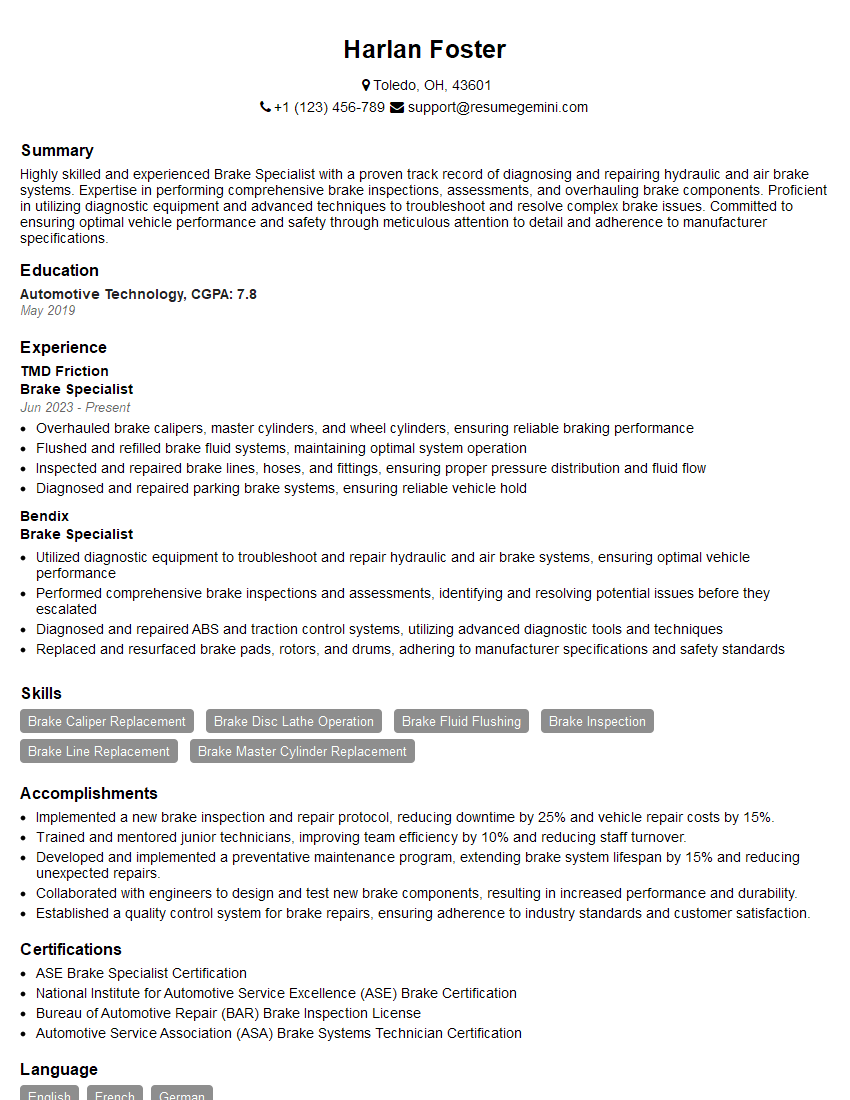
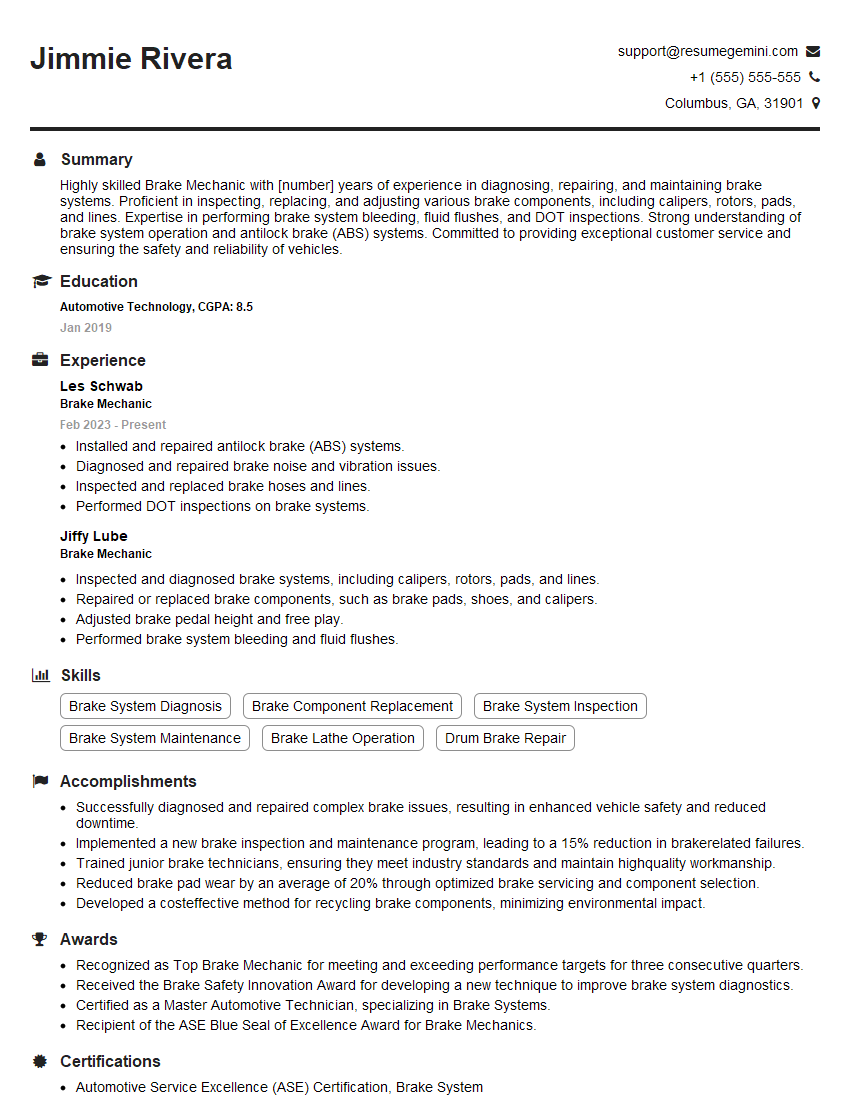
Mastering these key areas significantly enhances your prospects for career advancement within Brakes, a leading player in the foodservice industry. A well-crafted resume is crucial for navigating Applicant Tracking Systems (ATS) and making a strong first impression. To maximize your chances, we strongly recommend using ResumeGemini to build an ATS-friendly resume tailored to highlight your relevant skills and experience. Examples of resumes optimized for Brakes applications are available for your review, providing valuable insights into creating a compelling document that showcases your qualifications effectively.
Explore more articles
Users Rating of Our Blogs
Share Your Experience
We value your feedback! Please rate our content and share your thoughts (optional).
What Readers Say About Our Blog
Very informative content, great job.
good