The right preparation can turn an interview into an opportunity to showcase your expertise. This guide to Cake Design Techniques interview questions is your ultimate resource, providing key insights and tips to help you ace your responses and stand out as a top candidate.
Questions Asked in Cake Design Techniques Interview
Q 1. Describe your experience with different types of fondant.
My experience with fondant spans several types, each with its unique properties. I regularly use rolled fondant, which is ideal for covering cakes smoothly and creating intricate decorations. Its plasticity allows for easy shaping and molding. I also work with gum paste, a firmer, less pliable fondant, perfect for detailed sugar flowers and delicate embellishments because it holds its shape exceptionally well. Finally, I occasionally use modeling chocolate, a type of fondant made with chocolate, which offers a richer flavor and a more matte finish, suited for certain decorative elements or sculpting.
The choice of fondant depends entirely on the design. For instance, a simple, elegant cake might only require rolled fondant, while a highly detailed cake featuring intricate sugar flowers would necessitate both rolled fondant and gum paste. I’ve even experimented with colored fondants to add vibrancy and minimize the need for extensive food coloring, ensuring consistent and even color throughout the design.
Q 2. Explain your process for creating realistic sugar flowers.
Creating realistic sugar flowers is a meticulous process that demands patience and precision. It starts with preparing the gum paste, ensuring it’s the right consistency – not too sticky, not too dry. Then, I use a variety of tools, from tiny sculpting tools to wire cutters and petal dust, to shape and color each petal individually. I employ techniques like veining, where I carefully create the natural lines found on real petals using a veining tool, and dusting, applying edible petal dust to add depth and realism to the color.
For example, creating a rose involves rolling out small portions of gum paste, cutting out petal shapes, and then carefully shaping and arranging each petal to form the rose bud. The process is repeated, adding more petals layer by layer until a full bloom is achieved. The wire gives the flower structure and allows for easy placement on the cake. Finally, the finished sugar flower is carefully left to dry completely, ensuring it maintains its shape and won’t wilt.
Q 3. How do you ensure the structural integrity of a multi-tiered cake?
Structural integrity in multi-tiered cakes is paramount. I achieve this through a combination of techniques, starting with sturdy cake boards for each layer. These provide a stable base. Then, I use dowels or cake supports – long, sturdy rods – inserted into the lower tiers to support the weight of the upper tiers. The number and placement of supports depend on the cake’s size and design. I also ensure that each cake layer is properly leveled and trimmed before stacking to create a consistent and stable structure. This prevents any uneven weight distribution that could cause the cake to collapse.
For instance, a four-tiered cake requires careful planning. I might use multiple dowels in the first tier to distribute the weight of the upper tiers evenly. I would also meticulously calculate dowel placement to avoid placing them in areas where they might interfere with design elements. Finally, a light-weight frosting helps reduce overall weight while ensuring smooth and appealing aesthetics.
Q 4. What are your preferred methods for cake leveling and frosting?
Cake leveling and frosting are fundamental steps. For leveling, I use a long serrated knife, ensuring a perfectly flat surface on each layer. This prevents uneven frosting and a wobbly cake. I then crumb coat the cake – a thin layer of frosting to seal in the crumbs – allowing it to chill briefly before applying the final layer of frosting. This prevents crumbs from mixing into the final layer, yielding a perfectly smooth finish.
My preferred method for frosting is a combination of techniques. I use a bench scraper to create perfectly smooth sides, applying even pressure to ensure a consistent finish. I often use a turntable to facilitate the frosting process, allowing for a more controlled and even application. Depending on the design, I may also use different frosting tips and techniques to add texture or designs.
Q 5. Describe your experience with various piping techniques.
My piping techniques range from simple borders to intricate floral designs. I’m proficient with various piping tips, from classic round tips for creating simple borders and dots to specialized tips for creating leaves, flowers, and other decorative elements. I also utilize different piping bags for different consistencies of frosting or buttercream, such as those for creating delicate swirls or bold rosettes.
For instance, creating a shell border involves using a round tip and applying consistent pressure while rotating the piping bag to create a series of overlapping shells. Creating a rose requires a specific petal tip and careful manipulation of the bag to create lifelike petals. I’ve mastered many techniques, each providing a different textural or aesthetic element to the cake.
Q 6. How do you handle a last-minute design change from a client?
Handling last-minute design changes requires adaptability and clear communication. First, I assess the feasibility of the change within the given timeframe. If it’s possible, I discuss the implications, including any potential cost or time adjustments, with the client. I might present alternative solutions if the initial request isn’t feasible within the deadline. Maintaining open communication is crucial. Transparency helps manage expectations and prevents misunderstandings.
For instance, if a client requests a significant color change right before pickup, I’ll assess whether I have the necessary materials and enough time. I’d clearly communicate any potential delays and adjust the schedule accordingly, while offering options if the original request is too complex for the timeframe. Professionalism and adaptability are key to addressing this scenario successfully.
Q 7. What are your go-to troubleshooting methods for common cake issues (e.g., cracks, sinking)?
Troubleshooting is a critical aspect of cake design. Cracks often occur due to improper baking or handling. To prevent cracks, ensure the cake is properly baked and cooled before frosting. Sinking can be due to insufficient baking or improper use of leavening agents. Careful recipe following and attention to baking times are essential. Other issues include uneven frosting; using a turntable and bench scraper can solve this, and a crumb coat is crucial. If a cake is too dry, adding a simple syrup can help.
If I encounter a crack, I might use frosting to carefully fill it and blend it seamlessly into the rest of the cake. If a cake sinks, I can carefully level it and then use a filling to make the cake even and then add extra frosting.
Q 8. Explain your knowledge of different buttercream types and their applications.
Buttercream is the cornerstone of many cake designs, offering a creamy texture and versatility in flavor and color. Different types cater to specific needs.
- American Buttercream: This is the most common type, made with butter, powdered sugar, and flavorings. It’s easy to make, fluffy, and readily accepts food coloring. It’s perfect for simple rosettes, smooth finishes, and creating basic designs. I often use this for children’s cakes where vibrant colors and a smooth texture are key.
- Swiss Meringue Buttercream: This is a more stable and less sweet buttercream made by whipping egg whites and sugar over a double boiler, then incorporating butter. It’s incredibly smooth and holds its shape well, making it ideal for intricate piping work and sculpted cakes. I’ve used this for wedding cakes requiring elegant details and precise designs.
- Italian Meringue Buttercream: Similar to Swiss meringue but the sugar syrup is cooked to a higher temperature before being incorporated into the egg whites, resulting in an even more stable and glossy buttercream. It’s less prone to weeping and perfect for warm climates or cakes that need to sit for a longer period. I choose this when transporting cakes across longer distances.
- French Buttercream: This buttercream uses cooked egg yolks and sugar, whipped with butter, resulting in a rich, custard-like flavor and texture. It’s less stable than meringue buttercreams and best used for cakes that will be consumed quickly.
- Ermine Buttercream: This is a cooked buttercream that is less likely to curdle and is known for its creamy texture. This is less common, but a good choice for a classic style.
The choice depends heavily on the cake design’s complexity, the climate, and the desired flavor and texture.
Q 9. How do you transport and store cakes to maintain their quality?
Transporting and storing cakes requires meticulous attention to detail to prevent damage and maintain freshness.
- Transportation: I use sturdy cake carriers lined with non-slip material to secure the cake during transport. For tiered cakes, each layer is carefully supported and secured with dowels or cake supports. I avoid bumpy roads and extreme temperatures. Cakes are always transported upright to prevent shifting and damage.
- Storage: Cakes are ideally stored in an airtight container or a cake box in a cool, dry place, away from direct sunlight and strong odors. For buttercream cakes, refrigeration is generally avoided unless necessary due to the risk of butter softening and affecting the design. I might refrigerate temporarily if the air conditioning is non-existent, and always bring it to room temperature before serving.
Proper packaging and careful handling are crucial for ensuring the cake arrives and remains in pristine condition.
Q 10. Describe your experience with airbrushing techniques.
Airbrushing allows for a smooth, even application of color and edible luster dusts onto cakes, creating unique effects.
My experience includes using various airbrush techniques like creating gradients, applying intricate patterns, and adding metallic accents. I’m proficient in using stencils for precise designs, and freehand airbrushing for more artistic, personalized effects. Cleaning and maintaining the airbrush is crucial to prevent clogging and ensure a smooth finish, which I carefully execute to maintain pristine results every time.
For example, I recently used airbrushing to create a delicate watercolor effect on a wedding cake, blending pastel shades seamlessly. Another time, I used stencils to add intricate lace patterns to a birthday cake, achieving an elegant and refined look.
Q 11. How do you price your custom cake designs?
Pricing custom cakes involves considering several factors to ensure fair compensation for time, skill, and materials.
- Cake Size and Layers: The more layers and the larger the cake, the higher the cost due to increased ingredients and labor.
- Design Complexity: Intricate designs, sculpting, and detailed decorations demand more time and skill, thus impacting the price.
- Ingredients: High-quality ingredients, specialty flavors, or imported items add to the overall cost.
- Delivery and Setup (if applicable): These additional services warrant extra charges.
I typically use a combination of per-serving pricing and design complexity fees. I provide a detailed breakdown of the cost to clients, ensuring transparency and mutual understanding. I also offer different tiers of designs to cater to varied budgets.
Q 12. What software or tools do you use for cake design planning?
Cake design planning involves meticulous organization and visualization.
- Sketching and Drawing: I begin with hand-drawn sketches to visualize the cake’s design and dimensions.
- Software: While I prefer hand sketching for initial concepts, I sometimes use Adobe Photoshop or Illustrator for digital rendering to showcase the designs to clients and refine details. I may also use design software like Procreate.
- Templates and Stencils: I create custom templates for intricate designs, ensuring consistent execution and accurate measurements.
Combining traditional methods with digital tools allows me to efficiently plan, design, and communicate my vision to clients.
Q 13. What is your experience with different types of cake boards and supports?
Cake boards and supports are critical for structural integrity and stability.
- Cake Boards: I use sturdy, appropriately sized cake boards made of heavy-duty cardboard or foam core for support and stability, selecting thicker boards for larger or tiered cakes. I always use boards larger than the cake base for a professional finish.
- Cake Drums: For tiered cakes, I utilize cake drums, which are sturdy round cardboard or plastic bases used for support in between each layer, ensuring stability and preventing the bottom tier from collapsing under the weight. I often use dowels, or structural supports to further ensure the weight distribution is perfect.
- Supports: For tiered cakes, I use dowels or support structures to add internal strength and prevent sagging. The type and number of supports depend on the cake’s size and weight. Bamboo dowels are readily available and are a strong option. I use a variety of these depending on the need.
The right choice of boards and supports is essential for a structurally sound and visually appealing cake.
Q 14. How do you maintain food safety and hygiene standards in your cake design process?
Maintaining food safety and hygiene is paramount in cake design. My process adheres strictly to best practices.
- Handwashing: Frequent and thorough handwashing is practiced before, during, and after all processes.
- Sanitation: All surfaces, tools, and equipment are thoroughly cleaned and sanitized before and after use. I use food-safe disinfectants to prevent cross-contamination.
- Ingredient Handling: Ingredients are stored properly, and their expiration dates are carefully monitored. I follow FIFO (First-In, First-Out) principles for ingredient usage.
- Temperature Control: Proper temperature control is maintained throughout the cake-making process to prevent bacterial growth. I use a thermometer for exact measurement.
- Food Allergens: I always inquire about potential food allergies and meticulously avoid cross-contamination to meet clients’ dietary requirements. Each ingredient is clearly labeled and stored separately.
Following strict hygiene standards ensures the safety and quality of my cakes, providing peace of mind for my clients.
Q 15. Describe your experience with working with edible images and transfers.
Working with edible images and transfers is a crucial part of modern cake design, allowing for intricate details and personalized designs that would be incredibly time-consuming to create by hand. I have extensive experience with both inkjet edible images printed on icing sheets and wafer paper, as well as with fondant and gum paste transfers.
For icing sheets, I ensure the image is printed correctly and carefully aligned before applying it to a perfectly smooth, slightly dampened fondant surface. Any excess moisture is gently blotted away to prevent blurring. Wafer paper transfers require a similar approach, but often necessitate the use of a light adhesive spray to ensure a secure bond, especially on curved surfaces. Fondant and gum paste transfers, on the other hand, demand a precise cutting technique, using sharp tools and ensuring the transfer is adequately hydrated to facilitate adhesion. I frequently use this method for logos or detailed patterns.
I’ve even incorporated edible glitter into transfers for added sparkle, requiring a careful layering process to prevent clumping or smudging. My experience includes troubleshooting issues such as image bleeding or wrinkling; I’ve developed techniques to mitigate these, such as using specialized edible glue or slightly adjusting the moisture content of the fondant.
Career Expert Tips:
- Ace those interviews! Prepare effectively by reviewing the Top 50 Most Common Interview Questions on ResumeGemini.
- Navigate your job search with confidence! Explore a wide range of Career Tips on ResumeGemini. Learn about common challenges and recommendations to overcome them.
- Craft the perfect resume! Master the Art of Resume Writing with ResumeGemini’s guide. Showcase your unique qualifications and achievements effectively.
- Don’t miss out on holiday savings! Build your dream resume with ResumeGemini’s ATS optimized templates.
Q 16. How do you handle client consultations and understand their design visions?
Client consultations are the foundation of every successful cake design. I begin by actively listening to their needs and preferences, asking detailed questions about the occasion, theme, color palette, and desired flavors. I encourage clients to share inspiration images, whether from Pinterest, magazines, or their own ideas. I then translate their vision into a tangible design proposal, often presenting mood boards or sketches to ensure we’re on the same page. This collaborative process is vital – it ensures I understand their expectations and helps prevent misunderstandings.
For example, a client might envision a ‘rustic chic’ wedding cake. Through conversation, I’d clarify what ‘rustic chic’ means to them – are we talking about a naked cake with buttercream flowers, or a textured fondant cake with delicate lace details? I’d also discuss their preferred flavors and the guest count to determine the appropriate cake size and tiers. This detailed approach ensures the final product exceeds their expectations.
Q 17. What are your strengths and weaknesses as a cake designer?
My greatest strength lies in my meticulous attention to detail and my ability to execute complex designs flawlessly. I’m known for my precise piping skills and my creative flair in combining different cake design techniques. I thrive on challenges and enjoy pushing the boundaries of traditional cake decorating.
However, my weakness, if I had to pinpoint one, would be delegating tasks. I sometimes find it difficult to relinquish control, especially when striving for perfection. I am actively working on improving this aspect by learning to trust my team and foster a collaborative environment where others can contribute their expertise.
Q 18. Explain your approach to creating unique and innovative cake designs.
Creating unique and innovative cake designs is a constant process of exploration and experimentation. I draw inspiration from various sources: nature, art, fashion, and architecture. I frequently browse design blogs, magazines, and social media platforms for inspiration, but I also strive to develop my own signature style.
My approach involves a three-step process: First, I brainstorm ideas based on the client’s brief and my research. Next, I create sketches and 3D models to visualize the cake design and refine the details. Finally, I meticulously execute the design, paying close attention to every element, from the cake structure and flavor combinations to the final finishing touches.
For example, a recent design involved incorporating geometric patterns onto a cascade cake using isomalt, a sugar that can be molded and sculpted into stunning, crystal-like structures. This design pushed the boundaries of traditional cake decorating and resulted in a showstopping masterpiece.
Q 19. How do you manage your time effectively when working on multiple cake orders?
Managing multiple cake orders requires a robust organizational system. I utilize project management software to track deadlines, inventory, and client communication. Each cake order has its own dedicated timeline, outlining key milestones such as consultations, design approvals, baking, decorating, and delivery. I break down large orders into smaller, manageable tasks, ensuring a smooth workflow. I also prioritize tasks based on deadlines and complexity.
Furthermore, I maintain a detailed inventory of supplies, ensuring I have enough ingredients and materials for all orders. This helps avoid last-minute delays and ensures consistency in quality. This meticulous planning allows me to work efficiently and deliver high-quality cakes on time, every time.
Q 20. Describe your experience with different types of cake fillings and frostings.
My experience with various cake fillings and frostings is extensive. I am proficient in creating classic fillings such as buttercream, ganache, curd, and fruit compotes. I also specialize in more innovative fillings, including flavored mousses, pastry creams, and even savory options for unique cake designs.
For frostings, I use different types depending on the design and desired texture. Buttercream is versatile and allows for smooth, textured, or piped designs. Fondant provides a sleek, polished finish ideal for intricate decorations. Ganache offers a rich, chocolatey coating, while cream cheese frosting is perfect for a tangy, decadent flavor. I always consider the overall flavor profile when pairing fillings and frostings, ensuring a harmonious balance.
For instance, a rich chocolate cake might be paired with a raspberry ganache filling and a chocolate buttercream frosting, balancing the intensity of the chocolate with the tartness of the raspberry.
Q 21. How do you stay updated on the latest trends and techniques in cake design?
Staying updated on the latest trends and techniques in cake design is essential for maintaining a competitive edge. I regularly attend industry workshops and conferences, participate in online courses and webinars, and follow leading cake designers on social media platforms.
I also subscribe to industry magazines and blogs, which provide insights into emerging trends and innovative techniques. Furthermore, I actively seek out new ingredients and tools to enhance my skills and expand my creative capabilities. This continuous learning approach allows me to stay ahead of the curve and consistently deliver innovative and captivating cake designs.
Q 22. What is your experience with using modeling chocolate and other sculpting mediums?
Modeling chocolate is my go-to medium for creating intricate cake decorations. Its plasticity allows for detailed sculpting, and it offers a smooth, professional finish that’s hard to achieve with other materials. I’ve extensively used it to create everything from lifelike flowers and animals to architectural elements and delicate lacework. Beyond modeling chocolate, I’m proficient with other sculpting mediums like gum paste, fondant, and even isomalt, each chosen based on the specific needs of the design. For instance, gum paste is excellent for delicate flowers that need to hold their shape, while isomalt provides a stunning, glassy finish for modern designs. I always consider factors like durability, shelf life, and the overall aesthetic when selecting a medium.
For example, I once sculpted a life-sized chocolate replica of a client’s beloved dog for their birthday cake. The attention to detail, from the fur texture to the subtle expression in its eyes, was achieved through careful layering and sculpting techniques with modeling chocolate.
Q 23. How do you adapt your designs for different dietary requirements (e.g., vegan, gluten-free)?
Adapting designs for dietary restrictions is crucial for inclusivity. My approach involves substituting ingredients without compromising the aesthetic appeal. For vegan cakes, I use vegan butter, eggs, and milk alternatives, ensuring the cake’s texture and taste remain excellent. For gluten-free options, I employ gluten-free flour blends, adjusting liquid quantities to achieve the desired consistency. I meticulously research and test different gluten-free blends to find those that produce the best results in terms of crumb structure and moisture retention. Similarly, I have a range of recipes for nut-free, dairy-free, and soy-free options, ensuring everyone can enjoy a delicious and beautifully designed cake. The decorations also undergo adaptation; I use vegan-friendly alternatives for things like buttercream and fondant.
For instance, I recently created a stunning gluten-free wedding cake that looked identical to the original design requested by the couple. The key was careful selection of gluten-free ingredients and understanding how they behave differently during baking. The final product looked and tasted fantastic, leaving the clients completely satisfied.
Q 24. Describe your process for creating a detailed cake design proposal for clients.
My cake design proposal process is thorough and collaborative. It begins with an initial consultation where I discuss the client’s vision, theme, flavor preferences, and budget. I then create a detailed proposal that includes:
- Concept sketches and mood boards: Visual representations of the cake design, incorporating the client’s feedback.
- Detailed description of the cake: Including flavors, fillings, layers, and sizes.
- List of decorations: Specifying the type and quantity of each element.
- Pricing breakdown: A transparent breakdown of all costs, including ingredients, labor, and delivery.
- Timeline and delivery details: Clear expectations for production and delivery.
- Contract terms and conditions: Protecting both the client and myself.
This structured approach ensures clear communication and prevents misunderstandings. I always encourage revisions and feedback from the client throughout the proposal process.
Q 25. How do you handle customer complaints or dissatisfaction with your work?
Addressing customer dissatisfaction is a crucial aspect of my business. My priority is to understand the client’s concerns and find a mutually agreeable solution. I actively listen to their feedback without interruption, acknowledging their feelings and validating their experience. Then, I thoroughly analyze the issue to determine its root cause – was it a flaw in execution, a miscommunication, or an unforeseen circumstance?
Depending on the nature of the complaint, I may offer a partial refund, recreate part or all of the cake, or provide a discount on a future order. My goal is always to restore trust and maintain a positive relationship with the client, even in challenging situations. Each situation is approached with empathy and a commitment to exceeding expectations, even when correcting a mistake.
Q 26. Explain your experience with different types of cake pans and their uses.
My experience encompasses a wide array of cake pans, each serving a specific purpose. Round pans are fundamental for classic cakes, while square and rectangular pans provide versatility for layered cakes and sheet cakes. I use heart-shaped, star-shaped, and other uniquely shaped pans to create visually appealing designs. Beyond basic shapes, I also utilize specialty pans like tiered cake pans for multi-tiered cakes and silicon molds for creating intricate, detailed decorations. The choice of pan depends heavily on the desired cake shape, size, and design. Furthermore, I’m also skilled in using non-traditional options such as creating cakes within custom-made molds for highly unique shapes.
For example, I used a set of offset round pans to create a cascading cake with each tier subtly smaller than the last, giving it a graceful, flowing appearance. On the other hand, I employed silicon molds to create beautiful flower decorations for a more modern design.
Q 27. How do you ensure the stability and presentation of intricate cake designs?
Ensuring the stability and presentation of intricate cake designs requires careful planning and execution. For multi-tiered cakes, I use sturdy dowels and cake boards to support the weight of each tier. I use appropriate adhesives, like edible glue, to secure decorations firmly in place and prevent them from falling or shifting. Furthermore, I often employ internal supports, such as a strong internal structure of cardboard or foam core, for particularly heavy or complex designs. The cake boards themselves are often chosen for their size and sturdiness, providing a stable base.
The presentation is just as important. I use cake stands that complement the cake’s design and carefully position it to highlight its features. The entire cake is usually transported in a protective case to prevent damage during transit.
Q 28. What are your techniques for creating smooth and flawless cake surfaces?
Achieving smooth, flawless cake surfaces is a cornerstone of professional cake design. My process involves several key techniques. First, I ensure the cake is properly baked and leveled to create a flat surface. Then, I apply a crumb coat—a thin layer of frosting—to seal in the crumbs before applying the final layer of frosting. This prevents crumbs from showing through the final layer. The final layer is then applied smoothly using a bench scraper or a spatula, rotating the cake as I go for an even finish. To achieve a truly professional finish, I use specific techniques such as the ‘crumb coat’ and apply the final layer of frosting while keeping the spatula at a consistent angle to the cake.
For exceptionally smooth surfaces, I might even use a cake smoother or a turntable, ensuring precision and an even texture. The final surface is often polished gently to remove any imperfections, leaving it ready for any further decorations.
Key Topics to Learn for Your Cake Design Techniques Interview
- Fundamental Cake Construction: Understanding different cake structures (layer cakes, sculpted cakes, tiered cakes), appropriate baking techniques for each, and methods for achieving structural integrity.
- Icing and Frosting Techniques: Mastering various icing types (buttercream, fondant, ganache), application methods (crumb coating, smooth finish), and achieving consistent texture and finish.
- Decorating Skills: Proficiency in piping techniques (various nozzles and styles), working with fondant (covering cakes, creating decorations), and using edible decorations (flowers, figurines, lettering).
- Design Principles: Application of color theory, design elements (line, shape, form, texture), and composition to create visually appealing and cohesive cake designs.
- Tools and Equipment: Familiarity with essential tools (mixers, spatulas, piping bags, cutters), their proper usage, and maintenance. Understanding the capabilities and limitations of different equipment.
- Troubleshooting and Problem-Solving: Identifying and addressing common cake-related issues (e.g., cracks, uneven layers, inconsistent texture) and developing effective solutions.
- Food Safety and Sanitation: Adherence to proper food handling and hygiene practices throughout the entire cake design process.
- Recipe Adaptation and Scaling: Adjusting recipes for different cake sizes and flavors while maintaining desired consistency and quality.
- Client Communication and Collaboration: Understanding how to interpret client briefs, offer creative suggestions, and manage expectations effectively.
Next Steps: Elevate Your Career with a Standout Resume
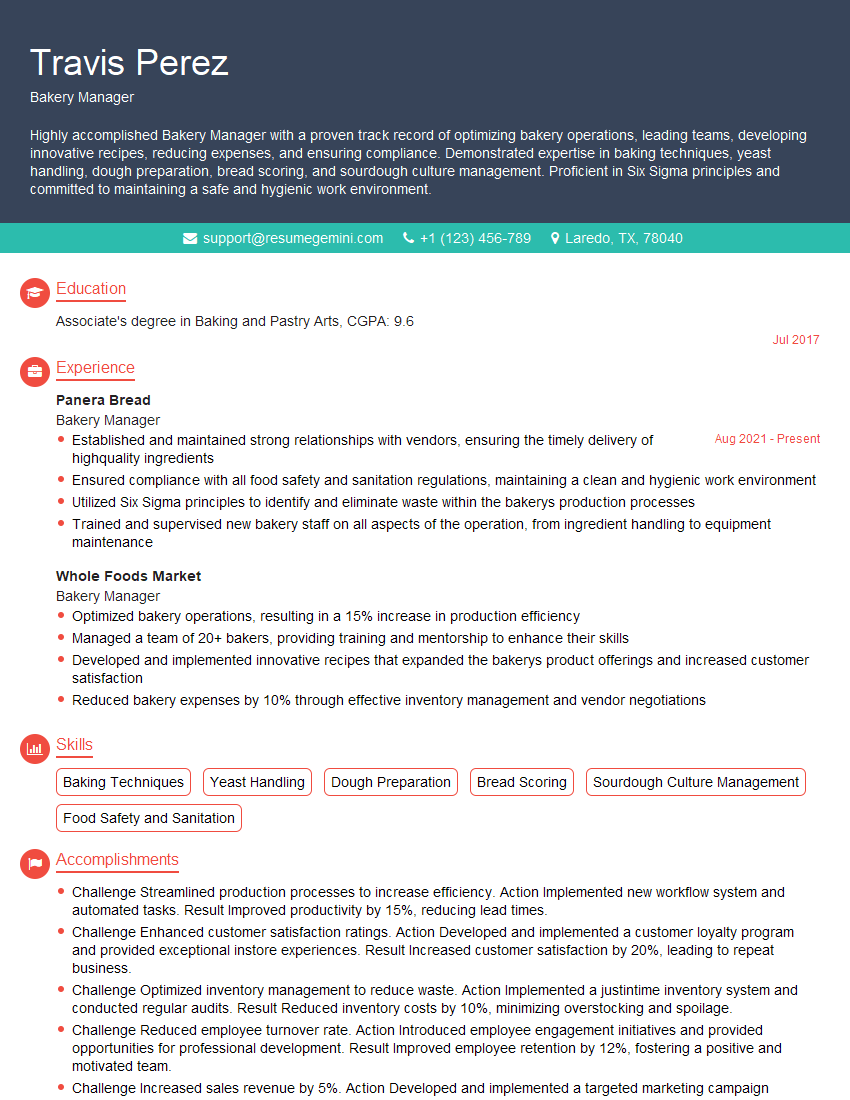
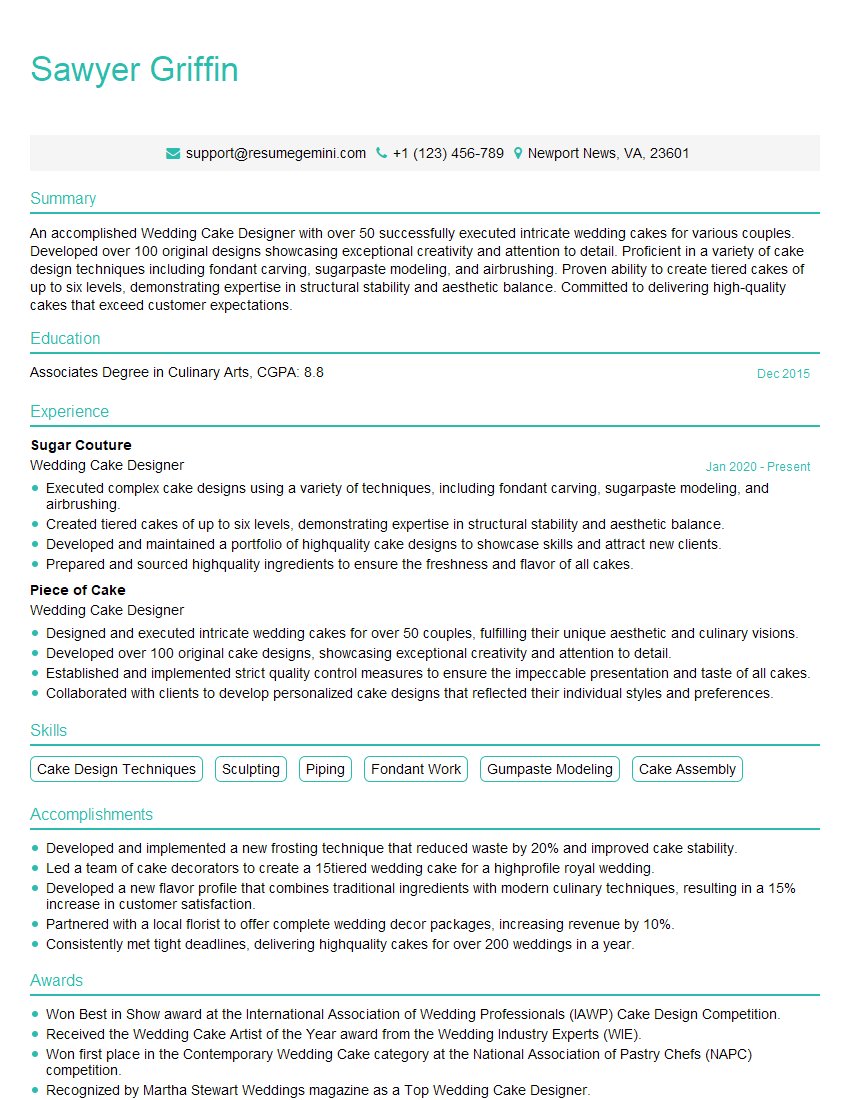
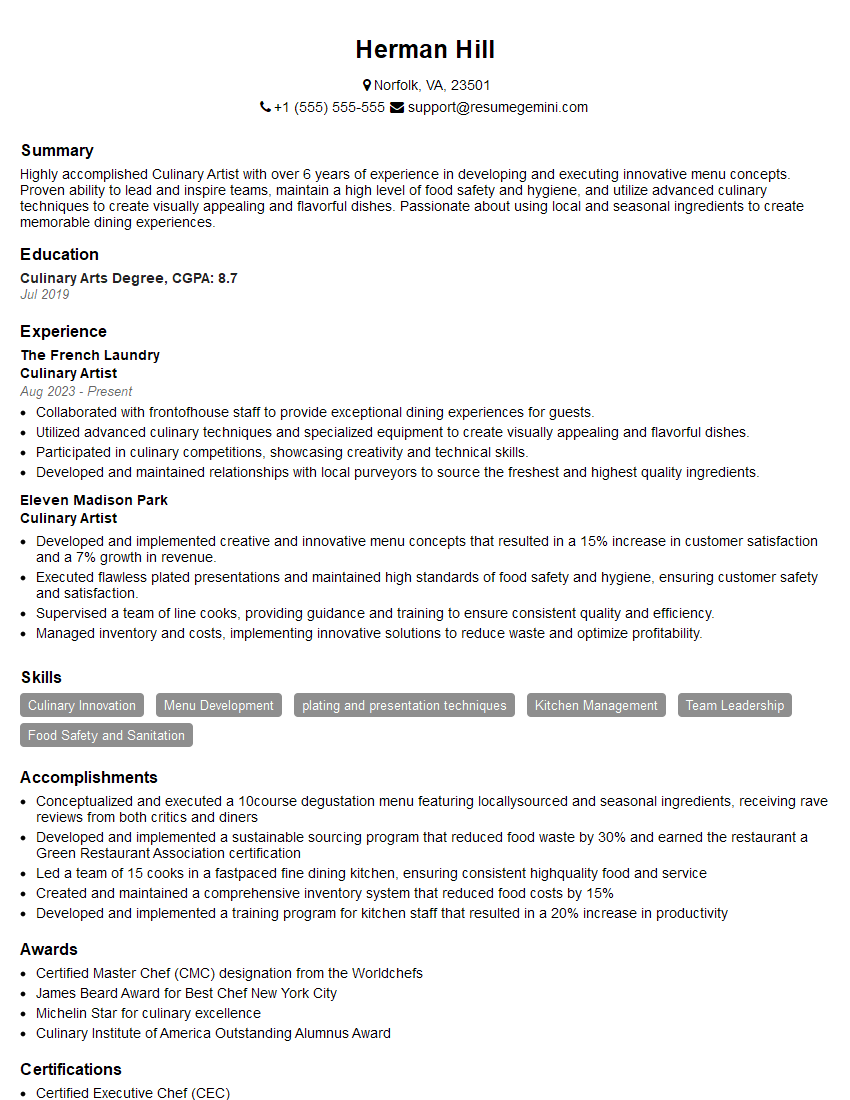
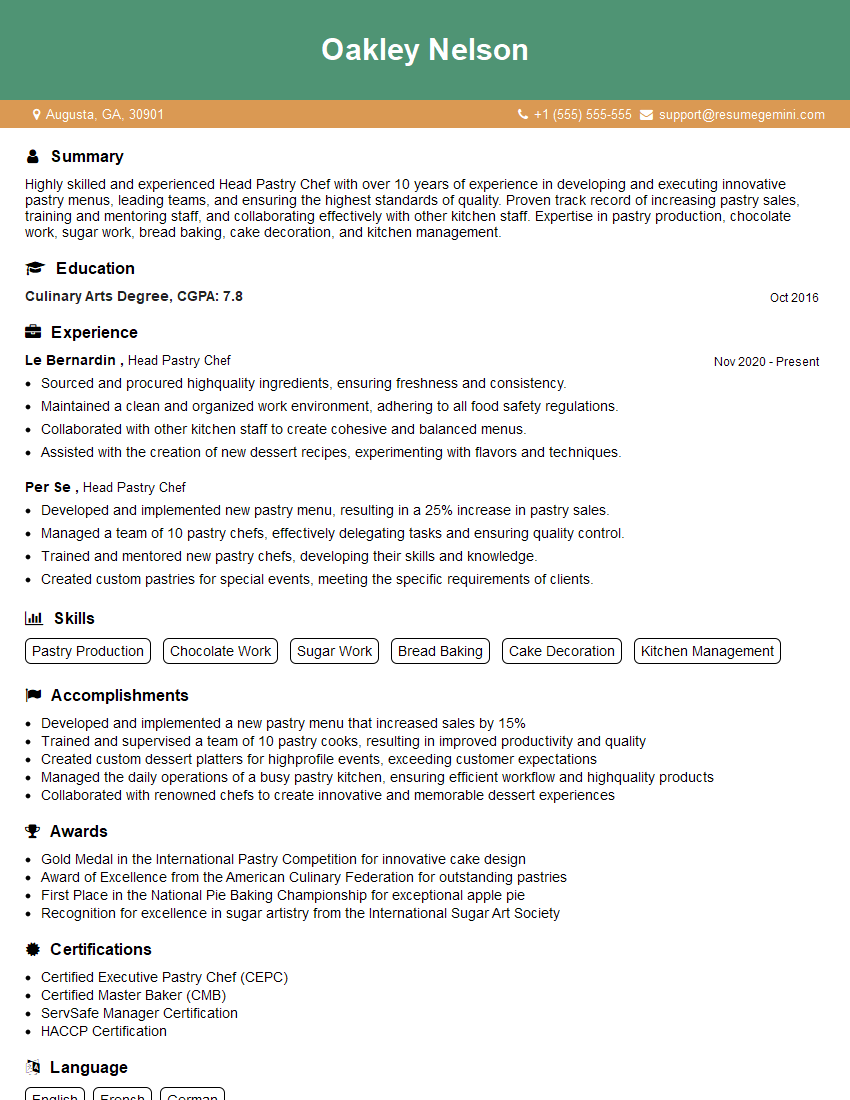
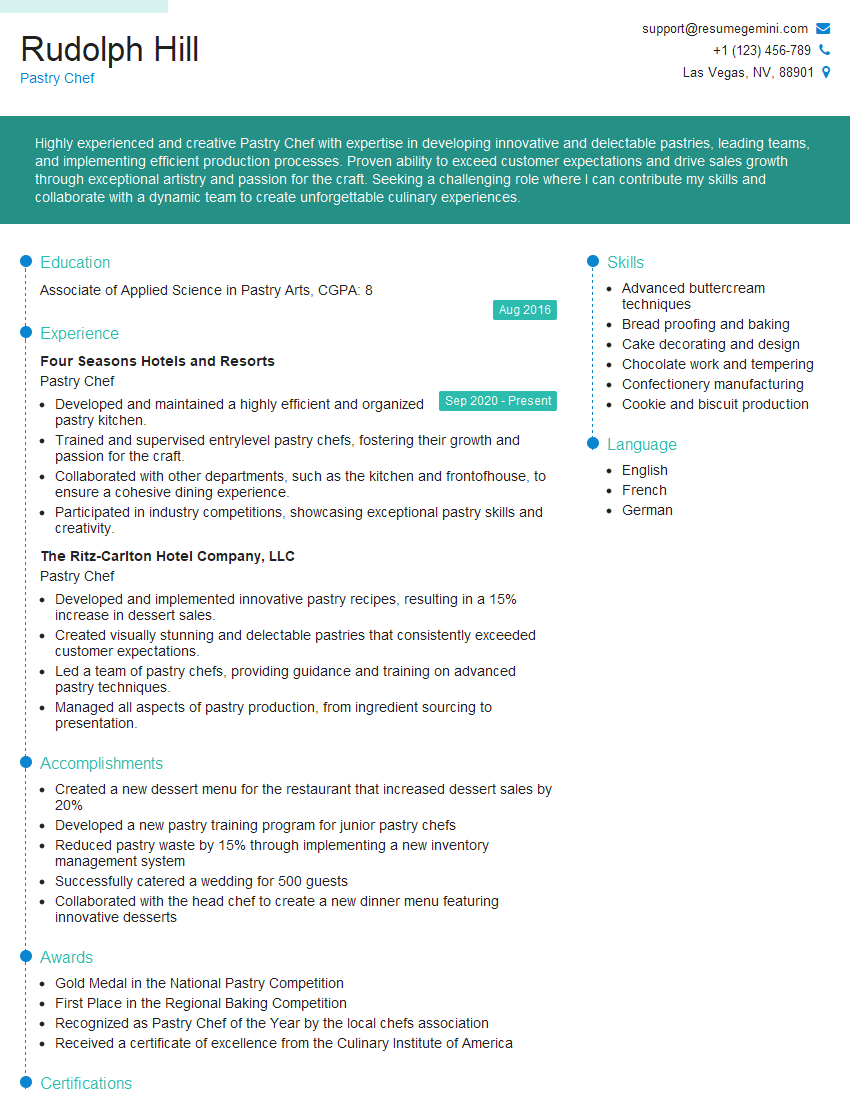
Mastering cake design techniques is crucial for career advancement in the competitive culinary arts industry. A strong foundation in these skills will open doors to exciting opportunities and higher earning potential. To make the most of your expertise, a well-crafted resume is essential. An ATS-friendly resume ensures your qualifications are effectively communicated to potential employers. We strongly encourage you to leverage ResumeGemini to build a professional and impactful resume that showcases your skills and experience in cake design techniques. Examples of resumes tailored specifically to this field are available to help you get started.
Explore more articles
Users Rating of Our Blogs
Share Your Experience
We value your feedback! Please rate our content and share your thoughts (optional).
What Readers Say About Our Blog
Very informative content, great job.
good