The thought of an interview can be nerve-wracking, but the right preparation can make all the difference. Explore this comprehensive guide to Chemical Blasting Equipment Operation interview questions and gain the confidence you need to showcase your abilities and secure the role.
Questions Asked in Chemical Blasting Equipment Operation Interview
Q 1. Describe the different types of chemical blasting agents used in your field.
Chemical blasting agents are carefully formulated mixtures designed to create a controlled explosion for various applications like mining, demolition, and quarrying. They’re categorized based on their composition and properties. Common types include:
- Ammonium Nitrate Fuel Oil (ANFO): This is the most widely used blasting agent, a simple but powerful mixture of ammonium nitrate (a fertilizer) and fuel oil. Its cost-effectiveness and ease of use make it ideal for large-scale operations. However, it’s sensitive to moisture and requires careful handling.
- Emulsions: These are more sophisticated blends of ammonium nitrate, fuel oil, and emulsifiers that create a stable, water-resistant mixture. Emulsions are denser and more powerful than ANFO, making them suitable for challenging conditions such as wet boreholes.
- Slurries: Similar to emulsions, slurries are thick, water-resistant mixtures. They often include additional additives to enhance their performance, such as sensitizers to improve their initiation characteristics. Slurries are particularly effective in confined spaces.
- Water gels: These are gel-like substances containing ammonium nitrate, fuel oil, and thickening agents. They offer a balance between the ease of handling of ANFO and the water resistance of emulsions.
The choice of blasting agent depends on factors such as the rock type, the required blasting power, environmental conditions, and cost considerations. For instance, in a wet quarry, an emulsion or slurry would be preferred over ANFO due to its superior water resistance.
Q 2. Explain the process of calculating the required amount of explosives for a specific blasting operation.
Calculating the required explosive charge involves several steps, and it’s crucial for safety and efficiency. It’s not a simple formula but a complex process that combines engineering principles and practical experience.
- Determine the desired fragmentation size: The size of the rock fragments needed influences the amount of explosive used. Smaller fragments require more explosives and a denser blasting pattern.
- Assess rock properties: The strength, density, and geological structure of the rock influence the blasting design. Hard rock necessitates a larger explosive charge than softer rock.
- Consider borehole diameter and spacing: The spacing and diameter of the boreholes where the explosives will be placed determine the distribution of energy and fragmentation.
- Use empirical formulas or software: Experienced blasters use empirical formulas, or sophisticated blasting design software, which takes into account all the above factors to predict the optimal charge weight. These programs simulate the blast and predict the fragmentation.
- Conduct field tests (if needed): Sometimes, trial blasts are conducted to fine-tune the explosive charge based on actual field conditions. This involves progressively adjusting the charge to find the optimal balance between fragmentation and ground vibration.
Imagine trying to break a large ice block. A small hammer blow might not break it, but too strong a blow might shatter it unnecessarily. Calculating explosive charge is similar – finding the right balance to achieve the desired effect.
Q 3. What safety precautions must be taken before, during, and after a chemical blasting operation?
Safety is paramount in chemical blasting. Rigorous safety protocols are implemented before, during, and after each operation.
- Before: This includes thorough site surveys, risk assessments, and pre-blast inspections. All personnel must receive comprehensive safety training and wear appropriate personal protective equipment (PPE) like hard hats, safety glasses, ear protection, and gloves. The area must be secured, and warning signs and barriers are set up to prevent unauthorized access.
- During: Strict adherence to established procedures during loading, initiating, and monitoring the blast is mandatory. A safe distance must be maintained from the blast site. Trained personnel monitor the blast remotely, and communication systems are in place to ensure swift and effective coordination.
- After: Post-blast inspections involve verifying that the blasting area is safe before personnel enter. Debris and unexploded materials must be carefully handled, and any environmental damage must be assessed and remediated.
Think of a surgeon performing a complex operation – meticulous preparation, precise execution, and careful post-operative care are essential to minimize risk and ensure a successful outcome. Blasting requires the same level of attention to safety.
Q 4. How do you ensure compliance with all relevant safety regulations and permits?
Compliance with safety regulations and permits is achieved through meticulous record-keeping and adherence to established protocols. This involves:
- Obtaining necessary permits: This requires submission of detailed plans, including blasting design and safety procedures, to regulatory authorities for approval.
- Maintaining detailed records: This includes recording pre-blast inspections, blasting logs, post-blast reports, and any incidents or near misses.
- Regular safety training: All personnel involved in chemical blasting undergo regular training to stay updated on best practices and safety regulations.
- Conducting routine inspections and maintenance: Chemical blasting equipment must be regularly inspected and maintained to ensure its proper functioning and safety.
- Auditing compliance: Internal and external audits are conducted regularly to assess and verify compliance with relevant regulations.
Think of a pilot adhering to air traffic control regulations – compliance is not just a suggestion, it’s mandatory to ensure safety and prevent accidents. Similarly, strict adherence to regulations is non-negotiable in chemical blasting.
Q 5. What are the common hazards associated with chemical blasting equipment operation and how do you mitigate them?
Chemical blasting presents several hazards, including:
- Explosions: Misfires, premature detonations, or accidental explosions can result in severe injuries or fatalities. Mitigation involves proper handling, storage, and initiation of explosives. Regular equipment inspections and adherence to safety protocols are vital.
- Ground vibrations: Blasting can cause ground vibrations that may damage nearby structures. Mitigation involves careful blasting design to minimize vibrations and monitoring vibration levels during blasting operations. Buffer zones around sensitive structures are often necessary.
- Flyrock: Fragments of rock can be ejected from the blast site at high velocities, posing a significant hazard. Mitigation includes proper stemming (filling the boreholes to contain the blast) and the use of protective barriers.
- Toxic fumes: Some blasting agents release toxic fumes that can be harmful to humans and the environment. Mitigation involves proper ventilation during and after blasting, and the use of respiratory protection if necessary.
Consider a volcano eruption – while nature is the primary driver, proper understanding and management are needed to minimize risks. The same logic applies to blasting – understanding the inherent hazards and employing appropriate mitigation strategies is essential.
Q 6. Explain the different types of initiation systems used in chemical blasting.
Initiation systems are crucial for safely and reliably initiating the detonation of chemical blasting agents. They provide the necessary energy to trigger the explosive reaction.
- Non-electric systems: These systems use shock tubes or detonating cord to initiate the explosives. They’re safer in environments with high electrical interference, or where the risk of accidental initiation from stray electricity is high. They are also easier to handle in wet environments.
- Electric systems: These use electric detonators that are connected to a blasting machine that delivers the electrical current. Electric systems are generally easier to use, especially in large blasts with multiple boreholes. However, care must be taken to prevent accidental initiation from stray electricity. Using a suitable blasting machine and safe cabling practices are essential.
- Electronic detonators: These advanced detonators offer precise timing control and improved safety features. They’re often used in complex blasting patterns to optimize fragmentation and minimize ground vibrations.
Think of a light switch – a simple mechanism that triggers a larger action. Initiation systems in blasting serve a similar purpose, triggering a carefully controlled chain reaction.
Q 7. Describe your experience with different types of blasting patterns and their applications.
Blasting patterns are designed to achieve the desired fragmentation and minimize unwanted effects like ground vibrations. Experience with various patterns is vital for effective blasting.
- Burn cut: This pattern is used to create a free face to facilitate the controlled breaking of the rock mass. It’s often the first step in larger blasting operations.
- Parallel drilling: This pattern involves drilling parallel boreholes, and it’s suitable for relatively uniform rock formations.
- Fan-shaped drilling: Used for breaking rock around a curved surface, and is very effective for precision demolition.
- Pre-split blasting: This method uses closely spaced boreholes to create a controlled crack in the rock, preventing uncontrolled fragmentation.
The choice of blasting pattern depends on factors such as the rock type, the desired fragmentation size, and the geometry of the excavation. For example, a burn cut might be ideal for a quarry face, while a pre-split pattern might be used to create a neat and clean cut during road construction. Experience helps in selecting the best pattern for each specific situation, taking account of the site characteristics and potential environmental impacts.
Q 8. How do you determine the appropriate blasting techniques for various geological conditions?
Selecting the right blasting technique hinges on understanding the rock mass characteristics. We need to consider factors like rock strength, fracturing, and the presence of water. For instance, a hard, massive rock formation might require a higher explosive charge density and a different initiation pattern compared to a fractured, weaker rock.
- Hard, intact rock: This often calls for a more concentrated charge, potentially using larger diameter boreholes and higher energy explosives. We might employ techniques like pre-splitting or smooth blasting to minimize damage to surrounding areas.
- Fractured or jointed rock: Here, a lower charge density and a more dispersed initiation system might be more appropriate to prevent excessive fragmentation and ground vibration. This often involves using smaller diameter boreholes and optimizing the burden and spacing between boreholes.
- Water-saturated rock: Water significantly affects the blasting process. It can dampen the explosive effect and increase the risk of flyrock. We’d need to incorporate techniques to control water ingress, such as using waterproof explosives or modifying the borehole design.
In practice, I always conduct a thorough geological investigation before recommending a blasting technique. This involves reviewing existing geological data, conducting site visits, and possibly taking rock samples for laboratory testing. This ensures the chosen technique is safe and efficient for the specific geological conditions.
Q 9. What are the environmental considerations when planning a chemical blasting operation?
Environmental considerations are paramount. We must minimize dust, noise, vibrations, and air and water pollution. Our planning incorporates several key measures:
- Dust Suppression: We use water sprays during and after blasting to control dust generation. The amount of water used is carefully calculated to minimize water runoff and potential environmental impacts.
- Noise Mitigation: We carefully select blasting times to minimize noise disturbance, often working during designated hours and employing noise barriers when possible. We also calculate and monitor blast vibrations to ensure compliance with regulations.
- Vibration Monitoring: This involves strategically placing vibration sensors to measure ground vibrations from the blast. This data ensures we remain within acceptable limits set by local regulations and protect nearby structures.
- Water Pollution Prevention: We use environmentally friendly explosives and implement measures to prevent contamination of surface and groundwater. This might include containing blast debris and ensuring proper disposal of waste materials.
- Air Quality Monitoring: Monitoring air quality before, during and after the blast to ensure compliance with air quality standards. Post-blast air sampling can ensure we meet acceptable limits.
For example, on a recent project near a sensitive ecosystem, we implemented a comprehensive environmental management plan that included detailed air and water quality monitoring, noise level analysis, and dust suppression measures. This proactive approach ensured the operation minimized its environmental footprint.
Q 10. How do you monitor and control vibrations during a chemical blasting operation?
Vibration control is crucial to protect nearby structures and the environment. We use a multi-pronged approach:
- Pre-blast vibration modelling: Sophisticated software predicts vibration levels based on factors like charge size, distance to sensitive structures, and geological conditions. This allows us to optimize the blast design for minimal vibration.
- Vibration monitoring: During the blasting operation, seismographs record ground vibrations at strategically located monitoring stations. Real-time data ensures we stay within pre-defined limits.
- Optimized blasting design: This involves carefully choosing the type and amount of explosives, borehole patterns, and initiation systems to minimize vibration generation. Techniques like smooth blasting or pre-splitting can reduce vibrations.
- Buffer zones: Establishing safety zones between the blast site and nearby structures, and using specialized blasting techniques in the vicinity of sensitive locations such as underground pipelines.
If vibrations exceed the pre-determined limits, we immediately halt the operation and investigate the cause. This might involve adjusting the blast design or changing the blasting parameters.
Q 11. What is your experience with different types of blasting equipment, such as detonators, initiators and blasting machines?
My experience encompasses a wide range of blasting equipment. I’m proficient with various detonators, including non-electric, electric, and electronic detonators. Non-electric detonators offer safety advantages in certain conditions. Electronic detonators allow for precise timing and sequencing, crucial for complex blasting operations. I have experience with different initiators such as shock tubes and detonating cord, each suited to specific applications.
My experience with blasting machines ranges from simple, hand-held units to advanced, computerized systems. I’m familiar with their operation, maintenance, and safety procedures. Understanding the specific capabilities and limitations of different machines is essential for selecting the right equipment for a given project.
For instance, I’ve used millisecond delay detonators to control fragmentation during a large-scale quarry blasting operation. In another project involving a sensitive infrastructure, I relied on non-electric detonators to mitigate the risk of stray electrical currents triggering accidental explosions.
Q 12. Describe your experience with troubleshooting and maintaining chemical blasting equipment.
Troubleshooting and maintaining blasting equipment are critical aspects of my role. Regular inspections are essential to identify potential problems early on. This involves checking for damage, wear and tear, and ensuring proper functioning of all components. I’m adept at diagnosing problems and performing necessary repairs, or calling in specialized support when necessary.
For example, I once encountered a situation where a blasting machine failed to initiate the detonators correctly. Through systematic troubleshooting, I identified a faulty connection within the machine’s circuitry. By replacing the faulty component and performing a thorough test, I was able to restore the system’s functionality and avoid a costly delay to the project.
Moreover, I adhere to strict safety protocols throughout the process, ensuring all equipment is handled and maintained according to the manufacturer’s instructions and all relevant safety regulations.
Q 13. How do you conduct a pre-blast survey and risk assessment?
A pre-blast survey and risk assessment are vital to ensure a safe and successful operation. This involves a multi-step process:
- Site reconnaissance: A thorough examination of the site to identify potential hazards, including geological features, nearby structures, utilities, and environmental sensitivities.
- Geological investigation: Determining rock type, strength, fracturing, and the presence of water. This often involves drilling and sampling.
- Hazard identification and risk assessment: Identifying potential hazards such as flyrock, ground vibrations, airblast, and environmental impacts. A quantitative risk assessment determines the likelihood and severity of these hazards.
- Development of a blasting plan: Based on the assessment, we develop a detailed plan that includes charge design, initiation sequence, and safety measures.
- Consultation with stakeholders: Engaging with relevant parties, such as landowners, residents, and regulatory agencies, to address concerns and ensure transparency.
For a recent project near a residential area, the pre-blast survey revealed the presence of sensitive structures within close proximity to the blast site. This led to a revised blasting plan that incorporated reduced charge sizes, precise initiation timing, and vibration monitoring to minimize impacts on the nearby homes.
Q 14. What is your experience with post-blast inspections and documentation?
Post-blast inspections and documentation are crucial for evaluating the effectiveness and safety of the operation. They help identify areas for improvement and ensure compliance with regulations.
- Assessment of fragmentation: Checking the size and distribution of fragmented rock to ensure it meets specifications. Insufficient fragmentation might require adjustments to the blasting design for future operations.
- Inspection for damage: Careful examination of the blast site and surrounding areas to check for any damage to structures, equipment, or the environment. This includes checking for any evidence of flyrock or ground heave.
- Data analysis: Reviewing vibration and airblast data to verify compliance with pre-set limits and identify potential areas for improvement in future blasting operations.
- Documentation: Maintaining thorough records of all aspects of the operation, including pre-blast surveys, blasting parameters, post-blast inspections, and any corrective actions taken. This documentation is essential for auditing and future reference.
Detailed documentation and post-blast analysis is important for continuous improvement and learning. By analyzing post-blast data from previous projects, we can continually refine our techniques, improve our safety protocols, and ultimately ensure more efficient and environmentally conscious blasting operations.
Q 15. How do you handle unexpected situations or emergencies during a blasting operation?
Unexpected situations during blasting operations demand immediate, decisive action based on thorough training and established emergency protocols. My approach prioritizes safety above all else. Think of it like a fire drill – we’ve practiced so much that reacting under pressure becomes second nature.
Immediate Assessment: First, I’d quickly assess the situation: Is there an immediate danger to personnel? Has there been a misfire? A premature blast? What’s the extent of any damage?
Emergency Procedures: Following the assessment, I would implement our pre-established emergency response plan, including evacuation procedures and contacting emergency services if necessary. This plan includes designated safe zones and communication channels.
Communication: Clear and concise communication with the team is crucial. We use pre-designated signals and radios to ensure everyone understands the situation and their roles in the emergency response. This is critical to prevent panic and ensure coordinated action.
Post-Incident Review: Following resolution of the emergency, a thorough investigation is conducted to determine the root cause of the incident, implement corrective actions, and prevent recurrence. This includes documenting everything for a comprehensive report.
For example, if a misfire occurs, we have a strict protocol involving a mandatory waiting period before any attempt to investigate or disarm. Safety is paramount; rushing could be disastrous.
Career Expert Tips:
- Ace those interviews! Prepare effectively by reviewing the Top 50 Most Common Interview Questions on ResumeGemini.
- Navigate your job search with confidence! Explore a wide range of Career Tips on ResumeGemini. Learn about common challenges and recommendations to overcome them.
- Craft the perfect resume! Master the Art of Resume Writing with ResumeGemini’s guide. Showcase your unique qualifications and achievements effectively.
- Don’t miss out on holiday savings! Build your dream resume with ResumeGemini’s ATS optimized templates.
Q 16. Explain your understanding of different blasting techniques, like emulsion blasting or ANFO blasting.
Different blasting techniques cater to specific geological conditions and project needs. The choice depends on factors like the rock type, desired fragmentation size, and environmental considerations.
ANFO (Ammonium Nitrate-Fuel Oil): This is a widely used, cost-effective blasting agent. It’s a mixture of ammonium nitrate (a fertilizer) and fuel oil. ANFO is relatively insensitive, requiring a strong detonator. It’s ideal for large-scale projects in relatively homogenous rock formations. Think large open-pit mines.
Emulsion Blasting: Emulsion explosives are more powerful and water-resistant than ANFO. They consist of microscopic droplets of fuel and oxidizer suspended in water. The addition of sensitizers increases their sensitivity, making them suitable for challenging applications in wet or difficult-to-blast rock. This would be preferable in underwater blasting or in areas with high water content.
The key difference lies in sensitivity and water resistance. ANFO is cheaper but less versatile, while emulsion is more expensive but offers superior performance in adverse conditions. Selecting the right technique requires a thorough understanding of the site-specific conditions and project objectives.
Q 17. How do you ensure the proper storage and handling of explosives?
Safe storage and handling of explosives is paramount. It’s not just about following regulations; it’s about protecting lives and preventing environmental damage. We treat explosives with the utmost respect, akin to handling hazardous materials in a nuclear power plant.
Designated Magazine: Explosives are stored in a secure, purpose-built magazine, far from ignition sources, human habitation, and potential hazards. This magazine adheres to strict safety standards and regulations, regularly inspected for structural integrity and security.
Inventory Control: Strict inventory control measures are followed to track the quantity and type of explosives, ensuring proper accountability and preventing unauthorized access. This includes detailed logs and regular audits.
Transportation: Transportation of explosives is conducted following all relevant regulations and using specifically designed vehicles to minimize risk. This includes secure containers, appropriate speed limits, and avoidance of populated areas.
Handling Procedures: Strict handling procedures are followed, emphasizing minimizing friction, static electricity, and exposure to heat or impact. Personnel receive extensive training in safe handling techniques.
A lapse in safety protocol here can be catastrophic. Every step in the process, from storage to transportation and use, requires precision and adherence to regulations.
Q 18. What is your experience with different types of blasting caps and their applications?
Blasting caps are essential for initiating the detonation of explosives. Different types are used depending on the specific application and desired detonation characteristics. We choose them like selecting the right tool for a specific job.
Electric Blasting Caps: These are initiated by an electric current from a blasting machine. They offer precise control and synchronization of multiple blasts, useful in large-scale operations where precise timing is crucial.
Non-Electric Blasting Caps: These use shock tubes or detonating cord to initiate the detonation. They are safer in environments with potential electrical hazards and are often preferred in wet conditions.
Delay Blasting Caps: These introduce a time delay between detonations, creating a controlled sequence of blasts. This is important for creating controlled fragmentation and minimizing ground vibrations.
Choosing the wrong type of blasting cap can lead to misfires, premature detonations, or incomplete blasting. Therefore, careful selection and handling are paramount.
Q 19. Explain the importance of maintaining accurate blasting records and logs.
Accurate blasting records are critical for safety, efficiency, and legal compliance. They act as a vital history of the blasting operations, which is essential for future reference and analysis.
Safety: Records provide a detailed account of each blast, including the type and amount of explosives used, the location, and the timing. This information is essential for investigating any incidents or accidents.
Efficiency: Accurate records allow us to analyze past blasts to optimize future operations, improving efficiency and reducing costs. We can identify which techniques yielded the best results and which areas need improvement.
Legal Compliance: Blasting operations are heavily regulated. Maintaining thorough records ensures compliance with local, regional, and national regulations, avoiding potential legal issues or fines.
Imagine trying to troubleshoot a problem without a record of what happened before. It would be impossible. Our records are essential for continuous improvement and for ensuring we always operate within legal and safety guidelines.
Q 20. How do you communicate effectively with other team members during a blasting operation?
Effective communication is the cornerstone of safety in any blasting operation. It’s not just about talking; it’s about ensuring everyone understands and acknowledges the message. Think of it like a well-orchestrated symphony; each section needs to be in sync.
Pre-Blast Meeting: Before every blast, we hold a mandatory pre-blast meeting to discuss the plan, safety procedures, and potential hazards. Everyone has a chance to ask questions and raise concerns.
Clear Signals: We use standardized signals, both visual and auditory, to communicate during the blasting process. These are pre-determined and clearly understood by all team members. This eliminates ambiguity and ensures quick, coordinated action.
Radios: We utilize two-way radios for immediate communication during the blast. This is critical for relaying information quickly in case of unexpected events or emergencies.
Post-Blast Report: After each blast, we conduct a post-blast report to review what went well, what could be improved, and address any issues that arose. This ensures continuous improvement.
Communication is not an afterthought; it’s a critical element, woven into every stage of the operation. A miscommunication can have devastating consequences.
Q 21. Describe your experience with using blasting software or other relevant technology.
I have extensive experience utilizing blasting software and other relevant technology to enhance efficiency, safety, and precision in blasting operations. This technology is as essential as the equipment itself.
Blast Design Software: I’m proficient in using various software packages for designing blasts, optimizing charge placement, and predicting blast outcomes. This includes modeling the blast’s effects on the surrounding environment.
Data Acquisition Systems: I’ve worked with data acquisition systems to record vibration, air overpressure, and other parameters during and after blasting. This data is crucial for analyzing the effectiveness of the blast and ensuring compliance with regulations.
Remote Blasting Systems: I’m experienced in using remote blasting systems to initiate blasts from a safe distance. This increases safety by minimizing the risk of personnel exposure to hazards.
Technology plays a crucial role in modern blasting. It enhances accuracy, safety, and efficiency, making operations safer and more cost-effective. My expertise extends beyond just the physical aspects of the work to encompass the advanced technological tools that are integral to responsible blasting operations.
Q 22. What are the key differences between surface and underground blasting operations?
Surface and underground blasting, while both utilizing chemical explosives, differ significantly in their execution and safety protocols. Surface blasting involves open-air detonations, generally simpler to manage in terms of ventilation and access. However, it poses risks related to flyrock (fragments ejected during the blast), airblast (shockwave), and ground vibration affecting nearby structures and the environment. Underground blasting, on the other hand, presents unique challenges related to confined spaces. Ventilation is crucial to prevent the buildup of toxic gases produced during detonation. Controlling ground vibration and ensuring the structural integrity of the mine are paramount. Furthermore, access and evacuation procedures are much more complex in underground operations. Think of it like this: surface blasting is like carefully popping a balloon outside, while underground blasting is like popping a balloon inside a tightly sealed room – you need much greater control and precautions.
- Surface Blasting: Simpler setup, greater risk of flyrock and airblast, easier access and post-blast inspection.
- Underground Blasting: More complex setup, risk of gas buildup and roof collapse, challenging access and ventilation management.
Q 23. How do you manage the disposal of leftover explosives or blasting materials?
Disposal of leftover explosives is governed by strict regulations and must be handled by licensed personnel. Absolutely no unauthorized disposal is permitted. Generally, we follow a strict protocol. First, we segregate and carefully package the remaining explosives according to their type and sensitivity. This usually involves returning them to their original containers or using designated, approved secondary containers. Next, the explosives are transported back to a licensed storage facility, adhering to all transportation regulations. For smaller quantities of unusable materials, we might utilize controlled burn-offs under the strict supervision of a blasting expert and with appropriate permits, ensuring complete destruction and minimal environmental impact. Improper disposal is not only illegal but extremely hazardous. This process is similar to how a hospital would dispose of hazardous medical waste, prioritizing safety and regulatory compliance above all.
Q 24. Describe your experience with different types of stemming materials and techniques.
Stemming materials are crucial for channeling the explosive force in a controlled manner and preventing premature detonation. I have extensive experience with various types, including inert materials like sand, clay, or stemming plugs, and more specialized materials like non-combustible stemming compounds. The choice depends on the specific application, rock type, and blasting design. For instance, in hard rock conditions, a denser stemming material like stemming plugs might be preferred to effectively contain the explosive energy. In softer formations, a more readily available material like sand or clay might be sufficient. The stemming technique also varies; we can use manual stemming, pneumatic stemming equipment, or even specialized stemming tools depending on the project’s scale and requirements. Imagine stemming as a cork in a champagne bottle – it controls the release of pressure.
- Sand Stemming: Cost-effective and readily available.
- Clay Stemming: Forms a good seal and is easy to use.
- Stemming Plugs: Durable and suitable for deep boreholes.
Q 25. What is your understanding of the legal and regulatory requirements for chemical blasting?
Chemical blasting is heavily regulated, varying slightly by region. These regulations encompass all aspects of the process, from the licensing and training of personnel to the transportation, storage, and handling of explosives. Key regulations often cover aspects such as blast design, safety procedures, environmental protection, and emergency response plans. For example, there are detailed specifications for blast mats and safety distances. Non-compliance can lead to severe penalties, including fines and suspension of licenses. Thorough understanding and adherence to these regulations is not only a legal requirement but also essential for ensuring safety and preventing accidents. I regularly review and stay updated on all relevant local, state, and federal regulations to maintain compliance. Think of these regulations as a very detailed instruction manual – crucial for a safe and successful blasting operation.
Q 26. How do you ensure the safety of personnel and equipment during a blasting operation?
Safety is paramount in chemical blasting. We meticulously follow a comprehensive safety plan that covers every stage of the operation. This includes thorough risk assessments, pre-blast surveys, and detailed safety briefings for all personnel. We establish clear communication protocols, using designated personnel for safety checks and emergency responses. Proper use of personal protective equipment (PPE), such as safety glasses, hard hats, ear protection, and protective clothing, is strictly enforced. Furthermore, we implement strict control zones around the blast site, ensuring that unauthorized personnel are kept at a safe distance. We also conduct regular equipment inspections to prevent mechanical failures. Pre-blast safety checks are crucial, and we ensure that everything is in perfect working order before proceeding. This is akin to a pilot conducting pre-flight checks before takeoff, prioritizing safety above all else.
Q 27. How do you conduct a post-blast analysis to determine the effectiveness of the blasting operation?
Post-blast analysis is crucial to evaluate the effectiveness and safety of the operation. This involves multiple steps. Firstly, we assess the fragmentation and muck pile characteristics to determine whether the blasting achieved the desired rock breakage. We then analyze ground vibrations and air overpressure data, collected by monitoring devices during the blast, to assess compliance with environmental regulations and to identify areas for improvement in future blasts. Finally, a thorough review of safety records ensures that all procedures were followed correctly and no incidents occurred. Through this analysis, we can optimize future blasting designs and enhance safety protocols. This iterative process, similar to a scientific experiment, is vital for continuous improvement.
Q 28. Explain your experience with various types of delay systems used in chemical blasting.
I have experience with various delay systems, from non-electric to electronic detonators. Non-electric systems use shock tubes, offering simplicity and reliability in certain conditions. However, they can be less precise in terms of timing than electronic systems. Electronic systems, using detonators programmed with precise delay times, provide greater control and allow for complex blast designs optimized for specific geological conditions and fragmentation requirements. The choice of delay system depends on the specific project needs, geological conditions, and safety requirements. For instance, in large-scale quarrying operations, electronic delay systems are frequently chosen for their precision and ability to control vibration and fragmentation. Selection of the right system, much like choosing the right tool for a job, ensures effectiveness and safety.
Key Topics to Learn for Chemical Blasting Equipment Operation Interview
- Safety Procedures and Regulations: Understanding and adhering to all relevant safety protocols, including pre-blast surveys, hazard identification, and emergency response plans. This includes familiarity with relevant legislation and industry best practices.
- Equipment Operation and Maintenance: Detailed knowledge of the mechanical and electrical components of various chemical blasting systems, including their proper operation, troubleshooting, and preventative maintenance. Practical experience with different types of equipment is highly valuable.
- Chemical Handling and Mixing: Safe and efficient handling of explosives and related chemicals, understanding the properties and potential hazards of each component, and mastering the precise mixing procedures required for different blasting applications.
- Blasting Design and Calculations: Ability to perform calculations related to charge weight, initiation systems, and expected blast effects. This includes understanding the factors influencing blast design, such as rock type, desired fragmentation, and environmental considerations.
- Data Analysis and Reporting: Analyzing blast results, including vibration monitoring and post-blast assessments. Accurately documenting procedures and results for compliance and continuous improvement.
- Troubleshooting and Problem-Solving: Identifying and resolving equipment malfunctions, analyzing unexpected blast outcomes, and implementing corrective actions. This requires a strong understanding of the entire blasting process and the ability to think critically under pressure.
- Environmental Considerations: Understanding and minimizing the environmental impact of blasting operations, including dust control, noise mitigation, and water management. This demonstrates responsibility and awareness of industry best practices.
Next Steps
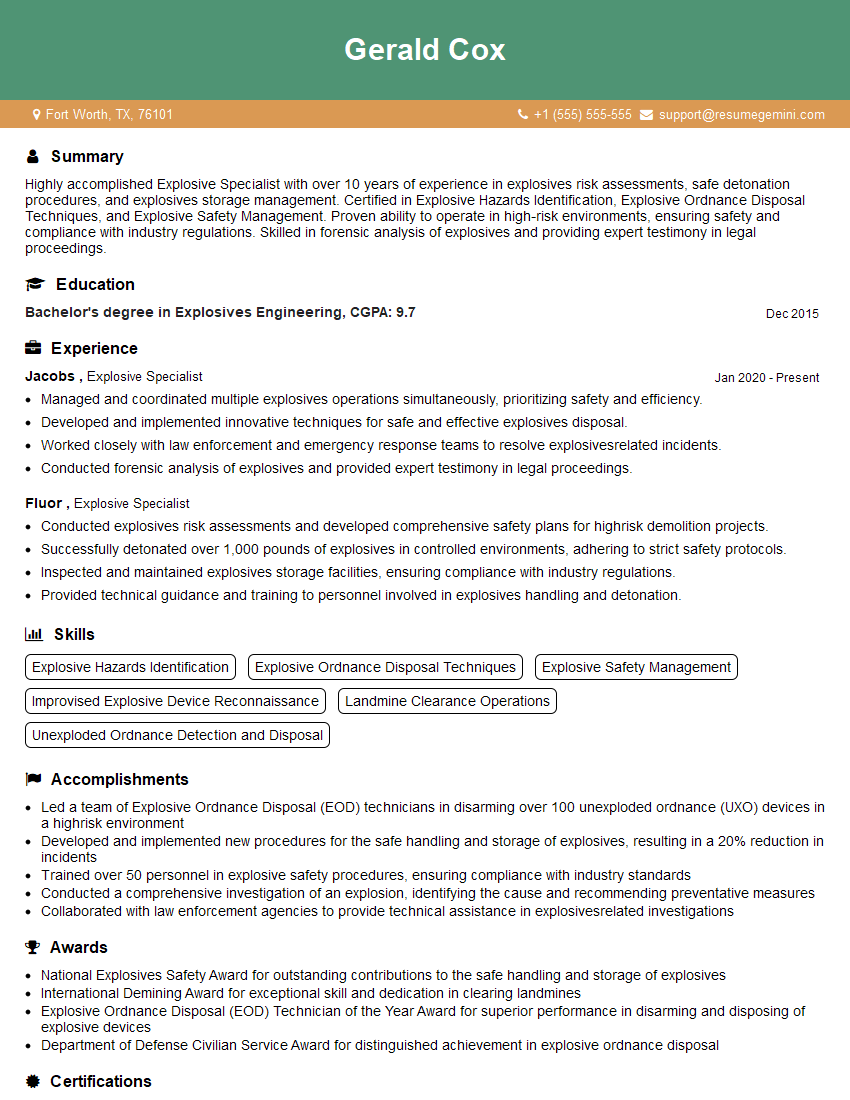
Mastering Chemical Blasting Equipment Operation opens doors to exciting and rewarding career opportunities in mining, construction, and other related industries. Advancement often hinges on demonstrating a strong understanding of both theory and practical application. To stand out, you need a resume that clearly showcases your skills and experience to Applicant Tracking Systems (ATS). Creating an ATS-friendly resume is crucial for maximizing your job prospects. ResumeGemini is a trusted resource that can help you build a professional and effective resume tailored to your experience. Examples of resumes tailored to Chemical Blasting Equipment Operation are available to help you craft the perfect application.
Explore more articles
Users Rating of Our Blogs
Share Your Experience
We value your feedback! Please rate our content and share your thoughts (optional).
What Readers Say About Our Blog
Very informative content, great job.
good