Are you ready to stand out in your next interview? Understanding and preparing for Prop and Set Management interview questions is a game-changer. In this blog, we’ve compiled key questions and expert advice to help you showcase your skills with confidence and precision. Let’s get started on your journey to acing the interview.
Questions Asked in Prop and Set Management Interview
Q 1. Describe your experience with prop budgeting and tracking.
Prop budgeting is crucial for successful productions. It involves meticulously estimating the costs associated with every prop, from sourcing and acquisition to maintenance and eventual disposal. This requires a deep understanding of market prices, potential rental fees, and the construction costs of bespoke items. I utilize spreadsheet software like Excel or Google Sheets to create detailed budgets, categorizing each prop and allocating funds. Each prop is assigned a unique ID for easy tracking and cross-referencing with purchase orders and invoices. For example, in a recent period drama, I broke down the budget into categories like ‘Period Furniture,’ ‘Costumes,’ ‘Small Props,’ each with their own sub-categories and detailed cost estimations. Throughout the production, I continuously track expenses against the budget, identifying potential overruns early and making necessary adjustments to avoid financial issues. Regular reports are created showing actual versus budgeted costs, enabling proactive management and informed decision-making.
Q 2. How do you handle last-minute prop changes on set?
Last-minute prop changes are a common occurrence in film and television. My approach is to remain calm, assess the situation swiftly, and communicate effectively. First, I pinpoint the nature of the change and its potential impact on the schedule and budget. Then, I immediately brainstorm solutions. This could involve substituting with an existing prop, quickly sourcing a replacement, or even constructing a temporary substitute if time allows. For example, if a key prop malfunctions just before a crucial scene, I would first try to repair it. If that’s not feasible, I might quickly locate a similar prop from our stock or from a nearby prop house. Clear communication with the director, art director, and production team is paramount, keeping them updated on the progress and any potential delays or cost implications. Maintaining a flexible and resourceful attitude is key to navigating such challenges.
Q 3. Explain your process for sourcing and acquiring props.
Sourcing props is a multifaceted process requiring creativity and resourcefulness. It begins with a thorough understanding of the script and art department’s vision. I typically start by reviewing the prop list, identifying items already in our stock, and then determining what needs to be acquired. My sourcing methods include:
- Prop Houses: These are essential resources for renting or purchasing a wide variety of props.
- Online Marketplaces: Websites like eBay and specialized auction sites can unearth unique and cost-effective items.
- Antique Shops and Flea Markets: These offer opportunities to discover authentic period props.
- Custom Fabrication: For unique or specialized props, we collaborate with skilled craftspeople.
- Production Purchases: Direct purchases from manufacturers or suppliers, particularly for mass-produced items.
Q 4. What software do you use for prop inventory management?
For prop inventory management, I utilize a combination of software and systems. A robust database system (I’ve used FileMaker Pro extensively, but other systems like Airtable can also be effective) is central to tracking our entire prop inventory. This includes detailed information for each item: name, description, condition, location, rental/purchase history, and associated images. This allows us to instantly search our database by keyword, ID number, or category. For simpler tracking, a spreadsheet system can be efficient, particularly for smaller productions. This integrated approach ensures efficient inventory management, reducing discrepancies and streamline the entire prop handling process. Using barcode or QR code scanning alongside the database further enhances accuracy and speed.
Q 5. How do you ensure prop safety on set?
Ensuring prop safety is a paramount concern. This starts with a thorough risk assessment, identifying potentially hazardous props and devising safety protocols. I implement strict handling procedures, establishing clear guidelines for the team. For example, fragile items are carefully handled and stored, sharp objects are sheathed, and hazardous materials are stored securely and handled only by trained personnel. Regular inspections are crucial. I often organize weekly walkthroughs to identify potential risks, ensuring that props are stored and handled correctly, and any damage is immediately addressed. Safety briefings for all team members, including props assistants and set crew, are mandatory. The use of appropriate PPE (Personal Protective Equipment) is strictly enforced when dealing with potentially dangerous props. A detailed safety log is maintained to record any incidents and subsequent corrective actions.
Q 6. Describe your experience with prop maintenance and repair.
Prop maintenance and repair are crucial for extending the lifespan of our assets. My approach involves regular inspections, identifying damage and wear and tear promptly. This often involves detailed checks after each use. Minor repairs, such as tightening screws or patching minor damage, are often done in-house. We maintain a dedicated workshop space equipped with necessary tools and materials for common repairs. For more complex repairs, I engage skilled professionals, ensuring the quality of restoration work and proper documentation of repairs. A detailed maintenance log is kept for each prop, tracking repairs, cleaning, and any necessary restoration work. This enables proactive maintenance, ensuring that our props are always in optimal condition for use and extends their overall service life. Preventing damage through careful handling and proper storage is just as important as repairing damage after it occurs.
Q 7. How do you manage a large team of prop assistants?
Managing a large team of prop assistants requires strong leadership, effective communication, and clear delegation. I start by assigning clear roles and responsibilities, ensuring each assistant understands their tasks and how they contribute to the overall goal. Regular team meetings are crucial for coordinating tasks, addressing challenges, and maintaining open communication. I use project management tools (like Trello or Asana) to assign tasks, track progress, and ensure everyone is on the same page. Clear and concise communication is essential, whether through written instructions, daily briefings, or informal check-ins. Providing regular feedback and recognition of achievements fosters motivation and team cohesion. Openness to feedback and valuing the contribution of each team member builds trust and respect, resulting in a highly efficient and productive working environment. I believe in fostering a collaborative spirit, encouraging teamwork and problem-solving among the team members.
Q 8. Explain your approach to working with different departments on set.
Collaboration is key in set management. My approach to working with different departments involves proactive communication, clear expectations, and a collaborative problem-solving mindset. I believe in establishing strong working relationships built on mutual respect and understanding.
- Pre-Production: I schedule meetings with key departments (art department, wardrobe, special effects, etc.) to discuss prop needs, availability, and potential challenges early on. This ensures everyone is on the same page from the start and prevents costly last-minute changes.
- Production: I maintain open communication channels, using daily reports, email updates, and regular check-ins to keep everyone informed of the prop status. I am always available to address questions and concerns promptly.
- Post-Production: I follow up on prop returns and accounting to ensure everything is properly documented and returned to storage.
For example, during a historical drama, I worked closely with the art department to source period-accurate furniture and ensured the wardrobe department had the correct props to complete specific scenes. By facilitating this open dialogue, we avoided conflicts and maintained a smooth workflow.
Q 9. How do you handle damaged or lost props?
Handling damaged or lost props requires a systematic approach involving immediate action, thorough documentation, and communication with the relevant parties.
- Immediate Action: I photograph and document any damage immediately, noting the extent of the damage and the circumstances under which it occurred. This is vital for insurance claims.
- Reporting: I file a detailed report with the production manager and the prop master, outlining the incident, the affected prop(s), and the estimated cost of repair or replacement.
- Repair or Replacement: If repairable, I’ll coordinate with a qualified artisan; otherwise, I will source a replacement, keeping in mind budget considerations and the production timeline.
- Insurance Claim (if applicable): I work with the production’s insurance provider to file a claim for damaged or lost props.
For instance, if a valuable antique chair was damaged during a scene, I’d immediately photograph the damage, report it, and explore options like repair by a specialist or replacement using insurance funds. Transparency and prompt action prevent larger issues from arising.
Q 10. What is your experience with different prop types (antique, special effects, etc.)?
My experience encompasses a wide range of prop types, requiring specialized handling and care for each category.
- Antique Props: I possess experience in handling fragile and valuable antique pieces, understanding their proper handling, storage, and preservation techniques. This includes working with conservators and ensuring appropriate environmental controls.
- Special Effects Props: I’m proficient in managing props requiring special effects, such as pyrotechnics, weaponry (replicas), and breakable items, working closely with the special effects team to guarantee safe and effective execution.
- Digital Assets: I am also familiar with managing 3D-printed props, digital models and their integration into set production. Understanding file formats and working with the visual effects team is a crucial aspect of this.
- Everyday Props: I also have extensive experience procuring and managing common props needed for everyday scenes. This includes food props, everyday items, and set dressing.
For example, I successfully managed the handling of a rare 18th-century desk (requiring climate-controlled storage) while also overseeing the safe use and disposal of breakaway furniture used in a stunt sequence.
Q 11. How do you prioritize tasks when faced with competing deadlines?
Prioritizing tasks with competing deadlines requires a strategic approach, combining effective planning with flexible adaptation.
- Prioritization Matrix: I use a prioritization matrix (e.g., Eisenhower Matrix – Urgent/Important) to categorize tasks based on their urgency and importance. This allows me to focus on the most critical tasks first.
- Time Management: I employ time management techniques such as time blocking and the Pomodoro Technique to allocate time effectively and avoid task switching.
- Communication: I communicate openly with the production team about potential delays and adjust the schedule accordingly, collaborating to find solutions.
- Contingency Planning: I have a backup plan in case unforeseen circumstances arise (e.g., a prop is damaged unexpectedly). This allows me to mitigate risks and continue on schedule.
For instance, if faced with simultaneously needing to source period-accurate props and manage props for a crucial action sequence, I’d prioritize the action sequence props due to their immediate need and the potential for delays affecting other departments.
Q 12. Describe your experience working with digital assets related to props.
My experience with digital assets related to props includes collaborating with the art and VFX teams in the process of 3D modeling, texturing, rendering, and integrating them into a production workflow.
- 3D Model Management: I can manage files in various formats (e.g., .fbx, .obj, .ma). I understand the importance of proper file naming conventions and organization for efficient collaboration.
- Asset Tracking: I can track digital assets, ensuring versions are properly managed and updated, preventing confusion and duplication.
- Integration: I am proficient in working with the VFX team to integrate digital props seamlessly into live-action footage.
For example, I collaborated with a VFX team to create a highly realistic digital version of a prop that was too difficult or expensive to create physically. This ensured the desired visual effect was achieved while maintaining budget and time constraints.
Q 13. Explain your understanding of prop acquisition rights and licensing.
Understanding prop acquisition rights and licensing is crucial for avoiding legal issues and protecting the production.
- Copyright and Trademark: I’m aware of copyright and trademark laws relating to the use of props, especially those bearing logos, intellectual property, or artistic designs.
- Licensing Agreements: I’m familiar with negotiating and obtaining licenses when necessary, especially for using copyrighted materials, logos or branded products.
- Usage Rights: I ensure that any use of a prop falls under the agreed-upon licensing terms, adhering to restrictions on usage, duration, and modifications.
- Permissions: I obtain permissions when necessary, such as when using private property or filming on a location requiring special permission.
For example, if a scene requires using a specific brand’s product, I’d proactively contact the brand to obtain permission to use it and ensure we adhere to all their requirements before incorporating it into the set.
Q 14. How do you deal with difficult or demanding crew members?
Handling difficult or demanding crew members requires tact, diplomacy, and a problem-solving approach that prioritizes collaboration and respect.
- Understanding the Root Cause: I try to understand the underlying reasons for their behavior – stress, lack of communication, or unmet needs.
- Direct but Respectful Communication: I approach them directly but respectfully, voicing concerns while actively listening to their perspectives.
- Mediation (if needed): If the issue impacts others, I may involve the production manager or other relevant personnel to mediate the situation.
- Professional Boundaries: I maintain professional boundaries, focusing on resolving the issue at hand, while avoiding personal conflict.
For example, if a crew member consistently missed deadlines, I’d address it calmly and collaboratively, perhaps by offering support or discussing any workflow issues impacting their performance.
Q 15. Describe a time you had to solve a complex prop-related problem.
One of the most challenging prop-related issues I encountered was during a period drama film where we needed to recreate a historically accurate apothecary shop. The director insisted on complete authenticity, down to the labels on the jars and the composition of the ‘potions.’
The complexity stemmed from sourcing period-appropriate bottles and jars, many of which were unavailable commercially. We also faced the challenge of creating convincing-looking but safe ‘potions,’ requiring extensive research into historical recipes and adapting them for modern safety standards.
My solution involved a multi-pronged approach:
- Sourcing: We contacted antique dealers, museums, and even historical societies to locate and rent suitable containers. For items that couldn’t be found, we employed a skilled prop maker who replicated the historical designs.
- ‘Potion’ Creation: I collaborated with a chemist to develop non-toxic, visually realistic ‘potions’ that would meet the director’s aesthetic requirements and film safety regulations. We used food coloring, glycerin, and other safe ingredients to achieve the desired appearance and consistency.
- Labeling: We engaged a calligrapher to create historically accurate labels based on our research, ensuring both authenticity and readability on camera.
The final result was a convincing and historically accurate apothecary shop that met the director’s vision without compromising on safety or budget.
Career Expert Tips:
- Ace those interviews! Prepare effectively by reviewing the Top 50 Most Common Interview Questions on ResumeGemini.
- Navigate your job search with confidence! Explore a wide range of Career Tips on ResumeGemini. Learn about common challenges and recommendations to overcome them.
- Craft the perfect resume! Master the Art of Resume Writing with ResumeGemini’s guide. Showcase your unique qualifications and achievements effectively.
- Don’t miss out on holiday savings! Build your dream resume with ResumeGemini’s ATS optimized templates.
Q 16. How do you communicate effectively with the director and other key personnel?
Effective communication is paramount in prop and set management. I believe in proactive, transparent, and multi-faceted communication.
With the director, I prioritize understanding their artistic vision. This involves attending pre-production meetings, reviewing storyboards and shot lists, and actively soliciting feedback throughout the process. Clear and concise reports detailing prop availability, potential challenges, and budgetary considerations are vital.
For other key personnel, such as the set designer, art director, and production assistant, open communication channels are crucial. This includes regular check-ins, shared spreadsheets for prop tracking, and collaborative problem-solving sessions. I use a combination of email, instant messaging, and in-person meetings to ensure seamless communication and keep everyone informed. A shared cloud-based system for tracking the status of props (location, condition, availability) helps foster teamwork and efficiency.
Q 17. What is your experience with prop rentals and returns?
I have extensive experience with prop rentals and returns. This involves a meticulous process ensuring proper handling to avoid damage and prevent disputes.
Rentals: I work with reputable prop houses, negotiating contracts, confirming availability, and arranging delivery and pick-up schedules. Before a prop leaves the rental facility, I thoroughly inspect it and document its condition with photos and a detailed inventory. This is crucial for protecting the production from liability for pre-existing damage.
Returns: Upon completion of filming, I meticulously clean and repack each rented prop according to the rental agreement. Again, I document the condition with photos before returning it. Any damage is documented and reported immediately to the rental house to minimize potential disputes regarding replacement costs. I maintain comprehensive records of all rentals, returns, and related financial transactions.
Q 18. How do you ensure props are consistent with the overall set design?
Maintaining consistency between props and set design is achieved through close collaboration and meticulous planning. This starts long before the filming begins.
Pre-Production: I actively participate in set design meetings, reviewing the designs and identifying potential prop needs early on. This allows for adequate time to source or create props that harmoniously integrate with the overall aesthetic.
Prop Selection: Once the set designs are finalized, I carefully select props that reflect the period, style, and mood established by the art department. I pay close attention to color palettes, textures, and the overall style to ensure a cohesive look.
On-Set Management: During filming, I regularly monitor the placement and condition of props to ensure they remain consistent with the established design. This includes regular communication with the art department to address any issues or inconsistencies that may arise.
Q 19. How familiar are you with different prop construction techniques?
My familiarity with prop construction techniques is broad. I’m not necessarily a skilled craftsman myself, but I can collaborate effectively with those who are. My understanding allows me to effectively communicate design specifications and manage the construction process.
I understand techniques such as:
- Mold Making and Casting: Creating duplicates of existing props or sculpting original pieces.
- Woodworking: Constructing wooden furniture, props, or set pieces.
- Metalworking: Fabricating metal props or elements using techniques like welding or forging (though I generally rely on specialists for complex metalwork).
- 3D Printing: Utilizing this technology for rapid prototyping or producing complex, custom props.
- Sculpting: Working with materials like clay, foam, or resin to create intricate props.
Understanding these techniques allows me to assess the feasibility and cost of constructing props, and to effectively manage the timeline and budget.
Q 20. Describe your experience with prop storage and organization.
Organized prop storage is crucial for efficiency and the longevity of the props. I implement a systematic approach to storage and organization to ensure easy retrieval and prevent damage.
My methods include:
- Categorization: Props are categorized according to type (e.g., furniture, clothing, tools) and then further sub-categorized for easier identification and retrieval.
- Labeling: Clear and concise labeling of every prop with a unique ID number, description, and any special handling instructions.
- Inventory Management: Maintaining a detailed digital inventory that is readily accessible to the entire production team. This inventory includes photos of each prop, its location, condition, and any associated rental agreements.
- Storage Solutions: Utilizing appropriate storage solutions, such as shelves, cabinets, and protective cases, to minimize damage and deterioration. Environmentally controlled storage (temperature and humidity) is vital for preserving delicate or valuable items.
A well-organized storage system ensures that locating a specific prop is quick and efficient, preventing delays during filming.
Q 21. What safety measures do you implement to handle potentially hazardous props?
Safety is my top priority when handling potentially hazardous props. This involves a multi-layered approach:
- Identification and Assessment: Identifying all potentially hazardous props during the pre-production phase, classifying them according to their risk level (e.g., flammability, toxicity).
- Safe Handling Procedures: Developing and implementing strict handling procedures for each hazardous prop. This includes specifying the appropriate personal protective equipment (PPE) needed, such as gloves, eye protection, or respirators.
- Storage and Transportation: Storing and transporting hazardous props in secure containers with clear warning labels. They are often kept in designated areas with restricted access.
- Training and Communication: Providing thorough training to all personnel who will be handling hazardous props, ensuring they understand the risks and procedures. Open communication about the presence and handling of these props is critical.
- Emergency Procedures: Having clear emergency procedures in place in case of accidents or spills, including access to appropriate first aid and emergency response teams.
By prioritizing safety and following established protocols, I minimize the risks associated with handling hazardous props and maintain a safe working environment for everyone on set.
Q 22. How do you maintain accurate records of prop usage and location?
Maintaining accurate prop records is crucial for efficient set management. I utilize a robust, multi-faceted system combining digital and physical tracking. This typically involves a database (often a dedicated software like PropMaster or even a customized spreadsheet) that meticulously logs each prop: its unique ID, description, location (both storage and on-set), condition, assigned scene, and any relevant notes (e.g., special handling instructions).
Physically, props are often tagged with corresponding barcodes or RFID tags that are scanned in and out of locations, adding an extra layer of accountability. Regular physical inventories, ideally conducted weekly, compare the physical props against the database to ensure accuracy. High-value or easily damaged props warrant even more stringent tracking, possibly including dedicated storage containers and photographic records of their condition.
For example, on a recent period drama, we used a custom spreadsheet to track over 500 props, from antique furniture to tiny period-specific buttons. Regular reconciliation between the digital records and the physical inventory prevented any loss or damage from going unnoticed.
Q 23. How do you ensure the timely delivery of props to the set?
Timely prop delivery is essential for a smooth production. This starts with clear communication and meticulous planning. My process involves close collaboration with the art department and the production team to create a detailed schedule that outlines exactly when each prop is needed on set. This schedule accounts for set builds, shooting days, and potential re-shoots. The schedule is then used to develop a workflow that is efficient and minimizes the amount of time needed to transport props.
We designate a dedicated prop runner or team who are responsible for retrieving props from storage, ensuring they’re in the correct condition, and transporting them to the set at the precise moment they are required. I also prioritize organizing the prop storage area logically so that retrieval is quick and easy. Using clearly labeled containers, designated areas for different types of props, and a well-organized inventory system ensures efficiency.
On a fast-paced commercial shoot, a meticulously planned prop delivery schedule saved us crucial time. By having all props prepped and ready according to the schedule, we avoided costly delays and ensured the shoot stayed on track.
Q 24. What are your strengths and weaknesses related to prop management?
My strengths in prop management include meticulous organization, attention to detail, and proactive problem-solving. I thrive in fast-paced environments and excel at anticipating potential issues before they disrupt the production. My experience with various database management systems and inventory control techniques allows for efficient tracking and management of even large quantities of props.
One area I’m continuously working to improve is delegating tasks more effectively. While I have a strong desire to personally oversee every detail, recognizing the strengths of my team and assigning responsibilities appropriately will ultimately enhance efficiency and workflow.
Q 25. How do you collaborate effectively with the art department?
Collaboration with the art department is paramount. Effective communication is key; I maintain open lines of communication with the art director, set designer, and their team throughout the entire process. This begins with regular meetings to discuss prop needs and expectations, ensuring alignment on the vision and style for the set.
I actively participate in set design discussions, offering input on prop feasibility, sourcing options, and potential challenges. Sharing regular updates on prop availability and progress is essential, preventing surprises and allowing the art department to plan accordingly. We often use shared online platforms or cloud-based databases to facilitate easy access to prop information and maintain transparency.
For instance, on a recent project, collaborating closely with the art department on prop sourcing led to the discovery of unique vintage pieces that perfectly complemented the set’s aesthetic, exceeding initial expectations.
Q 26. Describe your process for creating a prop shopping list.
Creating a prop shopping list is a systematic process that begins with a thorough review of the script and production design documents. I meticulously identify every prop required, noting its description, quantity, and specific characteristics. This often involves referencing storyboards, mood boards, and production design blueprints.
Next, I research potential sources for each prop, considering factors like cost, availability, and authenticity. I often create a comparison chart to weigh different options, comparing price points, lead times, and quality. After selecting sources, I create the shopping list itself, including detailed descriptions, quantities, desired quality, and estimated budget for each item. This list is then reviewed and approved by the art director and production team before proceeding with procurement.
For example, while creating a prop list for a historical drama, comparing multiple sources for antique furniture allowed us to secure high-quality pieces at a significantly lower cost than initially anticipated.
Q 27. What is your experience with prop duplication and replication?
Prop duplication and replication are common practices, especially when dealing with fragile or unique items. My experience encompasses various methods, from creating exact replicas using 3D printing or molding techniques to sourcing similar alternatives when exact replication is impractical or too costly. The method selected depends on factors like the prop’s importance, budget constraints, and the required level of accuracy.
For example, a delicate antique vase might be replicated using a high-quality resin casting process to create a sturdy, identical stand-in for scenes involving potentially risky handling. Conversely, if numerous identical objects are needed, mass production techniques or sourcing similar items in bulk might be a more efficient and cost-effective approach.
Q 28. Explain how you handle prop continuity throughout filming.
Maintaining prop continuity is critical to ensure a consistent and believable visual narrative. This involves a multifaceted approach, starting with thorough documentation. I photograph each prop meticulously, noting any unique characteristics or markings. We also often use color-coded labels or unique identifiers to track specific prop versions used in different takes or scenes.
A detailed shot list is crucial, clearly indicating the specific prop to be used in each shot. Regular checks are performed before each setup to ensure that the correct prop is on set and in good condition. A dedicated “prop continuity” person is often assigned to oversee this process throughout filming, ensuring the appropriate items are used consistently from take to take. This vigilance prevents noticeable inconsistencies that can break the viewers’ immersion in the story.
On a recent film, meticulous attention to prop continuity avoided a costly reshoot when a subtle change in a character’s jewelry was identified by the continuity supervisor during post-production.
Key Topics to Learn for Prop and Set Management Interview
- Budgeting and Procurement: Understanding cost estimation, sourcing props and sets, negotiating with vendors, and managing expenses within budget constraints.
- Logistics and Inventory Management: Tracking prop and set inventory, organizing storage solutions, managing deliveries and returns, and ensuring items are readily available during production.
- Set Design and Construction Collaboration: Working closely with set designers and construction teams to ensure seamless integration of props and sets, addressing any logistical challenges that arise during the build process.
- Prop Acquisition and Maintenance: Sourcing, renting, building, or modifying props; understanding prop maintenance, repair, and restoration techniques.
- Safety Regulations and Procedures: Adhering to all safety protocols regarding prop handling, set construction, and storage to maintain a safe working environment.
- Teamwork and Communication: Effective communication with directors, production designers, and other crew members; demonstrating excellent teamwork and problem-solving skills within a fast-paced environment.
- Scheduling and Time Management: Understanding production schedules, prioritizing tasks, and effectively managing time to meet deadlines.
- Problem-Solving and Resourcefulness: Thinking on your feet, finding creative solutions to unexpected challenges, and effectively managing resources under pressure.
- Technical Knowledge: Familiarity with relevant software and tools for inventory management, budgeting, and communication.
Next Steps
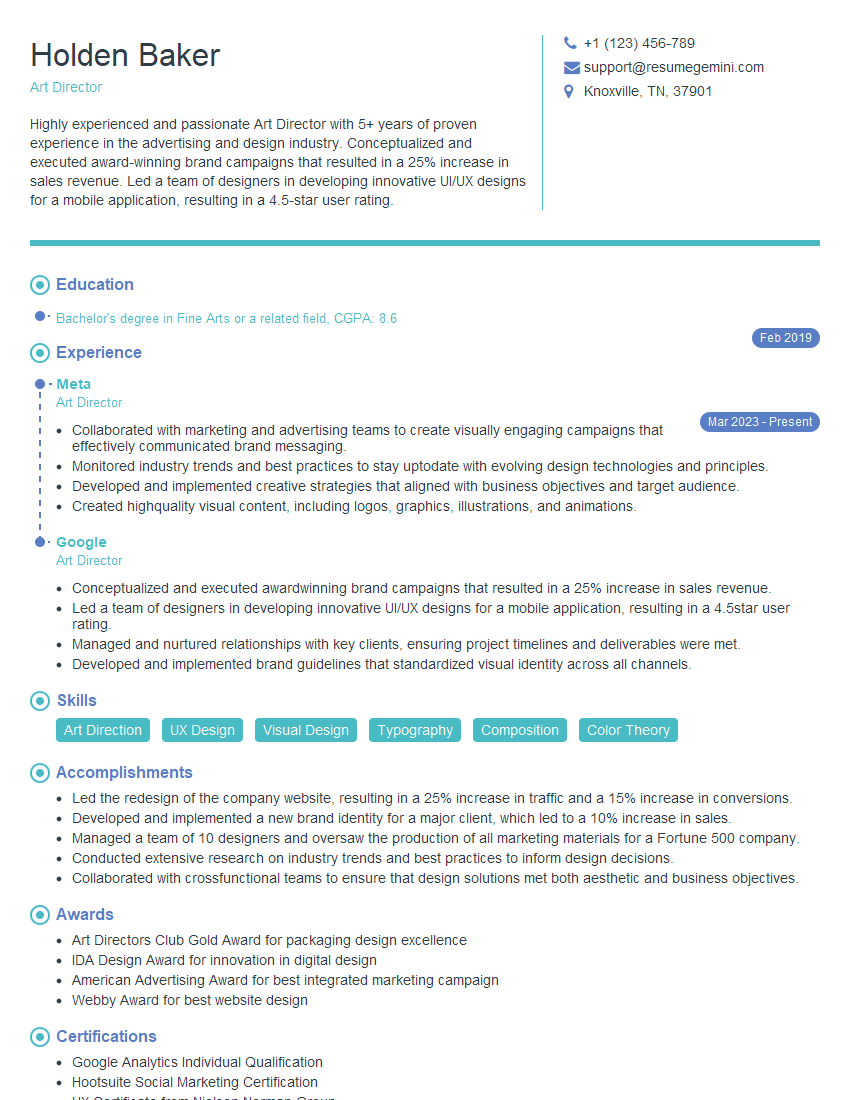
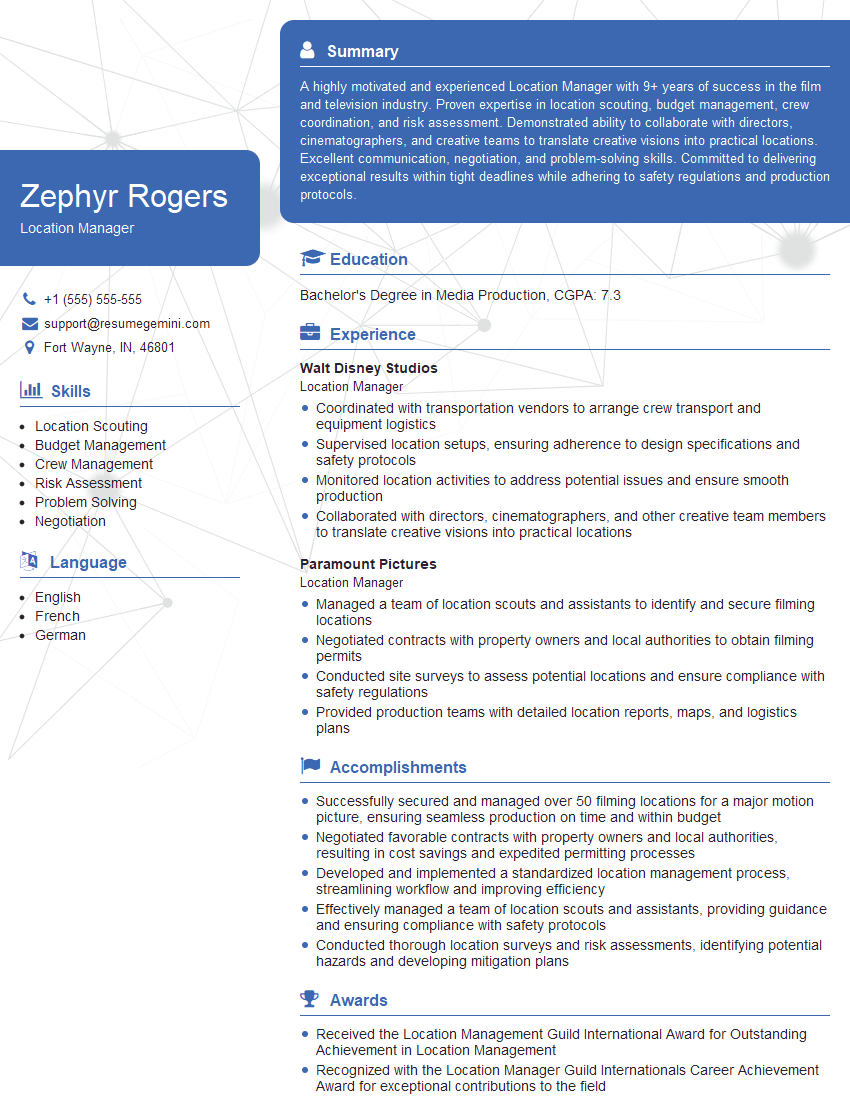
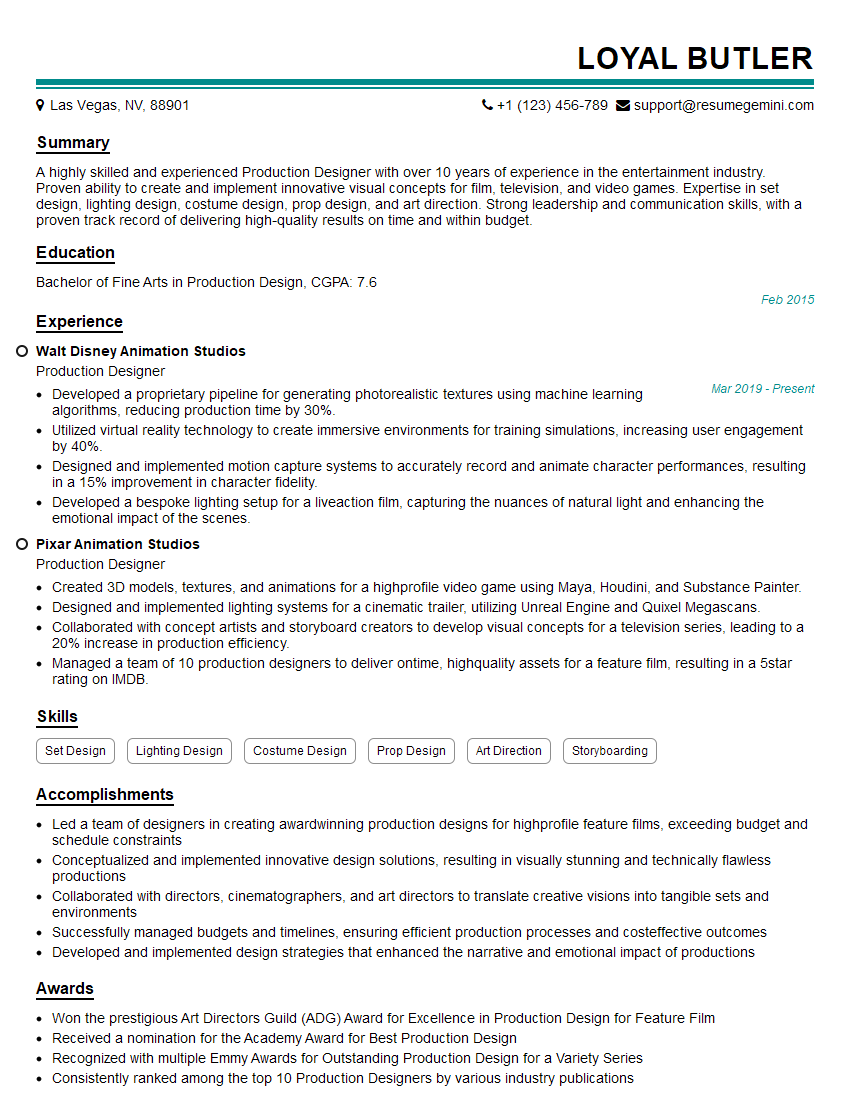
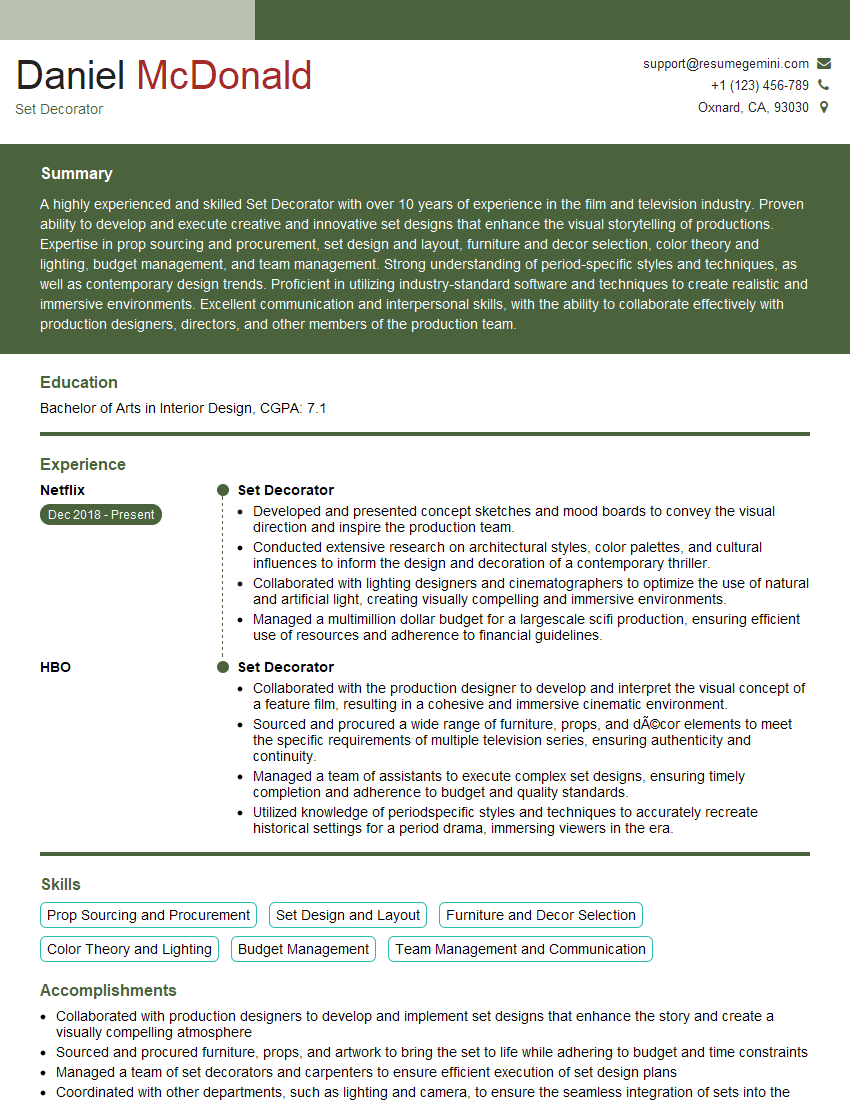
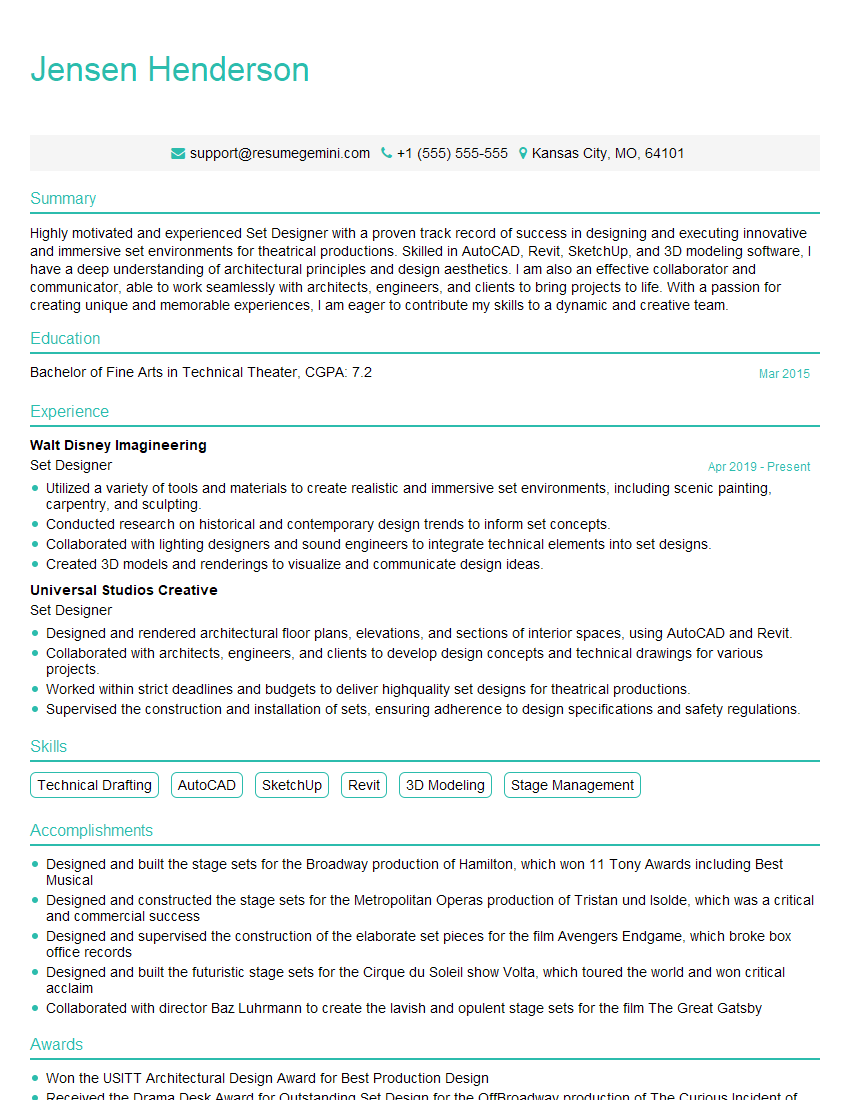
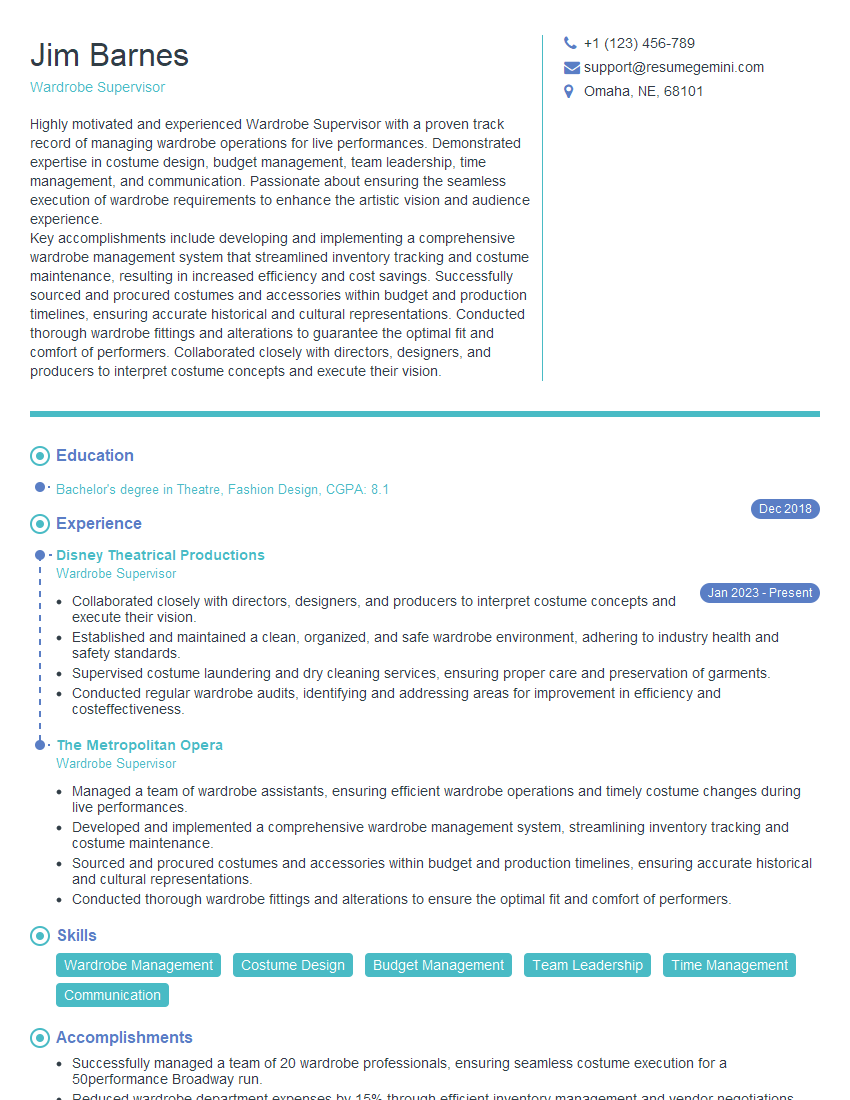
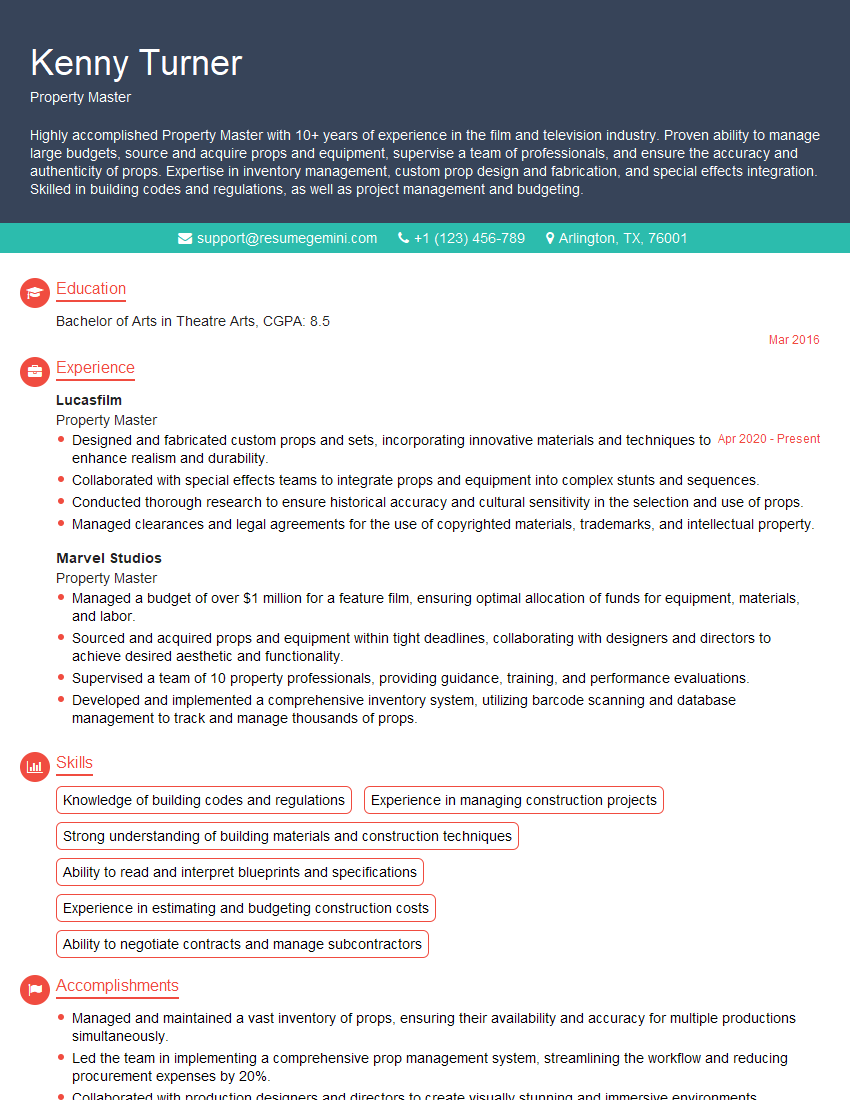
Mastering Prop and Set Management opens doors to exciting career opportunities in film, television, theater, and events. A strong understanding of these skills demonstrates your ability to contribute significantly to successful productions, leading to career advancement and increased earning potential. To maximize your job prospects, crafting a compelling and ATS-friendly resume is crucial. We strongly encourage you to utilize ResumeGemini, a trusted resource for building professional resumes that highlight your skills and experience effectively. Examples of resumes tailored to Prop and Set Management are available to guide you. Take the next step toward your dream career today!
Explore more articles
Users Rating of Our Blogs
Share Your Experience
We value your feedback! Please rate our content and share your thoughts (optional).
What Readers Say About Our Blog
Very informative content, great job.
good