The right preparation can turn an interview into an opportunity to showcase your expertise. This guide to Chromatic Correction interview questions is your ultimate resource, providing key insights and tips to help you ace your responses and stand out as a top candidate.
Questions Asked in Chromatic Correction Interview
Q 1. Explain the difference between color correction and color grading.
Color correction and color grading are often conflated, but they serve distinct purposes in post-production. Think of it like this: color correction is fixing a broken car, while color grading is customizing it.
Color correction aims to restore the image to its true, accurate colors. It addresses technical issues like white balance, color casts, and inconsistencies across different shots. The goal is neutrality and realism. For instance, correcting a scene that’s too blue due to a tungsten light source.
Color grading, on the other hand, is a stylistic choice. It uses color to evoke mood, emotion, and a particular visual aesthetic. This might involve shifting the overall color temperature, increasing saturation in specific areas, or applying creative color filters. Think of the distinct color palettes used in films to create a specific atmosphere, like the warm, desaturated tones of a period drama versus the vibrant, saturated hues of a fantasy film.
Q 2. Describe the three primary color channels and their interaction.
The three primary color channels – Red (R), Green (G), and Blue (B) – form the foundation of color representation in digital imaging. They’re additive; meaning, combining them in various proportions generates a wide spectrum of colors.
Imagine mixing paints: red, green, and blue are the base colors. Mixing red and green creates yellow, red and blue makes magenta, and green and blue makes cyan. Combining all three at full intensity produces white. Conversely, the absence of all three results in black. This additive nature is fundamental to how displays (monitors, screens) create color. Each pixel is composed of tiny subpixels of red, green, and blue, which are lit individually to create the desired color.
Their interaction is crucial in chromatic correction. By adjusting the levels of each channel, we can target specific color issues. For example, if an image has a green cast, we can reduce the green channel’s levels to neutralize it.
Q 3. What is color space and why is it important in chromatic correction?
A color space is a standardized system for representing colors numerically. It defines the range of colors that can be displayed or printed, as well as how those colors are defined. Common color spaces include sRGB (standard for web and most consumer devices), Adobe RGB (wider gamut than sRGB), and Rec.709 (standard for HDTV).
Color space is vital in chromatic correction because it dictates the accuracy and consistency of color representation. If you correct an image in one color space (say, Adobe RGB) and then view it on a display calibrated to sRGB, the colors might appear different because of the different gamut and color profile. Maintaining consistent color space throughout the workflow prevents unexpected shifts and ensures that the final image looks true to intent, regardless of the display.
Imagine trying to paint a picture with paints from different manufacturers – the colors may not mix properly or match up. Color space is like ensuring that all your paints are from the same manufacturer, compatible and consistent.
Q 4. Explain the concept of white balance and how to correct it.
White balance refers to the process of adjusting the color temperature of an image so that white appears white, and other colors appear true to their natural hues. Incorrect white balance leads to color casts (e.g., a blue or orange tint across the image). It often arises from inconsistent lighting sources (mixing daylight and tungsten lighting), or from the camera sensor’s automatic white balance not being accurate.
Correcting white balance typically involves using tools within your video or photo editing software. Most software packages allow for manual adjustment using controls to set white balance via color temperature (Kelvin) or by selecting a neutral point in the image (a gray card is often used in photography for this purpose). Many cameras and editing software offer presets (daylight, cloudy, tungsten, fluorescent) that can automate this process for typical lighting conditions. Using the appropriate preset is frequently a good starting point that can then be refined.
Q 5. How do you identify and fix color casts?
Color casts are undesirable color tints affecting an entire image or parts of it. They’re easily identified by a noticeable deviation from natural colors, creating an unnatural look. For example, a scene might have an overall orange cast due to a warm sunset or a blue cast from shadow areas.
Fixing color casts typically involves using color correction tools like color wheels, curves, or selective color adjustments. The key is to neutralize the unwanted tint. If you have an orange cast, you would desaturate the oranges and add complementary colors (cyan, in this case). Using the eyedropper tool to select a neutral area in the image (a naturally gray or white object) can be very useful in pinpointing the color correction needed to achieve neutrality. The process might involve tweaking levels, curves, or HSL adjustments until the image appears naturally balanced.
Q 6. What are some common color correction workflows?
Common color correction workflows often involve a combination of techniques, depending on the complexity of the project and the tools being used. A typical workflow might follow this order:
- Ingest and Organization: Import footage, organize media files, and create a project.
- White Balance Correction: Adjust the overall color temperature to ensure accurate representation of white.
- Primary Color Correction: Fine-tune the red, green, and blue channels, addressing general color casts and inconsistencies. Tools like curves and levels are commonly used.
- Secondary Color Correction (selective adjustments): Target specific color ranges or areas within the image to further refine the colors and ensure overall consistency. Masking might be used here.
- Color Grading (Optional): If creative color adjustments are required to enhance mood or establish a stylistic look.
- Output and Export: Export the corrected footage at the appropriate resolution and format.
More advanced workflows might incorporate techniques like color matching (to ensure consistent color across different shots) and using LUTs (look-up tables) for fast and consistent color transformations across multiple projects.
Q 7. Describe your experience with different color correction software (e.g., DaVinci Resolve, Baselight, Adobe Premiere Pro).
I have extensive experience with various color correction software packages. DaVinci Resolve is my primary tool for professional projects, appreciating its extensive features, flexibility, and powerful color grading capabilities. I’m proficient in using its nodes, curves, and other tools for precise color manipulation. Resolve’s ability to handle high dynamic range (HDR) content is another strong point.
I’ve also worked extensively with Adobe Premiere Pro, often leveraging it for simpler projects or when integrating color correction within a broader editing workflow. While not as feature-rich as Resolve in terms of dedicated color tools, Premiere Pro’s ease of use and integration with other Adobe applications make it valuable for many situations.
My experience with Baselight is limited to specific projects requiring its high-end features and precision – typically for high-end cinematic work where color accuracy is paramount. Baselight’s flexibility and control, particularly for complex color transformations, sets it apart.
Across all platforms, my approach focuses on achieving accurate color correction while maintaining a natural, realistic image. My goal is to create a balanced look that enhances the story, rather than overwhelming it with artificial coloring. This approach prioritizes subtle refinements and careful attention to detail.
Q 8. How do you manage color consistency across different shots or scenes?
Maintaining color consistency across different shots is crucial for a believable and visually appealing final product. Inconsistencies can be jarring and detract from the overall viewing experience. We achieve this through a multi-pronged approach.
- Careful On-Set Lighting and Workflow: Consistent lighting is paramount. Maintaining the same color temperature and light levels throughout the shoot minimizes post-production work. This involves meticulous planning, using color charts and reference images for consistency, and documenting lighting setups.
- White Balancing: Correct white balance ensures accurate color representation. Each shot needs proper white balance, either done in camera or corrected during post-production. Inconsistent white balance can lead to shots with color casts.
- Color Grading and Matching: After shooting, we use professional color grading software. This involves strategically adjusting the color of different shots to match a reference shot, using tools like color wheels, curves, and secondary color correction to target specific areas.
- LUTs (Look-Up Tables): LUTs help ensure a cohesive look by applying a pre-defined color transformation to multiple clips. Once a desirable look is established on a key shot, a LUT can be generated and applied to other shots to streamline the process and ensure consistency.
For example, imagine a scene transitioning from an outdoor sunny location to an indoor dimly lit room. Without careful color management, the transition would look jarring. By carefully matching the color temperature and exposure, we maintain a seamless transition.
Q 9. Explain the concept of gamma correction.
Gamma correction addresses the non-linear relationship between the numerical representation of color data and how it’s perceived by the human eye. Our eyes perceive brightness on a logarithmic scale, meaning small changes in dark areas are easily noticeable, while large changes in bright areas are less so. A display device, however, generally uses a linear scale.
Gamma correction adjusts the brightness values in images to compensate for this difference. A typical gamma value is 2.2. This means that a numerical value of 100 would be displayed as approximately 100(1/2.2) or 21. This transforms the linear values into a non-linear curve that looks more natural to the eye.
Without gamma correction, images would appear too dark or too bright. It’s a crucial step for accurate color representation and consistent image quality across different display devices.
Q 10. What are LUTs (Look-Up Tables) and how do you use them in color correction?
LUTs, or Look-Up Tables, are pre-defined transformations that map input color values to output color values. Think of them as a ‘recipe’ for color correction. They’re essentially a matrix of values that dictates how each color should be modified.
In color correction, we use LUTs to apply consistent color adjustments across multiple clips or even an entire project. This is especially helpful for creating a specific ‘look’ or ‘mood’ for a film, ensuring visual uniformity despite variations in lighting or camera settings.
For instance, a LUT could be designed to create a vintage film look, saturating colors and adding a specific grain. Once created, this LUT can be quickly applied to all the footage, saving significant time and ensuring consistency.
LUTs are commonly used in professional video editing and color grading software and can be created and shared among various software packages.
Q 11. How do you handle skin tones in color correction?
Handling skin tones accurately is critical as inconsistencies can make people look unnatural or even sick. It requires a delicate approach, avoiding over-correction that can lead to unrealistic results.
- Targeted Adjustments: We use tools to isolate skin tones and make precise adjustments. This may involve using color ranges, masks, or specific selections to target only the skin areas.
- Careful Saturation and Hue Shifts: Subtly adjusting saturation and hue can enhance the realism of skin tones without making them look artificial. Over-saturation can lead to an unnatural, almost plastic appearance.
- Maintaining Natural Variation: It’s important to maintain the natural variations in skin tone across different areas of the face and body. Uniformity can look artificial and unrealistic.
- Reference Images: Often, using reference images of real skin tones helps maintain a realistic look. Comparing to a skin tone chart can also be incredibly useful.
For example, a slight desaturation or a minor shift in hue can correct color casts and create more natural-looking skin tones without making them appear unrealistic.
Q 12. How do you address color fringing or halos?
Color fringing, also known as chromatic aberration, and halos are visual artifacts that often appear around high-contrast edges, especially when using shallow depth of field or telephoto lenses. These artifacts are caused by the lens failing to focus all wavelengths of light perfectly at the same point.
Addressing them typically involves:
- Lens Correction Software Tools: Most professional editing software has built-in lens correction tools that can automatically detect and reduce color fringing. These tools analyze the image and adjust the pixels around edges to minimize the effect.
- Manual Correction: In more complex cases, manual correction might be necessary, using masking and color adjustment tools to carefully remove or reduce the fringing.
- Shooting Practices: Avoiding shooting at the extreme edges of the lens and using lens hoods can help prevent or reduce these artifacts.
The goal is to make the transition between colors smooth and natural. A good strategy is to reduce the halos while maintaining the image sharpness and detail.
Q 13. What are some common colorimetric standards (e.g., Rec. 709, Rec. 2020)?
Colorimetric standards define the precise color space, or range of colors, that a particular system should reproduce. They ensure consistency across different devices and workflows.
- Rec. 709: This is a widely used standard for HDTV. It defines the color gamut, transfer characteristics (gamma), and white point for standard definition and high-definition television. It is designed for both broadcast and consumer displays.
- Rec. 2020: This is a newer standard with a much wider color gamut than Rec. 709. It was developed for Ultra High Definition Television (UHDTV) and aims to capture a more complete representation of the colors visible to the human eye. It is utilized in professional workflows and high-end display technologies.
- DCI-P3: Commonly used in digital cinema, this standard has a wider color gamut than Rec. 709, offering a more vibrant color palette.
Choosing the correct colorimetric standard depends on the intended viewing platform and the desired color accuracy and vibrancy.
Q 14. Explain the difference between linear and logarithmic color spaces.
The key difference lies in how they represent color values and how they are handled in calculations.
- Linear Color Space: In a linear color space, color values are directly proportional to the light intensity. This means that a value of 2 represents twice the light intensity of a value of 1. This is the way light actually behaves in the real world. Linear color spaces are ideal for accurate calculations involving light mixing and compositing.
- Logarithmic Color Space: A logarithmic color space compresses the range of brightness values, making it easier to handle very bright and very dark areas without losing detail. It mimics the way the human eye perceives brightness—more sensitive to changes in darker areas. Log color spaces are commonly used for high dynamic range (HDR) imaging, as they effectively manage the large brightness range.
Imagine a mountain range. Linear would represent every height precisely, while Log would compress the higher altitudes, still retaining information but making the whole range easier to see at once. Linear is best for accurate calculations, Log is better for managing a large dynamic range.
Q 15. How do you approach correcting color in challenging lighting conditions?
Correcting color in challenging lighting conditions requires a multifaceted approach. The key is understanding the nature of the lighting inconsistencies and employing targeted techniques to mitigate their effects. For instance, if you’re working with scenes featuring harsh shadows and bright highlights, a simple global adjustment won’t suffice.
My approach involves a combination of strategies: Firstly, I’ll assess the scene meticulously, identifying areas with color casts (e.g., an orange sunset causing a warm tint on everything) and inconsistencies in exposure. Secondly, I use localized adjustments—masking specific areas—rather than broad corrections to preserve detail and prevent unwanted artifacts. This could involve using tools like curves or color wheels to selectively adjust hue, saturation, and luminance within the problem areas. Thirdly, I might employ techniques like color grading to unify the overall look, ensuring a visually pleasing balance despite the initial lighting challenges. Finally, using reference images or color charts can help to ensure consistent accuracy across the image.
For example, I recently worked on a project filmed during golden hour. The warm light cast a strong orange hue on the main subject, while the background in shade appeared much cooler. Instead of globally adjusting the color temperature, I masked the subject and applied a subtle cool correction to counteract the orange cast, leaving the background relatively untouched. This preserved the ambiance of the golden hour light while improving the subject’s skin tones.
Career Expert Tips:
- Ace those interviews! Prepare effectively by reviewing the Top 50 Most Common Interview Questions on ResumeGemini.
- Navigate your job search with confidence! Explore a wide range of Career Tips on ResumeGemini. Learn about common challenges and recommendations to overcome them.
- Craft the perfect resume! Master the Art of Resume Writing with ResumeGemini’s guide. Showcase your unique qualifications and achievements effectively.
- Don’t miss out on holiday savings! Build your dream resume with ResumeGemini’s ATS optimized templates.
Q 16. What is color matching and how do you achieve it?
Color matching is the process of ensuring consistent color reproduction across different devices, images, or scenes. It’s crucial for maintaining visual continuity and accuracy. To achieve accurate color matching, a calibrated workflow is essential.
My process starts with hardware calibration: using a colorimeter or spectrophotometer to profile my monitor and ensure its accurate color representation. Then, during the color correction process, I utilize a standardized color space, like Rec.709 for video or sRGB for stills, to maintain consistency. Color references, such as standardized color charts, are invaluable tools for evaluating accuracy. I also carefully manage the color profiles throughout the entire production process, ensuring correct profile embedding and conversion as needed.
Software tools offer features like matching colors between selected areas in an image or matching a target color using tools like eyedroppers and color pickers. For example, I’ll frequently use an eyedropper to sample a consistent color on an object that remains constant in multiple shots, ensuring color consistency across those shots.
Q 17. Describe your experience with HDR (High Dynamic Range) color correction.
HDR (High Dynamic Range) color correction presents unique challenges and opportunities. Unlike Standard Dynamic Range (SDR), HDR allows for a much wider range of brightness and color, capturing more detail in both shadows and highlights.
My HDR color correction workflow typically involves working in a wide color gamut (like Rec.2020) and using HDR-capable monitors. This lets me see and manipulate the broader range of luminance. Careful attention to tone mapping is critical, since tone mapping translates HDR to SDR for display on standard screens, so accuracy here is paramount. I usually begin by making sure highlights retain detail, and then adjust mid-tones and shadows appropriately. The goal isn’t just to ‘fix’ the image but enhance the realism and impact of the extra dynamic range information.
For example, when working with HDR footage from a camera with a very high dynamic range, I may need to carefully compress the range to fit the display capabilities of a target device without losing visual integrity. Tools such as highlight and shadow recovery techniques and detailed masking become even more crucial in achieving a balance of highlights and shadows.
Q 18. How do you collaborate effectively with other post-production professionals during color correction?
Effective collaboration is fundamental in post-production. With color correction, this involves constant communication and shared understanding. I prioritize open communication with the director, cinematographer, and other post-production professionals.
Before starting, I typically engage in thorough review sessions with the director and DP, ensuring everyone is on the same page regarding the creative vision and desired look. I utilize collaborative platforms to share work-in-progress files and gather feedback in a timely manner. This is often facilitated through screen sharing and clear annotation of the color changes and decisions I’m making. Open dialogue, clearly stating any technical constraints and explaining creative choices, ensures a smooth and productive collaborative process.
For example, if the director wants a particular mood, I’ll collaborate to find the correct color palette and lighting techniques. I may present them with different grading options, carefully explaining the technical choices, allowing them to offer feedback and guide my decisions to reflect the artistic vision.
Q 19. Describe your troubleshooting process when facing color correction issues.
Troubleshooting color correction issues requires a systematic approach. I generally start with identifying the problem’s source – is it a hardware issue, a software glitch, or a problem with the source footage itself?
My troubleshooting strategy follows these steps: 1. **Replicate the issue:** Is it consistent across different clips? 2. **Check your settings:** Are your color spaces correctly set? Is your monitor calibrated? 3. **Isolate the problem:** Try rendering a single clip or a small section to see if the issue persists. 4. **Review your workflow:** Has anything changed in your process lately that may have introduced the problem? 5. **Consult resources:** Utilize online forums, documentation, and tutorials. 6. **Seek expert help:** If the issue remains unresolved, it might be beneficial to seek assistance from experienced colorists or software support.
For instance, if I’m getting banding in my gradients, I’ll first check the bit depth of my image. If it’s too low, I’ll try increasing it. If banding persists, I may need to investigate whether the issue exists in the source material, and if it’s a problem with the image’s compression.
Q 20. How do you maintain color accuracy throughout the post-production pipeline?
Maintaining color accuracy throughout post-production requires a rigorous and well-defined workflow. It’s a holistic process that starts from acquisition through to final delivery.
Key aspects include: using a consistent color space throughout; calibrating all monitors to a known standard; employing a color management system; using non-destructive editing techniques to avoid permanent changes; managing and controlling metadata properly; and using well-defined color profiles. Regular quality control checks during various stages of the process ensures that any unwanted shifts are detected early. Final output should always be reviewed on a variety of devices to guarantee consistent representation across different display technologies.
For example, I’d make sure that the color profile embedded in the footage from the camera is correctly handled by my editing and color grading software, and that the final output adheres to the correct profile for the target delivery platform (e.g., web, television, cinema).
Q 21. What are some advanced color correction techniques you are familiar with?
Beyond basic color correction, I’m proficient in several advanced techniques. These include:
- Advanced masking techniques: Using sophisticated masking tools like luma and chroma keys, and using channel-based masking to refine selections for highly localized color adjustments.
- Color grading for stylistic effects: Creating specific moods and aesthetics through strategic application of color palettes, filters, and LUTs (Look-Up Tables).
- Working with HDR and Wide Color Gamut: Accurately processing and managing the added complexity of HDR data while mastering advanced techniques for tone mapping.
- Image restoration techniques: Repairing various types of image imperfections, such as dust, scratches, or noise, and maintaining a color balance throughout the restoration process.
- 3D LUT manipulation: Creating and using custom LUTs to apply complex color transformations efficiently and consistently.
These advanced techniques enhance my ability to create visually stunning and technically accurate results, translating the director’s creative vision into impactful visuals.
Q 22. How do you handle color correction in different file formats?
Handling color correction across different file formats requires understanding how each format handles color information. For instance, RAW files contain the most color data, offering the greatest flexibility for correction. JPEGs, on the other hand, are lossy, meaning some color information is discarded during compression, limiting the extent of correction. TIFF files offer a good balance, supporting various color spaces and offering lossless compression options.
My approach is always to work in the highest-quality format available, ideally RAW, to retain maximum detail. If starting with a JPEG or TIFF, I assess the image carefully for any artifacts from compression that might affect color correction. The workflow then involves adjusting the white balance, exposure, and color curves within the chosen editing software, while always keeping in mind the limitations of the file format. For example, aggressive color adjustments in a JPEG might amplify compression artifacts leading to undesirable banding or noise. Therefore, a nuanced and careful approach is always preferred.
In practical terms, I might apply a different color grading approach to a RAW file compared to a JPEG, being more conservative with JPEGs to avoid introducing unwanted noise.
Q 23. Explain your understanding of colorimetry and its role in chromatic correction.
Colorimetry is the science of measuring and quantifying color. It’s the foundation of chromatic correction because it provides a standardized framework for understanding and manipulating color. Colorimetry defines color spaces (like sRGB, Adobe RGB, Rec. 709) and uses mathematical models (like XYZ and Lab) to represent colors numerically. This allows us to objectively measure color differences and apply consistent corrections.
In chromatic correction, colorimetry’s role is crucial for:
- Accurate color reproduction: Ensuring that colors appear consistent across different devices and workflows.
- Objective color grading: Allowing for precise color adjustments based on measurable differences, rather than subjective interpretations.
- Calibration and profiling: Creating color profiles for monitors and printers to ensure accuracy.
For example, colorimetry helps us understand why a specific shade of blue looks different on a calibrated monitor versus an uncalibrated one. By using colorimetry tools and understanding the underlying color spaces, I can make adjustments to ensure consistency.
Q 24. How do you use scopes (vectorscope, waveform monitor, parade) in color correction?
Scopes – vectorscope, waveform monitor, and parade – are essential tools for precise and objective color correction. Each scope offers a unique perspective on the image’s color and luminance information:
- Vectorscope: Displays color information as points on a plane, showing saturation and hue. It’s useful for checking color balance, skin tones, and ensuring colors are within a specific gamut.
- Waveform Monitor: Displays luminance levels across a scan line, useful for checking exposure, contrast, and highlight detail. It helps identify clipped highlights (pure white) or crushed blacks (pure black).
- Parade (Histogram): Displays the distribution of luminance and color levels, offering a visual representation of the tonal range and color balance. It is useful for checking contrast and determining how the pixels in the image are distributed across a range of values.
In my workflow, I often use the vectorscope to make sure skin tones fall within a certain range of hue and saturation. The waveform monitor helps me avoid clipping highlights, ensuring detail is preserved in bright areas. The parade assists with checking tonal balance for optimal dynamic range.
For example, if I notice skin tones clustering near the edges of the vectorscope, I might adjust the saturation to bring them back into a more natural range. If the waveform monitor shows clipped highlights, I’d reduce the exposure to preserve detail.
Q 25. Describe your experience with color management systems (CMS).
Color Management Systems (CMS) are critical for consistent color reproduction across different devices. My experience with CMS involves understanding ICC profiles and how they map colors between devices. I have extensive experience using CMS in various software applications, including Adobe Creative Suite and DaVinci Resolve.
A CMS involves several key aspects:
- Profile Creation: Generating ICC profiles for monitors, printers, and scanners to characterize their color response.
- Profile Embedding: Embedding ICC profiles in images to ensure that they’re displayed correctly on different devices.
- Color Space Conversion: Using the CMS to convert colors between different color spaces during editing and output.
In my work, I always ensure that my monitors are properly calibrated and profiled, so I can trust that the colors I see on screen accurately represent the colors that will be printed or displayed on other devices. This is crucial for delivering consistent results that meet client expectations.
Q 26. What are the ethical considerations regarding chromatic correction?
Ethical considerations in chromatic correction are centered around maintaining the integrity of the image and avoiding misleading representation. This means:
- Transparency: Clients should be aware of any significant color corrections applied and the reasons behind them.
- Accuracy: Corrections should aim for accuracy rather than artificial enhancements. Overly stylized or unrealistic color grading can be misleading.
- Context: The nature of the project influences acceptable color grading. A documentary might require more naturalistic color correction than a fantasy film.
- Informed Consent: Clients must approve the final color grade before it’s released.
For example, altering skin tones to create a biased representation of someone’s appearance is unethical and unacceptable. Similarly, making the colors unrealistically vibrant might misrepresent the scene or product. It’s vital to maintain a balance between enhancing the visual appeal and preserving factual representation.
Q 27. How do you stay up-to-date with the latest trends and technologies in chromatic correction?
Staying current in chromatic correction requires a multi-faceted approach. I regularly:
- Attend workshops and conferences: Industry events offer valuable insights into the latest techniques and technologies.
- Follow industry blogs and publications: Staying informed about advancements in software, hardware, and color science.
- Experiment with new software and plugins: Hands-on experience is crucial to understanding the capabilities of different tools.
- Network with other professionals: Discussing challenges and solutions with colleagues fosters professional development.
- Engage with online communities: Participating in forums and online discussions allows me to learn from others and stay informed about the latest trends.
This holistic approach keeps my skills sharp and allows me to adapt to the evolving landscape of color correction technology.
Q 28. Describe a time you had to solve a difficult color correction problem.
I once had to correct the color of a high-profile product shot where the lighting conditions on set were highly inconsistent. The product, a luxury watch, had severe color casts in various sections of the image – some areas were overly warm, others too cool, resulting in an unprofessional and jarring look.
My solution involved a multi-step approach:
- Careful Analysis: I began by meticulously analyzing the image using scopes (vectorscope, waveform monitor, parade) to identify the specific color casts and their location within the image.
- Targeted Corrections: Instead of applying global color corrections, I used masking techniques to isolate the affected areas. This allowed me to apply targeted adjustments (color balance, curves, selective color) to correct the color casts without impacting other parts of the image.
- Iterative Refinement: I iteratively refined the corrections, constantly checking the scopes and visually assessing the results to ensure a natural and consistent look across the entire image.
- Color Grading: Once the major color issues were addressed, I applied subtle color grading to enhance the image’s overall aesthetic while maintaining the natural appearance of the product.
By carefully analyzing the problem and utilizing targeted, precise techniques, I was able to achieve a polished and professional result despite the challenging initial conditions. This experience highlighted the importance of understanding not only color correction techniques, but also the effective use of masking and iterative refinement in solving complex color problems.
Key Topics to Learn for Chromatic Correction Interview
- Color Spaces: Understanding RGB, CMYK, LAB, and their transformations. Knowing when to use each space and the limitations of each is crucial.
- Colorimetry: Grasping the fundamentals of color measurement and how devices interpret and reproduce color. This includes concepts like spectral power distribution and color matching functions.
- White Balance: Mastering techniques for achieving accurate white balance in different lighting conditions and understanding the implications of incorrect white balance on image appearance.
- Gamma Correction: Understanding the role of gamma in displaying images correctly and how it affects the perception of brightness and contrast. Be prepared to discuss different gamma curves and their effects.
- Color Profiles (ICC Profiles): Knowing how color profiles define a color space and ensure consistency across different devices and workflows. Understanding profile embedding and conversion is vital.
- Chromatic Aberration: Understanding the causes and correction methods for chromatic aberration in lenses and how to address it in post-processing.
- Practical Applications: Be ready to discuss your experience with chromatic correction in specific software (Photoshop, DaVinci Resolve, etc.) or hardware contexts. Examples of real-world applications will strengthen your interview performance.
- Troubleshooting: Be prepared to discuss common issues encountered during chromatic correction, such as color casts, banding, and inaccurate color reproduction, and how you would approach solving them.
Next Steps
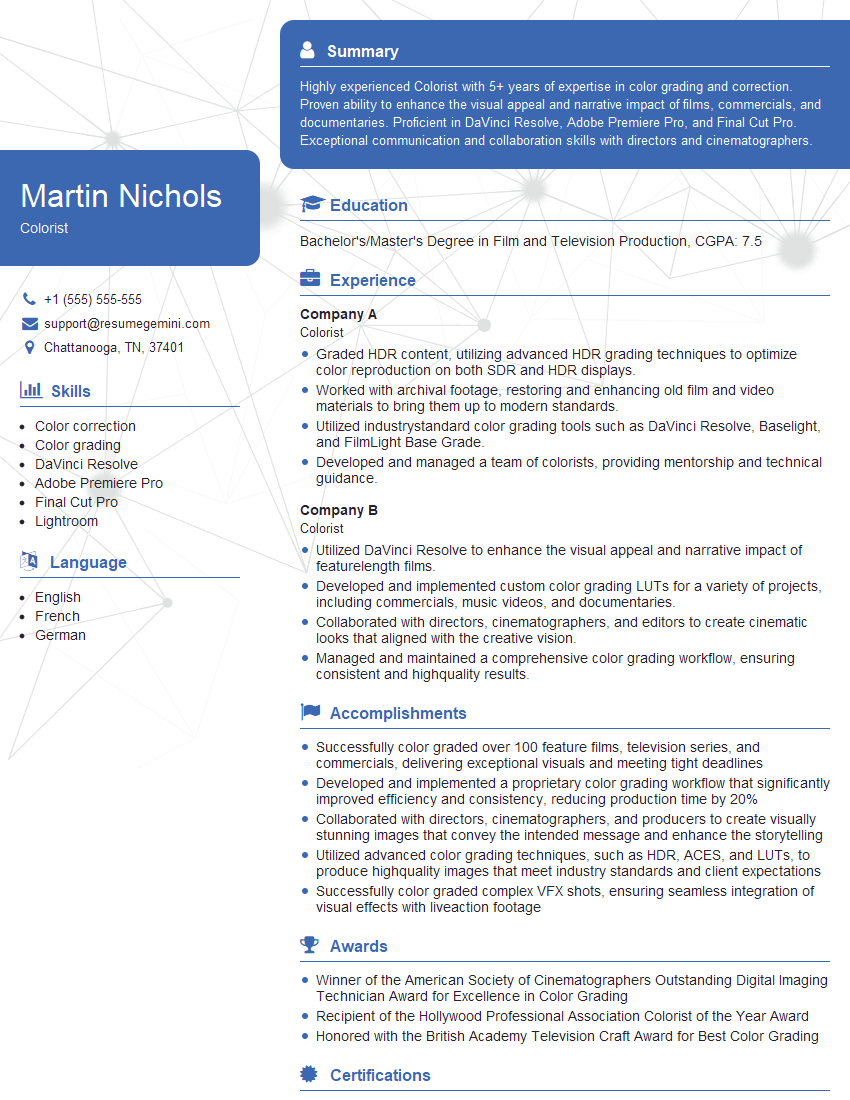
Mastering chromatic correction is essential for career advancement in many fields, from photography and videography to graphic design and image processing. A strong understanding of these concepts demonstrates your technical expertise and problem-solving abilities, making you a highly desirable candidate. To maximize your job prospects, creating an ATS-friendly resume is crucial. ResumeGemini is a trusted resource to help you build a professional and effective resume that highlights your skills and experience. Examples of resumes tailored to Chromatic Correction roles are available within ResumeGemini to guide you in creating a compelling application.
Explore more articles
Users Rating of Our Blogs
Share Your Experience
We value your feedback! Please rate our content and share your thoughts (optional).
What Readers Say About Our Blog
Very informative content, great job.
good