Cracking a skill-specific interview, like one for Coiled Tubing, requires understanding the nuances of the role. In this blog, we present the questions you’re most likely to encounter, along with insights into how to answer them effectively. Let’s ensure you’re ready to make a strong impression.
Questions Asked in Coiled Tubing Interview
Q 1. Explain the principle of operation of a coiled tubing unit.
A coiled tubing unit operates on the principle of deploying and retrieving a continuous length of high-strength steel tubing from a large reel. Imagine a giant spool of incredibly strong thread. This tubing, typically ranging from 1.5 inches to 2.25 inches in diameter, is fed from the reel onto a derrick and then deployed down a wellbore. The tubing is then used to convey various tools and fluids to perform a wide range of well interventions. Unlike traditional drill pipe, coiled tubing is continuous and doesn’t require time-consuming connections and disconnections during deployment or retrieval. This continuous operation significantly reduces non-productive time.
The reel, powered by a powerful motor, controls the deployment and retrieval speed. A top drive or similar mechanism on the derrick accurately guides the tubing into and out of the well. The tubing’s flexibility allows it to navigate complex well trajectories, reaching areas inaccessible to conventional drill strings.
Q 2. Describe different types of coiled tubing operations.
Coiled tubing operations are highly versatile. Some common types include:
- Well Stimulation: Injecting fluids such as acids or proppants to enhance well productivity. Think of it like unclogging a pipe to improve the flow of oil or gas.
- Sand Control: Deploying and retrieving sand screens or other devices to prevent sand production from damaging the wellbore.
- Completion and Workover: Setting downhole equipment such as packers, plugs, and other completion components. This is akin to performing maintenance or repairs on existing well infrastructure.
- Mill and Cut Operations: Cutting and removing obstructions from the wellbore, such as cement or scale buildup. This removes blockages to restore well function.
- Perf and Frac: Performing perforation operations to create channels for hydrocarbons to flow into the wellbore, and then executing hydraulic fracturing operations to stimulate the reservoir.
- Plugging and Abandonment: Sealing off zones or abandoning wells permanently. Similar to permanently sealing an old, unused pipe.
The specific operation will depend on the well’s condition and the desired outcome.
Q 3. What are the safety precautions associated with coiled tubing operations?
Safety is paramount in coiled tubing operations. Key precautions include:
- Rig Site Safety Procedures: Strict adherence to all rig site safety regulations, including personal protective equipment (PPE) use, confined space entry protocols, and emergency response procedures.
- Equipment Inspection and Maintenance: Regular inspection and maintenance of all equipment, including the coiled tubing itself, the reel, and the top drive. This ensures the equipment is in optimal condition to prevent malfunction.
- H2S Monitoring and Emergency Response: Continuous monitoring for hydrogen sulfide (H2S) gas, a significant hazard in many oil and gas wells, with clear emergency response procedures in place. This is crucial for worker safety.
- Proper Training and Certification: Ensuring all personnel involved are properly trained and certified to perform their tasks safely. This involves both theoretical knowledge and hands-on training.
- Emergency Shutdown Procedures: Well-defined emergency shutdown procedures for handling equipment malfunctions, well control issues, or other safety-critical events. Quick response is critical to minimize the risk of accidents.
- Risk Assessment: Conducting thorough risk assessments before every operation to identify and mitigate potential hazards. This proactive approach helps prevent accidents before they occur.
Q 4. How do you calculate the required pulling force for a coiled tubing job?
Calculating the required pulling force for a coiled tubing job is a complex process that often involves specialized software. However, the fundamental calculation considers several factors:
- Weight of the coiled tubing: This includes the weight of the tubing itself and any tools attached. The longer the tubing deployed, the heavier the load becomes.
- Friction: Friction forces are significant and account for a substantial portion of the total pulling force required. This friction is influenced by the tubing’s properties and the wellbore conditions.
- Inclination and curvature of the wellbore: More deviated wells require considerably more pulling force due to the increased friction and potential for tubing hang-up.
- Tool weight: This is the weight of any downhole tools attached to the end of the coiled tubing.
- Fluid pressure: The pressure of fluids in the wellbore contributes to the pulling force.
The calculation often involves iterative solutions, accounting for the changing friction forces as the tubing is pulled out of the well. Empirical formulas and software are commonly used to accurately estimate the required pulling force to prevent equipment failure and ensure successful operation.
Q 5. Explain the concept of friction in coiled tubing operations and how it’s managed.
Friction is a major consideration in coiled tubing operations. It significantly impacts the required pulling force and can cause operational difficulties. Friction arises from several sources:
- Tubing-tubing friction: Friction between the coiled tubing itself as it bends and moves within the wellbore.
- Tubing-wellbore friction: Friction between the tubing and the walls of the wellbore. This is greatly affected by the wellbore’s roughness and the presence of any obstructions.
- Tool friction: Friction generated by downhole tools such as packers or milling tools.
Friction is managed through several strategies:
- Lubrication: Injecting lubricants into the wellbore can significantly reduce friction. The choice of lubricant is dependent on the wellbore environment.
- Optimized pulling speeds: Excessive pulling speeds can increase friction. Careful control of pulling speed minimizes friction.
- Proper tubing design and material selection: Using tubing with a smooth inner surface and high-strength material reduces friction.
- Wellbore cleaning: Removing debris and scale from the wellbore before coiled tubing operations reduces friction.
Q 6. What are the common causes of coiled tubing failures?
Coiled tubing failures can stem from various causes:
- Tubing fatigue: Repeated bending and flexing of the tubing during deployment and retrieval can lead to fatigue cracks, especially in areas with high stress.
- Corrosion: Exposure to corrosive fluids in the wellbore can weaken the tubing over time, leading to failure. This is particularly relevant in sour gas wells.
- Overstress: Exceeding the tubing’s yield strength during operations. This may occur due to inadequate pulling force calculations or unexpected downhole obstructions.
- Poor handling practices: Incorrect handling, storage, or deployment of the tubing can cause damage. This includes accidental kinks or scratches.
- Environmental factors: High temperatures or pressures can weaken the tubing and reduce its strength.
- Equipment malfunction: Issues with the reel, top drive, or other equipment can lead to failures.
Regular inspections, proper maintenance, and adherence to operating procedures are essential to prevent coiled tubing failures.
Q 7. Describe different types of coiled tubing tools and their applications.
A wide variety of tools are used with coiled tubing:
- Conveyance Tools: These are essentially tubing-compatible adaptations of standard drilling tools. Examples include jars, slips, and fishing tools.
- Milling Tools: Used to cut and remove obstructions such as cement or scale buildup in the wellbore.
- Perforating Guns: Used to create perforations in casing or liner to allow hydrocarbons to flow into the wellbore. This allows the oil/gas to enter the well more easily.
- Packers: Used to isolate sections of the wellbore for various treatments or to prevent fluid flow between zones.
- Sand Screens: Used to prevent sand production from damaging the wellbore.
- Plugs and Bridge Plugs: Used to isolate sections of the wellbore or to seal off abandoned zones.
- Measurement Tools: Include pressure/temperature gauges and flow meters to measure the downhole parameters.
The specific tool selection depends on the nature of the coiled tubing operation being performed.
Q 8. How do you troubleshoot a stuck coiled tubing string?
Troubleshooting a stuck coiled tubing string requires a systematic approach, combining careful analysis with decisive action. The first step is to thoroughly assess the situation. This involves reviewing the real-time data from downhole pressure and temperature sensors, as well as the surface tension and torque readings. Understanding the last operation performed before the stuck point helps determine the potential cause.
Common causes include bridging (the tubing snagging on formations), differential sticking (pressure differences causing the tubing to stick), or mechanical issues such as a collapsed tubing section. Once the likely cause is identified, appropriate mitigation techniques can be implemented.
- For bridging: We might try to gently rotate and reciprocate the tubing to break the bridge, or we might use specialized tools like a jetting tool to clear debris. If that fails, we might use a milling tool to cut through the formation.
- For differential sticking: We typically use weight-on-bit or pressure differential management strategies to release the stuck tubing. This often involves carefully manipulating the mud weight or using specialized fluids.
- For mechanical issues: This usually requires more invasive techniques, potentially including pulling the tubing out in sections or using specialized fishing tools. We might even need to consider abandoning the string in extreme cases.
Throughout the process, safety is paramount. We always communicate closely with the entire team, keeping everyone informed and updating the safety plan as needed. The goal is always to resolve the situation safely and efficiently, minimizing the risk to personnel and equipment.
Q 9. Explain the importance of real-time data monitoring in coiled tubing operations.
Real-time data monitoring is crucial in coiled tubing operations because it provides an immediate window into the downhole environment and the tubing string’s condition. Think of it as a crucial life sign for the operation. Without it, we’d be operating blindly. The data allows for proactive intervention, preventing costly delays and potential damage.
Specifically, monitoring key parameters like downhole pressure, temperature, tension, torque, and rotation speed allows us to detect potential issues – such as high friction, a stuck pipe, or unexpected pressure build-up – before they escalate into major problems. This predictive capability saves time and money, as well as prevents potential safety hazards. For example, a sudden increase in torque might indicate an impending stuck pipe situation. Identifying this early allows us to take preventative measures rather than dealing with a much more complex issue later.
Data visualization dashboards provide a clear overview, enabling quick decision-making. These dashboards may highlight abnormal readings in real time, prompting immediate action. Real-time data also significantly aids in post-operation analysis, enabling continuous process optimization.
Q 10. How do you ensure the integrity of the coiled tubing string during operations?
Ensuring the integrity of the coiled tubing string is paramount for successful and safe operations. This requires a multi-faceted approach starting from pre-operational checks to real-time monitoring throughout the operation.
- Pre-operational inspection: Before deployment, a thorough inspection of the tubing string is mandatory to ensure there’s no visible damage, corrosion, or wear and tear. This includes checking for dents, cracks, or other imperfections.
- Proper handling and deployment: The tubing should be carefully handled to avoid kinks or bends during the deployment process. Slow and controlled deployment helps minimise the risk of damage.
- Real-time monitoring: Continuous monitoring of tension, torque, and other critical parameters during operations provides insights into the health of the tubing string. Abnormal readings can be a warning sign of potential problems.
- Regular maintenance: Regular maintenance of the coiled tubing unit itself is critical for ensuring it performs optimally and minimizes risks of damage to the string.
- Fluid selection and management: Appropriate selection of coiled tubing fluids is essential to prevent corrosion and other forms of damage to the tubing string. Regular monitoring of fluid properties helps to maintain its effectiveness.
- Regular testing: Periodic testing of the tubing string’s burst and collapse resistance ensures it maintains the required integrity to withstand the downhole conditions.
By diligently following these procedures, we maintain the structural integrity of the coiled tubing and maximize its operational life, ultimately contributing to increased safety and efficiency. Think of it like preventative maintenance for your car, only on a much larger and more complex scale.
Q 11. What are the environmental considerations during coiled tubing operations?
Environmental considerations are crucial in coiled tubing operations, focusing on minimizing the impact on air, water, and land. We have a responsibility to protect the environment and operate sustainably.
- Waste management: Proper management of drilling fluids and cuttings is essential. This includes the safe disposal of waste materials in accordance with local regulations and environmental best practices. We carefully track and manage these materials to prevent contamination.
- Air emissions: Minimizing emissions from equipment, such as diesel engines, is crucial. This often involves using emission control systems and ensuring regular maintenance of equipment. We also monitor air quality around the wellsite.
- Water conservation: Efficient use of water and treatment of wastewater are vital, especially in water-stressed regions. We use water-efficient practices and methods for treating used water before disposal.
- Soil erosion and land reclamation: Protecting the surrounding land from erosion and soil degradation is important. This usually includes implementing erosion control measures and restoring the land to its original condition once operations are complete.
- Noise pollution: Minimising noise pollution through noise barriers and employing quieter equipment is important for both environmental protection and worker well-being. We adhere to strict noise level regulations.
Environmental impact assessments are usually done before the operation begins to identify and mitigate potential hazards. Our operational procedures reflect a commitment to sustainable practices and adherence to environmental regulations.
Q 12. Describe your experience with different types of coiled tubing fluids.
My experience encompasses a wide range of coiled tubing fluids, each tailored to specific well conditions and operational objectives. The choice of fluid is critical because it impacts the efficiency and success of the operation, as well as its overall safety.
- Water-based fluids: These are cost-effective and environmentally friendly but may not always be suitable for high-temperature or high-pressure applications. They are often used in simpler operations.
- Oil-based fluids: These offer better lubricity and corrosion inhibition, making them suitable for challenging well conditions, but they carry higher environmental concerns. They are often preferred in high-temperature or corrosive environments.
- Synthetic-based fluids: These fluids offer a balance between performance and environmental considerations, providing good lubricity and corrosion inhibition with a reduced environmental impact compared to oil-based fluids. They are becoming increasingly popular due to their versatility.
- Specialized fluids: Certain operations might require specialized fluids, like those designed for specific cleaning tasks (e.g., acidizing) or those with specific rheological properties to enhance wellbore cleaning or improve the conveyance of other treatment fluids. Examples include nitrogen-based fluids or those with enhanced viscosity or density.
The selection process involves considering factors such as temperature, pressure, wellbore geometry, and the type of operation being performed. In my experience, proper fluid selection can significantly influence the efficiency and overall success of the coiled tubing operation. A well-chosen fluid is both cost-effective and enhances safety.
Q 13. How do you manage coiled tubing deployment and retrieval?
Coiled tubing deployment and retrieval are critical stages in any operation. Safety and efficiency are paramount. The process involves several key steps to prevent damage and ensure a smooth operation.
- Pre-deployment checks: Before deployment, a thorough check of the tubing string, the coiled tubing unit, and the wellhead is essential. This ensures everything is in good working order.
- Controlled deployment: The tubing is deployed slowly and carefully to avoid kinks or damage. Monitoring of tension and torque is crucial to maintain control.
- Accurate depth control: Precise depth control is needed to reach the target zone effectively and avoid unnecessary friction or damage.
- Fluid management: The type and volume of the fluid used greatly impacts the deployment process. Careful management and monitoring are essential.
- Retrieval process: The retrieval is conducted similarly to the deployment process—slow and controlled—to minimize damage and ensure safety.
- Post-retrieval inspection: After retrieval, a thorough inspection of the tubing string is required to assess its condition. This helps identify any potential damage or wear and tear.
In complex scenarios, like those involving highly deviated wells or challenging formation conditions, specialized techniques and tools are often employed to facilitate safe and efficient deployment and retrieval. The whole process is highly coordinated and requires close communication between various team members.
Q 14. What are the key performance indicators (KPIs) for coiled tubing operations?
Key Performance Indicators (KPIs) for coiled tubing operations are used to measure efficiency, safety, and overall success. These KPIs help us assess and improve performance over time.
- Operational uptime: This measures the percentage of time the coiled tubing unit is actively performing operations, excluding downtime caused by maintenance or issues. A higher percentage means better efficiency.
- Trip time: This measures the time taken to deploy and retrieve the coiled tubing string. Minimizing trip time leads to cost savings and increased efficiency.
- Number of incidents or non-productive time (NPT): This measures the number of unplanned stops or delays during operations. Reducing incidents leads to better safety and operational efficiency.
- Cost per meter: This measures the cost of operating the coiled tubing unit per meter of tubing deployed. Lower cost indicates improved efficiency.
- Treatment efficiency: In operations involving treatments, this KPI measures the effectiveness of the treatment, such as how well the well was cleaned or stimulated. This is crucial for successful well interventions.
- Safety performance indicators: These KPIs include Lost Time Incidents (LTIs), near misses, and environmental incidents. These are paramount, reflecting the safety culture and its effectiveness.
By continuously monitoring these KPIs, we can identify areas for improvement and implement changes that lead to safer and more efficient coiled tubing operations. It’s all about continuous improvement and learning from past experiences.
Q 15. Explain your experience with coiled tubing pressure control.
Coiled tubing pressure control is crucial for safe and efficient operations. It involves managing the pressure within the tubing string and the wellbore to prevent well control incidents like kicks or blowouts. My experience encompasses various pressure control techniques, including the use of pressure gauges, pressure-limiting valves, and choke manifolds. I’ve been involved in planning and executing operations with varying well pressures and fluid types, including gas, oil, and water. For instance, during a recent stimulation job, we carefully monitored the pressure build-up during the injection phase to prevent fracturing the formation beyond the desired zone. We used a combination of real-time pressure monitoring and pre-calculated pressure limits to maintain control and ensure operational safety. We also considered the pressure-bearing capacity of the coiled tubing itself, adjusting operational parameters based on factors like tubing grade and temperature.
Career Expert Tips:
- Ace those interviews! Prepare effectively by reviewing the Top 50 Most Common Interview Questions on ResumeGemini.
- Navigate your job search with confidence! Explore a wide range of Career Tips on ResumeGemini. Learn about common challenges and recommendations to overcome them.
- Craft the perfect resume! Master the Art of Resume Writing with ResumeGemini’s guide. Showcase your unique qualifications and achievements effectively.
- Don’t miss out on holiday savings! Build your dream resume with ResumeGemini’s ATS optimized templates.
Q 16. How do you manage risks associated with coiled tubing operations?
Managing risks in coiled tubing operations requires a multi-faceted approach. A strong emphasis on pre-job planning, including detailed risk assessments, is paramount. This involves identifying potential hazards like equipment failure, wellbore instability, H2S exposure, and human error. We then develop mitigation strategies such as using redundant equipment, implementing strict safety procedures, and conducting thorough personnel training. Regular inspections and maintenance of equipment, adherence to operational procedures and the use of appropriate safety equipment (e.g., PPE and emergency response equipment) are critical. Throughout the operation, real-time monitoring of key parameters, such as tubing tension, pressure, and temperature, is necessary to identify any anomalies promptly and prevent accidents. For example, on a job involving high-pressure formation, we implemented a two-person rule for critical operations and used a specialized pressure-control system with redundant components to greatly reduce the risk of a well control incident.
Q 17. Describe your experience with coiled tubing well intervention techniques.
My experience in coiled tubing well intervention techniques is extensive, covering various applications. This includes milling operations to remove obstructions, acidizing for stimulation, perforation to enhance reservoir connectivity, and cementing for well completion or remedial work. For instance, I successfully used coiled tubing to remove a large amount of scale build-up in a production well. This involved deploying a coiled tubing milling tool equipped with diamond bits that successfully cleaned the restricted sections allowing for a significant increase in the well’s production rate. Another time, we used coiled tubing to place cement plugs in an abandoned section of a well for enhanced zonal isolation. The precise placement and control afforded by coiled tubing were critical to successfully execute this operation.
Q 18. Explain your experience with coiled tubing logging tools.
I’m familiar with a range of coiled tubing logging tools, encompassing formation evaluation tools such as gamma ray, density, and neutron porosity logs; pressure and temperature measurement tools; and specialized tools for wellbore imaging. My experience involves both running and interpreting data from these tools. The choice of tools depends heavily on the specific objectives of the operation. For example, during a recent well intervention, we used a combination of gamma ray and caliper logs to assess the extent of corrosion damage in a wellbore. The acquired data was then used to plan effective remedial actions. In another case, we deployed a pressure-while-flowing (PWF) tool to assess the pressure profile in a producing well, helping to pinpoint restrictions and potential production issues.
Q 19. How do you handle communication during coiled tubing operations?
Effective communication is the cornerstone of safe and efficient coiled tubing operations. We use a combination of methods, starting with pre-operation meetings to outline the plan, roles and responsibilities, and potential challenges. During the operation, real-time communication is maintained through a dedicated communication system, usually including radio and direct verbal communication between team members on the rig and the control room. We also implement strict reporting procedures to ensure that any issues or changes are immediately communicated. Clear, concise, and unambiguous language is essential. For instance, in a situation where we experienced unexpected pressure surges, our immediate reporting protocols facilitated rapid decision-making, enabling us to safely address the issue and avoid a potential incident.
Q 20. What software or applications are you familiar with in relation to coiled tubing operations?
I’m proficient in several software applications used in coiled tubing operations. This includes specialized well planning software for designing and simulating coiled tubing operations, allowing us to accurately model wellbore conditions and optimize operational parameters. I also have experience with real-time data acquisition and analysis software which allows monitoring of crucial parameters and early detection of potential issues. Additionally, I use data management and reporting tools for documenting the operation and generating reports for clients. Finally, I have familiarity with basic modeling and simulation software in cases that require complex simulations of the coiled tubing’s behavior under extreme conditions.
Q 21. Describe your experience with different types of coiled tubing reels and their maintenance.
My experience encompasses various types of coiled tubing reels, including those designed for different tubing diameters, strengths, and operational pressures. I’m familiar with both stationary and mobile reel systems. Reel maintenance is crucial for operational safety and efficiency. Regular inspections include checking for signs of wear and tear on the reel itself, ensuring proper lubrication of moving parts, and inspecting the condition of the tubing. Any damage to the tubing or the reel must be addressed promptly. For instance, regular maintenance checks helped us identify and replace a faulty bearing on a reel before it caused a serious operational problem, which could have potentially caused damage to the expensive coiled tubing. Proper maintenance extends the life of the reels and reduces the risk of unexpected downtime.
Q 22. Explain the importance of pre-job planning in coiled tubing operations.
Pre-job planning in coiled tubing operations is paramount to ensuring safe, efficient, and successful interventions. It’s like meticulously planning a complex surgical procedure – without proper preparation, the outcome is unpredictable and potentially disastrous.
Well Data Review: This includes thoroughly analyzing well logs, pressure/temperature data, and previous intervention reports to understand the well’s geological characteristics and potential challenges.
Equipment Selection: Choosing the appropriate coiled tubing unit (CTU), tooling, and accessories based on the well’s specific requirements. For example, selecting a high-pressure CTU for a high-pressure well is critical.
Procedure Development: Defining a step-by-step operational plan, including contingency plans for potential complications. This involves specifying the type of operations (e.g., milling, perforation, stimulation), the required depth, and the anticipated time frame.
Risk Assessment: Identifying and mitigating potential hazards through a comprehensive risk assessment. This includes analyzing the potential for H2S, well control issues, or equipment malfunctions.
Personnel Training and Briefing: Ensuring all personnel involved are properly trained and briefed on the specific operation, emergency procedures, and safety protocols.
A well-defined pre-job plan minimizes risks, maximizes efficiency, and ultimately leads to a successful coiled tubing operation.
Q 23. How do you address unexpected challenges during coiled tubing operations?
Addressing unexpected challenges during coiled tubing operations requires a calm, decisive, and systematic approach. Think of it as firefighting – quick thinking and well-rehearsed procedures are essential.
Immediate Response: The first step is to immediately halt the operation and assess the situation. Safety is paramount. This often involves securing the well and evacuating personnel if necessary.
Problem Diagnosis: Identifying the root cause of the issue is crucial. This may involve reviewing real-time data from the CTU, analyzing pressure/temperature readings, or conducting visual inspections (if safe to do so).
Contingency Plan Implementation: Referring back to the pre-job plan’s contingency section, we select and execute the most appropriate remedial actions. This might include adjusting the operational parameters, deploying additional tools, or seeking expert advice.
Communication: Maintaining clear communication with all stakeholders, including the client, supervisors, and support teams, is vital. Providing regular updates ensures everyone is informed and collaborative problem-solving can occur.
Post-Incident Analysis: After resolving the issue, a thorough post-incident analysis is essential to learn from the experience and prevent similar issues from occurring in the future. Root cause analysis is crucial here.
For example, if a tubing break occurs, the immediate response would involve isolating the well, assessing the damage, and then potentially implementing a fishing operation to retrieve the broken tubing. The post-incident analysis might reveal issues with tubing quality or operational procedures, leading to improvements in future operations.
Q 24. Describe your experience with coiled tubing well testing.
My experience with coiled tubing well testing encompasses a wide range of applications, including production testing, pressure buildup testing, and injectivity testing. These tests provide crucial information about reservoir characteristics and well productivity.
Production Testing: Using coiled tubing to deploy specialized flow meters and pressure gauges, we determine the well’s production capacity and identify any flow restrictions.
Pressure Buildup Testing: This involves isolating the well and measuring the pressure recovery after production to analyze reservoir properties like permeability and skin factor. The coiled tubing provides the means to accurately isolate the tested zone.
Injectivity Testing: Using coiled tubing to inject fluids (e.g., water, brine) into the formation and monitoring the injection pressure and rate to assess reservoir injectivity, crucial for understanding stimulation treatments.
In one instance, I was involved in a pressure buildup test where an unexpected pressure surge was observed. Through careful analysis of the data and by adjusting our procedures and instrumentation, we were able to ascertain the root cause, allowing us to accurately assess the reservoir properties despite the initial hiccup.
Q 25. How do you ensure compliance with relevant safety regulations during coiled tubing operations?
Ensuring compliance with relevant safety regulations is not merely a box-ticking exercise; it’s an integral part of our operational philosophy. Safety is paramount, and we operate under the principle that all incidents are preventable.
Risk Assessments: We conduct thorough risk assessments before every operation, identifying potential hazards and implementing control measures. This involves following the guidelines set by regulatory bodies and incorporating best practices from the industry.
Permitting and Approvals: We follow proper permitting processes, ensuring all necessary approvals are obtained before commencement of any operations. This includes environmental permits and safety approvals.
Regular Inspections and Maintenance: Our equipment undergoes regular inspections and maintenance to ensure it’s in safe operating condition. We adhere strictly to manufacturers’ guidelines and documented procedures.
Emergency Response Planning: Comprehensive emergency response plans are developed and practiced regularly. All personnel are trained in emergency procedures, including well control and evacuation protocols.
Safety Training: We emphasize regular safety training for all personnel, ensuring everyone is aware of safety protocols and hazards. This includes job-specific training, health and safety inductions, and relevant certifications.
For example, if operating near a populated area, special precautions are taken, such as establishing exclusion zones and reinforcing emergency response procedures. All operations are guided by strict adherence to OSHA, API, and other relevant regulatory guidelines.
Q 26. Explain your understanding of coiled tubing hydraulics.
Coiled tubing hydraulics is the study of fluid flow within the coiled tubing string and its impact on the operation. Understanding this is critical for efficient and safe operations, much like understanding the circulatory system in the human body is critical for a surgeon.
Pressure Loss Calculations: Accurate calculations of friction losses, elevation changes, and minor losses in fittings are essential to determine the required pump pressure. These are generally calculated using established equations and software.
Fluid Selection: Choosing the right fluid (e.g., water, oil, or specialized chemicals) based on the operation and reservoir characteristics is crucial. The fluid properties (density, viscosity) directly influence pressure drop.
Flow Rate Optimization: Optimizing the flow rate is important for efficiency and preventing problems such as excessive pressure drops or formation damage.
Annular Pressure Calculations: Calculating the annular pressure is necessary to avoid potential wellbore instability or formation fracturing.
For instance, when selecting the flow rate during a stimulation operation, the interplay between the required injection pressure, the fluid viscosity, and the well’s geometry determines the optimal flow rate, minimizing pressure losses and maximizing effectiveness.
Q 27. What are the limitations of coiled tubing technology?
While coiled tubing offers many advantages, it has limitations. Understanding these limitations is crucial for proper application and avoiding operational challenges.
Depth and Weight Limitations: Coiled tubing has limitations in terms of the achievable depth and the weight of tools it can deploy. Heavier tools or deep wells might require alternative techniques.
Tubing Diameter Restrictions: The limited range of available tubing diameters restricts the size of tools that can be run. This can be a constraint when deploying larger tools or dealing with high flow rates.
Susceptibility to Kinking and Twisting: Coiled tubing is susceptible to kinking and twisting, especially in deviated wells. Careful planning and operation are crucial to avoid these problems.
Friction and Pressure Loss: Friction losses within the tubing string can be significant, particularly in long reaches or deviated wells. This necessitates careful hydraulic design to maintain sufficient pressure.
For example, if you are working with a high-pressure, high-temperature well, the limitations of coiled tubing’s temperature and pressure tolerance might necessitate the use of alternative technologies, such as workover rigs.
Q 28. Describe your experience with coiled tubing optimization techniques.
Coiled tubing optimization involves techniques and strategies aimed at improving efficiency, reducing costs, and minimizing risks. Think of it as fine-tuning an engine for maximum performance.
Hydraulic Optimization: This involves optimizing the flow rate and pressure to minimize friction losses, improve tool performance, and prevent potential wellbore instability.
Real-Time Data Analysis: Utilizing real-time data from the CTU to monitor pressure, temperature, and other parameters allows for adjustments to the operational parameters for optimized performance.
Tool Optimization: Selecting the appropriate tools and optimizing their deployment strategy to maximize efficiency and minimize downtime. For instance, the use of specialized milling tools can significantly improve the speed and efficiency of milling operations.
Predictive Modeling: Using software tools to simulate various scenarios and optimize operational parameters, reducing the risk of unexpected problems during the operation.
Continuous Improvement: Regularly analyzing past operations to identify areas for improvement and incorporate lessons learned into future operations.
In one project, by optimizing the flow rate during a stimulation operation using real-time data analysis, we were able to increase the injection rate by 15% while maintaining the pressure within acceptable limits. This resulted in significant time savings and improved treatment effectiveness.
Key Topics to Learn for Your Coiled Tubing Interview
- Coiled Tubing Operations: Understand the fundamental principles of coiled tubing deployment, retrieval, and various operational techniques. Consider different deployment methods and their applications.
- Tubing Properties and Selection: Learn about the different types of coiled tubing materials, their properties (strength, flexibility, fatigue resistance), and how to select the appropriate tubing for specific well conditions and operations.
- Wellbore Conditions and Challenges: Familiarize yourself with common wellbore challenges encountered during coiled tubing operations (e.g., friction, pressure drops, doglegs, formation damage). Understand how these challenges are mitigated.
- Coiled Tubing Tools and Equipment: Gain knowledge of the various tools and equipment used in coiled tubing operations (e.g., pumps, reels, control systems, specialized downhole tools). Understand their functionalities and limitations.
- Safety Procedures and Regulations: Demonstrate a strong understanding of safety protocols and regulations relevant to coiled tubing operations. This includes well control procedures and hazard identification.
- Data Acquisition and Interpretation: Understand how data is acquired during coiled tubing operations (e.g., pressure, temperature, flow rate) and how this data is used to monitor operations, troubleshoot problems, and optimize performance. This includes an understanding of relevant software and data analysis techniques.
- Problem-Solving and Troubleshooting: Be prepared to discuss your approach to problem-solving in the context of coiled tubing operations. Think through scenarios and how you would diagnose and resolve issues efficiently and safely.
- Advanced Applications: Explore more advanced applications of coiled tubing technology, such as milling, perforation, stimulation, and well intervention techniques.
Next Steps
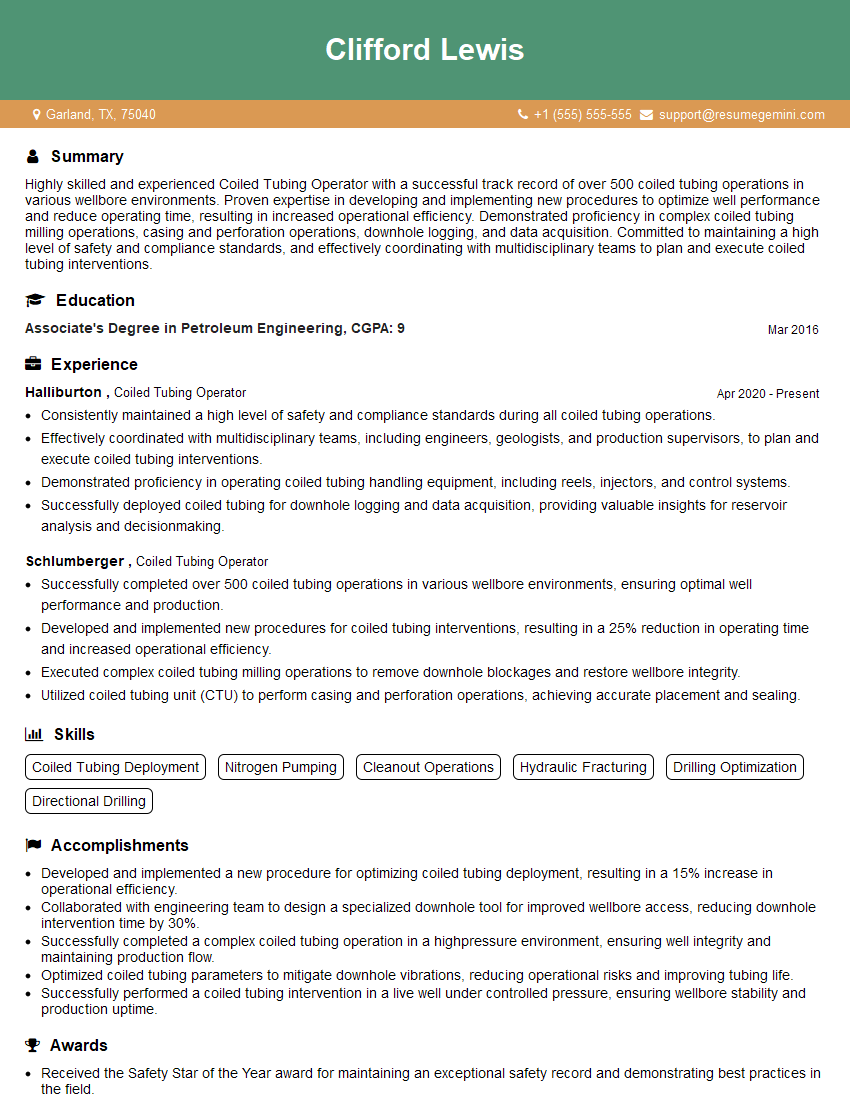
Mastering coiled tubing operations opens doors to exciting career opportunities in the energy sector, offering a path to technical expertise and leadership roles. To maximize your job prospects, creating a strong, ATS-friendly resume is crucial. ResumeGemini is a trusted resource that can help you build a professional resume designed to catch the eye of recruiters. ResumeGemini provides examples of resumes tailored to the Coiled Tubing industry, ensuring your qualifications shine. Take the next step towards your ideal career – build a compelling resume with ResumeGemini today!
Explore more articles
Users Rating of Our Blogs
Share Your Experience
We value your feedback! Please rate our content and share your thoughts (optional).
What Readers Say About Our Blog
Very informative content, great job.
good