Preparation is the key to success in any interview. In this post, we’ll explore crucial Coiling and Uncoiling interview questions and equip you with strategies to craft impactful answers. Whether you’re a beginner or a pro, these tips will elevate your preparation.
Questions Asked in Coiling and Uncoiling Interview
Q 1. Explain the difference between a powered and manual uncoiler.
The primary difference between powered and manual uncoilers lies in how the coil is unwound. A manual uncoiler relies on the operator to manually feed the material from the coil, often requiring significant physical effort, especially with heavier coils. Think of it like manually peeling a roll of paper towels – slow and labor-intensive. A powered uncoiler, on the other hand, uses a motorized mechanism to unwind the coil at a controlled speed and tension. This automation greatly increases efficiency and reduces the physical strain on the operator, similar to a motorized paper towel dispenser.
Powered uncoilers also offer more precise control over the unwinding process, leading to better material handling and reduced risk of damage. They are essential for high-volume production lines or applications requiring consistent material feed.
Q 2. Describe the safety precautions necessary when operating a coiling machine.
Safety is paramount when operating coiling machinery. Several precautions must be strictly adhered to:
- Lockout/Tagout Procedures: Before any maintenance or adjustment, always lock out and tag out the power source to prevent accidental startup.
- Personal Protective Equipment (PPE): Safety glasses, gloves, and hearing protection are crucial to safeguard against flying debris, sharp edges, and noise.
- Proper Training: Only trained and authorized personnel should operate coiling machines. Thorough training on machine operation, safety procedures, and emergency shutdown protocols is essential.
- Machine Guards: Ensure all safety guards are in place and functioning correctly to prevent access to moving parts.
- Regular Inspection: Conduct routine inspections of the machine for wear and tear, loose parts, or any signs of malfunction. Report and address any issues immediately.
- Emergency Stop Button: Know the location and operation of the emergency stop button and be prepared to use it in case of an emergency.
- Clear Workspace: Maintain a clean and organized workspace free from obstructions to prevent accidents.
Ignoring these safety precautions can lead to serious injuries or equipment damage.
Q 3. What are the common types of coil defects and how are they detected?
Common coil defects can significantly impact the quality of the final product. These defects can include:
- Loose Coils: Coils with insufficient tension resulting in loose loops or uneven spacing.
- Birdnesting: Tangled or overlapping loops of material, often caused by improper tension or guiding.
- Edge Damage: Scratches, dents, or tears at the edges of the coil.
- Surface Defects: Scratches, marks, or imperfections on the surface of the material.
- Inconsistency in Coil Diameter: Variations in the diameter throughout the coil.
- Overlapping: Coils not properly separated, leading to overlapping layers.
These defects are detected through a combination of visual inspection, automated measurement systems (e.g., diameter measurement devices, coil weight sensors), and sometimes specialized testing equipment. Visual inspection is particularly important for identifying surface defects and loose coils.
Q 4. How do you ensure the proper tension during coiling and uncoiling processes?
Maintaining proper tension during coiling and uncoiling is critical to prevent defects and ensure smooth operation. Several methods are used:
- Tension Control Devices: Many machines incorporate sensors and actuators to monitor and adjust tension automatically. This is particularly important for high-speed operations where consistent tension is crucial.
- Friction Brakes: Friction brakes are used to control the unwinding speed and tension. They can be manually adjusted or automated depending on the machine.
- Hydraulic Systems: Hydraulic systems provide precise and controlled tensioning, often used in heavier-duty applications.
- Air Brakes: Air brakes use compressed air to regulate tension, offering smooth and responsive control.
The specific method used depends on factors like material type, coil diameter, and desired processing speed. Regular calibration and maintenance of these tensioning mechanisms are essential to maintain consistent performance.
Q 5. What are the different methods used for coiling various materials (e.g., wire, metal sheet, fabric)?
The methods for coiling different materials vary depending on their properties and the desired coil geometry:
- Wire Coiling: Typically uses rotary coilers, which wind wire around a central mandrel. The speed and tension are carefully controlled to produce consistent coils.
- Metal Sheet Coiling: Often employs roll forming and coiling machines, which continuously shape and coil the metal sheet into tightly wound coils. These machines require precise control of the bending and coiling process to prevent material damage.
- Fabric Coiling: Can involve various methods, from simple manual winding for small quantities to specialized machines for large-scale production. The method chosen depends on the fabric type and the desired coil configuration.
The choice of coiling method considers factors like material thickness, flexibility, strength, and the desired final coil shape and size.
Q 6. Describe your experience with different types of coiling machines (e.g., rotary, mandrel, etc.).
My experience encompasses a wide range of coiling machines. I’ve worked extensively with rotary coilers for wire and small diameter materials, appreciating their ability to produce precise and consistent coils. I’m also familiar with mandrel coilers, which are excellent for creating coils with specific diameters and shapes. These are particularly useful for applications requiring custom coil geometries. Furthermore, I have experience with turret coilers used for heavier materials, requiring robust mechanisms to manage the coil weight and ensure controlled unwinding. Each machine type presents unique operational challenges and considerations related to safety, maintenance, and material handling.
My experience also includes troubleshooting and optimizing various coiling systems, adapting them to diverse materials and production requirements. This has involved programming adjustments, modifying tension control settings, and implementing preventative maintenance schedules to maximize efficiency and uptime.
Q 7. How do you handle different coil diameters and weights?
Handling varying coil diameters and weights requires adaptability and the use of appropriate equipment. For different coil diameters, we employ machines with adjustable mandrels or coil cradles that can accommodate the range of sizes. Larger diameter coils often necessitate different handling techniques and potentially specialized machinery. Similarly, heavier coils require more robust machinery with stronger motors and tensioning systems. The use of lifting equipment like cranes or forklifts may be necessary for safety and efficiency.
In practice, I would carefully evaluate the coil specifications before selecting the appropriate machine and adjusting settings to match the diameter and weight. This includes setting the correct tension, speed, and potentially utilizing specialized guides or supports to prevent coil damage or instability during the process. Safety is always prioritized, particularly with heavier coils, and appropriate lifting and handling procedures are strictly followed.
Q 8. What are the factors affecting the quality of a coiled product?
The quality of a coiled product hinges on several interconnected factors. Think of it like baking a cake – if one ingredient is off, the whole thing suffers. In coiling, these factors include the material’s properties (tensile strength, yield strength, surface finish), the coiling process parameters (coil tension, winding speed, mandrel diameter), and the condition of the equipment itself. For example, if the material is brittle, it’s more prone to cracking during coiling, regardless of the machine settings. Similarly, inconsistent tension can lead to loose or tightly wound sections, affecting the final product’s uniformity and stability. Regular maintenance of coiling machinery is crucial to prevent defects caused by worn parts, misalignment, or lubrication issues. Ultimately, meticulous attention to every aspect of the process ensures high-quality coils.
- Material Properties: Tensile strength, yield strength, surface finish, and material thickness.
- Coiling Parameters: Coil tension, winding speed, mandrel diameter, and inner diameter.
- Equipment Condition: Proper functioning of coiling machinery, including drive systems, tensioning devices, and guiding mechanisms.
Q 9. Explain your understanding of coil geometry and its importance in the process.
Coil geometry refers to the physical dimensions and shape of the coil, encompassing factors like outer diameter, inner diameter, coil width, coil height, and the overall coil shape (e.g., cylindrical, conical). It’s absolutely critical for efficient processing and downstream applications. Imagine trying to use a coil that’s irregularly shaped – it would be difficult to handle and could jam machinery. Precise coil geometry is essential for smooth feeding into subsequent processes like stamping, forming, or welding. Inconsistencies can lead to material jams, production delays, and potentially damage to downstream equipment. Therefore, tight control over coiling parameters is essential to ensure consistent and predictable coil geometry. For instance, accurately controlling the mandrel diameter directly impacts the inner diameter of the coil, while the tension during coiling affects the coil’s overall tightness and shape.
Q 10. How do you troubleshoot common problems encountered in coiling and uncoiling operations?
Troubleshooting coiling and uncoiling problems often involves a systematic approach. I usually start by visually inspecting the coil and the equipment. Common problems include coil breakage, uneven winding, jamming, and damage to the material. For instance, if a coil is breaking repeatedly, I’d first check the material’s tensile strength and then look at the coiling tension settings. Is it too high, causing the material to fracture? Or too low, resulting in loose coils prone to damage? If there’s uneven winding, I’d investigate the guiding mechanisms and the tension control system. A systematic check of all aspects will generally reveal the issue. If the problem persists, a more thorough examination of the machinery may be required, possibly including lubrication checks and adjustments to the drive system. Proper documentation of the issue and resolution helps prevent similar problems in the future.
- Coil Breakage: Check material properties, coiling tension, and mandrel condition.
- Uneven Winding: Inspect guiding mechanisms, tension control, and material properties.
- Jamming: Check for obstructions, coil geometry inconsistencies, and equipment alignment.
- Material Damage: Review material handling practices and equipment settings.
Q 11. What are the different types of material handling equipment used in conjunction with coiling and uncoiling?
Various material handling equipment is used in conjunction with coiling and uncoiling to enhance efficiency and safety. This includes forklifts for transporting coils, overhead cranes for heavier coils, coil cars for moving coils across large distances, and specialized coil handling attachments for forklifts and cranes. For instance, a specialized coil-handling attachment with rotating forks can grip and rotate a coil for easier placement. Conveyors and turntables facilitate the smooth movement of coils between processing stations. The choice of equipment depends on the coil’s weight, size, and the specific requirements of the manufacturing process. We also use robotic systems in some advanced facilities to automate certain aspects of coil handling and placement, improving both speed and precision.
Q 12. How do you ensure the efficient flow of materials during the coiling and uncoiling process?
Efficient material flow in coiling and uncoiling processes is crucial for minimizing downtime and maximizing productivity. This involves careful planning of the production layout, the strategic placement of equipment, and the use of appropriate material handling methods. The use of conveyors, especially powered roller conveyors, helps to smoothly transfer coils between different stages of processing. Proper storage of coils, preventing them from being damaged or interfering with movement, is equally important. We also employ ‘first-in, first-out’ (FIFO) inventory management principles to ensure the timely processing of materials. Additionally, real-time tracking systems can provide visibility into the location and status of coils, allowing for quicker identification and resolution of any bottlenecks.
Q 13. What are the common causes of coil damage and how can they be prevented?
Coil damage can stem from various causes, including improper handling, inadequate storage, and defects in the coiling process. For example, dropping a coil can cause severe dents and damage, rendering it unusable. Improper storage, such as stacking coils unevenly or in humid environments, can lead to corrosion and deformation. Defects in the coiling process itself, such as excessive tension or poor guidance, can cause surface scratches or internal stress cracks. Prevention strategies involve using appropriate material handling equipment, careful stacking techniques, and controlled storage conditions. Regular inspections of coils during and after processing and training personnel on proper handling procedures are key to minimizing damage. Investing in high-quality coiling machinery with advanced features like tension control and guiding systems contributes to creating high-quality, damage-free coils.
Q 14. Describe your experience with preventative maintenance on coiling and uncoiling equipment.
Preventative maintenance is paramount to ensure the smooth and reliable operation of coiling and uncoiling equipment. My experience encompasses creating and adhering to comprehensive maintenance schedules, including regular lubrication of moving parts, periodic inspections for wear and tear, and prompt replacement of worn components. This includes inspecting bearings, gears, chains, and tensioning mechanisms. We also regularly check the alignment of the equipment, and conduct routine electrical checks. We document all maintenance activities meticulously. This methodical approach significantly reduces the risk of equipment failure, improves product quality, and extends the operational lifespan of the machinery. Proactive maintenance saves time and money in the long run by preventing costly repairs and production downtime. I have also implemented programs for operator training on basic equipment maintenance and troubleshooting, empowering them to identify minor problems before they escalate into major issues.
Q 15. How do you maintain proper cleanliness and organization in your work area?
Maintaining a clean and organized workspace in coiling and uncoiling operations is paramount for safety and efficiency. Think of it like a well-oiled machine – if the environment is cluttered, the process is likely to be slowed down and prone to errors. My approach is multi-faceted:
- Regular Cleaning: I dedicate time at the beginning and end of each shift to clear away debris, scrap material, and spilled lubricant. This prevents accidents caused by tripping hazards and keeps machinery free from obstructions.
- Organized Storage: Tools, spare parts, and materials are stored in designated areas using clearly labeled containers and racks. This allows for quick access to necessary items and reduces the time spent searching, improving efficiency. For example, I keep different coil sizes segregated to avoid mix-ups.
- 5S Methodology: I implement the 5S methodology (Sort, Set in Order, Shine, Standardize, Sustain) to maintain a consistently clean and organized workspace. This systematic approach ensures continuous improvement in the work area.
- Preventative Maintenance: Regularly inspecting equipment and performing minor maintenance tasks like lubricating moving parts helps to prevent larger problems down the line, reducing downtime and keeping the work area cleaner.
By consistently applying these practices, I ensure a safe and efficient working environment.
Career Expert Tips:
- Ace those interviews! Prepare effectively by reviewing the Top 50 Most Common Interview Questions on ResumeGemini.
- Navigate your job search with confidence! Explore a wide range of Career Tips on ResumeGemini. Learn about common challenges and recommendations to overcome them.
- Craft the perfect resume! Master the Art of Resume Writing with ResumeGemini’s guide. Showcase your unique qualifications and achievements effectively.
- Don’t miss out on holiday savings! Build your dream resume with ResumeGemini’s ATS optimized templates.
Q 16. Explain your understanding of the relevant safety standards and regulations related to coiling and uncoiling.
Safety is my top priority. My understanding of safety standards and regulations related to coiling and uncoiling encompasses several key areas:
- Lockout/Tagout Procedures (LOTO): Before performing any maintenance or repair on coiling/uncoiling machinery, I strictly follow LOTO procedures to prevent accidental energization. This involves de-energizing equipment and affixing appropriate safety tags to prevent unauthorized access.
- Personal Protective Equipment (PPE): I consistently use appropriate PPE such as safety glasses, gloves, steel-toed boots, and hearing protection to mitigate risks associated with moving machinery, sharp edges, and high noise levels. The type of PPE varies depending on the specific task.
- Machine Guards and Safe Operating Procedures (SOPs): I ensure all machine guards are in place and functioning correctly. I adhere strictly to the SOPs specific to each machine, including proper startup, shutdown, and emergency stop procedures. For example, understanding the weight limits of the equipment and never exceeding them is critical.
- Ergonomics: I am aware of the ergonomic risks involved in manual handling of coils and use appropriate lifting techniques and mechanical aids, such as coil lifters, to minimize strain and prevent injuries. Back injuries are a major concern, so I always prioritize proper lifting techniques.
- Awareness of Hazards: I am constantly vigilant for potential hazards like tangled wire, sharp edges, and unstable stacks of coiled material and take proactive steps to mitigate these risks.
Regular safety training and compliance with all company and industry regulations are vital to my work.
Q 17. How do you prioritize tasks when multiple coiling or uncoiling operations are required?
Prioritizing multiple coiling or uncoiling operations requires a systematic approach. I typically use a combination of factors to determine the order of tasks:
- Urgency: Tasks with immediate deadlines or those that impact downstream processes take precedence. For example, if a production line is waiting for a specific coil, that task would be prioritized.
- Material Handling: If a specific coil requires a specialized handling technique or equipment, it may need to be handled before others to avoid delays or damage.
- Coil Size and Weight: Larger and heavier coils may require more time and resources, so those would be scheduled accordingly.
- Material Type: If some coils are more delicate or sensitive to damage than others, they may need to be handled with care and prioritized to avoid potential issues.
- Machine Availability: If certain machines are required for specific coiling processes, I ensure that the tasks are prioritized to optimize equipment utilization.
Using a combination of these factors and a well-organized schedule allows for efficient completion of multiple tasks without compromising quality or safety.
Q 18. What is your experience with automated coiling systems?
I have extensive experience working with automated coiling systems, from basic CNC-controlled machines to highly sophisticated robotic systems. This includes:
- Programming and Operation: I am proficient in programming and operating various automated coiling systems, including setting parameters such as coil diameter, tension, and speed.
- Troubleshooting and Maintenance: I have experience troubleshooting malfunctions, performing routine maintenance, and making minor repairs on automated systems. This often includes working with PLC (Programmable Logic Controller) systems.
- Integration with Other Systems: I understand how automated coiling systems integrate with other parts of the manufacturing process, such as material handling and quality control systems.
- Specific examples: I’ve worked with a system using servo-motors to control coil tension, ensuring consistent and tight coils, and a robotic arm that automatically feeds and unloads coils, increasing productivity and reducing the chance of manual handling errors.
My experience with these systems demonstrates a strong ability to improve efficiency and reduce manual labor requirements.
Q 19. Describe your experience using specific software or control systems for coiling machines.
My experience includes working with several different software and control systems for coiling machines. This includes:
- PLC Programming: I’m familiar with programming PLCs using languages like ladder logic to control and monitor various aspects of the coiling process, including speed, tension, and coil diameter. I’ve used this to improve production efficiency and reduce waste.
- HMI (Human-Machine Interface) Software: I am proficient in using various HMI software packages to monitor machine parameters, diagnose faults, and adjust operational settings. This allows for real-time monitoring and adjustments for optimal performance.
- SCADA (Supervisory Control and Data Acquisition) Systems: I have experience integrating coiling machines into larger SCADA systems for remote monitoring and control of multiple machines across the facility. This provides a centralized overview of production and helps in predictive maintenance.
- Specific Software Examples: I have worked with Allen-Bradley PLC programming software and various HMI platforms such as FactoryTalk View SE and WinCC.
This proficiency allows for efficient operation, proactive maintenance, and improved overall process control.
Q 20. How do you ensure the accuracy and consistency of coiled products?
Ensuring the accuracy and consistency of coiled products is critical for quality control. My methods include:
- Calibration and Maintenance: Regularly calibrating the coiling machines and performing preventative maintenance are crucial to maintain accuracy and consistency. This is done by regularly checking and adjusting settings as per the manufacturer’s recommendations.
- Process Monitoring: Close monitoring of key parameters such as coil diameter, tension, and speed using control systems and sensors is vital. Any deviation from set points is immediately addressed.
- Quality Control Checks: Regular quality control checks are done to ensure the coils meet the required specifications. This often includes measuring the coil diameter, weight, and overall appearance.
- Feedback Loops: Using feedback loops from the coiling machine and quality control checks, adjustments to the coiling process can be made to ensure consistency and prevent defects. This approach utilizes real-time data and feedback loops to address deviations promptly.
- Material Properties: Considering the material properties is essential. The tension and speed will need adjustment depending on the material type, thickness and rigidity. A high-tensile strength material requires a different approach from a soft, flexible material.
By employing these methods, I guarantee the production of high-quality, consistent coiled products.
Q 21. What metrics do you use to measure the efficiency of the coiling and uncoiling processes?
Measuring the efficiency of coiling and uncoiling processes involves tracking several key metrics:
- Production Rate: This measures the number of coils produced per unit of time (e.g., coils per hour or coils per shift). A higher production rate indicates improved efficiency.
- Downtime: Minimizing downtime due to machine malfunctions or material shortages is crucial for efficiency. Tracking downtime and identifying its root causes helps to reduce future occurrences.
- Material Waste: Monitoring the amount of scrap material generated during the coiling and uncoiling process helps to identify areas for improvement and reduce waste. This might involve analyzing coil defects and optimizing the coiling parameters.
- Defect Rate: Tracking the percentage of defective coils produced helps identify problems in the process and allows for implementing corrective actions. Analyzing defect rates can highlight areas in the process that require attention.
- Overall Equipment Effectiveness (OEE): OEE is a comprehensive metric that combines production rate, quality rate, and availability. This provides a single holistic measure of the overall efficiency of the equipment.
By regularly analyzing these metrics, I can identify areas for improvement and optimize the coiling and uncoiling processes for maximum efficiency.
Q 22. How do you work effectively as part of a team in a production environment?
Effective teamwork in a production environment hinges on clear communication, mutual respect, and a shared commitment to achieving production goals. In my experience, I thrive in team settings by actively participating in pre-production meetings to understand the day’s objectives and potential challenges. I contribute my expertise in coiling and uncoiling processes, offering solutions and anticipating potential bottlenecks. I believe in proactive problem-solving; if I identify a potential issue, I immediately communicate it to the team to prevent delays. Furthermore, I’m always willing to assist colleagues, sharing my knowledge and skills to ensure smooth operation. For instance, during a particularly tight deadline, I trained a new team member on the intricacies of operating our automated coiling machine, ensuring a seamless transition and maintaining production efficiency.
- Open Communication: I actively participate in discussions, share information, and solicit feedback.
- Collaboration: I work seamlessly with colleagues from different departments (e.g., maintenance, quality control).
- Proactive Problem-Solving: I anticipate and address potential issues before they impact production.
- Mentorship: I actively share my knowledge and skills to upskill colleagues.
Q 23. Describe a time you had to solve a complex problem involving coiling or uncoiling equipment.
We experienced a significant issue with our automated uncoiling system. The material, a high-tensile steel coil, was exhibiting irregular unwinding, leading to frequent jams and production stoppages. The initial troubleshooting focused on the machine’s mechanical components, but after several hours, the issue persisted. I decided to shift our focus to the material itself. We discovered the steel coil had a slight imperfection in its internal structure – a stress concentration that caused uneven tension during unwinding. We solved the problem by implementing a controlled tensioning system with a sophisticated brake mechanism, specifically designed to manage inconsistent coil tension. This involved adjusting the brake pressure dynamically based on the detected coil tension levels, ensuring smooth and consistent unwinding, eliminating the jams.
The solution required not just mechanical expertise, but also a deep understanding of material properties and their influence on the coiling and uncoiling process. It highlighted the importance of considering the entire system, from material characteristics to machinery functionality.
Q 24. What are the key performance indicators (KPIs) that you monitor in your work?
Key Performance Indicators (KPIs) in coiling and uncoiling focus on efficiency, safety, and quality. The most critical KPIs I monitor include:
- Production Rate (Units/Hour): This measures the overall efficiency of the coiling and uncoiling process.
- Downtime Percentage: Minimizing downtime due to equipment malfunctions or material issues is crucial for productivity.
- Coil Quality (Defect Rate): This includes assessing for defects like scratches, dents, or inconsistent coil diameter.
- Material Waste: Tracking and minimizing material waste during the process is essential for cost control.
- Safety Incidents: Maintaining a zero-incident safety record is paramount.
- Energy Consumption: Monitoring energy consumption helps optimize resource usage and reduce operational costs.
Regularly tracking these KPIs allows for continuous improvement and proactive identification of areas needing attention.
Q 25. How do you adapt your approach to coiling and uncoiling depending on the specific material being handled?
Adaptability is crucial in coiling and uncoiling. Different materials require tailored approaches to prevent damage and maintain efficiency. For instance, delicate materials like thin gauge aluminum necessitate gentler tension control and slower speeds to avoid stretching or wrinkling. Conversely, thicker and stronger materials like steel can withstand higher tensions and faster speeds.
This requires adjusting several parameters, including:
- Coil Tension: This needs to be carefully balanced to prevent damage and ensure consistent unwinding.
- Unwinding Speed: This should be optimized for each material’s properties to prevent defects.
- Mandrel Diameter: The mandrel (the central core around which the coil is wound) needs to be appropriately sized to support the material.
- Material Handling Equipment: Specialized equipment might be required for different materials (e.g., conveyors, lifting equipment).
Understanding material properties – such as tensile strength, yield point, and elasticity – is crucial for making the right adjustments.
Q 26. Describe your experience with different types of coil packaging and storage techniques.
My experience encompasses various coil packaging and storage techniques. These range from simple palletized coils secured with straps, to more sophisticated methods involving shrink wrapping, protective coverings (e.g., cardboard, plastic), and specialized storage racks. I’m proficient in using different types of packaging materials to protect coils from damage during transport and storage. The choice of packaging and storage techniques depends on factors like material type, size, weight, and destination. For instance, coils intended for export usually require more robust packaging to withstand the rigors of international shipping. Proper stacking and storage prevent deformation or damage to the coils, ensuring quality and preventing costly losses.
Q 27. How do you ensure the safety of the coiling and uncoiling equipment?
Safety is paramount in coiling and uncoiling operations. I rigorously follow established safety protocols, including regular equipment inspections, adherence to lockout/tagout procedures (to prevent accidental starts), and the proper use of Personal Protective Equipment (PPE), such as safety glasses, gloves, and steel-toe boots. Before operating any equipment, I thoroughly check for any signs of wear, tear, or damage. I also ensure that the machine’s safety features (e.g., emergency stops, guards) are functioning correctly. Regular training and awareness programs help maintain a safe work environment, and I actively participate in these initiatives. A proactive approach, coupled with regular maintenance and adherence to safety standards, is essential for preventing accidents.
Q 28. What are your strengths and weaknesses related to coiling and uncoiling?
My strengths lie in my in-depth knowledge of coiling and uncoiling processes, my proficiency in troubleshooting equipment malfunctions, and my ability to adapt my approach to different materials and situations. I’m a quick learner and possess strong problem-solving skills. One area where I am continually striving for improvement is expanding my knowledge of the latest advancements in automation and control systems within the coiling and uncoiling industry. I’m currently taking online courses to enhance my expertise in this area.
Key Topics to Learn for Coiling and Uncoiling Interviews
- Coil Geometry and Design: Understanding different coil types (e.g., helical, spiral, conical), their properties, and the factors influencing their design (material properties, desired tension, application requirements).
- Coiling and Uncoiling Machinery: Familiarize yourself with various types of coiling and uncoiling equipment, their operational principles, and maintenance procedures. Consider the differences between automated and manual systems.
- Material Handling and Tension Control: Mastering the principles of material handling during coiling and uncoiling, including techniques for maintaining optimal tension to prevent damage or defects. This includes understanding tension sensors and control systems.
- Safety Procedures and Regulations: Demonstrate a thorough understanding of safety protocols and industry regulations related to coiling and uncoiling operations. Highlight your experience with risk assessment and mitigation.
- Troubleshooting and Problem-Solving: Be prepared to discuss common issues encountered during coiling and uncoiling, such as coil breakage, jamming, or uneven tension. Practice explaining your approach to diagnosing and resolving these problems.
- Process Optimization and Efficiency: Discuss strategies for improving the efficiency and productivity of coiling and uncoiling processes, including reducing downtime and waste.
- Quality Control and Inspection: Understand the importance of quality control measures in coiling and uncoiling and the techniques used to inspect coils for defects.
Next Steps
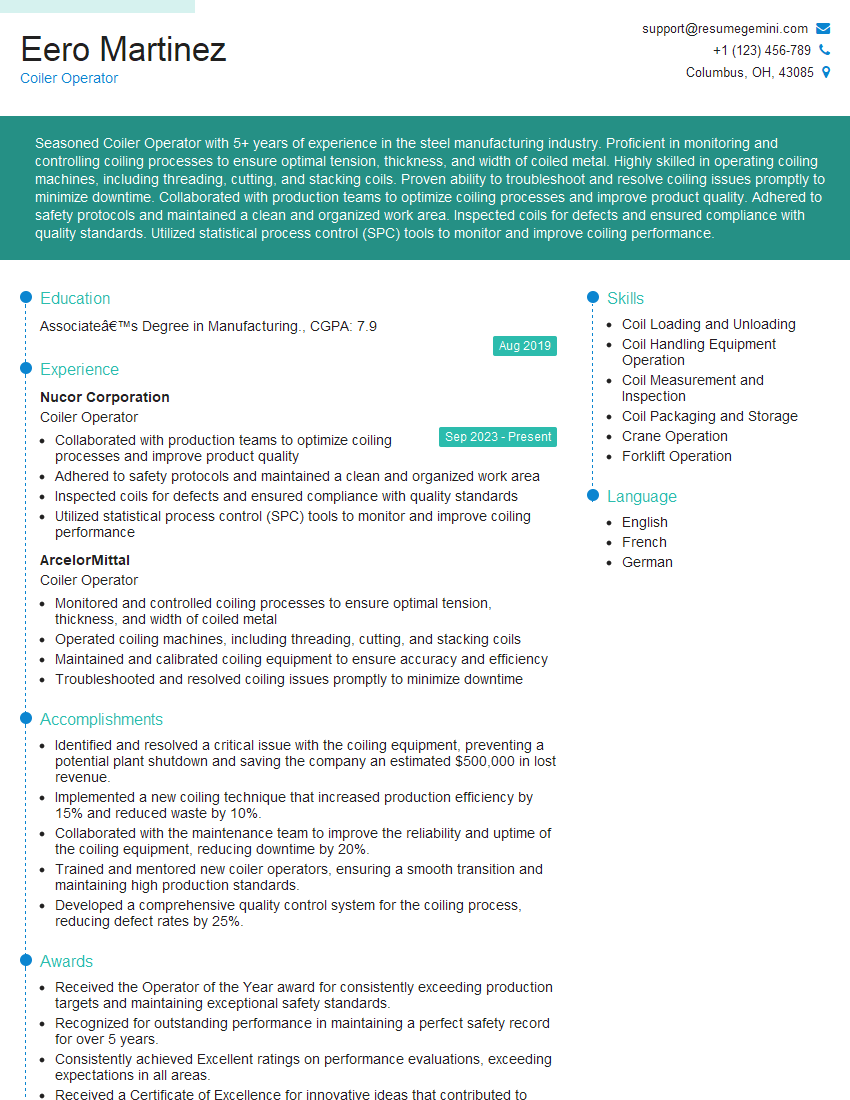
Mastering coiling and uncoiling techniques is crucial for career advancement in many manufacturing and industrial settings. A strong understanding of these processes demonstrates valuable skills in precision, safety, and problem-solving. To significantly increase your job prospects, create a compelling and ATS-friendly resume that highlights your relevant experience and skills. ResumeGemini is a trusted resource to help you build a professional and effective resume that showcases your abilities in the best possible light. Examples of resumes tailored to Coiling and Uncoiling are available to help guide your creation.
Explore more articles
Users Rating of Our Blogs
Share Your Experience
We value your feedback! Please rate our content and share your thoughts (optional).
What Readers Say About Our Blog
Very informative content, great job.
good