Are you ready to stand out in your next interview? Understanding and preparing for Collar Inventory Management interview questions is a game-changer. In this blog, we’ve compiled key questions and expert advice to help you showcase your skills with confidence and precision. Let’s get started on your journey to acing the interview.
Questions Asked in Collar Inventory Management Interview
Q 1. Explain the importance of accurate collar inventory tracking.
Accurate collar inventory tracking is the cornerstone of efficient operations in any industry utilizing collars, whether it’s the apparel, pet supply, or even industrial sectors. Without it, you’re essentially flying blind. Accurate tracking prevents stockouts, leading to lost sales and unhappy customers. Conversely, overstocking ties up capital in excess inventory, increasing storage costs and risking obsolescence. Accurate data allows for informed decision-making regarding purchasing, production planning, and resource allocation.
For example, imagine a pet supply company relying on estimations for collar stock. If they underestimate demand for a popular color, they lose sales. If they overestimate, they’re stuck with excess inventory that may become outdated or damaged over time. Accurate tracking avoids both scenarios.
Q 2. Describe your experience with different inventory management systems.
Throughout my career, I’ve worked with a variety of inventory management systems, ranging from simple spreadsheet-based solutions to sophisticated enterprise resource planning (ERP) systems. Spreadsheet solutions, while useful for smaller businesses, often lack the robust features of dedicated inventory software. I’ve used systems like Fishbowl Inventory, Zoho Inventory, and NetSuite. Each offers its own set of features and advantages, depending on the specific needs of the organization. For instance, Fishbowl is excellent for manufacturers, whereas Zoho might be better suited for e-commerce businesses. ERP systems like NetSuite offer comprehensive capabilities that integrate inventory management with other business processes such as accounting and customer relationship management (CRM). My experience allows me to select and implement the best system based on the scale and complexity of operations.
Q 3. How do you handle discrepancies in collar inventory counts?
Discrepancies in collar inventory are inevitable, but addressing them swiftly and systematically is crucial. My approach involves a multi-step process. First, I investigate the root cause. This could involve checking for errors in data entry, examining physical inventory procedures (were items misplaced, damaged, or stolen?), reviewing receiving and shipping documents, and even auditing the inventory management system itself for glitches or bugs. Once the cause is identified, I implement corrective actions, which might include retraining staff, improving data entry procedures, enhancing physical security, or upgrading software. Finally, I thoroughly document the entire process, including the discrepancy, the investigation, and the implemented solutions, to prevent similar issues from recurring.
For instance, if a discrepancy reveals a consistent shortage of a particular collar type, it may indicate theft or a problem with the receiving process. If the discrepancy is random, it could point to human error in counting or data entry.
Q 4. What methods do you use to forecast collar demand?
Forecasting collar demand is a critical function of inventory management. I utilize a combination of quantitative and qualitative methods. Quantitative methods involve analyzing historical sales data, using statistical techniques like time series analysis to identify trends and seasonal patterns. I also leverage external factors like economic indicators and marketing campaigns to refine forecasts. Qualitative methods incorporate insights from sales teams, market research, and customer feedback, providing a more nuanced understanding of future demand. This combined approach allows for more accurate and comprehensive forecasting.
For example, by analyzing past sales data, we can predict increased demand for brightly colored collars during the summer months. Coupling this with data on new marketing campaigns, we can fine-tune our forecasts to accurately reflect anticipated increases or decreases in sales.
Q 5. Explain your experience with cycle counting and its benefits.
Cycle counting is a crucial inventory management technique involving the regular counting of a small portion of the inventory rather than conducting a full inventory count at once. This approach significantly reduces downtime compared to a full count and increases accuracy over time. By regularly verifying the accuracy of stock levels, discrepancies can be identified and addressed promptly, minimizing the impact of errors. I schedule cycle counts strategically, prioritizing high-value or high-movement items. The data gathered is then compared to the system’s records and any discrepancies are investigated and rectified.
Imagine a warehouse with thousands of collars. A full count would require significant time and resources, potentially shutting down operations for days. Cycle counting allows for continuous monitoring, ensuring inventory accuracy without the disruption of a complete inventory count.
Q 6. How do you optimize collar storage and handling to minimize losses?
Optimizing collar storage and handling is critical to minimize losses due to damage, theft, or misplacement. This involves implementing a well-organized storage system that utilizes appropriate shelving, racking, and binning. Collars should be stored according to size, color, and style, making it easy to locate specific items. Implementing clear labeling and location identification systems is crucial. Employing FIFO (First-In, First-Out) inventory management methods helps prevent the expiration or obsolescence of older stock. Regular inspections for damage or deterioration should also be conducted.
For example, using clear, labeled bins to store collars according to size and color prevents confusion and streamlines the picking process. Regular audits of storage areas ensure that items are not damaged from improper stacking or environmental factors.
Q 7. How do you ensure the quality and condition of stored collars?
Maintaining the quality and condition of stored collars is essential to avoid losses from damage or degradation. This involves storing collars in a clean, dry environment, protected from extreme temperatures, humidity, and direct sunlight. Collars should be handled carefully to avoid scratches or tears. Regular inspections are necessary to identify any signs of damage or deterioration, such as fading, mildew, or insect infestation. Proper packaging, including the use of protective materials, can further help preserve the quality of stored collars.
For instance, storing collars in sealed, dust-free bags can prevent damage from dust or moisture. Regular checks for discoloration or fraying can identify potential quality issues before they become widespread problems.
Q 8. Describe your experience with inventory reporting and analysis.
Inventory reporting and analysis are crucial for understanding the health of my collar inventory. I’ve extensive experience generating reports that track key metrics like stock levels, turnover rates, and value of inventory. This involves using various software and databases to pull data, then analyzing it to identify trends, potential issues, and opportunities for improvement.
For example, in a previous role, I identified a consistent overstocking of certain collar styles through detailed sales analysis combined with inventory reports. This allowed us to adjust production forecasts and prevent significant losses from obsolete stock. I use tools like Excel for initial analysis and pivot tables to visualize trends, but also have experience with more advanced business intelligence software to create interactive dashboards showing real-time inventory performance.
Q 9. What metrics do you use to measure the effectiveness of collar inventory management?
Measuring the effectiveness of collar inventory management requires a multi-faceted approach, focusing on key performance indicators (KPIs). Some of the most important metrics I use include:
- Inventory Turnover Rate: This shows how quickly we sell our inventory. A higher turnover rate generally indicates efficient management. I calculate this as Cost of Goods Sold / Average Inventory.
- Stockout Rate: This measures the frequency of running out of specific collar styles. A high rate indicates potential lost sales and customer dissatisfaction.
- Inventory Holding Cost: This represents the expenses associated with storing and managing our inventory (storage fees, insurance, obsolescence, etc.). Lowering this cost is a primary goal.
- Fill Rate: This metric assesses our ability to meet customer demand from available stock. A high fill rate signifies excellent inventory management.
- Accuracy Rate: This is the percentage of inventory counts that match our system records. High accuracy is essential for making informed decisions.
By tracking these KPIs and analyzing trends over time, I can pinpoint areas for improvement and demonstrate the impact of inventory management strategies.
Q 10. How do you identify and address slow-moving or obsolete collar inventory?
Identifying slow-moving or obsolete collar inventory is a proactive process. I use a combination of techniques:
- ABC Analysis: This method categorizes inventory items based on their value and consumption rate. Focusing on ‘C’ items (low value, slow-moving) allows for targeted efforts to reduce excess stock.
- Sales Trend Analysis: Regularly reviewing sales data reveals items with declining sales velocity. This helps predict potential obsolescence.
- Inventory Age Reports: These reports show the length of time items have been in stock. Items exceeding a certain threshold are flagged for review.
Once slow-moving or obsolete items are identified, I take several steps:
- Discounting/Promotional Sales: To accelerate sales and reduce inventory levels.
- Liquidation: Selling off remaining stock to salvage some value.
- Donation/Disposal: If items are unsalvageable.
- Process Improvement: Analyzing the reasons behind slow-moving inventory to prevent future occurrences. This may involve improving forecasting techniques or modifying product offerings.
Q 11. Explain your experience with FIFO (First-In, First-Out) inventory management.
FIFO (First-In, First-Out) is a crucial inventory accounting method that I’ve used extensively. It assumes that the oldest items in stock are sold first. This approach helps ensure that products with shorter shelf lives (if applicable to certain collar materials) are utilized before they expire or become obsolete. It also simplifies inventory valuation, as the cost of goods sold reflects the cost of the oldest items.
For example, imagine we receive a batch of collars with a specific design in January and another batch in April. Using FIFO, we’d track sales as if the January batch was sold first. This is important for accurate cost accounting and financial reporting. Most inventory management systems readily support FIFO tracking.
Q 12. How do you manage inventory during peak seasons or unexpected surges in demand?
Managing inventory during peak seasons or unexpected demand surges requires a strategic approach. My strategies include:
- Demand Forecasting: Accurate sales forecasts are essential. I leverage historical data, market trends, and promotional calendars to predict demand. Sophisticated forecasting techniques can improve accuracy.
- Safety Stock: Maintaining a buffer of inventory to absorb unexpected demand spikes. The optimal safety stock level is determined based on factors like lead time for replenishment and demand variability.
- Strategic Sourcing: Having multiple suppliers or flexible contracts enables us to rapidly increase inventory if needed.
- Agile Production: Working with manufacturers to allow for rapid adjustments to production schedules in response to demand changes.
- Real-Time Monitoring: Constantly tracking inventory levels and sales data allows for proactive adjustments to avoid stockouts or excess inventory.
Q 13. Describe your experience with implementing and improving inventory processes.
I have significant experience in implementing and improving inventory processes. This often involves a systematic approach:
- Process Mapping: Identifying current processes and bottlenecks.
- Technology Implementation: Implementing or upgrading inventory management systems (WMS, ERP) to enhance accuracy and efficiency.
- Training and Development: Ensuring that all staff are properly trained on new systems and processes.
- Continuous Improvement: Regularly reviewing KPIs and adapting processes based on performance data. Techniques like Kaizen (continuous improvement) are helpful here.
In one case, I implemented a new barcode scanning system, which drastically reduced manual errors in inventory counting and improved the accuracy rate from 85% to 98% within six months. This directly translated to reduced costs and improved customer satisfaction.
Q 14. How do you collaborate with other departments to ensure efficient collar inventory management?
Effective collar inventory management requires close collaboration with various departments. I regularly work with:
- Sales and Marketing: To understand sales forecasts, promotional plans, and potential demand fluctuations. This ensures inventory levels align with marketing strategies.
- Purchasing/Procurement: To coordinate timely ordering of new inventory, negotiate with suppliers, and manage lead times. This prevents stockouts and ensures competitive pricing.
- Production/Manufacturing (if applicable): To optimize production schedules and minimize excess inventory. Close communication is vital for managing capacity and responding to demand changes.
- Finance: To accurately track inventory costs, manage budgets, and report financial performance. This helps ensure optimal allocation of resources.
This cross-functional collaboration promotes transparency and helps maintain an efficient and effective inventory management system. Regular meetings and shared data dashboards are key to successful collaboration.
Q 15. What is your experience with using barcode scanning or RFID technology for inventory tracking?
My experience with barcode scanning and RFID technology for collar inventory tracking is extensive. I’ve utilized both systems in various settings, from small-scale operations to large distribution centers. Barcode scanning is a cost-effective solution for tracking individual collars, particularly useful when dealing with a smaller volume or a simpler tracking system. The process involves assigning a unique barcode to each collar, scanning it at various points in the supply chain (receiving, storage, shipping), and using a database system to record the data. This allows for accurate tracking of individual units. For example, I’ve used this system to track the movement of high-value, custom-made collars through our production process.
RFID (Radio-Frequency Identification) offers a more advanced approach, particularly beneficial when dealing with large volumes of collars, requiring real-time tracking or automation. RFID tags are attached to each collar, and readers can track multiple collars simultaneously without line-of-sight requirements. I’ve implemented RFID in environments where fast, accurate tracking of thousands of collars was crucial for efficient order fulfillment and inventory management. This provided significant improvements in inventory accuracy and reduced the time needed for stocktaking. The data collected through both methods can be utilized for insightful analysis to optimize inventory levels and identify areas for process improvement. Think of it like comparing using a handheld inventory counter versus a sophisticated warehouse management system.
Career Expert Tips:
- Ace those interviews! Prepare effectively by reviewing the Top 50 Most Common Interview Questions on ResumeGemini.
- Navigate your job search with confidence! Explore a wide range of Career Tips on ResumeGemini. Learn about common challenges and recommendations to overcome them.
- Craft the perfect resume! Master the Art of Resume Writing with ResumeGemini’s guide. Showcase your unique qualifications and achievements effectively.
- Don’t miss out on holiday savings! Build your dream resume with ResumeGemini’s ATS optimized templates.
Q 16. How do you handle damaged or defective collars?
Handling damaged or defective collars involves a multi-step process focused on minimizing losses and maintaining accurate inventory records. First, damaged collars are identified and segregated from the good inventory. This is often done through visual inspection or automated quality control systems. A detailed record is kept which includes the collar’s ID, date of damage, type of damage, and the reason for the damage. This data is critical for identifying trends and addressing potential quality issues upstream in the supply chain. We then assess the extent of the damage; sometimes, the collar can be repaired or refurbished. Otherwise, it needs to be disposed of properly, considering ethical and environmental aspects. This often includes adhering to any specific regulations regarding disposal of materials. Documentation of the entire process ensures inventory accuracy and assists in cost analysis relating to damage and loss. We analyze the data to understand the root causes of damage – whether it’s due to manufacturing flaws, improper handling, or storage issues – to improve future procedures. For example, if consistent damage is found due to poor packaging, we’d adjust our packaging processes to mitigate this.
Q 17. What are some common challenges in managing collar inventory, and how have you overcome them?
Common challenges in collar inventory management include inaccurate tracking, high stock-out rates, excessive storage costs, and inefficient order fulfillment. I’ve successfully addressed these using a combination of strategies. Inaccurate tracking is mitigated through the use of barcode/RFID technology and rigorous inventory control procedures, including regular cycle counting and reconciliation processes. High stock-out rates are tackled by implementing robust forecasting models, considering factors such as seasonality, trends, and lead times. We regularly review these models and adjust them as needed. Excessive storage costs are managed through strategic inventory optimization techniques, aiming for the optimal balance between holding inventory and meeting demand. This often includes implementing lean principles and optimizing warehouse layout. Inefficient order fulfillment is improved by implementing a streamlined order processing system, optimizing warehouse layout for efficient picking and packing, and optimizing shipping processes.
For instance, one particularly challenging situation involved a sudden surge in demand for a specific type of collar during peak season. By rapidly adjusting our forecasting models, prioritizing order fulfillment for high-demand items, and using cross-docking strategies, we were able to meet the demand while minimizing stock-outs and excess inventory.
Q 18. Describe your experience with inventory software and database systems.
My experience with inventory software and database systems is extensive. I am proficient in using various systems, ranging from simple spreadsheet-based solutions to sophisticated enterprise resource planning (ERP) systems. I’ve worked with systems like Fishbowl Inventory, NetSuite, and SAP, among others. My expertise includes data entry, report generation, data analysis, and system configuration. I understand the importance of data integrity and accuracy, and I am skilled in troubleshooting system issues and implementing data validation rules. I can design and implement custom database solutions tailored to specific inventory management needs, such as integrating inventory data with sales and production data to provide a comprehensive overview of the supply chain.
For example, I once implemented a custom SQL database to track collar inventory in a multi-warehouse environment, enabling real-time visibility of inventory levels across multiple locations. This provided significant improvements in stock management and order fulfillment.
Q 19. How do you ensure compliance with industry regulations regarding collar inventory?
Ensuring compliance with industry regulations regarding collar inventory involves understanding and adhering to all relevant rules and guidelines related to product safety, labeling, traceability, and disposal. These regulations vary depending on the type of collar, materials used, and the intended use. For example, collars used in specific industries (e.g., medical, aviation) may have stricter regulations. This involves implementing a robust system for tracking product information, including materials used, manufacturing processes, and distribution records. We meticulously maintain documentation relating to product certification, testing results, and compliance audits. Regular internal audits and external inspections are also part of the process to ensure continuous compliance. Staying updated on evolving regulations is crucial, and we actively engage in industry best practices and training to maintain compliance.
Q 20. What is your understanding of safety stock and how do you determine appropriate levels?
Safety stock refers to the extra inventory held to buffer against unexpected demand fluctuations or supply chain disruptions. Determining appropriate safety stock levels is a crucial aspect of inventory management. It’s a balance between the risk of stockouts and the cost of holding excess inventory. Factors considered include demand variability, lead time variability, service level requirements, and the cost of stockouts and holding costs. We typically use statistical methods like calculating the standard deviation of demand to predict potential fluctuations. We also incorporate historical data and future demand forecasts to fine-tune our safety stock levels. The ultimate goal is to maintain a level of safety stock that minimizes the risk of stockouts while keeping overall inventory costs manageable. For instance, by analyzing past sales data and predicting future trends, we’ve accurately calculated safety stock levels for high-demand collar types, ensuring we always meet customer demand even during peak seasons.
Q 21. How do you manage inventory across multiple locations or warehouses?
Managing inventory across multiple locations or warehouses involves implementing a centralized inventory management system that provides real-time visibility of inventory levels across all locations. This requires robust software and technology, often an ERP system or a specialized warehouse management system (WMS). It is crucial to maintain accurate data synchronization across all locations to prevent discrepancies. We use barcoding or RFID technologies to accurately track inventory movement between warehouses and locations. Furthermore, optimizing warehouse layout and picking strategies in each location improves order fulfillment efficiency. We utilize sophisticated inventory planning tools and forecasting models to ensure that we have the right amount of inventory in the right place at the right time, considering factors like shipping costs and regional demand variations. Efficient inter-warehouse transfer procedures are also essential to avoid stock imbalances. For example, using a centralized database connected to all warehouses allows us to track inventory levels in real time, optimizing replenishment and enabling efficient order allocation from the warehouse best suited to meet customer needs.
Q 22. Explain your experience with inventory turnover analysis and its implications.
Inventory turnover analysis measures how efficiently a business sells its inventory. It’s calculated by dividing the cost of goods sold by the average inventory value over a period. A high turnover rate generally indicates strong sales and efficient inventory management, minimizing storage costs and the risk of obsolescence. A low turnover rate might suggest slow-moving stock, potential for losses due to markdowns, or overstocking.
In my experience, I’ve used inventory turnover analysis to identify slow-moving collar styles. For instance, we noticed a low turnover rate for a specific type of silk collar. Analyzing sales data and market trends, we concluded that the color was unpopular, leading us to adjust our purchasing strategy and offer discounts to clear the stock. This allowed us to free up capital and shelf space for faster-selling items. I also used this analysis to negotiate better terms with suppliers for fast-moving items, leveraging our high turnover rate as evidence of strong demand.
Understanding inventory turnover isn’t just about numbers; it’s about understanding the story behind the data. It helps us make data-driven decisions about purchasing, pricing, and marketing strategies, ultimately leading to improved profitability.
Q 23. Describe your experience with root cause analysis for inventory discrepancies.
Root cause analysis (RCA) is crucial for addressing inventory discrepancies—the difference between the recorded inventory and the physical count. When discrepancies occur, I employ a structured approach like the ‘5 Whys’ technique or a fishbone diagram to identify the underlying cause, rather than just addressing the symptom. This prevents recurring issues.
For example, a recent discrepancy revealed a shortage of 100 linen collars. Using the 5 Whys:
- Why is there a shortage? Because the physical count is lower than the recorded inventory.
- Why is the physical count lower? Because some collars were mistakenly marked as sold.
- Why were they mistakenly marked as sold? Because the point-of-sale system had a glitch.
- Why did the POS system have a glitch? Because of a recent software update that wasn’t properly tested.
- Why wasn’t the update properly tested? Due to inadequate quality assurance processes.
This helped us implement improved quality checks for software updates and enhance employee training on the POS system, resolving the root cause and preventing future discrepancies.
Q 24. How do you prevent stockouts and overstocking of collars?
Preventing stockouts (running out of stock) and overstocking requires a balanced approach combining forecasting, demand planning, and efficient inventory control. Accurate forecasting, considering seasonal trends and historical sales data, is key. We use a combination of time series analysis and machine learning models to predict demand more accurately.
To prevent overstocking, I utilize ABC analysis, classifying collars into A (high-demand), B (medium-demand), and C (low-demand) categories. This allows us to focus inventory management efforts on high-demand items, minimizing the risk of obsolescence for slow-moving collars. Regular inventory reviews and adjustments based on real-time sales data are also crucial.
For example, anticipating a surge in demand for specific collars during the holiday season, we adjust our production schedule and increase our inventory levels accordingly. This helps us meet the increased demand without stockouts. Conversely, for slow-moving items, we implement promotional strategies or consider discontinuation to avoid unnecessary holding costs.
Q 25. What is your experience with just-in-time (JIT) inventory management?
Just-in-Time (JIT) inventory management aims to receive materials only when needed for production, minimizing storage costs and waste. While not directly applicable to the retail context of selling finished collars, the principles are still relevant. We apply JIT principles to our supply chain for raw materials used in collar production.
For example, we work closely with our fabric suppliers to schedule deliveries according to our production needs. This ensures we have the materials necessary for production without incurring substantial storage costs or the risk of fabric becoming outdated. This requires strong collaboration with suppliers and precise demand forecasting to ensure timely deliveries.
However, relying solely on JIT for finished collars in a retail environment carries risks. Unexpected surges in demand could lead to stockouts. A balanced approach, combining elements of JIT for raw materials with a carefully managed safety stock of finished collars, is ideal.
Q 26. How do you handle returns and exchanges of collars?
Handling returns and exchanges efficiently is vital for maintaining customer satisfaction and accurate inventory records. Our process involves a clear return policy, easily accessible to customers. Returned collars undergo a thorough inspection to assess their condition. If acceptable, they are re-added to inventory after cleaning and quality checks. Damaged or unsaleable items are disposed of appropriately.
We use a dedicated system for tracking returns and exchanges, integrating it with our inventory management system. This provides real-time visibility into the number of returns, reasons for returns, and the status of each returned item. This data helps us identify potential issues with product quality or customer service, enabling proactive measures to improve our offerings and reduce return rates.
For example, a high return rate for a specific collar style prompted us to review its sizing chart and product description, leading to more accurate information and a subsequent reduction in returns.
Q 27. Describe your experience with using data analytics to improve collar inventory management.
Data analytics plays a transformative role in improving collar inventory management. By analyzing sales data, customer demographics, and market trends, we can gain insights into consumer preferences, predict demand, and optimize inventory levels. We use tools like business intelligence dashboards to visualize key metrics, such as inventory turnover, stock levels, and sales forecasts.
For example, we used data analytics to identify a correlation between collar color popularity and weather patterns. This allowed us to adjust our purchasing strategies, aligning inventory levels with seasonal demands and minimizing excess stock. Predictive modeling based on historical sales data helps us anticipate future demand, allowing us to proactively adjust production and purchasing plans.
The use of data-driven insights helps us avoid guesswork, leading to more efficient resource allocation and improved profitability.
Q 28. How do you stay updated on best practices in collar inventory management?
Staying updated on best practices in collar inventory management requires a multi-faceted approach. I regularly attend industry conferences and webinars, networking with other professionals in the field to learn about new technologies and strategies. I also subscribe to industry publications and journals, keeping abreast of the latest trends and research.
Continuous professional development is crucial. I actively participate in online courses and workshops focused on inventory management techniques and data analytics. Staying informed on emerging technologies, such as AI-powered forecasting tools, is also vital for maintaining a competitive edge.
Furthermore, I actively monitor changes in regulations and compliance standards relevant to inventory management. This ensures that our practices remain efficient and legally compliant.
Key Topics to Learn for Collar Inventory Management Interview
- Collar Inventory Tracking Systems: Understanding different software and hardware solutions used for tracking collar inventory, including their strengths and weaknesses. Practical application: Analyzing the efficiency of existing systems and proposing improvements.
- Inventory Control Methods: Mastering techniques like FIFO (First-In, First-Out), LIFO (Last-In, First-Out), and weighted average cost methods for accurate valuation and minimizing losses. Practical application: Calculating inventory costs and identifying potential discrepancies.
- Demand Forecasting and Planning: Developing accurate demand forecasts to optimize stock levels and prevent stockouts or overstocking. Practical application: Using historical data and market trends to predict future demand for various collar types.
- Data Analysis and Reporting: Extracting meaningful insights from inventory data to identify trends, optimize processes, and make informed business decisions. Practical application: Creating reports on inventory turnover, stock levels, and cost of goods sold.
- Warehouse Management and Logistics: Understanding the principles of efficient warehouse layout, storage, and retrieval of collars, minimizing handling time and potential damage. Practical application: Designing an optimized warehouse layout for efficient collar storage and retrieval.
- Quality Control and Assurance: Implementing procedures to ensure the quality and condition of collars throughout the inventory lifecycle. Practical application: Developing inspection protocols and addressing quality issues.
- Inventory Optimization Techniques: Exploring advanced techniques like ABC analysis and safety stock calculations to refine inventory management strategies. Practical application: Applying these techniques to reduce holding costs and improve service levels.
Next Steps
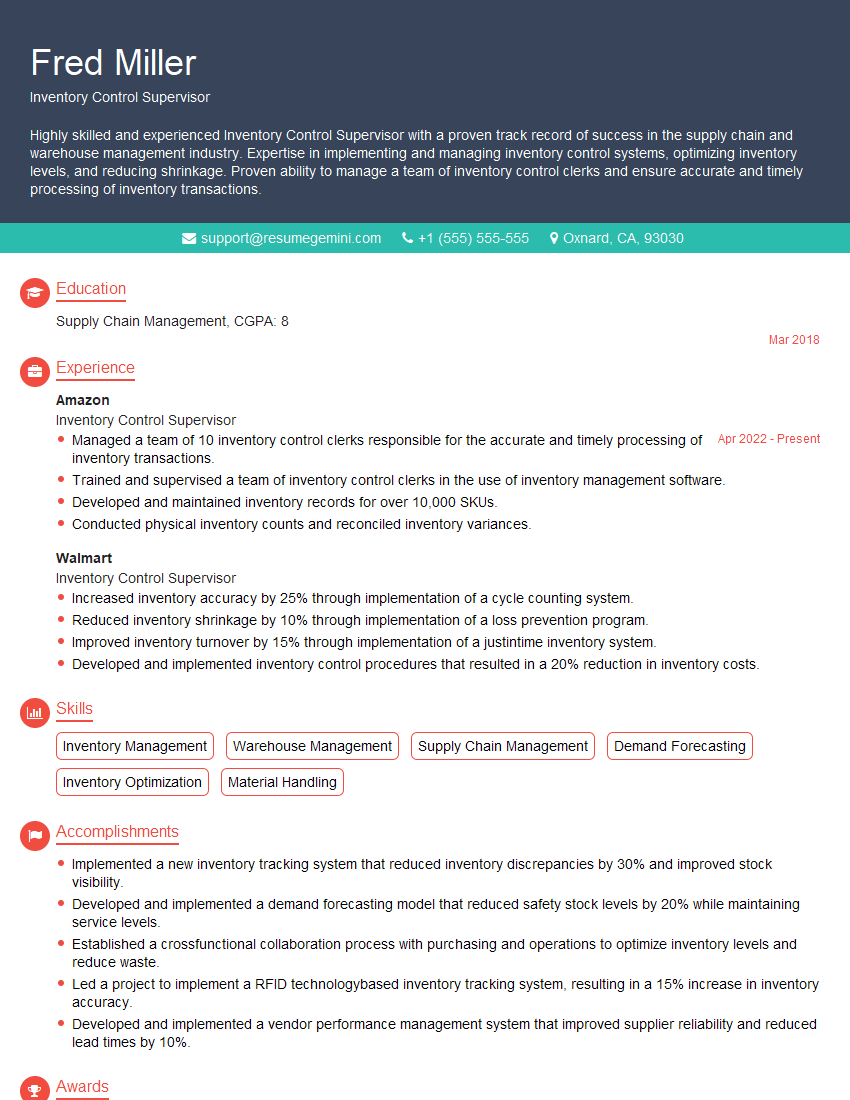
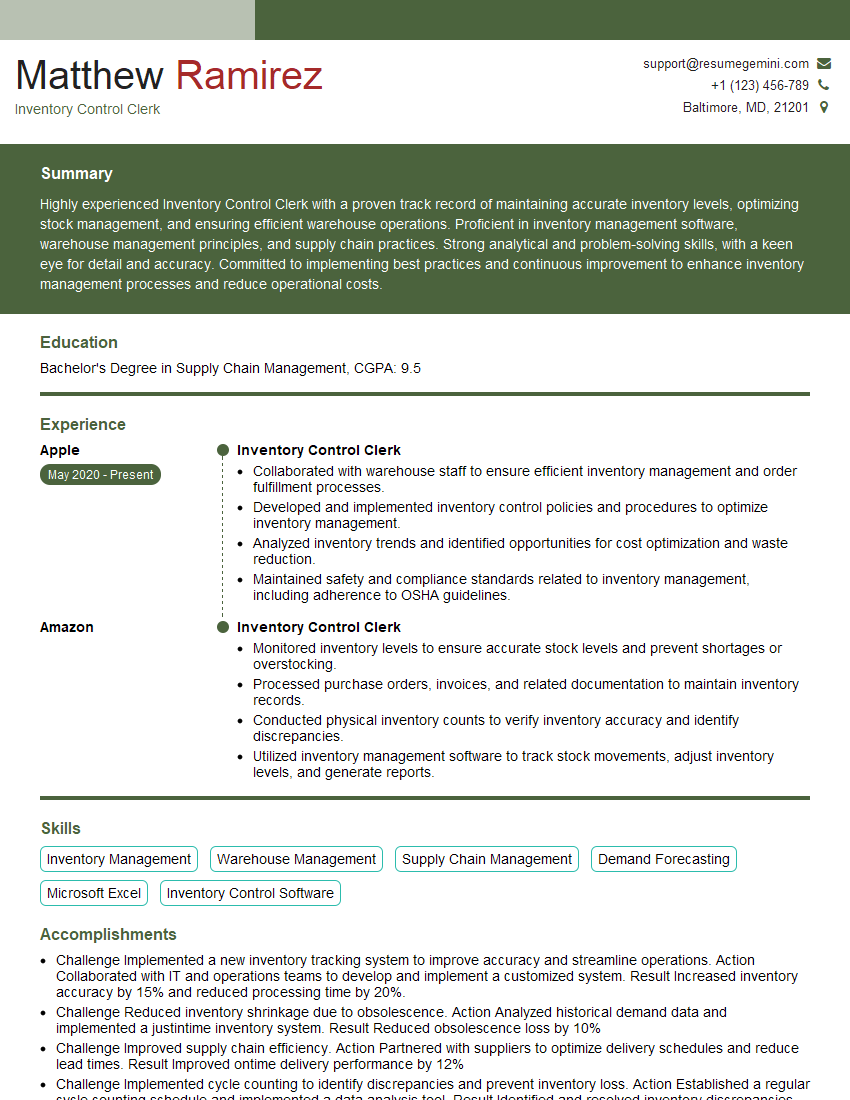
Mastering Collar Inventory Management is crucial for career advancement in logistics, supply chain, and operations management. It demonstrates valuable skills in data analysis, problem-solving, and process optimization, opening doors to leadership roles and higher earning potential. To maximize your job prospects, it’s vital to create an ATS-friendly resume that highlights your relevant skills and experience. ResumeGemini is a trusted resource to help you build a professional and impactful resume, ensuring your application gets noticed. Examples of resumes tailored to Collar Inventory Management are provided to guide you.
Explore more articles
Users Rating of Our Blogs
Share Your Experience
We value your feedback! Please rate our content and share your thoughts (optional).
What Readers Say About Our Blog
Very informative content, great job.
good