Interviews are opportunities to demonstrate your expertise, and this guide is here to help you shine. Explore the essential Collar Under Pressing interview questions that employers frequently ask, paired with strategies for crafting responses that set you apart from the competition.
Questions Asked in Collar Under Pressing Interview
Q 1. Describe the process of collar under pressing.
Collar under pressing is a crucial step in garment manufacturing, particularly for shirts and jackets. It involves pressing the underside of a garment’s collar to create a crisp, smooth, and well-defined shape. This process is critical for achieving a professional finish and ensuring the collar lies flat and neatly against the garment. The process typically involves using a specialized press machine with a shaped buck and a precisely controlled temperature and pressure. This ensures even heat distribution and prevents unwanted creases or distortions.
The process generally follows these steps: First, the collar is carefully positioned on the collar buck. Then, the pressing machine’s heated surface is lowered onto the collar, applying even pressure. The duration of pressing depends on the fabric type and desired level of crispness. After pressing, the collar is carefully inspected for any imperfections before moving on to other finishing processes.
Q 2. What types of fabrics require specialized collar under pressing techniques?
Certain fabrics demand specialized collar under pressing techniques due to their unique properties. Delicate fabrics like silk or linen require lower temperatures and gentler pressure to avoid scorching or damage. Heavier fabrics such as wool or denim, on the other hand, might need higher temperatures and more pressure to achieve the desired crispness. Furthermore, fabrics with intricate designs or embellishments necessitate extra care and potentially the use of pressing cloths or protective layers to prevent damage during the process. For example, a delicate silk collar would require a low-temperature press and possibly a pressing cloth to prevent shine or discoloration. Conversely, a thick denim collar might need a hotter press and more pressure for optimal shaping.
Q 3. Explain the importance of proper temperature and pressure control in collar under pressing.
Precise temperature and pressure control is paramount in collar under pressing to achieve optimal results and prevent damage to the fabric. Too much heat can scorch the fabric, leaving unsightly marks and weakening the fibers. Too little heat will result in a poorly defined collar. Similarly, insufficient pressure won’t create the desired crispness, while excessive pressure may crush or distort the collar’s shape, especially with delicate materials. The ideal temperature and pressure settings depend on the fabric type and the desired final result, and experienced pressers learn to adjust these parameters based on their observations and experience. This is almost like baking a cake – you need the right temperature and time to get the desired outcome.
Q 4. What are the common issues encountered during collar under pressing, and how are they resolved?
Several common problems arise during collar under pressing. Wrinkles or creases can result from improper positioning or uneven pressure. These can often be corrected by re-pressing the collar, paying attention to distribute pressure evenly. Scorch marks are caused by excessive heat; they are irreversible and often require discarding the garment piece. Distorted shape can be due to excessive pressure or uneven heat application. The solution is to use the appropriate pressure and temperature for the fabric and carefully adjust the collar’s position on the buck. Shiny marks can occur on certain fabrics due to too much pressure or heat. Using a pressing cloth or reducing pressure and temperature helps prevent these.
Q 5. How do you identify and correct defects in collar under pressing?
Identifying and correcting defects in collar under pressing requires a keen eye and a thorough understanding of the process. Visual inspection is key – look for wrinkles, creases, scorch marks, uneven shaping, or shiny patches. The location of the defect can often pinpoint the cause – for instance, creases often indicate uneven pressure, while scorch marks highlight excessive heat. Corrective actions range from re-pressing with adjusted settings to, unfortunately, discarding severely damaged pieces. Using a well-maintained machine and consistent techniques are crucial in minimizing defects.
Q 6. Describe different types of collar under pressing machines and their functionalities.
Collar under pressing machines come in various types, ranging from simple hand-operated presses to sophisticated, automated systems. Manual presses are affordable but require more skill and physical effort. Pneumatic presses use compressed air to apply pressure, offering better control and consistency. Fully automated systems are commonly used in large-scale manufacturing and incorporate features like digital temperature control, programmable pressure settings, and conveyor belts for high-volume production. The choice of machine depends on the production scale, budget, and the complexity of the garments being produced. A small tailor might use a manual press, while a large shirt manufacturer would employ a fully automated system.
Q 7. What safety precautions should be observed during collar under pressing?
Safety precautions during collar under pressing are crucial to prevent injury and damage. Always ensure the machine is properly grounded and in good working order. Never touch the hot pressing surface directly; always use appropriate tools and protective equipment like heat-resistant gloves. Maintain a clean workspace to avoid accidents and ensure good ventilation to dispel any steam or fumes generated during the pressing process. Regular machine maintenance is also important, including cleaning and inspecting components to avoid malfunction. Following the manufacturer’s safety guidelines is crucial to ensuring a safe working environment.
Q 8. How do you maintain and clean collar under pressing equipment?
Maintaining and cleaning your collar under pressing equipment is crucial for consistent quality and longevity. Think of it like regularly servicing your car – preventative maintenance prevents costly repairs later.
Daily Cleaning: After each use, allow the equipment to cool completely. Wipe down the pressing surface with a damp, soft cloth to remove any residual starch, fabric fibers, or adhesive. Pay close attention to the edges and crevices.
Weekly Maintenance: Check for any loose screws, worn parts, or buildup of residue on the heating element (if applicable). Use a specialized cleaning solution for your specific equipment type, following the manufacturer’s instructions carefully.
Monthly Deep Cleaning: Depending on usage, perform a more thorough cleaning. This may involve removing and cleaning the pressing pad (if removable), checking and cleaning any internal components as recommended in your equipment manual. This prevents the buildup of material that can affect the even distribution of pressure and heat.
Preventative Care: Regularly check the power cord for any damage and ensure proper ventilation around the equipment to prevent overheating. Avoid storing the equipment in damp locations.
Remember, consulting your equipment’s manual is crucial for detailed maintenance instructions specific to your model.
Q 9. What are the quality standards for properly pressed collars?
Quality standards for properly pressed collars hinge on achieving a crisp, smooth, and wrinkle-free finish that complements the garment’s overall appearance. Imagine the difference between a perfectly pressed shirt collar and one that’s limp and creased – the impact on the wearer’s overall look is significant.
Sharp Points and Curves: Collar points and curves should be clearly defined, with no lingering wrinkles or puckers. This requires careful attention to the pressure and heat applied during pressing.
Uniform Appearance: The entire collar should exhibit a uniform appearance; no areas should be over-pressed or under-pressed. Consistency is key here.
Fabric Integrity: The pressing process should not damage the fabric, causing shine, scorching, or structural weakening. Choosing the correct temperature and pressing cloth is paramount.
Correct Shape and Size: The collar should maintain its designed shape and size after pressing. Any distortion indicates an issue with the pressing technique.
Consistent adherence to these standards results in a polished, professional finish that enhances the garment’s perceived value.
Q 10. How do you adjust pressure and temperature settings for different fabrics?
Adjusting pressure and temperature is crucial for achieving optimal results without damaging the fabric. Think of it like cooking – different ingredients require different temperatures and cooking times. Too much heat can ‘burn’ delicate fabrics, while insufficient heat may leave behind wrinkles.
Delicate Fabrics (silk, linen): Use lower temperatures and lighter pressure. A pressing cloth is essential to prevent scorching.
Medium-Weight Fabrics (cotton, wool): A moderate temperature and pressure are usually appropriate. Experiment to determine the optimal settings.
Heavy-Weight Fabrics (denim, canvas): Higher temperatures and firm pressure are generally needed for crispness. However, always test on a small, inconspicuous area first.
Most collar under pressing equipment offers adjustable settings. Begin with low settings and gradually increase until you achieve the desired results. Always err on the side of caution with delicate fabrics.
Q 11. Explain the significance of using appropriate pressing cloths and pads.
Appropriate pressing cloths and pads act as buffers between the hot pressing surface and the garment, preventing scorching, shine, and unwanted imprints. Think of them as protective layers, ensuring an even distribution of heat and pressure.
Pressing Cloths: These are made of various materials (cotton, silk, Teflon) and are designed to absorb moisture and distribute heat evenly. The choice of cloth depends on the fabric type; for example, a damp cotton cloth is often used with cotton garments to reduce shine.
Pressing Pads: These pads cushion the garment and help to prevent sharp creases. They’re frequently constructed from layers of cotton or foam, providing even pressure distribution and helping to maintain the garment’s shape.
Using the wrong cloth or pad can lead to uneven pressing, shine, or even fabric damage. Choosing the appropriate materials is fundamental to professional-quality collar pressing.
Q 12. How do you handle delicate fabrics during collar under pressing?
Handling delicate fabrics requires extra care and attention to prevent damage during collar under pressing. Think of them as requiring a gentler touch compared to more robust materials.
Lower Temperatures: Always use lower temperatures than what you would use for heavier fabrics.
Lighter Pressure: Avoid applying excessive pressure, which can cause the fabric to stretch or become distorted.
Pressing Cloths: Use a pressing cloth, ideally made of a delicate material like silk or a thin cotton, to protect the fabric from direct heat.
Steam Control: If using steam, use a light mist and avoid excessive steam that can saturate delicate fibers.
Test Pressing: Always test on a small, inconspicuous area first to ensure the settings are appropriate for the fabric.
By implementing these precautions, you can effectively press delicate collars without risking any damage.
Q 13. Describe the process of pressing different collar styles (e.g., pointed, rounded).
Different collar styles require slightly different pressing techniques to achieve the desired shape and crispness. The key is understanding the unique characteristics of each style.
Pointed Collars: Focus on achieving sharp, well-defined points. Use a point presser or carefully shape the collar points with your fingers while pressing. Pay close attention to the edges to ensure a clean finish.
Rounded Collars: Concentrate on maintaining a smooth, rounded curve without any flat spots. Gentle, even pressure is crucial here. Avoid pressing too hard, which can create a crease at the curve.
Other Collar Styles: Different collars may require specific tools or techniques, which can be mastered through practice and observation. Reference guides or tutorials on specific styles can greatly assist.
Practice is key to mastering different collar styles. Experiment on scrap fabric until you are confident in your technique.
Q 14. How do you ensure consistent results in collar under pressing?
Consistency in collar under pressing relies on a combination of technique, equipment maintenance, and attention to detail. It’s like baking a cake – following the recipe closely yields consistent results.
Standardized Procedures: Develop and follow a consistent pressing procedure for each collar type and fabric. This minimizes variability.
Regular Equipment Calibration: Regularly check and calibrate the pressure and temperature settings on your equipment to ensure accuracy.
Quality Control Checks: Regularly inspect your finished work to identify any inconsistencies and make adjustments to your technique accordingly.
Proper Training: Ensure that anyone operating the equipment receives proper training on the correct techniques and safety procedures.
Use of Templates (if available): Using templates or guides can significantly assist in maintaining uniform size and shape of the collars.
By systematically addressing these aspects, you can achieve consistent, high-quality results in collar under pressing.
Q 15. What are the key differences between hand pressing and machine pressing collars?
Hand pressing and machine pressing collars both aim for a crisp, smooth finish, but differ significantly in technique and outcome. Hand pressing, using a tailor’s clapper and iron, offers unparalleled control and precision, allowing for nuanced adjustments to achieve the perfect shape and avoid unwanted creases. It’s particularly valuable for intricate collar designs and high-end garments. Think of it like sculpting – you’re carefully shaping the collar with each press. Machine pressing, conversely, utilizes a specialized press with heated platens. While faster and more consistent for large production runs, it lacks the individual attention of hand pressing, potentially leading to less nuanced results and a higher risk of damaging delicate fabrics. It’s more like using a mold – efficient, but less adaptable.
- Hand Pressing: More control, better for intricate designs, slower, higher skill required.
- Machine Pressing: Faster, consistent for mass production, less control, potential for damage.
Career Expert Tips:
- Ace those interviews! Prepare effectively by reviewing the Top 50 Most Common Interview Questions on ResumeGemini.
- Navigate your job search with confidence! Explore a wide range of Career Tips on ResumeGemini. Learn about common challenges and recommendations to overcome them.
- Craft the perfect resume! Master the Art of Resume Writing with ResumeGemini’s guide. Showcase your unique qualifications and achievements effectively.
- Don’t miss out on holiday savings! Build your dream resume with ResumeGemini’s ATS optimized templates.
Q 16. Describe your experience with various pressing techniques (e.g., steam pressing, dry pressing).
My experience encompasses both steam and dry pressing techniques, each offering distinct advantages. Steam pressing, using a steam iron or steam press, is ideal for loosening fibers and achieving a smooth finish on heavier fabrics, particularly those prone to wrinkles. I often use this for cotton shirts or linen jackets, as the moisture helps set the collar’s shape beautifully. However, excessive steam can damage some delicate materials, like silk. Dry pressing, on the other hand, applies heat without moisture. This is perfect for delicate fabrics or when a crisp, firm finish is needed without the risk of shrinkage or discoloration. I often employ this method with wool or synthetic blends, carefully controlling the temperature and pressure to prevent scorching. The key is understanding the properties of the fabric to choose the right technique and avoid mishaps.
For example, I recently worked on a bespoke silk shirt where dry pressing was crucial to avoid creating watermarks. The delicate nature of the silk required a light touch and precise temperature control to prevent any damage, resulting in a flawlessly pressed collar.
Q 17. How do you troubleshoot common machine malfunctions?
Troubleshooting machine malfunctions requires a systematic approach. I start by identifying the issue: Is the machine not heating properly? Are the platens misaligned? Is there a problem with the pressure mechanism? A visual inspection often reveals loose connections, faulty wiring, or obstructions. If the heating element isn’t working, I’d check the power supply and fuses. Misalignment might require recalibration or adjustment of the press components. A clogged steam vent can lead to uneven pressing, requiring cleaning. I maintain detailed records of machine maintenance to facilitate quick troubleshooting in the future.
For instance, a recent issue involved uneven pressure across the platens. A thorough inspection revealed a faulty pressure gauge. Replacing the gauge resolved the problem, restoring consistent pressure and preventing further damage to the garments.
Q 18. What is your experience with different types of collar interfacing?
My experience encompasses a range of collar interfacings, each with unique properties impacting the collar’s structure and drape. Woven interfacings, such as cotton or linen, offer a crisp, structured finish but can be less flexible. I use these for more formal collars where a firm, structured look is desired. Fusible interfacings, though convenient, require careful application to prevent scorching or bubbling. These are commonly used for simpler collars where ease of application is prioritized. Non-woven interfacings offer good flexibility and drape while providing enough support. My choice depends on the fabric weight, collar design, and desired stiffness. For a softer collar, I might use a non-woven interfacing, while for a stiff wing collar, a woven interfacing would be the better choice. Careful consideration of the interfacing is crucial for achieving the desired collar structure and overall garment appearance.
Q 19. How do you measure the quality of a pressed collar?
Assessing the quality of a pressed collar involves a multi-faceted evaluation. Firstly, I look for a crisp, even finish, free from wrinkles, creases, or puckers. The collar points should be sharply defined, and the overall shape should be symmetrical. The collar should lie smoothly against the garment, without any gaps or distortions. I also check for any signs of scorching or damage to the fabric. Uniformity of pressure across the entire collar surface is key – any inconsistencies reveal suboptimal pressing techniques. A high-quality pressed collar is a testament to precision and attention to detail, contributing significantly to the garment’s overall appeal and aesthetic integrity.
Q 20. How do you adapt your technique for different collar designs and garment styles?
Adapting my technique hinges on understanding the specific collar design and garment style. A stiff, pointed collar on a formal shirt demands a different approach compared to the softer, rounded collar on a casual shirt. For instance, I would use a higher temperature and more pressure for a crisp, structured collar, potentially incorporating a clapper for additional definition. Conversely, a more relaxed collar might require a lower temperature and gentler pressing to avoid over-stiffening. The fabric’s weight and composition also influence my choice of pressing method (steam versus dry) and the amount of pressure applied. The key is maintaining consistency while adjusting to the nuances of the individual collar and its intended aesthetic.
Q 21. Explain your understanding of the importance of quality control in collar under pressing.
Quality control in collar under pressing is paramount. A poorly pressed collar can ruin an otherwise well-made garment. It affects both the aesthetic appeal and the structural integrity of the garment. My quality control measures involve regular checks throughout the pressing process. I inspect the interfacing placement, ensuring it is smooth and free of wrinkles before pressing. During pressing, I monitor the temperature and pressure to avoid damaging the fabric. Finally, a meticulous post-pressing inspection ensures the collar is crisp, even, and free from defects. Documentation and consistent adherence to best practices are crucial for maintaining high-quality standards. A consistent quality control process ensures that each collar meets the standards of excellence that I’ve established over my career.
Q 22. Describe your experience with working in a fast-paced production environment.
My experience in fast-paced production environments spans over eight years, primarily in the garment manufacturing industry. I’ve worked in settings where daily output targets were demanding and required precise, efficient work. For instance, at my previous role at ‘Garment Perfection,’ we consistently met daily quotas of over 500 collars, each requiring meticulous under-pressing to maintain high-quality standards. This involved seamless coordination with other team members on the assembly line, proactive identification of potential bottlenecks, and rapid adaptation to changing priorities.
One memorable instance involved a sudden rush order demanding a 20% increase in our daily output. By collaborating closely with the team, optimizing our workflow to minimize downtime between pressing cycles, and implementing a prioritized task system, we successfully met the deadline without compromising quality. This experience honed my ability to work under pressure while maintaining precision and efficiency.
Q 23. How do you handle pressure and meet deadlines in a production setting?
Handling pressure and meeting deadlines in a production setting relies on a combination of proactive planning, efficient execution, and a calm, problem-solving approach. I prioritize effective time management by breaking down large tasks into smaller, manageable steps. This allows me to track progress, identify potential delays early on, and adapt my strategy accordingly. For example, I utilize checklists to ensure each step of the collar under-pressing process is completed systematically.
When unexpected challenges arise, I remain calm and focused, seeking immediate solutions rather than succumbing to panic. My ability to prioritize tasks and effectively communicate with my team is critical in resolving issues quickly and maintaining production flow. The ‘Garment Perfection’ rush order experience is a perfect example of this – the ability to remain calm and communicate clearly with the team was crucial to our success.
Q 24. What are your strengths and weaknesses related to collar under pressing?
My greatest strength in collar under-pressing lies in my precision and consistency. Years of practice have enabled me to achieve a uniform, high-quality finish on every collar, regardless of fabric type or style. I consistently receive positive feedback for the quality of my work and my ability to maintain a steady output rate without compromising on detail.
One area I’m actively working to improve is my proficiency with newer, automated pressing equipment. While I’m adept at using traditional irons and pressing machines, my training on the latest technologies is ongoing. I am committed to continuous learning and view this as an opportunity to enhance my skills and contribute even more effectively to the team.
Q 25. Why are you interested in this collar under pressing position?
I’m very interested in this collar under-pressing position because it offers an opportunity to contribute my expertise to a company known for its high-quality standards and commitment to excellence. The description of the role aligns perfectly with my skills and experience, and the opportunity to work within a team focused on precision and efficiency is highly appealing. Furthermore, the chance to utilize and further develop my skills with advanced pressing equipment is exciting.
I’m particularly drawn to [Company Name]’s reputation for [mention specific company value or achievement – e.g., innovative techniques, sustainable practices, employee development]. This resonates strongly with my personal values and professional goals.
Q 26. Describe your experience with different types of pressing irons or equipment.
Throughout my career, I’ve gained experience with a variety of pressing irons and equipment, ranging from traditional steam irons and manual pressing machines to automated, computer-controlled systems. I’m proficient in using different types of pressing bucks and forms to achieve the desired collar shape and crispness for various garment styles. For example, I’m skilled in using both flatbed and sleeveboard pressing systems, adapting my technique depending on the collar’s design and the fabric’s characteristics.
My experience includes working with both analog and digital temperature controls, allowing me to fine-tune the pressing process for optimal results with delicate fabrics and different collar constructions. I’m also comfortable maintaining and troubleshooting basic equipment malfunctions. I’m eager to learn and utilize any new pressing technologies that may be available within this role.
Q 27. How do you maintain consistency in production while meeting quality standards?
Maintaining consistency in production while meeting quality standards is paramount in my work. I achieve this through a combination of standardized procedures, meticulous attention to detail, and regular quality checks. Each step of the under-pressing process, from the initial preparation of the collar to the final inspection, follows a precise sequence. I utilize checklists to ensure consistency and to immediately address any deviations from the standard.
Regular self-audits, along with periodic checks by supervisors, allow for early identification and correction of any inconsistencies in the final product. By utilizing visual aids and comparing my work to established quality benchmarks, I ensure that all collars meet the required standards of crispness, shape, and overall appearance. Proactive identification of any issues ensures high production quality.
Q 28. What are your salary expectations for this role?
My salary expectations for this role are in the range of $[Lower Bound] to $[Upper Bound] annually, commensurate with my experience and skills in collar under-pressing, as well as the overall compensation package offered. This range reflects my understanding of the industry standard for similar roles with my level of expertise and reflects my dedication to long-term contribution to the company’s success. I am open to further discussion regarding the complete compensation structure.
Key Topics to Learn for Collar Under Pressing Interview
- Fabric Selection and Properties: Understanding different fabric types (cotton, linen, silk, blends) and their impact on pressing techniques. Knowing how fiber content influences pressing temperature and pressure is crucial.
- Pressing Equipment and Tools: Familiarity with various pressing equipment (industrial presses, steam irons, pressing cloths) and their appropriate applications. Understanding the importance of maintaining equipment and its impact on finished product quality.
- Pressing Techniques: Mastering different pressing techniques for various collar styles (pointed, rounded, spread), including the proper use of steam, pressure, and time to achieve crispness and shape retention.
- Troubleshooting Common Pressing Issues: Identifying and resolving common problems such as wrinkles, shine marks, scorch marks, and uneven pressing. Demonstrating problem-solving skills is key.
- Quality Control and Inspection: Understanding quality standards and inspection procedures for pressed collars. The ability to assess the quality of your work and identify areas for improvement.
- Safety Procedures and Ergonomics: Understanding and adhering to safety protocols when operating pressing equipment and maintaining good ergonomic practices to avoid injury.
- Production Efficiency and Time Management: Understanding how to efficiently press collars within production deadlines while maintaining high quality standards.
Next Steps
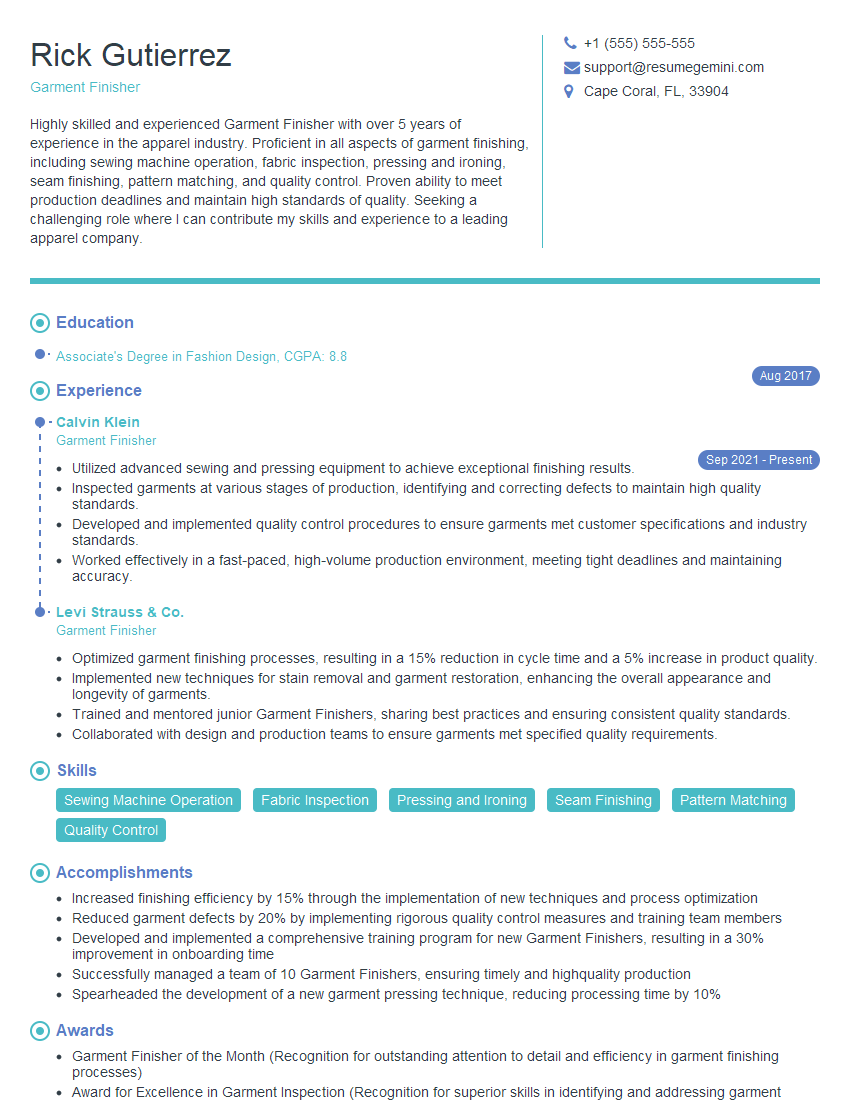
Mastering collar under pressing techniques is vital for career advancement in the garment industry, opening doors to specialized roles and increased earning potential. A well-crafted, ATS-friendly resume is your key to unlocking these opportunities. To ensure your resume effectively showcases your skills and experience, we strongly recommend using ResumeGemini. ResumeGemini provides a user-friendly platform for creating professional resumes, and we offer examples of resumes tailored to Collar Under Pressing to help guide you. Invest time in crafting a compelling resume – it’s your first impression on potential employers.


Explore more articles
Users Rating of Our Blogs
Share Your Experience
We value your feedback! Please rate our content and share your thoughts (optional).
What Readers Say About Our Blog
Very informative content, great job.
good