The right preparation can turn an interview into an opportunity to showcase your expertise. This guide to Color and Size Grading interview questions is your ultimate resource, providing key insights and tips to help you ace your responses and stand out as a top candidate.
Questions Asked in Color and Size Grading Interview
Q 1. Explain the difference between additive and subtractive color mixing.
Additive and subtractive color mixing are two fundamentally different approaches to creating colors. Think of it like this: additive is like building with LEGOs, adding more pieces to create something new, while subtractive is like sculpting clay, taking away material to reveal a shape.
Additive color mixing is used with light. It starts with black (no light) and adds different colored lights together. The primary colors are red, green, and blue (RGB). When you combine them all, you get white light. This is how your computer monitor or TV displays colors. For example, mixing red and green light produces yellow.
Subtractive color mixing is used with pigments, like paints or inks. It starts with white (reflecting all light) and subtracts light using colored pigments. The primary colors are cyan, magenta, and yellow (CMY), sometimes with black (K) added for better dark tones (CMYK). The more pigments you add, the darker the color becomes. For instance, combining cyan and magenta pigments results in blue.
Understanding the difference is crucial for working across different media. A color that appears vibrant on a screen (additive) might look dull when printed (subtractive) because the methods of producing color are so distinct.
Q 2. Describe your experience with color spaces (e.g., RGB, CMYK, LAB).
I have extensive experience working with various color spaces, each with its own strengths and weaknesses. RGB, CMYK, and LAB are the most common, and I’m proficient in all three.
- RGB (Red, Green, Blue) is ideal for screen displays. It’s an additive model, where the combination of red, green, and blue light produces a wide range of colors. I frequently use RGB in video editing and digital art creation.
- CMYK (Cyan, Magenta, Yellow, Key/Black) is primarily used for print. It’s a subtractive model, where pigments absorb certain wavelengths of light to create colors. I use CMYK when preparing images for print, carefully considering the limitations of the printing process and the specific paper type.
- LAB (L*a*b*) is a device-independent color space. It’s designed to be perceptually uniform, meaning that a small numerical change in LAB corresponds to a small visual change in color, regardless of the device used. I often use LAB for color correction and matching, especially when dealing with color inconsistencies across different devices or when working with complex color palettes.
Choosing the right color space is vital. Using RGB for print will lead to inaccurate color reproduction, and using CMYK for web design would be similarly problematic. My experience allows me to select the appropriate space based on the project’s final output and target medium.
Q 3. How do you handle color inconsistencies across different devices or platforms?
Color inconsistencies across devices stem from variations in how displays and printers reproduce colors. Managing this requires a multi-faceted approach.
- Color profiling: This involves creating profiles for each device, characterizing its color response. These profiles are then used by color management software to translate colors accurately across devices. I’m meticulous about creating and applying these profiles.
- Working in a device-independent color space: Using LAB allows me to work with colors in a standardized space, minimizing the impact of device differences. The final conversion to RGB or CMYK happens at the final stage of the process.
- Soft proofing: Before printing, I always soft-proof my work, simulating the appearance of the print on various devices. This reveals inconsistencies early on and allows me to make adjustments.
- Color calibration and monitoring: Regular calibration of my monitors ensures consistency in color representation across my workflow. I use a colorimeter to ensure accuracy.
For example, a logo designed in RGB on my calibrated monitor might look slightly different on an uncalibrated laptop screen. By carefully managing color profiles and using a device-independent color space like LAB, I can mitigate these discrepancies and guarantee consistency across platforms.
Q 4. What color management systems are you familiar with?
My experience encompasses several leading color management systems. I’m proficient in:
- Adobe Color Engine (ACE): Integrated into Adobe Creative Suite applications, ACE is a robust and widely used system for color management. I use its features for profile creation, conversion, and soft proofing.
- ICC (International Color Consortium) profiles: I extensively use ICC profiles to manage color across different devices. Understanding how these profiles work is fundamental to my work.
- X-Rite i1Display and i1Profiler: I use these hardware and software tools for calibrating monitors and creating custom color profiles to maintain precise color representation. Knowing the nuances of using these tools is critical for accuracy.
My familiarity with these systems ensures I can tackle color management challenges effectively regardless of the software or hardware involved. I constantly adapt and learn about new developments in color management technology.
Q 5. What are some common color grading workflows?
Color grading workflows can vary depending on the project and the desired look, but several common steps typically emerge:
- Initial color correction: Addressing global color imbalances, white balance, and exposure issues to create a neutral base. This stage focuses on technical accuracy rather than creative style.
- Primary grading: Adjusting overall color tones, contrast, and saturation. This stage sets the mood and feel of the piece.
- Secondary grading: Refining specific areas or elements. This includes selective color adjustments to highlight certain aspects of the image or video. Techniques like color keying and masking are employed here.
- Color space conversion: Translating the image or video to the appropriate color space for the final output (e.g., converting from LAB to RGB for screen display or to CMYK for print).
- Review and final touches: Checking for consistency across different sequences and ensuring the final grade meets the creative vision.
For instance, in a film project, I might begin by correcting the color temperature to match daylight or tungsten lighting conditions before moving on to adding a specific cinematic style, using techniques like selective color grading to highlight a character’s emotional state.
Q 6. Explain the concept of color profiling.
Color profiling is the process of creating a mathematical representation of a device’s color response. Think of it as a ‘translator’ that tells the computer how a specific monitor, printer, or scanner interprets and reproduces color. Without profiling, you’ll encounter discrepancies between what you see on your screen and what gets printed or displayed on another device.
The profile stores data about how the device reacts to different color inputs, characterizing its color gamut, white point, and other relevant factors. This profile is then used by color management software to correctly translate colors to and from that device. For example, a properly profiled monitor will reproduce colors consistently, accurately reflecting the intended hues. Creating accurate profiles is essential for high-quality color reproduction in any professional context.
Q 7. How do you identify and correct color casts in images or videos?
Color casts, unwanted color tints affecting the overall image or video, often arise from lighting inconsistencies or sensor limitations. Identifying and correcting them requires a keen eye and understanding of color theory.
I typically use these steps:
- Visual inspection: The first step involves careful observation. I look for overall color bias, noting any dominant hues that detract from the image’s natural appearance.
- White balance adjustment: A common cause of color casts is incorrect white balance. I use tools within my editing software to adjust the white point, neutralizing the color cast. This often addresses global color imbalances.
- Color temperature adjustments: Subtle adjustments to the color temperature (measured in Kelvin) can refine the overall tone. For example, an image with a blue cast might need a warmer color temperature.
- Selective color correction: For localized casts, I might use selective color correction tools or masking techniques to target specific areas. This allows me to adjust the color of a particular area without affecting the rest of the image. For instance, if only the sky has a color cast, I might select the sky area and adjust its hue and saturation individually.
- Color wheels and histograms: I leverage color wheels and histograms to analyze color distributions and identify areas needing correction. These tools help me visually assess and fine-tune color adjustments.
Correcting color casts is crucial for creating a natural and pleasing image. I approach it systematically, using a combination of global and local adjustments to achieve the best results, always keeping the intended look and feel of the project in mind.
Q 8. What methods do you use for color correction?
Color correction aims to achieve accurate and consistent color representation across an image or video. It’s about fixing inconsistencies, not enhancing the creative look. My approach is methodical and involves several steps. I begin by assessing the overall color balance, looking for casts (e.g., a strong green or blue tint). I then use tools like white balance adjustments to neutralize these casts. Next, I address individual color channels – adjusting reds, greens, and blues – to ensure accurate skin tones and other crucial color elements. This often involves using curves and color wheels to make fine-tuned adjustments. Finally, I’ll refine the image or video by addressing issues like clipping (loss of detail in highlights or shadows) and color banding (visible steps in color transitions).
- White Balance: Setting a neutral white point to ensure accurate color representation.
- Color Wheels/Vectorscopes: Visual tools to analyze and correct color imbalances.
- Curves: Precise adjustments to individual color channels and luminance.
- Secondary Color Correction: Isolating specific color ranges (e.g., skin tones) for targeted adjustments.
For instance, I recently worked on a project where the footage had a strong orange cast due to the sunset lighting. By carefully adjusting the white balance and using color curves to reduce the orange saturation and increase the blue and cyan tones, I restored the scene to a natural and pleasing look.
Q 9. Describe your experience with color grading software (e.g., DaVinci Resolve, Adobe Premiere Pro).
I’m proficient in both DaVinci Resolve and Adobe Premiere Pro, leveraging the strengths of each for different tasks. DaVinci Resolve’s color science is exceptional, offering unparalleled precision for complex color grading. Its node-based workflow allows for non-destructive editing, preserving the original footage integrity. I regularly use its primary and secondary color correction tools, along with powerful features like color trackers for consistent grading of moving elements across the video. Adobe Premiere Pro, on the other hand, integrates seamlessly into my editing workflow. While its color grading capabilities aren’t as robust as Resolve’s, I find its speed and ease of use particularly beneficial for simpler projects or quick color corrections during the editing process.
In a recent commercial project, I utilized DaVinci Resolve’s power for color grading, meticulously matching the color palette across various scenes shot in different locations and lighting conditions. For a smaller YouTube video edit, Premiere Pro’s integrated color correction tools were sufficient to quickly adjust the overall look and feel.
Q 10. What are the key considerations for size grading different types of garments?
Size grading garments involves systematically scaling a garment’s pattern pieces to create different sizes. Key considerations vary greatly depending on the garment type. For example, with tops, the primary focus is on chest and sleeve measurements. The changes in sleeve length need to be proportionate to the changes in the chest measurement. For bottoms, the focus shifts to waist, hip, and inseam adjustments. The increase in hip circumference requires appropriate adjustments in the curve to prevent a distorted look. Additionally, factors such as fabric drape, stretch, and garment construction heavily influence the grading process. A stretchy fabric, for instance, will require less increment increase compared to a non-stretchy one. Structured garments require more precise attention to seam allowances and pattern placement than simpler styles.
- Garment Style: Tops, bottoms, dresses, etc., each have unique grading requirements.
- Fabric Type: Stretchy fabrics allow for less grading than rigid fabrics.
- Design Details: Darts, seams, and other design elements must be adjusted proportionally.
- Target Audience: The size ranges and proportions will vary depending on who you’re designing for (e.g., children, adults).
Q 11. How do you ensure consistent size grading across different production batches?
Maintaining consistent size grading across production batches is crucial for brand consistency and customer satisfaction. This relies heavily on using a standardized grading system and meticulous record-keeping. I advocate creating digital grading templates, including precise measurements and grading rules, within a CAD (Computer-Aided Design) or similar software. These templates should be rigorously tested and updated as needed. In addition, regular quality checks using graded samples throughout production ensure discrepancies are caught early. Proper communication with the factory regarding the grading standards is essential. Regular visits or video calls to the factory are very helpful.
To illustrate, in a past project, we used a detailed digital grading template for all sizes of a particular dress. Each pattern piece had clear dimensions and grading increments. Regular quality checks at various stages of the production – pattern cutting, sample sewing, bulk production – ensured consistency, significantly reducing inconsistencies across batches.
Q 12. Explain the process of creating a size chart.
Creating a size chart involves defining a range of sizes based on standard body measurements, with careful consideration given to the target demographic. It’s a crucial step, not only for size grading, but also for accurate customer ordering. I usually start by defining a base size (often a size medium), then determining appropriate grading increments (the difference in measurements between sizes). These increments can be based on industry standards or customized depending on the specific garment and target market. Measurements include but are not limited to chest circumference, waist circumference, hip circumference, sleeve length, inseam, and height. The completed size chart should clearly display the measurement for each size in a tabular format. Visual aids like sketches of the garment detailing measurement points are helpful.
For example, a size chart for women’s tops might include chest measurements for sizes XS (32 inches), S (34 inches), M (36 inches), L (38 inches), XL (40 inches), and so on, with corresponding measurements for other dimensions. This chart would form the basis of the garment grading process.
Q 13. How do you handle discrepancies in size measurements?
Discrepancies in size measurements are inevitable, especially in large-scale production. My approach to handling these is multifaceted. First, I meticulously check the source of the error. Is it a pattern grading error, a measurement error during production, or an issue with fabric shrinkage? Once the source is identified, I address the problem systematically. For minor discrepancies, adjustments can be made during the production process, potentially involving minor pattern corrections or adjustments to the cutting process. Significant inconsistencies might require a more extensive review of the grading template and potentially even a reassessment of the sizing system. Documenting all discrepancies and corrections is essential for continuous improvement and for future production runs.
In a previous project, we discovered a significant discrepancy in the sleeve length of a particular size. Investigation revealed a minor error in the initial grading template. The template was corrected, and the remaining garments were re-graded to maintain size consistency across all produced items.
Q 14. Describe your experience with different size grading standards (e.g., ASTM, ISO).
My experience encompasses various size grading standards, including ASTM (American Society for Testing and Materials) and ISO (International Organization for Standardization) standards. While specific standards may vary slightly in their measurement methodologies or terminology, the underlying principles remain consistent: creating a standardized system for consistent sizing across different brands and manufacturers. The use of these standards ensures that a size ‘medium’ in one garment from different brands will provide a relatively consistent fit across those brands. These standards often offer detailed specifications regarding measurement techniques, tolerance levels, and data reporting procedures. Adherence to these standards is vital for ensuring customer satisfaction and minimizing returns related to sizing issues. Understanding these standards allows for smoother integration with global supply chains and effective communication with manufacturers. The application of these standards varies depending on the garment type, target market, and the specific demands of the client.
In recent projects, we’ve used specific ASTM standards for measuring children’s clothing sizes, ensuring that the garments conform to the recognized guidelines for child safety and comfort. The choice of standard largely depends on the client’s specific requirements and the target market’s expectations.
Q 15. What are the challenges of size grading for diverse body types?
Size grading for diverse body types presents significant challenges because people don’t conform to standardized measurements. A size 10 in one brand might fit completely differently than a size 10 in another, reflecting varying design philosophies and target demographics. The challenge lies in creating a grading system that accounts for the nuances of different body shapes and proportions, such as variations in bust, waist, hip, and torso length. For example, two individuals might both wear a size 12, but one might have a longer torso and smaller bust than the other, requiring adjustments to the garment pattern for a proper fit. This necessitates incorporating a comprehensive range of body measurements and developing flexible grading rules that adapt to these variations, often requiring more than just simple scaling.
Addressing these challenges often involves using advanced techniques like 3D body scanning and digital grading to accurately capture and account for body shape variations. This allows for a more accurate and inclusive size range, enhancing customer satisfaction and reducing returns due to poor fit.
Career Expert Tips:
- Ace those interviews! Prepare effectively by reviewing the Top 50 Most Common Interview Questions on ResumeGemini.
- Navigate your job search with confidence! Explore a wide range of Career Tips on ResumeGemini. Learn about common challenges and recommendations to overcome them.
- Craft the perfect resume! Master the Art of Resume Writing with ResumeGemini’s guide. Showcase your unique qualifications and achievements effectively.
- Don’t miss out on holiday savings! Build your dream resume with ResumeGemini’s ATS optimized templates.
Q 16. How do you utilize measurement tools and technologies in size grading?
Measurement tools and technologies are crucial for accurate and efficient size grading. We utilize a combination of traditional and modern methods. Traditional methods include measuring tapes, rulers, and pattern-making tools for taking precise measurements from samples and creating patterns. These are still essential for verification and quality control.
Modern technologies significantly enhance the process. For instance, we use 3D body scanners to collect detailed measurements from a diverse range of body types. This data is fed into digital grading software, allowing us to create multiple size variations automatically, reducing human error and dramatically increasing speed and efficiency. This software also allows for sophisticated pattern manipulation, ensuring that proportions are maintained across sizes. These digital tools often integrate with Computer-Aided Design (CAD) systems for seamless pattern creation and manufacturing.
Furthermore, we use digital measuring tools integrated with imaging systems to quickly and accurately assess the dimensional accuracy of graded samples. This minimizes manual measurement errors and provides a consistent method across the entire production process. In short, the combination of traditional expertise and modern technologies is key to producing garments that fit accurately and consistently.
Q 17. What are the common errors encountered during color and size grading?
Common errors in color and size grading can stem from various sources, impacting both the aesthetic and functional aspects of the garment. In color grading, inconsistencies can arise from inaccurate color matching between different batches of fabric, variations in dye lots, or incorrect calibration of color management systems (CMS).
- Color Discrepancies: Metamerism (colors appearing different under various light sources) is a frequent challenge. This can lead to significant differences in perceived color between the design stage, the sample, and the final product.
- Size Inaccuracies: Errors in grading include incorrect scaling of pattern pieces, leading to inconsistent proportions across sizes. For instance, a sleeve might be too short or too tight in one size compared to another. These problems often manifest in areas such as sleeve length, armholes, or across the neckline and shoulders.
- Data Entry Errors: Incorrect data entry in digital grading software can compound errors, and this is often missed until the final sample is made, leading to significant rework.
Another common error is a lack of consideration for fabric drape and stretch, resulting in ill-fitting garments even if the measurements seem correct. A tightly woven fabric will behave differently from a flowing knit, affecting the final shape and fit of the garment.
Q 18. How do you troubleshoot problems related to color and size discrepancies?
Troubleshooting color and size discrepancies requires a systematic approach. Firstly, we identify the source of the error: is it a material issue, a grading error, or a production problem? This often involves careful comparison of the original design specifications with the graded patterns and samples.
Color Discrepancies: We might re-calibrate our color management system, investigate dye lot variations, or request new fabric batches matching our color standards. We might employ spectrophotometers to objectively measure color values and ensure consistency across batches.
Size Discrepancies: We would analyze the graded patterns and the finished garment, using measurement tools to pinpoint discrepancies. This could involve checking the pattern scaling factors, reviewing the grading rules, or re-measuring the original base sample. If digital grading software is used, we’d carefully review the data inputs and algorithms for any errors. We might conduct further 3D body scans to refine the grading for specific body types.
Ultimately, effective troubleshooting relies on meticulous record-keeping, detailed analysis, and the ability to use the appropriate measurement technologies. Communication between design, pattern-making, and production is crucial to prevent and resolve these issues efficiently.
Q 19. Describe your approach to quality control in color and size grading.
Quality control in color and size grading is a multi-stage process integrated throughout the entire workflow. We begin with meticulous specification of color and size ranges at the design phase. Then, stringent quality checks are implemented at each stage of the process.
- Fabric Inspection: Thoroughly examine incoming fabrics for color consistency and any defects.
- Pattern Review: Before cutting, meticulously review all graded patterns for accurate scaling and proportions, especially critical areas such as darts and seams.
- Sample Evaluation: Create samples of each size and color variation. Compare these to the original specifications, checking for color accuracy, fit, and overall quality. Use measurement tools to validate size consistency.
- First Production Run Inspection: Closely inspect a representative sample of garments from the first production run to identify and rectify any remaining inconsistencies before full-scale production.
- Statistical Process Control (SPC): Employ statistical methods to monitor color and size parameters across production runs, to identify and adjust any deviations from the specified standards.
By integrating quality control throughout the workflow, we minimize errors and guarantee a consistent, high-quality product. This approach reduces rework, waste, and ultimately improves customer satisfaction.
Q 20. How do you document your color and size grading work?
Documentation is critical for traceability and reproducibility. We maintain detailed records of all aspects of the color and size grading process. This includes:
- Color Specifications: Precise color codes (e.g., Pantone, CMYK, LAB) with detailed notes on the source fabric and any color adjustments made.
- Size Specifications: Complete sets of measurements for each size, including body measurements used for grading and measurements of the graded patterns and finished samples.
- Grading Rules: Document the specific grading rules and algorithms used for scaling the patterns, with explicit details of any adjustments made for specific body shapes or fabric types.
- Digital Files: Store all digital design files, graded patterns, and measurement data in a secure, accessible system.
- Physical Samples: Retain physical samples of each color and size as references, ideally in a controlled environment to prevent deterioration.
- Quality Control Records: Document results of all quality control checks, including any discrepancies found and actions taken to resolve them. This data is useful for ongoing improvement and trend identification.
This comprehensive documentation system ensures that we can reproduce any color or size specifications accurately, track the evolution of our grading practices, and efficiently troubleshoot any issues that may arise.
Q 21. How do you maintain accurate records of color and size specifications?
Maintaining accurate records of color and size specifications is essential for consistency and efficiency across production runs. We leverage a combination of physical and digital systems.
Digital Database: We use a sophisticated database management system to store all digital specifications, including color codes, measurements, grading rules, and quality control data. The system is designed to ensure data integrity and easy access for authorized personnel.
Physical Sample Library: A well-maintained physical sample library provides a readily available reference for color and size standards. Samples are meticulously labeled and stored under controlled conditions to prevent fading or degradation.
Version Control: Implementing a version control system tracks all changes made to the specifications, ensuring that we maintain a history of revisions and can easily revert to previous versions if necessary. This is particularly useful when addressing corrections or making updates to existing designs.
Regular Audits: Periodic audits of the color and size records verify the accuracy and completeness of the data, flagging any discrepancies early on. This proactive approach ensures that our data remains reliable and facilitates streamlined production processes.
Q 22. How do you prioritize tasks in a fast-paced environment related to color and size grading?
Prioritizing tasks in a fast-paced color and size grading environment requires a structured approach. I use a combination of methods, including the Eisenhower Matrix (urgent/important), prioritization matrices based on project deadlines and client impact, and agile methodologies. For instance, if I have multiple urgent requests, I’d first assess which has the most significant impact on a live production or critical deadline. That one gets priority. Next, I would tackle tasks that while not immediately urgent, are crucial for preventing future bottlenecks, such as setting up standardized color profiles or organizing large datasets. Regular communication with the team and clients about priorities and potential delays is key. I find visual tools like Kanban boards incredibly helpful in tracking progress and adjusting priorities as needed.
Q 23. How do you collaborate with other departments (e.g., design, production) on color and size issues?
Collaboration is vital. With the design team, I establish clear communication channels early on. This often involves reviewing color palettes and size specifications before the production phase. This helps prevent costly corrections later. For example, I’ll work with the designers to ensure that the color gamut of their designs is achievable and that the sizes account for manufacturing tolerances. With production, I proactively share color and size specifications, ensuring they understand the tolerances and the critical importance of maintaining consistency across batches. I’d often provide detailed reports and visual guides to maintain a clear understanding. This might involve providing a standard color chart with Pantone numbers or detailed size charts with measurement tolerances explicitly stated.
Q 24. What are your preferred methods for communicating technical information about color and size?
My preferred methods for communicating technical information involve a multi-faceted approach. For color, I utilize standardized color systems like Pantone or CIELAB, supplemented with visual aids like color charts and spectral data. For size, I use detailed technical drawings and spreadsheets specifying dimensions with tolerances. I always prioritize clear and concise language, avoiding technical jargon when possible. Visualizations are key, using software to simulate the effects of color and size adjustments, demonstrating the impact in real-time. When needed, I can produce detailed reports that include numerical data, charts, and visual comparisons. Software like Adobe Acrobat for creating annotated PDFs with detailed specifications is frequently used.
Q 25. Describe a time you had to solve a complex color or size grading problem.
In one project, we encountered a significant color shift during mass production. The final product had a noticeable difference in hue compared to the approved samples. We initially suspected an issue with the printing process. To solve this, we systematically investigated every step of the production pipeline. This included comparing the spectral data of the approved samples and the produced batch, analyzing the printer’s color profiles, and inspecting the raw materials. We eventually discovered that a slight variation in the dye lot had caused the color shift. The solution involved working with the supplier to match the dye to the original specification, and we implemented stricter quality control procedures to prevent similar occurrences in the future. Thorough documentation of the issue, including spectral comparisons, was vital in resolving the problem efficiently and preventing future recurrence.
Q 26. How do you stay updated with the latest trends and technologies in color and size grading?
Staying updated is crucial. I regularly attend industry conferences and webinars, focusing on advancements in color management software and technologies. I subscribe to relevant industry publications and actively engage with online communities and forums. Exploring new software and hardware tools is a continuous process. For example, I recently explored the capabilities of new spectrophotometers for more precise color measurement, and I’m currently evaluating the benefits of integrating AI-powered color correction tools into our workflow. This proactive approach ensures that I remain informed about current trends and adapt my skills as needed.
Q 27. What are your salary expectations?
My salary expectations are in line with my experience and skills in this field. Considering my expertise in color and size grading, my proven track record of success in resolving complex issues, and my commitment to staying current with industry trends, I am seeking a competitive compensation package commensurate with my contribution. I would be happy to discuss this further once we’ve explored the specifics of the role and responsibilities in more detail.
Q 28. Why are you interested in this particular role?
I’m particularly drawn to this role because of [Company Name]’s reputation for innovation and its commitment to quality. The opportunity to contribute to such a respected organization, working on challenging projects and alongside a skilled team, is incredibly appealing. I’m excited by the prospect of leveraging my expertise to improve the overall production efficiency and product quality. The challenges involved in managing color and size across a variety of projects and production methods align perfectly with my strengths and interests.
Key Topics to Learn for Color and Size Grading Interview
- Color Theory Fundamentals: Understanding color spaces (RGB, CMYK, LAB), color perception, and color difference calculations (e.g., Delta E).
- Practical Application: Calibrating monitors and equipment for consistent color assessment; identifying and correcting color deviations in various materials (fabrics, plastics, etc.).
- Size Grading Principles: Mastering measurement techniques, understanding tolerance levels, and interpreting size specifications.
- Practical Application: Utilizing measuring tools accurately; identifying and resolving size inconsistencies; understanding grading systems and their implications for manufacturing.
- Quality Control Procedures: Implementing and maintaining quality control standards in color and size grading; documenting findings and communicating effectively with teams.
- Problem-Solving Approaches: Troubleshooting color and size discrepancies; using analytical skills to pinpoint root causes and suggest solutions; presenting findings clearly and concisely.
- Software Proficiency: Demonstrating familiarity with relevant software used in color and size grading (e.g., color management software, measurement tools).
- Industry Best Practices: Staying current with industry trends and standards; understanding the regulatory environment related to color and size specifications.
Next Steps
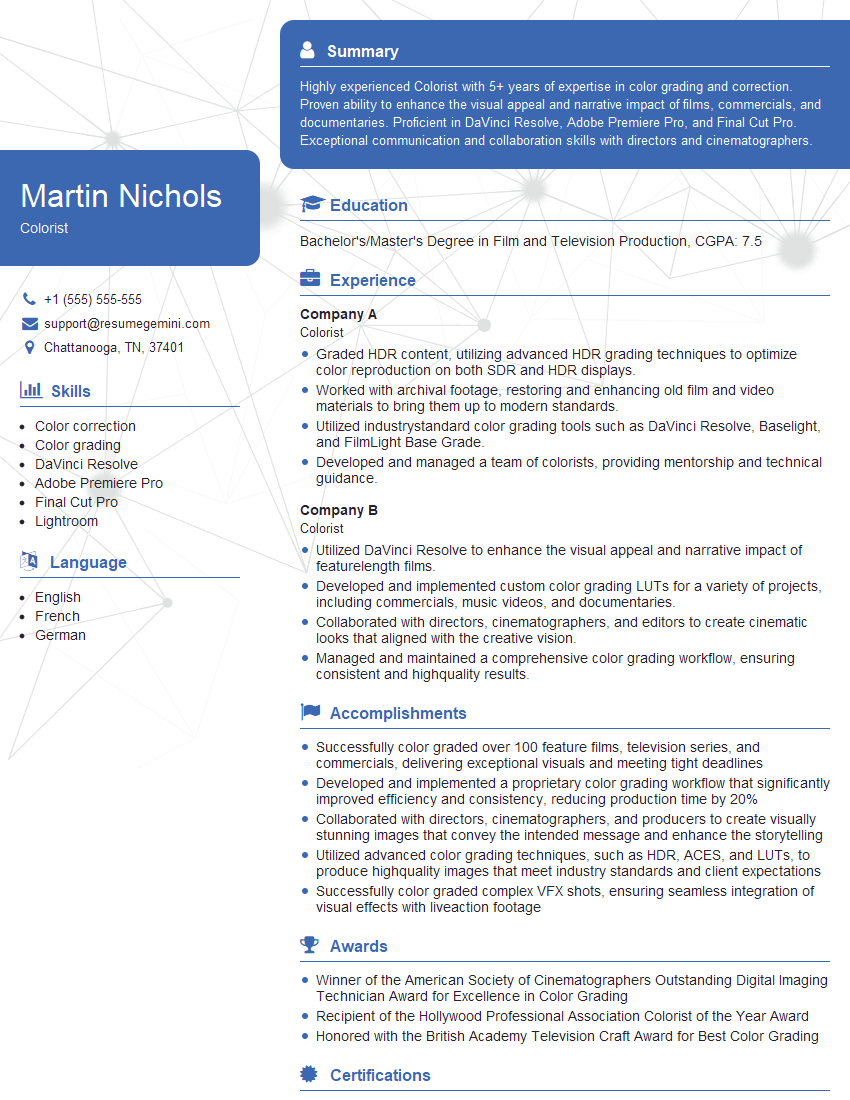
Mastering Color and Size Grading opens doors to exciting opportunities in various industries, offering excellent career growth potential with higher earning power and increased responsibility. To maximize your job prospects, creating a professional and ATS-friendly resume is crucial. ResumeGemini is a trusted resource to help you build a compelling resume that highlights your skills and experience effectively. We provide examples of resumes tailored specifically to Color and Size Grading roles to help you get started. Invest time in crafting a strong resume – it’s your first impression on potential employers.
Explore more articles
Users Rating of Our Blogs
Share Your Experience
We value your feedback! Please rate our content and share your thoughts (optional).
What Readers Say About Our Blog
Very informative content, great job.
good