Preparation is the key to success in any interview. In this post, we’ll explore crucial Commercial Music Composition interview questions and equip you with strategies to craft impactful answers. Whether you’re a beginner or a pro, these tips will elevate your preparation.
Questions Asked in Commercial Music Composition Interview
Q 1. Describe your experience composing music for different media (e.g., television, film, radio).
My experience spans a wide range of media, from the high-octane energy of television commercials to the nuanced storytelling of film scores and the catchy hooks of radio jingles. For television, I’ve composed music for everything from heartwarming family dramas to fast-paced car advertisements, always striving to match the emotional tone and visual style of the piece. Film work requires a deeper understanding of narrative and character arc, where music often acts as a silent storyteller, underscoring crucial moments and subtly shaping the audience’s emotional response. For radio, the challenge is to create memorable and effective jingles within a tight timeframe, often needing to condense a brand’s entire message into a few seconds of captivating music.
For example, I once composed a dramatic orchestral score for a documentary about wildlife conservation. The music needed to be both epic and emotive, conveying the grandeur of nature while highlighting the urgency of the conservation efforts. This contrasted sharply with a project for a tech company, where I crafted a short, upbeat, and techy jingle that used synthesizers and electronic sounds to emphasize innovation and forward thinking.
Q 2. Explain your process for creating a jingle that effectively communicates a brand’s message.
Crafting an effective jingle is a delicate balance of musicality and marketing. My process begins with a deep dive into the brand’s identity, target audience, and core message. I analyze their marketing materials, understand their values, and try to capture the essence of their brand in a musical form. Then, I sketch out several melodic ideas, experimenting with different rhythmic patterns and instrumentation to find the right ‘feel’. The melody needs to be memorable – simple enough to stick in people’s heads, yet sophisticated enough to avoid sounding cliché.
Lyrics are crucial; they need to convey the brand’s message clearly and concisely, often using rhyme and rhythm to enhance memorability. The arrangement then brings it all together – choosing instruments that reflect the brand’s personality and using production techniques to create a polished, professional sound. Throughout the process, I constantly iterate, seeking feedback and refining the jingle until it perfectly captures the brand’s essence.
For instance, for a children’s toy company, I created a jingle with a playful melody, light instrumentation (like bright woodwinds and hand claps), and lyrics that focused on fun and imagination. Conversely, a financial institution required a more mature and trustworthy sound, prompting the use of a sophisticated string arrangement, a calm and steady tempo, and reassuring lyrical themes of stability and security.
Q 3. How do you adapt your compositional style to fit various genres and target audiences?
Adaptability is paramount in commercial music. My compositional style is highly versatile; I seamlessly transition between genres, from the folksy charm of a coffee commercial to the pulsating energy of a sports advertisement. Understanding the target audience is crucial – what kind of music resonates with them? What are their cultural preferences and emotional sensibilities? This informs my choice of instrumentation, harmony, rhythm, and overall musical mood.
For example, composing for a younger audience might involve incorporating trendy electronic sounds, catchy pop melodies, and a fast tempo. On the other hand, targeting an older demographic might necessitate a more classic approach, perhaps employing acoustic instruments, slower tempos, and a more sophisticated harmonic palette. The key is to not impose my own style but rather to understand and craft music that genuinely connects with the intended listeners.
Q 4. What software and hardware are you proficient in using for commercial music composition?
My workflow relies heavily on both powerful software and versatile hardware. In terms of software, I’m highly proficient in Digital Audio Workstations (DAWs) such as Logic Pro X, Ableton Live, and Pro Tools. These allow me to record, edit, mix, and master audio, compose MIDI sequences, and work with virtual instruments. I also utilize notation software like Sibelius for scoring complex orchestral arrangements. My hardware setup includes a high-quality audio interface, studio monitors, a MIDI keyboard controller, and a selection of microphones for recording acoustic instruments.
Example of a simple MIDI sequence in Logic Pro X: //Note: This is a simplified example and would be much more extensive in a real-world scenario.
//Create a new MIDI track.//Add a software instrument (e.g., piano).//Input notes using the MIDI keyboard.
Q 5. How do you handle feedback and revisions during the music production process?
Feedback and revisions are integral to the creative process; they refine the final product and ensure it aligns perfectly with the client’s vision. I actively encourage open communication and treat feedback as a collaborative opportunity for improvement. I always approach revisions with a mindset of understanding the client’s concerns and translating them into tangible musical changes. This might involve adjusting the tempo, modifying the melody, altering the instrumentation, or even reworking entire sections of the composition.
I provide detailed explanations of my compositional choices and am transparent about the technical aspects of making changes. Clear communication is vital – ensuring the client understands the implications of any adjustments, both positive and negative. I always aim to deliver revisions promptly and efficiently, prioritizing both quality and speed.
Q 6. Describe your experience working with clients and understanding their creative vision.
Building strong client relationships is crucial. It’s essential to understand their brand, their vision, and their expectations. I achieve this through thorough initial consultations, where we discuss the project goals, target audience, and desired emotional impact. I actively listen, ask clarifying questions, and ensure that I fully grasp their creative vision before commencing work. This collaborative approach helps to build trust and rapport, setting the stage for a successful creative partnership.
Throughout the process, I maintain consistent communication, providing regular updates and seeking feedback at key stages. This proactive approach prevents misunderstandings and ensures the final product meets the client’s needs and expectations. A memorable project involved working with a small, independent coffee shop. Their vision wasn’t just about selling coffee; it was about creating a sense of community and warmth. By deeply understanding their values, I was able to compose a piece that captured that atmosphere perfectly, reflecting their unique brand personality.
Q 7. How do you manage deadlines and prioritize tasks within a fast-paced commercial music environment?
Managing deadlines and priorities in the fast-paced world of commercial music requires meticulous planning and efficient workflow. I use project management tools to track deadlines and tasks, breaking down large projects into smaller, manageable components. I allocate time for each stage of the composition process – brainstorming, sketching, arranging, recording, mixing, and mastering – ensuring a streamlined and efficient workflow. Prioritization is key; I identify the most critical tasks and tackle them first, ensuring the project stays on schedule.
Proactive communication with clients is crucial for managing expectations and addressing potential delays. Transparency about progress and any potential roadblocks keeps everyone informed and prevents last-minute surprises. A strong organizational system, coupled with clear communication, ensures projects are delivered on time and to the highest standard, even within the demanding timelines of the commercial music industry.
Q 8. Explain your understanding of music licensing and copyright laws.
Music licensing and copyright law are crucial for anyone working with music commercially. Copyright protects the original expression of a musical work, giving the composer exclusive rights to reproduce, distribute, perform, and create derivative works. This means that using someone else’s music without permission is illegal, unless a license is obtained.
There are various types of licenses, including:
- Mechanical Licenses: These allow reproduction and distribution of a musical work, like making copies for sale on CDs or digital platforms.
- Synchronization Licenses (Sync): These grant permission to synchronize a musical work with visual media, such as a film, television show, or commercial. This is the most common type of license in commercial music composition.
- Performance Licenses: These allow public performance of a musical work, such as in a live concert or on the radio. Organizations like ASCAP, BMI, and SESAC administer these licenses for many composers.
Understanding these distinctions is critical. Failing to obtain the correct licenses can result in costly legal battles and reputational damage. It’s always advisable to seek legal counsel when navigating complex licensing agreements.
Q 9. Describe your experience with music libraries and royalty-free music.
Music libraries and royalty-free music offer alternative approaches to acquiring music for commercial projects. Music libraries, like AudioJungle or Epidemic Sound, curate pre-composed tracks that can be licensed for use. The licensing terms vary; some offer one-time fees for perpetual use, while others might involve paying per use or subscribing for access to a catalog. This can save time and money for projects with tighter budgets.
Royalty-free music is often misunderstood. ‘Royalty-free’ doesn’t mean it’s free; it usually means you pay a one-time fee for the right to use the music in specified contexts, without paying ongoing royalties for each use. However, careful attention to the specific license terms is crucial, as some restrictions may still apply.
My experience involves both composing for libraries and directly for clients, offering flexibility based on project requirements. The decision to use a library track or a custom composition hinges on factors like budget, the unique needs of the project, and the creative direction.
Q 10. How do you ensure that your compositions are legally sound and avoid copyright infringement?
Ensuring legal soundness in my compositions involves a multi-pronged approach. First, I always compose original music. I avoid directly copying melodies, rhythms, or harmonic progressions from other works. If inspiration comes from existing music, I actively transform it significantly, ensuring it’s a distinct creation.
Secondly, I thoroughly research and clear any samples or pre-existing musical elements I plan to incorporate. This often involves contacting copyright holders or using legally cleared sample packs. Improper sampling can lead to serious copyright issues.
Finally, I meticulously maintain detailed records of my creative process, including sketches, demos, and revisions. This documentation is crucial in establishing proof of originality in case of any disputes. This proactive approach minimizes legal risks and protects my creative work.
Q 11. Explain your process for creating a music brief and understanding client needs.
Creating a music brief is the cornerstone of a successful commercial music project. My process involves a detailed conversation with the client to fully understand their vision. I begin by asking questions about:
- Target audience: Who are they trying to reach? What’s their age, demographic, and lifestyle?
- Brand identity: What is the brand’s personality? Is it playful, sophisticated, serious, or something else?
- Project goals: What message do they want to convey? What actions do they want viewers/listeners to take?
- Visuals: If it’s for video, I request viewing the footage to understand the pacing, mood, and visual elements that will influence the music.
- Budget and deadlines: This helps determine the scope of the project and the feasibility of different approaches.
Based on this information, I create a comprehensive brief that outlines the musical style, tempo, instrumentation, mood, and overall structure. The brief serves as a roadmap for both me and the client, ensuring we’re on the same page throughout the process. This collaborative approach ensures the final product perfectly aligns with the client’s needs and creative vision.
Q 12. How do you incorporate sound design elements into your commercial music compositions?
Sound design is integral to contemporary commercial music. It goes beyond traditional instrumentation and adds depth and texture to the composition. I incorporate sound design elements strategically to enhance the emotional impact and brand identity of the piece. This might involve:
- Creating custom sound effects: Using synthesizers, samplers, and processing techniques to create unique sounds that match the visual elements or enhance the storytelling aspect.
- Layering textures: Combining ambient sounds, drones, or rhythmic elements to add sonic richness and complexity.
- Using sound effects to punctuate key moments: Strategically placed sound effects can underscore emotional highs and lows, creating a more dynamic listening experience.
- Designing unique transitions: Employing sound design to create seamless transitions between sections of the music, maintaining a smooth flow.
For example, in a commercial for a car, I might use realistic engine sounds blended with futuristic synthesizers to convey a sense of power and innovation. The choice and application of sound design are crucial in establishing a specific mood and tone.
Q 13. Describe your understanding of different musical styles and their emotional impact.
My understanding of musical styles encompasses a wide range, from classical to electronic, jazz to hip-hop. Each style carries a distinct emotional palette. For example:
- Major keys and fast tempos often evoke feelings of happiness, energy, and optimism.
- Minor keys and slower tempos can create feelings of sadness, nostalgia, or introspection.
- Dissonance and unusual harmonies can convey tension, unease, or mystery.
- Simple, repetitive melodies might be used to create a sense of familiarity and comfort, while complex melodies might convey intelligence or sophistication.
The emotional impact is also significantly influenced by instrumentation. The choice of instruments can significantly influence the overall emotion. For example, string sections often evoke powerful emotions, while brass instruments often convey a sense of grandeur or strength. Understanding these nuances allows me to tailor my compositions to achieve the desired emotional response.
Q 14. How do you handle creative differences with clients or collaborators?
Creative differences are inevitable in collaborative projects. My approach focuses on open communication and mutual respect. I actively encourage feedback from clients and collaborators throughout the process. I view these differences not as obstacles, but as opportunities to refine the work and achieve a better outcome.
If disagreements arise, I facilitate a constructive dialogue, presenting various options and explaining the rationale behind my choices. I encourage clients to articulate their concerns clearly, while I aim to explain my artistic vision thoroughly. Compromise and finding a middle ground that respects both artistic integrity and client needs are key. I believe in approaching these situations with empathy and a problem-solving mindset, always prioritizing a positive working relationship.
In cases where a significant disagreement cannot be resolved, I will clearly communicate the limitations and potential outcomes, and explore alternative solutions that align with both parties’ expectations. The most important element is maintaining transparency and professional respect.
Q 15. What is your experience with music production techniques such as mixing and mastering?
Mixing and mastering are crucial post-production stages in music composition. Mixing involves balancing individual tracks (instruments, vocals) to create a cohesive and well-defined sonic landscape. Mastering is the final stage, optimizing the overall loudness, dynamics, and frequency balance for various playback systems.
My experience spans over [Number] years, working on a wide range of projects. I’m proficient in using Digital Audio Workstations (DAWs) like Pro Tools, Logic Pro X, and Ableton Live. I understand the nuances of EQ, compression, reverb, delay, and other effects, and I can tailor my approach based on the specific genre and desired sonic outcome. For instance, a commercial jingle for a children’s toy would require a brighter, more upfront mix compared to a moody background score for a corporate video. I always prioritize creating a transparent mix that retains the natural timbre of each instrument and vocal while enhancing clarity and impact.
In mastering, my focus is on achieving consistent loudness across different platforms without compromising dynamic range or introducing artifacts. I use high-end mastering plugins and hardware to ensure a polished and professional finish. I’m familiar with loudness standards like LUFS (Loudness Units relative to Full Scale) to ensure optimal playback across various streaming services and broadcasting platforms.
Career Expert Tips:
- Ace those interviews! Prepare effectively by reviewing the Top 50 Most Common Interview Questions on ResumeGemini.
- Navigate your job search with confidence! Explore a wide range of Career Tips on ResumeGemini. Learn about common challenges and recommendations to overcome them.
- Craft the perfect resume! Master the Art of Resume Writing with ResumeGemini’s guide. Showcase your unique qualifications and achievements effectively.
- Don’t miss out on holiday savings! Build your dream resume with ResumeGemini’s ATS optimized templates.
Q 16. How do you ensure your compositions are technically sound and compatible with various media formats?
Ensuring technical soundness and compatibility is paramount. I meticulously adhere to industry standards throughout the composition and production process. This includes using high-quality audio samples at appropriate sample rates (typically 44.1kHz or 48kHz) and bit depths (usually 16-bit or 24-bit). I also carefully consider the final delivery format, which can range from high-resolution WAV files for broadcast to compressed MP3s for online streaming.
For example, when creating music for a television commercial, I need to deliver audio files that meet specific broadcast specifications. This often involves exporting multiple versions – a stereo mix for standard playback, and 5.1 surround sound for cinemas and home theatre systems. Similarly, for online platforms, I optimize the audio for various streaming services’ compression algorithms, ensuring the music retains its quality across different devices and bandwidths.
I proactively monitor the technical aspects of my work, often performing quality checks using specialized tools to identify potential issues like clipping, phase cancellation, or inter-sample peaks. This ensures the end product is free from technical glitches and maintains its intended sound quality across all platforms.
Q 17. What are your strengths and weaknesses as a commercial music composer?
My strengths lie in my adaptability and versatility. I can comfortably compose across diverse genres, from upbeat pop and catchy jingles to atmospheric cinematic scores. I possess a strong understanding of music theory and orchestration, which allows me to create rich and nuanced compositions. I’m also a highly collaborative individual, valuing input and feedback from clients and other creatives.
However, like any composer, I have areas for ongoing development. While proficient in various styles, I am always striving to expand my knowledge and refine my skills in specific niches, such as electronic music production or sound design integration. I also actively work on improving my efficiency in project management and streamlining workflows to better handle multiple projects simultaneously.
Q 18. Describe your approach to using instrumentation and arrangement to enhance your compositions.
Instrumentation and arrangement are fundamental to conveying emotion and establishing the sonic identity of a piece. My approach is driven by the specific needs of the project. For a bright and energetic commercial, I might choose instruments like trumpets, acoustic guitars, and driving drums. In contrast, a somber or reflective piece might utilize strings, woodwinds, and perhaps a solo piano.
I strategically use layering and orchestration to add depth and texture. This involves carefully balancing different instrumental parts, ensuring each instrument has its space and contribution within the mix. For example, I might use a subtle string section to enhance the emotional impact of a vocal melody or incorporate percussion instruments to create rhythmic complexity.
I’m also acutely aware of how arrangement impacts the overall narrative. The structure of a piece—the introduction, verse, chorus, and bridge—plays a significant role in capturing and maintaining the listener’s attention. I always consider the emotional arc of the composition and strategically arrange the music to mirror that arc.
Q 19. How do you approach collaboration with other professionals, such as sound designers or voice actors?
Collaboration is essential in commercial music. I approach collaborations with a focus on open communication and mutual respect. Before embarking on a project with sound designers or voice actors, I establish clear expectations regarding the project’s vision, desired outcomes, and deadlines.
I believe in providing clear and concise briefs, outlining the specific requirements for each collaborator’s contribution. This ensures everyone is on the same page and working towards a unified goal. For example, when working with a voice actor, I might provide them with a detailed description of the character’s personality and emotional state, alongside a reference track to help them understand the desired tone and style.
Furthermore, I actively seek feedback from my collaborators throughout the process. I value their expertise and creativity and am always open to incorporating their suggestions to improve the final product. Regular check-ins and open dialogue allow for creative problem-solving and ensure the final product surpasses initial expectations.
Q 20. Describe your understanding of tempo, rhythm, and melody in commercial music composition.
Tempo, rhythm, and melody are the building blocks of any composition. In commercial music, understanding their interplay is critical for creating engaging and effective pieces. Tempo, the speed of the music, significantly influences the mood. A fast tempo can create excitement and energy, while a slow tempo conveys calmness or seriousness.
Rhythm, the pattern of sounds and silences, provides the underlying groove and momentum. It’s crucial for establishing a song’s character and danceability. In a commercial, a strong and memorable rhythm can help the audience retain the message.
Melody, the sequence of notes, is the most expressive element of music. It’s what often sticks in people’s minds. A memorable and simple melody is crucial for catchy jingles or commercials. I strive to create melodic lines that are both expressive and easily accessible to the listener. I consider the target audience when crafting melodies, tailoring them to resonate with their preferences.
Q 21. Explain your experience in creating music for different platforms and formats.
I’ve had the opportunity to create music for diverse platforms and formats, including television commercials, radio jingles, corporate videos, video games, and online advertisements. Each platform demands a slightly different approach. For television, I focus on creating dynamic scores that can seamlessly integrate with the visual elements and convey the commercial’s message in a short timeframe.
For online platforms, the considerations shift towards creating shorter, more concise pieces that are optimized for the platform’s audio characteristics and audience expectations. For video games, the demands change further, as I may need to create various musical themes and cues to accompany different gameplay situations.
My adaptability allows me to meet the unique requirements of each platform while maintaining a consistently high standard of quality. I understand the technical specifications of each platform and tailor my workflow and delivery formats to ensure the seamless integration of my music into the final product. The creative process remains adaptable, but the technical elements are precisely tuned for the chosen platform.
Q 22. How do you measure the success of your commercial music compositions?
Measuring the success of a commercial music composition isn’t solely about chart positions or awards; it’s multifaceted. Primarily, I assess success based on how effectively the music achieves its intended purpose. This could mean:
- Client Satisfaction: Did the music meet the client’s brief and expectations? Did they express happiness with the final product and its impact?
- Project Goals: Did the music enhance the brand image, drive sales, evoke the desired emotion in viewers, or achieve the specific aims of the advertising campaign or film?
- Usage and Longevity: How widely has the music been used? Is it still being used after the initial campaign, demonstrating its lasting value?
- Industry Recognition (Secondary): While less crucial than client satisfaction and project success, awards and nominations certainly contribute to a sense of accomplishment and can lead to future opportunities.
For instance, a piece composed for a car commercial might be deemed successful if it dramatically increases brand awareness and leads to a measurable sales uplift, even if it doesn’t become a viral hit. Conversely, a track used in a film might be celebrated by critics but deemed less successful if it fails to enhance the film’s emotional impact on the audience.
Q 23. What are some of the challenges you’ve faced in commercial music composition, and how did you overcome them?
One of the biggest challenges is balancing creative vision with client needs. Sometimes, a client’s initial idea may not be the most musically effective or aesthetically pleasing. I’ve overcome this by fostering open communication and collaborative brainstorming. I present different musical options and explain the reasoning behind my suggestions, using examples to illustrate how various approaches can achieve the same goal.
Another significant challenge is meeting tight deadlines while maintaining a high level of quality. To address this, I’ve developed efficient workflow strategies, including meticulous planning and utilizing advanced music software for faster composition and production. I also prioritize delegation where appropriate, working with trusted sound engineers and other professionals to manage the workload.
Finally, copyright issues can be tricky. I always ensure thorough clearance of any sampled or borrowed material, following best practices to prevent legal complications. I proactively address potential copyright issues in my initial stages of a project.
Q 24. How do you stay up-to-date with current trends and technology in the music industry?
Staying current in the music industry requires a multi-pronged approach:
- Regular Listening: I actively listen to diverse genres and styles of music across various platforms, paying attention to production techniques, trends, and the emotional impact of different soundscapes.
- Industry Publications and Blogs: I subscribe to industry magazines and follow relevant blogs, keeping tabs on technological advances and evolving musical tastes.
- Networking: Attending industry events and conferences allows for direct interaction with other composers, producers, and industry leaders, fostering the exchange of knowledge and insights.
- Software and Hardware Updates: I regularly update my digital audio workstation (DAW) and other relevant software and hardware, ensuring I can utilize the latest tools and technologies.
- Online Courses and Workshops: I participate in online courses and workshops focusing on new techniques, software, and trends in music production and composition.
By combining these methods, I can effectively adapt my skills and adapt my compositional style to meet current trends and industry demands.
Q 25. What are your rates and what factors influence your pricing?
My rates are project-based, not hourly. They vary significantly depending on several key factors:
- Project Scope: A simple jingle for a radio ad will cost less than a complex orchestral score for a feature film.
- Length and Complexity: Longer and more intricate pieces naturally require more time and effort, increasing the cost.
- Revisions: An excessive number of revisions can impact the overall pricing.
- Licensing Rights: The type of licensing rights granted (e.g., worldwide, limited-time use) affects the price.
- Client’s Budget: I work with clients to find a solution within their budget, while ensuring the project’s quality is maintained.
I typically provide a detailed quote upfront after carefully reviewing the project brief. This ensures complete transparency and helps manage expectations.
Q 26. Describe your experience with pitching your work to clients.
Pitching my work involves a strategic combination of showcasing my portfolio and demonstrating my understanding of the client’s needs. I begin by meticulously researching the client and their previous work to tailor my pitch to their specific style and objectives.
I usually submit a concise proposal that includes:
- A brief summary of my experience and relevant projects.
- Examples of my work aligned with the client’s needs (audio samples and possibly video examples).
- A proposed approach and creative concept for the project.
- A detailed quote outlining the scope of work and pricing.
I follow up with a phone call or in-person meeting, where I can address any questions and further demonstrate my ability to meet their specific requirements. Building rapport and showcasing my understanding of their brand and target audience is key to a successful pitch.
Q 27. Explain your approach to revision and refinement of a composition.
My approach to revision and refinement is iterative and collaborative. I view revisions not as corrections, but as opportunities to further enhance the composition. I actively solicit feedback from the client, explaining the technical aspects of the music in layman’s terms to ensure clear communication.
My revision process typically involves:
- Careful Review of Feedback: I meticulously analyze every piece of feedback received, categorizing suggestions for clarity and efficient implementation.
- Prioritized Implementation: I prioritize changes based on their impact on the overall effectiveness of the music. Sometimes, minor adjustments can significantly improve the piece.
- Testing and Iteration: After implementing changes, I test the revised composition in its intended context (e.g., within the advertisement or film scene) to ensure the adjustments achieve their desired effect.
- Clear Communication: I keep the client updated throughout the revision process, explaining the changes made and why those adjustments were made.
This iterative process ensures that the final composition perfectly aligns with the client’s vision and meets the project’s objectives.
Q 28. How do you handle unexpected changes or requests during a project?
Handling unexpected changes or requests during a project requires flexibility and adaptability. My strategy involves:
- Open Communication: I maintain open communication with the client throughout the project, encouraging them to share any changes or requests promptly.
- Assessing the Impact: Once a change request is received, I assess its impact on the project timeline, budget, and overall quality. I discuss these potential impacts with the client openly and honestly.
- Negotiating Solutions: I collaboratively work with the client to find solutions that accommodate the changes while minimizing disruptions.
- Contractual Considerations: I review the contract to ensure any significant changes are covered and agreed upon in writing.
- Prioritization: If necessary, I prioritize changes based on their impact and urgency.
Proactive communication and a flexible approach are key to successfully navigating unexpected situations during a project, ensuring client satisfaction and project completion.
Key Topics to Learn for Your Commercial Music Composition Interview
Ace your interview by mastering these key areas of Commercial Music Composition. Remember, demonstrating a well-rounded understanding and practical application is crucial.
- Music Theory Fundamentals: A strong grasp of harmony, counterpoint, rhythm, and melody is essential. Be prepared to discuss how these theoretical concepts inform your compositional choices.
- Genre-Specific Knowledge: Demonstrate proficiency in various commercial music genres (e.g., pop, rock, electronic, film scoring). Discuss your familiarity with stylistic conventions and production techniques within each genre.
- Orchestration and Instrumentation: Understanding the sonic capabilities of different instruments and how to effectively arrange them for various media (film, television, advertising, games) is vital. Be ready to discuss your approach to instrument selection and arrangement.
- Music Production Techniques: Familiarity with digital audio workstations (DAWs), mixing, mastering, and sound design is expected. Be prepared to discuss your workflow and problem-solving skills within the production process.
- Copyright and Licensing: Understanding the legal aspects of music composition, including copyright, licensing, and royalty payments, is crucial for a professional career. Show your awareness of industry standards.
- Collaboration and Communication: Commercial music often involves teamwork. Be ready to discuss your experience collaborating with other musicians, producers, and directors, highlighting your communication and teamwork skills.
- Problem-Solving and Adaptability: The ability to adapt to changing briefs, meet deadlines, and creatively overcome challenges is paramount. Prepare examples demonstrating your resilience and resourcefulness.
Next Steps: Level Up Your Career
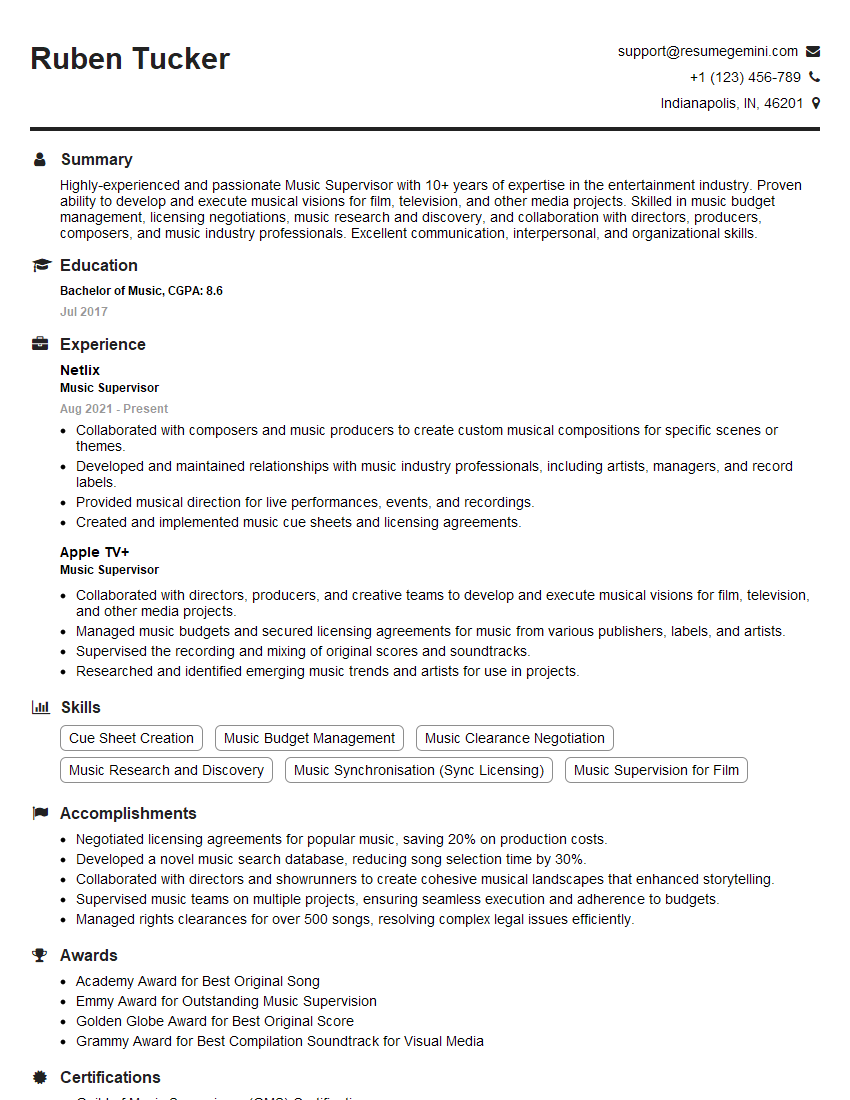
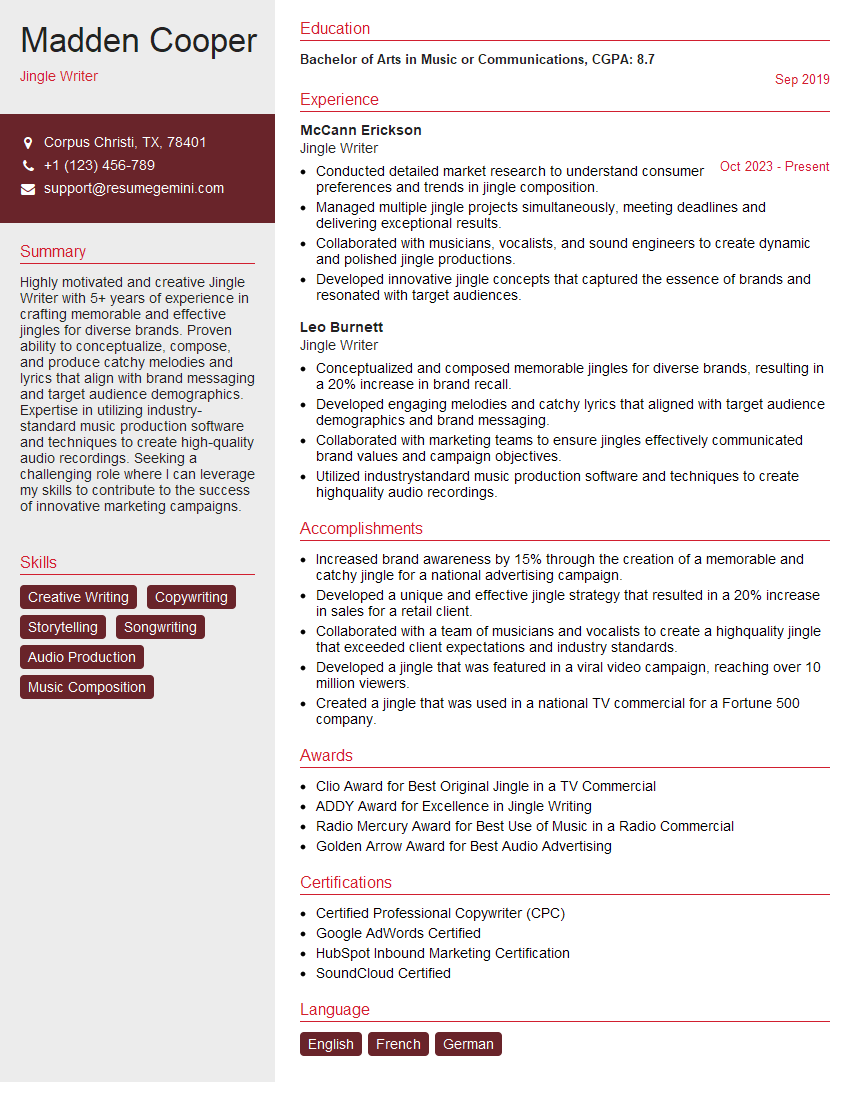
Mastering Commercial Music Composition opens doors to exciting opportunities in diverse industries. To maximize your job prospects, a strong, ATS-friendly resume is essential. ResumeGemini is a trusted resource to help you build a compelling and effective resume that showcases your skills and experience. We provide examples of resumes tailored to Commercial Music Composition to help you get started.
Explore more articles
Users Rating of Our Blogs
Share Your Experience
We value your feedback! Please rate our content and share your thoughts (optional).
What Readers Say About Our Blog
Very informative content, great job.
good