Interviews are opportunities to demonstrate your expertise, and this guide is here to help you shine. Explore the essential Construction Planning and Scheduling interview questions that employers frequently ask, paired with strategies for crafting responses that set you apart from the competition.
Questions Asked in Construction Planning and Scheduling Interview
Q 1. Explain the difference between critical path method (CPM) and Program Evaluation and Review Technique (PERT).
Both Critical Path Method (CPM) and Program Evaluation and Review Technique (PERT) are network diagramming techniques used in construction planning to determine the critical path – the sequence of tasks that determines the shortest possible project duration. However, they differ significantly in how they handle task durations.
CPM assumes deterministic task durations; meaning each task’s duration is known with certainty. It uses a single time estimate for each activity. This is suitable for projects with a history of similar activities where accurate time estimates can be obtained. Imagine building a standard brick wall – we have a good idea how long each bricklaying stage will take.
PERT, on the other hand, acknowledges the inherent uncertainty in estimating task durations, especially in novel projects. It uses three time estimates for each activity: optimistic, most likely, and pessimistic. This allows for variability and provides a probabilistic view of project completion time. Think of designing a new type of foundation – there are more unknowns, so we need to account for a range of possibilities.
In essence, CPM is simpler and more straightforward, while PERT is more robust and better suited for projects with high uncertainty. The choice between CPM and PERT depends on the nature of the project and the level of confidence in the time estimates.
Q 2. Describe your experience with Primavera P6 or MS Project.
I have extensive experience with Primavera P6, utilizing it for over seven years across various large-scale construction projects. My expertise encompasses creating and managing project schedules, resource allocation, cost control, and progress tracking. I’m proficient in developing WBS (Work Breakdown Structure), defining task dependencies, and using P6’s features for critical path analysis, what-if scenario planning, and reporting.
For example, on a recent high-rise building project, I used Primavera P6 to model the entire construction process, including foundation works, structural steel erection, MEP installations, and facade construction. This allowed for detailed resource leveling, identifying potential resource conflicts, and proactively mitigating potential delays. The use of P6’s reporting tools was crucial in communicating project status and progress to stakeholders effectively.
While I haven’t used MS Project extensively for construction projects, I possess fundamental knowledge of its scheduling capabilities and understand its limitations compared to Primavera P6, especially when dealing with the complexities of large construction projects.
Q 3. How do you handle schedule delays and identify their root causes?
Handling schedule delays requires a systematic approach. My process starts with identifying the delay, quantifying its impact, and then meticulously investigating the root cause. I utilize several techniques:
- Schedule Variance Analysis: Comparing the planned progress against actual progress using tools like Primavera P6, identifies activities behind schedule.
- Root Cause Analysis (RCA): This could involve conducting interviews with site personnel, reviewing project documentation, and analyzing progress reports. Common causes include unforeseen site conditions, material delays, equipment failures, design changes, or inadequate resource allocation.
- Critical Path Analysis: Identifying which activities on the critical path are causing the delay and focusing recovery efforts there.
Once the root cause is identified, I collaborate with the project team to develop and implement mitigation strategies. These might include accelerating critical activities, re-sequencing tasks, procuring additional resources, or revising the scope of work. Regular monitoring and reporting are essential to track the effectiveness of these strategies and make necessary adjustments.
For instance, on a recent project, a delay in steel delivery impacted the critical path. Through RCA, we determined the supplier’s logistical issues were the culprit. We mitigated the delay by securing alternative steel sources and adjusting the construction sequence to minimize impact on subsequent activities. This required close collaboration with the procurement and site teams.
Q 4. What are some common scheduling constraints in construction projects?
Construction projects are rife with scheduling constraints. These constraints can be broadly categorized as:
- Resource Constraints: Limited availability of skilled labor, equipment, or materials can significantly impact the schedule. For instance, a shortage of welders can delay structural steel erection.
- Financial Constraints: Budget limitations can restrict the allocation of resources and lead to scheduling delays. If funding is delayed, certain activities might be postponed.
- External Constraints: These encompass weather conditions, permits and approvals, third-party dependencies, or site access limitations. For example, heavy rainfall can halt outdoor activities.
- Logical Constraints: Certain tasks cannot begin until others are completed (precedence constraints). Foundation work must be finished before erecting walls.
- Legal and Regulatory Constraints: Compliance with safety regulations, building codes, or environmental guidelines may introduce delays.
Effective project scheduling involves proactively identifying and mitigating these constraints through meticulous planning, risk management, and close coordination with all stakeholders.
Q 5. Explain your understanding of Earned Value Management (EVM).
Earned Value Management (EVM) is a project management technique for measuring project performance and progress. It integrates scope, schedule, and cost data to provide a comprehensive view of project status. EVM uses three key metrics:
- Planned Value (PV): The budgeted cost of work scheduled to be completed by a specific point in time.
- Earned Value (EV): The value of the work actually completed by a specific point in time.
- Actual Cost (AC): The actual cost incurred to complete the work up to a specific point in time.
Key EVM indicators include:
- Schedule Variance (SV = EV – PV): Indicates whether the project is ahead or behind schedule.
- Cost Variance (CV = EV – AC): Shows whether the project is under or over budget.
- Schedule Performance Index (SPI = EV/PV): Measures schedule efficiency.
- Cost Performance Index (CPI = EV/AC): Measures cost efficiency.
By tracking these metrics, EVM provides valuable insights into project health, allowing for proactive identification of potential problems and timely corrective actions. For example, a negative SV indicates a schedule delay, while a CPI less than 1 suggests cost overruns.
Q 6. How do you create a realistic project schedule?
Creating a realistic project schedule requires a comprehensive and iterative process:
- Detailed Scope Definition: A well-defined Work Breakdown Structure (WBS) is crucial. The project should be broken down into smaller, manageable tasks.
- Accurate Task Duration Estimation: This relies on historical data, expert judgment, and considering potential risks and uncertainties. PERT is useful here.
- Resource Availability Assessment: Identify the required resources (labor, equipment, materials) and check their availability. Resource leveling might be necessary.
- Dependency Identification: Define the logical relationships between tasks (finish-to-start, start-to-start, etc.).
- Critical Path Determination: Identify the sequence of tasks that determines the shortest project duration.
- Contingency Planning: Include buffer time to account for unforeseen delays and risks. This could involve adding a contingency buffer to the critical path or creating a contingency reserve.
- Stakeholder Input: Involve all relevant stakeholders in the scheduling process for buy-in and to gather valuable insights.
- Iterative Review and Refinement: The schedule should be reviewed and updated regularly to reflect the actual progress and any changes in project scope or conditions.
Remember, a realistic schedule isn’t just about meeting deadlines; it’s about creating a feasible plan that accounts for all relevant factors and allows for effective project execution.
Q 7. Describe your experience with resource leveling and allocation.
Resource leveling and allocation are critical aspects of construction scheduling. Resource allocation involves assigning resources (labor, equipment, materials) to specific tasks. This process aims to optimize resource utilization and ensure that the right resources are available when and where they are needed. Resource leveling aims to smooth out resource demand over time, minimizing peaks and valleys in resource requirements. It involves adjusting the schedule to distribute resource utilization more evenly, thereby reducing the need for excessive overtime or the hiring of additional resources.
In my experience, I’ve employed various techniques for resource leveling, including:
- Using Primavera P6’s resource leveling tools: P6 offers sophisticated algorithms to optimize resource allocation and leveling.
- Manual leveling: For smaller projects or when fine-tuning is necessary, manual adjustments might be required.
- Developing resource histograms: These visually represent resource demand over time, helping to identify potential conflicts and areas for leveling.
Effective resource leveling requires careful coordination with project team members and proactive communication regarding resource availability and potential constraints. For instance, on a large infrastructure project, resource leveling allowed us to efficiently utilize our fleet of excavators by re-sequencing earthworks tasks, eliminating resource conflicts and minimizing idle time.
Q 8. What are the key performance indicators (KPIs) you track for scheduling?
Key Performance Indicators (KPIs) for scheduling are crucial for monitoring progress and identifying potential issues early. They provide a quantifiable measure of schedule performance. I typically track a combination of leading and lagging indicators.
Schedule Performance Index (SPI): This measures the efficiency of work completed against the planned schedule. An SPI of 1.0 indicates the project is on schedule, while values greater than 1.0 show ahead of schedule, and less than 1.0 indicates behind schedule. For example, if 50% of the work was planned to be completed in a month and 60% was actually completed, the SPI would be 1.2 (60%/50%).
Cost Performance Index (CPI): While not strictly a scheduling KPI, CPI is strongly correlated. It shows the efficiency of cost spending versus the planned budget. A low CPI can indicate schedule slippage due to resource constraints or cost overruns impacting planned activities.
Critical Path Float/Slack: Monitoring the float on the critical path (the sequence of activities determining the shortest project duration) provides a buffer and indicates vulnerabilities. A reduction in float highlights potential delays.
Percent Complete: A simple but vital indicator tracking the percentage of completed tasks against the plan. Significant deviations from the plan raise concerns needing investigation.
Number of Schedule Changes: Frequent schedule changes can signal instability in the project’s planning or execution. Tracking this helps understand change management effectiveness.
Regular monitoring of these KPIs allows proactive intervention and prevents minor issues from escalating into major problems.
Q 9. How do you manage changes to the project schedule?
Managing schedule changes is a critical aspect of construction project management. My approach involves a structured process ensuring transparency and minimal disruption.
Formal Change Request: All schedule changes must be documented through a formal change request, detailing the reason, impact, and proposed solution. This ensures traceability and accountability.
Impact Assessment: A thorough impact assessment is crucial to understand the effects on the critical path, deadlines, and resources. This involves analyzing the dependencies between tasks.
Schedule Update: The schedule is updated using project management software, reflecting the approved change. This often includes updating activity durations, dependencies, or resource allocation.
Communication: Stakeholders are promptly informed of the change, its impact, and any necessary adjustments to their expectations. This prevents misunderstandings and maintains project alignment.
Baseline Revision: Significant changes may require a baseline schedule revision to reflect the new reality, providing a clear foundation for monitoring future progress.
For instance, if a supplier delay impacts a critical activity, we initiate a change request, assess the delay’s ripple effect, update the schedule, communicate the delay to the client, and potentially explore mitigation strategies such as expediting other tasks.
Q 10. What is your experience with risk assessment and mitigation in scheduling?
Risk assessment and mitigation are integral to creating robust and realistic schedules. My approach involves a proactive and iterative process.
Risk Identification: I work with the project team to identify potential risks that could impact the schedule. This could include weather delays, material shortages, equipment malfunctions, or subcontractor performance issues.
Risk Analysis: Each risk is analyzed using a qualitative or quantitative approach to determine its likelihood and potential impact on the project schedule. Techniques like Probability & Impact matrices are valuable here.
Risk Response Planning: For each identified risk, we develop mitigation strategies. This might include buffer time added to the schedule, contingency plans, or alternative procurement methods. For example, if there’s a risk of weather delays, we might add extra time in the schedule for unforeseen circumstances.
Risk Monitoring and Control: Throughout the project, the risks are continuously monitored to detect early warning signs. If a risk materializes, the pre-defined mitigation plan is executed.
Regular risk reviews are held to update the risk register, evaluate the effectiveness of mitigation strategies, and adapt as needed. This ensures the schedule remains resilient and adaptable to evolving project conditions.
Q 11. How do you communicate schedule updates to stakeholders?
Effective communication of schedule updates is paramount to successful project delivery. My strategy involves a multi-faceted approach targeting different stakeholder needs.
Regular Project Meetings: I conduct regular project meetings to discuss progress against the schedule, highlighting any variances and planned corrective actions. This fosters transparency and collaboration.
Progress Reports: Detailed progress reports, typically weekly or bi-weekly, are generated and distributed to stakeholders. These reports use clear visuals like Gantt charts to illustrate progress and any schedule deviations.
Project Management Software: Utilizing project management software allows for real-time access to the schedule by authorized stakeholders. This ensures everyone is informed and can track progress independently.
Visual Communication: Visual aids such as Gantt charts, critical path diagrams, and progress dashboards effectively convey schedule information, particularly to non-technical stakeholders.
Targeted Communication: Communication is tailored to specific audiences. For example, high-level summaries are provided to senior management, while detailed reports are shared with project teams.
By using a combination of these methods, I ensure that all stakeholders receive timely and relevant information regarding schedule updates, promoting project success.
Q 12. Describe your process for developing a project baseline schedule.
Developing a project baseline schedule is a meticulous process that forms the foundation for project control. It’s a detailed, realistic representation of how the project will unfold.
Work Breakdown Structure (WBS): The project is broken down into smaller, manageable tasks using a WBS. This ensures comprehensive task identification and clear responsibility assignments.
Activity Sequencing and Dependencies: Tasks are sequenced logically, defining dependencies (finish-to-start, start-to-start, etc.) between them. This establishes the order of execution and identifies the critical path.
Duration Estimation: Realistic durations are assigned to each task, considering resource availability, complexities, and potential risks. Historical data and expert judgment are often used.
Resource Allocation: Resources (labor, equipment, materials) are allocated to each task, considering availability and potential conflicts.
Schedule Development: Using project management software, a network diagram or Gantt chart is created, visualizing the project schedule. This includes critical path identification and float calculation.
Baseline Approval: The draft baseline schedule is reviewed and approved by all key stakeholders to ensure consensus and commitment to the plan. This formally establishes the baseline against which future performance is measured.
A well-defined baseline serves as a benchmark, facilitating progress tracking, variance analysis, and effective change management.
Q 13. How do you handle conflicting priorities in a project schedule?
Conflicting priorities in a project schedule are common. Addressing them requires careful prioritization and effective communication.
Prioritization Matrix: A prioritization matrix (e.g., MoSCoW method – Must have, Should have, Could have, Won’t have) is used to rank tasks based on their importance and urgency. This helps focus resources on critical tasks.
Trade-off Analysis: Trade-offs might be necessary, carefully balancing competing priorities. This requires evaluating the impact of delaying or modifying less critical tasks to meet deadlines for crucial ones.
Resource Optimization: Optimizing resource allocation can help resolve conflicts. This might involve re-allocating resources, adjusting task durations, or seeking additional resources.
Stakeholder Negotiation: Open communication and negotiation with stakeholders are crucial to reach consensus on priorities. This ensures everyone understands the trade-offs and agrees on the revised plan.
Schedule Replanning: In some cases, a complete schedule replanning might be necessary to address significant conflicts. This involves re-sequencing tasks, adjusting durations, and potentially revising deadlines.
For example, if a design change requires extra time but a crucial delivery date is approaching, we’d use the prioritization matrix to evaluate the impact and potentially negotiate with the client to adjust expectations or find ways to expedite the critical path.
Q 14. Explain your understanding of activity sequencing and dependencies.
Activity sequencing and dependencies are fundamental to creating a realistic and accurate project schedule. They define the order in which tasks are performed and how they relate to each other.
Activity Sequencing: This involves determining the logical order in which tasks should be performed. It considers factors like workflow, resource availability, and technical constraints.
Dependencies: Dependencies represent relationships between activities. There are several types:
Finish-to-Start (FS): A task cannot begin until a preceding task is completed. This is the most common type of dependency.
Start-to-Start (SS): A task cannot start until a preceding task starts. Example: Excavation and foundation pouring can start concurrently.
Finish-to-Finish (FF): A task cannot finish until a preceding task finishes. Example: Drafting and review of a document must finish before final submission.
Start-to-Finish (SF): Less common; a task cannot finish until a preceding task starts. Example: Site preparation must start before demolition can finish.
Understanding dependencies is critical for accurately calculating the project duration, identifying the critical path, and assessing the impact of delays. Project management software helps visualize and manage these dependencies effectively, often using a network diagram or Gantt chart. Improper sequencing can lead to delays, resource conflicts, and increased project costs.
Q 15. How do you use progress reporting to monitor schedule performance?
Progress reporting is the cornerstone of effective schedule monitoring. It’s a systematic process of tracking actual progress against the planned schedule, allowing for early identification of potential delays or areas exceeding expectations. I use a combination of methods to ensure comprehensive monitoring.
- Regular Reporting: I establish a consistent reporting frequency (e.g., weekly, bi-weekly) tailored to the project’s complexity and criticality. This provides a continuous flow of information.
- Key Performance Indicators (KPIs): My reports always focus on relevant KPIs, such as percentage of work completed, critical path progress, and identification of any tasks falling behind schedule. These are presented visually, often using Gantt charts and other visual aids.
- Variance Analysis: I meticulously analyze the variance between planned and actual progress. This involves identifying the causes of any deviations, whether they are due to resource constraints, unforeseen challenges, or simply inaccurate initial estimations. This analysis informs proactive mitigation strategies.
- Earned Value Management (EVM): For larger, more complex projects, I often leverage EVM. EVM provides a powerful method for objectively measuring schedule and cost performance, offering insights into schedule variance, cost variance, and schedule performance index (SPI).
For example, on a recent high-rise construction project, weekly reports highlighted a consistent delay in steel erection. Through variance analysis, we discovered a bottleneck in the delivery of specialized fasteners. By proactively addressing the supply chain issue, we successfully mitigated the impact on the overall schedule.
Career Expert Tips:
- Ace those interviews! Prepare effectively by reviewing the Top 50 Most Common Interview Questions on ResumeGemini.
- Navigate your job search with confidence! Explore a wide range of Career Tips on ResumeGemini. Learn about common challenges and recommendations to overcome them.
- Craft the perfect resume! Master the Art of Resume Writing with ResumeGemini’s guide. Showcase your unique qualifications and achievements effectively.
- Don’t miss out on holiday savings! Build your dream resume with ResumeGemini’s ATS optimized templates.
Q 16. What is your experience with different scheduling software?
I have extensive experience with a variety of scheduling software, each with its own strengths and weaknesses. My proficiency spans both traditional and cloud-based solutions.
- Primavera P6: My go-to for large-scale, complex projects. Its robust features for resource allocation, critical path analysis, and risk management are invaluable. I’m proficient in creating detailed WBS structures and managing multiple baselines.
- Microsoft Project: A versatile tool suitable for smaller projects or those requiring simpler scheduling needs. I’ve used it extensively for task assignments, tracking progress, and generating reports.
- PlanGrid (now Autodesk Build): I utilize this cloud-based platform for field collaboration and real-time updates, facilitating seamless communication between the office and field teams. It enhances visibility and ensures that everyone is working with the most up-to-date schedule.
Choosing the right software depends heavily on project specifics. For instance, while Primavera P6 offers unmatched power, its complexity may be overkill for a smaller renovation project where Microsoft Project would suffice. I always assess the project’s demands before selecting the most appropriate tool.
Q 17. Describe a time you had to make a critical decision regarding project scheduling.
During the construction of a large-scale hospital, we faced an unexpected delay in the delivery of crucial medical equipment. This threatened to disrupt the entire project schedule and impact the hospital’s opening date.
My decision involved fast-tracking certain non-critical path activities, while simultaneously negotiating with the equipment supplier for expedited delivery. This involved carefully analyzing the project network, identifying activities with float time, and re-sequencing tasks to maintain critical path progress. We also initiated a parallel effort to identify and mitigate any potential risks that the fast-tracking might introduce.
This required careful communication with the various stakeholders, including the hospital administration, equipment suppliers, and our own internal teams. The successful resolution involved a collaborative approach, highlighting the importance of clear communication and effective risk management.
Q 18. How do you identify and resolve schedule conflicts?
Schedule conflicts arise when tasks require the same resources at the same time or when task dependencies are not properly defined. I employ a multi-step approach to identify and resolve these conflicts:
- Visual Inspection: Using Gantt charts or other visual scheduling tools, I visually inspect the schedule for overlapping activities.
- Critical Path Analysis: By identifying the critical path, I pinpoint activities with zero float, indicating that any delay will impact the overall project duration. Conflicts on the critical path require immediate attention.
- Resource Leveling: This technique adjusts the schedule to optimize resource allocation, minimizing conflicts and resource over-utilization. It might involve shifting non-critical activities or adjusting resource assignments.
- Constraint Analysis: I examine the constraints associated with each task (e.g., precedence, resource availability). Identifying and addressing constraint violations helps resolve conflicts.
- Negotiation & Collaboration: Often, resolving conflicts requires negotiation and collaboration with various stakeholders. This might involve adjusting task durations, prioritizing tasks, or securing additional resources.
For instance, on a recent project, a conflict arose between the electrical and plumbing teams vying for the same workspace. Through resource leveling, we adjusted the schedules, allowing for staggered access to the shared area, effectively eliminating the conflict.
Q 19. How do you utilize lookahead scheduling techniques?
Lookahead scheduling is a proactive planning technique focusing on the immediate future (typically 2-4 weeks) of a project. It’s particularly valuable in dynamic environments where changes are frequent.
I utilize lookahead scheduling to:
- Identify Potential Bottlenecks: By focusing on the near-term, I can identify resource conflicts or potential delays before they escalate.
- Proactive Resource Allocation: I ensure resources are available when and where they are needed, minimizing idle time and maximizing productivity.
- Enhanced Communication: Lookahead scheduling facilitates clearer communication with the field teams, as it provides a focused view of upcoming tasks and their resource requirements.
- Increased Flexibility: It allows for quick adaptation to unexpected changes or variations in the project plan.
Imagine a road construction project. Using lookahead scheduling, we might anticipate a potential delay due to inclement weather. We can proactively adjust the schedule and resource allocation to mitigate the impact, ensuring minimal disruption.
Q 20. Explain your experience with fast-tracking and crashing schedules.
Fast-tracking and crashing are schedule compression techniques used to shorten the project duration, but they come with trade-offs.
- Fast-tracking: This involves overlapping activities that are normally performed sequentially. It requires careful analysis to ensure that the overlaps don’t create conflicts or compromise quality. For example, we might start the foundation work concurrently with the design phase of the superstructure, but this only works if the design is sufficiently advanced to allow for simultaneous work without significant rework.
- Crashing: This involves adding resources to critical path activities to reduce their duration. This increases costs, so it requires a cost-benefit analysis to determine the optimal level of crashing. For example, we might add extra workers to speed up the concrete pouring process, but this increases labor costs.
Both methods increase risk. Fast-tracking introduces the potential for coordination issues and interference, while crashing adds cost and may compromise quality if not implemented carefully. I always perform a thorough risk assessment before employing either technique and prioritize safety.
Q 21. What are some common causes of schedule slippage?
Schedule slippage is a common issue, often stemming from a combination of factors.
- Inaccurate Estimating: Unrealistic initial estimations are a major contributor. This may underestimate task durations or overlook potential delays.
- Unforeseen Challenges: Unexpected site conditions, material shortages, or equipment failures can significantly impact the schedule.
- Poor Communication: Ineffective communication between stakeholders can lead to misunderstandings and delays.
- Inadequate Resource Allocation: Insufficient resources (labor, equipment, materials) can create bottlenecks and slow down progress.
- Scope Creep: Changes or additions to the project scope without proper schedule adjustments can cause delays.
- Risk Management Failures: Failure to identify, assess, and mitigate potential risks can result in unexpected setbacks.
Addressing these issues requires proactive risk management, thorough planning, accurate estimation, clear communication, and robust change management processes. Regular monitoring and progress reporting also enable early identification of potential slippages, allowing for timely corrective actions.
Q 22. Describe your experience with creating and maintaining a project master schedule.
Creating and maintaining a project master schedule is the backbone of successful construction. It’s a comprehensive document that outlines all project activities, their durations, dependencies, and milestones. My experience involves using various scheduling software (like Primavera P6 or MS Project) to develop these schedules, starting with a Work Breakdown Structure (WBS) to break down the project into manageable tasks. I then define task durations, sequencing, and resource allocation. Maintaining the schedule is an iterative process, requiring regular updates based on progress, risks, and change orders. This includes tracking actual progress against planned progress, identifying schedule slippage, and implementing corrective actions. For example, on a recent high-rise project, I used Primavera P6 to create a master schedule that encompassed over 500 activities. Regular updates and progress meetings allowed us to proactively address potential delays caused by material shortages and adjust the schedule accordingly, ultimately completing the project on time.
This involves not only inputting data but also performing critical path analysis (explained further in another answer), resource leveling, and what-if scenario planning to predict potential impacts of delays or changes.
Q 23. How do you integrate planning and scheduling with cost control?
Integrating planning and scheduling with cost control is crucial for project success. It’s not enough to simply have a schedule; you need to understand the cost implications of that schedule. This is achieved through techniques like Earned Value Management (EVM). EVM allows us to track budget versus actual spending at various stages of the project, correlating cost performance with schedule performance. For instance, if a task is running behind schedule, we can use EVM to quickly assess the associated cost overruns. We can then make informed decisions – perhaps by accelerating certain tasks or reallocating resources – to mitigate the impact. Furthermore, the initial schedule itself should incorporate cost estimates for each activity. This allows for early identification of cost-intensive phases and helps optimize resource allocation to prevent budget blowouts.
Think of it like a recipe: the schedule is the sequence of steps, and the cost control is the budget for the ingredients. Without aligning them, you’ll end up with an expensive or delayed project – or both!
Q 24. How do you utilize technology to improve project scheduling efficiency?
Technology plays a pivotal role in enhancing project scheduling efficiency. I extensively utilize software like Primavera P6 and Microsoft Project to create, manage, and analyze project schedules. These tools offer features like automated critical path calculations, resource leveling, what-if scenario analysis, and progress tracking. Furthermore, I use collaboration platforms like SharePoint or cloud-based project management software to facilitate communication and information sharing among the project team. This real-time access to project data allows for quicker decision-making and reduces the risk of errors. For example, using Primavera P6’s reporting capabilities, I can generate custom reports to quickly highlight tasks that are at risk of delay and provide detailed analysis to support decisions on resource allocation or schedule adjustments. Additionally, the use of BIM (Building Information Modeling) software integrated with scheduling tools allows for enhanced visualization and coordination between different disciplines.
Q 25. What are your strategies for preventing schedule overruns?
Preventing schedule overruns requires a proactive and multi-faceted approach. Firstly, accurate initial planning is paramount. This involves careful estimation of task durations, considering potential risks and uncertainties. Secondly, regular monitoring and progress reporting are crucial. I use various techniques to track progress against the baseline schedule and identify potential issues early on. Thirdly, effective communication and collaboration among the project team members are essential to identify and resolve problems quickly. Fourthly, a robust change management process is necessary to evaluate the impact of any changes to the scope of work on the project schedule. Finally, having contingency plans for potential risks – such as material delays or unforeseen site conditions – allows for quick adaptations and minimized disruption.
For example, on a recent project, we established a weekly progress meeting where potential delays were identified and discussed, allowing for preventative actions to be taken, thereby successfully avoiding a significant overrun.
Q 26. Explain your understanding of the critical path and its significance.
The critical path is the sequence of activities in a project that determines the shortest possible duration to complete the entire project. Any delay along the critical path directly impacts the project’s overall completion date. Identifying the critical path is essential because it allows us to focus resources and attention on those critical activities to prevent delays. For example, if a critical activity is experiencing a delay, we can explore options such as fast-tracking or crashing (adding resources) to shorten its duration and prevent a project delay. Ignoring the critical path can lead to unrealistic schedules and ultimately project failure. The significance lies in its ability to pinpoint the most vulnerable aspects of the schedule, allowing for proactive risk management.
Q 27. Describe your experience with lean construction principles in scheduling.
Lean construction principles emphasize eliminating waste and maximizing value. In scheduling, this translates to optimizing workflows, reducing lead times, and improving communication. I apply lean principles through techniques such as Last Planner® System (LPS), which focuses on collaborative planning and commitment to realistic schedules. LPS involves weekly meetings with the entire project team to review progress, identify potential problems, and agree on a plan for the following week. This participatory approach fosters a shared understanding and commitment to the schedule, improving its accuracy and feasibility. Another lean technique is pull planning, where tasks are scheduled based on the demand of subsequent activities, ensuring a continuous flow of work and minimizing inventory or waiting time. By incorporating these lean principles, I’ve been able to reduce project durations and improve overall efficiency on several projects.
Q 28. How do you incorporate safety considerations into the project schedule?
Safety considerations are integrated into the project schedule from the outset. This involves scheduling specific safety-related tasks, such as toolbox talks, safety inspections, and the provision of personal protective equipment (PPE). Safety-related activities are treated as critical activities and are incorporated into the critical path analysis. Delays in these activities can have significant consequences and hence are given the necessary priority. Furthermore, buffer time is often added to the schedule to account for potential safety incidents or delays due to safety-related issues. For instance, if a safety hazard is discovered during construction, the schedule must be updated to incorporate the time required to address the hazard and ensure the safety of workers. This proactive approach ensures that safety is not compromised due to time constraints, resulting in a safer and more efficient project.
Key Topics to Learn for Construction Planning and Scheduling Interview
- Project Planning Fundamentals: Understanding project lifecycles, defining project scope, and establishing clear objectives. Practical application: Developing a detailed work breakdown structure (WBS) for a hypothetical project.
- Scheduling Techniques: Mastering critical path method (CPM), precedence diagramming method (PDM), and other scheduling methodologies. Practical application: Analyzing a network diagram to identify critical activities and potential delays.
- Resource Allocation and Management: Optimizing resource utilization, leveling workloads, and managing resource conflicts. Practical application: Developing a resource histogram and addressing potential resource over-allocation issues.
- Risk Management in Construction: Identifying, assessing, and mitigating potential risks that could impact the project schedule. Practical application: Creating a risk register and developing contingency plans.
- Cost Control and Budgeting: Integrating scheduling with cost management to ensure projects stay on budget. Practical application: Understanding Earned Value Management (EVM) principles and their application to scheduling.
- Software Proficiency: Demonstrating familiarity with industry-standard scheduling software like Primavera P6 or Microsoft Project. Practical application: Discussing experience with software features and their use in real-world projects.
- Communication and Collaboration: Highlighting effective communication strategies for stakeholder management and team coordination. Practical application: Describing how to effectively communicate schedule updates and potential delays to clients and team members.
- Change Management: Understanding processes for managing changes to the project schedule and their impact on overall project timelines and costs. Practical application: Discussing approaches for evaluating and integrating change requests into the project schedule.
Next Steps
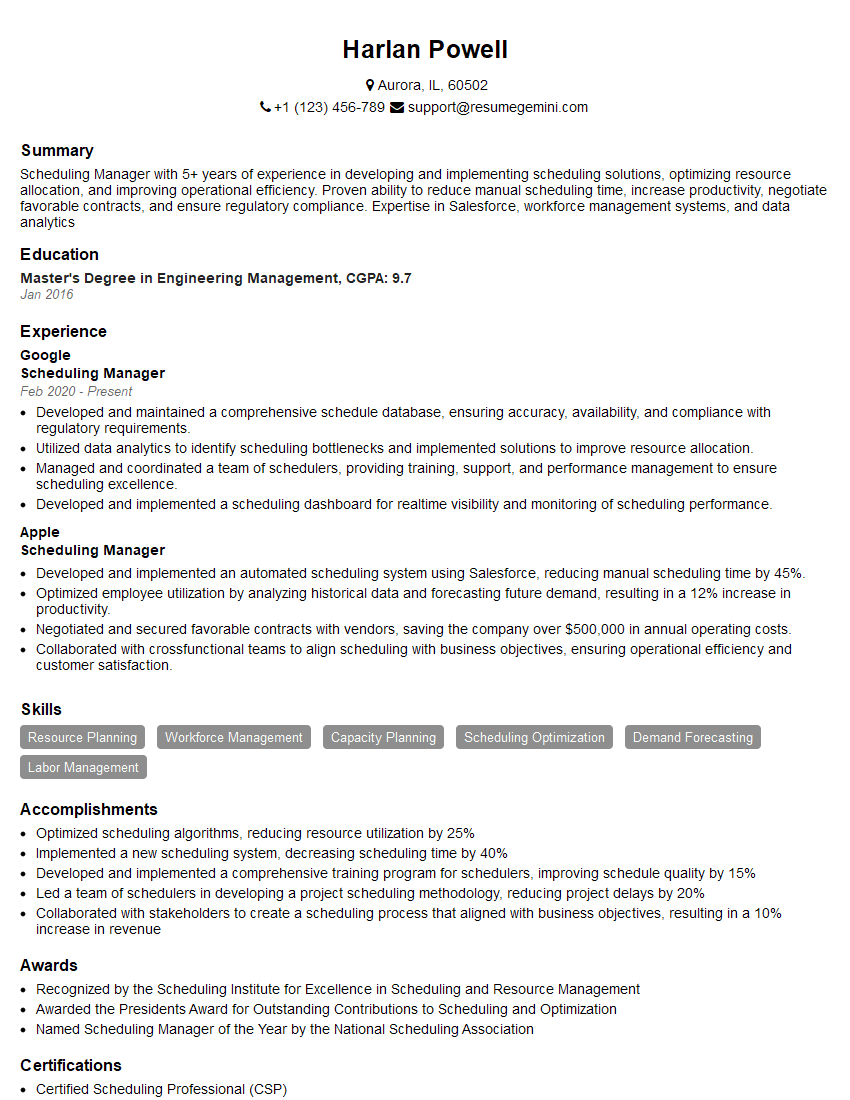
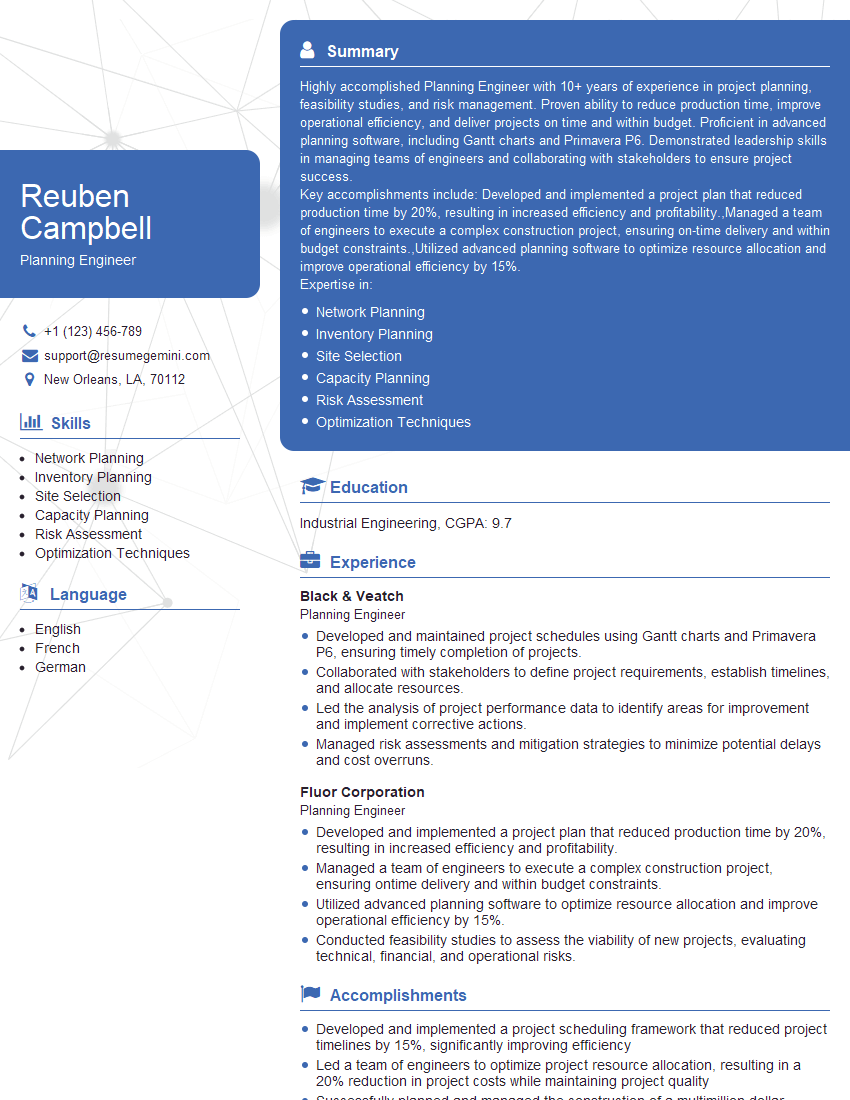
Mastering Construction Planning and Scheduling is crucial for career advancement in the construction industry, opening doors to leadership roles and higher earning potential. An ATS-friendly resume is your key to unlocking these opportunities. To make a powerful first impression, focus on building a resume that highlights your skills and experience effectively. ResumeGemini is a trusted resource that can help you craft a professional, impactful resume tailored to your skills and experience. Examples of resumes specifically designed for Construction Planning and Scheduling professionals are available to guide you.

Explore more articles
Users Rating of Our Blogs
Share Your Experience
We value your feedback! Please rate our content and share your thoughts (optional).
What Readers Say About Our Blog
Very informative content, great job.
good