Interviews are more than just a Q&A session—they’re a chance to prove your worth. This blog dives into essential Digital Rendering and Visualization Tools interview questions and expert tips to help you align your answers with what hiring managers are looking for. Start preparing to shine!
Questions Asked in Digital Rendering and Visualization Tools Interview
Q 1. Explain the difference between ray tracing and rasterization.
Ray tracing and rasterization are two fundamental rendering techniques used to create images from 3D models. They differ significantly in how they simulate light and create the final image.
Rasterization is a technique that works by projecting 3D geometry onto a 2D screen, then filling in the resulting polygons with color. Think of it like painting a wall – you cover the surface with a uniform color. It’s computationally efficient for simple scenes, but struggles with realistic light effects like reflections and refractions. It works by approximating light interactions at the polygon level rather than precisely calculating them for each light ray.
Ray tracing, on the other hand, simulates the path of light rays from the camera through the scene and back. Instead of painting polygons, it traces rays backward from the camera, bouncing them off surfaces and calculating the color based on the materials and light sources encountered along the way. This results in much more photorealistic images because it accurately calculates reflections, refractions, shadows, and other lighting effects. Think of it as meticulously following each light beam – much more accurate, but computationally intensive.
In essence, rasterization is fast but less accurate, while ray tracing is slow but much more realistic. Modern rendering often combines both techniques for optimal results. For instance, a game might use rasterization for faster rendering of the background and ray tracing for detailed reflections on the main character.
Q 2. What are the advantages and disadvantages of using different rendering engines (e.g., V-Ray, Arnold, Cycles)?
V-Ray, Arnold, and Cycles are all powerful rendering engines, each with its own strengths and weaknesses. The best choice depends on the specific project requirements and priorities.
- V-Ray: Known for its speed and versatility. It’s excellent for architectural visualization and product design due to its efficiency and robust features like its powerful global illumination algorithm. However, it can be more expensive than other options.
- Arnold: A very strong contender offering high-quality rendering with physically accurate lighting and materials. It excels in creating photorealistic imagery, particularly for film and VFX. However, it’s usually slower than V-Ray, and has a steeper learning curve.
- Cycles: A path-tracing engine developed by Blender, making it free and open-source. It boasts superior accuracy in simulating light transport and is great for creating highly detailed and realistic images. However, it tends to be computationally intensive, resulting in longer render times, especially for complex scenes.
For example, I might choose V-Ray for a fast turnaround on an architectural render where precise light interactions are less crucial than visual appeal. For a high-end cinematic scene demanding absolute photorealism, Arnold would be a better choice despite the longer render times. Cycles would be a good option for personal projects or when working with a limited budget, provided I have the time to compensate for its slower speeds.
Q 3. Describe your experience with different 3D modeling software (e.g., Maya, 3ds Max, Blender).
My experience encompasses several leading 3D modeling packages. I’m proficient in Maya, 3ds Max, and Blender, each with unique strengths and workflows.
- Maya: My go-to for complex character modeling and animation, particularly for high-end VFX. Its robust toolset and powerful scripting capabilities allow for efficient pipeline creation and customization.
- 3ds Max: Ideal for architectural visualization and game modeling, renowned for its intuitive modeling tools and integration with other Autodesk software. I often use it for creating large, detailed environments.
- Blender: A highly versatile and free alternative, excellent for both beginners and seasoned professionals. Its integrated modeling, sculpting, animation, and rendering capabilities make it an efficient all-in-one solution. I frequently use it for quick prototypes and personal projects.
For instance, I might use Maya for creating a detailed character model for a video game and then export it to 3ds Max to integrate into a larger game environment. Blender is often my choice for quick concept modeling before committing to a more expensive software like Maya or 3ds Max.
Q 4. How do you optimize a 3D scene for rendering speed?
Optimizing a 3D scene for rendering speed involves a multi-pronged approach focused on reducing the computational load on the renderer.
- Geometry Optimization: Reduce polygon count by using lower-resolution models where appropriate. Employ techniques like level of detail (LOD) to switch to simpler models at greater distances. Optimize meshes for efficient rendering (e.g., using quads over triangles).
- Material Optimization: Avoid complex shaders and materials wherever possible. Use simple, procedural materials instead of highly detailed ones where visual fidelity allows. Reduce the number of maps used per material.
- Lighting Optimization: Use fewer light sources. Employ light portals or other techniques to limit light calculations. Consider using light linking or global illumination techniques with optimized settings. Avoid unnecessary shadows by selectively turning them off where it won’t significantly impact the final render.
- Rendering Settings: Adjust render settings to balance quality and speed. Reduce sampling rates, anti-aliasing levels, or ray depth where acceptable. Experiment with different renderers or rendering engines to find one that fits your speed and quality needs.
For example, I might use a proxy model during initial lighting setups, and only replace it with the high-resolution model when the lighting is finalized and the final render is being processed. This drastically reduces render times during iterative refinement.
Q 5. Explain your workflow for creating realistic lighting in a 3D scene.
Creating realistic lighting is a crucial aspect of photorealistic rendering. My workflow involves these key steps:
- Understanding the Scene: I carefully analyze the scene’s purpose and mood to determine the appropriate lighting style. Is it a bright, sunny day, or a dimly lit interior? What feeling are we trying to evoke?
- Light Source Placement: I strategically place key, fill, and rim lights to simulate natural or artificial lighting. I consider the direction, intensity, and color temperature of each light source.
- Material Interaction: Materials interact differently with light, affecting the final image. I ensure that my materials accurately reflect light, ensuring realism in how light interacts with the surface of every object.
- Global Illumination: I typically use global illumination techniques (like path tracing or radiosity) to simulate indirect lighting effects, creating realistic bounces of light and ambient lighting.
- Image-Based Lighting (IBL): I often use HDR images to simulate environment lighting, adding realism and depth to the scene.
- Color Correction and Grading: Post-processing steps like color correction and grading can enhance the realism and mood of the final render.
For example, when creating an architectural visualization, I might use an HDRI image to simulate the sky and surrounding environment, and then add strategically placed lights to illuminate the interior spaces realistically. I also pay attention to how light passes through windows and interacts with the materials within the scene, creating realistic shadows and highlights.
Q 6. How do you handle complex geometry in your rendering pipeline?
Handling complex geometry in rendering requires strategies to balance visual fidelity with render times. I employ a combination of techniques:
- Level of Detail (LOD): I create multiple versions of the geometry with varying levels of detail. Far-away objects use low-poly models, improving speed. Closer objects use higher-resolution models for better detail.
- Instancing: Repeating elements (trees, plants, etc.) are instanced rather than modeled individually. The renderer only needs to process one model, saving significant time and memory.
- Mesh Optimization: I ensure that the polygon counts are as efficient as possible. I use tools to optimize meshes, reducing unnecessary polygons and vertices.
- Proxy Geometry: I replace highly detailed geometry with simpler proxies during lighting and initial composition stages. This speeds up iteration while preserving visual information that’s important to me. Once lighting is finalized, I will swap back to the detailed geometry for the final render.
- Decimation: This technique reduces polygon count while preserving the visual shape of an object. This is particularly effective for very high-poly models where every polygon isn’t necessary for the quality needed.
For example, when rendering a forest scene, I might create several LODs for the trees – distant trees with only a few polygons, close-up trees with more detail. This allows for a visually stunning image without the computational cost of rendering millions of high-poly trees.
Q 7. Describe your experience with texturing and materials.
Texturing and materials are fundamental to creating realistic renders. My experience involves creating and utilizing a wide variety of textures and materials.
- Texture Creation: I’m proficient in creating both procedural and bitmap textures using tools like Substance Designer and Photoshop. I understand the importance of creating high-resolution textures with clear details and optimized file formats.
- Material Assignment: I carefully assign materials to objects, paying attention to their physical properties (reflectivity, roughness, etc.). I use different shader types to achieve varied material appearance.
- Workflow Integration: I integrate textures and materials efficiently into my rendering workflow, using tools to manage and organize my assets.
- PBR Workflow: I utilize Physically Based Rendering (PBR) workflows, creating materials that behave realistically based on the principles of physics.
For example, when creating a realistic car model, I might create a PBR material using diffuse, specular, roughness, and normal maps, ensuring that the material reflects light realistically according to its physical properties. This would include creating a high-resolution texture for the car’s paint, considering its reflectivity and imperfections.
Q 8. How do you manage large datasets in a visualization project?
Managing large datasets in visualization is crucial for performance and efficiency. Think of it like trying to paint a massive mural – you wouldn’t try to paint every brushstroke at once! My approach involves a multi-pronged strategy:
Data Reduction Techniques: Before importing, I employ methods like decimation (reducing polygon count) or level of detail (LOD) systems. These techniques simplify geometry without significantly impacting visual fidelity, particularly for distant objects. For example, I might use a high-poly model for a close-up shot of a car, but switch to a low-poly version when showing the car from far away in a city scene.
Optimized File Formats: I utilize efficient file formats like FBX or glTF, which are designed for 3D data, offering better compression and faster loading times compared to formats like OBJ. Think of it like using a zip file versus transferring individual files – much more efficient.
Streaming and Level of Detail (LOD): For exceptionally large scenes, streaming data is essential. This means only loading the parts of the scene currently visible to the viewer. LOD further enhances this by loading simplified models of distant objects, only rendering high-detail models when they’re close.
Out-of-Core Rendering: In cases where RAM is insufficient, out-of-core rendering techniques move parts of the scene between RAM and hard drive, ensuring that the rendering process continues without interruption, even with massive scenes.
Data Management Software: I often use dedicated software like Houdini or Blender’s asset management features to organize and manage assets efficiently, preventing clutter and facilitating easy access to specific parts of the dataset.
Q 9. What are your preferred methods for creating realistic shadows and reflections?
Realistic shadows and reflections are paramount to creating believable 3D imagery. My preferred methods leverage the power of modern rendering engines:
Ray Tracing: This technique simulates the path of light rays, offering incredibly realistic shadows and reflections. It’s computationally intensive, but produces superior results. Think of it like tracing every light ray in a room to determine where shadows fall. I often use this for final renders where quality is paramount.
Path Tracing: A more sophisticated form of ray tracing that simulates the bouncing of light rays, resulting in even more accurate and visually pleasing global illumination effects.
Screen Space Reflections (SSR): For real-time rendering, SSR is often used as a compromise between quality and performance. It utilizes the screen’s contents to create reflections, which are less accurate than ray tracing but faster to compute.
Environment Maps: I use high-resolution environment maps (HDRI) to capture realistic reflections and lighting conditions. This acts like a virtual photograph of a surrounding environment that is applied to objects, creating authentic reflections.
The choice of method depends largely on the project’s requirements. For real-time applications like games, SSR or similar techniques are preferred. For high-fidelity stills or animations, ray tracing or path tracing is often the way to go.
Q 10. Explain your experience with different types of cameras and lenses in a 3D environment.
Understanding cameras and lenses is fundamental to visual storytelling. In 3D environments, I utilize various camera types and lens parameters to achieve specific artistic and technical goals.
Camera Types: I use perspective cameras for realistic viewpoints (mimicking a human eye), orthographic cameras for architectural visualizations (creating parallel projections without perspective distortion), and even fisheye cameras for dramatic wide-angle shots.
Focal Lengths: I leverage the power of focal length to control the field of view and depth of field. A short focal length (wide-angle lens) creates a broader field of view, while a long focal length (telephoto lens) compresses perspective and creates a shallow depth of field, blurring the background and emphasizing the subject.
Aperture: Adjusting the aperture controls the depth of field; a wider aperture (smaller f-number) produces a shallow depth of field, while a narrower aperture (larger f-number) increases the depth of field.
Camera Movement: I utilize camera animation to guide the viewer’s eye and control pacing within the visualization. This might involve smooth pans, tracking shots following a moving object, or dramatic zooms for emphasis.
For example, I might use a wide-angle lens for a sweeping shot of a landscape, but a telephoto lens to isolate a specific architectural detail. The camera’s position, orientation, and lens choices are essential in composing compelling visuals.
Q 11. How do you address rendering artifacts like aliasing and noise?
Rendering artifacts like aliasing (jagged edges) and noise (graininess) detract from image quality. I employ several techniques to mitigate these issues:
Anti-Aliasing (AA): Various AA techniques are used to smooth jagged edges. Common methods include multi-sampling anti-aliasing (MSAA), which renders the image multiple times at sub-pixel resolutions, and temporal anti-aliasing (TAA), which uses information from previous frames to reduce flickering.
Super Sampling: Rendering at a higher resolution than the target resolution and then downscaling produces a smoother image with reduced aliasing, but it’s computationally expensive.
Denoising: Noise is often reduced through post-processing denoising techniques. These algorithms analyze the image to distinguish between noise and actual detail, effectively cleaning up the image while preserving important visual information. Many renderers have built-in denoisers, or I might use dedicated software like Topaz Denoise AI.
Increasing Sample Counts: In path tracing or ray tracing, increasing the number of samples per pixel reduces noise. This is a brute force approach but yields high quality results.
The choice of technique depends on the renderer, the rendering time budget, and desired quality. For real-time applications, TAA might be preferred for its efficiency, while for high-quality still renders, increased sample counts are often used.
Q 12. Describe your experience with compositing and post-processing techniques.
Compositing and post-processing are crucial for finalizing a visualization. They’re like adding finishing touches to a painting.
Compositing: This involves combining multiple rendered elements or layers into a single image. I use software like Nuke or After Effects for this, layering different passes (such as diffuse, specular, shadows) to create more complex and visually rich scenes. For example, I might composite a 3D model of a building into a real-world photograph of the city.
Post-Processing Effects: These are used to enhance or modify the rendered image. Common effects include color grading (adjusting color balance and saturation), adding depth of field, motion blur, and lens flares to create specific moods or enhance visual impact. Think of it like using filters on a photo to adjust brightness and contrast.
Color Correction: Accurate color correction is vital to achieving a realistic look. I use tools within compositing software to adjust white balance, exposure, and contrast to ensure the visualization is visually appealing and accurate.
Through careful compositing and post-processing, I can polish the final output, correcting imperfections, enhancing realism, and achieving a cohesive artistic vision.
Q 13. What is your experience with VR/AR development and visualization?
My experience in VR/AR visualization focuses on creating immersive and interactive experiences. I’ve worked on projects using:
Unity and Unreal Engine: These game engines provide robust tools for developing VR/AR applications. I’ve leveraged their features to create interactive environments, integrating 3D models, real-time rendering, and user input to create immersive experiences. For example, I’ve built a VR architectural walkthrough, enabling users to explore a building design interactively.
ARKit and ARCore: These frameworks allow me to develop augmented reality applications that overlay digital content onto the real world, which is useful for things like interactive product demonstrations or visualizing furniture placement in a user’s home.
VR/AR headsets and controllers: I’m familiar with various hardware platforms, ensuring compatibility and optimizing performance for different headsets.
Developing for VR/AR requires a deeper understanding of user interaction and optimizing for performance within the limitations of the hardware. It’s about designing compelling experiences that go beyond simple visualization, making the digital world feel tangible and engaging.
Q 14. How do you ensure the accuracy of your visualizations?
Accuracy in visualization is paramount. It’s like building a scale model – the closer it is to the real thing, the better. I ensure accuracy through several methods:
Accurate Source Data: I use precise and reliable source data, such as architectural blueprints, laser scans, or high-resolution photographs. Garbage in, garbage out – the accuracy of the final product depends heavily on the initial data.
Reference Images and Models: Frequent comparisons to real-world reference images and accurate 3D models help maintain realism and identify discrepancies.
Calibration and Validation: When using real-world data, calibration processes ensure accurate positioning and scaling within the virtual environment. Validation checks confirm that the visualization matches the source material.
Material Accuracy: I carefully select and adjust materials to accurately reflect the properties of real-world objects. This includes accurate textures, reflectivity, and roughness values.
Peer Review and Client Feedback: I often utilize peer review to identify potential inaccuracies and incorporate client feedback to ensure alignment with project requirements and expectations.
Accuracy is an iterative process. It involves careful planning, meticulous execution, and consistent verification throughout the entire workflow.
Q 15. Explain your experience with different file formats and their compatibility.
Understanding file formats is crucial in digital rendering and visualization. Different formats cater to different needs in terms of storage size, compatibility, and data preservation. For instance, .obj files are commonly used for 3D model geometry, offering a lightweight, easily transferable format compatible with most 3D software. However, they lack texture and material information. .fbx files, on the other hand, are more comprehensive, storing geometry, textures, animations, and materials. They are widely compatible but can be significantly larger. .dae (Collada) is another versatile option, often used for interoperability between different applications. Then you have image formats like .jpg (lossy compression, ideal for web and general use), .png (lossless compression, suitable for images with sharp lines and text), and .tiff (lossless, high-quality, often used for print). My experience includes extensive work with all these, as well as more specialized formats like .blend (Blender), .max (3ds Max), and .ma (Maya). Knowing which format to use and how to handle potential compatibility issues, such as converting between formats with minimal data loss, is essential for a smooth workflow.
For example, if I’m receiving a 3D model from a client who uses SketchUp, I might receive it as a .skp file. While many programs can import this directly, the best approach often involves exporting it as a more universal format like .fbx or .obj to ensure compatibility with my preferred rendering pipeline (e.g., using Blender for modeling and Octane Render for rendering).
Career Expert Tips:
- Ace those interviews! Prepare effectively by reviewing the Top 50 Most Common Interview Questions on ResumeGemini.
- Navigate your job search with confidence! Explore a wide range of Career Tips on ResumeGemini. Learn about common challenges and recommendations to overcome them.
- Craft the perfect resume! Master the Art of Resume Writing with ResumeGemini’s guide. Showcase your unique qualifications and achievements effectively.
- Don’t miss out on holiday savings! Build your dream resume with ResumeGemini’s ATS optimized templates.
Q 16. Describe a challenging rendering project and how you overcame the obstacles.
One challenging project involved creating photorealistic renders of a highly detailed, intricately designed museum exhibit. The challenge lay in the sheer volume of geometric data: thousands of individual objects, each with complex textures and intricate details. This caused significant rendering times, even on high-end hardware. The initial render times were excessively long, making iterative design changes impractical. To overcome this, we implemented several strategies. First, we optimized the 3D models, reducing the polygon count where possible without compromising visual fidelity through techniques like decimation and level of detail (LOD) systems. We also utilized proxy geometry for distant objects, replacing detailed models with simpler representations to speed up rendering. Finally, we leveraged a render farm to distribute the workload across multiple machines, significantly decreasing the overall render time. By carefully analyzing the scene complexity and applying optimized rendering techniques and resource management, we were able to deliver high-quality renders within the project timeline.
Q 17. How do you collaborate with other team members in a visualization project?
Collaboration is key in visualization. I typically use a combination of tools and methods to ensure seamless teamwork. We utilize cloud-based project management software like Asana or Monday.com to track tasks, deadlines, and resource allocation. This allows for transparent communication and accountability. For file sharing, I prefer cloud storage platforms like Dropbox or Google Drive, offering version control and easy access for all team members. For real-time feedback and review, I often use online tools that allow for annotation and comments on rendered images and animations, fostering constructive criticism. Direct communication, through regular meetings and discussions, remains essential to ensure everyone is aligned with the project’s vision and goals. It’s crucial to establish clear communication channels and protocols early on to avoid confusion and ensure a smooth workflow.
Q 18. What are your preferred methods for presenting your work?
My preferred methods for presenting work depend on the audience and project scope. For client presentations, I usually create a visually compelling slideshow using tools like PowerPoint or Keynote, showcasing key renders, animations, and project milestones. This includes high-resolution stills and short video clips. For more technical audiences or internal reviews, I might use a screen recording demonstrating the software workflow or present directly from my 3D software to showcase the design process. In all cases, I focus on presenting clear and concise information, highlighting the project’s key features, and demonstrating how my work addresses the client’s or team’s needs. A clear, organized presentation ensures the impact of the work is fully appreciated.
Q 19. What are your strategies for managing deadlines and budgets in visualization projects?
Managing deadlines and budgets requires careful planning and proactive monitoring. I start by thoroughly analyzing the project’s scope, creating a detailed breakdown of tasks, time estimates, and resource requirements. This leads to a realistic timeline and budget. I employ project management software to track progress, identify potential delays, and make necessary adjustments. Regular communication with the client and team keeps everyone informed of potential issues and allows for proactive problem-solving. I also focus on optimizing the workflow, utilizing efficient rendering techniques, and avoiding unnecessary revisions. The key is consistent monitoring and communication; this allows for effective resource allocation and ensures the project stays within budget and on schedule.
Q 20. How do you stay updated on the latest trends and technologies in digital rendering and visualization?
Staying updated in this rapidly evolving field requires a multi-pronged approach. I regularly attend industry conferences and webinars, learning about the latest software updates and rendering techniques. I follow industry blogs, online forums, and publications dedicated to digital rendering and visualization. Experimentation is crucial; I regularly explore new software, plugins, and rendering techniques to assess their potential benefits. Online courses and tutorials allow me to deepen my understanding of specific software or techniques. Continuous learning is essential for maintaining a competitive edge and adapting to emerging technologies and trends within the industry.
Q 21. Explain your understanding of color management and color spaces.
Color management is critical for ensuring consistency and accuracy in rendering. Different devices and software interpret colors differently. Color spaces, such as sRGB (common for web and monitors) and Adobe RGB (wider gamut, used for printing), define the range of colors a device can reproduce. Understanding color spaces helps me choose the appropriate one for the intended output. Color profiles embed color transformation information, ensuring that colors are displayed or printed accurately. I use color management tools within my software to ensure that the colors I see on my monitor accurately represent the final rendered image or animation, whether it’s for a web presentation, print publication, or film. Ignoring color management can lead to significant discrepancies between the intended and final colors, impacting the overall quality and accuracy of the visualization.
Q 22. Describe your experience with creating photorealistic materials.
Creating photorealistic materials involves a deep understanding of how light interacts with surfaces. It’s not just about picking a color; it’s about replicating the subtle nuances of reflection, refraction, roughness, and subsurface scattering. I approach this by leveraging the material properties offered in rendering software like Arnold, V-Ray, or OctaneRender.
For example, to create a realistic wood material, I wouldn’t just use a simple wood texture. Instead, I’d use a combination of procedural noise to create the wood grain, a bump map to add surface detail, and potentially a displacement map for even more realism. I’d carefully adjust parameters like roughness to control the reflection and diffuse components of the light interaction, potentially incorporating subsurface scattering to get that translucent quality of wood. For metals, I’d utilize a metallic/specular workflow, carefully adjusting the fresnel reflections and possibly layering imperfections and scratches. I’ve worked on projects ranging from furniture design to architectural visualization, where the accuracy of material representation was critical to the overall success of the project. I frequently utilize reference images and physical samples for accurate material matching.
Q 23. How do you troubleshoot common rendering issues?
Troubleshooting rendering issues is a crucial part of the process. It often involves a systematic approach. My first step is to identify the nature of the problem: is it a visual artifact (e.g., flickering, banding, noise), a performance issue (e.g., slow rendering times), or an error message?
- Visual Artifacts: These can often be traced to settings within the renderer, such as insufficient sampling (increasing ray bounces or samples usually helps), incorrect material settings (double-checking the roughness, reflectivity, and other material properties), or problems with geometry (checking for overlapping faces or non-manifold geometry).
- Performance Issues: Slow rendering times can stem from overly complex geometry, high-resolution textures, or inefficient lighting setups. Optimizing the scene by simplifying geometry, using lower-resolution textures where appropriate, and employing techniques like light linking or instancing significantly improves rendering speed.
- Error Messages: Error messages should be carefully read and investigated. They usually pinpoint the location and nature of the problem, often related to missing textures, incorrect file paths, or memory issues.
I use a combination of trial and error, consulting the software’s documentation, and searching online forums for solutions. I find that understanding the underlying rendering principles allows me to more effectively diagnose and resolve issues.
Q 24. Explain your experience with using plugins and extensions in rendering software.
Plugins and extensions significantly enhance the capabilities of rendering software. I have extensive experience using plugins such as Forest Pack (for creating realistic vegetation), RailClone (for procedural modeling of repetitive elements), and various material libraries. These plugins streamline the workflow, enabling me to create complex scenes quickly and efficiently. For example, I used Forest Pack to populate a large landscape with thousands of trees in an architectural visualization project, saving significant time compared to manually modeling each tree.
Furthermore, I am proficient in using extensions that improve rendering performance, such as those related to denoising and optimization. Understanding the strengths and limitations of different plugins is key to successful project completion and efficient utilization of resources.
Q 25. What is your experience with creating and using shaders?
Shaders are programs that define how light interacts with a surface, giving me immense control over the visual appearance of materials. I’m experienced in writing custom shaders in languages like OSL (Open Shading Language) and using pre-built shaders provided by rendering engines.
For example, I’ve written custom shaders to simulate the iridescent effect on certain materials, creating realistic subsurface scattering in skin, and developing specialized shaders for highly reflective surfaces. The benefit of writing custom shaders is unparalleled control and the possibility to create unique visual effects not available through standard material presets. It allows for optimization and efficient resource usage by directly writing what’s needed into the shader, preventing unnecessary calculations.
//Example OSL code snippet (simplified): float roughness = 0.2; vector N = normalize(N); vector L = normalize(L); float NdotL = dot(N,L); color diffuse = color(1,0,0); //Red color shader myShader( output color Cout = diffuse * NdotL ); Q 26. How do you optimize textures for rendering performance?
Optimizing textures is critical for rendering performance. High-resolution textures significantly increase rendering times and memory consumption. My approach involves a multi-pronged strategy:
- Resolution Reduction: I start by reducing the resolution of textures where appropriate. Often, using a lower-resolution texture for elements far from the camera produces negligible visual difference while drastically improving rendering performance. I utilize image editing software to reduce texture sizes while preserving visual quality.
- Compression: Using appropriate compression techniques (like JPEG, PNG, or OpenEXR) helps reduce file size without significant visual loss. The choice of compression depends on the texture’s nature (e.g., color, normal, displacement).
- Texture Atlasing: Combining multiple smaller textures into a larger atlas reduces the number of texture lookups the renderer needs to perform, significantly speeding up rendering.
- Mipmapping: This technique generates multiple lower-resolution versions of the texture, allowing the renderer to use the appropriate level of detail based on distance, dramatically reducing aliasing and improving performance.
The key is to find the right balance between visual quality and performance. I often use A/B testing to compare different texture settings and choose the optimal approach for each project.
Q 27. Describe your understanding of global illumination techniques.
Global illumination (GI) simulates the way light bounces around a scene, creating realistic lighting effects like indirect illumination, ambient occlusion, and color bleeding. Understanding GI techniques is crucial for photorealistic rendering.
I’m familiar with various GI methods, including:
- Path Tracing: This computationally intensive method simulates light paths realistically, producing high-quality results but requiring significant render times. It’s often preferred for achieving the most accurate GI.
- Photon Mapping: This method pre-calculates light bounces and stores them as photons, then uses this information during rendering to speed up the process while maintaining a reasonable degree of realism. It is quite efficient for diffuse scenes.
- Irradiance Caching: This technique stores pre-computed lighting information in a cache, enabling faster rendering times. It works particularly well for static scenes.
- Lightmaps (Baked Lighting): These are pre-rendered texture maps that contain lighting information for static geometry. This method is efficient but less flexible and can’t handle dynamic lighting changes.
The choice of GI method depends on the scene’s complexity, the desired level of realism, and the available render time. I often combine multiple methods to achieve optimal results. For example, I might use irradiance caching for static elements and path tracing for dynamic elements to achieve a good balance.
Q 28. Explain your experience with creating and using different types of lighting setups (e.g., HDRI, IES).
Lighting is paramount in creating compelling renders. I have extensive experience with various lighting setups, including HDRI (High Dynamic Range Image) and IES (Illuminating Engineering Society) lighting profiles.
HDRI Lighting: HDRIs provide realistic and efficient lighting by capturing real-world environments as high-dynamic-range images. This offers rich and complex lighting with realistic reflections, and shadows. It’s a versatile tool suitable for both interior and exterior scenes. I frequently use HDRIs as primary lighting sources or as environment backdrops. The advantage of HDRI lies in its simplicity and photorealism.
IES Lighting Profiles: IES files contain detailed information about the light distribution of real-world light fixtures. They allow for precise control over the lighting in a scene, providing accurate representations of specific lamps and luminaires. This precision is crucial for architectural visualizations, product design, and other applications where the actual light characteristics are critical. For example, I used IES profiles to accurately model the light distribution of a specific chandelier in an architectural rendering. This guarantees that the resulting image precisely reflects the light source’s real-world behavior.
I often combine both techniques – using an HDRI for overall ambient lighting and supplementing it with IES profiles to highlight specific objects or areas with precise lighting. It allows for a combination of ease of use and accuracy.
Key Topics to Learn for Digital Rendering and Visualization Tools Interview
- Software Proficiency: Deep understanding of industry-standard software like Maya, 3ds Max, Blender, Unreal Engine, or other relevant tools. Focus on demonstrating practical experience with modeling, texturing, lighting, and rendering techniques.
- Rendering Techniques: Mastering various rendering techniques such as ray tracing, path tracing, global illumination, and physically based rendering (PBR). Be prepared to discuss the strengths and weaknesses of each approach and when to apply them.
- Workflow and Pipeline: Understanding the entire visualization pipeline, from initial concept to final render. This includes asset creation, scene setup, rendering optimization, and post-processing. Be ready to discuss efficient workflows and problem-solving strategies.
- Material Creation and Texturing: Showcase your ability to create realistic and visually appealing materials using various texturing techniques, including procedural and image-based methods. Understand the principles of PBR and how to create believable surfaces.
- Lighting and Shading: Demonstrate knowledge of lighting principles, including key lighting, fill light, and backlighting. Explain how different light types and shaders affect the final render. Be prepared to discuss the importance of realistic lighting for creating believable scenes.
- Problem-Solving and Troubleshooting: Be ready to discuss technical challenges you’ve faced during projects and how you overcame them. This demonstrates your ability to think critically and find creative solutions under pressure.
- Real-time Rendering: Familiarity with real-time rendering engines and techniques, including optimization strategies for performance and visual fidelity. This is increasingly important in interactive applications and virtual reality.
Next Steps
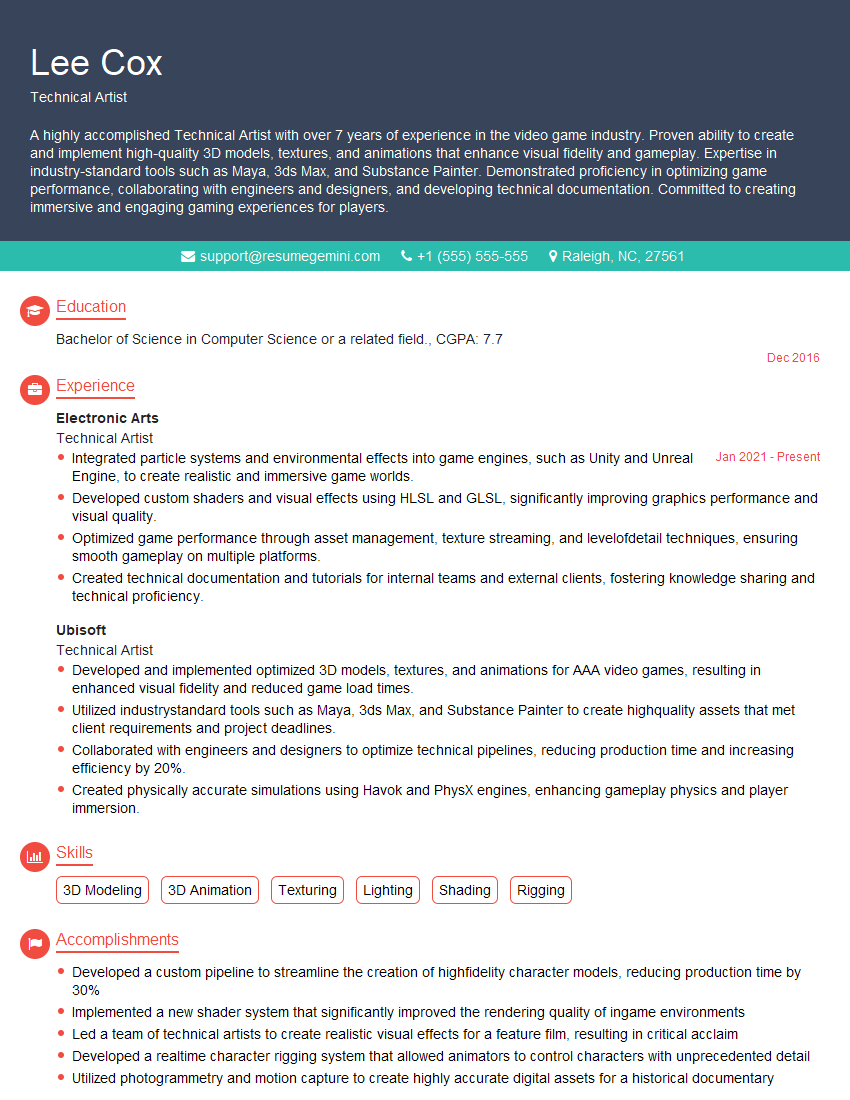
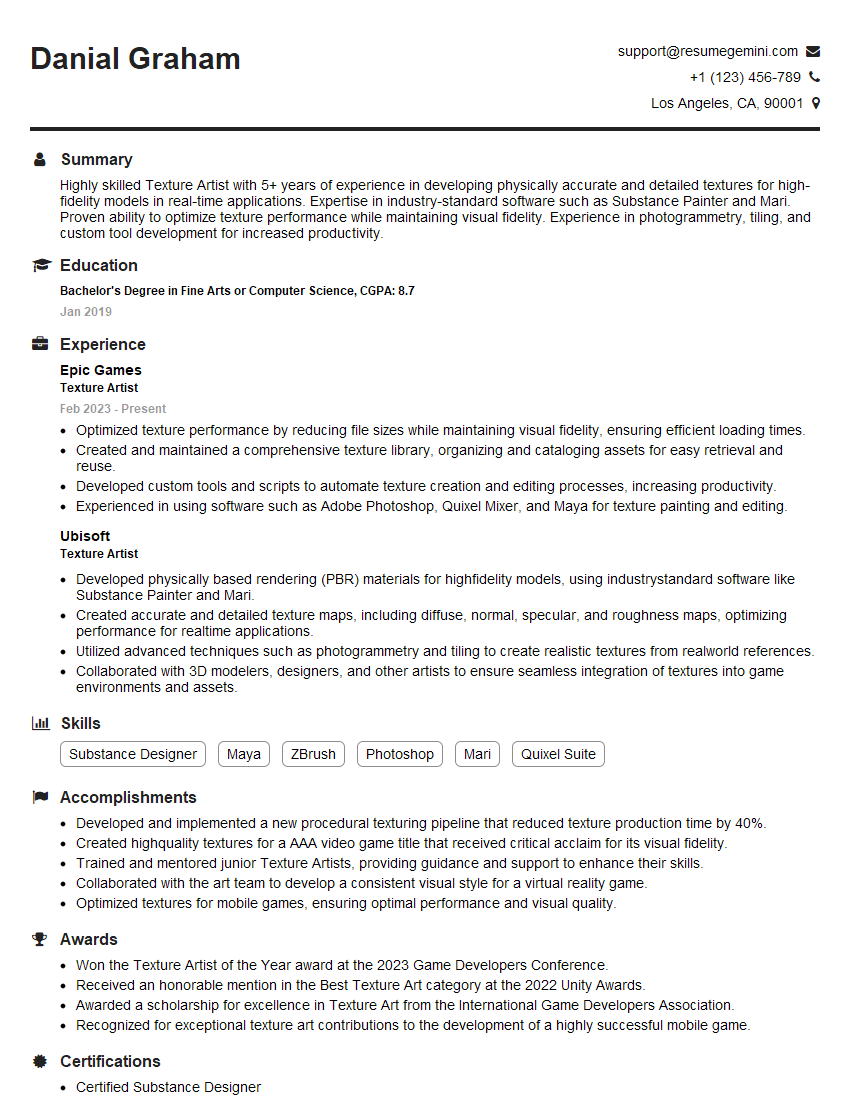
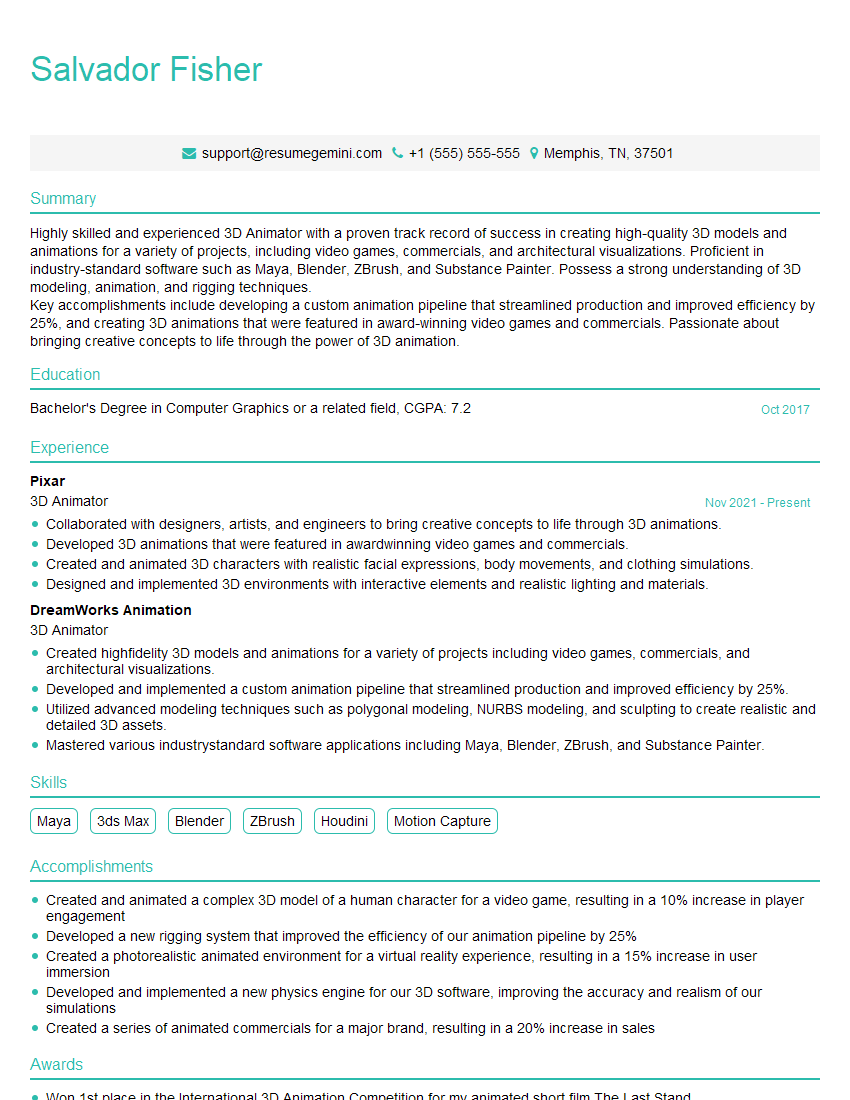
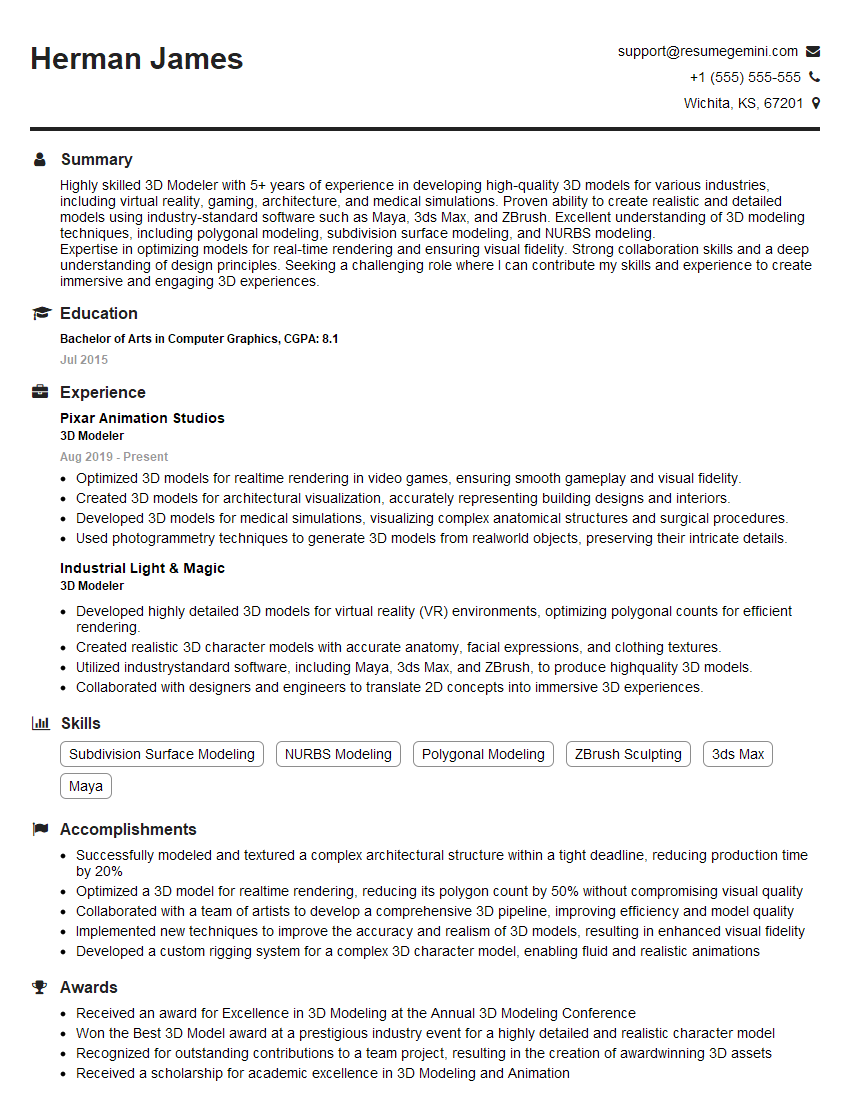
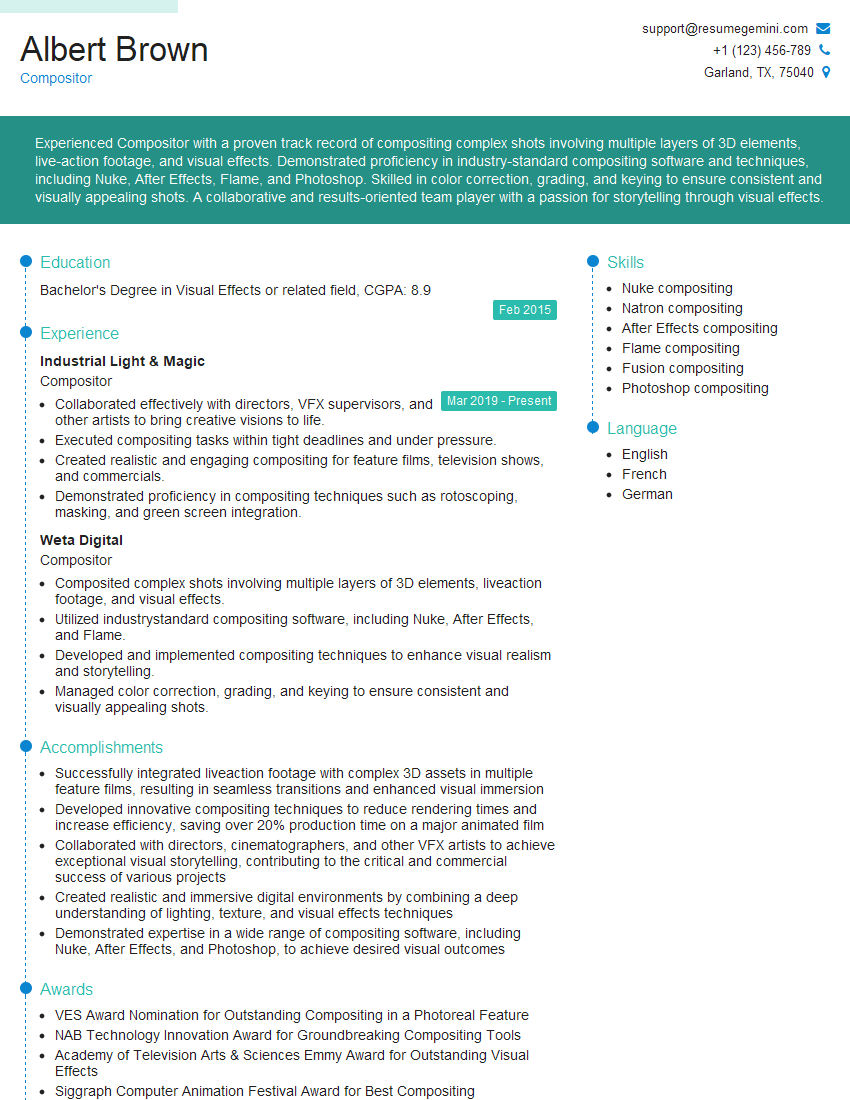
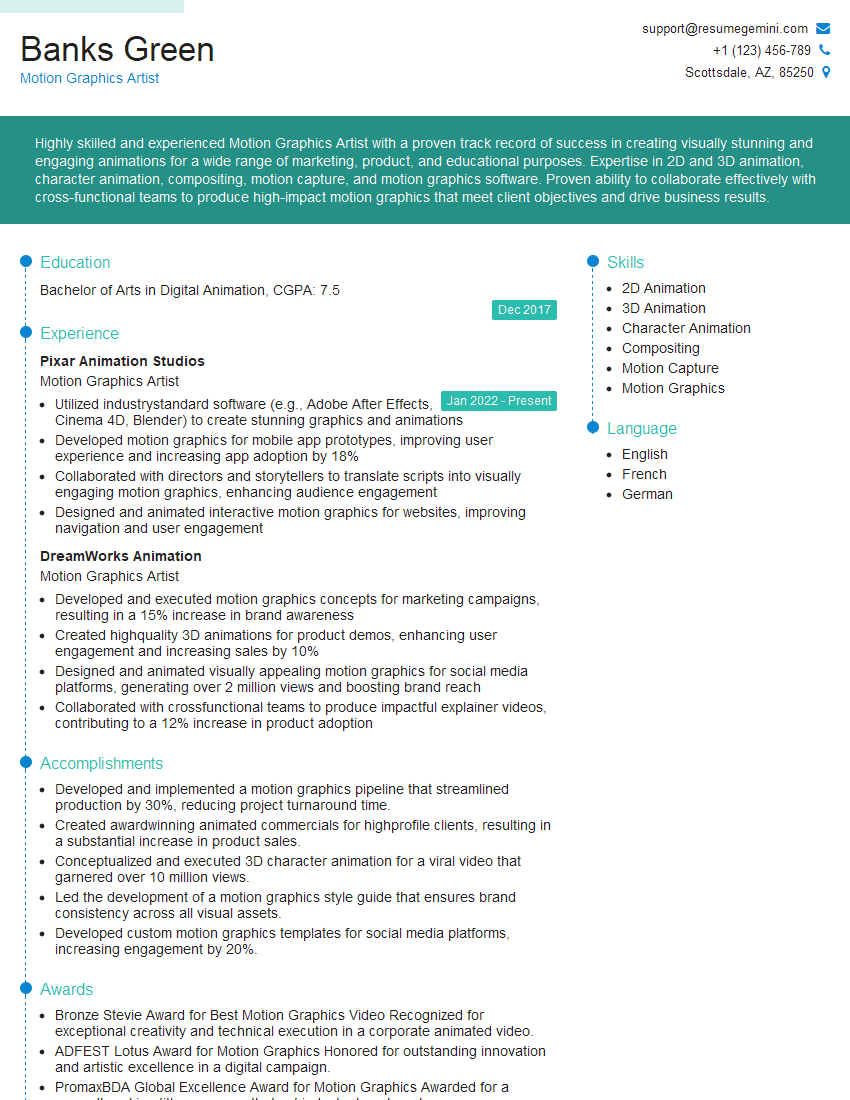
Mastering Digital Rendering and Visualization Tools is crucial for career advancement in this rapidly evolving field. A strong understanding of these tools opens doors to exciting opportunities in architecture, film, gaming, and product design. To significantly increase your chances of landing your dream role, focus on crafting an ATS-friendly resume that showcases your skills and experience effectively. ResumeGemini is a trusted resource to help you build a professional and impactful resume. We provide examples of resumes tailored to the Digital Rendering and Visualization Tools field to guide you. Take advantage of these resources to present your qualifications in the best possible light and accelerate your career journey.
Explore more articles
Users Rating of Our Blogs
Share Your Experience
We value your feedback! Please rate our content and share your thoughts (optional).
What Readers Say About Our Blog
Very informative content, great job.
good