Interviews are more than just a Q&A session—they’re a chance to prove your worth. This blog dives into essential Dress Alterations interview questions and expert tips to help you align your answers with what hiring managers are looking for. Start preparing to shine!
Questions Asked in Dress Alterations Interview
Q 1. What types of fabrics are most challenging to alter and why?
Some fabrics are notoriously difficult to alter due to their texture, drape, or construction. Heavily beaded fabrics, for instance, require meticulous care to avoid damaging the embellishments during alterations. The beads can easily be snagged or pulled off, making even small adjustments a significant challenge. Similarly, very delicate fabrics like silk chiffon or silk charmeuse can easily snag or tear with improper handling, requiring specialized techniques and a very steady hand. Leather and suede are also tricky because they don’t fray in the same way as woven fabrics, requiring specialized tools and knowledge to achieve clean, durable alterations.
Another challenging fabric type is heavily structured fabrics like brocade or stiff taffeta. These can be hard to manipulate and may require additional interfacing or techniques to maintain the garment’s shape and prevent distortion during alterations. Finally, stretch fabrics, while seemingly forgiving, can be difficult because their elasticity can make accurate measurements and adjustments tricky, leading to unexpected results if not carefully handled.
Q 2. Describe your experience with bridal gown alterations.
Bridal gown alterations are a significant part of my expertise. I’ve worked on hundreds of gowns, ranging from simple A-line dresses to elaborate ball gowns with intricate beading and lace. My experience includes adjusting the bodice for a better fit, taking in or letting out the seams, altering the length of the train or skirt, and even creating custom alterations to match the bride’s specific requests. I’m adept at handling various fabrics, from delicate lace and silk to heavier satins and brocades. I understand the emotional significance of a wedding dress and approach each alteration with utmost care and precision, always prioritizing the bride’s vision and ensuring a perfect fit for her special day. One particularly memorable alteration involved a gown with incredibly intricate beading that required hours of careful hand-sewing to adjust the bodice without damaging any embellishments.
Q 3. How do you handle difficult clients or alterations requests?
Handling difficult clients or alteration requests requires patience, empathy, and excellent communication skills. First, I actively listen to their concerns, validating their feelings even if I don’t fully agree with their request. I then thoroughly explain the technical challenges involved in the alteration, focusing on the potential results and the limitations of the fabric or design. I always present multiple options, offering different approaches to achieve the desired outcome to the best of my ability, always prioritizing the integrity of the garment. For example, if a client insists on a significant alteration that could compromise the structural integrity of the garment, I’ll explain the risks and explore alternative solutions, even suggesting a different garment if necessary. The goal is to create a collaborative environment where the client feels heard and understood, leading to a satisfactory result.
Q 4. What techniques do you use for taking precise body measurements?
Precise body measurements are crucial for successful alterations. I use a flexible measuring tape and follow a standardized procedure to ensure accuracy. I begin with the client standing upright, maintaining good posture, and wearing minimal undergarments. Key measurements include bust circumference, waist circumference, hip circumference, shoulder width, sleeve length, back width, center back neck to waist, and desired garment length. I take multiple measurements at each point, averaging them to minimize discrepancies. For bridal gowns, additional measurements may be required to ensure a perfect fit around the bust, waist, and hips. Throughout the measuring process, I frequently check my tape’s alignment and ensure the tape is lying flat against the body, avoiding any pulls or slack. The goal is to obtain measurements that accurately reflect the client’s body shape and inform my alteration plans.
Q 5. Explain your process for altering a garment’s fit.
My process for altering a garment’s fit starts with a thorough assessment of the garment and the client’s body shape. I pin the garment directly onto the client to identify areas needing adjustments, carefully noting where the garment is too tight or too loose. Then, I remove the garment and meticulously mark these areas on the fabric with tailor’s chalk. Depending on the alteration, I may take in or let out seams, adjust darts, or even reshape the garment’s structure. For example, if the waist is too large, I’ll take in the side seams. If the shoulders are too wide, I’ll adjust the shoulder seams. Throughout the process, I regularly check the fit and make fine adjustments until the desired result is achieved. Once the fitting is perfected, I carefully stitch the alterations, ensuring clean and professional seams. A final pressing completes the process, restoring the garment’s shape and enhancing its overall appearance.
Q 6. How do you repair a torn seam on delicate fabric?
Repairing a torn seam on delicate fabric requires extreme care and precision. First, I carefully stabilize the tear by using small pieces of fabric or a stabilizer tape, preventing further damage. I then use a very fine needle and thread that closely matches the fabric’s color and texture. I work from the inside of the garment, meticulously matching the original seam and stitch length. For extremely delicate fabrics, a hand-sewing technique called a ladder stitch is preferred for its invisibility. This stitch involves passing the needle through the fabric edges, creating a near-invisible seam. If the damage is extensive, I may need to use a patch, carefully concealing it beneath the top layer of fabric. A light pressing completes the repair, restoring the garment’s original look and feel.
Q 7. What experience do you have with different types of sewing machines?
My experience encompasses a wide range of sewing machines, from basic domestic machines to industrial-grade equipment. I’m proficient in operating both straight stitch and serger machines. I understand the nuances of different machine types and how their functionalities can be applied to various fabrics and alteration tasks. For instance, a serger is ideal for finishing seams on delicate fabrics preventing fraying. An industrial machine is best for heavier fabrics requiring greater power and consistency of stitching. The selection of the appropriate machine is crucial for achieving both quality and speed of work. My knowledge extends to machine maintenance and troubleshooting, ensuring that the equipment is always operating at peak efficiency.
Q 8. Describe your experience working with different types of closures (zippers, buttons, hooks).
Working with various closures is fundamental to dress alterations. My experience encompasses a wide range, from simple to complex fastenings. Zippers, for instance, require precision – I can replace broken zippers, adjust zipper placement for a better fit, or even invisibly insert zippers into garments. Button alterations include replacing worn buttons, relocating buttonholes, and adjusting button spacing for improved comfort and appearance. Hooks and eyes, often used on finer garments or for closures that need a secure yet delicate finish, require meticulous hand-sewing to ensure durability and an invisible seam. For example, I recently replaced the intricate hook-and-eye closure on a vintage gown, carefully matching the existing thread and stitching technique to maintain the garment’s integrity. Each closure type demands a different approach, dependent on the fabric’s weight and structure.
Q 9. How do you determine the appropriate seam allowance for alterations?
Determining the appropriate seam allowance for alterations is crucial for a successful outcome. It depends on several factors: the fabric type (lightweight fabrics require smaller seam allowances, while heavier fabrics tolerate larger ones), the alteration type (taking in a seam requires less allowance than letting one out), and the garment’s overall design. As a general rule, a 5/8 inch seam allowance is a good starting point for many alterations. However, I always carefully examine the existing seam allowances in the garment. If the original seam allowance is smaller, I will likely match it, to prevent visible discrepancies and maintain the garment’s original balance. If more allowance is needed, I carefully assess the amount of fabric available before proceeding. For example, when shortening pants, I will carefully measure the existing hem allowance to determine how much I can remove before compromising the garment’s structure.
Q 10. How do you manage alterations that require significant pattern adjustments?
Significant pattern adjustments require a thorough understanding of garment construction and pattern drafting. I begin by carefully assessing the area needing adjustment – perhaps the client needs a larger bust, narrower waist or broader shoulders. Then, I’ll use the existing garment as a guide, carefully marking the areas needing alteration. I might use a muslin mock-up to test the changes before working on the actual garment. This involves carefully cutting, pinning, and adjusting the pattern pieces until the desired fit is achieved. For example, to increase the bust size of a dress, I might add a seam allowance to the front bodice panels, smoothly blending it into the existing curves to maintain a seamless look. This process often requires knowledge of different pattern drafting techniques like adding darts, adjusting seam lines, and potentially even creating new pattern pieces.
Q 11. What is your experience with shortening or lengthening sleeves?
Shortening or lengthening sleeves is a common alteration. Shortening is relatively straightforward; it involves carefully measuring the desired length, removing excess fabric, and then re-finishing the hem or cuff. Lengthening requires a bit more creativity. I might let out an existing seam or add a fabric panel, carefully matching the existing pattern and fabric so the alteration is invisible. For example, when lengthening a sleeve, if there’s insufficient fabric in the seam allowance, I might carefully unpick the existing seam and re-stitch it with added fabric to maintain the original style of the sleeve. I always pay close attention to preserving the original sleeve shape and style throughout this process.
Q 12. How do you handle alterations on complex garments (e.g., ballgowns)?
Alterations on complex garments, such as ballgowns, require specialized skills and a meticulous approach. These garments often feature intricate details such as layers of fabric, beading, and delicate embroidery. I start by carefully assessing the garment as a whole, identifying the areas that need adjustment and the potential challenges. I might use a dress form that matches the client’s measurements to accurately mark and make the alterations. Working with multiple layers of fabric requires patience and precision; I often work on one layer at a time to avoid damaging other parts of the dress. I recently altered a ballgown that needed a smaller waist; I carefully took in the seams, paying close attention to the beadwork and delicate lace appliqué. I would never attempt to steam-press the beading directly, preferring to use a light hand-press to prevent damage.
Q 13. What are common alterations requested for pants and how do you approach them?
Common pants alterations include adjustments to length, waist, hip, and leg width. Lengthening pants usually involves adding fabric to the bottom hem, carefully matching the existing fabric and stitching. Shortening is simpler: I would remove excess fabric at the bottom hem or shorten the legs by adjusting the inseam. Waist alterations might involve taking in or letting out the side seams or adding a waistband. Hip alterations often require adjustments to the side seams. Leg width adjustments could involve taking in or letting out the leg seams, sometimes requiring reshaping to maintain the overall balance of the pants. I always strive to maintain the original style of the pants throughout the process.
Q 14. What are your methods for dealing with alterations involving beading or embroidery?
Alterations involving beading or embroidery require a delicate touch and specialized knowledge. Before making any adjustments, I assess the beading or embroidery to determine its type, security, and placement. If the alteration necessitates removing the embellishment, I carefully unpick it, taking notes on its pattern and placement. I use specialized tools and techniques to avoid damaging the delicate work, like using a sharp seam ripper and keeping the fabric taut. After the alteration, I meticulously reattach the beading or embroidery, ensuring its placement matches the original design. If the alteration is significant enough, it might be necessary to reproduce sections of the beading or embroidery using matching materials. For example, when altering a dress with delicate lace applique, I would carefully unpick it and then use a fine needle and thread to reapply it once the seams had been adjusted.
Q 15. How do you ensure the structural integrity of a garment after alterations?
Maintaining a garment’s structural integrity after alterations is paramount. It’s like building a house – you need a strong foundation. We achieve this through careful planning and execution. Before making any significant changes, I assess the garment’s existing construction, identifying areas of stress and potential weakness. For instance, if taking in a seam on a structured jacket, I wouldn’t simply stitch it tighter. Instead, I’d consider adding support to the shoulder pads or interfacing to prevent the garment from losing its shape. I always use appropriate stitching techniques, like reinforcing seams with a zigzag stitch or using French seams where needed to prevent unraveling. Ultimately, it’s about understanding how the garment is built and making alterations that strengthen, not weaken, its construction.
For example, when altering a wedding gown, I might use a combination of hand-sewing and machine stitching to create invisible seams and secure delicate beading or lace. This ensures the dress maintains its luxurious look and feel without compromising the overall structure.
Career Expert Tips:
- Ace those interviews! Prepare effectively by reviewing the Top 50 Most Common Interview Questions on ResumeGemini.
- Navigate your job search with confidence! Explore a wide range of Career Tips on ResumeGemini. Learn about common challenges and recommendations to overcome them.
- Craft the perfect resume! Master the Art of Resume Writing with ResumeGemini’s guide. Showcase your unique qualifications and achievements effectively.
- Don’t miss out on holiday savings! Build your dream resume with ResumeGemini’s ATS optimized templates.
Q 16. What tools and equipment are essential for your work, and why?
My toolkit is an extension of my hands! Essential equipment includes a high-quality sewing machine capable of handling various fabrics, from delicate silks to sturdy denim. This machine needs to have adjustable stitch length and width for precision. A good selection of needles is also vital; using the wrong needle can damage fabric. I also need strong shears for clean cuts, seam rippers for careful deconstruction, measuring tapes for accurate measurements, tailor’s chalk or a fabric marker for marking alterations, various types of pins (straight pins, silk pins, etc.), irons and ironing boards for pressing (essential for creating crisp seams and smooth finishes), and a wide array of interfacing to provide support. Finally, good lighting is a must for detailed work.
Each tool plays a crucial role; for example, the shears’ sharpness ensures clean cuts preventing fraying, while the ironing board and iron allow for precise shaping and seam creation. The use of appropriate pins prevents damage to the fabric.
Q 17. How do you determine the pricing for your alteration services?
Pricing alterations is a balance between my expertise, the complexity of the work, and the cost of materials. I carefully assess several factors: the type of garment (a simple hem is far less complex than a full gown reconstruction), the fabric type (delicate fabrics require more time and care), the extent of the alteration (a small adjustment versus a major redesign), and the time it will take to complete the work. I also factor in the cost of materials, like interfacing or zippers. I provide clients with a clear, itemized breakdown of the cost so there are no surprises.
For example, a simple hem on a pair of jeans will be priced differently from completely reconstructing a torn sleeve on a tailored suit. The detailed quote ensures both the client and I are on the same page regarding expectations and costs.
Q 18. Explain your experience with using different types of interfacing.
Interfacing is like the bones of a garment; it provides structure and support. My experience spans various types, each suited to different applications. I use woven interfacing for structured garments like jackets and coats, offering firmness and crisp lines. Fusible interfacing is convenient for quick application, especially for collars and cuffs, but I choose the correct weight to avoid stiffness or puckering. Knit interfacing provides more flexibility for stretchy fabrics like knits and jersey. Choosing the right interfacing is crucial – using too heavy an interfacing can make a garment stiff and uncomfortable, while too lightweight will provide insufficient support. I carefully consider the fabric weight, drape, and the desired finished effect when selecting interfacing.
I recently worked on a client’s silk blouse where the collar needed more structure. I selected a lightweight fusible interfacing to add support without compromising the drape of the delicate silk. The result was a beautifully crisp collar without sacrificing the garment’s overall elegance.
Q 19. What is your experience with hand-sewing techniques?
Hand-sewing is a cornerstone of my skillset. While a sewing machine offers speed and efficiency, many alterations demand the precision and control of hand-sewing. I’m proficient in various hand stitches, including slipstitching for invisible seams (perfect for delicate fabrics), backstitching for strength and durability, and running stitches for gathering or basting. Hand-sewing often proves indispensable when working with delicate fabrics or intricate details where a machine could cause damage. This skill is essential for creating clean, professional-looking alterations that blend seamlessly with the original garment.
For instance, hand-sewing is crucial when attaching delicate lace appliqués to a wedding dress. The control offered by hand-sewing ensures the lace is placed perfectly and secured without causing damage to the fabric.
Q 20. How do you maintain accurate records of client orders and progress?
Maintaining accurate records is critical for efficiency and client satisfaction. I use a combination of digital and physical methods. I keep a detailed order log with client information, garment details, alteration specifications, and pricing. Digital photographs of the garment before and after alterations are included to document progress. The system also tracks the current status and anticipated completion date for each order. For physical record-keeping, I attach a detailed order form to each garment, which travels with it throughout the alteration process. This comprehensive approach prevents errors and ensures smooth communication with clients.
This system helps me track everything from initial consultation to final fitting and delivery, allowing me to maintain clear communication with clients throughout the process.
Q 21. How do you handle rush orders and tight deadlines?
Handling rush orders requires careful prioritization and efficient time management. I assess the urgency of the request and the complexity of the alterations. Open communication with the client is key – discussing realistic timelines and any potential compromises that might be necessary. I prioritize tasks based on urgency and feasibility, focusing on those that can be completed most efficiently within the given timeframe. Sometimes, I might adjust my schedule to accommodate a truly urgent request, but this is always discussed transparently with the client to manage expectations.
For example, if a client needs a dress altered for an event happening within a week, I’ll explain what’s realistically achievable given the complexity of the alterations and available time. If there are necessary compromises, like simplifying a design element to meet the deadline, we’ll discuss them openly.
Q 22. What are some common mistakes in alterations, and how do you prevent them?
Common mistakes in dress alterations often stem from inaccurate measurements, improper fabric handling, and a lack of understanding the garment’s construction. For example, taking measurements too loosely can lead to ill-fitting garments after alterations. Similarly, using the wrong stitch type for a particular fabric can result in damage or a less-than-professional finish.
- Preventing Measurement Errors: I always double-check measurements and use a measuring tape consistently, ensuring the garment is flat and the client is standing correctly. I also take multiple measurements from different angles to confirm accuracy.
- Fabric-Specific Techniques: I carefully assess the fabric type before choosing techniques and thread. Delicate fabrics like silk require a delicate approach with smaller stitches and appropriate needles to prevent damage. For heavier fabrics like denim, a more robust stitch and needle are necessary.
- Understanding Garment Construction: Before starting, I carefully examine the garment’s construction, identifying seams, darts, and interfacings. This helps me plan the alteration process and anticipate potential challenges. For instance, altering a complex structured jacket requires a different approach compared to a simple A-line dress.
Q 23. Describe your experience with fitting garments on clients.
Fitting garments is crucial. I’ve gained extensive experience in this area, learning to read a client’s body language and understand their comfort level. I meticulously pin adjustments, explaining each step and allowing time for client feedback. I never rush the process. It’s a conversation, not a transaction. For instance, I might notice a client slightly hesitant when I’ve pinned the waist; this tells me I need to fine-tune the fitting to ensure maximum comfort.
I’ve learned to adapt my fitting techniques to different body types and styles, ranging from bridal gowns to tailored business suits. For example, fitting a bridal gown requires a different approach, and perhaps more pins and attention to detail, than adjusting a simple blouse. The client’s comfort and satisfaction throughout the fitting are paramount.
Q 24. How do you maintain quality control throughout the alteration process?
Quality control is an ongoing process. It starts with the initial consultation and continues until the final fitting.
- Pre-Alteration Checks: Before beginning any alteration, I thoroughly examine the garment for potential issues like fabric damage or structural weaknesses.
- Systematic Approach: I use a methodical approach, following a detailed checklist for each step. This helps ensure consistency and reduces the chance of error.
- Regular Checks During Alterations: I constantly check the garment’s alignment, fit, and stitch quality as I work. I use a seam ripper sparingly, only for essential corrections to maintain fabric integrity.
- Final Inspection: Before presenting the garment, I conduct a final, rigorous inspection, checking for any loose threads, uneven seams, or other imperfections.
Maintaining a clean and organized workspace also contributes to quality control, minimizing the risk of accidental damage or misplacing garment pieces.
Q 25. What is your understanding of different alteration techniques (e.g., dart manipulation, seam ripping)?
My understanding of alteration techniques is comprehensive. I’m proficient in various methods, each suited to different scenarios.
- Dart Manipulation: Darts are used to shape garments. I can alter dart placement, size, or even remove them completely, depending on the client’s needs. For example, shifting a dart to a different area can drastically change the overall silhouette.
- Seam Ripping: A crucial skill in alteration work. I carefully and accurately rip seams to let out or take in sections, ensuring the fabric isn’t damaged. The correct technique involves using a seam ripper to carefully separate the stitches without damaging the adjacent fabric.
- Let-out and Take-in: These are common techniques used for adjusting seam allowances and garment dimensions.
- Hemming: I’m adept at various hemming methods – from blind hems (ideal for delicate fabrics) to double-fold hems (suitable for heavier fabrics) to ensure a neat and professional finish.
Understanding the principles of garment construction allows me to effectively apply these techniques and choose the most appropriate approach for each garment.
Q 26. How do you communicate effectively with clients regarding their alterations?
Effective communication is fundamental. I begin with a detailed consultation, listening attentively to the client’s needs and expectations.
- Clear Explanations: I explain the alteration process in simple terms, avoiding technical jargon. I demonstrate the potential results through sketches or visual aids whenever possible.
- Open Dialogue: I encourage the client to ask questions and provide feedback at every stage.
- Realistic Expectations: I set realistic expectations, explaining any limitations or potential challenges. For example, if a garment’s fabric is particularly delicate, I’ll inform the client about possible limitations in the alterations.
- Written Confirmation: I provide a written summary confirming the agreed-upon alterations and the timeline, minimizing miscommunication.
I prioritize maintaining a positive and professional rapport with every client, creating a comfortable environment for discussion.
Q 27. What is your approach to troubleshooting fitting problems?
Troubleshooting fitting problems requires patience and a systematic approach.
- Pinning and Assessing: I methodically pin adjustments, assessing the fit from various angles to identify the source of the issue. This might involve trying on the garment multiple times to ensure a proper fit.
- Detailed Examination: I carefully examine the garment to see if there are any inconsistencies in the seams, darts, or other aspects of construction that could be contributing to the fitting problems.
- Incremental Adjustments: I make incremental adjustments rather than drastic changes, avoiding over-correction.
- Seeking Client Feedback: I regularly seek feedback from the client to get their perspective on the changes. This ensures we are working towards a mutually acceptable outcome.
If I encounter a particularly complex problem, I don’t hesitate to seek the advice of a colleague or consult relevant resources to ensure the best solution.
Q 28. Describe your experience with working independently versus in a team environment.
I’m comfortable working both independently and as part of a team.
- Independent Work: I’m highly self-motivated and possess excellent time management skills. I enjoy the autonomy of independently managing my workload and meeting deadlines.
- Teamwork: I thrive in collaborative settings. I can efficiently communicate ideas, share my expertise, and learn from others. This is invaluable for tackling challenging alterations that might require specialized skills.
In both settings, I’m committed to delivering high-quality work that meets or exceeds client expectations. Adaptability and clear communication are key to my success in either situation.
Key Topics to Learn for Dress Alterations Interview
- Fabric Knowledge: Understanding different fabric types (silk, chiffon, lace, etc.), their drape, and how they react to alterations is crucial. This includes recognizing potential challenges specific to each fabric.
- Measurement Techniques: Mastering accurate body measurements and garment measurements is fundamental. Practice taking precise measurements and understanding how to translate them into alteration plans.
- Seam Construction & Manipulation: A deep understanding of various seam types and techniques is essential for successful alterations. This includes knowledge of seam ripping, seam finishing, and adjustments to existing seams.
- Alteration Types: Become proficient in common alterations such as taking in or letting out seams, adjusting hems, altering sleeve lengths, and making adjustments to necklines and shoulders. Be prepared to discuss your experience with different alteration techniques for various garment styles.
- Pattern Adjustment: For more advanced alterations, understanding how to adjust patterns to achieve a perfect fit is a significant advantage. This demonstrates a high level of skill and problem-solving ability.
- Problem-Solving & Troubleshooting: Be ready to discuss how you approach challenges such as fitting issues, fabric damage during alterations, or client requests that require creative solutions. This shows your adaptability and resourcefulness.
- Tools & Equipment: Familiarity with essential tools and equipment used in dress alterations, including sewing machines, pressing tools, and measuring instruments, is necessary. Be prepared to discuss your experience with different types of equipment.
- Client Communication & Consultation: Discuss your approach to client consultations, understanding their needs, managing expectations, and providing professional advice.
Next Steps
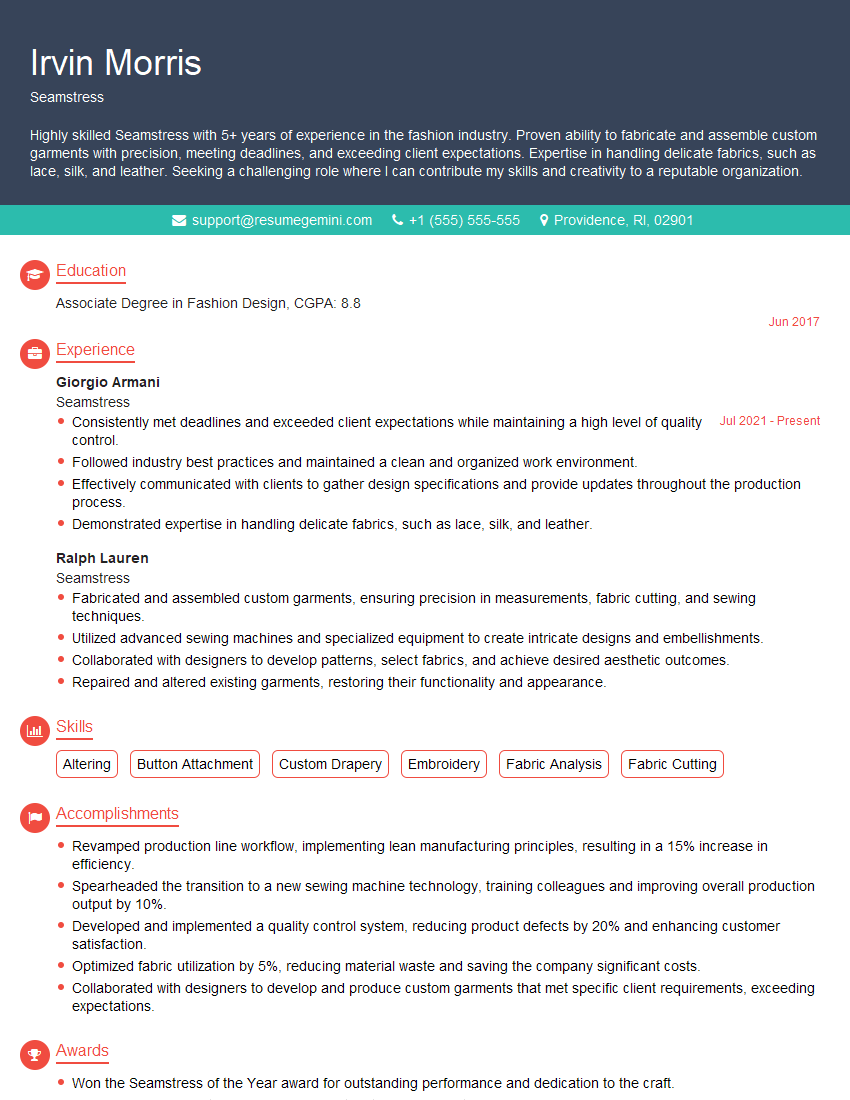
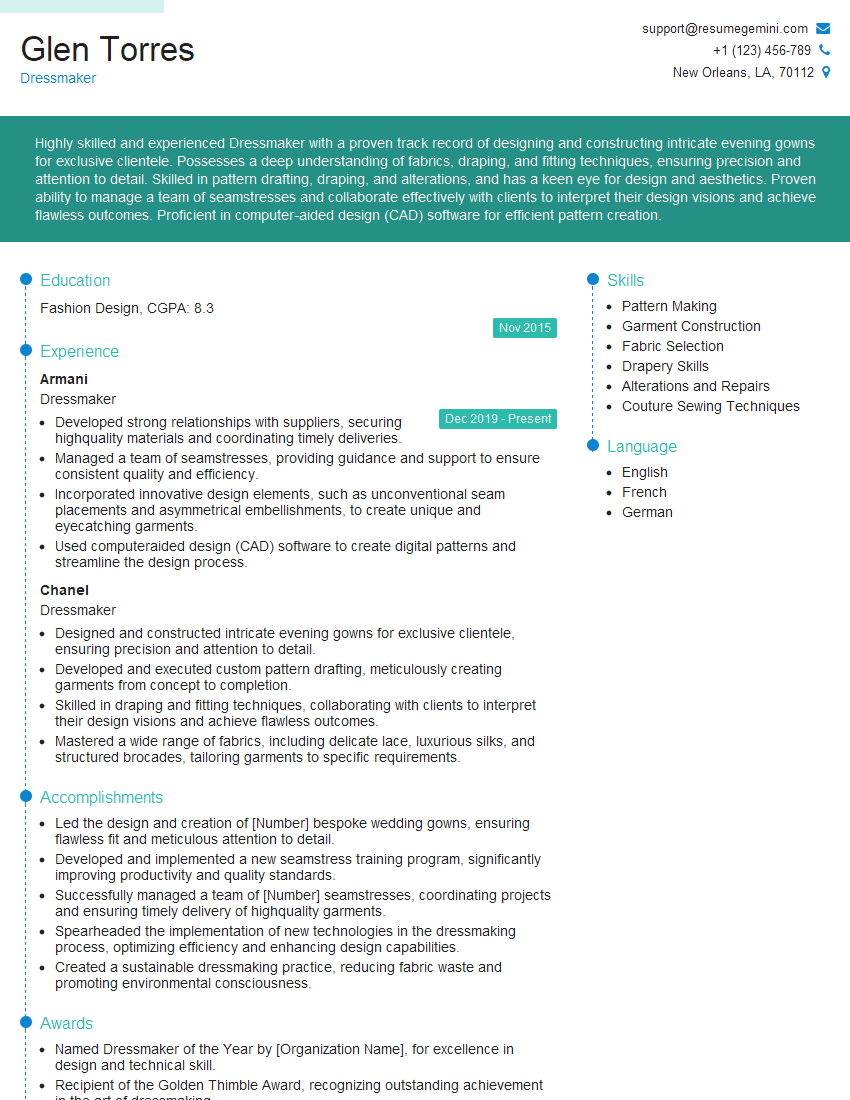
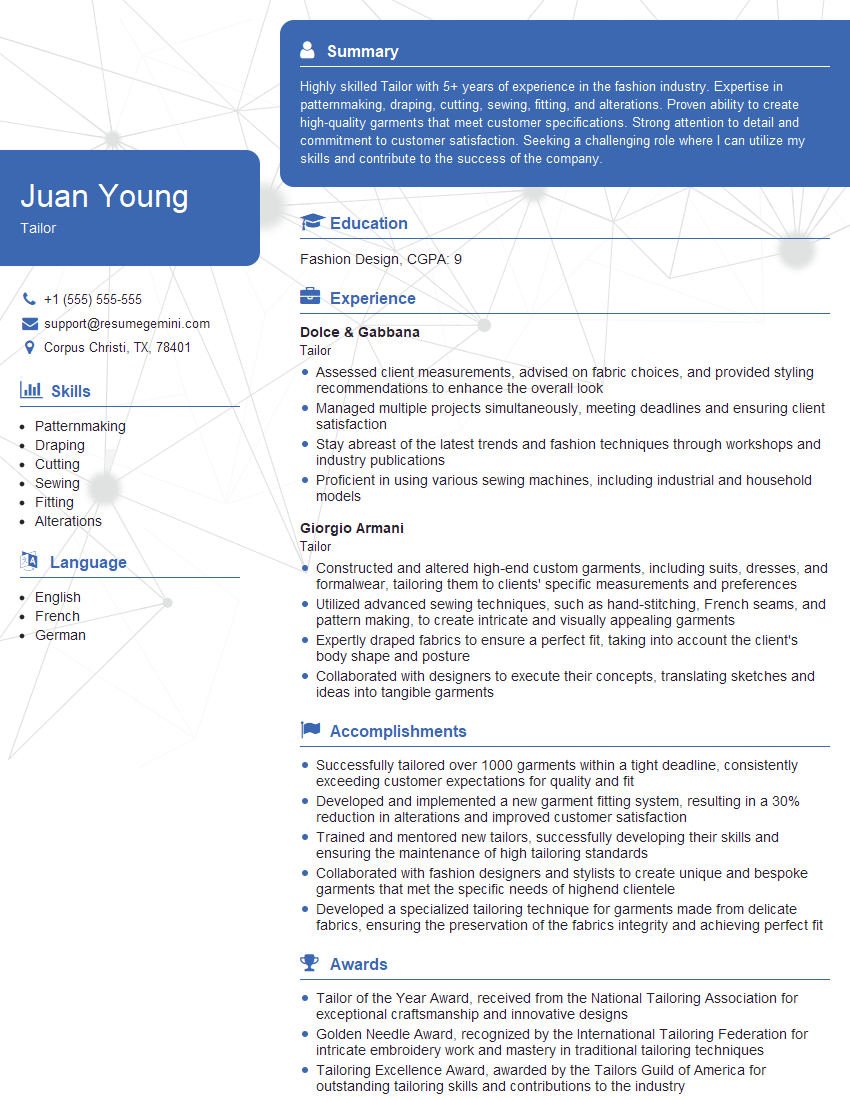
Mastering dress alterations is key to a successful and rewarding career in the fashion industry, offering opportunities for growth and specialization. An ATS-friendly resume is crucial for maximizing your job prospects. To enhance your chances, leverage ResumeGemini, a trusted resource for creating professional and effective resumes. ResumeGemini provides examples of resumes tailored to the Dress Alterations field, giving you a head start in crafting your application materials.
Explore more articles
Users Rating of Our Blogs
Share Your Experience
We value your feedback! Please rate our content and share your thoughts (optional).
What Readers Say About Our Blog
Very informative content, great job.
good