Are you ready to stand out in your next interview? Understanding and preparing for Equipment Selection and Design interview questions is a game-changer. In this blog, we’ve compiled key questions and expert advice to help you showcase your skills with confidence and precision. Let’s get started on your journey to acing the interview.
Questions Asked in Equipment Selection and Design Interview
Q 1. Explain your experience in selecting equipment for a specific industrial process.
Selecting equipment for an industrial process is a critical step that demands a thorough understanding of the process requirements, available technologies, and vendor capabilities. My experience in this area spans various industries, including chemical processing and manufacturing. For instance, in a recent project involving the optimization of a chemical reactor system, I meticulously evaluated different reactor designs – including Continuous Stirred Tank Reactors (CSTRs) and Plug Flow Reactors (PFRs) – considering factors like reaction kinetics, heat transfer needs, and product specifications. This involved extensive data analysis, simulations, and vendor consultations to determine the most suitable reactor type and size for the desired throughput and quality.
The process involved creating a detailed equipment specification document outlining performance requirements, operating parameters (temperature, pressure, flow rates), safety features, and material compatibility. I then compared the technical specifications from multiple vendors, scrutinizing their proposals for aspects like efficiency, reliability, and maintainability. Ultimately, we selected a CSTR configuration from Vendor X due to its superior mixing characteristics and ease of control, leading to improved product yield and reduced operating costs.
Q 2. Describe your process for evaluating the cost-effectiveness of different equipment options.
Evaluating cost-effectiveness goes beyond simply comparing upfront purchase prices. My approach involves a lifecycle cost analysis (LCCA), which incorporates all costs associated with the equipment over its entire lifespan. This includes:
- Capital Costs: Purchase price, installation, and commissioning.
- Operating Costs: Energy consumption, raw material usage, labor, and maintenance.
- Maintenance Costs: Repair parts, preventive maintenance, and potential downtime.
- Disposal Costs: Decommissioning and disposal at the end of the equipment’s life.
I use specialized software and spreadsheets to model these costs over time, considering factors such as inflation and the equipment’s expected lifespan. For example, while one piece of equipment might have a lower initial cost, it could have higher energy consumption and maintenance needs, making it less cost-effective in the long run. The LCCA provides a clear, quantitative comparison, allowing for informed decision-making.
Q 3. How do you ensure equipment selection aligns with safety regulations and industry standards?
Safety is paramount in equipment selection. My process involves a rigorous review of safety regulations and industry standards applicable to the specific process and equipment. This typically includes adherence to standards such as OSHA (Occupational Safety and Health Administration), NFPA (National Fire Protection Association), and relevant industry-specific codes.
For instance, when selecting pumps for a flammable liquid handling system, I ensure they meet the requirements for explosion-proof motors and have appropriate seals to prevent leaks. I also verify that the equipment has the necessary safety interlocks and emergency shutdown systems. I often collaborate with safety engineers throughout the selection process to ensure compliance and to identify potential hazards early on. Documentation and compliance are critical, so detailed records are kept for each component, showing compliance with all relevant safety standards.
Q 4. What are the key factors you consider when designing equipment for scalability and future needs?
Designing for scalability and future needs is crucial for long-term cost-effectiveness and flexibility. I consider several key factors:
- Modular Design: Equipment is designed with modular components that can be easily added or replaced to increase capacity or adapt to changing process requirements. This approach minimizes disruption during upgrades or expansions.
- Capacity Planning: Careful assessment of future production demands is conducted to select equipment with sufficient initial capacity, allowing for some headroom for future growth.
- Technology Foresight: Considering emerging technologies that may improve efficiency or reduce costs in the future. This involves staying up-to-date with industry trends and advancements.
- Standardization: Using standardized components and interfaces wherever possible simplifies maintenance, upgrades, and future expansion.
For example, in designing a new packaging line, we might use a modular conveyor system that can be easily extended or reconfigured to accommodate different product sizes or packaging formats in the future. This modularity significantly reduces the cost and disruption associated with future upgrades.
Q 5. Explain your familiarity with different types of equipment failure analysis techniques.
I am familiar with various equipment failure analysis techniques, including:
- Failure Mode and Effects Analysis (FMEA): A systematic approach to identify potential failure modes and their impact on the system.
- Root Cause Analysis (RCA): Investigating the underlying causes of equipment failures to prevent recurrence.
- Fault Tree Analysis (FTA): A top-down approach to identify combinations of events that can lead to a specific failure.
- Reliability-centered Maintenance (RCM): A systematic approach to develop maintenance strategies based on equipment reliability and risk.
I use these techniques to understand failure mechanisms, predict potential problems, and develop effective maintenance strategies to minimize downtime and enhance equipment lifespan. For instance, using FMEA during the design phase can help identify potential weaknesses and incorporate design changes to enhance reliability before the equipment is even built.
Q 6. How do you balance performance, cost, and maintenance requirements during equipment selection?
Balancing performance, cost, and maintenance is a crucial aspect of equipment selection. It’s often a trade-off, and the optimal balance depends on the specific application and priorities. I use a weighted scoring system that assigns different weights to performance, cost, and maintenance based on the relative importance of each factor.
For example, in a high-volume production environment where downtime is extremely costly, performance and reliability might receive higher weights, even if the equipment has a slightly higher initial cost and maintenance requirements. Conversely, for a low-volume operation, cost might be the dominant factor, and a less expensive option with slightly lower performance and higher maintenance might be preferable. This systematic approach ensures a well-considered decision aligned with overall project goals.
Q 7. Describe your experience with equipment lifecycle management and optimization.
Equipment lifecycle management (ELM) is crucial for maximizing the value and minimizing the cost of equipment throughout its lifespan. My experience in ELM includes developing and implementing strategies for:
- Preventive Maintenance: Establishing regular maintenance schedules to prevent failures and prolong equipment life.
- Predictive Maintenance: Using sensors and data analytics to predict potential failures and schedule maintenance proactively.
- Condition Monitoring: Continuously monitoring equipment performance to detect anomalies and prevent unexpected failures.
- Spare Parts Management: Efficiently managing inventory of spare parts to minimize downtime in case of failures.
- Decommissioning and Disposal: Planning for the safe and environmentally responsible decommissioning and disposal of equipment at the end of its life.
For example, implementing a condition monitoring system on critical pumps in a chemical plant allowed us to detect early signs of wear and tear, enabling timely maintenance and preventing costly unplanned shutdowns. This resulted in significant cost savings and improved plant efficiency.
Q 8. What software or tools do you utilize for equipment design and analysis?
My equipment design and analysis workflow relies on a suite of software tools, each tailored to specific tasks. For CAD (Computer-Aided Design), I primarily use SolidWorks, which allows for detailed 3D modeling, simulations, and the creation of comprehensive technical drawings. For finite element analysis (FEA), crucial for stress and strain calculations, I employ ANSYS, a powerful tool capable of handling complex geometries and material properties. To manage projects and collaborate effectively with teams, I utilize project management software like Asana or Jira. Finally, for simulations involving fluid dynamics, particularly in areas like piping design or heat transfer, I rely on COMSOL Multiphysics. The selection of software depends on the project’s complexity and specific requirements; sometimes I’ll even utilize specialized software for particular analyses such as noise and vibration analysis.
For example, during the design of a new high-pressure hydraulic pump, I used SolidWorks to create the 3D model, ANSYS to simulate stress on the critical components under different operating pressures, and COMSOL to model the fluid flow and optimize the pump’s internal geometry for efficiency and minimal energy loss. This integrated approach helps to ensure that the final design is both robust and performs optimally.
Q 9. How do you handle conflicts or disagreements within a team regarding equipment selection?
Disagreements regarding equipment selection are inevitable in collaborative projects. My approach prioritizes open communication and a data-driven decision-making process. First, I encourage each team member to clearly articulate their rationale, highlighting the advantages and disadvantages of their preferred options, including supporting data such as cost analysis, technical specifications, and performance metrics. Then, we systematically evaluate each option against pre-defined criteria that align with the overall project goals and constraints, such as budget, safety, and environmental impact. This allows for a comparative assessment, making the decision transparent and objective.
In cases where a consensus cannot be immediately reached, I might facilitate a structured brainstorming session, inviting each team member to contribute creative solutions or explore compromise options. Sometimes, involving an external expert or conducting a pilot test of competing technologies can resolve the impasse. The key is maintaining a respectful environment where all viewpoints are valued, and the final decision is based on objective evidence and the best interests of the project.
Q 10. Describe a time when you had to make a critical decision regarding equipment selection under pressure.
During a plant upgrade project, we faced a critical decision regarding the selection of a new control system. The existing system had failed unexpectedly, resulting in significant downtime and production losses. We had to select and implement a replacement within a tight deadline of 72 hours, otherwise, we risked substantial further financial losses. The pressure was immense. We had two viable options: a proven, but more expensive system, and a newer, less expensive system with limited field testing data.
After carefully weighing the risks and benefits of both systems, consulting with vendors, and conducting a rapid risk assessment, we opted for the proven system. While more costly upfront, the associated risks of the newer system – potential incompatibility with existing infrastructure and uncertain reliability – were deemed too significant given the urgency and potential consequences of further downtime. This decision, while stressful, proved correct; the new system was integrated successfully and avoided further disruptions.
Q 11. How do you stay current with advancements in equipment technology and industry best practices?
Staying current in this rapidly evolving field requires a multifaceted approach. I actively participate in industry conferences and workshops, attending presentations and networking with peers to learn about the latest advancements and best practices. I subscribe to several industry journals and publications and regularly read research papers to stay informed about new materials, technologies, and design methodologies. Online platforms such as LinkedIn and professional engineering societies offer access to ongoing industry discussions and updates. Furthermore, I actively seek out training and development opportunities, including online courses and workshops, to enhance my skills and knowledge.
For instance, recently I completed an online course on the design and application of advanced composite materials, expanding my skill set in lightweight and high-strength design techniques. Continuous learning is vital for staying competitive and delivering innovative solutions in this dynamic field.
Q 12. Explain your understanding of different materials selection criteria for equipment design.
Material selection is critical in equipment design, impacting factors such as cost, performance, durability, and environmental impact. The selection process involves considering several key criteria. First, strength and stiffness: the material must be able to withstand the anticipated loads and stresses without yielding or fracturing. Durability and corrosion resistance are crucial for long-term performance, especially in harsh environments. Cost-effectiveness balances material properties with budgetary constraints. Manufacturing considerations include factors such as machinability, weldability, and formability. Finally, the environmental impact, encompassing factors such as toxicity, recyclability, and embodied carbon, must also be evaluated.
For example, selecting materials for a pressure vessel requires a detailed analysis considering material yield strength, fatigue strength, and resistance to corrosion in the operating environment. Stainless steel might be a suitable choice for its corrosion resistance, but a more cost-effective alternative might be carbon steel with a corrosion-resistant coating, depending on the specific application and cost constraints.
Q 13. How do you evaluate the environmental impact of different equipment choices?
Evaluating the environmental impact of equipment choices is crucial for sustainable engineering. This involves a Life Cycle Assessment (LCA), which analyzes the environmental impacts of a product across its entire life cycle, from raw material extraction to disposal. Key factors considered include energy consumption during manufacturing and operation, greenhouse gas emissions, waste generation, water usage, and the toxicity of materials used. Tools like SimaPro or GaBi software can assist in conducting comprehensive LCAs.
For instance, when comparing two pumps, one made from recycled materials and the other from virgin materials, the LCA will reveal the environmental differences in terms of energy consumption, carbon footprint, and waste generation. This information aids in making informed decisions favoring environmentally sound options, even if it involves higher initial costs.
Q 14. Describe your experience with equipment integration into existing systems.
I have extensive experience in integrating new equipment into existing systems. This process requires careful planning and coordination to avoid disruptions and ensure seamless operation. It involves a thorough understanding of both the new equipment’s specifications and the existing system’s architecture. The integration process typically includes detailed design reviews, interface compatibility assessments, and rigorous testing procedures. Effective communication and collaboration with stakeholders, including operations personnel, maintenance teams, and IT specialists, are essential.
In one project, I integrated a new robotic welding system into an existing automotive assembly line. This involved careful coordination with the line’s existing control systems, PLC programming to integrate the robot into the automation sequence, and rigorous testing to verify its compatibility and performance. The successful integration resulted in increased production efficiency and improved product quality.
Q 15. What are your preferred methods for testing and validating equipment functionality?
Testing and validating equipment functionality is crucial to ensure it performs as designed and meets specifications. My approach is multifaceted, employing a combination of methods throughout the design and implementation process. This includes:
Unit Testing: Individual components are tested in isolation to verify their functionality. For example, if designing a robotic arm, each joint’s motor and sensor would be rigorously tested before integration.
Integration Testing: Once components are assembled, integration testing ensures they work together seamlessly. This involves simulating real-world operating conditions, such as testing the robotic arm’s ability to lift a specified weight within a certain timeframe.
System Testing: This involves testing the complete system under simulated real-world conditions to evaluate its overall performance, reliability, and safety. For the robotic arm, this might involve testing it in the actual workspace it’s intended for, handling different materials and speeds.
Acceptance Testing: This final stage involves the client or end-user testing the equipment to confirm it meets their requirements. This is crucial for ensuring the solution addresses the user’s needs.
Simulation and Modeling: Before physical prototyping, I leverage simulations (e.g., Finite Element Analysis –FEA) to predict equipment performance and identify potential problems early on. This reduces costs and time associated with physical prototypes and fixes.
Comprehensive documentation of testing procedures, results, and any deviations is vital for traceability and future maintenance.
Career Expert Tips:
- Ace those interviews! Prepare effectively by reviewing the Top 50 Most Common Interview Questions on ResumeGemini.
- Navigate your job search with confidence! Explore a wide range of Career Tips on ResumeGemini. Learn about common challenges and recommendations to overcome them.
- Craft the perfect resume! Master the Art of Resume Writing with ResumeGemini’s guide. Showcase your unique qualifications and achievements effectively.
- Don’t miss out on holiday savings! Build your dream resume with ResumeGemini’s ATS optimized templates.
Q 16. How do you ensure equipment design meets both functional and aesthetic requirements?
Balancing functional and aesthetic requirements in equipment design requires a holistic approach. Functionality is paramount – the equipment must perform its intended task efficiently and reliably. However, aesthetics significantly impact user experience and overall acceptance. My approach involves:
User-Centered Design: Understanding the end-user’s needs and preferences through interviews, surveys, and observation sessions is crucial. This guides the design toward both intuitive operation and visual appeal.
Industrial Design Principles: Incorporating principles of ergonomics, human-machine interface (HMI) design, and visual appeal ensures the equipment is comfortable, safe, and visually pleasing. Think about the intuitive placement of controls or the use of color coding to enhance safety and readability.
Material Selection: Choosing materials that meet both functional and aesthetic needs is key. For example, a high-strength, lightweight aluminum alloy might be preferred for its structural integrity and sleek appearance.
Iterative Design Process: I employ an iterative design process, incorporating feedback from users and stakeholders at each stage to refine both functionality and aesthetics. Prototyping plays a key role here, allowing for physical evaluation and adjustments.
Ultimately, the goal is to design equipment that not only works flawlessly but is also visually appealing and enhances user satisfaction.
Q 17. Explain your approach to troubleshooting equipment malfunctions or performance issues.
Troubleshooting equipment malfunctions requires a systematic and methodical approach. My strategy involves:
Gather Information: Start by gathering comprehensive information about the malfunction – error messages, operating conditions, and any unusual observations. A detailed log of events is invaluable.
Isolate the Problem: Use diagnostic tools and techniques to isolate the source of the problem. This might involve checking sensors, analyzing data logs, or performing visual inspections.
Develop Hypotheses: Based on the collected information, formulate potential causes for the malfunction. It’s helpful to consider common failure modes for each component.
Test Hypotheses: Systematically test each hypothesis to identify the root cause. This may involve isolating components, running tests under controlled conditions, or substituting suspected faulty parts.
Implement Corrective Actions: Once the root cause is identified, implement corrective actions, which might involve repairs, replacements, or software updates. Ensure the solution is documented thoroughly.
Verify the Solution: After implementing the corrective action, retest the equipment to verify the problem is resolved and prevent recurrence.
Using a combination of diagnostic tools, logic, and experience enables efficient troubleshooting and minimizes downtime.
Q 18. Describe your experience with vendor selection and contract negotiation for equipment procurement.
Vendor selection and contract negotiation are critical aspects of equipment procurement. My approach emphasizes a thorough evaluation process:
Requirement Definition: Clearly define equipment specifications, performance requirements, and budgetary constraints before contacting vendors. A detailed Request for Proposal (RFP) is essential.
Vendor Research and Selection: Identify potential vendors based on reputation, experience, and capacity. Evaluate their technical capabilities, financial stability, and track record.
Proposal Evaluation: Carefully review vendor proposals, comparing technical specifications, pricing, delivery timelines, and warranty terms. A weighted scoring system can be used to objectively assess proposals.
Site Visits and Demonstrations: Conduct site visits and request equipment demonstrations to verify vendor claims and assess their capabilities firsthand.
Contract Negotiation: Negotiate favorable contract terms, addressing pricing, payment schedules, delivery timelines, warranty provisions, and liability issues. Seek legal advice when necessary.
Throughout this process, open communication and collaboration with vendors are crucial for ensuring a successful procurement outcome. This includes establishing clear communication channels and expectations regarding deliverables and timelines. Protecting the interests of the organization while building a collaborative relationship with the vendor is essential.
Q 19. How do you quantify the return on investment (ROI) for proposed equipment solutions?
Quantifying the ROI for equipment solutions is essential for justifying investment decisions. My approach involves a comprehensive analysis considering various factors:
Cost Analysis: Determine the total cost of ownership (TCO), including purchase price, installation costs, maintenance, and operating expenses. This requires detailed cost estimations and projections over the equipment’s lifespan.
Benefit Quantification: Identify and quantify the benefits of the proposed equipment solution. This might include increased productivity, reduced labor costs, improved product quality, reduced energy consumption, or enhanced safety.
ROI Calculation: Use appropriate ROI calculation methods, considering the equipment’s lifespan and the time value of money. Common methods include Net Present Value (NPV) and Internal Rate of Return (IRR).
Sensitivity Analysis: Perform a sensitivity analysis to assess the impact of uncertainties and variations in input parameters (e.g., maintenance costs, production volumes) on the calculated ROI.
Risk Assessment: Identify and assess potential risks and uncertainties associated with the equipment investment, such as technological obsolescence or unexpected maintenance issues.
A robust ROI analysis provides a clear picture of the financial implications of the equipment investment, enabling informed decision-making.
Q 20. Explain your understanding of different manufacturing processes and how they influence equipment selection.
Manufacturing processes significantly influence equipment selection. Understanding these processes is key to choosing equipment that optimizes efficiency and quality. Different processes have unique requirements and constraints:
Batch Processing: This involves processing materials in discrete batches. Equipment like mixers, reactors, and ovens are typically used. Considerations include batch size, processing time, and cleaning cycles.
Continuous Processing: Materials are processed continuously in a flow. This requires equipment such as conveyors, extruders, and pipelines. Focus is on flow rate, throughput, and process control.
Discrete Manufacturing: This involves assembling individual components into a finished product. Equipment includes robots, CNC machines, and assembly lines. Considerations include automation level, cycle time, and precision.
Lean Manufacturing: This philosophy emphasizes waste reduction and efficiency. Equipment selection prioritizes flexibility, modularity, and ease of maintenance.
Equipment selection needs to align with the specific manufacturing process to avoid bottlenecks, maximize output, and ensure product quality. Consider factors like capacity, throughput, automation level, and integration with existing systems.
Q 21. Describe your experience with using CAD software for equipment design.
I have extensive experience using CAD software for equipment design, primarily SolidWorks and AutoCAD. My proficiency extends beyond basic modeling to encompass advanced features like:
3D Modeling: Creating detailed 3D models of equipment components and assemblies, incorporating geometric constraints and tolerances.
Finite Element Analysis (FEA): Using FEA tools integrated within CAD software to simulate stress, strain, and deformation under various load conditions. This is crucial for ensuring structural integrity and optimizing designs.
Simulation and Kinematics: Simulating the movement and interaction of equipment components, vital for mechanisms and robotic systems. This helps verify functionality and identify potential interference issues.
Design for Manufacturing (DFM): Incorporating DFM principles into the design process, considering manufacturability, assembly, and cost. This includes features such as simplifying part geometries and avoiding complex machining operations.
Drawing Generation and Documentation: Generating detailed engineering drawings, including assembly drawings, part drawings, and bill of materials (BOMs).
My CAD skills enable efficient design iteration, rigorous analysis, and the creation of comprehensive design documentation, leading to robust and well-manufactured equipment.
Q 22. How do you address limitations or constraints during the equipment design process?
Addressing limitations and constraints in equipment design is a crucial aspect of successful project delivery. It’s akin to building with LEGOs – you have a limited set of pieces (constraints), but you need to build a specific structure (the equipment). My approach involves a multi-step process:
- Identify and categorize constraints: This involves meticulously listing all limitations, whether they’re budget-related, spatial, material availability, regulatory compliance, or performance-based. I use a structured format like a spreadsheet to categorize them clearly.
- Prioritize constraints: Not all constraints are created equal. Some are deal-breakers (e.g., safety regulations), while others might be negotiable (e.g., aesthetic preferences). Prioritization ensures we focus on the most critical aspects first.
- Brainstorm creative solutions: Once constraints are understood, I engage in brainstorming sessions with the team, exploring potential design modifications, alternative materials, or even re-evaluating project goals to accommodate limitations. We explore “out-of-the-box” solutions, sometimes challenging fundamental assumptions.
- Perform trade-off analysis: Often, compromises are necessary. A trade-off analysis helps us quantitatively compare different design options, weighing the advantages and disadvantages of each in light of the constraints. This might involve comparing cost vs. performance, weight vs. durability, etc.
- Iterative design and refinement: The design process isn’t linear. We iterate, revisiting and refining the design based on the outcomes of the trade-off analysis and any further constraints identified. This iterative approach helps us arrive at an optimal solution within the boundaries.
For example, in designing a high-pressure reactor, a budget constraint might necessitate the use of less expensive (but perhaps less durable) materials. Through a trade-off analysis, we might find that increasing the thickness of the less expensive material offsets its reduced durability, making it a viable option.
Q 23. How do you manage risks associated with equipment failure or malfunction?
Managing risks associated with equipment failure is paramount. My approach is proactive, emphasizing prevention over reaction. It’s like having a robust safety net for a high-wire act. The key strategies include:
- Failure Modes and Effects Analysis (FMEA): This systematic technique identifies potential failure modes, their causes, and their effects on the system. We assign severity, occurrence, and detection ratings to each failure mode to prioritize risk mitigation efforts.
- Redundancy and fail-safes: Designing in redundancy (e.g., backup systems) and fail-safe mechanisms (e.g., pressure relief valves) ensures that a single component failure doesn’t cause catastrophic equipment failure. Think of a plane having multiple engines.
- Robust design principles: Incorporating design principles that minimize sensitivity to variations in operating conditions or component tolerances reduces the likelihood of failure. This often involves simulations and testing to validate robustness.
- Regular maintenance and inspections: A preventative maintenance schedule, coupled with regular inspections, ensures early detection and repair of potential problems before they escalate into major failures. It’s like regular check-ups at the doctor.
- Safety interlocks and alarms: These systems provide immediate warnings or shutdowns in case of unsafe operating conditions, preventing accidents. Think of an oven turning off when the door opens.
For example, in a chemical processing plant, incorporating redundant safety shutdown systems and pressure relief valves is crucial to mitigating the risks associated with a potential pressure buildup in a reactor.
Q 24. Explain your experience with designing equipment for specific operating environments (e.g., high temperature, high pressure).
Designing equipment for extreme environments demands specialized knowledge and materials. I’ve extensively worked on projects involving high-temperature and high-pressure conditions. For instance, I was involved in the design of a high-temperature furnace for a semiconductor manufacturing facility. Key considerations include:
- Material selection: Choosing materials with appropriate high-temperature strength, corrosion resistance, and thermal shock resistance is crucial. This often involves using exotic alloys or ceramic composites.
- Thermal management: Effective cooling or heating systems are essential to maintain operating temperatures within acceptable limits. This might involve designing intricate cooling channels, insulation, or specialized heat exchangers.
- Pressure vessel design: For high-pressure applications, rigorous calculations and simulations are needed to ensure the pressure vessel can withstand the operating pressure without failure. Finite element analysis (FEA) is a common tool used in this process.
- Sealing and joining techniques: Specialized sealing techniques and robust joining methods are necessary to prevent leaks at high temperatures and pressures. This could involve advanced welding techniques or specialized gaskets.
- Safety systems: Robust safety systems, including pressure relief valves, temperature sensors, and emergency shut-down mechanisms, are vital for preventing accidents.
In the semiconductor furnace project, we used a combination of high-temperature alloys, advanced ceramic insulation, and sophisticated cooling systems to ensure the furnace could operate reliably at temperatures exceeding 1000°C.
Q 25. Describe your understanding of different types of manufacturing equipment (e.g., CNC machines, robots).
My understanding of manufacturing equipment encompasses a wide range, from traditional machinery to advanced automation systems. I’m familiar with:
- CNC Machines (Computer Numerical Control): These machines use computer-aided design (CAD) files to precisely machine parts, offering high accuracy and repeatability. I’ve used them extensively for prototyping and manufacturing components with complex geometries.
- Robots (Industrial Robots): These automated systems are capable of performing various tasks, such as material handling, welding, painting, and assembly. I’ve incorporated robots in designs to improve efficiency and productivity, particularly in high-volume manufacturing.
- Injection Molding Machines: Used to create plastic parts by injecting molten plastic into a mold. My experience includes selecting and specifying injection molding machines based on part geometry, material properties, and production volume.
- 3D Printers (Additive Manufacturing): These machines build parts layer by layer from a digital design, enabling rapid prototyping and customized manufacturing. I’ve leveraged 3D printing for rapid prototyping and for manufacturing complex parts that would be difficult or impossible to produce using traditional methods.
- Laser Cutting Machines: These machines use lasers to cut and engrave various materials, offering precision and speed. Their application ranges from prototyping to high-volume production.
The choice of manufacturing equipment depends heavily on factors such as part complexity, production volume, material properties, and budget constraints. I’m skilled at selecting the most efficient and cost-effective manufacturing methods for a given project.
Q 26. How do you collaborate with other engineering disciplines (e.g., electrical, software) during equipment design?
Collaboration is the cornerstone of successful equipment design. It’s not a solo effort. My experience working with electrical, software, and other engineering disciplines is extensive. Effective collaboration involves:
- Clear communication: Using clear and concise language, coupled with visual aids like schematics and diagrams, is essential. Regular meetings and progress reports help keep everyone on the same page.
- Interface definition: Carefully defining the interfaces between different subsystems (e.g., mechanical, electrical, software) prevents conflicts and ensures seamless integration. This is often documented using interface control documents.
- Shared design tools and platforms: Utilizing collaborative design tools and platforms (e.g., cloud-based CAD software) allows multiple engineers to work simultaneously on the same design, promoting efficiency and reducing errors.
- Early integration and testing: Integrating different subsystems early in the design process helps identify and resolve conflicts before they become major issues. This might involve simulating the interaction of different components.
- Respect for other disciplines: Understanding the limitations and expertise of different disciplines is critical for effective collaboration. It is vital to listen to and value the input of other engineers.
For instance, during the design of an automated assembly line, I worked closely with electrical engineers to integrate sensors and actuators, and with software engineers to develop the control system. Regular meetings and careful interface definition ensured a smooth integration of all components.
Q 27. Explain your approach to documentation and record-keeping for equipment design and selection projects.
Meticulous documentation and record-keeping are essential for managing equipment design and selection projects. My approach involves:
- Version control for design files: Using a version control system (e.g., Git) allows us to track changes to design files, collaborate effectively, and revert to previous versions if necessary. This ensures we can always retrieve prior versions of documents.
- Centralized document repository: Storing all project documents in a centralized location (e.g., a shared network drive or cloud storage) ensures easy access and prevents loss or misplacement of crucial information.
- Detailed design specifications: Producing comprehensive design specifications ensures that all aspects of the equipment are clearly defined, minimizing misunderstandings and errors during manufacturing and assembly.
- Test results and reports: Thoroughly documenting test results and preparing detailed reports provides evidence that the equipment meets the required specifications and safety standards. This is a crucial element for regulatory compliance.
- Manufacturing drawings and BOM (Bill of Materials): Creating accurate manufacturing drawings and a detailed BOM ensures that the equipment is manufactured correctly and efficiently. These are critical for the manufacturing process.
This systematic approach ensures that the design process is transparent, auditable, and easily understood by others. This also significantly simplifies maintenance and future modifications of the equipment.
Q 28. How do you ensure the equipment you select or design meets the required capacity and throughput?
Ensuring selected or designed equipment meets required capacity and throughput is achieved through a combination of careful planning and rigorous verification. The process involves:
- Defining clear requirements: Begin by establishing precise requirements for capacity and throughput, including operating conditions, production rate, and material handling aspects. This might involve analyzing production needs and market demands.
- Process simulations and modeling: Use computer simulations and models to predict the performance of the equipment under various operating conditions. This allows for optimization and identification of potential bottlenecks early in the design process.
- Sizing calculations and selections: Perform detailed sizing calculations to determine the appropriate dimensions and specifications for critical components based on the required capacity and throughput. This might involve using standard engineering formulas or specialized software tools.
- Prototype testing and validation: Construct and test prototypes to validate the predicted performance. This could involve conducting experiments to measure capacity and throughput under realistic operating conditions.
- Margin for error: Incorporate a safety margin to account for unexpected variations in operating conditions or material properties. This helps prevent equipment from being overloaded and reduces risk.
For example, when designing a conveyor system for a manufacturing plant, we would use simulation software to model the flow of materials and determine the optimal speed and capacity of the conveyors. We would also test the system under different load conditions to verify that it meets the required throughput.
Key Topics to Learn for Equipment Selection and Design Interview
- Needs Assessment and Requirements Definition: Understanding the specific needs of a project, defining performance criteria, and translating them into equipment specifications.
- Economic Analysis and Cost Optimization: Evaluating the lifecycle costs of different equipment options, considering factors like initial investment, operating costs, maintenance, and disposal.
- Technical Specifications and Standards: Familiarity with relevant industry standards, safety regulations, and technical specifications for various types of equipment.
- Selection Criteria and Decision-Making Processes: Applying systematic approaches to equipment selection, using tools like decision matrices and weighted scoring methods. Understanding trade-offs between different criteria.
- Equipment Integration and System Design: Considering the compatibility and interaction of different equipment within a larger system, ensuring seamless operation and efficiency.
- Simulation and Modeling: Utilizing software tools to simulate equipment performance and optimize system design before implementation.
- Risk Assessment and Mitigation: Identifying potential risks associated with equipment selection and developing strategies to mitigate them.
- Sustainability and Environmental Considerations: Evaluating the environmental impact of different equipment options and selecting sustainable alternatives.
- Maintenance and Reliability Analysis: Understanding the importance of equipment maintenance and incorporating reliability factors into the selection process.
- Case Studies and Practical Applications: Analyzing real-world examples of equipment selection and design to learn from best practices and potential pitfalls.
Next Steps
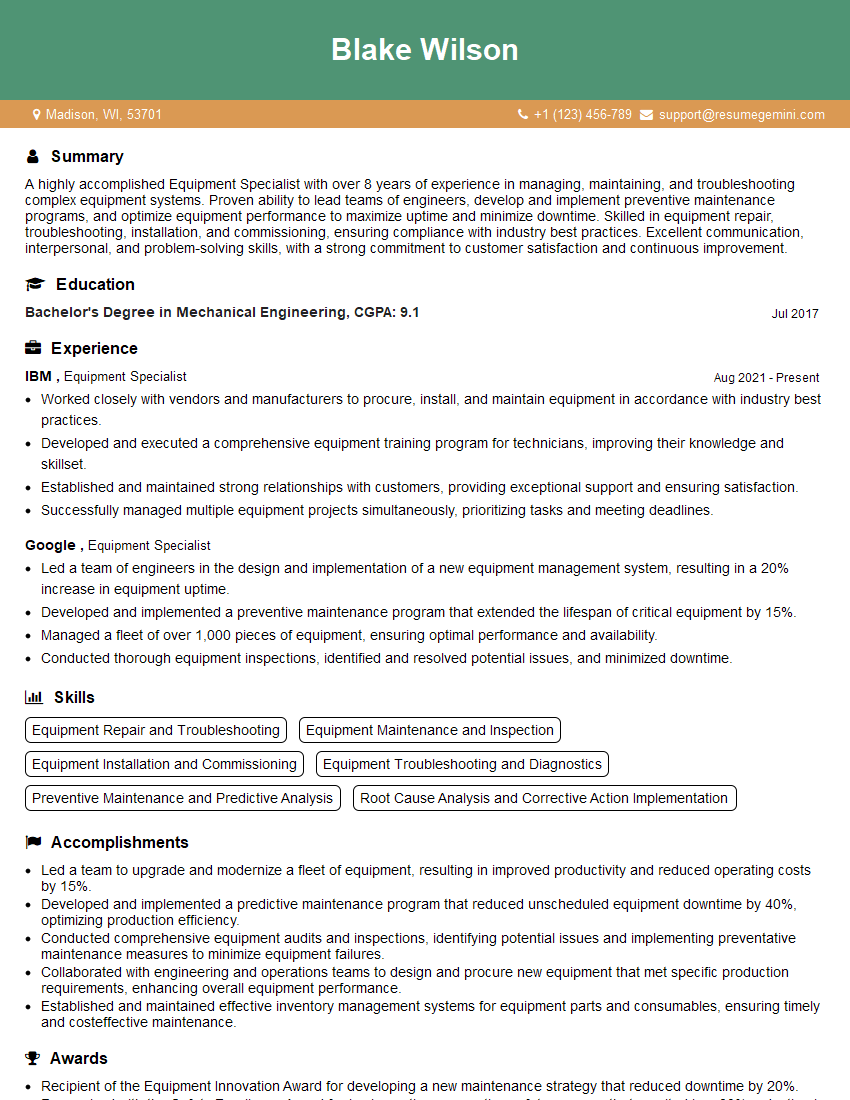
Mastering Equipment Selection and Design is crucial for career advancement in engineering and related fields. It demonstrates a strong understanding of technical principles, economic considerations, and problem-solving skills highly valued by employers. To significantly boost your job prospects, focus on crafting an ATS-friendly resume that showcases your skills and experience effectively. ResumeGemini is a trusted resource that can help you build a professional and impactful resume tailored to your specific career goals. We provide examples of resumes specifically designed for candidates in Equipment Selection and Design to give you a head start.
Explore more articles
Users Rating of Our Blogs
Share Your Experience
We value your feedback! Please rate our content and share your thoughts (optional).
What Readers Say About Our Blog
Very informative content, great job.
good