Unlock your full potential by mastering the most common Experience in applying AI and Machine Learning techniques to real-world problems interview questions. This blog offers a deep dive into the critical topics, ensuring you’re not only prepared to answer but to excel. With these insights, you’ll approach your interview with clarity and confidence.
Questions Asked in Experience in applying AI and Machine Learning techniques to real-world problems Interview
Q 1. Explain the difference between supervised, unsupervised, and reinforcement learning.
The core difference between supervised, unsupervised, and reinforcement learning lies in how the algorithms learn from data. Think of it like teaching a dog:
- Supervised Learning: This is like explicitly showing the dog pictures of cats and saying “cat.” You provide labeled data (input data with corresponding correct outputs), and the algorithm learns to map inputs to outputs. Examples include image classification (identifying cats vs. dogs), spam detection, and predicting house prices based on features.
- Unsupervised Learning: Here, you just show the dog a bunch of pictures of different animals without labeling them. The algorithm learns to identify patterns and structures in the data without explicit guidance. Examples include clustering customers based on purchasing behavior, dimensionality reduction, and anomaly detection (finding unusual credit card transactions).
- Reinforcement Learning: This is like teaching a dog a trick through rewards and punishments. The algorithm learns through trial and error by interacting with an environment, receiving rewards for good actions and penalties for bad ones. Examples include game playing (AlphaGo), robotics (teaching robots to walk), and resource management (optimizing traffic flow).
In essence, supervised learning uses labeled data, unsupervised learning uses unlabeled data to find structure, and reinforcement learning learns through interaction and feedback.
Q 2. Describe the bias-variance tradeoff.
The bias-variance tradeoff is a fundamental concept in machine learning. It describes the tension between a model’s ability to fit the training data well (low bias) and its ability to generalize to unseen data (low variance).
Bias refers to the error introduced by approximating a real-world problem, which might be highly complex, by a simplified model. A high-bias model makes strong assumptions about the data and may miss important relationships, leading to underfitting (poor performance on both training and test data). Think of it like using a straight line to fit a curvy dataset – you’ll get a poor fit.
Variance refers to the model’s sensitivity to fluctuations in the training data. A high-variance model is overly complex and fits the training data too closely, including its noise. This leads to overfitting (great performance on training data but poor performance on unseen data). Think of it like fitting a very complex polynomial to the same curvy data; it might perfectly fit the training data but perform poorly on new points.
The goal is to find a balance: a model with low bias and low variance. This often involves finding the right model complexity. Techniques like regularization help manage this tradeoff.
Q 3. What are some common techniques for handling imbalanced datasets?
Imbalanced datasets, where one class significantly outnumbers others, are a common challenge. For instance, in fraud detection, fraudulent transactions are far fewer than legitimate ones. Here are common techniques to handle this:
- Resampling Techniques:
- Oversampling: Duplicate or generate synthetic samples of the minority class to balance the dataset. SMOTE (Synthetic Minority Over-sampling Technique) is a popular method.
- Undersampling: Remove samples from the majority class to reduce its dominance. Random Undersampling is simple but can lead to information loss.
- Cost-Sensitive Learning: Assign different misclassification costs. Penalize misclassifying the minority class more heavily than the majority class. This can be implemented by adjusting class weights in algorithms like logistic regression or support vector machines.
- Ensemble Methods: Use ensemble techniques like bagging and boosting that can handle imbalanced data effectively. Random forests and AdaBoost are examples.
- Anomaly Detection Techniques: If the minority class represents anomalies, techniques like One-Class SVM or Isolation Forest are better suited than traditional classification.
The best approach depends on the specific dataset and problem. Experimentation is key to finding the optimal solution.
Q 4. Explain the concept of regularization and its purpose.
Regularization is a technique used to prevent overfitting by adding a penalty to the model’s complexity. It discourages the model from learning overly complex relationships that might fit the training data very well but generalize poorly to unseen data.
The penalty is typically added to the model’s loss function. Common types of regularization include:
- L1 Regularization (Lasso): Adds a penalty proportional to the absolute value of the model’s coefficients. This tends to shrink some coefficients to exactly zero, leading to feature selection.
- L2 Regularization (Ridge): Adds a penalty proportional to the square of the model’s coefficients. This shrinks all coefficients towards zero but doesn’t force them to be exactly zero.
The strength of the penalty is controlled by a hyperparameter (e.g., lambda or alpha). A larger penalty value leads to greater regularization and simpler models.
In essence, regularization helps find a better balance in the bias-variance tradeoff by preventing the model from becoming too complex and overfitting the training data.
Q 5. How do you evaluate the performance of a classification model?
Evaluating a classification model involves assessing its ability to correctly classify instances into different categories. Common metrics include:
- Accuracy: The percentage of correctly classified instances. Simple but can be misleading with imbalanced datasets.
- Precision: Out of all instances predicted as positive, what proportion is actually positive? High precision means few false positives.
- Recall (Sensitivity): Out of all actual positive instances, what proportion was correctly identified? High recall means few false negatives.
- F1-Score: The harmonic mean of precision and recall, providing a balanced measure. Useful when both precision and recall are important.
- AUC-ROC (Area Under the Receiver Operating Characteristic Curve): A measure of the model’s ability to distinguish between classes across different thresholds. A higher AUC indicates better performance.
- Confusion Matrix: A table showing the counts of true positives, true negatives, false positives, and false negatives. Provides a detailed breakdown of the model’s performance.
The choice of metric depends on the specific problem and the relative importance of different types of errors.
Q 6. How do you evaluate the performance of a regression model?
Evaluating a regression model focuses on how well it predicts continuous values. Common metrics include:
- Mean Squared Error (MSE): The average squared difference between predicted and actual values. Sensitive to outliers.
- Root Mean Squared Error (RMSE): The square root of MSE. Easier to interpret as it’s in the same units as the target variable.
- Mean Absolute Error (MAE): The average absolute difference between predicted and actual values. Less sensitive to outliers than MSE.
- R-squared (R²): The proportion of variance in the target variable explained by the model. Ranges from 0 to 1, with higher values indicating better fit.
Additionally, visualization techniques like residual plots (plotting the difference between predicted and actual values) can help identify patterns and potential issues in the model’s predictions.
Q 7. What is cross-validation and why is it important?
Cross-validation is a resampling technique used to evaluate a model’s performance and prevent overfitting. It involves splitting the data into multiple folds (subsets), training the model on some folds, and testing it on the remaining folds. This process is repeated multiple times, with different folds used for training and testing in each iteration.
k-fold cross-validation is a common approach, where the data is split into k folds. The model is trained k times, each time using k-1 folds for training and the remaining fold for testing. The performance metrics are then averaged across all k iterations.
Why is it important? Cross-validation provides a more robust estimate of the model’s generalization performance compared to a single train-test split. It helps to avoid overfitting by giving a more realistic picture of how the model will perform on unseen data. This is crucial for making reliable predictions in real-world applications.
Q 8. Explain the difference between precision and recall.
Precision and recall are two crucial metrics used to evaluate the performance of a classification model, particularly in situations with imbalanced datasets. Think of it like this: you’re searching for a specific type of flower (positive class) in a field filled with many different flowers (all classes).
Precision answers the question: “Out of all the flowers I identified as the target flower, how many were actually the target flower?” It’s the ratio of true positives (correctly identified target flowers) to the total number of predicted positives (all flowers identified as the target flower, including false positives).
Precision = True Positives / (True Positives + False Positives)
Recall answers the question: “Out of all the actual target flowers in the field, how many did I correctly identify?” It’s the ratio of true positives to the total number of actual positives (all target flowers in the field, including those missed).
Recall = True Positives / (True Positives + False Negatives)
Example: Imagine a spam filter. High precision means few legitimate emails are incorrectly flagged as spam (low false positives). High recall means few spam emails are missed (low false negatives). The ideal scenario is high precision and high recall, but often there’s a trade-off. A very strict spam filter might have high precision but low recall (missing some spam), while a loose filter might have high recall but low precision (flagging legitimate emails as spam).
Q 9. What is an ROC curve and how is it used?
The Receiver Operating Characteristic (ROC) curve is a graphical representation of the performance of a binary classification model at various classification thresholds. It plots the true positive rate (TPR) against the false positive rate (FPR) for different threshold settings.
True Positive Rate (TPR), also known as sensitivity or recall, is the proportion of actual positives that are correctly identified. False Positive Rate (FPR) is the proportion of actual negatives that are incorrectly identified as positives.
The ROC curve helps visualize the trade-off between sensitivity and specificity. An ideal classifier would have a TPR of 1 and an FPR of 0, corresponding to a point in the top-left corner of the ROC space. The area under the ROC curve (AUC) provides a single numeric measure of the model’s overall performance. A higher AUC indicates better performance.
How it’s used: In practice, you’d train your model, generate predictions with varying probability thresholds, calculate the TPR and FPR at each threshold, plot them on the ROC curve, and finally compute the AUC. This allows you to choose the threshold that best balances sensitivity and specificity based on your specific needs. For example, in medical diagnosis, a high TPR (minimizing false negatives) might be prioritized, even if it means accepting a higher FPR. In fraud detection, a high specificity (minimizing false positives) may be preferred.
Q 10. What are some common feature scaling techniques?
Feature scaling is a crucial preprocessing step in many machine learning algorithms, particularly those that use distance-based metrics (like k-Nearest Neighbors) or gradient descent optimization (like linear regression). It involves transforming the features to a similar scale to prevent features with larger values from dominating the model.
Common techniques include:
- Min-Max Scaling (Normalization): Scales features to a range between 0 and 1. The formula is:
x_scaled = (x - min(x)) / (max(x) - min(x)) - Z-score Standardization: Centers the data around a mean of 0 and a standard deviation of 1. The formula is:
x_scaled = (x - mean(x)) / std(x) - Robust Scaling: Uses the median and interquartile range (IQR) instead of the mean and standard deviation, making it less sensitive to outliers. It’s particularly useful when dealing with datasets containing many outliers.
The choice of technique depends on the dataset and the algorithm used. Min-max scaling is suitable when you want to maintain the original distribution of the data, while Z-score standardization is preferred when outliers might significantly influence the mean and standard deviation.
Q 11. Explain the difference between L1 and L2 regularization.
L1 and L2 regularization are techniques used to prevent overfitting in machine learning models by adding a penalty term to the loss function. Overfitting occurs when a model learns the training data too well, resulting in poor generalization to unseen data.
L1 regularization (LASSO): Adds a penalty term proportional to the absolute value of the model’s coefficients. This penalty encourages sparsity, meaning many coefficients will be driven to exactly zero. This is useful for feature selection, as it effectively removes less important features from the model.
Loss = Original Loss + λ * Σ|θ| (where λ is the regularization strength and θ are the model coefficients)
L2 regularization (Ridge): Adds a penalty term proportional to the square of the model’s coefficients. This shrinks the coefficients towards zero, but doesn’t force them to be exactly zero. This helps reduce the influence of individual features but keeps all features in the model.
Loss = Original Loss + λ * Σθ² (where λ is the regularization strength and θ are the model coefficients)
The choice between L1 and L2 depends on the specific problem. L1 is preferred when feature selection is desired, while L2 is generally preferred when all features are expected to be relevant.
Q 12. What are some common methods for dimensionality reduction?
Dimensionality reduction techniques aim to reduce the number of features in a dataset while preserving as much important information as possible. This is beneficial for several reasons: it can improve model performance by reducing noise and overfitting, speed up computation, and enhance data visualization.
Common methods include:
- Principal Component Analysis (PCA): A linear transformation that projects the data onto a lower-dimensional subspace while maximizing variance. It’s particularly effective when dealing with correlated features.
- t-distributed Stochastic Neighbor Embedding (t-SNE): A non-linear technique that is excellent for visualizing high-dimensional data in lower dimensions (often 2D or 3D). However, it’s computationally expensive and the results can be sensitive to parameter choices.
- Linear Discriminant Analysis (LDA): A supervised method that finds the linear combinations of features that best separate different classes. It’s used primarily for classification problems.
The choice of method depends on the data characteristics and the goals of the analysis. PCA is a good general-purpose technique, while t-SNE is valuable for visualization, and LDA is specifically designed for classification problems.
Q 13. Explain the concept of a decision tree.
A decision tree is a supervised machine learning algorithm that uses a tree-like structure to make decisions based on a series of feature tests. Imagine it like a flowchart where each node represents a feature, each branch represents a decision based on the feature’s value, and each leaf node represents a prediction or classification.
The algorithm recursively partitions the data based on the feature that best separates the classes (or predicts the outcome variable) at each node. Common metrics used for splitting include Gini impurity and information gain. The process continues until a stopping criterion is met (e.g., reaching a maximum depth or minimum number of samples per leaf).
Example: Predicting whether a customer will buy a product based on their age, income, and location. The tree might first split on age (e.g., under 30 vs. over 30), then further split based on income within each age group, eventually leading to leaf nodes that predict the probability of purchase.
Decision trees are easy to interpret and visualize, but they can be prone to overfitting if not properly pruned or regularized.
Q 14. Explain the concept of a random forest.
A random forest is an ensemble learning method that combines multiple decision trees to improve prediction accuracy and robustness. Instead of relying on a single decision tree, which can be prone to overfitting, a random forest constructs many decision trees and aggregates their predictions.
The key idea is to introduce randomness at two stages:
- Bagging (Bootstrap Aggregating): Randomly sampling the training data with replacement to create multiple subsets. Each subset is used to train a separate decision tree.
- Random Subspace: At each node of a decision tree, only a random subset of features is considered for splitting. This further reduces correlation between the trees.
The final prediction is typically the average (for regression) or the mode (for classification) of the predictions from all the individual trees. Random forests are less prone to overfitting than individual decision trees, are relatively easy to tune, and often achieve high accuracy on a wide range of problems.
Example: Image classification, where each tree might be trained on a different random subset of the images and a random subset of pixels. The final classification is determined by the majority vote across all trees.
Q 15. Explain the concept of a support vector machine (SVM).
A Support Vector Machine (SVM) is a powerful and versatile supervised machine learning algorithm used for both classification and regression tasks. At its core, an SVM aims to find the optimal hyperplane that maximally separates data points of different classes. Imagine you have a scatter plot with red and blue dots representing two different categories. The SVM finds the line (in 2D) or plane (in 3D), or hyperplane (in higher dimensions) that best divides these dots, creating the largest possible margin between the classes.
This margin is the distance between the hyperplane and the closest data points from each class, called support vectors. These support vectors are crucial because they define the hyperplane; points far from the hyperplane have little influence on its position. SVMs are particularly effective when dealing with high-dimensional data and can handle non-linearly separable data through the use of kernel functions, which map the data into a higher-dimensional space where linear separation becomes possible.
Example: Imagine using an SVM to classify emails as spam or not spam. The features could be the frequency of certain words, the sender’s email address, etc. The SVM would learn a hyperplane that separates spam from non-spam emails based on these features.
Real-world application: SVMs are used extensively in image classification, text categorization, bioinformatics, and financial modeling.
Career Expert Tips:
- Ace those interviews! Prepare effectively by reviewing the Top 50 Most Common Interview Questions on ResumeGemini.
- Navigate your job search with confidence! Explore a wide range of Career Tips on ResumeGemini. Learn about common challenges and recommendations to overcome them.
- Craft the perfect resume! Master the Art of Resume Writing with ResumeGemini’s guide. Showcase your unique qualifications and achievements effectively.
- Don’t miss out on holiday savings! Build your dream resume with ResumeGemini’s ATS optimized templates.
Q 16. Explain the concept of a neural network.
A neural network is a computational model inspired by the biological neural networks that constitute animal brains. It consists of interconnected nodes, or neurons, organized in layers: an input layer, one or more hidden layers, and an output layer. Each connection between neurons has an associated weight, representing the strength of the connection. Information flows through the network as input data is fed into the input layer, processed through the hidden layers, and finally produces an output in the output layer.
Each neuron performs a simple computation: it receives weighted inputs, sums them up, applies an activation function (which introduces non-linearity), and produces an output. The process of learning in a neural network involves adjusting these weights to minimize the difference between the network’s output and the desired output (the target). This adjustment is typically done through a process called backpropagation (explained in the next question).
Analogy: Think of a neural network as a complex assembly line. Each worker (neuron) performs a simple task, but the combined work of all workers produces a sophisticated final product (prediction).
Real-world application: Neural networks are behind many AI breakthroughs, including image recognition (e.g., self-driving cars), natural language processing (e.g., chatbots), and speech recognition (e.g., virtual assistants).
Q 17. What is backpropagation?
Backpropagation is a crucial algorithm used to train neural networks. It’s a method for calculating the gradient of the loss function with respect to the network’s weights. The loss function measures how well the network is performing—a lower loss indicates better performance. The gradient indicates the direction of steepest descent in the loss landscape.
In simpler terms, backpropagation works by propagating the error from the output layer back through the network, layer by layer. It calculates how much each weight contributed to the overall error. Then, it adjusts the weights proportionally to reduce the error. This iterative process of calculating gradients and updating weights continues until the network’s performance reaches a satisfactory level. It’s like finding the bottom of a valley by repeatedly taking steps downhill, guided by the steepness of the slope (gradient).
Step-by-step:
- Forward Pass: Input data is fed through the network, producing an output.
- Loss Calculation: The difference between the network’s output and the target output is calculated using the loss function.
- Backward Pass: The error is propagated backward through the network, calculating the gradient of the loss function with respect to each weight.
- Weight Update: The weights are updated using an optimization algorithm (like gradient descent) to minimize the loss.
Real-world application: Backpropagation is fundamental to training virtually all deep learning models.
Q 18. What are some common activation functions used in neural networks?
Activation functions introduce non-linearity into the network, allowing it to learn complex patterns. Without them, the network would simply be performing linear transformations, limiting its capabilities. Several common activation functions are:
- Sigmoid: Outputs values between 0 and 1, often used in the output layer for binary classification problems.
σ(x) = 1 / (1 + exp(-x)) - Tanh (Hyperbolic Tangent): Outputs values between -1 and 1, often used in hidden layers.
tanh(x) = (exp(x) - exp(-x)) / (exp(x) + exp(-x)) - ReLU (Rectified Linear Unit): Outputs
xifx > 0and 0 otherwise. Popular due to its computational efficiency and ability to mitigate the vanishing gradient problem.ReLU(x) = max(0, x) - Softmax: Outputs a probability distribution over multiple classes, commonly used in the output layer for multi-class classification.
softmax(xᵢ) = exp(xᵢ) / Σⱼ exp(xⱼ)
The choice of activation function depends on the specific task and the architecture of the neural network. For example, ReLU is frequently preferred for hidden layers due to its efficiency, while softmax is commonly used in the output layer for multi-class classification.
Q 19. What are some common optimization algorithms used in neural networks?
Optimization algorithms are used to update the weights of a neural network during training. They aim to find the set of weights that minimizes the loss function. Some common optimization algorithms include:
- Gradient Descent: The most fundamental optimization algorithm. It iteratively updates weights in the direction of the negative gradient of the loss function (see next answer for more details).
- Stochastic Gradient Descent (SGD): Updates weights using the gradient calculated from a single data point (or a small batch) at each iteration. This introduces noise but can lead to faster convergence in some cases.
- Mini-Batch Gradient Descent: A compromise between batch and stochastic gradient descent. It updates weights based on the gradient calculated from a small batch of data points.
- Adam (Adaptive Moment Estimation): A popular adaptive learning rate optimization algorithm that combines the advantages of several other algorithms. It adapts the learning rate for each weight individually.
- RMSprop (Root Mean Square Propagation): Another adaptive learning rate optimization algorithm that addresses the issues of diminishing learning rates in some situations.
The choice of optimization algorithm can significantly impact the training speed and performance of a neural network.
Q 20. What is gradient descent?
Gradient descent is an iterative optimization algorithm used to find the minimum of a function. Imagine you’re standing on a hillside and want to reach the bottom (the minimum). Gradient descent works by repeatedly taking steps downhill, in the direction of the steepest descent. The ‘steepness’ is determined by the gradient of the function at your current location.
More formally, gradient descent updates the parameters (weights in the case of neural networks) using the following formula:
θ = θ - η∇L(θ)
Where:
θrepresents the parameters.ηis the learning rate (step size).∇L(θ)is the gradient of the loss functionLwith respect to the parametersθ.
The learning rate determines the size of the steps taken. A small learning rate leads to slow convergence, while a large learning rate may cause oscillations and prevent convergence.
Real-world application: Gradient descent (and its variants) is fundamental to training most machine learning models, including neural networks, linear regression, and logistic regression.
Q 21. Explain the difference between batch, stochastic, and mini-batch gradient descent.
Batch, stochastic, and mini-batch gradient descent are variations of the gradient descent algorithm that differ in how they compute the gradient:
- Batch Gradient Descent: Computes the gradient using the entire training dataset at each iteration. This provides a very accurate gradient but can be computationally expensive for large datasets.
- Stochastic Gradient Descent (SGD): Computes the gradient using a single data point at each iteration. This is computationally efficient but introduces noise into the gradient calculation, leading to a more noisy and less smooth descent toward the minimum. However, this noise can sometimes help escape local minima.
- Mini-Batch Gradient Descent: Computes the gradient using a small batch (subset) of data points at each iteration. This balances the accuracy of batch gradient descent with the efficiency of stochastic gradient descent. It’s the most commonly used approach in practice.
Analogy: Imagine navigating a mountain range. Batch gradient descent is like carefully surveying the entire landscape before taking each step, ensuring you’re going in the most efficient direction but taking a lot of time. SGD is like blindly taking small steps based on only what you see at your current location, occasionally making less optimal moves but getting there potentially faster. Mini-batch gradient descent is like surveying a small area before taking each step, finding a good balance between efficiency and speed.
The best choice depends on factors like dataset size, computational resources, and desired accuracy.
Q 22. What is overfitting and how can it be prevented?
Overfitting occurs when a machine learning model learns the training data too well, including its noise and outliers. Think of it like a student memorizing the answers to a practice test instead of understanding the underlying concepts. This leads to excellent performance on the training data but poor generalization to unseen data (like a real exam).
Preventing overfitting involves several strategies:
- Data Augmentation: Artificially increasing the size of the training dataset by creating modified versions of existing data. For image recognition, this might involve rotating or cropping images.
- Cross-Validation: Dividing the data into multiple subsets, training the model on some subsets, and evaluating its performance on the remaining held-out subset. This gives a more reliable estimate of the model’s generalization ability.
- Regularization: Adding penalty terms to the model’s loss function to discourage overly complex models. L1 and L2 regularization are common techniques that penalize large weights.
- Feature Selection/Engineering: Carefully choosing the most relevant features for the model to learn from. Removing irrelevant or redundant features can significantly reduce overfitting.
- Early Stopping: Monitoring the model’s performance on a validation set during training and stopping the training process when the validation performance starts to decrease (indicating overfitting).
- Dropout (for neural networks): Randomly ignoring neurons during training, forcing the network to learn more robust features.
For example, if a model is overfitting on an image classification task, we might use data augmentation to generate slightly altered versions of the existing images. Or, we can apply L2 regularization, which adds a penalty to the model’s loss function proportional to the square of the model’s weights.
Q 23. What is underfitting and how can it be prevented?
Underfitting, on the other hand, occurs when a model is too simple to capture the underlying patterns in the data. It’s like trying to fit a straight line through a set of data points that clearly form a curve. The model performs poorly on both the training and testing data because it hasn’t learned the complexities of the data.
Preventing underfitting is addressed by:
- Increasing model complexity: Using a more powerful model with more parameters or layers (in the case of neural networks).
- Adding more features: Including additional relevant features that could help the model capture the underlying patterns. This requires careful feature engineering.
- Reducing regularization: If regularization is used, decreasing the strength of the penalty term allows the model to be more flexible.
- Addressing data imbalance: Underfitting can occur if the data is heavily skewed towards one class. Techniques like oversampling or undersampling can balance the data.
- Using more data: A larger and more representative dataset often helps the model learn more complex patterns.
Imagine trying to predict house prices using only the size of the house as a feature. This simple model would likely underfit because many other factors contribute to house prices (location, age, features, etc.). Adding more relevant features would improve the model’s ability to capture the complexity of the house price prediction problem.
Q 24. Describe a time you had to debug a complex machine learning model.
During a fraud detection project, our model—a gradient boosting machine—was initially performing poorly on unseen data, despite excellent training performance. This suggested overfitting. After investigating, we discovered that a significant portion of our training data had erroneous timestamps. This introduced noise the model over-learned, leading to poor generalization.
My debugging process involved several steps:
- Reproducing the error: I carefully examined the model’s predictions on the test set, focusing on instances where the model performed poorly.
- Feature analysis: I analyzed the importance of each feature, identifying the timestamps as a significant contributor to the model’s predictions.
- Data investigation: I meticulously inspected the data related to timestamps, discovering the errors. This involved cross-referencing with our transactional database.
- Data cleaning: We corrected the erroneous timestamps, either by imputation based on other features or removing the affected data points.
- Retraining: I retrained the model with the cleaned data. The model’s performance improved substantially.
This experience highlighted the critical importance of data quality and thorough data exploration in machine learning projects. A seemingly minor issue in the data can have catastrophic consequences for the model’s performance.
Q 25. Explain your experience with a specific AI/ML framework (e.g., TensorFlow, PyTorch, scikit-learn).
I have extensive experience with TensorFlow, primarily using Keras as a high-level API. I’ve used it to build a variety of models, including convolutional neural networks (CNNs) for image classification, recurrent neural networks (RNNs) for time series analysis, and dense neural networks for regression tasks.
TensorFlow’s flexibility allows for efficient prototyping and deployment of complex models. I’m comfortable using its various features, such as:
- TensorBoard: For visualizing model training and debugging.
- TensorFlow Datasets: For easily accessing and preprocessing standard datasets.
- Keras functional and sequential APIs: For building different model architectures easily.
- TensorFlow Hub: For using pre-trained models and transfer learning.
For example, in a recent project involving image segmentation, I utilized TensorFlow’s CNN capabilities along with the U-Net architecture to create a highly accurate model for identifying and segmenting specific objects within images. I leveraged TensorBoard to monitor training progress and optimize hyperparameters efficiently.
Q 26. Describe a project where you applied AI/ML to solve a real-world problem.
I worked on a project predicting customer churn for a telecommunications company. Using a combination of historical customer data (usage patterns, demographics, billing information, etc.), I developed a machine learning model to identify customers at high risk of churning.
The process involved:
- Data Preprocessing: Cleaning, transforming, and encoding the data to prepare it for model training. This included handling missing values and creating new features based on existing ones.
- Feature Engineering: Creating new features like average monthly usage or the ratio of data to voice usage.
- Model Selection: I experimented with various models, including logistic regression, random forests, and gradient boosting machines (GBMs), and evaluated them using appropriate metrics like precision, recall, F1-score, and AUC.
- Model Training and Evaluation: I trained and evaluated the models using cross-validation to obtain a reliable estimate of their performance on unseen data.
- Deployment: The final model was deployed into a production environment, integrated with the company’s existing systems to provide real-time churn risk predictions.
The project resulted in a significant improvement in the company’s ability to identify and retain at-risk customers, directly impacting their customer retention rate and overall profitability.
Q 27. How do you handle missing data in a dataset?
Handling missing data is crucial for building reliable machine learning models. The best approach depends on the nature of the data and the extent of missingness. Here are several common strategies:
- Deletion: This involves removing rows or columns with missing values. This is simple but can lead to information loss, especially if many values are missing.
- Imputation: Replacing missing values with estimated values. Common methods include:
- Mean/Median/Mode Imputation: Replacing missing values with the mean, median, or mode of the column. Simple but can distort the distribution if many values are missing.
- K-Nearest Neighbors (KNN) Imputation: Imputing missing values based on the values of similar data points. More sophisticated and can capture relationships between features.
- Regression Imputation: Using a regression model to predict the missing values based on other features. This approach is more complex but can yield better results.
- Model-Based Approaches: Some machine learning models, like XGBoost, can handle missing data internally without requiring explicit imputation.
The choice of method depends on the context. For example, if the amount of missing data is small and randomly distributed, simple deletion or mean imputation might suffice. However, if there’s a significant amount of missing data or if the missingness is not random, more sophisticated imputation techniques or model-based approaches are necessary.
Q 28. What are some ethical considerations in developing and deploying AI/ML systems?
Ethical considerations in AI/ML are paramount. Developing and deploying AI systems responsibly requires careful attention to several aspects:
- Bias and Fairness: AI models can inherit and amplify biases present in the training data, leading to unfair or discriminatory outcomes. Careful data selection, preprocessing, and model evaluation are crucial to mitigate bias.
- Privacy and Security: AI systems often process sensitive personal data. Robust data protection measures are essential to ensure privacy and prevent data breaches.
- Transparency and Explainability: Understanding how an AI model arrives at its predictions is vital for building trust and accountability. Explainable AI (XAI) techniques are being developed to address this challenge.
- Accountability and Responsibility: Clear lines of responsibility need to be established for the decisions made by AI systems, particularly in high-stakes applications like healthcare or criminal justice.
- Job Displacement: The automation potential of AI needs to be carefully considered to mitigate potential negative impacts on employment.
- Misuse and Malicious Applications: AI systems can be misused for malicious purposes, such as creating deepfakes or developing autonomous weapons. Safeguards need to be put in place to prevent such misuse.
For example, a facial recognition system trained primarily on images of one demographic group might perform poorly on other groups, perpetuating bias. It’s crucial to ensure diversity in training data and carefully evaluate model performance across different demographic groups to minimize these biases.
Key Topics to Learn for Experience in applying AI and Machine Learning techniques to real-world problems Interview
- Problem Definition and Data Analysis: Understanding the business problem, identifying relevant data sources, and performing exploratory data analysis (EDA) to gain insights.
- Model Selection and Training: Choosing appropriate ML algorithms (e.g., regression, classification, clustering) based on the problem and data characteristics; training and evaluating models using appropriate metrics.
- Feature Engineering: Creating, selecting, and transforming features to improve model performance. This includes understanding techniques like dimensionality reduction and feature scaling.
- Model Deployment and Monitoring: Deploying trained models into production environments (e.g., cloud platforms, embedded systems); monitoring model performance and retraining as needed.
- Ethical Considerations in AI: Understanding and addressing potential biases in data and algorithms; ensuring fairness, accountability, and transparency in AI applications.
- Practical Applications: Being able to discuss real-world examples of AI/ML applications in your field (e.g., fraud detection, recommendation systems, image recognition). Prepare to discuss your contributions and the impact of your work.
- Technical Proficiency: Demonstrating a strong understanding of relevant programming languages (Python, R), libraries (scikit-learn, TensorFlow, PyTorch), and cloud platforms (AWS, Azure, GCP).
- Problem-Solving Approach: Articulating your systematic approach to tackling complex problems, from defining the problem to deploying and monitoring solutions. Showcase your ability to debug and troubleshoot issues.
Next Steps
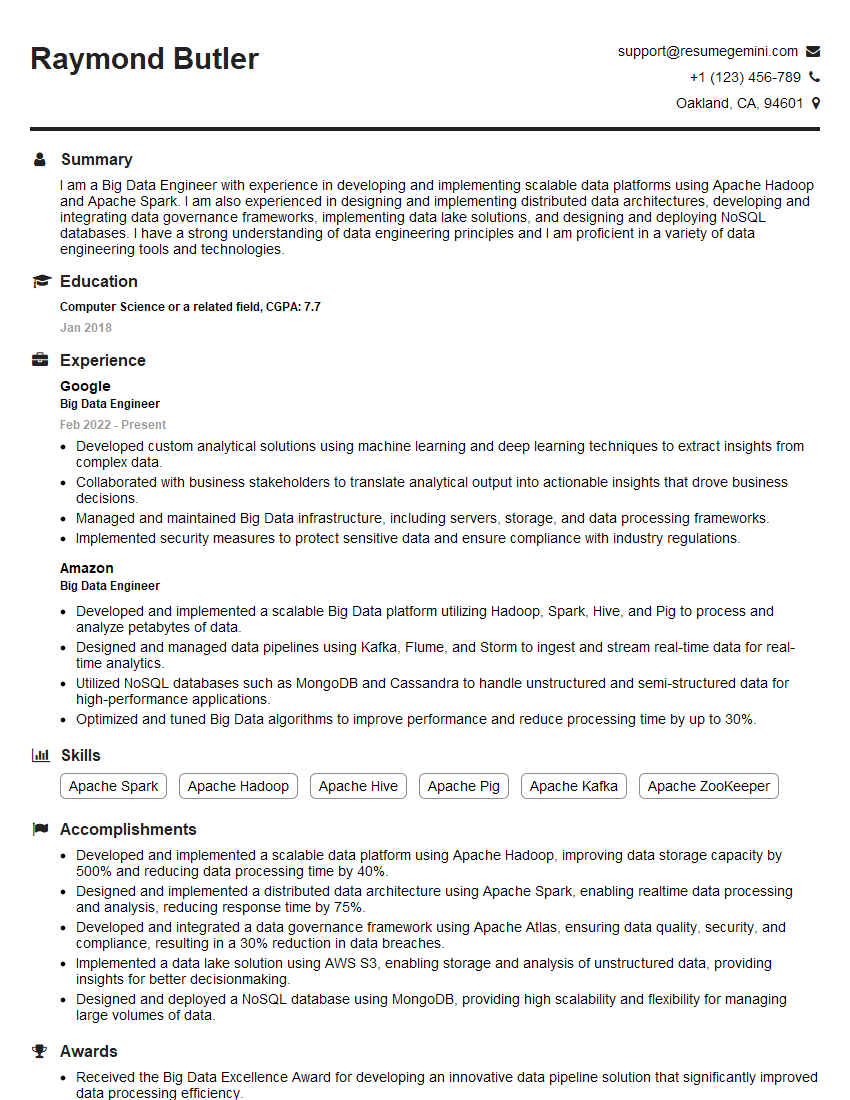
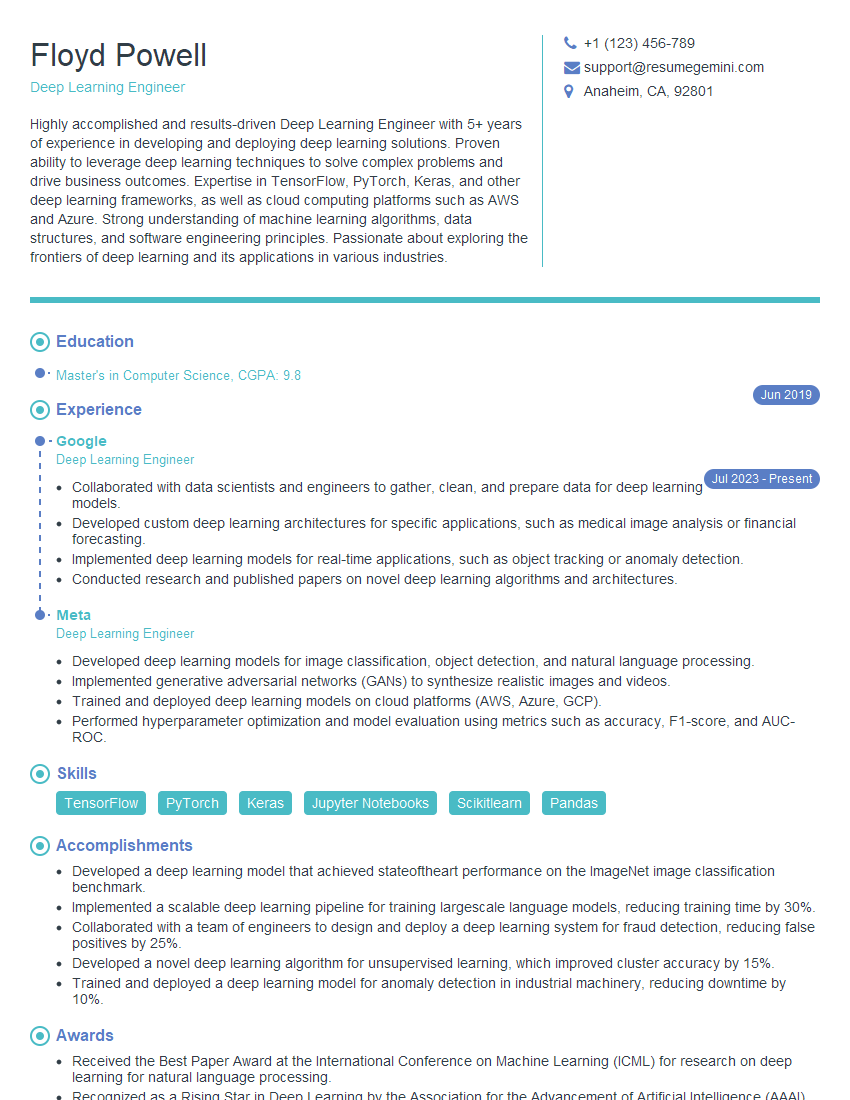
Mastering the application of AI and Machine Learning techniques to real-world problems is crucial for career advancement in today’s data-driven world. It opens doors to high-impact roles and significantly boosts your earning potential. To maximize your job prospects, it’s vital to present your skills effectively. Creating an ATS-friendly resume is essential for getting your application noticed. We highly recommend using ResumeGemini to build a professional and compelling resume that highlights your expertise. ResumeGemini provides examples of resumes tailored to showcasing experience in applying AI and Machine Learning techniques to real-world problems, helping you present your qualifications in the best possible light.


Explore more articles
Users Rating of Our Blogs
Share Your Experience
We value your feedback! Please rate our content and share your thoughts (optional).
What Readers Say About Our Blog
Very informative content, great job.
good