Every successful interview starts with knowing what to expect. In this blog, we’ll take you through the top Experience with Glass Automation Systems interview questions, breaking them down with expert tips to help you deliver impactful answers. Step into your next interview fully prepared and ready to succeed.
Questions Asked in Experience with Glass Automation Systems Interview
Q 1. Explain your experience with different types of glass automation systems.
My experience encompasses a wide range of glass automation systems, from individual robotic arms handling delicate glass sheets to fully integrated production lines. I’ve worked with systems utilizing various technologies for handling, cutting, grinding, polishing, and inspection. This includes:
- Robotic systems: Experience with six-axis robots from FANUC, ABB, and KUKA, programmed for precise handling and placement of glass in various stages of production. For instance, I worked on a project integrating KUKA robots to load and unload a furnace, dramatically increasing throughput.
- Conveyor systems: Designed and implemented high-speed conveyor systems incorporating servo-driven rollers and sophisticated control systems to ensure smooth and damage-free transport of glass through various process steps. One project involved optimizing a conveyor system to reduce breakage rates by 15% through fine-tuning speed and acceleration profiles.
- Vision systems: Extensive experience with machine vision systems for quality control and automated inspection. This includes programming algorithms to detect defects such as scratches, bubbles, or dimensional inconsistencies in real-time. I successfully implemented a system that reduced waste due to defective glass by identifying and removing flawed pieces before further processing.
- CNC machinery: Experience programming and operating CNC machines for cutting, grinding, and polishing glass to precise specifications. I’ve worked with both stand-alone machines and those integrated into larger automation lines, improving precision and reducing machining times significantly.
Q 2. Describe your experience with PLC programming in a glass manufacturing environment.
My PLC programming experience in glass manufacturing primarily revolves around Allen-Bradley (Rockwell Automation) PLCs, though I also have familiarity with Siemens PLCs. I use structured programming techniques to create robust and maintainable code. I’m proficient in ladder logic, function block diagrams, and structured text. A key aspect of my work is the ability to seamlessly integrate PLC programs with other automation components, such as HMI screens and robotic controllers.
For example, I developed a PLC program to control a complex glass tempering furnace. This program managed the heating and cooling cycles, monitored temperature sensors, controlled the conveyor system, and implemented safety interlocks. The program also incorporated advanced features such as predictive maintenance based on sensor data and self-diagnostic routines to minimize downtime. A sample code snippet (simplified for clarity) illustrating a temperature control loop might look like this:
IF Temperature < Setpoint THEN
  Activate Heater
ELSE IF Temperature > Setpoint + Tolerance THEN
  Deactivate Heater
END_IF
Q 3. What are the common challenges in integrating robotic systems into glass production?
Integrating robotic systems into glass production presents several challenges:
- Fragility of Glass: Glass is inherently fragile. Robots need extremely precise control and gentle gripping mechanisms to avoid breakage. This requires careful selection of end-effectors (grippers) and sophisticated motion control algorithms.
- High-Precision Movement: Glass manufacturing often requires micron-level precision. Robots need to be calibrated and programmed precisely to achieve the required accuracy. Any deviation can lead to defects or damage.
- Integration Complexity: Integrating robots into existing production lines can be complex, requiring careful consideration of interfaces, communication protocols, and safety systems. It’s crucial to ensure that all systems work together seamlessly.
- Dust and Debris: Glass manufacturing environments can be dusty and dirty. This can affect the performance and reliability of robotic systems, necessitating robust design and regular maintenance.
- High Temperatures: Some processes, like tempering, involve high temperatures. Robots need to be designed to withstand these temperatures or be kept at a safe distance.
Addressing these challenges involves careful planning, meticulous programming, the use of advanced sensor technologies, and rigorous testing.
Q 4. How do you troubleshoot malfunctions in glass automation equipment?
Troubleshooting malfunctions in glass automation equipment follows a systematic approach:
- Safety First: Always prioritize safety and power down the equipment before commencing any troubleshooting.
- Identify the Problem: Clearly define the malfunction. What exactly is not working? When did it start? Are there any error messages?
- Check Sensor Readings: Inspect sensor readings to identify potential issues with input signals. Are the sensors functioning correctly? Are they providing accurate data?
- Review PLC Program: Examine the PLC program for any logic errors or faults. Use diagnostic tools to monitor the program execution and identify problematic areas.
- Check Actuators and Mechanisms: Inspect mechanical components like motors, cylinders, and conveyors for any physical damage or malfunctions. Lubrication and proper alignment are crucial.
- Review HMI Data: Examine the HMI data to see if there are any error messages or unusual trends that might provide clues.
- Consult Documentation: Refer to the equipment manuals and schematics for troubleshooting guidance.
- Isolate the Problem: Systematically isolate the source of the problem through testing and elimination.
- Implement Corrective Actions: Once the cause is identified, take the necessary corrective actions, including repairs, replacements, or code modifications.
- Retest and Verify: Thoroughly test the system to ensure that the problem has been resolved and that it operates correctly.
Q 5. What safety protocols are crucial when working with glass automation systems?
Safety is paramount when working with glass automation systems. Crucial protocols include:
- Lockout/Tagout Procedures: Strict lockout/tagout procedures must be followed before any maintenance or repair work is performed to prevent accidental activation of equipment.
- Emergency Stop Systems: Easily accessible and well-maintained emergency stop buttons must be present throughout the system.
- Light Curtains and Safety Sensors: Light curtains and other safety sensors should be used to detect the presence of personnel near moving equipment and automatically halt operation if necessary.
- Interlocks and Guards: Interlocks and protective guards should be in place to prevent access to hazardous areas during operation.
- Personal Protective Equipment (PPE): Appropriate PPE, such as safety glasses, gloves, and hearing protection, must be worn at all times.
- Regular Safety Inspections: Regular inspections and maintenance are essential to identify and address potential safety hazards before they result in accidents.
- Training and Education: All personnel working with glass automation systems must receive adequate training and education on safe operating procedures and emergency response protocols.
Ignoring these protocols can lead to serious injuries or fatalities. A safety-first culture must be fostered and consistently reinforced.
Q 6. Explain your familiarity with SCADA systems in glass manufacturing.
My familiarity with SCADA (Supervisory Control and Data Acquisition) systems in glass manufacturing is extensive. I’ve used SCADA systems to monitor and control various aspects of the production process, including temperature, pressure, flow rates, and production outputs. I’m proficient in using various SCADA platforms, such as Wonderware and Ignition. SCADA systems provide a centralized view of the entire production line, allowing for real-time monitoring, data logging, and remote control. They are vital for optimizing production efficiency and minimizing downtime.
For example, I used Ignition SCADA to develop a system that monitored the entire glass production line, from raw material input to finished product output. This system provided real-time visualization of key process parameters, generated reports on production performance, and alerted operators to potential problems. The implementation resulted in improved process optimization and reduced waste.
Q 7. How do you ensure the quality control of automated glass production?
Quality control in automated glass production relies on a multi-layered approach:
- In-Process Monitoring: Sensors and vision systems are strategically placed throughout the production line to continuously monitor key parameters and detect defects in real-time. This allows for immediate corrective action and reduces the number of defective pieces reaching the end of the line.
- Automated Inspection: Automated vision systems can be programmed to detect various defects, such as scratches, bubbles, and dimensional inconsistencies, with high accuracy and speed. This is significantly faster and more consistent than manual inspection.
- Statistical Process Control (SPC): SPC techniques are used to monitor process parameters and identify trends that may indicate potential quality issues. This allows for proactive adjustments to the process before defects become widespread.
- Data Analysis and Reporting: Data collected from various sources is analyzed to identify areas for improvement in the production process and reduce the incidence of defects.
- Sampling and Testing: While automated systems perform much of the quality control, random sampling and testing of finished products are still important to verify the overall quality and consistency.
Implementing robust quality control systems is crucial for minimizing waste, reducing costs, and maintaining high product quality. The goal is to achieve a balance between automation and human oversight to guarantee a consistently high standard.
Q 8. Describe your experience with HMI programming and design.
HMI (Human-Machine Interface) programming and design is crucial for effective interaction with glass automation systems. I’ve extensive experience designing and implementing HMIs using platforms like Siemens TIA Portal, Rockwell Automation Studio 5000, and Wonderware InTouch. My focus is on creating intuitive and user-friendly interfaces that allow operators to monitor and control the entire production line seamlessly. This includes designing dashboards for visualizing key performance indicators (KPIs), creating alarm management systems for immediate alerts, and developing user access control for security purposes.
For example, in a recent project involving a float glass production line, I designed an HMI that displayed real-time data on glass temperature, speed, and thickness, alongside historical trends. This allowed operators to quickly identify potential issues and make necessary adjustments. The system also included a detailed alarm system that alerted operators to critical events like temperature excursions or equipment malfunctions, significantly reducing downtime and improving product quality.
My approach emphasizes ergonomic design principles to minimize operator fatigue and maximize efficiency. I always incorporate clear visual cues, intuitive navigation, and context-sensitive help to ensure that even less experienced operators can effectively use the system.
Q 9. What programming languages are you proficient in for glass automation?
My expertise in glass automation programming spans several languages. I am highly proficient in PLC programming languages such as Ladder Logic (used extensively in Allen-Bradley PLCs) and Structured Text (common in Siemens PLCs). I also have solid experience with SCADA (Supervisory Control and Data Acquisition) programming using languages like VBA (Visual Basic for Applications) for custom scripting and report generation. Furthermore, I’m familiar with high-level languages like Python for data analysis and integration with other systems, such as MES (Manufacturing Execution Systems).
For robotic control, I’ve worked with languages specific to robot manufacturers, including RAPID (ABB robots) and KRL (KUKA robots). Understanding these different languages allows me to adapt quickly to various automation environments and leverage the strengths of each system for optimized performance. For example, I’ve used Python to create custom algorithms for optimizing robot path planning in a glass handling application, resulting in a 15% increase in throughput.
Q 10. How do you optimize the efficiency of glass automation systems?
Optimizing glass automation system efficiency involves a multifaceted approach. It’s not just about maximizing speed; it’s about achieving a balance between speed, quality, and minimal downtime. My strategies involve analyzing the entire production process to identify bottlenecks and inefficiencies. This often involves using data analytics techniques to pinpoint areas for improvement.
- Process optimization: Analyzing cycle times, identifying delays, and streamlining processes through lean manufacturing principles.
- Predictive maintenance: Utilizing sensor data and machine learning algorithms to anticipate equipment failures and schedule preventative maintenance proactively.
- Robot path optimization: Designing efficient robot movements to minimize cycle times and reduce wear and tear on equipment. This often involves simulation and optimization software.
- Material flow improvement: Optimizing the flow of materials through the production line to minimize bottlenecks and maximize throughput.
- Energy efficiency: Implementing measures to reduce energy consumption, such as using more efficient equipment and optimizing control algorithms.
For instance, in one project, I used data analysis to identify a bottleneck in the cooling process of a float glass line. By adjusting parameters and implementing a new control algorithm, we managed to increase throughput by 8% without compromising product quality.
Q 11. Describe your experience with preventative maintenance of glass automation equipment.
Preventative maintenance is paramount for ensuring the reliable operation of glass automation equipment. My approach is proactive and data-driven. I develop and implement comprehensive preventative maintenance schedules based on the manufacturer’s recommendations, historical data, and real-time sensor data. This involves regular inspections, lubrication, cleaning, and calibration of equipment.
I utilize computerized maintenance management systems (CMMS) to track maintenance activities, schedule tasks, and manage spare parts inventory. This ensures that maintenance is performed efficiently and effectively, minimizing downtime. Furthermore, I work closely with technicians to train them on proper maintenance procedures and troubleshoot common equipment problems.
A key aspect of my preventative maintenance strategy is the use of condition-based monitoring. By analyzing sensor data, such as vibration levels, temperature, and current draw, I can identify potential issues before they lead to catastrophic failures. This allows for timely intervention and prevents costly unplanned downtime. For example, by monitoring the vibration levels of a robot arm, I was able to detect an impending bearing failure and schedule its replacement before it caused production disruption.
Q 12. What are your experiences with different types of robots used in glass manufacturing?
My experience encompasses various types of robots used in glass manufacturing, including:
- Articulated robots: These highly versatile robots are used for a wide range of tasks, such as handling glass sheets, loading and unloading furnaces, and performing inspection tasks. I’ve worked extensively with ABB, KUKA, and Fanuc robots in these applications.
- Cartesian robots: These robots are often used for precise linear movements, such as cutting, grinding, or polishing glass. Their simplicity and reliability make them well-suited for repetitive tasks.
- SCARA robots: These robots are particularly useful for tasks requiring high speed and accuracy in a two-dimensional plane, such as pick-and-place operations in glass assembly.
The selection of the appropriate robot depends on the specific application and its requirements. I consider factors such as payload capacity, reach, speed, accuracy, and the overall production environment when choosing a robot. For example, in a high-speed glass cutting application, I would choose a SCARA robot due to its speed and precision. For handling heavy glass sheets, an articulated robot with a high payload capacity would be more suitable.
Q 13. How do you handle unexpected downtime in glass automation lines?
Unexpected downtime in glass automation lines can be costly, so a structured approach is crucial. My strategy involves a combination of immediate response, root cause analysis, and preventative measures to avoid recurrence.
- Immediate Response: First, I focus on mitigating the impact of the downtime by quickly identifying the problem and implementing temporary workarounds if possible. This might involve rerouting material flow or switching to manual operation of certain tasks.
- Root Cause Analysis: Once the immediate issue is addressed, a thorough investigation is conducted to identify the root cause of the failure. This often involves reviewing logs, analyzing sensor data, and collaborating with maintenance personnel. Tools like fault tree analysis can be highly beneficial.
- Corrective Actions: Based on the root cause analysis, appropriate corrective actions are implemented to prevent future occurrences. This might involve repairing or replacing faulty components, revising control algorithms, or improving maintenance procedures.
- Preventative Measures: Finally, preventative measures are put in place to minimize the likelihood of similar downtime events. This can involve implementing improved monitoring systems, enhancing preventative maintenance procedures, or upgrading equipment.
For example, during a recent incident involving a robot malfunction, we used a combination of PLC diagnostics and sensor data to pinpoint a faulty motor encoder. After replacing the encoder, we reviewed the robot’s maintenance log and realized that preventive maintenance was overdue. We then adjusted the maintenance schedule to prevent similar incidents in the future.
Q 14. Explain your knowledge of different glass manufacturing processes.
My knowledge of glass manufacturing processes encompasses a range of techniques, including:
- Float Glass Process: This is the most common method for producing flat glass, involving melting silica sand and other raw materials in a furnace and floating the molten glass on a bed of molten tin to achieve a uniform thickness. I understand the critical parameters involved, such as temperature control, tin bath management, and annealing.
- Drawn Glass Process: In this process, molten glass is drawn vertically to produce sheets of varying thickness. I’m familiar with the challenges associated with controlling the drawing process and maintaining consistency.
- Rolled Glass Process: Molten glass is rolled between rollers to create thicker sheets. I understand the principles behind this method and its limitations in achieving high-quality, ultra-flat glass.
- Glass Forming Processes: These processes involve shaping molten glass into various forms using molds, such as in the production of containers or specialized glassware. I have experience with automated glass forming lines, which often involve sophisticated robotic systems.
Understanding these different processes is vital for designing and implementing effective automation systems. Each process has unique requirements in terms of temperature control, material handling, and quality control. My experience ensures I can effectively adapt automation solutions to different glass manufacturing scenarios.
Q 15. How familiar are you with sensor technologies used in glass automation?
Sensor technologies are crucial for the precise and efficient operation of glass automation systems. They provide real-time feedback on various aspects of the process, allowing for automated adjustments and error correction. I’m highly familiar with a wide range of sensors used in this field, including:
- Photoelectric sensors: Used for detecting the presence or absence of glass sheets, monitoring their position, and verifying their dimensions. For example, these sensors ensure that a robotic arm picks up the correct sheet and places it in the right position for further processing.
- Temperature sensors: Crucial for monitoring the temperature of furnaces and annealing lehrs, ensuring the glass maintains the desired temperature profile for optimal quality. Thermocouples and RTDs are commonly employed.
- Proximity sensors: Used for safety, detecting the presence of personnel near moving machinery to prevent accidents. Inductive and capacitive proximity sensors are prevalent choices.
- Strain gauges: Used for monitoring stress levels in the glass during processing. This allows for adjustments to prevent breakage or cracking.
- Laser sensors: Provide high precision measurements of glass thickness, flatness, and surface defects. This helps in quality control and ensures only defect-free products proceed to the next stages.
My experience encompasses selecting, installing, calibrating, and troubleshooting various sensor types, ensuring optimal performance and data accuracy within the automated system.
Career Expert Tips:
- Ace those interviews! Prepare effectively by reviewing the Top 50 Most Common Interview Questions on ResumeGemini.
- Navigate your job search with confidence! Explore a wide range of Career Tips on ResumeGemini. Learn about common challenges and recommendations to overcome them.
- Craft the perfect resume! Master the Art of Resume Writing with ResumeGemini’s guide. Showcase your unique qualifications and achievements effectively.
- Don’t miss out on holiday savings! Build your dream resume with ResumeGemini’s ATS optimized templates.
Q 16. Describe your experience with vision systems and their application in glass automation.
Vision systems are indispensable in modern glass automation, offering a non-contact method to inspect glass quality and guide robotic operations. I have extensive experience integrating and using vision systems, particularly in:
- Glass defect detection: Vision systems analyze images captured by high-resolution cameras to identify defects such as scratches, bubbles, inclusions, and other imperfections. Sophisticated algorithms process these images to classify and quantify the defects, allowing for automatic rejection of faulty glass sheets. Think of it like a highly trained inspector, only much faster and more consistent.
- Robotic guidance: Vision systems provide precise positional information, guiding robotic arms to pick, place, and manipulate glass sheets with extreme accuracy. This is essential for tasks such as cutting, stacking, and transporting the glass.
- Dimensional measurement: Vision systems quickly and accurately measure glass dimensions, ensuring consistency in size and shape. This data is crucial for quality control and process optimization.
My expertise includes the selection of appropriate cameras, lighting, and software to achieve the desired accuracy and throughput. I’m proficient in using various image processing algorithms and integrating vision systems with robotic controllers and PLCs.
Q 17. What are the different types of actuators used in glass automation systems?
Glass automation systems utilize a variety of actuators to perform tasks such as moving glass sheets, controlling the temperature of furnaces, and operating cutting tools. Some common types include:
- Pneumatic actuators: These are commonly used for simpler, lower-force applications such as gripping glass sheets or actuating valves. Their simplicity and relatively low cost make them attractive for certain operations.
- Hydraulic actuators: Ideal for high-force applications requiring significant power, such as large-scale movement of heavy glass sheets. They provide high torque and are suitable for demanding environments.
- Electric actuators: These include servo motors and stepper motors, providing precise control and positioning. They’re widely used in robotic systems for accurate manipulation of glass sheets. Their energy efficiency and ease of control make them increasingly popular.
- Linear actuators: Offer linear motion and are useful in applications requiring precise linear displacement of glass, such as feeding mechanisms or adjusting the position of processing tools.
The choice of actuator depends on factors such as the required force, speed, accuracy, and environment. My experience covers the selection, integration, and maintenance of various actuator types to optimize performance and reliability within the glass automation system.
Q 18. How do you ensure data integrity and security in glass automation systems?
Data integrity and security are paramount in glass automation systems. Compromised data can lead to production downtime, quality issues, and even safety hazards. My approach involves a multi-layered strategy:
- Redundancy and backup systems: Implementing redundant sensors, actuators, and communication pathways minimizes the impact of failures. Regular backups of crucial data ensure data recovery in case of unexpected events.
- Data validation and error checking: Implementing algorithms to check for data inconsistencies and errors ensures the quality of the data collected. This includes real-time checks and regular audits.
- Access control and authentication: Restricting access to the system and implementing secure authentication mechanisms prevents unauthorized access and modification of data. Role-based access control is crucial here.
- Network security measures: Implementing firewalls, intrusion detection systems, and secure network protocols protects the system from cyber threats. Regular security audits and updates are vital.
- Data encryption: Encrypting sensitive data both in transit and at rest prevents unauthorized access and maintains confidentiality.
By employing these measures, we can ensure the continuous, reliable, and secure operation of the glass automation system while maintaining the integrity of collected data.
Q 19. What is your experience with network protocols used in industrial automation?
My experience with network protocols in industrial automation is extensive, covering a range of protocols used for communication between various components within glass automation systems, including:
- PROFINET: A common Ethernet-based protocol for real-time communication, offering high speed and determinism. I’ve used it extensively to connect PLCs, drives, and other automation components in complex glass manufacturing processes.
- Ethernet/IP: Another widely used Ethernet protocol, particularly prevalent in North American industrial automation. I’ve worked extensively with this protocol to integrate various devices and create a unified, flexible automation network.
- Modbus TCP/IP: A widely adopted serial communication protocol, adapted for use over Ethernet. Its simplicity and open standard nature make it suitable for communication between various automation devices.
- Profibus DP: While becoming less common, my experience includes working with Profibus DP, a fieldbus system often found in legacy systems. Understanding these legacy protocols is vital for integration with existing facilities.
Understanding these protocols is crucial for establishing reliable and efficient communication between various parts of the automation system, ensuring seamless operation and data exchange.
Q 20. Explain your knowledge of industrial communication networks (e.g., Profibus, Ethernet/IP).
Industrial communication networks are the backbone of any modern glass automation system. My deep understanding includes both the practical implementation and the theoretical aspects of these networks. I’m particularly experienced with:
- Profibus: A fieldbus system offering reliable and fast communication between PLCs and field devices. I have experience with both Profibus DP (for decentralized peripherals) and Profibus PA (for process automation applications). I understand the intricacies of its configuration and troubleshooting, including handling issues related to cabling, termination, and network topology.
- Ethernet/IP: A powerful Ethernet-based industrial communication protocol that allows for high-bandwidth and efficient communication. My expertise includes setting up and configuring Ethernet/IP networks, including the use of CIP (Common Industrial Protocol) for device communication. This includes managing network addressing, setting up device parameters and troubleshooting network connectivity issues.
Understanding these networks is key to ensuring reliable data transmission, efficient control, and seamless integration of diverse automation components in a high-volume, fast-paced glass production environment. I can assess network performance, identify bottlenecks, and implement optimization strategies to ensure maximum throughput and efficiency.
Q 21. Describe your experience with different types of drives used in glass automation.
The choice of drive in glass automation depends heavily on the specific application and the required level of precision and control. I have experience working with several types:
- AC Drives (Variable Frequency Drives – VFDs): These are widely used to control the speed and torque of AC motors, frequently used in conveyor systems, annealing lehrs, and other applications requiring adjustable speed control. I have experience selecting and configuring VFDs, including setting up control parameters and implementing safety features.
- DC Drives: While less prevalent than AC drives, DC drives are still used in specific applications requiring high torque at low speeds. My experience includes selecting the right DC drive based on the motor characteristics and application requirements.
- Servo Drives: These are precision motion control drives used with servo motors, often found in robotic systems and high-precision applications requiring tight control and accurate positioning. I’m proficient in programming and tuning servo drives for optimal performance and precise movement.
- Stepper Motor Drives: These drives control stepper motors, often used in applications where precise incremental movements are required. My expertise encompasses selecting and configuring stepper motor drives for various applications, ensuring accurate positioning and reliable operation.
The selection of the right drive is critical for optimizing performance, energy efficiency, and safety within the glass automation system. My experience covers troubleshooting drive-related issues, ensuring the smooth and reliable operation of the system.
Q 22. How do you conduct risk assessments for glass automation systems?
Risk assessment for glass automation systems is a crucial process, aiming to identify potential hazards and implement mitigating controls. It’s not just about preventing accidents; it’s about ensuring smooth, efficient, and safe operation. My approach involves a multi-stage process:
Hazard Identification: This begins with a thorough walkthrough of the system, identifying potential hazards at each stage of the process. This includes identifying moving parts (conveyors, robots), high-temperature areas (furnaces, annealing ovens), sharp edges, and potential points of glass breakage. I use checklists, process flow diagrams, and even video recordings to document these hazards.
Risk Analysis: Once hazards are identified, we assess the likelihood and severity of each. Likelihood considers factors like frequency of operation, maintenance procedures, and the presence of safety devices. Severity assesses the potential consequences, ranging from minor injuries to fatalities or significant production downtime. I often use a risk matrix to visualize and prioritize risks.
Risk Evaluation and Control: This step involves determining the acceptability of the identified risks. If a risk is deemed unacceptable, we implement control measures. These can range from engineering controls (e.g., safety guards, light curtains, emergency stops) to administrative controls (e.g., lockout/tagout procedures, training programs) and personal protective equipment (PPE).
Monitoring and Review: The risk assessment isn’t a one-time event. It’s a continuous process that needs regular review and updates, especially after system modifications, maintenance activities, or incidents. We regularly monitor the effectiveness of implemented controls and make adjustments as needed.
For example, in one project involving a robotic glass handling system, we identified a risk of workers getting caught in the robot’s operational area. We mitigated this by implementing safety light curtains and installing emergency stop buttons within easy reach. This two-tiered approach ensures multiple layers of protection.
Q 23. Explain your experience with implementing and managing change in glass automation systems.
Implementing and managing change in glass automation systems requires a methodical and collaborative approach. It’s about minimizing disruption and maximizing the benefits of the change. My experience emphasizes careful planning and effective communication.
Needs Assessment: The change process starts with a thorough understanding of the ‘why’. What problem are we solving? What improvements are we aiming for? This involves data analysis, stakeholder input, and a clear definition of project objectives.
Planning and Design: Once the objectives are clear, we develop a detailed plan outlining the change implementation. This includes timelines, resource allocation, and risk mitigation strategies. For example, in one instance we phased in a new software upgrade for our glass cutting system to minimize downtime and allow for thorough testing.
Testing and Validation: Thorough testing is crucial. We conduct rigorous testing in a simulated environment before implementing changes in the live system. This minimizes the risk of unforeseen issues impacting production.
Training and Communication: Change management often fails due to poor communication and insufficient training. We provide comprehensive training to operators and maintenance personnel before and after implementing the changes. Regular communication helps keep everyone informed and engaged.
Monitoring and Evaluation: After implementing the change, we monitor its effectiveness. Key performance indicators (KPIs) are tracked to measure success. This allows for adjustments and improvements to maximize the benefit of the change.
For instance, we recently transitioned from a pneumatic system to a servo-driven system for handling delicate glass sheets. The phased rollout with extensive operator training ensured a smooth transition and minimized disruption. We tracked KPIs like production throughput, defect rates, and downtime to validate the success of the change.
Q 24. Describe your experience with different types of glass handling equipment.
My experience encompasses a wide range of glass handling equipment. I’ve worked with various types, each with its own set of advantages and disadvantages depending on the application and the type of glass being handled:
Robotic arms: These are highly versatile and precise for handling various shapes and sizes of glass. They’re often used in automated loading/unloading of furnaces, cutting, and inspection processes. I have experience programming and troubleshooting different robotic systems (e.g., FANUC, KUKA).
Vacuum lifters: Essential for handling large, fragile sheets without causing damage. Different types exist for different sheet sizes and weights, and their efficient use requires understanding vacuum pressure and distribution.
Grippers and clamps: These provide mechanical means to hold and move glass, suitable for more robust glass types and shapes. They are often integrated into automated cutting and processing lines.
Conveyor systems: These transport glass through different stages of the manufacturing process, often incorporating rollers, belts, or specialized mechanisms to handle specific glass types. (Detailed explanation of conveyor types is in the answer to question 5).
One project involved integrating a new robotic system for handling oddly shaped architectural glass panels. Selecting the right end-of-arm tooling (EOAT) and programming the robot for precise movement and orientation was crucial for the project’s success. Each system requires a unique approach to ensure safe and efficient glass handling.
Q 25. How do you ensure compliance with safety regulations in glass automation environments?
Ensuring compliance with safety regulations is paramount in glass automation environments. My approach is proactive and multi-faceted:
Regular Safety Audits: We conduct regular safety audits to identify potential hazards and ensure adherence to relevant standards (OSHA, local regulations). This involves reviewing safety procedures, inspecting equipment, and observing worker practices.
Lockout/Tagout Procedures: Stringent lockout/tagout (LOTO) procedures are enforced for all maintenance and repair activities to prevent accidental energization or movement of equipment, thus preventing injuries.
Emergency Response Plan: A comprehensive emergency response plan is in place, covering various scenarios such as glass breakage, equipment malfunction, and fires. Regular drills ensure preparedness.
Personal Protective Equipment (PPE): Appropriate PPE, including safety glasses, gloves, and hearing protection, is mandatory for all personnel working in glass automation areas. Training is provided on proper use and maintenance of PPE.
Machine Guarding: All machinery is equipped with appropriate guarding to prevent accidental contact. This includes light curtains, safety interlocks, and other safety devices that stop machinery immediately if a hazard is detected.
Training and Education: Regular safety training is provided to all employees to ensure awareness of potential hazards and safe working procedures. This includes specific training on emergency procedures and the use of safety equipment.
For example, we implemented a comprehensive system of light curtains and interlocks on our automated glass cutting system to prevent workers from accessing the hazardous area while the machine is operating, effectively ensuring compliance with stringent safety guidelines.
Q 26. What are your experiences with different types of conveyors used in glass manufacturing?
Various conveyor systems are used in glass manufacturing, each suited for specific needs and glass types:
Roller conveyors: Simple and economical, these use rollers to move glass sheets. They are suitable for heavier sheets but require careful consideration of roller spacing to avoid damage.
Belt conveyors: Offer smoother transport and better control over speed and direction. Specialized belts with cushioned surfaces are used for delicate glass.
Chain conveyors: Often used for heavier loads or when precise positioning is required. They can be customized with different attachments to handle various glass shapes and sizes.
Air conveyors: Use air pressure to move lighter glass components, minimizing physical contact and reducing the risk of scratches.
Specialized conveyors: These may incorporate features like tilt mechanisms for inclined transport or specialized clamping systems for fragile items. For example, in a recent project involving curved glass, we used a conveyor with individual, adjustable supports to prevent breakage during transport.
The choice of conveyor depends on factors like glass type, size, weight, fragility, and the required throughput. My experience includes selecting, installing, and maintaining a wide range of these systems, ensuring their proper integration into the overall production line.
Q 27. How do you debug and troubleshoot complex automation issues in glass manufacturing?
Debugging and troubleshooting complex automation issues in glass manufacturing requires a systematic approach. My process generally follows these steps:
Identify the Problem: Begin by precisely defining the issue. This involves gathering data from various sources, including error logs, sensor readings, operator observations, and video footage. The more precise the problem description, the easier it is to pinpoint the root cause.
Isolate the Problem: Narrow down the potential causes. This often involves checking individual components of the system, starting with the most likely suspects based on the symptoms. I use diagnostic tools and software to test the functionality of various parts of the automation system.
Analyze the Data: Analyze the data collected during the problem identification and isolation phases. This may involve using data analysis tools or programming techniques (e.g., scripting in Python to automate data collection and analysis).
Develop and Implement a Solution: Once the root cause is identified, develop a solution. This might involve repairing a faulty component, modifying control parameters, or implementing software updates. Always consider the impact on safety and production before implementing any solution.
Test and Validate: Thoroughly test the implemented solution to ensure it resolves the problem without introducing new issues. This may involve rigorous testing under various operational conditions.
Document the Solution: Properly document the problem, the steps taken to diagnose it, and the solution implemented. This is crucial for future troubleshooting and helps prevent similar issues from recurring.
For example, I recently resolved a recurring issue with glass breakage on a conveyor system by analyzing sensor data and identifying a slight misalignment in the rollers. A simple adjustment resolved the problem, saving significant production downtime and reducing material waste.
Q 28. Describe your experience with using data analytics to improve the performance of glass automation systems.
Data analytics plays a vital role in optimizing glass automation systems. By analyzing operational data, we can improve efficiency, reduce defects, and minimize downtime. My experience includes:
Predictive Maintenance: Using sensor data and machine learning algorithms to predict equipment failures before they occur. This allows for proactive maintenance, minimizing unexpected downtime.
Process Optimization: Analyzing production data to identify bottlenecks and inefficiencies in the manufacturing process. This allows for adjustments to optimize throughput and reduce waste.
Quality Control: Using image processing and machine learning to automate glass inspection and identify defects early in the process. This improves the quality of the final product and reduces scrap.
Energy Efficiency: Analyzing energy consumption data to identify opportunities for energy savings. This includes optimizing the operation of furnaces and other energy-intensive equipment.
In one project, we used data analytics to optimize the annealing process. By analyzing temperature and time data, we identified an opportunity to reduce the annealing time without compromising glass quality, resulting in significant cost savings and increased throughput.
Key Topics to Learn for Experience with Glass Automation Systems Interview
- System Architecture: Understanding the overall design and components of glass automation systems, including robotic arms, vision systems, and control software. Consider the interaction between hardware and software components.
- Programming and Control: Familiarity with programming languages (e.g., Python, C++) used to control robotic systems and integrate vision processing. Discuss experience with PLC programming or similar industrial control systems.
- Robotics and Kinematics: Knowledge of robotic arm movements, trajectory planning, and error correction. Be prepared to discuss practical applications such as pick-and-place operations or precise glass handling.
- Vision Systems and Image Processing: Understanding how vision systems are used for object detection, recognition, and measurement in glass automation. Be ready to explain your experience with image processing techniques and calibration.
- Safety and Maintenance: Discuss safety protocols and procedures within glass automation environments. Highlight your experience with preventative maintenance and troubleshooting of robotic systems.
- Quality Control and Inspection: Explain your experience with implementing quality control measures within automated glass handling processes. Discuss methods for detecting defects and ensuring consistent product quality.
- Troubleshooting and Problem-Solving: Be prepared to discuss your approach to diagnosing and resolving issues within complex automation systems. Provide examples showcasing your analytical and problem-solving skills.
Next Steps
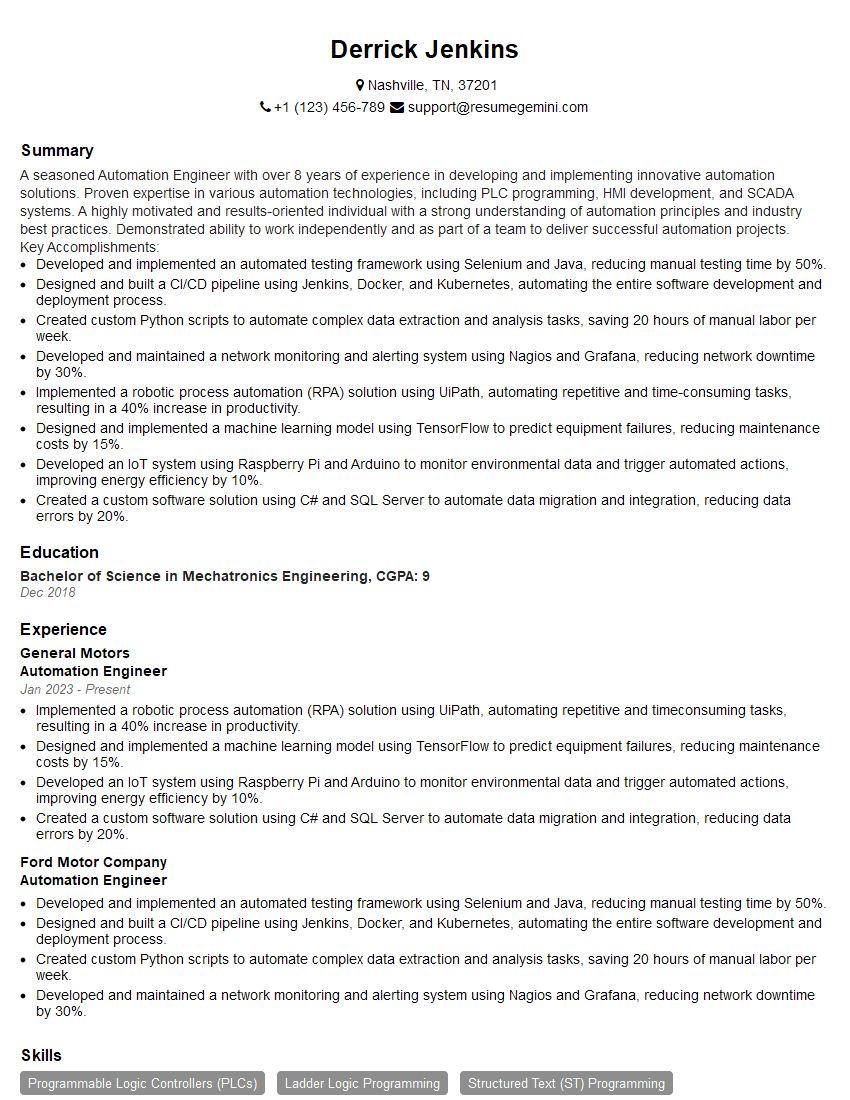
Mastering experience with Glass Automation Systems opens doors to exciting career opportunities in a rapidly growing industry. These systems are crucial for efficient and high-quality production in various sectors. To maximize your job prospects, it’s essential to create a compelling and ATS-friendly resume that highlights your skills and experience effectively. ResumeGemini is a trusted resource to help you build a professional resume that showcases your qualifications in the best possible light. Examples of resumes tailored to Experience with Glass Automation Systems are available through ResumeGemini to guide you in building your own.
Explore more articles
Users Rating of Our Blogs
Share Your Experience
We value your feedback! Please rate our content and share your thoughts (optional).
What Readers Say About Our Blog
Very informative content, great job.
good